© 2018 IJSRCSEIT | Volume 3 | Issue 5 | ISSN : 2456-3307
An Innovative Artificial Replacement to Facilitate
Communication Between Visually And Hearing- Impaired
People
Sangeetha R*1, Elakkiya S2*1Research Scholar, VLSI,Vandayar Engineering College, Thanjavur, Tamilnadu, India 2Assistant Professor of ECE in VandayarEngineering College,Thanjavur, Tamilnadu, India
ABSTRACT
The communication between visually- and hearing-impaired people is don’t share any common communication channel. A proposed scheme included algorithms for speech recognition and synthesis to aid communication between visually and hearing-impaired people. The communication environment designed to foster an immersive experience for the visually and hearing impaired. The modality replacement framework combines a set of different modules, sign language analysis and synthesis, speech analysis and synthesis, etc.., an accelerometer-based gesture recognition algorithm. We proposed a new technique called artificial speaking mouth for dumb people. Some peoples are easily able to get the information from their motions, remaining is not able to understand their way of conveying the message. In order to overcome the complexity the artificial mouth is introduced for the dump people. This system is based on the motion sensor. Their message is kept in a database. Likewise all templates are kept in the database. In the real time the template database is fed into a microcontroller and the motion sensor is fixed in their hand. For every action the motion sensors get accelerated and give the signal to the microcontroller. The microcontroller matches the motion with the database and produces the speech signal.
Key words: Sign language synthesis, ANN, speech synthesis, feature selection, feature extraction
I.
INTRODUCTION
In real word, there are many people who are deaf and dumb cannot communicate easily. Hence in this paper a glove is designed using flex sensor to communicate between Dumb and normal people and assigning particular message for each gesture. The gestures created by the glove will be sent to normal person’s phone and will also be displayed on LCD. In this paper a Braille Embosser is designed to communicate with blind person having servomotors to imprint Braille characters with the advancement in the technology. Disabilities like blind, deaf, dumb are more of serious concern. Science and Technology have made Human life addictive to comfort but still there exists an underprivileged group of people who
are fighting for finding an innovative way that can make the process of communication easier for them. According to the World Health Organization, about 285 million people in the world are blind, 300 million are deaf and 1 million are dumb. In day to day life communication is major issue for deaf, dumb, blind people. This paper “A Novel Approach to Communicate with Deaf, Dumb and Blind Person” removes the barrier of communication between them and normal person.
use of “Sign Language”. Sign language is the main technique for deaf, dumb communication. They face difficulties in their way of communication. This problem motivated us to implement blind, deaf, dumb computerized communicator. The long-term goal is to enable communication between visually impaired (i.e., blind), people on the one hand and hearing and speech impaired (i.e. deaf and dumb), people on the other. Since the former cannot see and the latter use sign language, there is currently no means of communication between such people who are unfortunately in significantly large numbers in a country such as India. The main aim of the project is to design and develop a user friendly technology to communicate between the deaf as well as dumb person and a blind person in this project image processing is used to recognize gesture, comparing that with stored database, recognizing correct expression using MATLAB and displaying output in the form of voice through voice processor. And on other side speech of blind person is transmitted to pc through mike. Speech signal is processed through MATLAB present in the pc and displaying as text through LCD by interfacing with micro controller. The developments in the science and technology have made our life so easier and comfortable that we even do not have to move our body to do a task. But always running in the race to be ahead of everyone, we have forgotten that we still have a part of our society called as physically disabled people. These people are deprived of advancements of science and technology. The main aim of this paper is to focus on the above mentioned facts and tries to develop new technology which is helpful for different disabled people. The main of this paper is to fill the gap in communication and bring forward technology that can help different disabled people or combination of this. We propose a new system called as SHAROJAN BRIDGE that will help to solve the above problems. Mainly SHAROJAN BRIDGE is based on the concept of wearable technology. This type of a gadget can be wear by any disabled or normal person and thus making the device flexible. We are using arduino
circuit board and sensors to make the transfer of message among different people. The message transfer includes the transfer of message in the form of text or audio or Braille language as per the level of disability of person Sign languages are the medium that allows the speech impaired people to communicate with rest of the world. But issue with sign language is that it is only confined to the people who are deprived of speech. In order to communicate, normal people also have to be aware of the sign language. Thus this paper explores the various methods that have been implemented to give voice to the speech impaired, so that they can interact with the normal people, with an ease. Sign language makes use of various gestures made using hand that have their generic meaning in their respective languages. Thus Sign language is different for different countries and different languages. For developing gesture recognition system different techniques have been implemented to handle complexity of that particular language.
II.
EXISTING METHOD
This research investigates a new way that can be productize so that a new gadget can be developed that can bridge the gap in communication among differently able people who suffer from any of the possible combinations of disabilities of blindness, deafness and dumbness. For this we are looking some sort of technology that can satisfy our purpose.
A. Data Entry Glove
The data Entry glove was presented by Gary Grimes from Bell Telephone laboratories in 1983, and was the first widely published sensor glove. The data entry glove was originally devised as an alternative to the keyboard, and made it possible to generate 96 printable ASCII characters from 80 different figure positions. The glove was made out of cloth and had flex sensors along the figure, tactile sensors on the figure tips. The distribution of sensors was specified with the aim of recognizing the single hand manual alphabet for the American Deaf.
B. Multi-Modal Interface:
This project was proposed in order to achieve the need to convert different modalities into common medium shared and understandable by deaf and dumb individuals. This project gave a prototype that considered of cameras attached to dark glasses along with the speaker and microphone and portable PC. Most existing aids for the visually impaired detect visual cues captured from cameras and present them to the visually impaired using symbolic information in alternate communication channels, such as audio or vibrotactile feedback. Concerning aids for the hearing impaired.
Most developments focus on the recognition and synthesis of sign language. A problem that stresses the high importance of modality replacement is that communication between a visually- and hearing-impaired user is not possible using physical means.
III.
PROPOSED METHOD
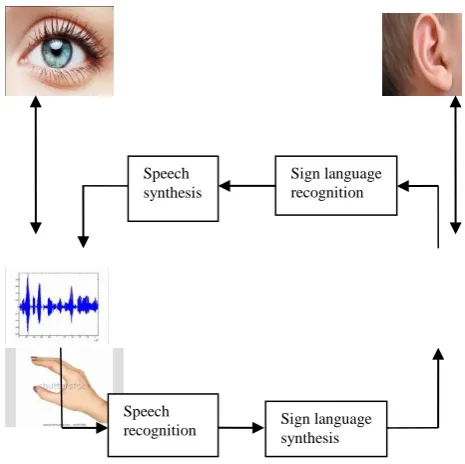
Figure 1 presents the architecture of the proposed system, including the communication between the various modules used for integration of the system as well as intermediate stages used for replacement between the various modalities. The left part of the figure refers to the visually impaired user’s terminal, while the right refers to the hearing-impaired user’s terminal.
Figure 1. block diagram of the software proposed method
The visually impaired user interacts with the computer using sign language and speech. System tasks and verbal information are presented to the visually impaired user via speech synthesis, while the computer through speech recognition perceives verbal input from the visually impaired user.
At the hearing-impaired user’s terminal, things are simpler because the user can use sight to navigate the virtual environment. To enable unobtrusive interaction, verbal information is presented to the user via sign language synthesis, while the user can provide input to the system through the sign language recognizer.
Visual information about the environment has to be conveyed to the visually-impaired user via the haptic and/or the auditory channel, while communication and the acquisition of various semantic information can be performed using natural language. The hearing-impaired user acquires visual information using vision and communicates with other people using sign language.
Speech synthesis
Sign language recognition
Sign language synthesis Speech
A problem that stresses the high importance of modality replacement is that communication between visually- and hearing-impaired users is not possible using physical means. Ideally, as illustrated in Figure 1, a modality replacement system would be used to recognize all spoken language input of the visually impaired user, convert it into sign language, and present it to the hearing-impaired user with an animated avatar. Similarly, sign language gestures would be recognized and converted into text and would then be synthesized into speech using text-to-speech synthesis techniques. The present work takes the first step toward the development of such interfaces. It’s obvious that because multimodal signal processing is essential in such applications, specific issues such as modality replacement and enhancement should be addressed in detail.
Sign Language Recognition
Sign language is a non-verbal language used by deaf and hard of hearing people for everyday communication among themselves. Information is conveyed visually, using a combination of manual and non-manual means of expression. The manual parameters are hand shape, hand posture, hand location, and hand motion. The non-manual parameters include head and body posture, facial expression, gaze and mouth movements. The latter encode, e.g., adjectives and adverbials, contribute to grammar or provide specialization of general items. Some signs can be distinguished by manual parameters alone, while others remain ambiguous unless additional non-manual information is made available. Unlike pantomime, sign language does not include its environment. Signing takes place in a three-dimensional space close to the signer’s trunk and head, called signing space. Signs are performed either one-handed or two-handed. For one handed signs the action of only one hand is required, where a person generally uses the same hand, known as the dominant hand.
The grammar of sign language is fundamentally different from spoken language. The structure of a sentence in spoken language is linear, one word followed by another, whereas in sign language, a simultaneous structure exists with a parallel temporal and spatial configuration. The configuration of a sign language sentence carries rich information about time, location, person, or predicate. Spread all over the world, sign language is not universal. Nationally different languages have evolved, such as German Sign Language (DGS) or American Sign Language (ASL). Just like in spoken language, there are regional dialects in sign language. In contrast to the pronunciation of words, however, there is no standard for signs, and people may use an altogether different sign for the same word. Even when performing identical signs, the variations between different signers are considerable.
Speech recognition
speaker, rather than what they are saying. Recognizing the speaker can simplify the task of translating speech in systems that have been trained on a specific person's voice or it can be used to authenticate or verify the identity of a speaker as part of a security process.
From the technology perspective, speech recognition has a long history with several waves of major innovations. Most recently, the field has benefited from advances in deep learning and big data. The advances are evidenced not only by the surge of academic papers published in the field, but more importantly by the worldwide industry adoption of a variety of deep learning methods in designing and deploying speech recognition systems.
Speech synthesis
The artificial production of human speech. A computer system used for this purpose is called a speech computer or speech synthesizer, and can be implemented in software or hardware products. A text-to-speech (TTS) system converts normal language text into speech other systems render symbolic linguistic representations like phonetic transcriptions into speech. Synthesized speech can be created by concatenating pieces of recorded speech that are stored in a database. Systems differ in the size of the stored speech units; a system that stores phones or dip hones provides the largest output range, but may lack clarity. For specific usage domains, the storage of entire words or sentences allows for high-quality output. Alternatively, a synthesizer can incorporate a model of the vocal tract and other human voice characteristics to create a completely "synthetic" voice output. The quality of a speech synthesizer is judged by its similarity to the human voice and by its ability to be understood clearly. An intelligible text-to-speech program allows people with visual impairments or reading disabilities to listen to written words on a home computer. A computation of the target prosody, which is then imposed on the output speech. Text-to-speech
system is composed of two parts a front-end and a back-end. The front-end has two major tasks. First, it converts raw text containing symbols like numbers and abbreviations into the equivalent of written-out words. This process is often called text normalization, pre-processing, or to kenization. The front-end then assigns phonetic transcriptions to each word, and divides and marks the text into prosodic units, like phrases, clauses, and sentences. The process of assigning phonetic transcriptions to words is called text-to-phoneme or grapheme-to-phoneme conversion. Phonetic transcriptions and prosody information together make up the symbolic linguistic representation that is output by the front-end. The back-end—often referred to as the synthesizer—then converts the symbolic linguistic representation into sound.
Synthesizer technologies
The most important qualities of a speech synthesis system are naturalness and intelligibility. Naturalness describe how closely the output sounds like human speech, while intelligibility is the ease with which the output is understood. The ideal speech synthesizer is both natural and intelligible. Speech synthesis systems usually try to maximize both characteristics.
The two primary technologies for generating synthetic speech waveforms are concatenative synthesis and formant synthesis. Each technology has strengths and weaknesses, and the intended uses of a synthesis system will typically determine which approach is used.
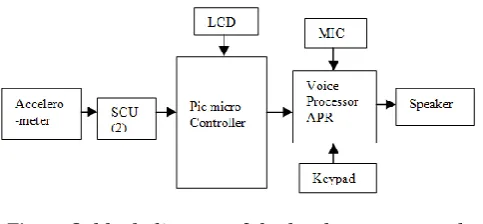
the data glove that consists of five Flex sensors on fingers (Thumb, index, middle, ring, and pinky) and one accelerometer of PIC microcontroller , Speaker Three outputs (X, Y, and Z positions).The captured by the accelerometer where Flex sensors can measure the bend of the five fingers when making a sign. The microcontroller which convert the analog signals to digital values through its 8-channel ADC. These values are formatted into a simple state matrix: five values for the Flex sensors, one for each axis of the accelerometer. Each level is represented by a value between 0 and 255. The microcontroller matches the motion with the database and produces the speech signal. Hand gesture recognition has the various advantages of able to communicate with the Technology through basic sign language. The gesture will able to reduce the use of most prominent hardware devices which are used to control the activities of computer.
Accelerometer Sensor
An accelerometer is an electromechanical device that will measure accelerometer is a device that measures the vibration, or acceleration of a structure. The force caused by vibration or a change in motion (acceleration) causes the mass to “squeeze “the pizeo electric material which produces an electrical charge that is proportional to the force exerted upon it. Since the charge is proportional to the force, and the mass is a constant, then the charge is also proportional to the acceleration. There are two types of piezoelectric accelerometers. The first type is a “high impedance” change output accelerometer. In this type of accelerometer the piezoelectric crystal produces an electrical charge which is connected directly to the measurement instruments. This type of accelerometer is also used in high temperature applications (>120C) where low impedance models cannot be used.
Signal Control Unit
Signalling control is the process by which control is exercised over train movements by way of and
ensures that trains operate safely, over the correct route and to the proper. Signalling control was originally exercised via a decentralised network of control points that were known by a variety of names including signal box (International and British),interlocking tower, signal poste and signal cabin Currently these decentralised systems are being consolidated into wide scale signalling centres or dispatch offices. Whatever the form, signalling control provides an interface between the technical apparatus used to control signals and block systems.
The Control Unit (CU) is digital circuitry contained within the processor that coordinates the sequence of data movements into, out of, and between a processor's many sub-units. The result of these routed data movements through various digital circuits (sub-units) within the processor produces the manipulated data expected by a software instruction (loaded earlier, likely from memory). It controls (conducts) data flow inside the processor and additionally provides several external control signals to the rest of the computer to further direct data and instructions to/from processor external destinations (i.e. memory).
PIC Microcontroller (16F877)
consists of two 8 bit and one 16 bit timer. Capture and compare modules, serial ports, parallel ports and five input/output ports are also present in it. Some pins for these I/O ports are multiplexed with an alternate function for the peripheral features on the device. In general, when a peripheral is enabled, that pin may not be used as a general purpose I/O pin. Additional Information on I/O ports may be found in the IC micro™ Mid-Range Reference Manual. whereas writing to it will write to the port latch. All write operations are read-modify-write operations. Therefore a write to a port implies that the port pins are read; this value is modified, and then written to the port data latch.
The TRISA register controls the direction of the RA pins, even when they are being used as analog inputs. The user must ensure the bits in the TRISA register are maintained set when using them as analog inputs. A single control bit can turn on all the pull-ups. The weak pull-up is automatically turned off when the port pin is configured as an output. The pull-ups are disabled on a Power-on Reset. Some peripherals override the TRIS bit to make a pin an output, while other peripherals override the TRIS bit to make a pin an input. Since the TRIS bit override is in effect while the peripheral is enabled, read-modify write instructions
Pic Start Plus Programmer
The PIC start plus development system from microchip technology provides the product development engineer with a highly flexible low cost microcontroller design tool set for all microchip PIC micro devices. The pic start plus development system includes PIC start plus development programmer and mplab ide.
The PIC start plus programmer gives the product developer ability to program user software in to any of the supported microcontrollers. The PIC start plus software running under mplab provides for full interactive control over the programmer.
APR 9600
The automatic play back recorder device offers true single-chip voice recording, non-volatile storage and playback capability for 40 to 60 seconds. The device supports both random and sequential access of multiple messages. Sample rates are user-selectable, allowing designers to customize their design for unique quality and storage time needs. Integrated output amplifier, microphone amplifier, and AGC circuits greatly simplify system design. The device is ideal for use in portable voice recorders, toys, and many other consumer and industrial applications. APLUS integrated ac hieves these high levels of storage capability by using its proprietary analog/multilevel storage technology implemented in an advanced Flash non-volatile memory process, where each memory cell can store 256 voltage levels. This technology enables the APR9600 device to reproduce voice signals in their natural form. It eliminates the need for encoding and compression. A differential microphone amplifier, including integrated AGC, is included on-chip for applications requiring use. The next block encountered by the input signal is the internal anti-aliasing filter. The filter automatically adjusts its response according to the sampling frequency selected so Shannon’s Sampling Theorem is satisfied. After anti-aliasing filtering is accomplished the signal is ready to be clocked into the memory array. This storage is accomplished through a combination of the When playback is desired the previously stored recording is retrieved from memory, low pass filtered, and amplified.
IV.
CONCLUSION
Sign language may be a helpful gizmo to ease the communication between the deaf or mute community and additionally the standard people. This project aims to lower the communication gap between the mute community and additionally the standard world. The projected methodology interprets language into speech. The system overcomes the necessary time difficulties of dumb people and improves their manner. Compared with existing system the projected arrangement is compact and is possible to carry to any places. This system converts the language in associate passing voice that's well explicable by blind and ancient people. The language interprets into some text kind displayed on the digital display screen, to facilitate the deaf people likewise. In world applications, this system is helpful for deaf and dumb of us those cannot communicate with ancient person. The foremost characteristic of this project is that the gesture recognizer may be a standalone system, that's applied in commonplace of living. It’s in addition useful for speech impaired and paralyzed patient means those do not speak properly and in addition used for Intelligent Home Applications and industrial applications.
V.
REFERENCES
[1]. J. Lumsden and S.A. Brewster, "A Paradigm Shift: Alternative Interaction Techniques for Use with Mobile & Wearable Devices," Proc. 13th Ann. IBM Centers for Advanced Studies Conf., IBM Press, 2003, pp. 97-100.
[2]. O. Lahav and D. Mioduser, "Exploration of Unknown Spaces by People Who Are Blind, Using a Multisensory Virtual Environment (MVE)," J. Special Education Technology, vol. 19, no. 3, 2004, pp. 15-24.
[3]. T. Pun et al., "Image and Video Processing for Visually Handicapped People," Eurasip J. Image and Video Processing, vol. 2007, article ID 25214, 2007.
[4]. A. Caplier et al., "Image and Video for Hearing Impaired People," Eurasip J. Image and Video Processing, vol. 2007, article ID 45641, 2007. [5]. S.C.W. Ong and S. Ranganath, "Automatic Sign
Language Analysis: A Survey and the Future beyond Lexical Meaning," IEEE Trans. Pattern Analysis and Machine Intelligence, vol. 27, no. 6, 2005, pp. 873-891.
[6]. N. Bourbakis, A. Exposito, and D. Kobraki, "MultiModal Interfaces for Interaction-Communication Between Hearing and Visually Impaired Individuals: Problems and Issues," Proc. 19th IEEE Int’l Conf. Tools with Artificial Intelligence, IEEE Press, 2007, pp. 522-530.
[7]. D. Tzovaras et al., "Design and Implementation of Haptic Virtual Environments for the Training of Visually Impaired," IEEE Trans. Neural Systems and Rehabilitation Eng., vol. 12, no. 2, 2004, pp. 266-278.
[8]. H. Petrie et al., "Universal Interfaces to Multimedia Documents," Proc. 4th IEEE Int’l Conf. Multimodal Interfaces, IEEE CS Press, 2002, pp. 319-324.
[9]. N.O. Bernsen and L. Dybkjaer, Multimodal Usability, HumanComputer Interaction Series, Springer, 2010.
[10]. O. Aran et al., "Signtutor: An Interactive System for Sign Language Tutoring," IEEE MultiMedia, vol. 16, no. 1, 2009, pp. 81-93. [11]. G. Bologna et al., "Transforming 3D Coloured
Pixels into Musical Instrument Notes for Vision Substitution Applications," Eurasip J. Image and Video Processing, special issue on image and video processing for disability, vol. 2007, article ID 76204, 2007.
[13]. G.C. Burdea, Force and Touch Feedback for Virtual Reality, Wiley-Interscience, 1996. [14]. K. Moustakas, D. Tzovaras, and M.G. Strintzis
"Sq-map: Efficient Layered Collision Detection and Haptic Rendering," IEEE Trans. Visualization and Computer Graphics, vol. 13, no. 1, 2007, pp. 80-93.
[15]. K. Moustakas et al., "Haptic Rendering of Visual Data for the Visually Impaired," IEEE MultiMedia, vol. 14, no. 1, 2007, pp. 62-72. [16]. R. Ramloll et al., "Constructing Sonified Haptic
Line Graphs for the Blind Student: First Steps," Proc. ACM Conf. Assistive Technologies, ACM Press, 2000.
[17]. S. Young, the HTK Hidden Markov Model Toolkit: Design and Philosophy, tech. report CUED/ F-INFENG/TR152, Cambridge Univ. Engineering Dept., Sept. 1994.
[18]. B. Bozkurt et al. "Improving Quality of Mbrola