© 2018 IJSRCSEIT | Volume 3 | Issue 5 | ISSN : 2456-3307
To Recognize the Crop Growth Rate in Agricultural Land By
Using K-Means Clustering Algorithm and Contrast
Enhancement Algorithm
T. Williams1, Dr. P. ShanthiBala2
Department of Computer Science Pondicherry University, Kalapet, Puducherry, Tamil Nadu, India
ABSTRACT
Agriculture is pillars of the entire world.Over 58 percent of the country homes depend on agriculture as their major means of living. Planting high quality crop is the source by which agriculture yield is increased. Because of the vast range of associated sub domain it is having the current attention of the researchers. In this paper, the exploration of different domains associated with agricultural image processing is defined. MATLAB tool used for identifying the crop growth. Contrast Enhancement algorithm help us to find the difference of crop images. K-means clustering algorithms can categorize 1….n. Grey scale images is converted black & white images. After converting Pixel area is calculated. Future work is to find out the varieties of crops present in the particular area depending upon the growth.
Keywords: Image processing, k-means clustering, algorithm, contrast enhanced algorithm, MATLAB.
I.
INTRODUCTION
The word agriculture is the English adaption of Latin Agricultura, from ager, “a field”,and cultura, “cultivation” in the strict sense of tillage of the soil. Agriculture is also called farming or husbandry of cultivation of animals, plants, fungi and other life forms for food, fiber, and other product used to sustain life.
Image processing is a process to change an image into digital form and complete few processes on it, in order to become an improved image or to excerpt some useful information from it. It is a kind of signal privilege in which input is image, like video structure or snapshot and result can remain image or features associated with that image.
Generally Image Processing system comprises giving images as dual dimensional signs however smearing
already fixed signal processing methods to user. It is among quickly increasing technologies nowadays, with its applications in several phases of a business. Image Processing methods main exploration part is within engineering and computer science regulation too.
The persistence of image processing is separated into five clusters. They are: Visualization- To detect the objects that are not visible. Image refining and renovation - To generate a recovered image. Image retrieval To Pursue for the image concern. Quantity of pattern – To Measures several entity in an image. Image Recognition – To differentiate the entity in an image.
highlights the three-dimensional processing and explore as well as statistical and stochastic moulding. K-means clustering is an algorithm to categorize or to cluster the objects built on attribute into n number of group. It is one of the easiest unsupervised learning algorithms that explain the eminent clustering problem.
Contrast is the variance in bright or intensity level concerning objects or regions in an image.
II.
RELATED WORK
Neetu Chahal et al [1] proposed a complete and broader view of plant/leaf disease detection and categorization is defined. This paper has explored the agricultural image processing along with the investigation of allied application area and has distinct a broader replica to achieve the efficient identification of image. The paper has also explained a study on some of the obtainable cataloging approaches.
Man Yan et al [2] proposed an exploiting structure of biomedical images, stretch-equal color gamut enhancement principles are employed to differentiate the color information in different portions in the image by using k-means clustering algorithm. The method can not only avoid information lost, but also can maintain the texture features. Therefore, this approach has broad applicability for the identification and segmentation of cell image. The next stage is to syndicate the projected algorithm with other segmentation methods to achieve a more fined segmentation effect in cytoplasm and nucleus images segmentation.
Natalia Kussul et al [3] recommended a multilevel Deep Learning approach for land cover and crop types cataloguing using multi-temporal multisource satellite imagery. The architecture uses both unsupervised and supervised NNs for dissection and subsequent classification of satellite imagery,
respectively. The author has used Landsat-8 and Sentinel-1A images over the JECAM (joint experiment of crop assessment and monitoring) test site in Ukraine. Ensemble of 1-D and 2-D CNNs outstripped the RF classifier and a collaborative of MLP (Multilayer Perceptron) allowing us to better categorize summer crops, in specific maize and soybeans. The main benefit of using CNNs over MLP and RF is that it allows constructing a hierarchy of local and sparse features resulting from spectral and temporal profiles while MLP andRF build a worldwide alteration of features.
TuLinLi et al [4] proposed the K-means clustering algorithm which played a major role in the data analysis, pattern recognition, image processing, and market research. In this paper, in response to the drawback which the k-means algorithm is complex to the early cluster centers and a new method is proposed. This algorithm not only progresses the correctness of the classical k-means algorithm, but also make up the flaws of classical k-mean clustering algorithm due to the different choice of the initial cluster centers variability.
Yousef Farhang et al [5] anticipated to solve one of the snags of clustering algorithms, i.e., the inequity of the clustering algorithms. In this paper, as an initial stage, the K-means clustering algorithm for face extraction was used. Additionally, a pioneering, enhanced clustering algorithm was offered to extract the face. In future studies, other difficulties of clustering can be addressed using clustering algorithm. Also, the projected algorithm can be assessed with other standards. Finally, the database can ponder medicinal images such as those used in radiology, mammography, and in cancer patients.
hard to measure length of seedling by human. Human may familiarize errors in the measurement. The results may vary person to person and lab to lab. The system proposed in this project will be objective, reliable. It will provide exactness in the measurement.
Nor Ashidi Mat Isa et al [7] proposed four new clustering algorithms namely the fuzzy k-means (FKM), fuzzy moving k-means (FMKM), adaptive moving k-means (AMKM) and fuzzy adaptive moving k-means (AFMKM) for the segmentation purpose. The proposed clustering algorithms have been applied to two standard images. The proposed adaptive idea of assigning the members for each data as introduced in the AMKM algorithm has also been confirmed to surge the segmentation capabilityof the conventional MKM algorithm. Then, the idea of combining the concept introduced in the FMKM and AMKM algorithms has effectively produced a new clustering algorithm called the AFMKM clustering algorithm which outstripped the segmentation presentation as compared to the other clustering algorithms. In addition, the proposed AFMKM clustering algorithm is also less subtle to noise and initialization procedure. These approaches are moderately fast and accurate methods and suitable for consumer electronic products.
Tao Xing [8] proposed a refined SAR image segmentation algorithm KM_ RAMKM. The suggested procedure is more effectual than KM_AMKM and has better segmentation quality meanwhile.
Heather North[9] proposed a classification method which shows a great deal of assurance in unraveling meaningful broad land use classes in what is a highly multifaceted and variable landscape. Future work is to: a) further sub-divide timing classes into crops or groups of crops using spectral data, where the broad classification will be useful to locate the expected
date of peak „green-ness‟; b) carry out a validation exercise using an independent dataset.
Dariusz Małyszko [10] performed experiments which recommend that genetic versions of k-means clustering techniques are similarly healthy in comparison to standard versions. Segmentation results showed that in the long process, both types of techniques applied to image clustering - lead to the equivalent values of fitness with somewhat better values in the case of standard versions of k-means algorithms find solutions with marginally worse fitness values but at the same time with remarkably good values of distinct legitimacy indices.
III.
PROBLEM DEFINITION
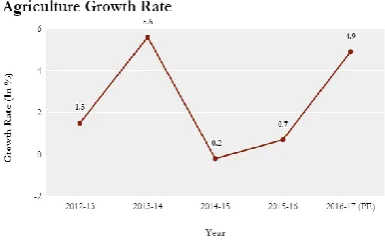
The growth level of crops has extremely reduced during the period of 2015- 2017 compare with 2012-2013. This work will help the agriculturalist to notify
the growth level of the crops. Thus, we can recover the production ratio for the change of our country.
Figure 1. Decrease in growth of crops
IV.
PROPOSED SYSTEM
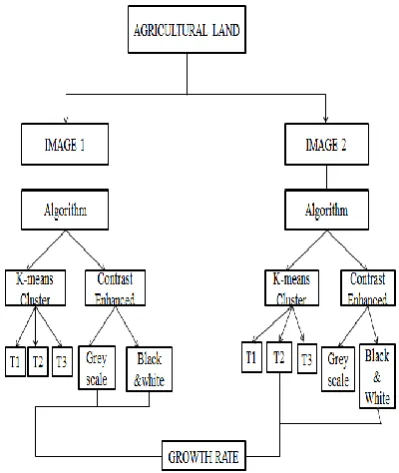
crop growth is recognized by using the algorithm such as k-means clustering algorithm and contrast enhanced algorithm.
Figure 2. Architecture for proposed system of crop growth
V.
IMPLEMENTATION
Crop weed insight is an essential step concerning the calculation of crop properties and particular plant weed control. In the following the proposed agricultural test train split is chosen. The 20 training images are used during the training practice which involves feature extraction. The Crop Field Image Dataset (CFID) is presented in online and can be downloaded from http://github.com/cwfid. MATLAB possess a very big and developing database of in-built procedures for image processing. It allows testing of algorithms which instantly avoid re-assemblage. The user can type something in the command line or implement a segment in the editor and instantaneously see the results. The MATLAB Desktop atmosphere, allows the individual to work interactively with respected data and it helps to check the files, variables and simplifies common programming/debugging tasks. The capacity to read in an extensive variability of both mutual and domain-specific image layouts.
A. K-MEANS CLUSTERING
This process arise simple and facile technique to categorize a specified dataset through a particular amount of clusters in fixed apriori. The main hint is to define n centres, one for each cluster. These centres should be positioned in a calculating way because of altered position causes altered outcome. So, the better choice is to place them as much as possible far away from each other. The following stage is to take separate point fitting to a specified data set and assistant it to the adjacent centre.
B. CONTRAST ENHANCEMENNT
If the contrast is too below, all pixels are a centre cover of grey creating the objects to disappear into each other. Hence, low contrast causes defeat of evidence in some areas in the image, while good contrast marks objects or sights described in an image special and visually interpretable for human and machine exploration. Contrast enhancement is a method to altered the image level sharing to refuge a wide series.
VI.
SCREENSHOTS
Figure 4, Adding first image
Figure 5. First image converted to contrast image
Figure 6. Contrast image is categorised in three ways.
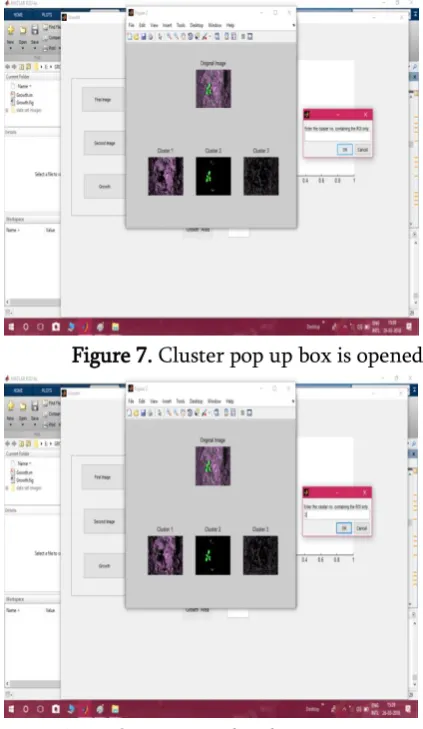
Figure 7. Cluster pop up box is opened
Figure 8. Entering the cluster image 1,2,..n
Figure 10. Entering the second image
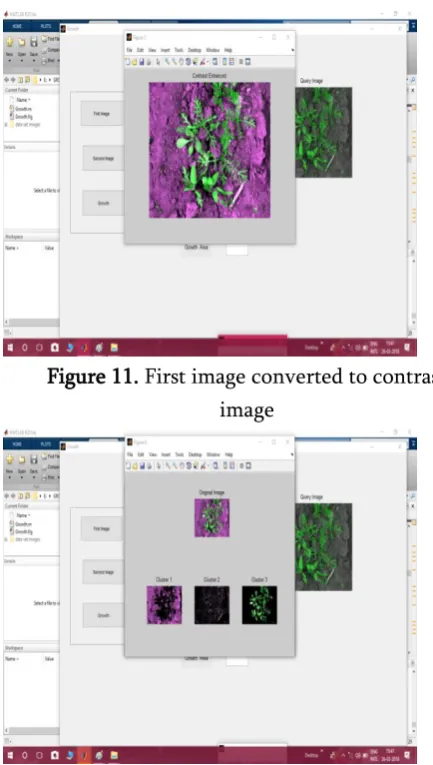
Figure 11. First image converted to contrast image
Figure 12. Contrast image is categorized in three ways
Figure 13. cluster pop up box is opened and entering cluster image
Figure 14. Grey scale, Black & white images
Figure 15. Calculating the growth rate of crops
VII.
CONCLUSION
using K-mean clustering and contrast enhancement algorithm. In Future work is to recognize the crop types of particular area.
VIII.
REFERENCES
[1]. Chahal, Neetu. "A study on agricultural image processing along with classification model." Advance Computing Conference (IACC), 2015 IEEE International. IEEE, 2015.
[2]. Yan, Man, et al. "K-means cluster algorithm based on color image enhancement for cell segmentation." Biomedical Engineering and Informatics (BMEI), 2012 5th International Conference on. IEEE, 2012.
[3]. Kussul, Nataliia, et al. "Deep learning classification of land cover and crop types using remote sensing data." IEEE Geoscience and Remote Sensing Letters 14.5 (2017): 778-782. [4]. Linli, Tu, Deng Yanni, and Chu Siyong. "A
K-Means Clustering Algorithm Based on Double Attributes of Objects." Measuring Technology and Mechatronics Automation (ICMTMA), 2015 Seventh International Conference on. IEEE, 2015.
[5]. Farhang, Yousef. "Face Extraction from Image based on K-Means Clustering Algorithms."
INTERNATIONAL JOURNAL OF
ADVANCED COMPUTER SCIENCE AND APPLICATIONS 8.9 (2017): 96-107.
[6]. Belsare, P. P., and S. K. Shah. "Evaluation of seedling growth rate using image processing." Computational Intelligence and Computing Research (ICCIC), 2013 IEEE International Conference on. IEEE, 2013.
[7]. Isa, Nor Ashidi Mat, Samy A. Salamah, and Umi Kalthum Ngah. "Adaptive fuzzy moving K-means clustering algorithm for image segmentation." IEEE Transactions on Consumer Electronics 55.4 (2009).
[8]. Xing, Tao, et al. "Refined SAR image segmentation algorithm based on K-means clustering." Radar (RADAR), 2016 CIE International Conference on. IEEE, 2016.
[9]. North, Heather, et al. "Classifying agricultural land uses with time series of satellite images." Geoscience and Remote Sensing Symposium (IGARSS), 2012 IEEE International. IEEE, 2012.
[10]. Malyszko, Dariusz, and Slawomir T.