Developing Interface Design of Interactive Multimedia for
Learning English in Senior High School
Anita Ratnasari1, Wachyu Hari Haji2
Faculty of Computer Science, Universitas Mercu Buana, Jakarta Barat, Indonesia
ABSTRACT
The development of mobile technology leads to changing of learning style and environment. This situation encourage the educators uses the mobile technology as media or tools to support learning activities. Many developer and researchers have been completed their works to explore about application for learning English. This research attempted to complete preliminary research to understand main feature and interface design of application for learning English in Indonesia. The phases of research methodology are literature review, data collection, use case modelling, interface design and report. As the result, we grouped the interface design based on learning categories, including speaking, writing, listening and reading. Moreover, application must support for accessing content and communicating with native speakers or other users to support learning English. The further study is collecting data from student in senior high school and building application by using mobile technology.
Keywords : Interface Design, Mobile Learning, English
I.
INTRODUCTIONToday, the era of smartphone allowed the people to download and install application on their phone easily [1], [2]. In field of education, many developers attempted to design the application that can support learning process by using mobile phone [3]. The emerging of mobile technology lead to the change of learning style and environment. This situation encourage the educators uses the mobile technology as media or tools to support learning activities [4][5].
Many researchers have been completed their works to explore about application for learning English in 2013 until 2017 [6]–[9]. Andersen (2013) explored several applications to learn English. In their research mentioned the feature for each application. The application that is reviewed including Voxy, eTeacher, Learn English, Hello-hello and Busuu [9].
Mindog (2016) explored the research about mobile application to support learning English as a Foreign Language (EFL). Based on their findings, mobile application can support learning process because learners can access content and communicate with native speakers [8].
Amasha and Al-Omary (2017) designed and evaluated Quizrevision that is developed to help student Phonetics course (Arab 342). This application allowed student to recognize differences between sounds and their pronunciation. The application is developed using MIT App Inventor code [7].
This research attempted to complete preliminary research to understand main feature and interface design of application for learning English in Indonesia. The further study is collecting data from student in senior high school and building application by using mobile technology.
II.
RELATED WORKWe attempted to find the related work based on the current development of mobile application for learning English. This related work used as basic design of interface of interactive multimedia for learning English in senior high school in this research.
Wang (2017) explored research about pilot study of mobile application development to enhance ability of college students in memorizing English vocabulary with both description of English and Chinese named New General Service List or NGSL application [6].
Figure 1. Overview of NGSL application [6]
year. In this application, student must learn thirty words a week. Moreover, this application is completed by questionnaires that were used to collect opinion of student toward the application [6].
Amasha and Al-Omary (2017) designed and evaluated Quizrevision that is developed to help student Phonetics course (Arab 342). This application allowed student to recognize differences between sounds and their pronunciation. The application is developed using MIT App Inventor code [7].
Figure 2. MIT App Inventor code [7].
Figure 3. Quizrevision in Google Play [7].
application can support learning process because learners can access content and communicate with native speakers [8].
Figure 4. The application used for learning English [8]
Andersen (2013) explored several applications to learn English. In their research mentioned the feature for each application. The application that is reviewed including Voxy, eTeacher, Learn English, Hello-hello and Busuu [9].
Figure 5. Overview of Busuu [9]
Figure 7. Overview of Learn English [9]
Figure 8. Overview of eTeacher [9]
Figure 10. Overview of GymGlish [9]
III.
RESEARCH METHODOLOGY
In this study, we first conducted preliminary research to understand main feature and interface design of application for learning English in Indonesia. The phases of this study including literature review, data collection, use case modelling, interface design and report, which is depicted in Figure 11.
Figure 11. Research Methodology
IV. RESULT
We attempted to explore some famous applications to learn English. We grouped the interface design based on learning categories, including speaking, writing, listening and reading. The use case diagram is presented in Figure 12.
Figure 12. Use Case Diagram LearnEnglishStudent (L.E.S)
Based on Andersen (2013), the points of mobile application of learn English refers to Voxy, eTeacher, Learn English, Hello-hello and Busuu is to learn speaking, writing, listening and reading [9]. Moreover, the representation to learn those points is different based on age of users [10].
Figure 13. Main menu of LearnEnglishStudent (L.E.S)
Every learn speaking, writing, listening and reading menu is contained material course and exercise. Student can check the material course first, and then
Literature
Study
Collection
Data
Use Case
Modelling
conduct exercise to know their scores or ability as shown in Figure 14.
Figure 14. Sub menu of LearnEnglishStudent (L.E.S)
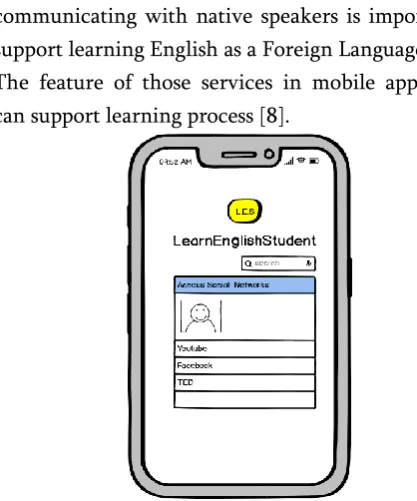
Based Mindog (2016), accessing content and communicating with native speakers is important to support learning English as a Foreign Language (EFL). The feature of those services in mobile application can support learning process [8].
Figure 15. Menu to access other resources (L.E.S)
In this application, user also can contact other users to exchange knowledge and interact each other. Every user also can see status of learning process of other user as shown in Figure 16.
Figure 16. Menu to see other user (L.E.S)
V.
CONCLUSION
As the conclusion of this research is presented as follows:
1. The research aim is to complete preliminary research to understand main feature and interface design of application for learning English in Indonesia.
2. The phases of research methodology are literature review, data collection, use case modeling, interface design and report.
3. We found the group of interface design based on learning categories, including speaking, writing, listening and reading. Moreover, application must support for accessing content and communicating with native speakers or other users to support learning English.
VI. ACKNOWLEDGMENT
We completed our research by using research fund from Universitas Mercu Buana with scheme “Penelitian Internal” for 2017 - 2018.
VII.
REFERENCES
[1]. H. Noprisson, N. Husin, M. Utami, Puji Rahayu, Y. G. Sucahyo, and D. I. Sensuse, "The Use of a Mixed Method Approach to Evaluate m-Government Implementation," in 2016 International Conference on Information Technology Systems and Innovation (ICITSI), 2016.
[2]. G. J. Robert, "Emerging technologies, mobile apps for language learning," Lang. Learn. Technol., vol. 15, pp. 2–11, 2011.
[3]. C. M. Chen and Y. L. Li, "Personalized context-aware ubiquitous learning system for supporting effective English vocabulary learning," Interact. Learn. Environ., vol. 18, no. 4, pp. 341–364, 2010.
[5]. I. Handriani, "Design Concept E-Learning Using Absorb-Do-Connect Type Method For Junior Homeschooling Education," Int. J. Comput. Trends Technol., vol. 54, no. 3, pp. 120–126, 2017.
[6]. B.-T. Wang, "Designing Mobile Apps for English Vocabulary Learning," Int. J. Inf. Educ. Technol., vol. 7, no. 4, 2017.
[7]. M. A. Amasha and S. Al-Omary, "Quizrevision: A Mobile Application using the Google MIT App Inventor Language Compared with LMS," Int. J. Adv. Comput. Sci. Appl., vol. 8, no. 6, pp. 313–320, 2017.
[8]. E. Mindog, "Apps and EFL: A case study on the use of smartphone apps to learn English by four Japanese university students," Th JALCT CALL J., vol. 12, no. 1, pp. 3–22, 2016.
[9]. I. Andersen, "Mobile Apps for Learning English: A Review of 7 Complete English Course Apps: Characteristics, Similarities and Differences," MA-afhandling, 2013.
![Figure 1. Overview of NGSL application [6]](https://thumb-us.123doks.com/thumbv2/123dok_us/1040661.1129720/2.595.48.281.400.708/figure-overview-ngsl-application.webp)
![Figure 5. Overview of Busuu [9]](https://thumb-us.123doks.com/thumbv2/123dok_us/1040661.1129720/3.595.72.260.337.711/figure-overview-of-busuu.webp)
![Figure 8. Overview of eTeacher [9]](https://thumb-us.123doks.com/thumbv2/123dok_us/1040661.1129720/4.595.226.532.71.687/figure-overview-of-eteacher.webp)
![Figure 10. Overview of GymGlish [9]](https://thumb-us.123doks.com/thumbv2/123dok_us/1040661.1129720/5.595.309.509.378.651/figure-overview-of-gymglish.webp)