Manipulating arguments, credibility of the source and Involvement- what factors influence Risk Perception?
Bachelorthese Veiligheid en Gezondheid, University of Twente, Enschede, the Netherlands Sarah Kedzia (s0129577)
25 August 2008, Enschede
Docenten: Jan M. Gutteling (University of Twente, Department: Behavioural Sciences)
Abstract
This study tried to investigate the influence of source credibility, health threat and personal involvement in risks on the perception of these risks. It uses the elaboration likelihood model (ELM) to study the effect of chosen route on elaboration of messages. It tested the hypotheses that involvement influences risk perception, and that the source which gives a certain kind of arguments influences the way people respond to it, as well as the amount of trust they will have into the message. Moreover it was assumed that even the kind of arguments, which could estimate the risk of a specific health threat as high or low, influenced risk perception, and elaboration. 8 different groups of respondents were set down in 2 different countries. Unfortunately this study could not find any significant relation between involvement and risk perception. However it found interesting effects concerning trust into the source in relation to arguments given
Introduction
Risk communication is an interesting field, which gains more and more importance in the face of the variety of (health) risk our environment poses. Nowadays we are faced with new risks nearly every day, and so the question under with circumstances people elaborate messages containing risk information needs to be clarified. Risk communication, especially persuasive communication is “a process of attitude change” (Brehm, Kassin, Fein, & Mervielde, 2000, p. 189). Thus the intent of risk communication is to persuade individuals to accept a new attitude for their own welfare.
Petty and Cacioppo (1981, 1986a, 1986b) have developed a model that aims at clarifying the process of processing risk-relevant information, the elaboration likelihood model (ELM). They pose that people take a specific route to process risk relevant information, namely the central or the peripheral Route. They base their model on the assumption that certain features of a message will lead to the adoption of one route.
The Elaboration likelihood model
In essence there are two ways individuals can choose by elaborating messages, the central and the peripheral route. It has to be clarified that this process is not a conscious one. Individuals do not “choose” to take one route of elaboration as they would choose what to eat today, but this “decision” is completely unconscious. The word “choose” is used on the following pages to indicate this unconscious process. So the reader of this article should keep in mind that the meaning of the word “to choose” is used in a little different way.
If individuals choose the central route there are likely to elaborate on the given information, critically consider the arguments given and form an own opinion (Petty and Cacioppo, 1986a, 1986b). It occurs only when the receiver possesses both the motivation and the ability to think about the message. Individuals who chose the peripheral route are thought to lack ability or motivation to critically think about the message. They also focus more on cues the message contains, such as number of arguments instead of the quality, the credibility or attractiveness of the source instead of focusing on the content and strength of the argument given.
Thus motivation and cognitive ability to think about the message given are of great importance. Knowing if the current audience possesses this abilities so seems crucial if a speaker wants to have his message thoughtfully elaborated.
The importance of the different ways of elaborating health relevant messages also lies in the attitudes formed after persuasion (Petty, Haughtvedt & Smith, 1995, cited in Petty, Heesacker & Hughes, 1997). Attitudes formed after taking the central route are more easily to access, which heightens the chance that they result in behavioural change. They are also more strongly related to actual behaviour (Meijnders, Midden & Wilke 2001).
But if the intent of the speaker is, to inform the public about certain health risk, which poses a great, but hidden threat to the public? Two new factors come into play here, first the features of the health threat and the grade of personal involvement, both have shown to have a great impact on the motivation to actively evaluate given information.
It is a well known finding that the way people perceive a risk directly influences the way they respond to it. Research conducted by Slovic (see for example Slovic, 1987, Slovic, 1993, Slovic 2000), has demonstrated that factors such as whether a risk is perceived to be involuntarily, catastrophic or uncontrollable are more important factors than the risk information alone. So it follows, that risks which are perceived as controllable, voluntarily and non-catastrophic are not taken that seriously by an audience and will more likely lead to low involvement and so to taking the peripheral route of elaboration.
The question, whether or not health related risk information on itself is eliciting some kind of involvement remains here. This is a well known problem in the field of health and risk psychology. If this should be true than this would have consequences for this study, because it uses an involvement manipulation. If the theme on itself would create some kind of involvement on itself it would be interesting to see whether the manipulation still works or if all respondents report being highly involved.
It also seems logical that high involvement in a threat contributes to choosing the central route of persuasion.
It is plausible that if involvement is high, en thus consequently the central route is chosen and the information is thoughtfully elaborated, the quality of arguments becomes more important (Petty & Cacioppo, 1984). What is meant with arguments here has to be clarified. Petty and Cacioppo themselves define arguments as “bits of information contained in a communication that are relevant to a person’s subjective determination of the true merits of an advocated position” (Petty & Cacioppo, 1981, p. 11). These are thought to be a part of a message that elicits a cognitive reaction, as for example thinking about an issue.
So an argument could simply be a statement in a whole sentence, for example that red roses are red. But it would also remain an argument when a source is added to it, as for example, the most famous rose-expert of the world claims that red roses are red. Of course adding a source changes the strength of an argument. Here an argument indicates the statements made in the text, while the source is believed to mediate its quality and strength.
This shows that the arguments given in a message are of great importance too. If the threat poses a great risk to the audience and if they are more personally involved they are likely to be more motivated to think about given arguments, to choose the central route. By doing this and attending more to arguments, the strength of these arguments become more and more important and will strongly determine the success of the message (Brehm et al., 2000). As Festinger points out, people seek for consistency in their cognitive system (Festinger, 1957). Moreover, thoughts based on positive cognitions are supposed to be more often accessed and that negative material is not so often consulted. Sometimes even peripheral factors, like the attractiveness of the source create positive emotions. People connect these positive feelings directly to the message, so risk perception should be more favourably if positive emotions are elicited. (Petty et al., 1993).
What does this mean for risk perception? Do arguments containing threatening information, thus eliciting negative feelings, heighten risk perception? This will be one focus of this study. Because this is a main part of the manipulation given in the text, we will not pose an extra hypothesis for this assumption but rather control for this by doing manipulation checks.
Besides the audience and arguments threat relevant information always comes from a source. Especially health relevant information is often given by the government or by medical instances.
Work from Slovic points out that people generally do not trust the government, and this effect gets even more articulated if risk information is about risks that are viewed as involuntarily, potentially catastrophic, uncontrolled. As mentioned above, under these conditions the credibility of the source becomes important (Slovic, 1987, 2000). Also lay people deeply distrust the scientifically world, and view social and scientifically world as separate (Woolgar, 1996). If a distrusted sources provides information that appears to promote its own interest, this will influence peoples attitudes in the opposite direction (not gaining trust, but losing it), especially if attitude already was “negative” in first place. This means that risk communication by a deeply distrusted source can result in even more resistance against the topic. This is even made clearer by Frewer (1999), as he made a distinction between outcome uncertainty (what happens, with what probability?) and assessment uncertainty (to what extent will that change through given information?). So information that is perceived to have no effect on initial risk perception will generally be rejected, but this effect is more strongly if the source that gives the information is a distrusted one (Frewer, 1999). Because this relates mainly to serious health risk, as nuclear or chemical plants it is interesting to find out whether this is also true for “minor” health risks. These are not that catastrophic as for example the explosion of a nuclear plant, so the question remains whether people in this study hold a more negative and sceptic attitude against the government. This highlights the complex interplay between source factors, arguments and personal involvement on the chosen route of elaboration and the outcome (risk perception/ attitude change).
So we pose that trust is an important predictor for risk perception.
H2: Motivation to elaborate on arguments given by the government is lower than the motivation to elaborate on arguments from health professionals
H3: Trust into arguments given by the government is lower than trust into arguments from the health professionals
If this article should find that arguments given by the government indeed result in rejecting the message then this could give a little more information about the complex way people elaborate on health relevant risk information and so lead to more effective communication.
Methods
Design and Procedure
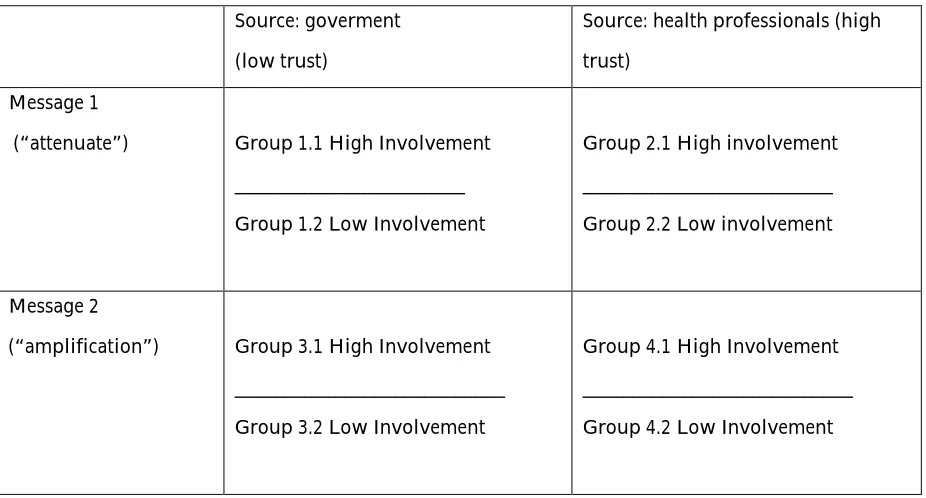
The design of this study is a 2 (arguments: attenuate vs. amplification) x 2 (source: Government vs. health professionals) x2 (Involvement: high vs. low) factorial design. Participants are randomly assigned to one of the eight groups (see table 1). These groups differ accordingly to the kind of message, source and involvement. For a more detailed description of the manipulation see table 1 below.
Table 1
Overview over groups
Source: goverment (low trust)
Source: health professionals (high trust)
Message 1
(“attenuate”) Group 1.1 High Involvement _______________________ Group 1.2 Low Involvement
Group 2.1 High involvement _________________________ Group 2.2 Low involvement
Message 2
(“amplification”) Group 3.1 High Involvement ___________________________ Group 3.2 Low Involvement
Manipulation
The text given to participants informs them about the risk of the Meticilline-resistent Staphylococcus aureus, named MRSA bacterium. This is a bacterium known as hospital-bacterium, because it mostly appears in hospital and medical settings. It has serious consequences such as lung infections which can lead to death of the patient. Information over this is given, framed in a newspaper article. The main part of the text is the same for all groups, except a last part, which contains the manipulation. There is one message which minimizes the risk of getting MRSA, the so called attenuate group. The other message, the amplification group, maximizes the risk the bacterium poses. This difference forms the first manipulation, whether the risk is displayed to be high or low.
The students are told that this bacterium has either been found at the University where they study, thereby creating high involvement, or at a university far away, so students are minimal involved. The University is named at the beginning and end of the text, so that risk and involvement are explicitly mentioned and connected to each other.
The source is mentioned two times too, as the one who presents the risk and as the one who makes a statement about the threat this risk poses to students of the given University. It is expected that this will have a significant effect on the perception of the message, on whether they will or will not trust in the information given in it. This effect interacts with the kind of message (amplification or attenuate) someone gets, so interaction effects will be likely.
Someone who gets attenuation-arguments from the government is supposed to be most sceptical, because he or she would think that the government just plays down the risk to avoid mass panic or actually facing a problem. They could also think that the government just do not want to admit that there could be a problem that can not be solved easily. On the other hand, if the source is the health professionals, then people are more likely to hold a more positive attitude against them and in turn against the message. People are assumed to see the health professionals as someone who cares more about the patients than the government does, so it is supposed that they are more open to accept messages given by them, and that this will translate into higher scores on the test assessing trust.
Measures
Independent Variables are of course the manipulated ones, as: Involvement in the issue (high vs. low), the source which gives the message (government vs. doctors), the arguments (attenuate vs. amplification).
Dependent Variables are: Risk perception, trust into the source, trust into the arguments,
Route of elaboration (indicated by: score on the knowledge test and number of words written down at the free-response task, for a detailed description see below)
Route of elaboration was first measured by a free-response task, where participants were asked to write down as many words that came up to the theme MRSA. A high rate of words referring to facts is assumed to point out that participants chose the central route of elaboration and so think about arguments. Secondly, a qualitative analysis of the words mentioned can pose several interesting results. For example as mentioned in the introduction, emotion is more influencing when choosing the peripheral route, and this could also be indicated by respondents writing down mainly words referring to emotion than to facts.
This test does not stand alone, but has to be analyzed with respect to a second test, that asked
multiple-answers questions about statements made in the text, as “How many people are infected by the MRSA-Bacterium per year?”. The answer to these questions is information mentioned in the text. It is assumed that people who chose the central route of elaboration captured more of the information given, and so they will score high on this test (giving right answers). Opposable, choosing the
peripheral route of elaboration the score will be low, indicating that participants do not attend to precise facts given. This seems logical, because if someone chooses the central route he will give more attention to numbers and facts, than to emotional arguments. People who chose the peripheral route of elaboration are supposed to score low on this test, because they focused more on attitudes and emotions, and neglect the given facts. They will be motivated to interpret the facts immediately as “dangerous” and not keeping the exact number in mind.
Risk perception was assessed by making statements about the risk, such as: “I would be scared after an infection with the MRSA virus”, or: “The MRSA-virus poses a significant health treat”. Participants could indicate their agreement on a 5-point-Lickert scale (strong disagreement, disagreement, neutral, agreement, strong agreement). A high score on this questionnaire indicates a high risk perception; the highest reachable score was 65. One item served as control variable. The list consisted of 13 items and Cronbachs alpha was 0.628
Trust in the source was assessed by a questionnaire that made statements about the source, like “I trust the Source” or “I think the source acts on its own favour”. Here again a 5-point-Lickert scale (strong disagreement, disagreement, neutral, agreement, strong agreement) were used to score the answers. High scores indicate high trust into the source; here the highest reachable score was 45. Two items in this scale specifically measure trust here, which serve as control measures (see manipulation check). The list consisted of 9 items and Cronbachs alpha was 0.849
Trust in the message was assessed by a last questionnaire were participants again could indicate their agreement with statements on a 5-point-Lickert scale (strong disagreement, disagreement, neutral, agreement, strong agreement). The highest reachable score, indicating high trust into the message was 25. Examples of items are: “I think that the information given is true”, “I trust the given information”. If the score is high then participants trust in the information given in the message. Again 1 item specifically measure trust into to measure and serve as control measure (see manipulation check). The list consisted of 5 items, and Cronbachs alpha was 0.569.
Pre-test
Participants
All participants were supposed to be students of either a Dutch or a German University. Unfortunately this did not resulted in a high number of respondents, so people were invited via internet forums for students. This led to the problem that even former students participated in the study. Respondents who were not studying any longer are falling into the category non-students. It has to be said that these former students are analyzed together with the students, groups are not split up.
The study was conducted in both countries, so the possibility of comparing these both countries was achieved.
In total 177 respondents participated in the survey, 65 of them had to be excluded from data analysis because of missing values, and not answered questions. In these cases people answered the first few questions but stopped soon, so that relevant data could not be gained.
112 cases remained for further analysis. Still some missing values retained, but these are limited to a few questions, so they were not excluded from the analysis.
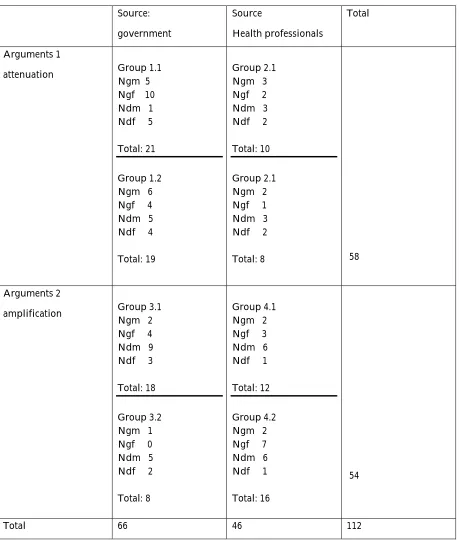
Of these 112 respondents 61 (54.5%) were male and 51 (45.4%) were female. Mean age was 23 years. Response rate was rather low, participants were individually asked per email or via a post in a student’s forum to fill out the questionnaire online.
In the Dutch survey 58 respondents participated, mean age was 23.94 years. 79 % of Dutch respondents were students from the University of Twente, 21 % were non-students.
Table 2
attenuation Group 1.1Ngm 5 Ngf 10
amplification Group 3.1Ngm 2 Ngf 4
Procedure
At the beginning of the experiment respondents are asked to give demographic information, such as the University they are student of, their age and nationality (see Appendix). Then they read an artificial newspaper article which informs them about a certain health risk. This text also contains the manipulation (high vs. low involvement; great risk vs. no risk; Source). After reading this they have to fill out a free-association test about what they remember about the information given, then a test that asks questions about the given information, one that estimates the level of risk perception, one that estimates trust in the source and one assessing trust in de message. After doing so they are told that the newspaper article was completely made up and given the possibility to leave their email address if they would be interested in the results.
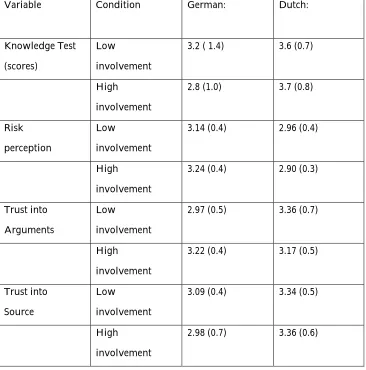
Results Table 3
Means (SD) of Test scores
Manipulation Check
Three variables were manipulated, personal involvement, the arguments participants received (Amplification vs. attenuate the risk) and the source which gave the arguments. Evidence for the effectiveness of the manipulations comes from MANOVA analysis. This showed that means in all groups indeed differed concerning risk perception F (1, 89) = 4308, p < 0.00.
Involvement was expressed by one item in each survey (German: item 6, Dutch: item 9). Analysis of these items revealed that in the German group high and low involvement groups did not differ in answering that item, F (1, 53) = 0.310, p > 0.5. In the Dutch sample the manipulation did seem to work, F (1, 55) = 4.794, p 0.03.
Consequently when analysing effects of high and low involvement we will focus on the Dutch sample and not on the German one.
Whether or not the samples differed concerning trust into the message depending on the kind of arguments they received was indicated by one item in each survey (German : item 6, Dutch: item 7). No such effect was found, neither for the Dutch sample, F (1, 53) = 0.152, p > 0.6, nor for the German one, F (1, 48) = p > 0.8.
The same test was executed for the question whether the source which gave the arguments had any effect of the trust participants had into the source. This was measured by two control items in each sample (both: items 1 and 7). Just one item in the German survey revealed significant effects, F ( 1, 49) = 5.563, p < 0.03.
Table 3 presents means and standard deviation values of these tests.
A qualitative analysis was exerted to analyse the free-response task, where subjects were asked to write down all words which came to their mind in relation to the MRSA virus. Here the number of words was counted as well as if they referred to facts or to more emotional thoughts. Both groups did not differ in the number of words counted F (1, 114) = 0.525, p > 0.4. Analyzing only the Dutch sample did not change this result significantly F (1, 63) = 0.514, p > 0.4.
Analysis
Because Dutch and German participants showed variations on nearly all measured variables we will analyse the samples apart.
To test for main and interaction effects a MANOVA with risk perception, trust into the arguments and route of elaboration as dependent variables was executed. Involvement, source and arguments functioned as independent variables.
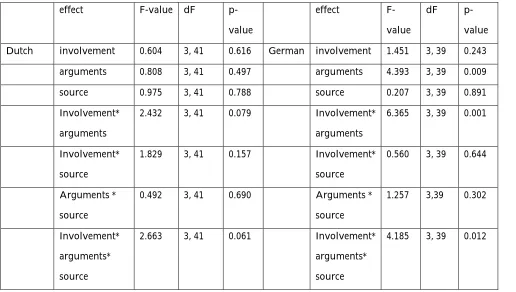
Analysis revealed that there was no significant main effect for involvement, for arguments or for the source for the Dutch sample. In the German survey there was a main effect for arguments, and a significant three way interaction effect of involvement, arguments and the source. For exact values see table 4.
Table 4
Main and interaction effects for independent variables
effect F-value dF
p-Dutch involvement 0.604 3, 41 0.616 German involvement 1.451 3, 39 0.243
arguments 0.808 3, 41 0.497 arguments 4.393 3, 39 0.009
source 0.975 3, 41 0.788 source 0.207 3, 39 0.891
Involvement* arguments
2.432 3, 41 0.079 Involvement*
arguments
6.365 3, 39 0.001
Involvement* source
1.829 3, 41 0.157 Involvement*
source
2.663 3, 41 0.061 Involvement*
arguments* source
Single ANOVA analysis did reveal that there is no evidence for an interaction effect of involvement and arguments on risk perception F (3, 105) = 24.407, p> 0.5. So we can disapprove hypotheses one.
Analysis of the so called knowledge test should reveal whether people in the high involvement group answered more questions right than did people in the low involvement group (cutting point 3 good answers). ANOVA analysis revealed that this was not the case Fgerman (1, 51) = 0.218, p > 0.6, Fdutch (1, 55), p > 0.9. Also scores on the knowledge test are not significantly higher in the sample which
received the arguments from the government than those who received the message from the health professionals, neither in the German F (1, 51) = 0.791, p > 0.3, nor in the Dutch sample F (1, 55) = 0.503, p > 0.2. This means that groups did not differ concerning their motivation to elaborate; consequently we can conclude that the second hypothesis is wrong.
The third hypotheses asked the question whether trust into the government is lower than trust into the health professionals. ANOVA revealed that this was not the case, F (1, 49) = 3.855, p (1-0.055)/2= p > 0.4 for the German sample, F (1, 55) = 3.124, p (1-0.083)/2 = p > 0.4 for the Dutch sample.
Also the interaction effect from arguments given and the source on the perception of risk is not significant, neither in the German F (1, 41) = 0.219, p > 0.6, nor in the Dutch sample F (1, 43) = 0.89, p > 0.7. This means that hypotheses four has to be disapproved.
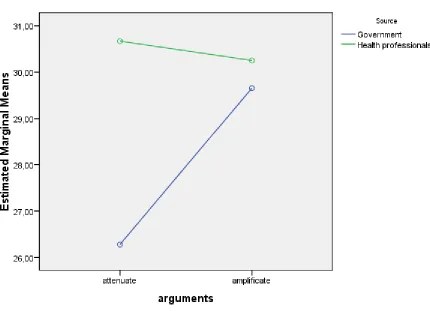
Effect from source and arguments on trust into the source.
Table 5
Main and interaction effects of arguments and source
df F-value p-value
Arguments 1, 104 1.898 0.171
source 1, 104 5.386 0.022
Arguments* source
Discussion
This study addressed the question which factors such as message, source and involvement influence risk perception. The leading idea behind this study was that if people knew more about factors that influence how people elaborate on messages, communication could be adapted to these findings to make it more effective. This study could not find significant effects for the influence of involvement on risk perception. However, this could be due to the original issue, which already poses a significant health threat. This kind of theme alone could make people more involved into this issue. Also it has to be kept in mind, that although the survey asked participants to name the university they study on, most people did not gave that information. The involvement manipulation was highly based on this kind of information, because it was crucial to see whether the manipulation worked. For example, someone studying in Twente should perceive him or herself as highly involved, if the MRSA virus appeared at his/her university. But because of this missing information this could not be traced back, so we do not know which people study were. Consequently it could be, that the manipulation could not work, because we do not know who really was highly involved or not. An additional factor here is that the universities named in the text are not that far away, between 150 and 360 kilometres. Maybe this could not be enough to calm down people in the “low involvement” group. In a next study this could be solved by controlling the assignment of participants to groups, and by choosing universities which are more far away. The author suggests choosing only one country (for example the Netherlands) and manipulating involvement by choosing one university in that country and one in another (for example: Africa). Low and high involvement groups can be secured by giving the survey to students of just this one university. So treatment conditions are better controlled and the manipulation should be more effective.
Response rate was very low, and a high percentage of answered surveys had to be excluded from data analysis because they were not complete. So it could be possible that the actual group of respondents were quite selective, and the survey too long (36 Questions). Some feedback from participants also indicated that they felt that the questions all asked quite the same, and that they missed variation. This could have led to response bias, because it could be that participants just clicked themselves through the questions to reach the end as quickly as possible. The problem here is that questions have to be alike to measure the same construct, but that this is kind of boring for participants, because they need more variation to keep them interested and motivated to answer all questions careful. Follow-up research should think about this problem, and find solutions. The author suggests trying to find more appealing formulations to keep respondents interested.
Also the kind of measurement, via internet, has not proven successful. It is surely a possibility if researchers already have a pool of participants they can send the links to, but it did not prove easy to actually find participants via internet. Especially if instruments are not validated, it is hard to control how respondents actually react to the questionnaires. The author suggests not making an internet research if instruments are used for the first time, or if the researcher is not familiar with conducting surveys.
Maybe another obstacle to this study lies in the original formulation of the questions and hypothesis. Results showed significance when analysing trust into the message and trust into the source, but could not find any significant results concerning risk perception. As said above this could relate to the theme, but also this could be due to the formulation of the text and questionnaires. Follow-up research should carefully consider this point.
But still this study found that under high involvement conditions the arguments and the source become important and determine whether one trusts the source. It seems that the government may not underestimate the risk a certain health threat poses, whereas this is okay for health
professionals. This is an interesting point for further research.
Appendix – overview
Appendix A: Survey Germany Appendix B : Survey Netherlands Appendix C: Litterature
Appendix A : Survey Germany
Du wirst gleich einen Zeitungsartikel lesen und dazu einige Fragen beantworten. Bitte beantworte die Fragen ehrlich
und spontan, es gibt hier keine "richtigen" oder "falsche" Antworten. Bitte waehle nicht mehr als eine Antwortmoeglichkeit. Darueber hinaus ist es wichtig, dass du alle Fragen beantwortest.
1. Vielen Dank fuer deine Teilnahme
1. Geschlecht 2. Alter
3. Nationalitaet
4. Beruf (Studenten bitte angeben welche Universitaet)
2. Default Section
Bielefeld, 12 Februar 2008
Die Bedrohung durch die MRSA Bakterie, das so genannte „Krankenhausbakterium“ ist schon seit geraumer Zeit ein
Begriff für Ärzte und Patienten.
Heute Morgen gab das Gesundheitsministerium eine Pressekonferenz zum Thema MRSA.
Allein im letzten Jahr infizierten sich 12.500 Menschen mit dem hoch ansteckenden Bakterium, das vor allem in
Krankenhäusern vorkommt, und deswegen auch die „Krankenhausbakterie“ genannt wird, ungefähr 610 Menschen
starben an den Folgen.
Bislang ist dieses Bakterium nur in Krankenhäusern nachgewiesen worden, doch Anfang Januar wurde es auch an der
Universität Berlin entdeckt. Dieser Fund wird als sehr gefährliche Entwicklung angesehen, da an einer Universität
täglich tausende verschiedene Menschen zusammen kommen, zum Beispiel in der Bibliothek.
„Die Bedrohung die von dem MRSA Bakterium ausgeht ist eine sehr reale und formt ein Problem für die deutsche
Volksgesundheit.“ So äußerte sich unsere Gesundheitsministerin Schmidt.
„MRSA ist die Abkürzung für Metizillin-resistentes Staphylococcus aureus. Wie der Name nahe legt ist das
grundlegende Problem, dass das MRSA Bakterium sehr schnell resistent wird gegen Antibiotika und deswegen fast
unbehandelbar ist.
Zu den Risikogruppen gehören vor allem Menschen mit einem schwachen Immunsystem, die eine Operation, oder
Außerdem kann ein infizierter Patient jeden Menschen anstecken, den er anfasst.
Und wie sieht Ministerin Schmidt die Bedrohung durch das MRSA Bakterium und vor durch allem seine Entdeckung an
der Universität Berlin? „ich denke, dass das Risiko das von dem MRSA Bakterium ausgeht maßlos überschätzt wird.“
So Zypris, „Es ist ein sehr seltenes Bakterium und ist nur für Menschen mit einem sehr schwachen Immunsystem
wirklich gefährlich. Nach einer Operation, oder bei bejahrten Menschen. Wo das Risiko für junge, gesunde Studenten
ist, das müssen sie mir wirklich erklären.“
Deswegen, so die Gesundheitsministerin, stellt das MRSA Bakterium keine Gefahr dar, für die Studenten in Berlin.
3. Bitte lese dir den unterstehenden Zeitungsartikel gut durch
BITTE NICHT ZURUECKSCROLLEN ("prev" nicht benutzen!!!)
4. ACHTUNG
1. Nenne bitte spontan alles, was dir zum Thema MRSA einfällt.
5.
1. Wie viele Menschen sterben pro Jahr an einer Infektion mit dem MRSA Bakteriums?
1. In Deutschland werden ungefähr _____ Personen mit dem MRSA Bakterium infiziert
1. Das Risiko an einer MRSA Infektion zu sterben liegt bei _____ %
8.
10
15
5
1. Was ist das Größte Problem der Behandelbarkeit einer MRSA Infektion?
9.
Das MRSA Bakterium ist resistent gegen die meisten Antibiotika
Viele Ärzte wissen nicht, wie sie diese Infektion behandeln müssen
Eine MRSA Infektion wird meistens mit einer anderen Krankheit verwechselt
Antibiotika sind sehr teuer und kaum vorrätig
1. Für welche Menschen ist eine MRSA Infektion besonders gefährlich?
10.
Bejahrte Menschen
Kinder und Jugendliche
Menschen, mit einem schwachen Immunsystem
Ärzte und Krankenhauspersonal
1= Ich stimme überhaupt nicht überein 2= Ich stimme nicht überein
3= Neutral, keine Meinung
4= Ich stimme mit der Aussage überein 5= Ich stimme sehr mit der Aussage überein
11. Gib auf einer Skala von 1-5 an, wie sehr du mit folgenden Aussagen übereins...
1. Ich würde es sehr schlimm finden mit dem MRSA-bakterium infiziert zu werden
12.
Ich stimme überhaupt nicht überein
Ich stimme nicht überein
Neutral, keine Meinung
Ich stimme mit der Aussage überein
1. Ich denke dass eine MRSA Infektion ernste Folgen für mich hätte
13.
Ich stimme überhaupt nicht überein
Ich stimme nicht überein
Neutral, keine Meinung
Ich stimme mit der Aussage überein
Ich stimme sehr mit der Aussage überein
1. Ich wäre sehr ängstlich im Falle einer Infektion
14.
Ich stimme überhaupt nicht überein
Ich stimme nicht überein
Neutral, keine Meinung
Ich stimme mit der Aussage überein
Ich stimme sehr mit der Aussage überein
1. Ich finde dass diesem Thema zu viel Aufmerksamkeit gewidmet wird
15.
Ich stimme überhaupt nicht überein
Ich stimme nicht überein
Neutral, keine Meinung
Ich stimme mit der Aussage überein
1. Ich fühle mich gut informiert über das Thema MRSA
16.
Ich stimme überhaupt nicht überein
Ich stimme nicht überein
Neutral, keine Meinung
Ich stimme mit der Aussage überein
Ich stimme sehr mit der Aussage überein
1. Ich finde dieses Thema persönlich relevant
17.
Ich stimme überhaupt nicht überein
Ich stimme nicht überein
Neutral, keine Meinung
Ich stimme mit der Aussage überein
Ich stimme sehr mit der Aussage überein
1. Ich finde, dass diesem Thema zu wenig Aufmerksamkeit gewidmet wird
18.
Ich stimme überhaupt nicht überein
Ich stimme nicht überein
Neutral, keine Meinung
Ich stimme mit der Aussage überein
Ich stimme sehr mit der Aussage überein
1. Ich finde es wichtig dass die Bürger über dieses Thema aufgeklärt werden
19.
Ich stimme überhaupt nicht überein
Ich stimme nicht überein
Neutral, keine Meinung
Ich stimme mit der Aussage überein
1. Ich finde dass das MRSA Bakterium ein wichtiges Thema ist
20.
Ich stimme überhaupt nicht überein
Ich stimme nicht überein
Neutral, keine Meinung
Ich stimme mit der Aussage überein
Ich stimme sehr mit der Aussage überein
1. Ich finde dass das MRSA Bakterium eine große Bedrohung darstellt
21.
Ich stimme überhaupt nicht überein
Ich stimme nicht überein
Neutral, keine Meinung
Ich stimme mit der Aussage überein
Ich stimme sehr mit der Aussage überein
1. Ich finde dass das MRSA Bakterium eine reale Bedrohung darstellt
22.
Ich stimme überhaupt nicht überein
Ich stimme nicht überein
Neutral, keine Meinung
Ich stimme mit der Aussage überein
Ich stimme sehr mit der Aussage überein
1. Das MRSA Bakterium stellt eine Bedrohung für Patienten da
23.
Ich stimme überhaupt nicht überein
Ich stimme nicht überein
Neutral, keine Meinung
Ich stimme mit der Aussage überein
1. Im Falle einer Aufnahme in ein Krankenhaus würde ich mit dem Bakterium infiziert werden
24.
Ich stimme überhaupt nicht überein
Ich stimme nicht überein
Neutral, keine Meinung
Ich stimme mit der Aussage überein
Ich stimme sehr mit der Aussage überein
1= Ich stimme überhaupt nicht überein 2= Ich stimme nicht überein
3= neutral, keine Meinung
4= ich stimme mit der Aussage überein 5= ich stimme sehr mit der Aussage überein
25. Gib auf einer Skala von 1-5 an, wie sehr du mit den folgenden Aussagen über...
1. Ich habe Vertrauen in das Gesundheitsministerium
26.
Ich stimme überhaupt nicht überein
Ich stimme nicht überein
Neutral, keine Meinung
Ich stimme mit der Aussage überein
Ich stimme sehr mit der Aussage überein
1. Ich denke dass die Gesundheit der Menschen für das Gesundheitsministerium wichtig ist
27.
Ich stimme überhaupt nicht überein
Ich stimme nicht überein
Neutral, keine Meinung
Ich stimme mit der Aussage überein
1. Ich denke dass das Gesundheitsministerium alles tut um die Menschen gut über Krankheiten zu informieren
28.
Ich stimme überhaupt nicht überein
Ich stimme nicht überein
Neutral, keine Meinung
Ich stimme mit der Aussage überein
Ich stimme sehr mit der Aussage überein
1. Ich denke dass das Gesundheitsministerium vor allem auf seinen eigenen Vorteil bedacht ist
29.
Ich stimme überhaupt nicht überein
Ich stimme nicht überein
Neutral, keine Meinung
Ich stimme mit der Aussage überein
Ich stimme sehr mit der Aussage überein
1. Das Gesundheitsministerium kommuniziert ehrlich mit den Bürgern
30.
Ich stimme überhaupt nicht überein
Ich stimme nicht überein
Neutral, keine Meinung
Ich stimme mit der Aussage überein
Ich stimme sehr mit der Aussage überein
1. Ich finde das Gesundheitsministerium glaubwürdig
31.
Ich stimme überhaupt nicht überein
Ich stimme nicht überein
Neutral, keine Meinung
1. Ich finde den Patientenverbund vertrauenswürdig.
32.
Ich stimme überhaupt nicht überein
Ich stimme nicht überein
Neutral, keine Meinung
Ich stimme mit der Aussage überein
Ich stimme sehr mit der Aussage überein
1. Das Gesundheitsministerium kümmert sich nicht um den einzelnen Menschen
33.
Ich stimme überhaupt nicht überein
Ich stimme nicht überein
Neutral, keine Meinung
Ich stimme mit der Aussage überein
Ich stimme sehr mit der Aussage überein
1. Ich denke dass das Gesundheitsministerium wichtige Information zurückhält
34.
Ich stimme überhaupt nicht überein
Ich stimme nicht überein
Neutral, keine Meinung
Ich stimme mit der Aussage überein
Ich stimme sehr mit der Aussage überein
Gib auf einer Skala von 1-5 an, wie sehr du mit den folgenden Aussagen übereinstimmst 1= Ich stimme überhaupt nicht überein
2= Ich stimme nicht überein 3= neutral, keine Meinung
4= ich stimme mit der Aussage überein 5= ich stimme sehr mit der Aussage überein
1. Ich fühle mich gut informiert
36.
Ich stimme überhaupt nicht überein
Ich stimme nicht überein
Neutral, keine Meinung
Ich stimme mit der Aussage überein
Ich stimme sehr mit der Aussage überein
1. Ich habe Vertrauen in die Richtigkeit der Information
37.
Ich stimme überhaupt nicht überein
Ich stimme nicht überein
Neutral, keine Meinung
Ich stimme mit der Aussage überein
Ich stimme sehr mit der Aussage überein
1. Ich finde diese Information wichtig
38.
Ich stimme überhaupt nicht überein
Ich stimme nicht überein
Neutral, keine Meinung
Ich stimme mit der Aussage überein
Ich stimme sehr mit der Aussage überein
1. Ich finde die Information deutlich
39.
Ich stimme überhaupt nicht überein
Ich stimme nicht überein
Neutral, keine Meinung
Ich stimme mit der Aussage überein
1. Ich fühle mich jetzt besser informiert als vorher
40.
Ich stimme überhaupt nicht überein
Ich stimme nicht überein
Neutral, keine Meinung
Ich stimme mit der Aussage überein
Ich stimme sehr mit der Aussage überein
1. Ich habe kein Vertrauen in die Richtigkeit dieser Information
41.
Ich stimme überhaupt nicht überein
Ich stimme nicht überein
Neutral, keine Meinung
Ich stimme mit der Aussage überein
Ich stimme sehr mit der Aussage überein
1. Ich finde die Information deutlich
42.
Ich stimme überhaupt nicht überein
Ich stimme nicht überein
Neutral, keine Meinung
Ich stimme mit der Aussage überein
Ich stimme sehr mit der Aussage überein
Falls du nach Ablauf dieser Untersuchung ueber die Ergebnisse informiert werden moechtest, dann hinterlasse bitte
deine Emailadresse
43. VIELEN DANK FUER DEINE MITARBEIT
Vielen Dank für deine Teilnahme. Der Zeitungsartikel den du gelesen hast, ist frei erfunden. Es sind niemals Spuren
von dem MRSA Bakterium an der Universität Bielefeld/Berlin gefunden worden, auch die Pressekonferenz und alle in
44.
Appendix B : Survey Netherlands
Je gaat nu een krantartikel lezen en moet dan een aantal vragen beantwoorden. Geef a.u.b. eerlijke antwoorden, er
bestaan geen “foute” antwoorden. Geef a.u.b. niet meer dan een antwoord op een vraag. Verder is het van belang,
dat je alle vragen beantwoordt.
1. Hartelijk bedankt voor je deelname
1. Geslacht
De dreiging door MRSA bacteriën, de zogenoemde ziektenhuisbacterie is al lang bekend bij zowel artsen als ook
patiënten in Nederland. Het NederlandseMinisterie van Volksgezondheid hield vanochtend een persconferentie over
dit onderwerp. In het afgelopen jaar werden er ongeveer 2650 patiënten met de bacterie besmet, 125 van hen zijn
eraan overleden.
Tot voor kort bleef het tot de ziekenhuizen beperkt. Begin dit jaar werd de bacterie ook op de Universiteit Tilburg
vastgesteld. Dit is een gevaarlijke ontwikkeling omdat een Universiteit een ideaal plek voor een bacterie is om zich
ongemerkt te verspreiden. Hier komen dagelijks heel veel mensen samen, bijvoorbeeld in een bibliotheek, tijdens
hoorcolleges of in de pc-zalen.
“De bedreiging door de MRSA bacterie is reëel en het is een van de problemen in de Nederlandse gezondheidszorg”
Zo luidde het statement van Meneer Klink, de Minister van Volksgezondheid, op een persconferentie van het
ministerie. MRSA is de afkorting van Meticilline-resistente Staphylococcus aureus. Zoals de naam suggereert is het
probleem met de MRSA bacterie, dat het immuun is tegen antibiotica wat de bestrijding ervan heel moeilijk maakt.
Heel groot is het risico van deze bacterie voor mensen met een zwak immuunsysteem, bijvoorbeeld na een operatie
of een langere periode in het ziekenhuis. Het gevolg zijn erge infecties, of longontstekingen, die kunnen uitmonden in
een coma. Zelfs leidt de infectie tot de dood bij een van 20 geïnfecteerden. En een besmette patient kan iederen die
hij aanraakt op zijn beurt met de bacterie infecteren.
Ziet meneer Klink, de Minister van Volksgezondheid dan een probleem in de MRSA bacterie, en in het bijzonder de
ontdekking ervan op een publieke plaats, zoals de Universiteit Tilburg? “ Ik denk dat het risico van MRSA enorm
Aldus de minister, “ Het is een niet zo vaak voorkomende bacterie en, men mag niet vergeten, dat het, als het optreedt, pas gevaarlijk wordt als het immuunsysteem niet werkt. Na een operatie bijvoorbeeld, of bij
wat bejaarde mensen. Waar het risico voor gezonde, jonge studenten in Tilburg dan ligt- ik weet het niet. “
3. Lees a.u.b de onderstaand krantartikel goed door
1. Noem a.u.b. het eerste wat je te binnen schiet met betrekking tot het thema MRSA in je hoofd komen
4.
1. Hoeveel mensen overlijden ongeveer per jaar aan een infectie met de MRSA bacterie?
5.
20
125
100
300
1. In Nederland worden ongeveer ______ patiënten per jaar met de MRSA bacterie besmet
6.
50
325
7000
2650
1. Hoe groot schat je de kans in, dat een met MRSA geïnfecteerde patiënt(e) daaraan overlijdt?
7.
5 percent
50 percent
25 percent
1. Wat is het grootste probleem gezien de behandelbaarheid van een MRSA-infectie
8.
de MRSA bacterie is al immuun tegen de meeste antibiotica
de meeste artsen hebben te weinig kennis over de juiste medicatie
een MRSA-infectie wordt meestaal voor een andere aandoening gehouden
medicatie is duur en nauwelijks beschikbaar
1. Voor welke mensen is de MRSA-bacterie het meest gevaarlijk?
9.
voor oude mensen
voor kinderen
voor mensen met een zwak of niet werkend immuunsysteem
voor artsen en ziekenhuis-medewerkers
1. Hoeveel kans (in percent) heeft een gemiddelde Nederlandse patient(e) om met de bacterie besmet te raken?
10.
1= helemaal mee oneens 2= mee oneens
3= niet oneens, niet eens 4= mee eens
5= helemaal mee eens
11. Geef op een schaal van 1 tot 5 aan, hoe je volgende stellingen zou beoordel...
1. Als ik besmet zou raken met de MRSA-bacterie, dan zijn de gevolgen daarvan ernstig
12.
helemaal mee oneens
mee oneens
niet oneens, niet eens
mee eens
1. Ik denk dat ik ten gevolge van een MRSA besmetting ernstige schaden zou lijden
13.
helemaal mee oneens
mee oneens
niet oneens, niet eens
mee eens
helemaal mee eens
1. Ik denk dat er te veel aandacht aan het thema wordt besteed
14.
helemaal mee oneens
mee oneens
niet oneens, niet eens
mee eens
helemaal mee eens
1. Ik zou heel angstig zijn in geval van een infectie
15.
helemaal mee oneens
mee oneens
niet oneens, niet eens
mee eens
helemaal mee eens
1. Ik ben goed geinformeerd over de MRSA bacterie
16.
helemaal mee oneens
mee oneens
niet oneens, niet eens
mee eens
1. Ik vind de MRSA bacterie gevaarlijk
17.
helemaal mee oneens
mee oneens
niet oneens, niet eens
mee eens
helemaal mee eens
1. De MRSA bacterie vormt een dreiging voor patienten
18.
helemaal mee oneens
mee oneens
niet oneens, niet eens
mee eens
helemaal mee eens
1. Ik denk dat er te weinig aandacht aan het thema wordt besteed
19.
helemaal mee oneens
mee oneens
niet oneens, niet eens
mee eens
helemaal mee eens
1. Dit onderwerp is voor mij persoonlijk relevant
20.
helemaal mee oneens
mee oneens
niet oneens, niet eens
mee eens
1. Dit onderwerp is voor mij persoonlijk belangrijk
21.
helemaal mee oneens
mee oneens
niet oneens, niet eens
mee eens
helemaal mee eens
1. Ik denk dat een MRSA infectie ernstige gevolgen heeft
22.
helemaal mee oneens
mee oneens
niet oneens, niet eens
mee eens
helemaal mee eens
1. Ik zou het erg vinden om met de MRSA bacterie besmet te raken
23.
helemaal mee oneens
mee oneens
niet oneens, niet eens
mee eens
helemaal mee eens
1. Als ik in een ziekenhuis terecht kom, loop ik een grote kans om met de MRSA bacterie besmet te raken
24.
helemaal mee oneens
mee oneens
niet oneens, niet eens
1= helemaal mee oneens 2= mee oneens
3= niet oneens, niet eens 4= mee eens
5= helemaal mee eens
25. Geef op een schaal van 1 tot 5 aan, hoe sterk je met de volgenden stellinge...
1. Ik heb vertrouwen in het ministerie van volksgezondheid
26.
helemaal mee oneens
mee oneens
niet oneens, niet eens
mee eens
helemaal mee eens
1. Ik denk dat het welzijn van patienten voor de overheid belangrijk is
27.
helemaal mee oneens
mee oneens
niet oneens, niet eens
mee eens
helemaal mee eens
1. Ik denk dat de overheid er alles voor doet om de mensen goed te informeren
28.
helemaal mee oneens
mee oneens
niet oneens, niet eens
mee eens
1. Ik denk dat de overheid vooral op zijn eigen voordeel uit is
29.
helemaal mee oneens
mee oneens
niet oneens, niet eens
mee eens
helemaal mee eens
1. De overheid communiceert eerlijk met de burgers
30.
helemaal mee oneens
mee oneens
niet oneens, niet eens
mee eens
helemaal mee eens
1. Ik vind de overheid geloofwaardig
31.
helemaal mee oneens
mee oneens
niet oneens, niet eens
mee eens
helemaal mee eens
1. Ik vind de overheid betrouwbaar
32.
helemaal mee oneens
mee oneens
niet oneens, niet eens
1. De overheid geeft niet om de mensen als individuen
33.
helemaal mee oneens
mee oneens
niet oneens, niet eens
mee eens
helemaal mee eens
1. Ik denk dat er belangrijk informatie wordt achtergehouden
34.
helemaal mee oneens
mee oneens
niet oneens, niet eens
mee eens
helemaal mee eens
Geef op een schaal van 1 tot 5 aan, hoe sterk je met de volgenden stellingen eens/oneens bent m.b.t de krantartikel
die je net hebt gelezen. 1= helemaal mee oneens 2= mee oneens
3= niet oneens, niet eens 4= mee eens
5= helemaal mee eens
35.
1. Ik voel mij goed geïnformeerd
36.
helemaal mee oneens
mee oneens
niet oneens, niet eens
mee eens
1. Ik heb geen vertrouwen in deze boodschap
37.
helemaal mee oneens
mee oneens
niet oneens, niet eens
mee eens
helemaal mee eens
1. Ik denk dat hier eerlijke informatie wordt gegeven
38.
helemaal mee oneens
mee oneens
niet oneens, niet eens
mee eens
helemaal mee eens
1. Ik vind de gegeven informatie helder
39.
helemaal mee oneens
mee oneens
niet oneens, niet eens
mee eens
helemaal mee eens
1. Ik vind de gegeven informatie duidelijk
40.
helemaal mee oneens
mee oneens
niet oneens, niet eens
1. Ik vind de gegeven informatie belangrijk
41.
helemaal mee oneens
mee oneens
niet oneens, niet eens
mee eens
helemaal mee eens
1. Ik heb er vertrouwen in de juistheid van de informatie
42.
helemaal mee oneens
mee oneens
niet oneens, niet eens
mee eens
helemaal mee eens
1. Ik geloof er niets van
43.
helemaal mee oneens
mee oneens
niet oneens, niet eens
mee eens
helemaal mee eens
1. Ik denk dat ik nu beter ben geïnformeerd dan van tevoren
44.
helemaal mee oneens
mee oneens
niet oneens, niet eens
mee eens
1. Als je na afloop van deze studie over de uitkomsten en bevindingen geïnformeerd wil worden laat dan je email adres achter
45. BEDANKT VOOR JE MEDEWERKING
Hartelijk bedankt voor je medewerking. Het krantartikel dat jij hebt gelezen was in feite opgemaakt. Er is nooit een
spoor van de MRSA bacterie op de Universiteit Twente/Tilburg aangetroffen. Ook de persconferentie en alle daarin
gemaakte opmerkingen zijn in het geheel opgemaakt.
References
Brehm, S.S., Kassin, S.M., Fein, S. & Mervielde, I. (2000). Sociale psychologie. Gent: Academia Press
Cacioppo,J. T., Petty, R. E., & Morris, K. (1983). Effects of need for cognition on message
evaluation, recall, and persuasion. Journal of Personality and Social Psychology, 1983, (45), 805-818.
Festinger, L. (1957), A theory of cognitive dissonance. Stanford, California.
Cited in:
http://books.google.de/books?hl=de&lr=&id=voeQ-8CASacC&oi=fnd&pg=PR5&dq=Festinger,+L.+(1957),+A+theory+of+cognitive
+dissonance.+Stanford,+California&ots=9v48SAvfsy&sig=LfrA2uqaleqp7XSBd DnJm6XbakI
Frewer, L.J., 1999. Risk perception, social trust, and public participation into strategic
decision-making—implications for emerging technologies. Ambio, 1999 (28), pp. 569– 574
Greenwald, A. G. (1968). Cognitive learning, cognitive response to persuasion, and attitude change. In A. G. Greenwald, T. C. Brock, & T. M. Ostrom (Eds.), Psychological foundations of attitudes (pp. 147-170). New York: Academic Press.
Meijnders, A.L., Midden, C.J.H., & Wilke, H.A.M., (2001). Role of negative emotion in communication about CO2Risks. Risk Analysis, 21(5), 955-966.
Perloff, R M., & Brock, T. C. (1980). `And thinking makes it so': Cognitive responses
to persuasion. In M. E. Roloff & G. R. Miller (Eds.), Persuasion: New directions in Theory and research (pp. 67-99). Beverly Hills: Sage.
Petty, R.E., Cacioppo, J.T. & Heesacker, M. (1981). Effects of rhetorical questions on
persuasion: a cognitive response analysis. Journal of personality and social psychology, 40(3), 432-440.
Petty, R.E., Cacioppo, J.T. & Goldman, R. (1981). Personal involvement as a
determinant of argument-based persuasion. Journal of personality and social psychology, 41(5), 847-855.
Petty, R. E., & Cacioppo,J. T. (1981). Attitudes and persuasion: Classic and contemporary approaches. Dubuque, IA: William C. Brown.
Petty, R. E., & Cacioppo, J. T. (1984). The effects of involvement on responses to argument
quantity and quality: Central and peripheral routes to persuasion. Journal of Personality and Social Psychology, 46, 69 --81.
Petty, R. E., & Cacioppo, J. T. (1986a). Communication and persuasion: Central and peripheral routes to attitude change. New York: Springer-Verlag.
Petty, R. E., & Cacioppo, J. T. (1986b). The elaboration likelihood model of persuasion. In L. Berkowitz (Ed.), Advances in experimental social psychology (vol. 19, pp. 123-205). San Diego, CA: Academic Press.
Petty, R.E., Heesacker, M. & Hughes, J.N., (1997). The elaboration likelihood model: Implications for the practice of school psychology. Journal of School Psychology, 35(2). 107-136.
Slovic, P., 1987. Perception of risk. Science 236, pp. 280-285. View Record in Scopus, Cited by in Scopus (1009)