Automatic Discovery of Semantic Relations using MindNet
Zareen Syed1, Evelyne Viegas2, Savas Parastatidis2 1
University of Maryland Baltimore County 1000 Hilltop Circle
Baltimore, MD 21250
2
Microsoft Research One Microsoft Way Redmond, WA 98052 E-mail: [email protected], [email protected], [email protected]
Abstract
Information extraction deals with extracting entities (such as people,organizations or locations) and named relations between entities (such as "People born-in Country") from text documents. An important challenge in information extraction is the labeling of training data which is usually done manually and is therefore very laborious and in certain cases impractical. This paper introduces a new “model” to extract semantic relations fully automatically from text using the Encarta encyclopedia and lexical-semantic relations dis-covered by MindNet. MindNet is a lexical knowledge base that can be constructed fully automatically from a given text corpus with-out any human intervention. Encarta articles are categorized and linked to related articles by experts. We demonstrate how the struc-tured data available in Encarta and the lexical semantic relations between words in MindNet can be used to enrich MindNet with se-mantic relations between entities. With a slight trade off of accuracy a sese-mantically enriched MindNet can be used to extract relations from a text corpus without any human intervention.
1.
Introduction
In this paper we present a new model to extract semantic relations fully automatically from text. For achieving this goal we rely on MindNet (Richardson, 1997) which pro-vides a methodology for discovering lexical-semantic rela-tions between words. An attractive feature of MindNet is that it can be built fully automatically from text without any human intervention. However, currently MindNet is restricted to finding lexical-semantic relations between words only. Enriching MindNet with semantic relations between entities would make it possible to extract semantic relations fully automatically from a text corpus. We em-ploy a machine learning approach for enriching MindNet with semantic relations. Machine Learning approaches require labeled training data as input. Generating training data manually for all possible entities and relations is not feasible, therefore, we demonstrate how the structured data and content available in an online Encyclopedia, i.e. Encar-ta (http://encarEncar-ta.msn.com), can be exploited for generating training data automatically. We first developed our ap-proach for simpler tasks like Entity Classification and Clustering using MindNet and then designed our approach for Relation Extraction task. Entity Clustering and Classi-fication are also often used as sub-tasks for Relation Ex-traction in order to constrain the relation arguments. This is the first time where the MindNet resource has been em-ployed and evaluated for Information Extraction tasks.
In the next section we give a brief introduction to MindNet and then discuss our approach for entity classification, entity clustering and relation extraction tasks followed by evaluation and conclusions.
2.
MindNet
MindNet is a knowledge representation methodology that uses a broad-coverage parser to build semantic networks from dictionaries, encyclopedias, and free text. MindNets are produced by a fully automatic process that takes the input text, sentence-breaks it, parses each sentence to build a semantic dependency graph (Logical Form), aggregates these individual graphs into a single large graph, and then assigns probabilistic weights to sub-graphs based on their frequency in the corpus as a whole. The process also en-compasses a number of mechanisms for searching, sorting, and measuring the similarity of paths in a MindNet (Rich-ardson, 1997). MindNet has different lexical semantic rela-tions built between words and can be queried using a sin-gle word (to find out how different words are related to it) or a pair of words (to find out the different lexical-semantic paths between the input words). MindNet that has been built from dictionaries can be queried through a web inter-face (Vanderwende et al., 2005). Through MindNet, words are connected to other words within a sentence, across sen-tences and even across documents. For example, if the word “car” occurs in a particular sentence then it will be connected to words in the same sentence and also to words in other sentences present anywhere in the corpus wherever the word “car” is present. In this way one is able to retrieve how a particular word is related to other words in sen-tences across documents in a corpus. Unlike WordNet, MindNet is a methodology; MindNet can be created fully automatically from text.
3.
Approach
re-quires grammars to be hand crafted to express the rules for the system, a quite laborious process; an automatic training approach which requires the hand annotation of training data by a domain expert, and where sufficient volume of training data is required in order to get reasonable accura-cy. Our approach focuses on generating training data au-tomatically by exploiting the rich structure and content of an online encyclopedia Encarta. We also discuss in detail how we employ MindNet for feature extraction as well as for enriching MindNet itself with semantic relations be-tween entities thus enabling fully automatic relation extrac-tion from a text corpus.
3.1 Automatic Generation of Training Data
We exploited the rich structure and content of Encarta in order to generate training data automatically. Below we discuss our approach for generating training data for Entity Clustering and Classification task and for Relation Extrac-tion using Encarta.
3.1.1 Training Data for Entity Classification and Clustering
For Entity Classification and Clustering tasks we used the associated categories with Encarta articles on entities in order to automatically label them with an Entity Class. For testing our approach we randomly selected 85 country and 85 city articles from Encarta under the category “Coun-tries” and “World Cities, Towns & Villages” respectively. We automatically labeled the training data as “City” and “Country” and generated two feature sets, one feature set consisted of lemma from full text of articles and the second feature set consisted of first 10 nouns in articles on entities.
3.1.2 Training Data for Relation Extraction
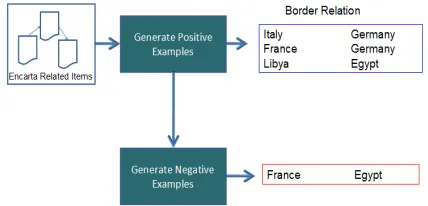
For Relation Extraction task, we exploited the “Related Items” section in Encarta. Encarta articles are linked ma-nually to related articles by experts through the “Related Items” section. The links are grouped under a hierarchy of labels up to three levels. We have exploited this rich se-mantic structure present in Encarta for automatically gene-rating semantic classifiers for relation extraction (Figure 1). For example, there is a link from the article on “Pakis-tan” to the article on “Iran”, and the link is grouped with
other similar links under the label of “Neighboring Re-gions and Countries” in the “Related Items” section in Pa-kistan. This information can be used to identify that a rela-tionship exists between the entities “Pakistan” and “Iran”. To find which kind of relationship exists between these two entities, we can use the existing label (“Neighboring Regions and Countries”) under which this link is grouped in the hierarchy in “Related Items” section. Further in this paper, we demonstrate how the training data can be gener-ated automatically from Encarta by considering an exam-ple relation between countries i.e. “border/neighbor” rela-tion between them. The approach that we used to label the training data automatically using Encarta is described in detail below.
For classifying the border relation between entities we generated the training data automatically. For that we gen-erated the positive examples using the information present in Encarta “Related Items”. We generated the negative examples from the positive examples (Figure 2). The ap-proach we adopted is described in detail below.
For generating the positive pairs we selected specific labels in “Related Items” and further selected links grouped under those labels. The details are as follows:
Related Item Label Selection: Since the “Related Items” are listed manually by experts and do not follow a rigid assignment scheme, we can find a variety of labels for the same kind of related items, for example, for the border relation we selected the following two labels in “Related Items” (1) “neighboring countries” (2) “neighboring re-gions and countries”.
Related Item Link Selection: The “Related Items” might have links to different kinds of Entities grouped under the same label. For example, the “Foreign Relations” related item has links to Afghanistan (Location) and Bandung Conference (Event).
Such links could be handled by Entity Classification to select the appropriate links for the relation under consid-eration. For example, if we define the “Foreign Relation” relation to be a relation between two locations/countries Figure 1: Relation Extraction using “Related Items” in
Encarta
then we can use Entity Classification to select such links from “Related Items”. This step was also needed for the “border” relation between countries to ignore links to re-gions that are not countries and are defined under the “neighboring regions and countries” label. Another chal-lenge in using the “Related Items” is that there are links that point to different sections of an article, this can add more complications. For example, the article on “Pakistan” has a link labeled as “Universities”, one would expect to find a link to an article on some University however, it is linked to a section of the article on the city “Islamabad” which mentions the university in that city. Such links are difficult to interpret automatically. To avoid such difficult links we only select links that are to full articles rather than sections of articles.
After label selection and link selection we had 138 neigh-boring countries pairs from Encarta. We further performed some filtering steps to filter out symmetric pairs; names which were not countries such as United_States_(People); names that were not available as a single word in Encarta MindNet such as Bosnia_and_Herzogovina. We also re-duced the multiword names of countries to single word names for example, we removed the phrase “Federal Re-public of” that occurred in several country names. After the filtering steps we were left with 113 entity pairs that served as positive examples for classification.
We generated equal number of negative pairs i.e., 113 ran-domly using the Positive Pairs, to create each negative pair we randomly picked the first member of a positive pair, randomly picked second member of a positive pair and paired them together. We skipped all those pairs which existed in positive examples and which were symmetric to existing pairs and also manually verified that the pairs created were negative examples. Since the positive pairs list is not exhaustive we had to add this manual step. How-ever, this step can be avoided completely by using
classifi-cation algorithms that can work with positive examples only (Gang et al., 2007). However, since such algorithms generally find negative examples heuristically, the tradeoff will be slight reduction in accuracy, therefore the decision of selecting the appropriate classifier will depend on the level of accuracy required for the particular application and also the feasibility of applying the manual verification step.
3.2 Feature Set Construction using MindNet
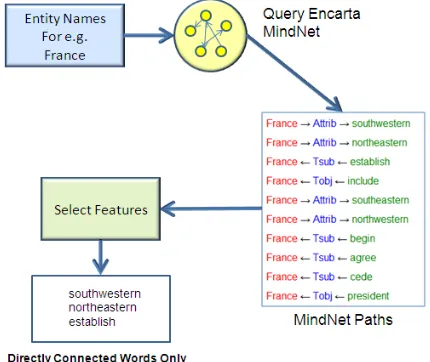
For Entity Classification and Clustering tasks we queried MindNet built from Encarta using the Entity Names. We extracted all the directly connected words to the queried entity name in the top 100 paths returned by MindNet (Figure 3). We used term frequencies as weights for fea-tures in all Feature Sets i.e., feafea-tures generated directly from Encarta and features generated using MindNet.
To generate features for Relation Extraction task, we que-ried MindNet using the pair of entity names and retrieved the paths connecting the pair of words. We generated three kinds of feature sets from the MindNet paths (Figure 4).
MindNet Relation Patterns: This feature set was con-structed by extracting the relation patterns between the pair of words and ignoring the intersecting words.
Intersecting Words: This feature set was constructed us-ing the intersectus-ing words in the MindNet paths.
Intersecting Words Patterns: In this case, we extracted the intersecting word patterns from the MindNet Paths.
3.3 Enriching MindNet with Semantic Relations
We have already discussed how Encarta could be exploited to label training data automatically and how feature sets based on lexical-semantic relations could be constructed from MindNet. Among the different feature sets extracted using MindNet the feature set with “Relation Patterns On-ly” is very interesting as it can be used to enrich MindNet itself with semantic relations. We can use the lexical se-mantic relations present between words in MindNet to de-Figure 3. Feature Extraction for Entity Classification and
Clustering using MindNet
rive higher level semantic relations between Entities (Fig-ure 5). For example “Pakistan” and “China” exist as words in MindNet built from Encarta, we can enrich MindNet relations by deriving the “border” relation between these two entities using automatically labeled data from Encarta and the relation patterns feature set from MindNet. As dis-cussed earlier, MindNet can be built fully automatically from text; therefore enriching MindNet with semantic rela-tions between entities will enable one to automatically generate the entity relations in addition to lexical relations between words. We can also associate the classification accuracy for a particular relation as weight on the edge corresponding to that relation in MindNet, thus building the graph of entity relations fully automatically.
4.
Experiments and Results
In this section we discuss the experiments we de-signed for evaluating MindNet generated feature sets for simpler tasks like Entity Clustering and Classification and report their results. We then discuss in detail our approach for relation extraction and conduct its evaluation with the Bor-der/Neighbor relation as an example.
4.1 Named Entity Classification
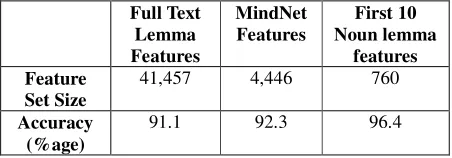
We created labeled training data for City and Country class as described in the previous section. We used SVM im-plementation in Weka (Witten and Frank, 2005) and 10 fold cross validation (Kohavi, 1995) to evaluate the accu-racy of our automatically generated classifiers and feature sets. The results are shown in Table 2. The first 10 noun lemmas gave the highest accuracy for classification i.e. more than 96%. The accuracy obtained by MindNet and full text features was very close i.e. 92.3% and 91.1% re-spectively.
Full Text Lemma Features
MindNet Features
First 10 Noun lemma
features Feature
Set Size
41,457 4,446 760
Accuracy (%age)
91.1 92.3 96.4
Table 2. Comparison of different feature sets for Named Entity Classification
Since there was a great difference between the feature set sizes of the three feature sets we repeated the experiments by selecting the top 100 features through feature selection using Information Gain (Witten and Frank, 2005) (Table 3). It was again observed that the first 10 noun lemmas performed best with the accuracy of 97%. However, this time the difference was smaller and it was followed by full text features and then MindNet features.
Full Text Lemma Features
MindNet Features
First 10 Noun lemma
features Feature
Set Size
100 100 100
Accuracy (%age)
96.4 94.1 97.0
Table 3. Comparison of different feature sets for Named Entity Classification after Feature Selection
4.1.1 Evaluation on Wikipedia Articles
We used our automatically constructed classifier built us-ing first 10 noun lemma features from Encarta on articles taken from Wikipedia. We randomly selected 100 city ar-ticles and 100 country arar-ticles from Wikipedia. We com-pared the accuracy obtained for Wikipedia Articles with Encarta Articles themselves (Table 4).
Test Sets Accuracy
Encarta Articles 94.5%
Wikipedia Articles 88.5%
Table 4. Classification of Wikipedia and Encarta Articles using Classifiers constructed and trained on Encarta
The accuracy for Encarta articles is higher since our clas-sifier was trained on Encarta. However, the accuracy for Wikipedia articles is also reasonably high i.e. 88.5% which indicates that classifiers constructed automatically from Encarta can be used on another similar resource such as Wikipedia with reasonably high accuracy.
4.2 Named Entity Clustering
For Named Entity Clustering we used the same training data as for Named Entity Classification however, this time we were interested in evaluating our feature set with re-spect to Entity Clustering task. Our goal was to evaluate and compare MindNet generated feature set with text based features to see which feature set gives more accurate clus-ter assignments. We used the K-Means algorithm with va-rying number of k (number of clusters) and evaluated the quality of our clusters using F-Measure for clustering (Toral and Munoz, 2006). The results are shown in Figure 6. It was observed that the cluster quality for full text lem-ma features was the least and deteriorated with increasing number of k, whereas for MindNet features the cluster quality was almost similar to text features for k < 7. How-ever, for k >=8 the cluster quality significantly improved to Figure 5: Deriving Semantic Relations between Entities
F-Measure > 0.8. After close examination of the data it was observed that there were 6 outliers in the data and each of the 6 outliers was assigned a separate cluster. Among the remaining two clusters, one had majority of city and the other had majority of country class instances. The fea-ture set with first 10 noun lemma gave the best cluster quality with F-measure equal to 1 at k=2 (100% accuracy). We also performed clustering after feature selection but again the first ten noun lemma gave the best results.
4.3 Relation Extraction
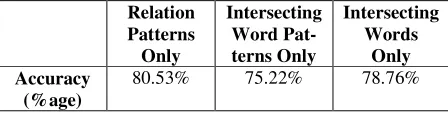
For Relation Extraction task we compared the performance of the three feature sets extracted from MindNet for classi-fying the border relation between countries. The results are shown in table 5. The classification was done using the SVM implementation in Weka (Witten and Frank, 2005) and the accuracy was computed using 10 fold cross valida-tion (Kohavi, 1995). The features were extracted using the top 100 paths returned on querying MindNet for the pair of entities. Increasing the number of paths to 500 reduced the accuracy.
Relation Patterns Only
Intersecting Word Pat-terns Only
Intersecting Words
Only Accuracy
(%age)
80.53% 75.22% 78.76%
Table 5. Comparison of the Accuracy obtained using dif-ferent feature sets extracted from MindNet
Among the three feature sets, the feature set with the rela-tion patterns gave the highest accuracy followed by inter-secting word patterns and then interinter-secting words features. We were most interested in the performance of the relation patterns feature set this feature set would enable enriching MindNet with semantic relations. We were interested in evaluating how the relation patterns would perform in comparison to baseline text features. If their performance is reasonably close to baseline text features and not too low then they can be used to directly enrich MindNet with se-mantic relations. With this in mind we carried our
experi-ments further and compared the accuracy obtained by sim-ple text features and MindNet Relation Pattern features.
4.3.1 Comparison of MindNet features and Text Fea-tures
The simple text features were constructed using the Bag of Words approach (BOW). In MindNet, we selected the top 5 paths. Using > 5 paths reduced the accuracy. We com-pared both feature sets by classifying the border relation using SVM with 10 fold cross validation (Table 6).
Text Features MindNet (Relations) Accuracy
(%age)
92% 82%
Table 6. Comparison of Text features and MindNet Fea-tures
The accuracy obtained by MindNet features was lower than the text features but still reasonably acceptable i.e. 82% given the fact that this feature set could be used to add semantic relations to MindNet and enable fully auto-matic relation extraction. Therefore by trading off a little accuracy, this feature set offers fully automated relation extraction which could be an attractive choice to make in certain cases.
5.
Discussion
We have developed an approach for extracting semantic relations fully automatically from text and demonstrated and evaluated our approach with the Border/Neighbor rela-tion as an example. We investigated the performance of MindNet generated features for simpler tasks like Entity Clustering and Classification to guide us in crafting our approach for Relation Extraction. In this section we discuss the results of our experiments and propose possible ways to further improve accuracy.
For the Entity Classification and Clustering tasks, the first 10 noun lemma gave the best results. A key reason for this is due to the fact that Encarta is an encyclopedia and the first one or two sentences of articles on entities essentially define the entity. Therefore, using just the features in the first few sentences helps in distinguishing that entity from other types of entities and also avoids the noise that is in-troduced by considering full text feature sets. For example the articles on countries have some typical words in the first few sentences such as “country”, “monarchy”, “repub-lic” whereas, the articles on cities have words like “city” or “town” in the first few sentences. Similar observations have been reported on Wikipedia articles that the first tence often defines the Entity and the words in first sen-tence provide very informative features related to the Enti-ty (Sumida et al.,2008; Nguyen et al., 2007; Wang et al., 2007). However, in the case where we are dealing with non-encyclopedic articles, the top ten noun lemma might not give reasonable performance and exploiting full text features might be the only option, in such a case, MindNet Figure 6: Comparing cluster quality for different feature
Lucy Vanderwende, Gary Kacmarcik, Hisami Suzuki and Arul Menezes. 2005. MindNet: An Automatically-Created Lexical Resource In Proceedings of HLT/EMNLP 2005 Interactive Demonstrations, Van-couver, British Columbia, Canada, October 2005. Lucy Vanderwende. 1994. Algorithm for Automatic
Inter-pretation of Noun Sequences. In: Proc. 15th Int'l. Conf. Computational Linguistics, ACL, Morristown, NJ, 782-788, 1994.
Lucy Vanderwende. 1995. Ambiguity in the Acquisition of Lexical Information.In: Proc. of the AAAI 1995 Spring Symposium Series, symposium on representation and acquisition of lexical knowledge, 174-179, 1995. Ron Kohavi. 1995. A study of cross-validation and
boot-strap for accuracy estimation and model selection. Pro-ceedings of the Fourteenth International Joint Confer-ence on Artificial IntelligConfer-ence 2 (12): 1137–1143, (Mor-gan Kaufmann, San Mateo), 1995.
Stephan Bloehdorn and Sebastian Blohm. 2006. A Self Organizing Map for Relation Extraction from Wikipe-dia using Structured Data Representations. In: Proc. of the International Workshop on Intelligent Information Access (IIIA-2006), Helsinki, Finland, 2006.
Stephen D. Richardson. 1997. Determining Similarity and Inferring Relations in a Lexical Knowledge Base. PhD. dissertation, City University of New York, 1997. Tomas Kliegr. 2008. Unsupervised Entity Classification
with Wikipedia and WordNet. Proc. of the 2nd K-Space PhD Jamboree Workshop, TELECOM Paris-Tech, Paris, France, July 25th 2008.
William Dolan, Lucy Vanderwende, and Stephen D. Rich-ardson. 2000. Polysemy in a Broad-Coverage Natural Language Processing System. In Polysemy: Theoreti-cal and Computational Approaches, Ravin, Y. and Leacock, C., eds., Oxford University Press.178-204. 2000. William Dolan. 1994. Exploiting Lexical Information for
Visual Processing. In Proceedings of AAI-94 Workshop on the Integration of Natural Language and Vision Proc-essing, Seattle, Washington, 185-188, 1994.
William Dolan. 1995. Metaphor as an Emergent Property of Machine-Readable Dictionaries. In: Proc. of the AAAI 1995 Spring Symposium Series, 27-32, 1995. William Dolan. 1994. Word Sense Ambiguation:
Cluster-ing Related Senses. In: Proc. 15th Int'l. Conf. Compu-tational Linguistics, ACL, Morristown, N.J., 712-716, 1994.
Gang Wang, Yong Yu and Haiping Zhu. 2007. PORE: Positive-Only Relation Extraction from Wikipedia Text. The Semantic Web: 6th International Semantic Web Conference, Springer-Verlag New York Inc, 2007. Yotaro Watanabe, Masayuki Asahara and Yuji Matsumoto.
2007. A Graph-based Approach to Named Entity Cate-gorization in Wikipedia Using Conditional Random Fields. In Proc. of EMNLP-CoNLL 2007, 649-657, 2007.