An Evolving eScience Environment for Research Data in Linguistics
Claus Zinn, Peter Wittenburg, and Jacquelijn Ringersma
Max Planck Institute for Psycholinguistics Wundtlaan 1, 6525 XD Nijmegen, The Netherlands
Abstract
The amount of research data in the Humanities is increasing at fast speed. Metadata helps describing and making accessible this data to interested researchers within and across institutions. While metadata interoperability is an issue that is being recognised and addressed, the systematic and user-driven provision of annotations and the linking together of resources into new organisational layers have received much less attention. This paper gives an overview of our evolving technological eScience environment to support such functionality. It describes two tools, ADDIT and ViCoS, which enable researchers, rather than archive managers, to organise and reorganise research data to fit their particular needs. The two tools, which are embedded into our institute’s existing software landscape, are an initial step towards an eScience environment that gives our scientists easy access to (multimodal) research data of their interest, and empowers them to structure, enrich, link together, and share such data as they wish.
1.
Introduction
The Max Planck Institute for Psycholinguistics (MPI-PL) holds more than 40 terabyte of research data in the area of language documentation. In the past 10 years, it has de-veloped and deployed the Language Archiving Technology suite that helps researchers and archive management to dig-itize, ingest, catalogue, describe, and subsequently access all data. The sheer vastness of research data led to various tools for browsing and viewing research data, including the IMDI Browser and metadata search engine (Broeder et al., 2004), the ANNEX annotation exploration tool including the TROVA content search (Berck and Russel, 2006), ge-ographic browsing (Uytvanck et al., 2008), and more re-cently, facetted browsing. Once research data is identified, however, users would want to further enrich it with com-mentaries and other types of annotations, or to link together resources via some semantic relation. In brief, they require means to organise and reorganise research data to fit their particular needs.
1.1. Managing research data at the MPI-PL
The archive of the MPI-PL hosts various forms of data in various media types. In the DoBeS project (Witten-burg, 2003) (Documentation of Endangered Languages, see http://www.mpi.nl/dobes/), rich resources have been gathered in the form of audio, video, and photographic material. All primary sources were catalogued with meta-data using the IMDI editor. Most researchers describe their resources in terms of the content (e.g., language, genre, modality); often researchers also add metadata to the actors (e.g., interviewer, interviewee) together with actor details (e.g., age or gender). Information on the quality of the re-sources is sometimes given, indicating whether the record-ings were made under windy field or laboratory conditions. There is also some technical metadata of the resources (file type, format, size), which is determined automatically from the resource file during the upload process.
To a smaller but substantial extent, primary data is anno-tated along a multitude of dimensions using ELAN (Wit-tenburg et al., 2006). Often, for instance, alignments are being produced between transcriptions and audio signals,
or annotation layers for speakers, voices, or voice qualities are being created. Another substantial type of resource cre-ated by MPI-PL researchers are lexica of the languages they document. Using MPI-PL’s in-house tool LEXUS (Kemps-Snijders et al., 2006; Cablitz et al., 2007), researchers can define a lexicon’s schema and then add entries as instantia-tions of the schema. LEXUS supports the inclusion of mul-timedia media either stored locally or from archived mate-rial. Photographic, audio and video material can thus be part of the lexicon to better illustrate the usage of a word in its social and cultural context.
1.2. New Requirements
Despite the variety of tools the amount of data can be over-whelming for users. Thus, users would profit from another layer of organisation where the space of research data can be organized to their needs, and where research data can be connected across the various types of data (metadata, mul-timedia data, lexicon dataetc.). To achieve this, we aim at building a framework that allows researchers:
• to create their own user-defined workspace as selec-tion and view of all archived material;
• to make accessible (a part of) their workspace to other researchers to foster collaboration;
• to attach notes, commentaries, to-do lists,etc. to each element (or their parts) of the workspace;
• to link together the various elements (or their parts) of the workspace by a variety of user-definable semantic relations.
We have built initial software towards achieving these aims, which we present next.
2.
A First Step: ADDIT
Figure 1: ADDIT Main Window
metadata records, other structured textual data such as an-notations, and lexical data fragments. These full-text com-mentaries could direct researchers to review a particular multimedia resource, its metadata description, an annota-tion or a lexical entry. ADDIT also supports the linking together of research data of various typesviasemantic rela-tion, for instance, to create genealogical relations between the interviewed persons of a large media resource (linking together parts of IMDI records), synonym relations (linking together entries of lexical resources), or connections across resource types,e.g., linking together a lexeme from a lexi-con with an audio fragment where it occurs.
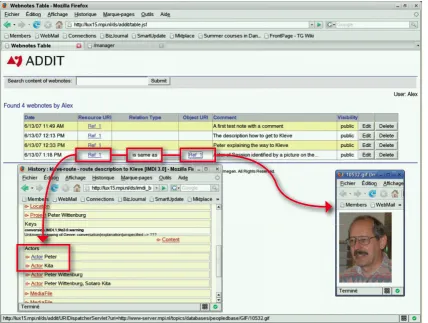
Fig. 1 shows ADDIT’s main window with three webnotes and one semantic relation, which is detailed. Here, the metadata field “Actor” with value “Peter” is linked to an archived photo via a “is same as” relation. Every web-note or semantic relation created is associated with the one (webnote) or two URIs (semantic relations) it enriches, a comment to describe it, the type of relations (for semantic relations), and other values such as date of creation, creator, and access permissions.
ADDIT requires MPI-PL’s web applications such as AN-NEX, IMDI and LEXUS to adhere to ADDITs applica-tion programming interface (API) and to deliver unique re-source or rere-source fragment identifiers, which could then be stored in ADDIT’s data storage. ANNEX, IMDI and LEXUS can query ADDIT to find out whether there are webnotes or semantic relations defined for a given
re-source fragment, and if existing, to display such informa-tion to their users. ADDIT is implemented using Java with JavaServerFaces (see http://java.sun.com/ javaee/javaserverfaces/), and the text engine Lucene (seehttp://lucene.apache.org/). While ADDIT supports various LAT tools, its feature base is rather shallow and its user interface rather poor. With ViCoS, we aim at exploring a wide range of features, sup-ported with a user-friendly and attractive user interface, but focus on enriching lexical resources only.
3.
ViCoS
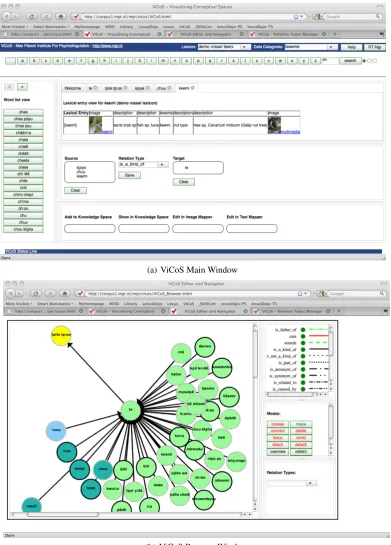
The current version of ViCoS is designed to add value to LEXUS, allowing users to add an additional layer to ex-isting data, complementing a given linguistic description with a conceptual account. ViCoS’ motivation in this set-ting is that a language is so much more than a list of lexical entries and their scientific description in linguistic parlour. With ViCoS, words can be turned into culturally relevant concepts and placed in relation to other concepts. Users can browse between lexical and ontological space more or less simultaneously and can thus gain a richer experience of the language and culture being documented.1 Fig. 2(a) de-picts ViCoS’ main window, indicating how users can select
1
The following research data stems from the Y´elˆı Dnye project of Stephen Levinson’s group, see the website athttp: //www.mpi.nl/institute/research-groups/
(a) ViCoS Main Window
(b) ViCoS Browser Window
Figure 2: The ViCoS Tool
lexical information and create semantic relations between them. ViCoS offers a few standard pre-defined “universal”
Papua New Guinea, and MPI researchers have collected rich data sets encompassing many images, videos, and annotations thereof. There is also a lexicon of more than 6000 lexical entries, created with LEXUS, which also contains references to objects and species in the natural world, and links to corresponding material in the archive. In this context, ViCoS is being used to complement the lexical space with a conceptual space, to represent various cultural aspects of the language community and the natural world.
Figure 3: Overview functionality to display the complete conceptual space
http://www.isocat.org).
To view the conceptual space for a lexical entry, the user drags this lexical entry into the “Show in Knowledge Space” area. The lexical entry’s corresponding concept will take center stage in the conceptual space browser, sur-rounded by all concepts that aredirectly related to it (see Fig. 2(b)).
The conceptual space browser offers, among others, the following modes (for more details, see (Zinn, 2008)). In LEXUS mode, clicking on the node will open LEXUS to show the corresponding lexical entry in linguistic con-text, thus strongly linking together lexical and ontological spaces. Inattach mode, it is possible to link arbitrary URIs to a node; in “world” mode, clicking on a node with border will open the URI in a new browser tab. Users can thus link concept nodes to URI-accessible material of the MPI archive. If the URI, for instance, points to an ELAN file, the ANNEX viewer opens and shows the multimedia file and its annotations (playing the file from a time as retrieved from the time stamp parameter of the URI). Incolour mode, colours can be attached to nodes; here colour coding is en-tirely up to the user. The depicted conceptual space, for in-stance, uses different colours to represent the generic term for bird and fish, and then other colours for bird and fish instances.
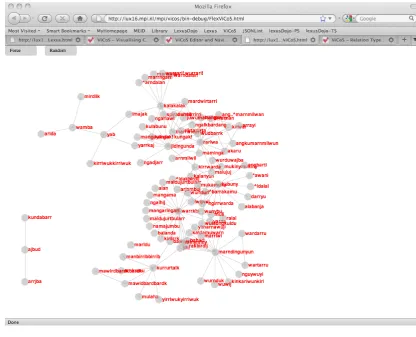
The ViCoS Browser Window only shows direct rela-tions between the “center concept” and other concepts. To obtain a full overview, users can press the mode button
“overview”, and then the complete knowledge space is be-ing displayed (see Fig. 3). The overview helps researchers to get a good first impression of his data; in our example, one can see clusters of bird, fish, crab, and man instances. On the front-end, ViCoS uses the AJAX framework Dojo (seehttp://www.dojotoolkit.org/), which com-municates with LEXUS via http requests. On the back-end, ViCoS uses Java-based code on top of the OWL knowledge representation language (McGuinness and van Harmelen, 2004). Conceptual spaces are stored within the JENA framework (seehttp://jena.sourceforge. net/), which provides a programmatic environment for OWL constructs and a rule-based inference engine for re-trieving implicit information.
4.
Discussion
So far, the current usage of ADDIT among MPI-PL re-searchers was rather disappointing. The reasons for this could be manyfold: there has been no systematic promo-tion of the tool within MPI-PL’s researcher community, and thus only few commentaries or webnotes have been created so far. Moreover, ADDIT’s UI is rather simple, and its ca-pabilities to search for or display available webnotes and semantic relations is rather poor.