Dialogue Reference in a Visual Domain
Jette Viethen
1, Simon Zwarts
1, Robert Dale
1, Markus Guhe
21Centre for Language Technology
Macquarie University Sydney, Australia
[jviethen|szwarts|rdale]@science.mq.edu.au
2School of Informatics
University of Edinburgh Edinburgh, Scotland [email protected]
Abstract
A central purpose of referring expressions is to distinguish intended referents from other entities that are in the context; but how is this context determined? This paper draws a distinction between discourse context –other entities that have been mentioned in the dialogue– and visual context –visually available objects near the intended referent. It explores how these two different aspects of context have an impact onsubsequent referencein a dialogic situation where the speakers share both discourse and visual context. In addition we take into account the impact of the reference history –forms of reference used previously in the discourse– on forming what have been calledconceptual pacts. By comparing the output of different parameter settings in our model to a data set of human-produced referring expressions, we determine that an approach to subsequent reference based on conceptual pacts provides a better explanation of our data than previously proposed algorithmic approaches which compute a new distinguishing description for the intended referent every time it is mentioned.
1.
Introduction
There is now a quite substantial body of work in referring expression generation, a subfield of natural language gen-eration (NLG) where the central concern is how to deter-mine the semantic content of a nominal expression whose purpose is to identify an intended referent for a hearer. In almost all of this work, the basic idea pursued is that, to be successful, a referring expression must distinguish the in-tended referent from other entities in thecontext; we call such a referring expression adistinguishing description.
One question that has not been explored a great deal in the literature is the question of how the set of entities that make up the context is determined. Clearly, getting the context set right is a key factor in how well such approaches to reference work: if the context set mistakenly contains en-tities that are not considered to be part of the context by the hearer, there is the danger that the referring expres-sion generated may contain unnecessary information, po-tentially leading to unintended Gricean implicatures, or at the very least, wasted effort on the part of the generator. On the other hand, if the context set used by the generator does not contain entities that the hearer believes to be in the context, then the referring expression generated may be ambiguous from the hearer’s point of view.
In the initial characterisations of this problem, it was recog-nised that the context, particularly for subsequent refer-ences to an entity already mentioned, would be determined by properties of the precedingdiscourse(see, for example, Dale, 1989). A number of influential works in the 1980s (for example, Grosz et al., 1983; Grosz and Sidner, 1986) were concerned with the hierarchical structure of discourse, and how this hierarchy impacted on the accessibility of pre-viously mentioned entities at any given point in the dis-course, thus determining which entities would serve as po-tential distractors for an intended referent. We can think of a context set derived in this way as consisting of what we will calldiscourse distractors.
Keeping track of discourse distractors is important for any
natural language generation system whose purpose is to produce multisentential or more extended discourse, as in report generation or summarisation. Most recent work in referring expresion generation, however, has concerned it-self with corpora of human-produced referring expressions elicited in situations where the context, and therefore the set of distractors, is defined in terms of avisualfield. In the TUNA corpus (van der Sluis et al., 2006), subjects were asked to distinguish a target referent from the rest of the en-tities visible on the screen serving as distractors; similarly, in the GRE3D3 corpus (Viethen and Dale, 2008), subjects were asked to distinguish a target entity from two other en-tities visible in a simple blocksworld scene. In these cases, the context set consists of what we will callvisual distrac-tors.
An important and relevant orthogonal distinction which has not been considered as a factor in more recent work in this area is the distinction betweeninitial referenceand subse-quent reference: we use an initial reference to introduce an entity into a discourse, and subsequent reference to refer to it after it has been introduced. This distinction is of consid-erable significance in the generation of extended discourse: for example, notwithstanding rare cases of cataphora, pro-nouns can be used for subsequent reference but not initial reference. The initial vs subsequent reference distinction is not of obvious significance in the visual reference studies mentioned above, however, since in these cases every ref-erence is an initial refref-erence: in the acquisition of the data, each scene is presented to subjects anew, and only one ref-erence is generated per scene.
This raises the question of how subsequent reference works in a visual domain, where the visible objects are referred to repeatedly. One simple hypothesis, for example, would be that the initial reference is determined on the basis of visual distractors, and then subsequent references are determined on the basis of discourse distractors.
howalignment, whereby a conversational participant will adopt the same semantic, syntactic and lexical alternatives as the other party in a dialogue, has an impact on refer-ence, with speakers formingconceptual pactsin their use of language (Brennan and Clark, 1996). The implication of much of this work is that one speaker introduces an en-tity by means of some description, and then (perhaps af-ter some negotiation) both conversational participants share this form of reference, or a form of reference derived from it, when they subsequently refer to that entity.
In our work, we aim to model a conversational participant in a dialogue that concerns a shared visual scene, a com-mon scenario where automated referring expression gener-ation might be particularly useful. Consequently, we need to determine how these three factors—discourse context, visual context and the other participant’s use of language— interact to determine how our model should construct ap-propriate referring expressions. In this paper we describe some initial experiments that explore this question.
Consideration of situations where all three factors play an explicit role is rare. Jordan and Walker (2000; 2005) ex-plored how the model proposed by Grosz and her col-leagues plays together with the task and the intentions of the speaker in influencing the content of non-pronominal subsequent referring expressions. However, unlike Jordan and Walker’s domain, in which the objects under discus-sion were not usually visible to both dialogue partners, the landmarks on the maps that are described in our corpus are in general visible to both partners. A second difference is that at least the vast majority of the referring expressions in our corpus have the main function of uniquely identifying the target referent, which is only one of a number of tasks the descriptions in Jordan and Walker’s corpus perform.
The remainder of this paper is organised as follows. The data set we use and the particular referring expressions we concentrate on are described in Section 2. Our aim is to explore the influence of different factors on the content of a subset of the subsequent referring expressions in our data with the ultimate goal of creating a system that is able to regenerate these expressions as accurately as possible. The hypotheses we set out to test are detailed in Section 3 and our model is outlined in Section 4.
In Section 5 we try out a variety of parameter settings for the model and compare the results to the human-produced instances in our data set using theDICEmetric (Salton and McGill, 1983) and the MASI metric (Passonneau, 2006), which have been used in the recentREG Challenges (Gatt et al., 2008). We focus in particular on the first subsequent reference by the second speaker in the dialogue; our results show that the most influential factor shaping the content of the subsequent referring expressions from our data set is the way the target referent has been described previously in the dialogue, consistent with an alignment-based model. Combining this with the need to distinguish from either the set of other entities described in the discourse or the set of visual distractors does not considerably improve the results of our model, suggesting that the model assumed in earlier work on referring expression generation, where each refer-ence is explicitly constructed with a deliberate concern for
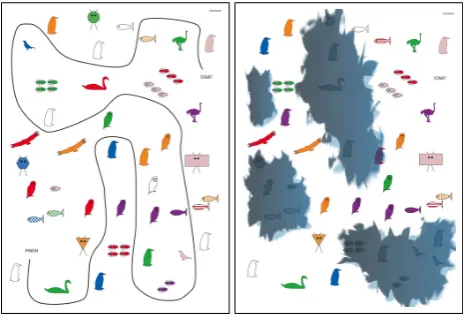
Figure 1: An example pair of maps.
its ability to discriminate, is not the most explanatory.
We close with a summary of our conclusions and a number of suggestions for future work in Section 6.
2.
The Data
We use the iMAP corpus (Louwerse et al., 2007; Guhe and Bard, 2008), which consists of 256 dialogues elicited from 32 dyads of participants. In each dialogue, one participant is the instruction giver (IG) and the other the instruction follower (IF). Both participants have a map with landmarks in front of them. The task is for the IG to communicate a path, which is only shown on her map, to the IF in such a way that the IF can draw it onto his map. This is compli-cated by the presence of a number of small discrepancies between the IG’s and the IF’s maps in the form of ink dam-age obscuring colour in some spots on the IF’s map, and by slight differences in the landmarks. Figure 1 shows an example of a pair of maps.
The landmarks on the maps can be distinguished from each other by their COLOURand one of the properties SHAPE, PATTERN, NUMBER or KIND, depending on theTYPE of landmark, which is also often included in the descriptions. Each map has one main type of landmark, which is either BUILDING, BIRD, TREES, BUGS, ALIEN, TRAFFIC SIGN, FISHor CAR. The main type of landmark on the maps in Figure 1 isBIRD; in the iMAP domain, birds can be distin-guished by theirCOLOURand theirKIND.
We would like to develop a model of how referring expres-sions are constructed in this context. In this paper, we focus on the specific case of the first reference made by the sec-ond speaker to an entity that has already been introduced in the discourse by the other speaker. We call these descrip-tionsSecond-speaker Initial References (SSIRs) and the landmark they refer to in each case thetarget landmark. In this way, we aim to determine the influence of the three factors introduced above: the discourse context, the visual context, and the other speaker’s particular use of language in describing the entity.
contains another 2366 coreference chains in which the tar-get landmark was described at least once as part of a plural referring expression describing a group of several objects, such asthe two purple owls.
3.
Possible Scenarios
Given the three factors we have identified, there are three baseline hypotheses we can consider:
1. It could be the case that the only important factor is the
reference history of the target referent—given that we are focussing on the first reference by the second speaker, this is the collection of descriptions that the first speaker to mention the target landmark used to describe it.
2. It might be the case that the reference history is not taken into account at all, but rather theSSIRonly dis-tinguishes from other entities that have recently been mentioned, thediscourse distractors.
3. SSIRs might be similar to the first mentions by the first speaker in that they distinguish the target landmark from thevisual distractorsaround it.
It is also possible that combinations of any two of these factors might be at play:
4. An SSIR might distinguish the target landmark from both discourse and visual distractors, but not take any account of the reference history.
5. While taking into account the reference history, an SSIR might also need to distinguish the target land-mark from the visual distractors.
6. AnSSIRmight be based on the previous reference his-tory, but it might also distinguish the landmark from discourse distractors.
And finally, all three factors might have an effect:
7. An SSIR might build on the content of the previous mentions in the reference history and also distinguish from both discourse distractors and visual distractors.
Intuitively, one might expect Hypothesis 6 to be the most plausible of these, on the basis that the reference history ‘costs in’ the discourse and visual distractors up to that point, so that a subsequent reference only needs to take additional account of any distractors mentioned since the target landmark was last mentioned.
4.
The Model
We use a simple rule-based model to explore the scenarios from the previous section with the aim of creating a system that is able to re-generate the descriptions in our human-produced data set as accurately as possible. We define a number of input parameters that allow us to fine-tune our model and explore if and explicitly in which ways the fac-tors mentioned above influence the content of theSSIRs we attempt to replicate.
Two parameters define if and how the reference history im-pacts anSSIR:
• history strategy: This parameter toggles be-tween a setting in which the SSIR repeats the last mention from the reference history in its entirety (repeat last), a setting which retains only the head noun from that last mention (drop to type), and a setting which ignores the reference history (drop all).
• property strategydefines which properties can be used in the SSIR for the target landmark. They are either drawn from the set of previously mentioned properties, from the set of properties that the database holds for the target landmark (db; this may include properties which are visually available but have not yet been verbalised), or from both these sets (union).
One parameter controls the influence of the discourse dis-tractors:
• discourse strategy defines which properties of the discourse distractors theSSIRneeds to distinguish from. We can take into account only the properties that have been mentionedfor these landmarks, we can also take into account any additional visual properties that our database holds (union), or we can ignore the discourse distractors (none).
We define one parameter for the control of the visual dis-tractors:
• visual strategydefines whether the visual distrac-tors get taken into account or not. We define a radius around the landmarks in such a way that each circle contains on average six visual distractors.1
The main algorithm used by our model is shown in Fig-ure 2. Step #2 here ensFig-ures that the description rules out all distractors by applying the Incremental Algorithm (Dale and Reiter, 1995) (IA). We also experimented with the Greedy Algorithm (Dale, 1989), but in line with earlier experiments on initial reference (Viethen and Dale, 2006; van der Sluis et al., 2007), theIAselection strategy consis-tently outperformed the Greedy strategy.
In a post-processing step, we ensure that theTYPE of the target landmark is included in theSSIR, if it has not already been chosen by the model; this is a standard procedure in the literature to ensure that the resulting noun phrase will have a head. If no properties have been chosen, theTYPE is specified asPRONto ensure that the expression will be pronominalised.
5.
Exploration
5.1. Method
We report performance in terms of accuracy and two set dis-tance measures. Accuracy measures the proportion of times
1
history property discourse visual average summed average Accu- strict strict strategy strategy strategy strategy DICE DICE MASI racy subset superset
1 repeat last n/a none no 0.673 0.680 0.531 40.2% 13.8% 33.1%
2 drop to type n/a none no 0.459 0.457 0.339 22.3% 56.5% 6.9%
3 drop all db mentioned no 0.467 0.471 0.326 22.8% 30.9% 9.6%
4 drop all db none yes 0.558 0.570 0.348 18.6% 10.7% 39.1%
5 repeat last mentioned none yes 0.667 0.675 0.519 38.4% 12.8% 35.8%
6 repeat last union none yes 0.672 0.680 0.530 40.1% 13.7% 33.4%
7 drop all db mentioned yes 0.559 0.573 0.349 18.9% 9.1% 39.8%
8 drop all db union no 0.564 0.579 0.349 18.2% 8.6% 42.7%
9 repeat last union mentioned no 0.676 0.682 0.529 39.6% 12.8% 33.8%
10 repeat last mentioned mentioned no 0.677 0.681 0.528 39.4% 12.2% 34.94%
11 repeat last union union no 0.677 0.683 0.530 39.7% 12.6% 34.0%
12 repeat last mentioned union no 0.674 0.680 0.525 39.0% 11.9% 35.5%
13 repeat last union mentioned yes 0.675 0.682 0.528 39.4% 12.5% 34.4%
14 repeat last mentioned mentioned yes 0.671 0.677 0.518 37.9% 11.4% 36.9%
15 repeat last union union yes 0.676 0.682 0.529 39.5% 12.5% 34.4%
16 repeat last mentioned union yes 0.670 0.677 0.516 37.7% 11.4% 37.1%
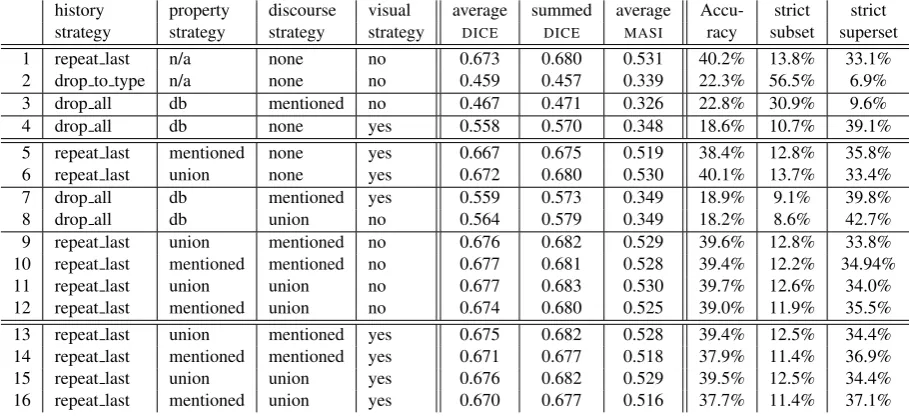
Table 1:The results for the parameter settings we explored.Lines 1 to 4 are the baselines which only take into account one of the three factors. Lines 5 to 12 combine two factors each and Lines 13 to 16 combine all three factors.
# Initialise
P={the set of properties of the target landmark
1
according toproperty strategy} C={the set of distractors according to
2
discourse strategyandvisual strategy}
SSIR={}
3
# Step 1 — continue the history SSIR={the properties returned by the
4
history strategy}
C=C− {the distractors ruled out bySSIR}
5
# Step 2 — rule out distractors
run IA(SSIR,P,C)
6
returnSSIR
7
Figure 2: The main algorithm
the system output is an exact match of the human-produced referring expressions. Both the DICE coefficient and the MASIscores are set-comparison metrics that deliver values ranging between 0 and 1. In the context of content deter-mination inREG, they are applied by comparing the set of properties contained in the description that the system has produced to those contained in the human-produced refer-ence description. The two measures have both been used to evaluate the fit of REG output to human-produced data in the recent evaluation challenges in this field (Gatt et al., 2008). The main difference between them is thatMASI is biased in favour of solutions that are a subset or a superset of the gold standard.
Given two sets of attributes, A and B,DICEis computed as
(1) DICE = 2× |A∩B|
|A|+|B|
andMASIas
(2) MASI =δ×|A∩B| |A∪B|
whereδis a monotonicity coefficient which biases the met-ric in favour of solutions that are a subset or a superset of the gold standard. It is defined as
(3) δ=
0 ifA∩B=∅
1 ifA=B
2
3 ifA⊂B or B ⊂A 1
3 otherwise
We apply the metrics on the level of attributes: a prop-erty is counted as correct if it was included by our system and the gold standardSSIRalso contained this property; the value of the property is not taken into account. In doing this we follow the practice of the TUNA evaluation challenges (Gatt et al., 2008), in order not to penalise our system’s output in cases where the participants used property values that are superficially different from those in the data base and that our system therefore has no access to.
For both measures we report the average value over the complete data set. For DICEwe also report what we call thesummed mean, which is sensitive to the difference be-tween getting a long referring expression right and getting a short one right. Like theBLEUmetric used in MT (Pap-ineni et al., 2002), it sums the numerators and the divisors separately. This ensures that a long referring expression contributes more to the overall score than a short one.
5.2. Results
Lines 1 to 4 show the results of the parameter settings that we used to test the baseline hypotheses from Section 3 (reference history only; discourse distractors only; and vi-sual distractors only—recall that the database contains only those properties which are visually available). Lines 1 and 2 represent different ways in which we can take the refer-ence history into account without giving the discourse or visual distractors any influence. They differ in the setting for history strategy.2 Setting this to repeat last,
i.e. simply repeating the last description used by the first speaker, achieves by far the best results here.
Line 3 represents the hypothesis that only the mentioned properties of the discourse distractors are taken into account in anSSIR. It does not reach the sameDICEscores as those of Setting 1, but achieves similar results as Setting 2, which simply uses onlyTYPE.
Line 4 shows that only distinguishing from the visual dis-tractors of the target landmark also results in worse perfor-mance than simply repeating the last mention. However, this does increase performance over only taking into ac-count discourse distractors (Setting 3).
The performance increases again to the same level as that of Setting 1, if we combine taking into account visual distrac-tors (visual strategy=yes) with the best performing setting for thehistory strategy(Lines 5 and 6). Mak-ing available both mentioned and visual properties achieves slightly betterDICEscores than only using the properties of the target landmark that were mentioned in the history, but results in a small drop in Accuracy.
Combining the two types of distractors and not giving the reference history any influence (Lines 7 and 8) achieves worse results than any of the settings that are based on re-peating the last mentioned properties.
The settings in Lines 9 to 12 combine the influence of the reference history with that of the discourse distractors. For both the target landmark and the discourse distractors we test using only mentioned attributes and additionally using all properties that are recorded in the data base. There is almost no difference between these four settings. The best performance is achieved here by the settings in Line 11, which also outperform the four best settings in which we tried combining all three factors (Lines 13 to 16).
Overall the summedDICEscores are slightly better than the averagedDICEresults. This shows that we are getting some of the longer referring expressions right, which the average does not honour as much as the summedDICE. TheMASI scores cannot be directly compared to theDICEscores, al-though we note that the ranking of the settings according toMASIis only very slightly different from theDICE rank-ing. However,MASIdoes correspond better to the Accuracy ranking thanDICEdoes.
The principal finding here is that the content of the previous mentions of the target landmark have a large impact on the content of anSSIR. Taking into account the visual distrac-tors does not improve the performance of our model; and, perhaps surprisingly, the need to distinguish from
distrac-2
Changingproperty strategywould have no effect as no distractors have to be excluded in these settings.
tors introduced in the discourse also does not seem to have a large influence on the content of theSSIRs we attempt to replicate.
5.3. Error Analysis
The last three columns of Table 1 show how often each setting produced exactly the same referring expression as in the human-produced data set, and how often our result was either astrict subsetor astrict supersetof the human-produced referring expression. When our model produces a referring expression whose content is a strict subset of that of the human-produced description, we may be guilty of having produced an underspecified description given the context; and when we produce a superset, our referring ex-pression will be overspecified.
These columns show that whenever our model achieves rel-atively high results, both for Accuracy andDICEscore, it is also overspecifying to a large degree. This means that the remaining error is largely due to the system including too many properties in the referring expressions it generates.
This is in particular true for the simple baseline that copies the last mention of the target landmark. What we can con-clude from these results is that the 14% of human-produced SSIRs that are a superset of the last-used description do not contain this additional information in order to distinguish the target landmark from any discourse or visual distrac-tors. If this was the case, we should see a real increase in performance from the baseline setting under which our system simply copies the last mention (Line 1 in Table 1) to those settings where it takes the last mention as a basis but adds extra properties to it if that is necessary to distinguish from new distractors (Lines 5, 6 and 9 to 12).
6.
Conclusions and Future Work
Our experiments indicate that, for second speaker initial reference at least, the reference history has a large impact, while visual distractors do not play an important role. Per-haps surprisingly, taking into account discourse distractors does not appear to help much either. The simple baseline of copying the last mention gets close to the best results.
some relevant way. Each reference to a given entity in a dis-course can be thought of as ‘building on previous work’ in this way, opening the door to more collaborative algorithms for referring expression generation.
Our experiments so far simplify various aspects of the sce-narios we are exploring here. First, we could take into ac-count more situational factors; in particular, in the iMAP corpus, we should take account of whether the target’s colour is obscured by an inkblot on the IF’s map, as well as features such as the particular speaker or speaker-pair, and the main type of landmarks on the map. While these features might increase performance with regard to this par-ticular data set, it would be at the cost of a loss of generality of the model. However, taking into account the speaker is a necessity if we take seriously the view that speaker vari-ation is a significant factor underlying varivari-ation in the con-tent of referring expressions (Viethen and Dale, 2006).
Also, additional discourse factors could be integrated. For example, explicit communication between the dialogue partners about the areas in which colour is missing for the IF, or which of the landmarks seem to differ between the maps, could be taken into account. Another discourse fac-tor that might have an impact on referring expression gen-eration is the dialogue act type of each utterance contain-ing a referrcontain-ing expression; however, explorcontain-ing these aspects would require considerable additional annotation of the cor-pus.
Currently the decision as to whether our model takes ac-count of the reference history is somewhat arbitrary. In-stead, it might make sense to make the reference history’s influence dependent on the distance between the current re-ferring expression and the last mention of the target refer-ent. It is likely that the impact of this last mention dimin-ishes the further back it lies. It is also likely that a larger number of discourse distractors being mentioned since the last reference to the target landmark decreases its impact.
The SSIRs, which we have focussed on in this work, are, of course, only one subclass of coreferential expressions in dialogues. As well as improving the performance of our model on this special case, we aim to explore how the model extends to other subsequent references in the corpus.
7.
References
Susan E. Brennan and Herbert H. Clark. 1996. Concep-tual pacts and lexical choice in conversation. Journal of Experimental Psychology: Learning, Memory, and Cog-nition, 22:1482–1493.
Robert Dale and Ehud Reiter. 1995. Computational inter-pretations of the Gricean maxims in the generation of re-ferring expressions.Cognitive Science, 19(2):233–263. Robert Dale. 1989. Cooking up referring expressions. In
Proceedings of the 27th Annual Meeting of the Asso-ciation for Computational Linguistics, Vancouver B.C., Canada.
Albert Gatt, Anja Belz, and Eric Kow. 2008. The TUNA Challenge 2008: Overview and evaluation results. In Proceedings of the 5th International Conference on Nat-ural Language Generation, pages 198–206, Salt Fork OH, USA.
Barbara J. Grosz and Candance L. Sidner. 1986. Attention, intentions, and the structure of discourse. Computational Linguistics, 12(3):175–204.
Barbara J. Grosz, Aravind K. Joshi, and Scott Weinstein. 1983. Providing a unified account of definite noun phrases in discourse. InProceedings of the 21st Annual Meeting of the Association for Computational Linguis-tics, pages 44–49, MIT, Cambridge MA, USA, 15-17 June.
Markus Guhe and Ellen Gurman Bard. 2008. Adapting re-ferring expressions to the task environment. In Proceed-ings of the 30th Annual Conference of the Cognitive Sci-ence Society, pages 2404–2409, Austin, TX. Cognitive Science Society.
Pamela W. Jordan and Marilyn Walker. 2000. Learning attribute selections for non-pronominal expressions. In Proceedings of the 38th Annual Meeting on Association for Computational Linguistics, Hong Kong, China. Pamela W. Jordan and Marilyn Walker. 2005. Learning
content selection rules for generating object descriptions in dialogue. Journal of Artificial Intelligence Research, 24:157–194.
Max M. Louwerse, Nick Benesh, Mohammed E. Hoque, Patrick Jeuniaux, Gwyneth Lewis, Jie Wu, and Megan Zirnstein. 2007. Multimodal communication in face-to-face computer-mediated conversations. In Proceedings of the 28th Annual Conference of the Cognitive Science Society, pages 1235–1240.
Kishore Papineni, Salim Roukos, Todd Ward, and Wei-Jing Zhu. 2002. Bleu: a method for automatic evaluation of machine translation. InProceedings of the 40th Annual Meeting of the Association for Computational Linguis-tics, pages 311–318, Philadelphia PA, USA.
Rebecca Passonneau. 2006. Measuring agreement on set-valued items (MASI) for semantic and pragmatic annota-tion. InProceedings of the 5th International Conference on Language Resources and Evaluation, Genoa, Italy. Gerard Salton and Michael J. McGill. 1983. Introduction
to Modern Information Retrieval. McGraw-Hill, New York NY, USA.
Ielka van der Sluis, Albert Gatt, and Kees van Deemter. 2006. Manual for the TUNA corpus: Referring expres-sions in two domains. Technical Report AUCS/TR0705, Computing Department, University of Aberdeen, UK. Ielka van der Sluis, Albert Gatt, and Kees van Deemter.
2007. Evaluating algorithms for the generation of refer-ring expressions: Going beyond toy domains. In Pro-ceedings of the International Conference on Recent Ad-vances in Natural Language Processing, Borovets, Bul-garia.
Jette Viethen and Robert Dale. 2006. Algorithms for gen-erating referring expressions: Do they do what people do? InProceedings of the 4th International Conference on Natural Language Generation, pages 63–70, Sydney, Australia, July.