Many Uses, Many Annotations for Large Speech Corpora:
Switchboard and TDT as Case Studies
David Graff and Steven Bird
Linguistic Data Consortium University of Pennsylvania
3615 Market Street, Philadelphia, PA 19104, USA http://www.ldc.upenn.edu
Abstract
This paper discusses the challenges that arise when large speech corpora receive an ever-broadening range of diverse and distinct annotations. Two case studies of this process are presented: the Switchboard Corpus of telephone conversations and the TDT2 corpus of broadcast news. Switchboard has undergone two independent transcriptions and various types of additional annotation, all carried out as separate projects that were dispersed both geographically and chronologically. The TDT2 corpus has also received a variety of annotations, but all directly created or managed by a core group. In both cases, issues arise involving the propagation of repairs, consistency of references, and the ability to integrate annotations having different formats and levels of detail. We describe a general framework whereby these issues can be addressed successfully.
1.
Introduction
Any well-constructed corpus of speech data can provide a valuable resource for a wide variety of uses in language research and technology development, especially if the cor-pus is centered on common and naturally-occurring speech events. Both the potential and the motivation for re-use in-crease with the size of the corpus: larger corpora provide a better representation of linguistic diversity and variability, and so are richer objects of study for any research goal; also, the expense and effort that go into the creation of a large corpus, typically on behalf of a particular research program, can provide powerful leverage for researchers in-volved in other projects or areas of study.
It is often the case that a new use of a corpus will require a new annotation that was not part of the initial corpus creation effort. But for large corpora, it often happens that the new annotations can be applied only to subsets of the collection, depending on the difficulty of the new task and the resources available to carry it out. In this case, it becomes increasingly important, and increasingly difficult, to maintain the coherence of shared resources.
The Linguistic Data Consortium (LDC) has been involved in managing multiple annotations of two large speech corpora: the Switchboard Corpus of conversational telephone speech (SWB), and the Topic Detection and Tracking corpus of broadcast news (TDT). In the case of SWB, the original corpus creation and all subsequent annotations have been done by others outside the LDC, and we have acted simply as the central point of contact and access for all users and annotators; in the case of TDT, LDC personnel have been responsible for most forms of annotation done so far.
The following sections will review these corpora in terms of their overall content, the particular types of annota-tions that have been applied to them so far, and the relative coverage of those annotations (including the overlap that exists among them). We then discuss some of the problems that arose due to localized data repairs that were applied
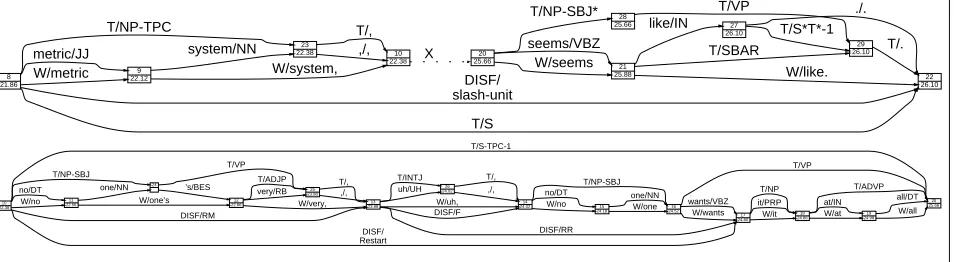
in some annotations, and measure the extent of referen-tial consistency among the diverse annotations. Finally, we describe how the application of annotation graph structure to the various derivative data sets provides a powerful and flexible means for comparing and integrating their contents.
2.
The Switchboard Corpus
Switchboard-1, the first large collection of spontaneous conversational speech over the telephone, was collected in 1990 by Texas Instruments (TI) (Godfrey et al., 1992). The current published corpus comprises 2438 calls involving 520 native speakers of American English, recruited from all over the United States. The calls range between five and ten minutes in length, and each call contains a unique pairing of speakers. Individual speakers are designated by identification numbers, and information is provided as to their gender, age, education and dialect region. On average, each speaker appears in about nine calls (the range of calls per speaker varies between 1 and 32).
The speech data for each call is provided in the form of a two channel interleaved sample file; the two channels, des-ignated “A” and “B”, represent the mu-law encoded signal received from the telephone handsets of the two speakers participating in the call.
2.1. Initial transcription
TI created an initial set of manual transcripts, employ-ing professionally trained transcribers equipped with ana-log tape copies of the sample files. These transcripts were then submitted to an automatic speech recognition (ASR) process to establish approximate time alignments at the word level.
for each turn in the dialog, but no time annotations; (2) the time-aligned version of the text, with one word token per line, accompanied by the speaker designation, and the beginning time and duration of the word. The transcript release also included documentation and tables describing the corpus content.
Given the size, complexity and novelty of this effort, a variety of problems affected the first release of the corpus by the LDC:
In about 200 calls, the transcribers had made mistakes
in assigning the speaker labels (“A” or “B”) to some or all of the turns in the transcripts. Because the speaker label is intended to represent the signal channel in the speech file, an error in the speaker label would direct the corpus user to the wrong channel when retrieving the audio data for a given turn in the dialog.
Other more typical kinds of errors, involving
misper-ceptions by transcribers about what was said, presum-ably affected nearly all files, but only to a very small degree.
The ASR word alignment was applied to a
single-channel (combined) version of the speech data, and so was not affected by speaker label errors, but it was rel-atively ineffective in regions where turns overlapped in time, and where the transcript contained omissions, additions or substitutions of words relative to what had been spoken.
In about 30 calls, the two forms of transcript data did
not match up in terms of the number of speaker turns present in the dialog.
For about 30 additional calls, some or all of the
tran-script data were absent from the publication, because the text files were missing, incomplete or corrupted due to errors in preparing the publication.
In 1994, the LDC released an “interim” version of the transcripts, fixing all cases of the last two types of prob-lems, and about one quarter of the files containing known speaker-label errors (particularly, those files where the la-bel errors were limited to small portions of the transcript). The remaining speaker-label problems were documented as well as possible, but were not fixed, nor was any attempt made to correct other transcription or time-alignment er-rors.
2.2. Subsequent annotations
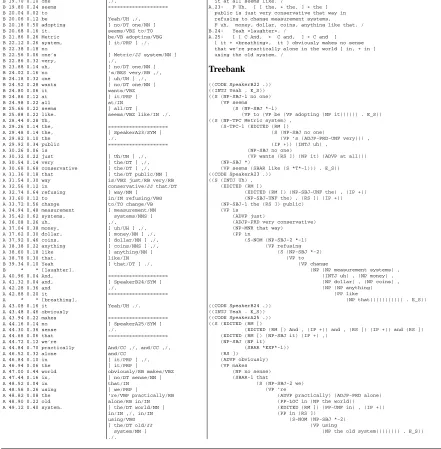
Since the initial release of SWB transcripts, a number of research sites have used this data, either with or without reference to the speech, as input to a range of divergent annotation projects. These are briefly described below, in roughly chronological order. Some of the resulting annota-tions are displayed in Figure 1.
Phrase-level time stamps (BBN)
The first application of SWB data for research in large vocabulary conversational speech recognition was in con-junction with the DARPA LVCSR project. In preparation
for initial training on SWB, researchers at BBN created a modified version of the original TI transcripts, and circu-lated this among the LVCSR participants. The modification involved forming time-stamped “phrasal” regions from the word-level time-aligned transcripts, and assigning a unique identifier to each region. This produced a segmentation of the dialogs that differed from the turn units created by the original transcribers: a single time-stamped phrase might encompass parts of two consecutive turns, if the original transcriber had broken up the phrase in order to insert an in-terruption by the other speaker; also, multiple time-stamped phrases might be derived from a single turn, if that turn was considered too long for reliable ASR processing. The speaker-label errors mentioned above were not repaired in this process (though a list of affected files was circulated among LVCSR participants). This form of the transcripts has never been made available through the LDC.
Disfluency annotation (Penn Treebank Project)
As a preliminary step to prepare for Treebank annota-tion, 650 transcript files were selected from the LDC “in-terim” release and annotated for various types of disfluency that occurred in the spontaneous speech. This annotation was essentially text-based, relying entirely on the represen-tation of disfluencies in the (non-time-aligned) transcripts (see Figure 1). The objective was to tag hesitations, stutters, word fragments, restarts, and a limited class of discourse markers, since these elements in the transcripts would con-stitute exceptions or barriers to syntactic analysis. These annotations are included in the current “Treebank 3” cor-pus, available from the LDC.
POS-tagging, parsing (Penn Treebank Project)
Building on the output of the disfluency annotations, the Penn Treebank Project applied part-of-speech tagging and syntactic parsing to the 650 files that had been selected (see Figure 1). In the course of this annotation, a small num-ber of corrections were made to the text data, consisting mostly of repairs to punctuation and replacements of some incorrect words. Again, this annotation was done without reference to the audio data. It is currently available as the “Treebank 3” corpus.
Discourse annotation (Univ. of Colorado, SRI)
This annotation project set out to “model the speech act type of each utterance” and “model sociolinguistic facts about conversation structure...” (Jurafsky et al., 1997) It builds on the disfluency annotation mentioned above, us-ing the same conceptual basis for segmentus-ing dialog turns into phrases (“utterances”) that are cohesive in terms of the speech acts being performed. An exhaustive segmentation of such utterances was carried out on 1155 conversations, and each utterance was categorized as to speech act or dis-course function. All 650 files covered by the Treebank Project are included in this set. The data is available di-rectly from the University of Colorado (Jurafsky, 1997).
Phonetic transcription (ICSI)
the transcription data, applying a new speech transcription tool developed at ISIP with particular attention to locating known types of problems and avoiding known pitfalls in this type of annotation effort. By the time this project be-gan, the SWB calls that had previously been held back as test data had been used over the course of several bench-mark tests in the LVCSR project, and were now available for publication. The current release of SWB speech and transcript data now comprises 2438 calls. By agreement with the LDC, ISIP has made the complete set of SWB tran-scripts freely available on their web site (Mantha, 2000).
2.3. Rectification and Integration
With the completion of the ISIP review of SWB tran-scripts, it is now possible to assess the impact of transcrip-tion errors on the various divergent annotatranscrip-tions. As an ini-tial step to check for the magnitude of errors involving lex-ical content, we treated the LDC “interim” transcripts as a test set to be measured for error rates, using the ISIP tran-scripts as the reference text. Comparable versions of the two data sets were constructed by aligning the phrase-level ISIP time marks with the original TI word-level time marks, and the NIST scoring tool “SCLite” was used to calculate insertions, deletions and substitutions. The results are sum-marized in table 1.1 It should be noted that word fragments
and non-lexical tokens (e.g. “uh-hum” vs. “uh-huh”) ac-counted for roughly 30% (over 19,000) of the substitution errors, and about 21% (nearly 34,000) of the insertion and deletion errors.
Units Status K % Per-file % range
phrases correct 136 55.1
w/errors 111 44.9 7.6 - 90.9 words correct 2895 94.8 77.4 - 99.5
accuracy 92.8
all errors 220 7.2 0.8 - 27.9
substit. 63 2.1 0.0 - 14.5
deleted 95 3.1 0.3 - 15.5
inserted 63 2.0 0.0 - 21.0
Table 1: Summary of word errors in LDC “interim” tran-scripts
The comparison of ICSI annotations to the other ver-sions of SWB transcripts is somewhat more problematic. ICSI transcribers made corrections to the lexical content in accordance with their more detailed attention to the ac-tual pronunciation of phrases, but they used different con-ventions regarding word hyphenation and disfluencies, and occasionally inserted annotations for non-linguistic events (e.g. “breath”, “mouthnoise”, etc.) without the intended markup to distinguish these from lexical tokens. Still, we can estimate the upper bound on the number of corrections imposed by ICSI, again using the NIST SCLite scoring method. In this case, the LDC transcripts contained 96% of the words in the 3.5 hours of ICSI word-level data – there
1
LDC files that still contained speaker/channel labeling errors over some or all of their transcripts were not included in this scoring.
were, at most, 2% omissions and 2% substitutions in the LDC transcripts.
ICSI’s use of the BBN phrasal time marks as the basis of phrase selection creates some additional difficulties:
Correlation with original TI word-level time marks
is imperfect at best; insertion errors predominated in scoring the LDC transcripts (6.2%, three times more than deletions or substitutions), yielding an overall word accuracy of 89.2%. This was due mostly to dis-crepancies at phrase boundaries.
Some of the BBN “phrase boundaries” occur at
impractical positions within syllables, causing some boundary tokens to be interpreted differently.
Until a reliable word-level time marking is done for
the ISIP transcripts, there will be no reasonable way to align the ICSI and ISIP annotations, due to significant differences in phrase segmentation.
Overall, these tabulations indicate that the lexical accu-racy of the original TI transcripts was quite high, and the impact of word errors on downstream annotations, partic-ularly the Treebank and discourse data, may be considered negligible.
A major challenge remains, however, in terms of inte-grating the various annotations. All three versions of time-marked transcripts (LDC “interim”, ICSI and ISIP) assign unique identifiers to each turn or phrase unit, but each set has a distinct inventory of units that cannot, as yet, be cross-referenced to the other two sets in any reliable way. The only stable point of reference is the audio data, and the use of time offsets into the speech files.
3.
The TDT Corpora
The design and content of the TDT corpora are de-scribed in other presentations at LREC-2000 (Wayne, 2000; Cieri et al., 2000). The present discussion will focus on the range of distinct annotations applied to the data, the rela-tionships among them, and the problems involved in coor-dinating them.
3.1. Multiple data streams from audio and text sources
represents only what the speaker intended to say, and omits filled pauses, false starts, stutters, and the like. On the basis of this one source, then, it is possible to estimate a base-line of “word error rate” for closed-caption text, which can be useful when assessing other sources for which only the closed-captions are available.
The radio sources in TDT did not have publicly avail-able transcripts, and four different transcription services were enlisted to transcribe these programs as part of the corpus creation effort (one for all TDT Mandarin data, one for TDT3 English, and two others for TDT2 English). The services varied in terms of the quality of transcripts deliv-ered, with one of the TDT2 English services having been poorest.
In addition to manual transcription, all audio sources were submitted to unguided ASR, to establish a benchmark of TDT system performance given this quality of text as input. The TDT2 English data was submitted to two differ-ent English-based ASR systems; of course, in the absence of fully accurate manual transcriptions for most of this ma-terial, it remains difficult to compare their performance in terms of word error rate.
For all Mandarin sources, both newswire text and radio transcripts, additional data streams were produced by run-ning the data through a Chinese-to-English machine trans-lation system (SYSTRAN), with no manual guidance or re-vision of the system output. For audio data, both the manual and ASR transcriptions were translated in this way. Again, this was intended to set a benchmark for cross-lingual TDT performance given this quality of input.
As a result, most data sources were represented by at least two parallel, independent data streams – a couple of sources had three or four streams – each with its own pe-culiar properties and token sequence. The stable points of reference across all streams were the boundaries between news stories, and in the case of audio sources, the time off-sets of those boundaries in the speech data.
3.2. Creating and tracking multiple annotations A relational database was used to track the main stages of data creation and TDT-specific annotations. The basic units of the corpus are the sample file and the topical story unit. For audio sources, an entry was created each time a recording process was scheduled; the entry was updated at the conclusion of the recording, updated again after manual inspection to determine whether the recording was success-ful, and again after manual segmentation of the 30- or 60-minute file into story and non-news segments. This done, each story was assigned a unique identifier, which included the source, date, broadcast start time, and time offset within the file at the start of the story, and these identifiers were en-tered into the database to guide the topic annotation. (The equivalent stages for newswire data were fully automated to prepare the stream or bulk archive text data for topic an-notation.)
During the main topic annotation phase, in which ev-ery story had to be read some minimum number of times to assess it against all selected TDT topics, annotators also had to decide whether a given story was flawed in any of four ways, making it unsuitable for topic labeling. In the
newswire data, a reported flaw would typically result in the removal of a story from the corpus, but for broadcast data, a flaw would generally be the result of a mistake during the manual story segmentation phase. Broadcast stories could not simply be discarded, as this would create gaps in the coverage of the continuous audio signal – segmentation er-rors needed to be fixed, and this would affect the inventory of news stories in the file, and/or the locations of bound-aries (hence the identification numbers assigned to the sto-ries would change, as well).
A further complication was the need in TDT3 to sup-port alternative methods of topic annotation while the main annotation was still in progress. These alternative forms of labeling – first-story detection and story-link detection – were not actively tied into the database management of the main topic annotation; rather, they used a snap-shot of the corpus, taken as late and as carefully as possible dur-ing the main annotation. Fortunately, they would involve only a subset of the full TDT3 corpus, so it was possible to avoid particular files or stories where problems had been observed, and still provide an adequate sample. Despite our best efforts, some of the results of these alternate anno-tations could not be used in the final delivery of the corpus, because the stories to which they applied had been altered or removed in the course of repairs prompted by the main annotation; in particular, 0.5% of the 21,600 story link an-notations were discarded because a number of stories had been eliminated from the corpus.
Additional uses of TDT data have already begun, spurring new annotations that were not part of the original corpus design. In order to establish a better estimate of ASR performance on this data set, NIST selected a random sample of 530 individual news stories from the TDT2 English corpus, totaling 10 hours of speech. The LDC adapted the text for these stories to the Hub-4 transcription specifications for broadcast news, and carefully went over each story, adding in the missing words and disfluencies, correcting spelling errors (common in closed-caption text), and adding time stamps to break long turns by news announcers into manageable phrases. This 10-hour set of careful transcription is now available from the LDC.
Other directions for annotation of TDT have included the identification of named entities, in support of the TREC project and related research, and the identification of new information across a sequence of stories on a given topic.
5.
Conclusion
We have presented an overview of two large speech cor-pora, both of which have received a wide range of divergent and independent annotations. For Switchboard, we have discussed some details about the comparability and com-patibility of the various annotations, and have presented an analysis framework that will enable a high degree of in-tegration among them, in terms of both maintenance and research use. The case of TDT demonstrates that even with a centralized corpus creation effort, there can still be prob-lems with handling data repairs and consistency when dis-tinct sets of annotation must be carried out simultaneously. Both corpora present the need to accommodate sparse an-notations in a manner that does not sacrifice the overall co-herence of the larger corpus. Annotation graphs provide an effective framework for meeting this need.
6.
References
Bird, S. and M. Liberman, 1999a. A Formal Frame-work for Linguistic Annotation. Technical Report MS-CIS-99-01, Department of Computer and Informa-tion Science, University of Pennsylvania. (Available at http://morph.ldc.upenn.edu/Papers/).
Bird, S. and M. Liberman, 1999b. Annotation graphs as a framework for multidimensional linguistic data anal-ysis. Towards Standards and Tools for Discourse Tag-ging – Proceedings of the Workshop, Association for Computational Linguistics. Somerset, NJ. (Available at http://morph.ldc.upenn.edu/Papers/).
Cieri, C., D. Graff, M. Liberman, N. Martey, S. Strassel, 2000. The TDT-2 Text and Speech Corpus. Proceedings of LREC-2000.
The Center for Language and Speech Processing. FTP server for Summer Workshops at Johns Hopkins Univer-sity. http://www.clsp.jhu.edu/.
Godfrey, J., E. Holliman and J. McDaniel, 1992. SWITCH-BOARD: Telephone speech corpus for research and de-velopment. Proceedings of ICASSP-92, pp. 517–520. San Francisco.
Greenberg, S., 1999. Switchboard Transcription Project. http://www.icsi.berkeley.edu/real/stp/.
Jurafsky, D., 1997. Web page for the 1997 CLSP/JHU Summer Workshop. http://www.Colorado.EDU/linguis-tics/jurafsky/ws97/.
Jurafsky, D., L. Shriberg, D. Biasca, 1997. Switch-board SWBD-DAMSL Shallow-Discourse-Function Annotation. http://stripe.colorado.edu/˜jurafsky/man-ual.august1.html.
Mantha, V. , 2000. Switchboard Resegmentation Project. http://www.isip.msstate.edu/projects/switchboard/. Wayne, C. L., 2000. Multilingual Topic Detection and