ItalWordNet: a Large Semantic Database for Italian
Adriana Roventini*, Antonietta Alonge**, Nicoletta Calzolari***
Istituto di Linguistica Computazionale, CNRArea della Ricerca di Pisa Via Alfieri 1, Loc. S. Cataldo Ghezzano 56010 (PI) – ITALY
* [email protected], ** [email protected], *** [email protected]
Bernardo Magnini
Istituto per la Ricerca Scientifica e Tecnologica I-38050, Povo, Trento
Francesca Bertagna
Consorzio Pisa RicercheVia S. Maria 40 Pisa 56100 - ITALY [email protected]
Abstract
The focus of this paper is on the work we are carrying out to develop a large semantic database within an Italian national project, SI-TAL, aiming at realizing a set of integrated (compatible) resources and tools for the automatic processing of the Italian language. Within SI-TAL, ItalWordNet is the reference lexical resource which will contain information related to about 130,000 word senses grouped into synsets. This lexical database is not being created ex novo, but extending and revising the Italian lexical wordnet built in the framework of the EuroWordNet project. In this paper we firstly describe how the lexical coverage of our wordnet is being extended by adding adjectives, adverbs and proper nouns, plus a terminological subset belonging to the economic and financial domain. The relevant changes involved by these extensions both in the linguistic model and in the data structure are then illustrated. In particular we discuss i) the new semantic relations identified to encode information on adjectives and adverbs ii) the new architecture including the terminological subset.
1.
Introduction
Since the Princeton WordNet database, a semantic network in which the meanings of words are represented in terms of their conceptual-semantic and lexical relations to other words (Miller et al., 1990), has become available it has been the tool of choice for researchers aiming at building Natural Language Processing (NLP) systems of various kinds, mainly because that resource contains information which is necessary for a fundamental task of various applications, i.e. for Word Sense Disambiguation (WSD). However, WordNet was not designed to meet the requirements of NLP, so it has become clear that it lacks some information which could be very useful for a variety of applications (cf. Gonzalo et al., 1998).
The main goal of the EuroWordNet (EWN) project1 was thus to develop a (multilingual) lexical resource,
1
EWN was a project in the EC Language Engineering (LE4003) programme. In a first phase, the partners involved were the University of Amsterdam (coordinator); the Istituto di Linguistica Computazionale, CNR, Pisa; the Fundacíon Universidad Empresa (a cooperation of UNED, Madrid, Politecnica de Catalunya, Barcelona, and the University of Barcelona); the University of Sheffield; and Novell Linguistic Development (Antwerp), changed to Lernout & Hauspie during
retaining the basic underlying design of WordNet (in particular, of the database version WordNet 1.5, hereafter WN1.5) while at the same time trying to improve it in order to answer the needs of research in the computational field. Thus, a fundamental change made in EWN was that the set of lexical relations to be encoded between word meanings was extended or modified in various ways with respect to the set defined in WN 1.5.
Within EWN semantic information was encoded, for about 50,000 word senses (nouns and verbs) in each of the languages dealt with, in the form of lexical semantic relations between synsets (i.e. synonym sets). A rich framework of relations was designed which were considered useful for computational applications. In any case, synonymy and hyponymy were extensively encoded in the wordnets produced, while, due to time limits, the more ‘sophisticated’ relations were encoded for selected sets of words in each wordnet.
PAROLE entries EWN entries Intersection Subset EWN only PAROLE only
Nouns Nouns Nouns Nouns Nouns
13257 24416 11377 ( 85.82%) 13039 1880
Verbs Verbs Verbs Verbs Verbs
3090 6578 2868 (92.82%) 3710 222
Table 1: Comparison between EWN and PAROLE
Moreover, within EWN we did not deal with adjectives and encoded only a few proper nouns, while, of course, in order to be able to use our resource for WSD8 or other tasks, we had to add them in IWN. So, we firstly identified a set of adjectives to be encoded in our database and chose some adverbs (those derived by adjectives by means of the suffix –mente) to be added too. Then, given the high incidence/frequence of proper nouns not only within the TAL corpus but in whatever other corpus/text, we considered as an useful extension the introduction of a few types of proper nouns, in particular those which have common nouns as derivatives. According to this criterion of derivational productivity, we are introducing in IWN a set of istances belonging to both the geografic and human domains.
As far as the adjectives are concerned, we selected from the DMI about 17,000 senses already partially encoded by means of numeric codes which individuate different types of definitions such as the synonymical or the functional type (Calzolari, Ceccotti & Roventini, 1983). This cluster has been the starting point of our analysis for the linguistic model of this class (see the following subsection). Below we show a few examples of the definitions encoding we benefit when acquiring this class and defining for it the new semantic relations. In the examples a) and b) we have two synonymical definitions in which the antonym(s) is (are) also indicated (signalled by C.=); in the examples c) and d) we have two functional definitions in which, the defining formula “atto a”, points out the regular semantic relation that the suffix –ivo establishes between a large group of verbs and the derived adjectives.
a) Balsamico (balsamic): odoroso (fragrant), salubre (healing) C.= fetido (foetid, stinking), malsano (unhealthy)
b) Benevolo (benevolent): benigno (well-disposed), affabile (affable) C.= malevolo (malevolent)
c) Disgiuntivo (disjunctive): atto a (suitable for) disgiungere (to disjoin)
d) Elogiativo (laudatory): atto a (suitable for) elogiare (to praise)
In addition to the DMI definitions, the contexts of the most frequent adjectives occurring in the TAL corpus have been analysed. This preliminary study of the information contained in both the dictionary
8
As said above, within SI-TAL IWN is the reference lexical resource and, in this framework, it is used mostly for the corpus semantic annotation. Since in the SI-TAL corpus we find 3.370 adjectival lemmas which are not encoded in EWN, and 43,80% of the nouns found are proper nouns we needed to deal with the issue of properly encoding both adjectives and proper nouns in IWN.
definitions and the corpus contexts made it possible to individuate a few Base Concepts for the adjectives, following the same criterion used for nouns and verbs in the EWN framework: i) high number of relations with other dictionary entries, ii) high usage frequency9
. As the nouns and verbs Base Concepts, the most frequently used adjectives are characterised by generic meaning and high degree of polisemy. Moreover, they show aptitude to combine with various types of nouns. These, together with the adjectives showing a considerable number of hyponyms, will be the Base Concepts of this class.
3.2 Lexical-semantic relations being encoded
The basic notion around which the IWN database is built is the same around which both WN and EWN were built, i.e. that of a synset, or set of synonymous words with the same Part-of-Speech (PoS) that can be interchanged in a certain context. Then, the network is mainly based on the hyponymy (or IS-A) relation, but various other relations can be encoded, partly inherited from EWN, to better describe the semantics of words.
Whereas in WN1.5 a rigid distinction is drawn among different PoSs and each PoS forms a separate system of language-internal relations, following EWN in IWN various relations applying between different PoSs can be encoded. Indeed, instead of separating the networks on the basis of their PoSs, traditionally identified by using a mixture of morphological, syntactic and semantic criteria, a distinction is drawn among the semantic orders of the entities to which word meanings refer (cf. Lyons, 1977): 1st order entities (referred to by concrete nouns), 2nd order entities (referred to by verbs, adjectives or nouns indicating properties, states, processes or events), and 3rd order entities (referred to by abstract nouns indicating propositions existing independently of time and space).10 This allows to establish cross-PoS relations between words of the same semantic order referring to similar concepts (e.g., cross-PoS synonymy between arrival and to arrive, etc.), but also other cross-PoS relations which emphasize the language-specific lexicalisation patterns of semantic components. Table 2 provides a list of the main relations defined in EWN which are also encoded in IWN.
9
Within EWN a common set of so-called Base Concepts were defined for nouns and verbs and used as a starting point by all the sites to develop the cores of the wordnets. Base Concepts are meanings that play a major role in the wordnets.
10
Relation Semantic orders linked Example
NEAR_SYNONYM 1st/1st, 2nd/2nd, 3rd/3rd tools/instrument; to bear witness/to assure
XPOS_NEAR_SYNONYM 2nd/2nd arrival/to arrive
ANTONYM 1st/1st, 2nd/2nd, 3rd/3 inside/outside; arrival/departure; low/high
XPOS_ANTONYM 2nd/2nd arrival/to leave
HAS_HYPERONYM/HAS_HYPONYM 1st/1st, 2nd/2nd, 3rd/3 dog/animal; to arrive/to go
XPOS_HAS_HYPERONYM/HYPONYM 2nd/2nd arrival/to go
HAS_HOLONYM/HAS_MERONYM 1st/1st arm/body; hand/finger
CAUSES/IS_CAUSED_BY 2nd/2nd to kill/to die; to execute/death sentence
HAS_SUBEVENT/IS_SUBEVENT_OF 2nd/2nd to buy/to pay; to snore/to sleep
INVOLVED/ROLE 2nd/1st or 3rd and viceversa to hammer/hammer; to enter/inside
CO_ROLE 1st/1st guitar player/guitar
BE_IN_STATE/STATE_OF 1st/2nd and viceversa poor (N)/poor (Adj)
IN_MANNER/IS_MANNER_FOR 2nd/2nd (Adv) to whisper/in a low voice
HAS_INSTANCE/BELONGS_TO_CLASS 1st/1st (proper noun) river/Thames
DERIVATION All (between lexical units) presidential/president
Table 2: Main IWN relations inherited from EWN
Note that some of these relations can be further specified (e.g., the verb uscire – to go out – may be linked to the noun esterno – outside – by means of an
INVOLVED_ TARGET_DIRECTION relation). Moreover, some labels may be added to certain relations to make clear some implications that they may carry: conjunction and disjunction (for multiple relations of the same kind encoded for a synset); non-factivity (to indicate that a causal relation does not necessarily hold); intention (added to a cause relation to indicate intention to cause a certain result); negation (to explicitly encode the impossibility of a relation occurring); reversed (automatically added by the tool to reversals of not conceptually bi-directional relations).11
Within IWN we have further enriched the set of relations which can be encoded, mainly to account for adjectives and adverbs (which were not dealt with in EWN), but also to encode certain relations more properly. For instance, within EWN a whole family of ‘causal’ relations was identified:
a) to kill RESULTS_IN to die
b) to search FOR_PURPOSE_OF tofind
c) vision ENABLES_TO to see
d) heat IS_MEANS_FOR to distill
However, given the granularity of such distinctions and the time limits of the project, an underspecified CAUSE
relation, together with labels indicating particular implications, was actually used in EWN to encode all these links. In IWN, we have instead decided to encode (a), (b) and (d) relations above as sub-classes of the underspecified CAUSE relation, due to their prominence, while we shall not use (c) relation, since it only applies between a very limited number of synset pairs.
Much work has then been devoted at identifying a set of relations to be used to encode data on adjectives, since within EWN no analysis had been carried out on this topic.
11
We are not going into the details of all the EWN relations here. For a complete discussion of them see Alonge et al. (1998).
In WN the possibility of encoding hyponymy for adjectives is denied and the basic relation encoded for adjectives is antonymy. Within IWN we have reconsidered the possibility of encoding hyponymy for adjectives, given the important inferences which can be drawn on the basis of this relation. By analysing data coming from machine-readable dictionaries (in particular from the DMI) we find subsets of adjectives which have a genus + differentia definition, like nouns or verbs. That is, these adjectives seem to be organised into classes sharing a superordinate. Here below some examples are provided:
albino (whitish): affetto da albinismo (suffering from albinism) acneico (acned): affetto da acne (suffering from acne)
acquoso (watery): contenente acqua (containing water) alcalino (alkaline): contenente alcali (containing alkalis)
filoso (thready): pieno di fili (full of threads) stellato (starry): pieno di stelle (full of stars).
We have decided, therefore, to encode hyponymy also for these sets of adjectives. The IS-A taxonomies which can be built are different from those built for nouns or verbs, since they are generally rather flat, consisting almost always of two levels only (an exception is, e.g., the color adjectives taxonomy). However, by encoding hyponymy for these adjectives, we obtain classes for which it will be possible to make various inferences. For instance, it will be possible to infer semantic preferences of certain classes: e.g., all the adjectives occurring in the taxonomy of affetto above will modify nouns referring to animate entities; the contenente hyponyms will occur as attributes of concrete nouns; etc. Furthermore, it will also be possible to infer information on syntactic characteristics of adjectives found in the same taxonomy: e.g., the hyponyms of atto (suitable for) are always found in predicative position (and do not accept any complements); the hyponyms of privo (lacking) may occur both in attributive and in predicative position (and may take certain prepositional complements), etc..
Relation Semantic Orders Linked Examples
COMPL_ANTONYM 1°/1°, 2°/2°, 3°/3 alive/dead
GRAD_ANTONYM 1°/1°, 2°/2°, 3°/3 cold/hot
RESULTS_IN/IS_RESULT_OF 2°/2° to kill/to die
FOR_PURPOSE_OF/IS_PURPOSE_OF 2°/2° to search/to find
IS_MEANS_FOR/HAS_MEANS 2°/2° heat/to distill
LIABLE_TO/HAS_LIABILITY 2°/2° triable/to judge
PERTAINS_TO/HAS_PERTAINED 2°/1° and viceversa atomic/atom
IS_A_VALUE_OF/HAS_VALUE 2°/2° tall/stature
Table 3: New relations being encoded in IWN
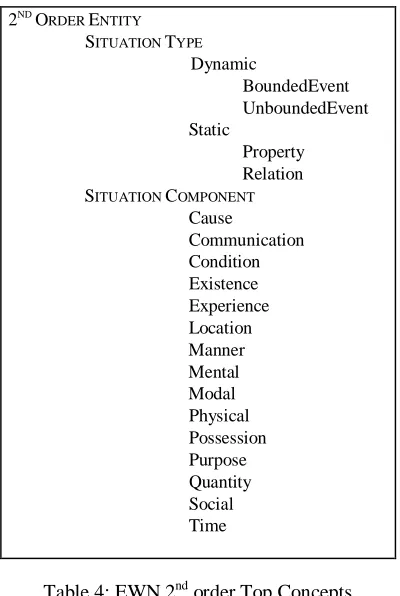
2NDORDER ENTITY SITUATION TYPE
Dynamic
BoundedEvent UnboundedEvent Static
Property Relation
SITUATION COMPONENT
Cause
Communication Condition Existence Experience Location Manner Mental Modal Physical Possession Purpose Quantity Social Time
Table 4: EWN 2nd order Top Concepts
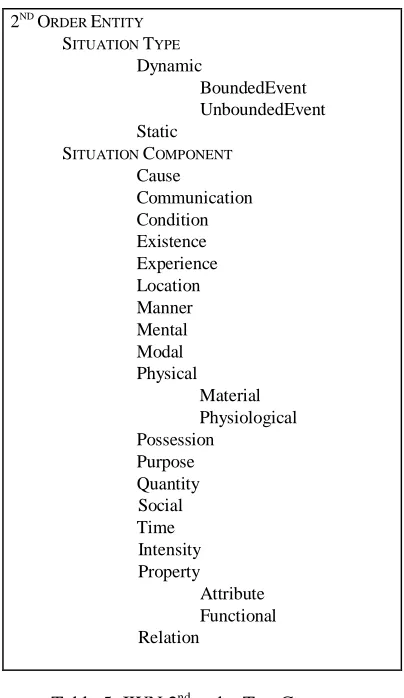
In order to be able to draw generalizations also on adjective meanings by using the TO, we partially modified this scheme. First of all, we moved the PROPERTY and RELATION nodes under the SITUATION COMPONENT node.
This was done for two interconnected reasons: first of all because this distinction is not directly linked to Aktionsart (lexical aspect), while the distinctions under SITUATION TYPE are Aktionsart distinctions, i.e. they are connected with the “the procedural characteristics (i.e. the ‘phasal structure’, ‘time extension’ and ‘manner of development’) ascribed to any given situation referred to by a verb phrase” (Bache, 1982:70)15. Secondly, adjectives may refer to PROPERTIES or RELATIONS, but they may be either
stative or not (cfr. e.g. Lakoff, 1966; Quirk et al., 1985; Peters, Peters & Gaizauskas, 1999). Thus, in our system it has to be possible to specify e.g. that an adjective expresses a PROPERTY while being DYNAMIC. In any case, since many adjectives may have both a DYNAMIC sense
15
Of course, all 2nd order entities (and therefore also nouns or adjectives) can be classified according to their Aktionsart.
and a STATIC one, we have also the possibility to under-specify this information by linking adjectives directly to the SITUATION TYPE node.
Adjectives may indicate many different types of properties: temporal (passeggiata mattutina - morning walk), psychological (canzone triste - sad song), social (uomo ricco rich man), physical (superficie legnosa -wooden surface), physiological (bambino magro - thin child), perceptive (minestra calda - hot soup), quantitative (magra ricompensa - poor reward) and intensity properties (vino forte - strong wine). In the EWN TO there are already nodes which may be used to represent these distinctions (TIME, MENTAL, SOCIAL, PHYSICAL,
QUANTITY) but we needed to better specify or also add
some features. For example, we have added, under the already present node PHYSICAL, the node MATERIAL, to
represent, among others, some Italian adjectives ending in –oso (for example legnoso - wooden, acquoso - watery) which indicate the property of containing a certain material. Moreover, we added the node PHYSIOLOGICAL
(to classify adjectives corresponding to tired, hungry, sick, etc.) under PHYSICAL. For adjectives denoting intensity,
we then added the node INTENSITY directly under the
SITUATION COMPONENT node.
One of the main problem we had was that no Top Concept in the EWN TO could be used to classify reference-modifying adjectives (cf. Bolinger, 1967; Chierchia & McConnel-Ginet, 1990 name them intensional adjectives): i.e. adjectives like former, future, present. These are a very particular kind of adjectives, because they do not indicate a property of the referent of the noun they modify. So, aiming at showing the distinction between referent-modifiers and reference-modifiers, we created two new Top Concepts under the node PROPERTY: ATTRIBUTE and FUNCTIONAL, where the latter can be used for reference-modifying adjectives.
A particular case of functional adjectives are the ‘argumental’ ones. They introduce a comparison between different entities (e.g., simile - similar, diverso - different, etc.). A comparison presupposes a relation so these adjectives can be linked to both PROPERTY and RELATION. Since in the EWN TO these two Top Concepts were two different kinds of SITUATION TYPE, they were mutually exclusive; now, in the IWN revised TO they can be conjoined.
Chierchia, G. & McConnel-Ginet S., 1990. An Introduction to Semantics. Cambridge, The MIT Press. Cruse, D. A., 1986. Lexical Semantics. Cambridge,
Cambridge University Press.
Dixon, R. M. W., 1991. A new Approach to English Grammar on Semantic Principles. Oxford, Clarendon Press.
Gonzalo, J., Verdejo F., Peters C., Calzolari N., 1998. Applying EuroWordNet to Cross-Language Text Retrieval. In: Ide N., Greenstein D., Vossen P. (eds.), Special Issue on EuroWordNet. Computers and the Humanities, Vol. 32, Nos. 2-3, 185-207.
Hirst, G. & St-Onge D., 1998. Lexical Chains as Representations of Context for the Detection and Correction of Malapropisms. In Fellbaum, C. (ed.) WordNet, An Electronic Lexical Database. Cambridge, The MIT Press.
Lakoff, G., 1966. Stative Adjectives and Verbs in English. Computation Laboratory, Harvard University Report No. NSF-17.
Lyons, J., 1977. Semantics. London, Cambridge University Press.
Miller, G., Beckwith R., Fellbaum C., Gross D., Miller K.J., 1990. Introduction to WordNet: An On-line Lexical Database. International Journal of
Lexicography, Vol.3, No.4, 235-244.
Peters, I., Peters W. and Gaizauskas R., 1999. The Representation of Adjectives in SIMPLE. Ms.
Quirk, R., Greenbaum S., Leech G. Svartvik J., 1985. A Comprehensive Grammar of the English Language. London, Longman.
Rodriguez H., Climent S., Vossen P., Bloksma L., Roventini A., Bertagna F., Alonge A., Peters W., 1998. The Top-Down Strategy for Building EuroWordNet: Vocabulary Coverage, Base Concepts and Top Ontology. In: Ide N., Greenstein D., Vossen P. (eds.), Special Issue on EuroWordNet. Computers and the Humanities, Vol. 32, 2-3, 117-152.
Roventini, A., Calzolari N., Peters C., Bertagna F., 1998. Building a Semantic Network for Italian Using Existing Lexical Resources. In: Antonio Rubio et al. (eds.), First International Conference on Language Resources & Evaluation Proceedings, Granada 28-30, 377- 383. Sanfilippo, A., Calzolari N., Ananiadou S., Gaizauskas R.,
Saint-Dizier P., Vossen P. (eds.), 1999. Preliminary Recommendations on Lexical Semantic Encoding. EAGLES LE3-4244 Final Report.
Vossen, P. (ed.), 1999. EuroWordNet General Document,