Information Extraction from Text Corpora: Using Filters on Collocation Sets
Gerhard Heyer, Uwe Quasthoff, Christian Wolff
Leipzig University
Computer Science Institute, NLP Dept. Augustusplatz 10/11
04109 Leipzig, Germany
{heyer, quasthoff, wolff}@informatik.uni-leipzig.de
Abstract
This paper describes the application of filtering techniques to collocation sets calculated for very large text corpora. Additional infor-mation like patterns, grammatical inforinfor-mation, subject areas and numerical values associated with the collocations are used to identify collocations with given semantic structure. Various examples and different techniques for applying such filters are described. We also give several examples of practical applications for this type of information extraction.
1.
Introduction
Within he last years we have been developing an infra-structure for the analysis of large text corpora of different Indo-European languages, following an integrated ap-proach which combines corpus data with lexicographic information like linguistic categories or semantic attrib-utes. We have studied various approaches towards infor-mation extraction from text corpora to be used for aca-demic as well as industrial applications in domains like knowledge management, ontology engineering or infor-mation retrieval. Among them, one of the most powerful is the calculation and further analysis of collocation sets for all concepts identified in a text corpus. While the gen-eral setup of our corpus analysis infrastructure has already been presented, in this paper we want to concentrate on information extraction using different types of filters.
For tests and examples we used the German and Eng-lish corpora of more than 10 million of sentences each. Both the corpora and the collocations can be found at
http://wortschatz.uni-leipzig.de.
2.
Collocation sets as unstructured
informa-tion pools
In this paper, the term collocation means a pair of words (or multi word terms) which appear significantly often within a given text window. The two kinds of windows we are exploring are the sentence and immediate (left or right) neighborhood. The collocations found depend on the statistics for the calculation of the significance. For the calculations in this paper, we use a Poisson measure (see Chung 2000) which gives similar results to the well known Log-likelihood measure (Krenn 00) but can be shown to have some nice mathematical properties justify-ing the name measure (cf. Heyer et al. 01). The filterjustify-ing methods described below do not depend on the method used for calculating the collocations, though. Usually, collocations are given together with a significance value.
Given a large text corpus, collocations for all concepts may be calculated suing highly efficient software tools (see Heyer, Quasthoff, Wolff 00). The resulting colloca-tion sets may easily be interpreted by humans, but they are hardly apt for further automatic processing, as colloca-tions represent different types of relacolloca-tions between con-cepts: They may be interpreted using syntactic as well as semantic categories and with respect to the direction of
analysis, different sets of relation types may be applied. In the following example the set of sentence-based colloca-tions for the German word Zylinder is given:
Frack (217), Kolben (113), Gehrock (71), Ventile (58), Hubraum (48), Motor (43), Kaninchen (42), PS (39), Ke-gel (32), Kolbens (28), Luft (27), schwarzen (27), Frischgase (26), Kubus (25), schwarzem (25), Ein-spritzung (22), Quader (22), Ventil (22), Dampf (21), Kugel (20), Liter (18), Motorblock (18), Altgase (17), Auslaßventile (17), Würfel (17), Zylinders (17), bewegt (17), strömt (17), Spazierstock (16), rotierenden (16), An-saugen (15), Auslasskanal (15), Durchmesser (15), Luft-Kraftstoff-Gemisch (15), Ventilen (15), Grundformen (14), Konus (14), Kraftstoff (14), [...]
It can easily be seen that the basic fact of significant co-occurrence within a sentence can be interpreted in various ways: Concepts occurring in the collocation set identifying different meanings of “Zylinder” like “Frack” (tail-coat) or “Gehrock“(cutaway) hinting at the meaning of “Zylinder” as a type of hat worn on formal occasions; “Quader” (cuboid), “Kugel” (sphere), and “Würfel (cube) as in interpretation of “Zylinder” as a geometrical form; “Ventile” (valves), “Motor”, “Einspritzung” (injection) giving the interpretation of “Zylinder” as part of an en-gine.
1. Typical attributes of “Zylinder” like “schwarzem” (black) or “rotierendem” (rotating).
2. Typical verbs (i. e. activities or operations) associated with the concept (“bewegt” (moves). “strömt” (streams).
3. Part-of-relationships: “Zylinder” being part of the “Motorblock” (engine block) as well as the “Motor” 4. Co-Hyponymy-relationships for concepts having a
common broader term (i. e. concepts appearing as neighbours at the same level in a classification tree).
While these examples for the interpretation of colloca-tions are taking into account linguistic information as well as knowledge of the world, it is obvious that this kind of further analysis of collocation sets requires additional in-formation in order to be performed automatically.
differ-ent filtering methods as well as the analysis results to be obtained by their application.
3.
Filtering Methods
The general approach to analysing collocation sets is that of applying well-defined filters to a set of collocations aiming at the extraction of a pre-defined type of informa-tion. According to the type of filter applied to the colloca-tion set, the outcome may be interpreted in various ways. The following examples for filters only show some of the possibilities given with this approach:
1. Analysis of the numeric value of our collocation measure: The comparison of relative collocation strengths as well as its additivity property both may be used as filters.
2. Positional information and typical patterns for well-defined types of information like person names and ti-tles or company and product names can be applied as a filter.
3. Additional knowledge given by categorical and part-of-speech information: Given an additional dictionary in which information on possible syntactic categories for each concept in the corpus is stored, the typical adjectives (features) or verbs (operations, activities) associated with a concept may be filtered from the set of its collocations, given that the concept is a noun. Additionally, part-of-speech (POS) information gen-erated with state-of-the-art pos taggers can be used as filter as well.
4. Additional knowledge about categories of named enti-ties or given by subject area codes: For generic fea-tures and functions, a list of typical representatives can be extracted. Good examples are names for pro-fessional functions; among their right neighbor collo-cations typical representatives appear which can be filtered out, if information on what may be a name is given.
5. Domain specific collocation sets from another corpus: The various interpretations of Zylinder in the example mentioned above result from the analysis from a very large general language corpus. If the same analysis is run on a more specific corpus (e. g. containing tech-nical texts on automobiles) a more specific set of col-locations will be calculated which can be used as a filter for the original, polysemic collocation set. 6. Applying set operations on collocation sets:
Calculat-ing the intersection of collocation sets for two differ-ent concepts typically yields a secondary set of con-cepts containing concon-cepts that have something in common with both of the starting concepts. This op-eration can ideally be of direct use for question an-swering:
Using groups of sentence collocations
Depending on the structure of the collocation set these filters can be applied in different scenarios. The following problems will be addressed:
Extraction of multiwords and phrases;
Inference of semantic categories and subject areas; Identifying the type of relation between words; Dealing with polysemy (see also ch. 3.6 below).
While it is clear that there are many practical problems to be solved with this approach (How are concepts de-fined? How are phrases or multi term concepts handled?
In what way is generality or domain-specificity of a cor-pus defined?), we strongly believe that this general ap-proach towards interpreting and filtering of collocation sets can be of great value in various fields of application In the following subsections, the above-motioned types of filtering are presented in more detail. It should be noted that all examples below are directly derived from the analysis of our reference corpora, which are available online at http://www.wortschatz.uni-leipzig.de.
3.1. Filtering by Analyzing Numeric Values of
Collocation Measures
The first two types of filtering operations make use of the values of the collocations measure itself, either for detec-tion of multiwords, or for the analysis of polysemous words.
3.1.1. Relative Collocation Strength: Extracting Mul-tiwords and Phrases
If for a word A there is a (left or right) neighbor colloca-tion B with
large collocation value compared to all other colloca-tions of A and
collocation value near to the maximum possible for A, then there is a good chance that BA (or AB) form a multi-word term or phrase. Examples found this way are 20th Century-Fox, Agents provocateurs, abdominale Hernie,….
Note that the above relation is not symmetric in A and
B. For example, the terms Corpus iuris, Corpus ventriculi, Corpus mandibulae, Corpus juris, Corpus uteri can only be identified starting from the right component.
3.1.2. Quantitative Analysis of Polysemy
Given a polysemous word, usually one knows the differ-ent meanings, but there is no quantitative information as-signed to the different meanings. Such information is in-teresting on its own, but also useful for Machine Transla-tion or InformaTransla-tion Retrieval.
Assume a given polysemous word A has n senses. We are interested in the probabilities pi, i = 1, …, n, for the different senses. Additivity of our collocation measure (see Heyer et al. 01) allows us to estimate the probabilities
pi as follows: First, assign the appropriate sense of A to each sentence collocations of A, if possible. Ignore collo-cations which did not get a sense in this step. Second, add the collocation measures for each sense. Then normalize to get pi.
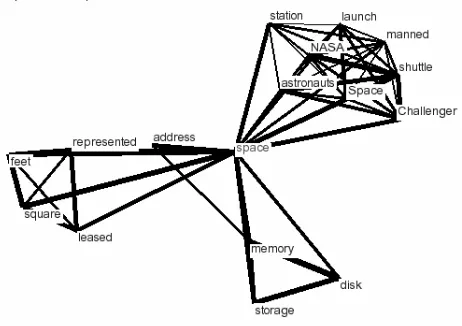
EXAMPLE: There are basically three meanings of
space to be found in ordinary texts like newspaper arti-cles. Most of the collocates of space belong to exactly one of these senses. The top collocations of space together with their measures, ordered by sense, are
Sense 1: Outer space. Total measure 11044: shuttle (2618), station (991), NASA (920), Space (602), launch (505), astronauts (473), Challenger (420), manned (406), mission (385), Discovery (341), Mir (335), rocket (329), orbit (326), NASA's (297), flight (293), Atlantis (291), cosmonauts (275), Earth (239), satellite (238), satellites (203), outer (193), orbiting (188), telescope (176),
Sense 3: Real estate. Total measure 3715: square (1163), feet (822), leased (567), lessor (390), office (382), lessee (201), heating (190),
Without assignment: address (653), represented (412), program (308), free (300), amount (230), requires (223), Cornish (209), virtual (198), desk (182).
Hence, we get the following approximate weights for the three senses:
Sense 1: Outer space; p1=0.56
Sense 2: Computer; p2=0.25
Sense 3: Real estate; p3=0.19
These probabilities depend on the corpus and the addi-tivity assumes independence of the collocates, which is never strictly fulfilled in language.
For this type of filter, a visualization strategy may be applied: Again we consider the collocates of a polysemous word A. We can expect that for a given sense, some of the collocations B and C belonging to this sense, are also col-locations of each other. Hence, we have a triple (A, B, C) of collocations. To visualize the polysemy of A, we take the collocation set of A and remove all collocates which are not element of a triple as above. Next we use simu-lated annealing for a planar representation (see Davidson & Harel 96).
Figure 1: Visualization of the collocations of space
3.2. Filtering Using Positional or Pattern
In-formation
Beyond relative collocation strength, the introduction of simple positional or pattern-based information is a next step in refining collocation analysis. Positional informa-tion is already taken into account in the calculainforma-tion of immediate neighborhood collocation sets. Thus, it is used in many other filtering techniques described in subsequent chapters. A more complex example is given in ch. 3.2.1 for multiword extraction.
3.2.1. Pattern-based Multiwords
A person usually is referenced by an optional title, first name(s) and a surname. From this, we can find the follow-ing rules:
Surnames are typical right next neighbor collocations
of first names
Both titles and first names are left neighbor colloca-tions of surnames
Only titles are left neighbor collocations of first names.
In many languages, determiners are left neighbor col-locations for titles, not for surnames.
These rules allow the extraction of large lists of persons together with their titles. Similar rules apply to company names. Company names, in turn, allow for the extraction of product names.
3.3. Filtering by Using Additional Syntactic or
Semantic Knowledge
One of the most important types of filtering operation sis the introduction of additional lexical (syntactic, semantic) knowledge for analysis of collocation sets. In the simplest case, collocation sets are reduced to the noun category, excluding all other word categories which may be used in the automatic generation of concept networks. More inter-esting filtering techniques using additional knowledge are described below.
3.3.1. Category Detection with Keywords
For some types of proper names, its category or class identifier is given as part of the name or given in the text as direct neighbor This applies to left neighbors if Island
(English corpus) and right neighbors of Insel (German corpus), where more than 200 islands can be identified each. The same applies to other geographic identities like regions, cities, etc.
Other category-keywords with category-elements as neighbors are trademark, professions like tenor or minis-ter, can be used analogously. But, there seems to be no comprehensive list of such category words in the litera-ture.
3.3.2. Standard Relations and Meaning-Text Theory Meaning-Text Theory [Steele 90] describes more then 70 semantic relations between words. Some of the more im-portant relations are the so-called standard relations like
• typical properties of Objects, usually given by an adjective-noun-relation
• typical participants and objects of an action, usually given by verb-noun-relations
To distinguish between subject and object we can use word order. Even in German, where word order in a sen-tence is less restrictive than in English, we typically have the default word order SPO. Hence, left neighbors for a verb are good candidates for typical subjects, right neighbors are good candidates for typical objects.
If we have grammatical POS information for the colloca-tions, we can translate this to semantic information as, for example, as follows: Given a noun, we search for adjec-tives as left next neighbor collocations. We interpret the result as typical properties of tat noun.
EXAMPLE: Adjectives as left neighbors for space-craft describe standard properties: unmanned, manned, robot, winged, planetary, orbiting, long-duration, low-orbiting, reusable, alien, earth-low-orbiting, nuclear-powered, exploratory, …
is obvious that various fields of application exist in areas as diverse as information retrieval or object-oriented reen-gineering using text mining methods. Two applications of this approach shall be mentioned; both of them have al-ready been applied in industrial projects.
4.1. Knowledge Re-engineering
Building ontologies and semantic networks for very spe-cialised domains can be a very time-consuming effort when being performed by intellectual analysis of the do-main only. Various standards for ontology markup and description have been defined (DAML; Topic Maps; OIL, see Maedche & Stab 01). Still, a methodology for auto-matic ontology construction is an important academic as well as practical desire. Using our approach towards cor-pus analysis which calculates collocation sets for any given text corpus, the application of various filters results in a raw semantic net or ontology which represents knowledge found in the text corpus. Although manual refinement still has to be applied, the process of knowl-edge extraction is at least partially performed automati-cally. We employ the topic map standard (ISO/IEC 13250, see Biezunski & Newcomb 01) for representing these “raw semantic networks” (for a detailed discussion see Böhm et al. 02). An export tool generates Topic Maps in a XML format which is ready for postprocessing by Topic Map editors or knowledge management tools.
4.2. Object-oriented Reengineering
Categorical filters for the extraction of typical adjectives or verbs going along with a noun can be interpreted as typical properties and methods as applied in object-oriented analysis and design. The same holds for generic concepts and typical representatives when seen as a class - object (instantiation) relationship. This kind of analysis has been successfully applied to text corpora describing large software project. The analysis results can directly be used in OO-tools as a starting point for a new software model (see Heyer, Quasthoff, Wolff 02 for further details).
5.
Outlook
While our approach towards filtering of collocation sets has already been applied in number of projects, three major lines of further development can clearly be identi-fied:
• The development of a general theory of information filtering and extraction based on a multi-level ap-proach comprehending statistical corpus analysis as a baseline process upon which knowledge-based filters as described in this paper may operate: Starting from a generic idea of relatedness which is represented by the calculation of collocations, additional knowledge or various kinds allows for a fine-grained in-depth analysis.
• The collection of additional knowledge to be used in filtering like syntactic or semantic information. The examples given are derived from our German corpus as for this language our knowledge base is already comparatively large.
• The optimisation of software tools for corpus analysis and comparison which shall allow for a straightfor-ward application of this kind of analysis as well as its integration in ontology or knowledge management
software (e. g. software for defining and handling topic maps).
6.
References
[Armstrong 93]. Armstrong, S. (ed.); “Using Large Cor-pora”; Computational Linguistics 19, 1/2 (1993) [Spe-cial Issue on Corpus Processing, repr. MIT Press 1994]. [Biezunski & Newcomb 01] “XML Topic Maps: Finding
Aids for the Web”; IEEE Multimedia 8, 2 (2001), 108. [Böhm et al. 02]. Böhm, K.; Heyer, G.; Quasthoff, U.;
Wolff, Ch. “Topic Map Generation Using Text Min-ing.” In: Proc. IKNOW ’02 – Intl. Conf. on Knowledge Management, Graz, to appear.
[Chung 00]. Chung, K. L. “A Course in Probability The-ory”, Academic Press 2000.
[Davidson & Harel 96]. Davidson, R., Harel, D. (1996). “Drawing Graphs Nicely Using Simulated Annealing.” In: ACM Transactions on Graphics 15(4), 301-331. [Heyer et al. 01] Heyer, G.; Läuter, M.; Quasthoff, U.;
Wit-tig, Th.; Wolff, Ch.; “Learning Relations using Colloca-tions"; In: Proc. IJCAI Workshop on Ontology Learning, Seattle/WA, August 2001, 19-24.
[Heyer, Quasthoff, Wolff 00] Heyer, G.; Quasthoff, U.; Wolff, Ch.; “Aiding Web Searches by Statistical Classi-fication Tools. “ Proc. Proc. 7. Intern. Symposium f. In-formationswissenschaft ISI 2000, UVK, Konstanz (2000), 163-177.
[Heyer, Quasthoff, Wolff 02] Heyer, G.; Quasthoff, U.; Wolff, Ch.; “Automatic Analysis of Large Text Corpora - A Contribution to Structuring Web Communities. “ In: Proc. I2CS 2002, Rostock, Germany, to appear in LNCS. [Krenn 00] Krenn, B.; “Distributional and Linguistic Implica-tions of Collocation Identification.” Proc. CollocaImplica-tions Workshop, DGfS Conference, Marburg, March 2000. [Lemnitzer 98] Lemnitzer, L.; “Komplexe lexikalische
Einheiten in Text und Lexikon.” In: Heyer, G.; Wolff, Ch. (edd.). Linguistik und neue Medien. Wiesbaden: Dt. Universitätsverlag, 1998, 85-91.
[Maedche & Staab 01] Maedche, A.; Staab, St.; „Ontol-ogy Learning fort he Semantic Web”; IEEE Intelligent Systems 16, 2 (2001), 72-79.
[Manning & Schütze 99]. Manning, Ch. D.; Schütze, H.; Foundations of Statistical Language Processing; Cam-bridge/MA, London: The MIT Press 1999.
[Quasthoff & Wolff 00] Quasthoff, U.; Wolff, Ch.; “An In-frastructure for Corpus-Based Monolingual Dictionaries.” Proc. LREC-2000. Second International Conference on Language Resources and Evaluation. Athens, May/June 2000, Vol. I, 241-246.
[Schatz 02] Schatz, B.; “The Interspace: Concept Naviga-tion across Distributed Communities”; IEEE Computer 35, 1 (2002), 54-62.
[Smadja 93] Smadja, F.; “Retrieving Collocations from Text: Xtract”; Computational Linguistics 19, 1 (1993), 143-177.