Automatic Discovery of Telic and Agentive Roles from Corpus Data
Ichiro YamadaScience & Technical Research Laboratories Japan Broadcasting Corporation
1-10-11 Kinuta, Setagaya-ku, Tokyo 157-8510, Japan [email protected]
Timothy Baldwin CSSE
University of Melbourne Victoria 3010, Australia [email protected]
Abstract
We present two methods for automatically discovering the telic and agentive roles of nouns from corpus data. These relations form part of the qualia structure assumed in generative lexi-con theory, where the telic role represents a typical purpose of the entity and the agentive role represents the origin of the entity. The first discovery method uses hand-generated templates for each role type, and the second employs a supervised machine-learning technique. To eval-uate the effectiveness of the two methods, we took a sample of 30 nouns, selected 50 verbs for each, and then generated a ranked list of verbs for a given noun. Using a variant of Spearman’s rank correlation, we demonstrate the ability of the methods to identify qualia structure.
1 Introduction
We present a study of methods for automatically discovering the telic and agentive roles of nouns based on corpus data. These relations form part of the qualia structure assumed in generative lexicon theory (Pustejovsky, 1995). The qualia structure of a given noun incorporates (at most) the following four roles:
Formal role: the conceptual superclass of the noun.
e.g., orientation, magnitude, shape, dimensionality, color, or position.
Constitutive role: the internal constitution of the entity. e.g., material, weight, parts, or component elements.
Telic role: the typical function of the entity. i.e. what the entity is for.
Agentive role: the origin of the entity, or its coming into being e.g., creator, artifact, natural kind, or casual chain
For example, for the noun book, publication is a formal role noun, text is a constitutive role noun, read is a telic role verb, and write is an agentive role verb.
who use symbolic learning to identify “qualia pairs”—token instances of noun–verb pairs which corre-spond to a some qualia role—in corpus data. Our work differs in that we can identify the qualia roles of an arbitrary noun, as suitable for the development of a lexical resource, and sub-classify noun–verb pairs according to the specific qualia role they constitute.
An example application of telic and agentive roles is the interpretation of logical metonymy (Lapata and Lascarides, 2003), such as in Mary finished her beer. Under the standard interpretation of logical metonymy, finish here predicates over an unexpressed verb, which takes her beer as object. By ac-cessing the qualia structure of beer, it is possible to resolve the unexpressed verb by way of telic and agentive roles, resulting, e.g., in the interpretation finished drinking her beer (from the telic role – al-though in other cases the agentive role may be more appropriate). Busa and Johnston (1996) proposed an interpretation-based method of translating complex nominals from English to Italian, interpreting the relation between the nouns based primarily on telic and agentive role data. Qualia structure is also use-ful for QA tasks. Choi et al. (2003) proposed a QA system that uses rich lexical semantic knowledge incorporating relations between nouns and verbs of the type manifested in qualia structure.
In the qualia structure of a given noun, telic and agentive roles are described by a set of predicates (po-tentially specified for argument structure). For example, the prototypical telic role for book is normally considered to be read, and the prototypical agentive role is write. However, alternate predicates such as
study and publish can also be considered to be telic and agentive roles, respectively. In line with this
observation, we treat the telic and agentive roles of a given noun as a (partially) ranked list rather than a closed set of predicates. The purpose of this research is thus to generate a ranked list of verbs for a given noun for each of the telic and agentive roles, with the ranking encoding the relative prototypicality of the verb fulfilling the given role of the target noun. Verbs that rank high in this list can then be considered as the telic and agentive roles of the noun in question.
In this paper, we propose two basic methods for extracting the telic and agentive roles of nouns from corpus data. These are in the same vein as Hearst’s template-based strategy (Hearst, 1992), whereby we identify highly precise (generally low-recall) syntactic constructions that are indicative of a verb constituting the agentive or telic role of a given noun. An example of such a template is an N’ modified by an infinitival relative clause, such as (a) book to read, wherein read represents the purpose of book and is thus a candidate for the telic role. We estimate the occurrence of different verbs with a given noun in these constructional templates by running a dependency parser (RASP Briscoe and Carroll (2002)) over the British National Corpus (BNC: Burnard (2000)). The first method uses hand-generated templates for each role type. The second employs a maximum entropy-based supervised learning technique which dynamically learns constructional and lexical preferences from the dependency data. In evaluation, we took a sample of 30 nouns, independently selected 50 verbs for each, and generated a ranked list of verbs for a given noun. We then evaluated the results using a variant of Spearman’s rank correlation.
In the remainder of this paper, we first introduce the resources used in this research ( 2). We then present the two methods we propose for extracting qualia structure ( 3). Finally, we provide details on the methodologies used to evaluate these methods ( 4), before concluding the paper ( 5).
2 Resources
The methods we propose make use of a number of resources, namely: corpus data, a parser, test data for evaluating the methods, and gold-standard data that are judged by two annotators to determine the “goodness” of each noun–verb pair for each of the telic and agentive roles.
2.1 Corpus and pre-processing
tags to derive a structural analysis of the sentence. This is, in turn, translated into dependency tuples specifying a head and its dependent(s), marked-up according to 23 grammatical relations (GRs). For ex-ample, thencmodrelation is used to capture noun–noun dependencies, and thedobjrelation to capture direct object-type noun–verb dependencies. The following is the output of RASP for inputs airplane
tickets and read books.
ncmod( ,ticket NN1,airplane NN2) airplane tickets
dobj(read VV0,book NN2, ) read books
Here,NN1,NN2, andVV0are the CLAWS-2 POS tags for singular common noun, plural common noun, and base form verb, respectively.
2.2 Test data
The primary test data used in this research is comprised of 30 nouns. 10 of these nouns were selected from the literature on qualia structure. The remaining 20 were selected randomly, and include both concrete and abstract nouns. The targeted nouns are given below.
Targeted nouns
book, car, knife, speech, food, table, door, prisoner, juice, novel, executive, delega-tion, phone, clinic, cash, beef, review, letter, counter, county, sunshine, accounting, register, complexity, gaze, profession, investigation, imagination, estimate, maturity
We selected 50 verbs for each noun independently of the BNC data sentences. A small number of verbs were hand-chosen as being representative of a telic or agentive relation with the corresponding noun, while the remainder were selected randomly. For example, the verbs selected for the noun book are given below.
Targeted verbs for the noun book
abandon, add, appear, believe, borrow, bring, browse, buy, call, compile, dedicate, design, destroy, dispose, end, expect, fill, find, follow, get, hand, hold, introduce, keep, lay, make, move, need, pack, plan, prepare, print, provide, publish, read, re-move, return, show, snatch, start, steal, suit, think, throw, thrust, translate, treat, want, withdraw, write
The total number of noun–verb combinations is thus 1,500. Note that, while there is considerable variation in the verbs associated with each noun, the same 50 verbs are used in annotation/evaluation of both the agentive and telic relations.
2.3 Annotation
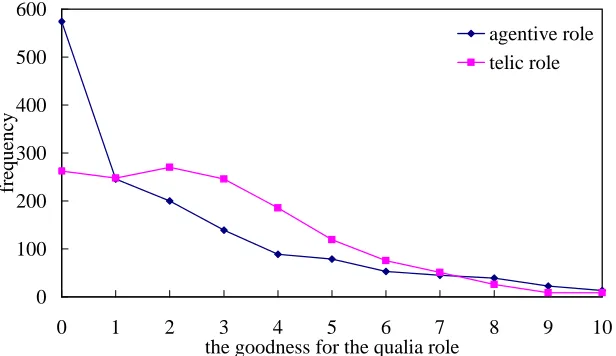
Two symbolic-system-major undergraduates where asked to judge the “goodness” of each noun–verb pair for the telic and agentive roles based on a 0-10 discrete numeric scale. The value 10 means that the verb is regarded as prototypically filling the given qualia relation for the noun in question, and the value 0 means that there is no way in which the verb could be construed as being related to the noun by the given qualia relation. The mean human ratings are regarded as gold-standard data, based on which we evaluate the performance of our methods.
0 100 200 300 400 500 600
0 1 2 3 4 5 6 7 8 9 10
the goodness for the qualia role
fr
eq
u
en
cy
agentive role telic role
Figure 1: Distribution of total frequency for each numeric scale in gold-standard data
3 Proposed ranking methods for extracting telic and agentive roles
To extract the telic and agentive roles of a given noun, we propose two methods, each of which generates a ranked list of verbs which expresses the relative “goodness” of each noun–verb pair for the qualia role in question. A highly-ranked verb can then be considered as a candidate for inclusion in the qualia structure of that noun.
Below, we outline the two methods, the first of which uses hand-generated templates to identify can-didates for each role type, while the second employs a supervised learning technique to dynamically identify templates predictive of the different role types.
3.1 Template-based ranking method
Verbs which form part of the qualia structure of a noun tend to occur frequently in particular constructions (Pustejovsky et al., 1993; Bouillon et al., 2002). For example, verbs which readily allow passivization of a given noun tend to be good candidates for the agentive role of that noun, i.e. frequent occurrence of sentences such as This book was written (by him) is evidence for write being a candidate for the agentive role of book. Similarly, the a N worth V+ing construction, e.g. a book worth reading, indicates that V (e.g. read) is a candidate for the telic role of N (e.g. book). We identified several constructional templates for the telic role and one for the agentive role, and counted the raw frequency of occurrence for each verb with a given noun in the two template sets. The templates used in our method are described in Tables 1 and 2, where N and V refer to the target noun and verb, respectively, V[+ing] refers to the present participle of V, V[+en] refers to the past participle of V, and V[+nom] refers to the nominalization of V.
All templates assume that the noun will occur as the deep object (ARG1) of a transitive verb. We recognize that this is an oversimplification, as evidenced by knife and its telic role cut, which we would not expect to occur as cut (the) knife. The principal motivation for making this simplifying assumption is empirical, in that our primary concern is with high precision, potentially at the cost of low recall.
In order to normalize for the effects of the independent noun and verb word probabilities in calculating the frequencies of occurrence of a given noun–verb pair over the set of templates, we use point-wise mutual information (Church and Hanks, 1989). If is the probability of occurrence of word , the mutual information between noun and verb is defined as follows.
noun, based on the first two characters of the CLAWS-2 POS tag (reducing the tagset from 170 to 49 tags in the process). From this, we generated a feature vector of the following form for each noun–verb pair in the sentence token:
The grammatical relation of the noun–verb dependency tuple
The grammatical relation of any other dependency tuples the noun occurs in, and the POS tag of other words in the dependency tuple
The grammatical relation of any other dependency tuples the verb occurs in, and the POS tag of other words in the dependency tuple
For example, the RASP output for the question Can I have a book to read?, which incorporates the noun
book and verb read, is as follows (with the target words in boldface for expository purposes):
( Can:1 VM I:2 PPIS1 have:3 VH0 a:4 AT1 book:5 NN1
to:6 TO read:7 VV0 ?:8 ? ) ( ncsubj have:3 VH0 I:2 PPIS1 )
( dobj have:3 VH0 book:5 NN1 ) ( ncsubj read:7 VV0 I:2 PPIS1 )
( xcomp to:6 TO book:5 NN1 read:7 VV0 ) ( detmod book:5 NN1 a:4 AT1 )
( aux have:3 VH0 Can:1 VM )
Elements of the feature vector derived from this sentence are:
The grammatical relation between book and read: xcomp.to
The grammatical relation of other dependency tuples book occurs in, and the POS tag of other words in the tuple:
detmod, AT(from a and book) dobj, VH(from have and book)
The grammatical relation of other dependency tuples read occurs in, and the POS tag of other words in the tuple:
ncsubj, PP(from I and read)
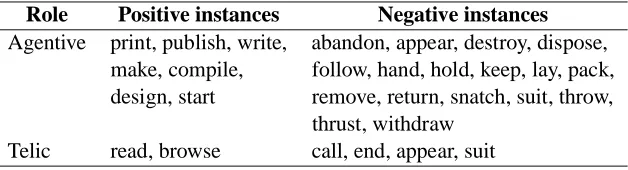
Here,xcompdenotes a grammatical relation between a subjectless predicate and clausal complement, detmoddenotes a grammatical relation between a noun and determiner,dobjdenotes a grammatical relation between a predicate and its direct object, andncsubjdenotes the grammatical relation between a predicate and its subject; the POS tagATdenotes an article,VHdenotes the verb have, andPPdenotes a pronoun. Combined, this feature vector is a positive training exemplar used in estimating the relative goodness of other noun–verb pairs with respect to the telic role, as read is a positive telic role instance for book.
We used training exemplars such as this to learn a token-level maximum entropy classifier (Berger et al., 1996) for each of the 30 nouns. This performed in the manner of cross validation, whereby, for each noun, we take exemplars from the remaining 29 nouns as training data. Additionally, for the test nouns, we use only sentences which do not include a training exemplar.
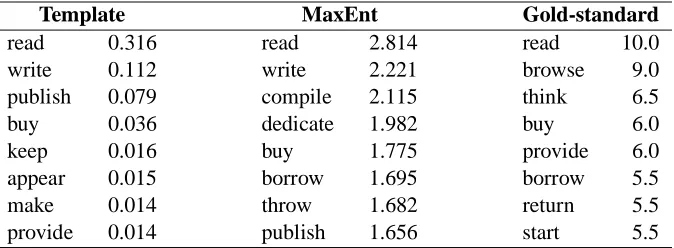
To get a sense for the effectiveness of this classifier architecture at identifying agentive and telic role data, the values for
) . .
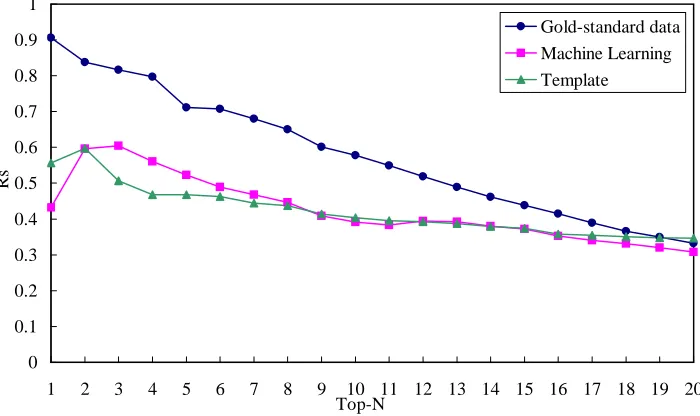
values of N. The experimental results for the agentive role indicate that the correlation for the top-3 items was 1& with the maximum entropy model, & with the template method, and for the gold standard data. For the telic role, the correlation was with the maximum entropy model,11& with the template method, and & for the gold standard data. There was little difference in performance between the maximum entropy method and the template method, but the maximum entropy method tended to outperform the template method for smaller values of N, except in top-1 evaluation where the template method came out on top for both the agentive and telic roles. It would appear that there is grounds for hybridization, in analyzing occurrences of fixed templates but also dynamically learning the more subtle preferences of each qualia role type. We leave this as an item for future research.
Clearly, there is still room for improvement. To this end, we are planning to use more sophisticated features and filters on the training data. In this experiment, we used all sentences that incorporated pos-itive instance noun–verb pairs to learn constructional and lexical preferences. However, not all of these had constructional features indicative of the qualia role. If we had filtered out sentences not correspond-ing to constructions of the type used in the template-based method, we would undoubtedly have obtained better results. Also, making more aggressive use of lexical features may aid extraction, particularly for the agentive role.
5 Conclusion
We proposed two methods for discovering the telic and agentive roles of nouns from corpus data. The first method used hand-generated templates, and the second employed a supervised learning technique based on sentence structure. In evaluation using a variant of Spearman’s rank correlation, we found that these methods were moderately successful at extracting key information, but also that there was room for improvement. We are planning to use more sophisticated features and learning methods to extract qualia role data.
In future research, we intend to generate a lexical resource that incorporates qualia structure, and use this in a range of applications.
Acknowledgements
This research was carried out in part while the first author was a visitor to the CSLI LinGO Laboratory at the Center for the Study of Language and Information, Stanford University, and while the second author was employed in the CSLI LinGO Laboratory. The authors would like to thank Dan Flickinger, Pat Langley, Kentaro Torisawa, Hideki Sumiyoshi, Nobuyuki Yagi, Masahiro Shibata and the anonymous reviewers for their valuable comments.
References
Berger, A.L., P. F. Brown, and V. Della Pietra. 1996. A maximum entropy approach to natural language processing. Computational Linguistics, 22(1):39–71.
Bouillon, Pierrette, Vincent Claveau, C´ecile Fabre, and Pascale S´ebillot. 2002. Acquisition of qualia elements from corpora – evaluation of a symbolic learning method. In Proc. of the 3rd International Conference on Language Resources and Evaluation (LREC 2002), Las Palmas, Canary Islands.
Briscoe, Ted and John Carroll. 2002. Robust accurate statistical annotation of general text. In Proc. of the 3rd International Conference on Language Resources and Evaluation (LREC 2002), pages 1499–1504, Las Palmas, Canary Islands.
Burnard, Lou. 2000. User Reference Guide for the British National Corpus. Technical report, Oxford University Computing Services.
Choi, Key-Sun, Jae-Ho Kim, Masaru Miyazaki, Jun Goto, and Yeun-Bae Kim. 2003. Question-answering based on virtually integrated lexical knowledge base. In Proc. of the The Sixth International Workshop on Information Retrieval with Asian Languages (IRAL2003), Sapporo, Japan.
Church, Kenneth W. and Patrick Hanks. 1989. Word association norms, mutual information and lexicography. In Proc. of the 27th Annual Meeting of the ACL, pages 76–83, Vancouver, Canada.
Fellbaum, Christiane, editor. 1998. WordNet: An Electronic Lexical Database. MIT Press, Cambridge, USA.
Girju, Roxanne, Adriana Badulescu, and Dan Moldovan. 2003. Learning semantic constraints for the automatic discovery of part-whole relations. In Proc. of the 3rd International Conference on Human Language Technology Research and 4th Annual Meeting of the NAACL (HLT-NAACL 2003), Edmonton, Canada.
Hearst, Marti. 1992. Automatic acquisition of hyponyms from large text corpora. In Proc. of the 14th International Conference on Computational Linguistics (COLING ’92), Nantes, France.
Lapata, Mirella and Alex Lascarides. 2003. Detecting novel compounds: The role of distributional evidence. In Proc. of the 10th Conference of the EACL (EACL 2003), Budapest, Hungary.
Pustejovsky, James. 1995. The Generative Lexicon. MIT Press, Cambridge, USA.
Pustejovsky, James, Peter Anick, and Sabine Bergler. 1993. Lexical semantic techniques for corpus analysis. Computational Linguistics, 19(2):331–58.