Supervisors:
Abstract
Application development is a process that becomes increasingly complex depending on the intricacy of the application being developed. Development techniques and
methodologies exist to manage and control the complexity of this development process. Amongst the techniques introduced to manage the complexity of the application development process is Domain-driven design (DDD).
DDD prescribes a specific application of separation of concerns to the application model into a domain model and DDD-services.
This Masters assignment investigates how to handle issues concerning the modelling and implementation of authorization and authentication functionality in an application developed according to the DDD principle of separating domain-related functionality from domain-independent functionality. This means an application where security functionality is located in a DDD-service.
The goal of this Masters assignment is to find design options to separate security from domain-related functionality and provide guidelines for usage of these design options. To find the best design options, the problem is explored and the levels of coupling between DDD-services and the domain implementation are clarified.
Criteria for the application design phase are that the design should comply with the DDD principle of separating domain-related functionality from domain-independent functionality, and that the design should provide usability and efficiency when implemented.
Two prototypes use Aspect-Oriented Programming (AOP) to separate security logic into a DDD-service. AOP allows for cross-cutting concerns to be declared in a single place called an aspect. This aspect is then applied in all the places this functionality is needed.
The implementation resulted in three prototypes:
1. A prototype with intermediary adapters that regulate interactions with the domain implementation.
2. A prototype with AOP point-cuts aimed at intermediary adapters. 3. A prototype with AOP point-cuts aimed at the domain implementation.
Table of contents
Chapter 2 Domain-driven design and Security 7
2.1 DDD 7
3.2 Reference implementation: Security embedded in the domain model 21
3.3 Criteria for case study designs 23
Chapter 4 Security service design scenarios 25
4.1 Scenario 1: Security service as regular service 25
4.2 Scenario 2: Security embedded in the UI 28
4.3 Scenario 3: Security service encapsulating the domain model 31
4.4 Scenario 4: Security service as a gateway for the UI 34
4.5 Scenario 5: Security service as an adapter for the UI 36
4.6 Scenario 6: Security service integrated by AOP with adapters 39
4.7 Scenario 7: Security service integrated with AOP 43
Chapter 5 Security design implementations 46
5.1 Scenario selection 46
5.2 General implementation choices 49
5.3 Scenario 5 implementation: Security service as an adapter for the UI 49 5.4 Scenario 6 implementation: Security service integrated by AOP with adapters 51 5.5 Scenario 7 implementation: Security service integrated by AOP 56
Chapter 1
Introduction
This chapter starts by introducing the context of the investigation performed to analyse a problem occurring in Domain-driven design (DDD).
After introducing the background information concerning DDD this chapter presents the problems related to security in DDD. Based on the problem description the goals for this investigation are clarified. Next, this chapter describes how these goals are achieved within this Masters assignment.
This chapter’s role is to describe the context of this Masters assignment. This context is used to clarify the objectives and approach.
1.1 Background
Application development is a process that becomes increasingly complex as the intricacy of the application being developed increases. Development techniques and
methodologies have been defined to manage and control the complexity of this
development process. These methodologies and techniques are often based on specific application models and the fact that models should facilitate the understanding, implementation and maintenance of the application being developed. Amongst the various techniques introduced to manage the complexity of the application development process is Domain-driven design [EVAN03]. A short overview of other methodologies and techniques is found later in this report.
Figure 1: The development process
Understanding of the terms used in the development processseen in Figure 1is vital to provide a clear description of DDD.
document describing the set of requirements. This requirements specification is needed before the design phase is started.
The design phase transforms these requirements into the application model that meets the defined requirements. During this phase the requirements are adjusted according to insights gained by producing the application model.
The second level of abstraction consists of the specification of the application model that is used to represent the problem domain.
During the implementation phase an implementation is produced with functionality that corresponds with the application model.
The third level of abstraction is the application implementation, which represents the code structure and behaviour of the actual implementation.
DDD originates from the notion that the heart of the complexity of software development lies within the problem domain itself. DDD presents guidelines for applying separation of concerns to an application model and implementation. This separation aims to move the focus in software projects to the deep issues of the problem domain, namely the domain logic [DDDO] [EVAN03] [SDWZ07]. The domain logic is also commonly referred to as business logic.
During the design phase, collaboration between developers and domain experts is needed to attain the goal of creating a coherent application model expressed in a ubiquitous language defined by the team itself [EVAN03 p.32]. In DDD, ubiquitous language means ensuring the domain experts and software specialists communicate in the same common language, thus enabling efficient and correct communications between these team members.
In DDD the transformation from the problem domain into an application model results in a specific layout in the application model. At this level the application model consists of a domain model, containing domain-related functionality, and domain-independent functionality. Domain-independent functionality is represented by different services that facilitate the usability of the domain model. Therefore, the term ‘service’ has a special meaning in DDD when compared to the use of this term in other architectures like service-oriented architecture (SOA), as services represent domain-independent functionality.
In the application implementation structure the separation between domain-independent (service implementation) and domain-related functionality (domain implementation) is maintained. On the implementation level this means the classes in the domain implementation have no references to the classes and interfaces in the service implementations.
Both transformations during the design and implementation phase are conducted in an iterative manner. Changes made to the application implementation structure are also reflected in the application model.
Services however, are more likely to be the target of requirement changes. An example is a new web-based front end that allows access to the domain implementation or another type of database that is used to store the state of the domain implementation.
1.2 Problem Description
In some cases, the separation of concerns prescribed by DDD is difficult to achieve, namely when functionality is considered which is domain-independent but which is intrusive on and closely related to domain-related functionality.
These problems apply to security. Security is conceptually domain-independent
functionality, thus security should be modelled as a service in DDD. But security is hard to separate from domain-related functionality in the implementation.
For the security service to function properly it needs to be intrusive on domain-related functionality.
Two main problems arise when separating security into a service:
1. The security service must authorise actions that affect the implementation of domain classes. This applies when these actions are initiated by other services. The security service must be aware of these actions and be able to regulate them. 2. When reviewing security as a service within DDD, it is clear that when access
control is only based on the role of a user, security functionality can be located in a security service with low coupling to the domain implementation.
However, when the state of the domain implementation affects access control, decoupling security functionality becomes more problematic. An example of this problem is a domain concerning contract management. A user must have the role of manager in order to close a contract, this constraint can be enforced by the security service.
However, if more complicated conditions need to be checked, like ‘Hiring contracts can only be closed by HR-managers and sales contracts may only be closed by Sales-managers’, the security service needs domain knowledge and could be required to retrieve information, from the domain implementation to enforce the security rules. Such a service is hard to decouple from the domain implementation it secures.
From these problems the question arises whether it is feasible to separate security into a service and which possibilities exist to implement this service. Strong coupling between a service and the domain implementation contradicts the aim of DDD to have a low coupling between services and the domain implementation, while maintaining high cohesion between the objects inside the domain implementation or a service. Regular solutions for the problem of strong coupling like using events or observer and
1.3 Goals
This Masters assignment investigates how to handle issues concerning the modelling and implementation of authorization and authentication functionality as a security service in a DDD environment. The separation of security into domain-independent functionality should be performed in such a manner that the benefits of DDD are maintained.
For this Masters assignment the scope of security (containing audit, privacy, authentication, trust, authorization etc.) is narrowed to the authentication and authorization of users.
The first goal is to provide insight into the coupling of services in DDD and how services are classified according to their behaviour.
The second goal is to find the best design options to separate security functionality from domain-related functionality. The best design options are tested by creating a prototype implementation. Prototype implementations should comply with the principles of DDD while still providing usability and efficiency when implementing an application.
If multiple design options are found, the best design options must be implemented. Evaluation of the design options is performed by reviewing the prototype
implementations that demonstrate the possibilities for assigning authentication and authorisation functionality to a security service decoupled from the domain
implementation.
For these prototypes, guidelines are presented describing which implementation is applicable for which situation.
1.4 Approach
The approach to reach the goals for this Masters assignment consists of four phases: investigation, design, implementation and evaluation.
To clarify how DDD is applied in practice, we have investigated the terminology, inner workings and benefits of DDD.
The knowledge gained from the investigation is used to describe a problem domain for a case study. This case study has been used to compare the different design options. The case study illustrates how DDD works in a practical environment. The case study has also been used as a starting point to be able to compare new design and
implementation options.
From this case study, requirements for the design options have been derived.
The design phase is followed by the implementation phase. The implementation phase consists of two parts.
1. If there were more than three design options, the number has been reduced based on the ranking of the design options. This ranking has been performed by using criteria specified at the introduction of the case study. It was not feasible to implement more than three variants of this case in the limited time of this assignment.
2. The best design options were implemented for the case study described in the investigation phase.
After the implementation phase, the implemented case studies were evaluated. The different implementations have been compared on the compliance with the DDD target situation in the case study as presented in the investigation. Measurements to determine the complexity and clarity of the design and implementation experiences are also
factored into the evaluation. The evaluation phase also contains a comparison between the different implementations by measuring the coupling between the security service and the domain implementation.
Because each implementation solves the problems in a different way, the evaluation could result in different prototypes options being recommended in different situations and environments.
1.5 Report structure
The report structure reflects the four phases from the approach: investigation, design, implementation and evaluation.
Chapter 2describes a more detailed view of DDD. It explains the origin of DDD and its relation to some other development techniques. It elaborates on the coupling between the domain implementation and service implementations. It also contains an analysis of the problems that occur when separating security into a service is presented.
Chapter 3presents a case study that is used to clarify the implementation phase of the development process. A reference implementation of the case is presented to illustrate the usage of this case study. Criteria for the design options are defined based on the case study.
Chapter 4provides an overview of design options that can be used to structure the application model. Differences in the design options occur due to use of different techniques or due to a different choice for separation between domain-related and domain-independent functionality. These design options are treated as different scenarios, each with individual characteristics and trade-offs.
implementations, a selection is made in case more than three design options are defined in Chapter 4.
Chapter 6evaluates the measurements performed on the prototype implementations from Chapter 5. The case study implementations are compared to the reference
implementation from Chapter 3. The results of these measurements and comparison is analysed and the relations between the results are explained. Based on these results guidelines for the usage of the scenarios are presented.
Chapter 2
Domain-driven design and Security
This chapter presents the background and terminology used in the application of DDD. This chapter’s role is twofold. In the first place this chapter provides detailed
information about Domain-driven design and how it is applied. The second role is to analyse the current problem with separating security into a service.
2.1 DDD
The content of this section is based on various DDD sources. The references for the content are [DDDO] [EVAN03] [EVAN06] [SDWZ07] [WOLT05] [NILS06] [YDDD].
2.1.1 Principles
Application development is a process that becomes increasingly complex depending on the intricacy of the application being developed. Amongst the various techniques
introduced to manage the complexity of the application development process is Domain-driven design.
To more efficiently deal with requirements changes, complexity in the application needs to be manageable. According to [BROO86], essential and accidental complexities exist. Brooks argues that while essential complexity cannot be reduced because it is inherent to the problem being solved, accidental complexity can be managed by design and
implementation choices. To manage the accidental complexity in the application model, DDD uses the principle of separation of concerns. This principle is used to separate the application model into a domain model, consisting of domain-related functionality, and domain-independent functionality, which is represented by different services that facilitate the usability of the domain model. Therefore, the term service has a special meaning in DDD, when compared to the use of this term in other architectures like service-oriented architecture (SOA). In DDD services represent domain-independent functionality.
The separation of domain-related and domain-independent functionality in DDD is based on the idea of applying separation of concerns to software development, which dates back to the early 1970s [PARN72] [DIJK74].
At its core, DDD can be characterized as a specific style of applying OO programming. The principle of separation of concerns is also related to the foundation of Object-Oriented (OO) programming [WBMC03]. In the late 1970s OO was applied in Smalltalk [SMAL08] by considering that “everything is an object”, in this way associating
properties and behaviour to individual classes.
same terminology, a ubiquitous language is defined by the team. Ubiquitous language in DDD stands for getting all team members, software specialists and domain experts, to use the common language in diagrams, writing and speech. This ubiquitous language enables the creation of a clear and understandable application model for all team members.
In DDD, the key to controlling the complexity of the application model is to use a correct and complete domain model. The creation of this correct and complete model is the objective in DDD during the design phase. Correctmeans that the team members are satisfied with the functionality that is incorporated andcomplete means that all domain-related functionality is present in the domain model. Complete does not mean that the domain model is a fixed, rigid or finished product after the design phase. Changes introduced by decisions during the development phase are reflected in the domain model. This means that the domain model remains centred and consistent with the domain implementation during the entire development process.
Although not required, DDD is perfectly suited for performing the design and implementation phases in an iterative fashion.
Applying the domain model correctly should result in a complex development effort becoming more dynamic and more focused on the core issues of the problem domain. This focus on the domain models results in increased separation of concerns in the application model, illustrated by the loose coupling of services to the domain model. This increased separation yields an application implementation that is more flexible, making it easier to facilitate the addition of new requirements or features.
The aforementioned separation of domain-independent functionality into services is an attempt to ensure the independence of the domain model from technology. Technology means specific versions or types of databases or different UIs. Especially services like UIs are susceptible to changes in technology and requirements.
Determining the separation between independent functionality and domain-related functionality is not a trivial task. The decision can be difficult because a lot of functionality does not fit clearly into either category.
Deciding where functionality should be placed in the model is based on knowledge, experience and common sense.
2.1.2 Models
In [EVAN03] a layered application model is used to show how DDD can be projected onto a layered model (seeFigure 2). The goal of this layered model is to concentrate the code related to the domain model in one layer and isolate it from the user interface, application, and infrastructure code.
Services can be present in any of these three layers.
Each of these layers has a special purpose. In contrast to regular layered models where layers are only allowed to communicate with the layers directly above and below, the layers in this model are allowed to interact in the direction of the arrows without intervention of the intermediate layers. The arrows show the direction of the interactions between the different
components in the model. This means that the components in the Domain layer are unaware of the existence of the layers above the Domain layer and have no references to those components.
The four layers identified in Figure 2 are:
- The User Interface (or Presentation) layer is responsible for showing information to the user and interpreting user commands.
- The Application layer is an optional layer that helps translate actions in order to use the Domain layer. It does not contain any business rules or knowledge. This layer is kept thin and has no state.
- The Domain layer represents the domain implementation. It contains the concept of business information, business rules and the state of the current business situation.
- The Infrastructure layer provides generic technical capabilities that support the higher layers. Examples are data persistency and message exchange.
The layered model is unable to represent more services clearly than are currently depicted. New services would be placed in the Infrastructure layer or User Interface layer. More complex designs lose a lot of clarity when depicted in this layer model, because different services would reside in one layer while their function could vary distinctively.
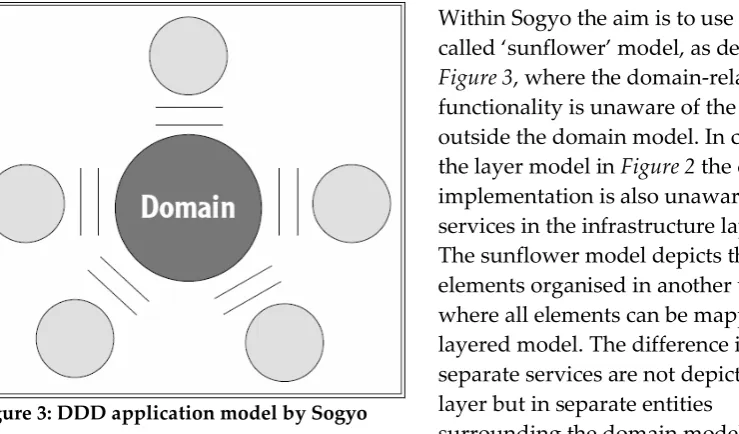
Within Sogyo the aim is to use a so-called ‘sunflower’ model, as depicted in
Figure 3, where the domain-related functionality is unaware of the services outside the domain model. In contrast to the layer model in Figure 2the domain implementation is also unaware of the services in the infrastructure layer. The sunflower model depicts the same elements organised in another way, where all elements can be mapped to the layered model. The difference is that the separate services are not depicted in one layer but in separate entities
surrounding the domain model and the domain model is unaware of the elements from the infrastructure layer.
The domain model is depicted in the centre of the application model to stress its importance. The various services are depicted around the domain model. Choices are made during implementation whether the services have references to surrounding services and the domain classes. There is no clear consensus in the DDD community on whether services are allowed to only have references to other services, thus not knowing the implementation of domain classes.
The domain model remains the foundation of the design. The domain implementation does not require any service to operate, the domain implementation is independent and is able to operate standalone. Operating standalone has the advantage that for example no persistency service is required to test and run the domain.
The double lines between the services and the domain model represent a ‘glue’ layer. This glue layer is used to translate actions in order to use the domain classes. The glue layer it is considered equivalent to the application layer in Figure 2.
2.1.3 Goals and benefits
Domain-driven design is not a goal in itself, but aims to provide the means to facilitate easier maintenance, speed up development, and add flexibility and robustness to requirement changes. The reasons behind these positive effects are related to the separation between the domain model and the services that facilitate the use of the domain model. During development, requirement changes are far less likely to impact the domain model. New functionality is mostly contained in a few methods to be added to the implemented domain classes. Services are more likely to need new functionality and entire new classes or even a new service are introduced to provide new
functionality. Since changes to services impact a smaller part of the total development process, this results in a decrease of the total impact of a requirement change.
Changes to business rules are more easily introduced because they are centralized in the domain model. This centralisation inherently introduces a drawback, since changes in the domain implementation can have an impact on all service implementations. All services that interact with the changed domain class have to be checked for correctness.
Thus changes to the domain implementation can propagate throughout the services and have a large potential impact.
Another benefit of applying the DDD principles to a project is increased testability of the domain implementation. Increased testability is achieved because the domain
implementation operates independent from services. This independence facilitates the testing of methods with unit tests. The independence from services also eliminates the need for mock databases.
2.2 State of the art
This section describes technologies and techniques related to DDD and techniques that are used within this thesis. Different development methodologies that are related to DDD are discussed to be able to place DDD better within its context. Furthermore, implementation techniques and measurement metrics that are relevant to this thesis are clarified.
2.2.1 Development methodologies
DDD is not the only development technique or methodology that is defined to manage and control the complexity of the development process. Examples of other related techniques include Driven Architecture (MDA) [MDA04] [HAYW04], Model-Driven Development (MDD) [IBMR06] and Table-Model-Driven Design (TDD) [FOWL02]. These techniques are shortly described here to indicate how they work and how they influence the development process. These techniques are discussed because they are related to DDD.
MDA is the Object Management Group (OMG) [OMG08] implementation of MDD. The MDA concept is implemented by a set of tools and standards that can be used within an MDD approach to software development. MDD describes concepts related to the
modelling of an application that are also applicable within DDD. However, in DDD the model is closer to the code than in MDD.
TDD is a domain logic pattern described by Martin Fowler in [FOWL02]. TDD is used in applications that are centred around databases and with data table representations that are easily mappable on business objects.
Model-Driven Architecture and Model-Driven Development
Model-Driven Architecture (MDA) describes a set of viewpoints for defining models, such as the Platform-Independent Model (PIM) and Platform-Specific Model (PSM). Models from these viewpoints can be packaged as reusable assets. If there is a situation in which some recurring business concepts can be applied across multiple applications and implementation technologies, it can be valuable to invest the effort to create the PIM and PSM models and any associated transformations, each of which may be a reusable asset and stored in an asset repository [IBMR06](p541).
DDD and MDD are compatible. The main difference is that MDD is more aimed at the translation of models into code, while DDD is more aimed at defining a correct domain model. Within a MDD-based project there are no problems to apply the DDD principles. Model-Driven Development (MDD) is the approach corresponding with MDA, as MDD focuses on models as the primary artefacts. Model-Driven Development recognizes the necessity of having several kinds of models to represent the system as it progresses from early requirements through final implementation. These models may represent different aspects of the system (e.g., structural or behavioural), or they may represent the system at varying levels of abstraction (e.g., an analysis model or a design model) [DDMD].
Table-Driven Design
Table-Driven Design (TDD) organises business logic around objects that can be directly mapped to data tables. This method is applied in the current Sun blueprint for EJB implementations.
The application of TDD addresses the problems that occur when mapping objects in OO models to relational databases. In these situations an O/R-mapping is needed to persist the business objects. The retrieval and instantiation of these objects from a database is a fault prone task in an object oriented mindset [ORM97]. Despite improvements made concerning databases that can handle objects, these solutions are still not fully
satisfactory, as described in [COOK06].
Table-Driven Design is built around table representations of business objects. For each type of object, a table is available for storage, which is a flat and simplistic representation of a real world business entity. Objects like datasets are used to exchange information back and forth between UIs and databases [SDWZ07]. Instead of the dataset objects, an active record pattern can be used to link the objects to corresponding tables. This pattern places the data access logic in the objects themselves [FOWL02].
2.2.2 Implementation techniques
Within this Masters assignment the concept of Aspect-Oriented Programming (AOP) [YASE07] is used. This is an important aspect of some design options in this Masters assignment.
Aspect-Oriented Programming
Aspect-Oriented Programming (AOP) is a concept to deal with cross-cutting concerns efficiently. Cross-cutting concerns are functionality of a program that affects other
functionality [KICZ96]. These concerns often cannot be cleanly separated from the rest of the functionality.
To deal with cross-cutting concerns, AOP defines aspects, advices, join points and point-cuts [YASE07] [LADD02].
- Aspects represent a specific piece of functionality that was identified as a cross-cutting concern.
- The aspect consists of advices that define what actions should be executed in specific situations, like a method entry or method exit.
- Point-cuts exist to link the join points to the advices that should be executed. Point-cuts define to which join points a specific advice should be applied.
This structure enables AOP to modularize the cross-cutting functionality in aspects. According to [EADD07] this modularisation of cross-cutting concerns improves software quality.
AOP is applied to the source code by weaving the aspects into the source code. The programming language is important for weaving because special compilers are required to weave AOP aspect code into source code. Examples of these weavers are: AspectJ [ASPJ] for Java [JAVA08] or PostSharp [POST] for .NET [MSFT08].
Other .NET options the Policy Injection Application Block [PIAB07] in Enterprise Library 3, Aspect.NET and LOOM.NET.
The choice for PostSharp over the other available .NET AOP implementations is based on recent research into applicability of AOP in the .NET environment by [SRIN07]. In this research, PostSharp is recommended over Aspect.NET and LOOM.NET.
A drawback of PostSharp is that point-cuts are declared at the target location, this means that the point-cuts would reside in the domain implementation if domain classes are targeted. This is unwanted behaviour in DDD because then a dependency on the aspects is introduced in the domain implementation.
2.2.3 Metrics for measurements
In this Masters assignment, metrics are used to measure coupling and complexity in implementations.
Coupling Between Objects
The Coupling Between Objects (CBO) [CHID94] metric is frequently used to measure the amount of coupling between object classes. An object is coupled to another object if the object uses the other object.
A higher CBO value between classes means a stronger coupling. A stronger coupling is not beneficial for changes in the development phase, since with stronger coupling changes in a class have more impact on other classes. A class with a high CBO figure is more difficult to maintain and test. Stronger coupling also reduces the possibility for code reuse.
Coupling consists of two factors, namely fan-in and fan-out:
- Fan-in indicates how many references other objects have to the selected object.
- Fan-out indicates how many references the selected object has to another object.
The CBO is calculated by counting of the number of references in the code. This count is meaningful under the assumption that all references are actually used when the system executes. Another important factor is how often the reference is actually used during program execution. This can not be measured with CBO, because this CBO is calculated based on the static environment.
When measuring the fan-in and fan-out of larger applications, counting the references can be performed on a selected group of objects. Since a service is a collection of classes with an interface, instead of measuring the coupling between two objects at a time, the coupling of a whole service to the domain classes can be measured.
Cyclomatic Complexity
Cyclomatic Complexity (CC) [CCMB89] is a method to measure the complexity of software. The CC value of a programming method is measured by counting the number of possible paths through the method. This means the CC of a class is measured by counting the number of methods and then adding the CC value of each method.
The higher the CC value the more complex the method is. A complex method is potentially harder to understand, harder to test and has higher maintenance costs. A method with a lower CC value is easier to test because there are fewer possible paths through the method, which means fewer test cases are needed.
The CC measurement yields three values: - Total Cyclomatic Complexity - Cyclomatic Complexity per method - Number of Decision Points (DP)
Because the total CC value is less suitable for comparison between implementations with largely varying numbers of classes, the CC per method value is also used in this thesis. The CC per method value presents the average CC per method in the measured class. CC value displayed as an average per method provides a better interpretation of how complex a class implementation actually is than the total CC measurement.
Decision points represent the number of expressions in the source code where different paths are possible. In the DP value the ‘while’, ‘for’ and ‘for each’ loops count for 2 decision points, because these cycles make the code more difficult to understand. The DP value indicates the number of paths that can be taken in the code and thus the actual complexity of a class. For example a class with 1 method containing 20 decision points is harder to understand than a class with 10 methods containing 2 decision points per method.
2.3 Coupling of services
more closely, considering the type of coupling with the domain implementation, the services can be divided into three categories:
1. A service that queries the domain implementation
2. A service that alters the state of the domain implementation
3. A service that requires the domain implementation to interact with this service
This means there are three fundamentally different types of services that interact with the domain implementation.
Differences between these types of services can be found by defining the amount and type of coupling between the service and the domain implementation.
2.3.1 A service that queries the domain implementation
If a service only reads information from the domain classes, interactions with the domain classes take place that do not alter the state of the domain classes.
Examples of services that display this behaviour are persistency and logging. In DDD the persistency and logging services take the initiative to retrieve this information from the domain implementation after they have been notified. This behaviour is facilitated by the observer and observable pattern, where the domain classes implement the
observable role and the service the observer role. Another option is that a service responds to events originating from the domain classes.
The coupling between a service that only queries the domain implementation and the domain classes consists of an amount of fan-in to the domain classes. The fan-in consists of the references needed for the retrieval of information by the services.
2.3.2 A service that alters the state of the domain implementation
This type of service consists of services that call methods in the domain. Methods called in the domain classes can alter the state of the domain implementation or values
contained by classes. By changing the state of the domain implementation, reactions in other services inside the application can be triggered like the persistency service. A typical example for this type of service is a user interface.
A user interface either responds to events originating from the domain classes by updating views, or initiates interactions with the domain classes.
The coupling between a service that alters the state of the domain implementation and the domain classes consists of an amount of fan-in to the domain classes. This fan-in consists of the references needed for the retrieval of information and the alteration of the domain state by the services.
2.3.3 A service that requires the domain implementation to interact with
this service
This type of service contains information that is required by the domain classes before actions are executed by these domain classes.
A service that displays this behaviour is a security service. Input from services that interact with the domain classes, like user interfaces, requires checking before the actions are executed by the domain classes.
Other services, like a user interface, initiate an action. Then the domain classes have to check the permission for this action before executing the action, which means that the user interface has delegated the initiative for permission checking to the domain classes. This results in the domain classes having to consult a service and producing fan-out from the domain classes.
The coupling between a service that requires the domain implementation to interact with this service and the domain classes consist of both fan-in and fan-out.
2.4 Security service
Implementations designed with security as a normal service in DDD suffer from the problems described in section 1.2.
These problems are specific for the interactive type of service security belongs to, as discussed in section 2.3.3. The result is that the security service has a strong coupling to the domain classes and that the domain classes need to be aware of the existence of the security service.
The scope of what encompasses security has, for the purposes of this Masters assignment, been narrowed to authentication and authorisation.
- Authentication consists of proving that the user is a specific person (or role), who is allowed to access functionality in the application.
- Authorisation consists of proving that the specific person (or role), who has been authenticated, is authorised to access specific functionality in the application.
The function of the security service is to regulate actions performed by other services by implementing authentication and authorisation functionality. Especially interactions with either the domain classes or other services originating from user interfaces must be checked. If the security service is placed on the same level as a normal service in DDD, the security service is unable to perform its task properly.
This is the case because in DDD services are coupled to the domain classes, but domain classes have no references to the services. However, services cannot be trusted to perform the security checks themselves. In a default DDD situation the security service does not know about the interactions between the user interface and the domain classes.
To perform authentication, the security service needs to receive credentials and check these credentials against stored credentials. Authentication is a crosscutting concern because every time authorisation is needed, the authentication of the issuer has to be checked. Authentication is either performed only once, after which a session bound object is created to store the login, or it is performed each time an authorisation is needed. In either case, the authentication is checked at every authorisation.
performed during authorisation: check if an interaction is allowed for this role or user, and check if an interaction is allowed under certain conditions for this role or user. These conditions are usually related to the state of the domain classes. If an interaction is allowed, some filtering might still need to be applied to the results based on the authorisation of the user.
The type of the security service, as discussed in section 2.3, indicates that it is difficult to separate security from the domain implementation in the way other types of services are separated. The crosscutting nature of authentication and authorisation of security add up to the problem resulting in a service with high coupling to the domain
Chapter 3
Case Study
This chapter presents the design and a reference implementation of the case study. This chapter also provides the criteria to determine the usability of new designs to implement this case study.
The role of this chapter is to present the case study, in order to compare new design options and review these possible improvements.
3.1 Case study overview
To describe the problems and possible solutions, the ‘Bank case study’ [BANK07] is chosen because this is a case where multiple levels of security are easily and naturally represented. In this case study the effect of adding security functionality is clearly visible and easily comprehendible.
A case study is needed to illustrate the concepts behind the separation of security as a service. The reference implementation of the case study provides the possibility to measure the amount of coupling introduced by the security service.
The reference implementation of the case study has the security functionality built into the domain classes. This implementation will be used as a reference implementation and provides reference measurements that can be compared to new implementations of the case study.
The design of the reference implementation is provided to be able to compare new designs with the reference design. Because at the design phase only the application model exists and no actual code is available, only estimations of the coupling between different objects are available.
The bank case study models how a bank is run and how clients and managers can interact with the accounts. Clients and managers each have their own specific possibilities and restrictions.
The bank case study allows clients and managers to perform actions with certain
limitations, as shown in Table 1. Clients are allowed to manage their own accounts up to certain limits. Clients can withdraw up to 1000 euros a day, deposit an unlimited amount of money and transfer money up to 1000 euros a day. Clients are also allowed to view their own account status.
Roles
Rights Client Junior Manager Senior Manager
Deposit Unlimited 500/Client/day 2000/Client/day
Withdraw 1000/day 2000/Client/day 5000/Client/day
Transfer 1000/day 2000/Client/day 5000/Client/day
Add client Not Allowed Not Allowed All clients
Alter client name Not Allowed Not Allowed All clients
Alter client address Own address All clients All clients
Create account Not Allowed For clients that are less than
1000 euros in dept All clients
View client details Own details All clients All clients
Table 1: Roles and rights in the bank case
Both managers and clients interact with the domain implementation via the same user interface. The difference between these roles in the user interface is made by the credentials used to login.
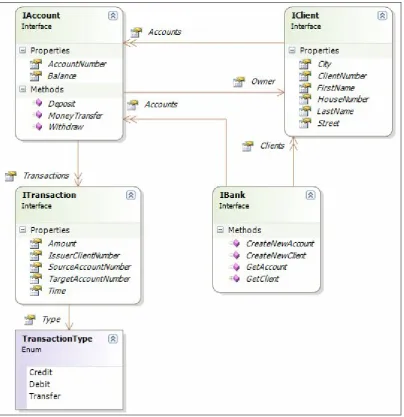
The bank case study is designed according to a DDD application model. The domain model consists of the interfaces IBank, IClient, IAccount, ITransaction. The domain implementation contains these interfaces and classes that implement these interfaces. The Bank class implementation contains lists of clients and accounts and class is able to create new clients and accounts. The Client class implementation contains information about a client and related accounts. The Account class implementation contains the account number, owner, current balance and a collection of all transactions performed related to the account. The Transaction class implementation contains information about a transaction. The interfaces and their relations are depicted in Figure 5. An
Figure 5: The relations between the interfaces in the domain model in the Bank case study
3.2 Reference implementation:
Security embedded in the domain model
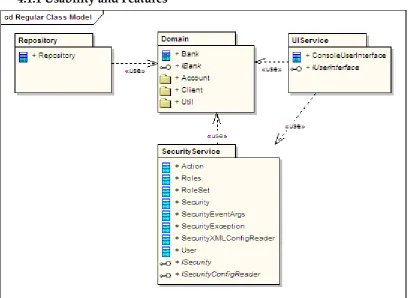
Currently when security is applied to a problem domain, the security functionality is integrated into the domain model as seen in Figure 6. This implementation structure with security functionality in the domain implementation is often found in projects at Sogyo.
Figure 6: Class diagram of the application of security in a DDD application
The implementation only provides accessibility for one concurrent instance of the UI service, so the ability to facilitate concurrent UI service instances is only visible in the model.
For the implementation, Role Based Access Control (RBAC) is used because this is a better solution than authorising individual users. RBAC is preferred over authorisation of individual users because it is easier to configure and maintain [COMP03].
3.2.1 Usability and Features
Due to the integration of the security functionality in the domain implementation, the security functionality is only consulted in the domain model when information is being accessed that needs authorisation. Authentication and authorisation functionality are both centralised in the domain model and are checked by the domain classes when needed.
In this scenario, the UI communicates directly with the domain model and no restrictions are imposed on the methods it can access.
The domain class implementation is responsible for checking the UI service’s
public override string ToString() {
if (!security.user.RoleSet.IsPrintClientDetailsPermitted(this)) {
security.GenerateSecurityException(
“You are not allowed to view this clients details.”); }
return String.Format(“{0} {1} {2} – {3} {4}, {5}”,
this.clientNumber, this.firstName, this.lastName, this.street, this.houseNumber, this.city);
}
Code Fragment 1: Security check in the Client implementation
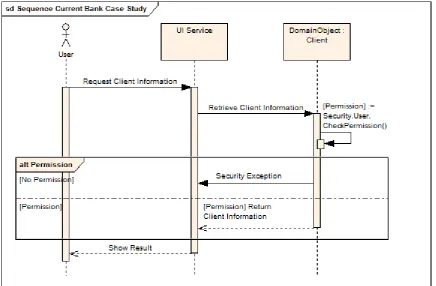
Code Fragment 1 is executed when the client’s ToString() method is called. First the authorisation of the current user is checked. The current user is retrieved in the security functionality and then the corresponding Roleset with the user’s authentication is retrieved. According to the Roleset of the user this action is allowed or disallowed. In case the action is disallowed, the calling object receives an exception and the code execution in the client class is stopped. In case the action is allowed, the calling object receives a string representation of the client class. This behaviour is shown in the sequence diagram in Figure 7.
Figure 7: Sequence diagram of the security checks in the Client implementation
3.2.2 Concerns
The high cohesion between security and the domain model poses a problem for separation of concerns. The coupling results in security functionality that cannot be separated from the domain functionality in this scenario.
3.2.3 Conclusion
Within this scenario no problems arise concerning authentication and authorisation. This implementation does not apply the DDD idea, where security should be a service, as it is domain-independent functionality. This should be improved in new scenarios.
The coupling between security classes and the other domain classes is strong because of the cohesion between the individual methods in the Client, Bank and Account classes and the security functionality. The domain class implementations were found to have a fan-in of 10 references and a fan-out of 17 references to the security functionality, as the domain classes have a reference to the security functionality in almost every method.
3.3 Criteria for case study designs
Selection criteria have been defined to determine the usability of the scenario designs. These criteria are the design and implementation level goals that should be attained. To what extent the scenarios comply with these criteria indicates their usability as a
solution.
A design option complies with the target DDD situation, in this case study, if it complies with these requirements:
- The security functionality is placed in a service with low coupling between the security service and domain implementation.
- The security functionality is implemented as a separate service and only fulfils the tasks of authentication and authorisation.
- The security service has knowledge and control over all interactions with the domain implementation.
- The security service and the other services are ‘regular’ services. A ‘regular’ service has access to both the domain implementation and the other services. This means that other services are still allowed to interact with the domain
implementation and not only with the security service.
Six criteria have been defined. These criteria are used to judge the potential of designs. Criteria for the new case study designs are:
2. The extent to which the scenario complies with the principles of separation of concerns. Is the security functionality separated from the domain
implementation? Does the security functionality only handle the concerns of correct authentication and authorisation?
3. The usability and efficiency for developers. How much code is needed to
implement the security? Can, a part of, this code be generated? The scalability of the solution proposed in the scenario should be considered here. In the bank case study this means the model can be effectively used in an environment containing multiple instances of the UI service.
4. The extent to which the scenario yields the same level of security as the design in section 3.2. This level of security indicates whether the UI service has possibilities to bypass the authentication and authorisation functionality.
5. The degree to which the scenario complies with the target DDD situation as explained in this section and the DDD definition as presented in Chapter 2. If the security functionality is implemented in a service, does it follow the general service definition?
Chapter 4
Security service design scenarios
This chapter presents the alternative scenarios developed to implement a security service in a DDD environment.
This chapter’s role is to create a set of platform-independent models that describe the design alternatives to the problems faced when designing security as a service in DDD. The goal is to create security in a service while maintaining ease of use and
authentication and authorisation correctness. In this chapter the assumption is made that the UI service is running on the computer of a user, and thus cannot be trusted.
If in this chapter a comparison is made with section 3.2, this comparison is made between the design of the case study implementation described in section 3.2and the design of the scenario.
The scenarios in this chapter are reviewed to determine the possibilities and features the model provides, but also to determine concerns about the restrictions introduced by the model structure. Finally a conclusion is made considering the usability of the design.
The scenario conclusion reflects on the design taking into account both the advantages and disadvantages of the design. The usability of the design indicates the usability for developers to work with the design is reviewed. The usability is determined by the compliance to the criteria that are summarized in section 3.3.
4.1 Scenario 1:
Security service as regular service
This scenario presents the possibilities that are available to developers when security functionality is implemented as a regular service.
4.1.1 Usability and Features
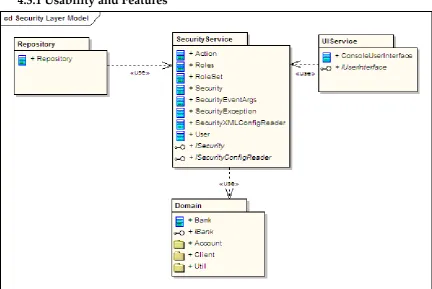
Figure 8: Class diagram of security as a regular service
In this scenario security is coupled to the domain model in the same way as a regular service. Separating the service resolves the issue concerning domain-integrated security. Because the security service is not able to impose rules on other services in this scenario, the UI service is allowed to interact with either the security service or directly with the domain classes.
The first part of security involves the authentication of the user. When interacting with the domain implementation the UI service first authenticates the user with the security service. The security service keeps track of the correct credentials for the UI. After authentication the UI service is able to request authorisation for actions.
The second part of security involves authorising actions of the user. The credentials for the user should be already available by authentication. The UI service is authorized according to its authentication level or roles. After authorisation the security service can perform the actions and return possible results or leave this interaction to the UI service.
Figure 9: Sequence diagram of successful security checks in the Security service
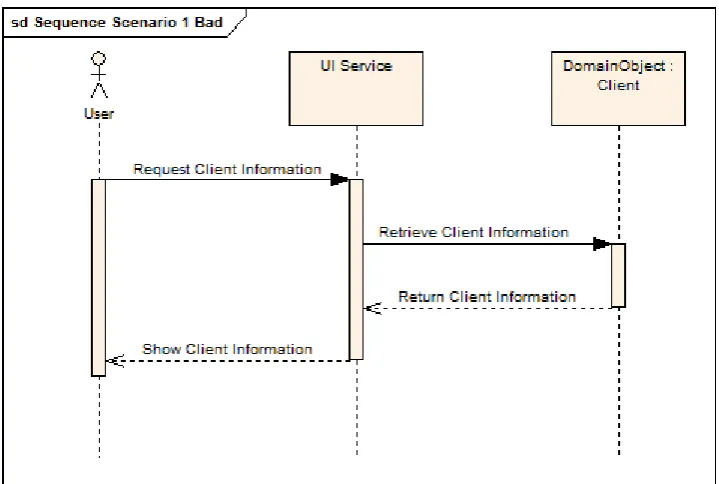
If the UI service interacts with the domain classes directly problems occur because these interactions are not checked, this behaviour is shown in Figure 10.
4.1.2 Concerns
Because the security service is implemented as a regular service, it is unable to regulate all interactions performed by the UI service. The UI service is able to interact with the domain classes without the security service being aware of this interaction. This interaction is shown in Figure 10. The UI service accesses the domain class without the security functionality being aware of this interaction.
When the UI service interacts with the methods in domain classes a problem arises, namely the identity of the user behind the UI service is not verified by the domain
classes. Here authentication is not performed. The same problems occur in authorisation. In some way the domain classes need to assure that the UI service has been
authenticated and is authorised to perform the action. This represents a problem in the DDD environment. The authorisation of the UI service can not be checked if the domain model is not aware of any service.
If the UI service interacts with the domain classes directly the remaining options are insecure:
- The event raising method is unsafe because there are no guarantees about which service responds to these events, if any.
- If a method is reserved to be called by the security service, this rule can not be enforced by the domain classes.
4.1.3 Conclusion
This design results in a lower coupling between the domain model and security. But this change is obtained in an insecure way.
This scenario is not usable because the UI service cannot be trusted. The direct interaction between the UI service and the domain model allow the UI service to perform arbitrary actions.
4.2 Scenario 2:
Security embedded in the UI
This scenario places the security functionality in the UI service. Moving the security functionality into the UI service could solve the problems with security seen in Scenario 1.
4.2.1 Usability and Features
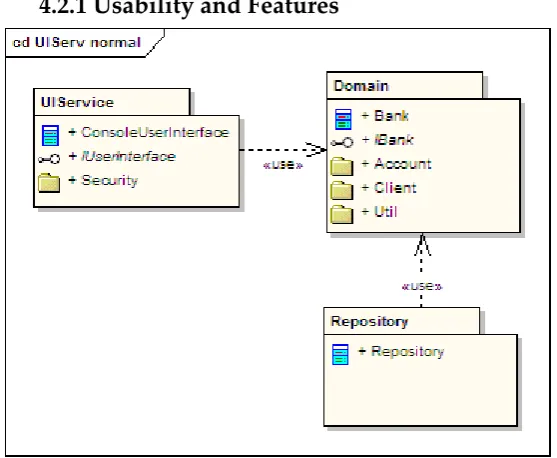
Figure 11: Class diagram of integrated security in the UI
In this scenario, the UI service embeds and implements all required features for
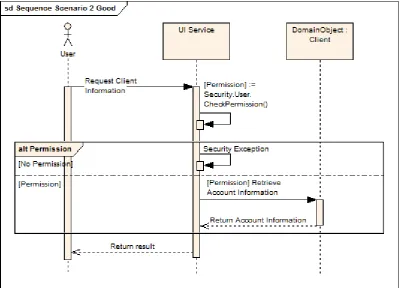
authentication and authorisation. When this scenario is used in a problem domain, the UI service authenticates the user by checking the provided credentials. After a successful authentication, the UI service checks all the actions to authorise them, before sending the actions to the domain model. The self regulating behaviour is efficient to program
because the security classes are only used when needed. The authorisation code for an action can be coded in the corresponding method or delegated to a security class inside the UI service.
Figure 12: Sequence diagram of successful security checks in the UI service
By placing the security features into the UI service, the domain classes are unaware of the security service implementation. The domain model has no pollution into the source code and does not implement any security features.
This scenario works in compliance with the DDD paradigm concerning the domain-related functionality and separation of security into a service. However, integrating different domain-independent functional components (the user interface and security) is not compliant with the DDD target situation as presented in section 3.3.
4.2.2 Concerns
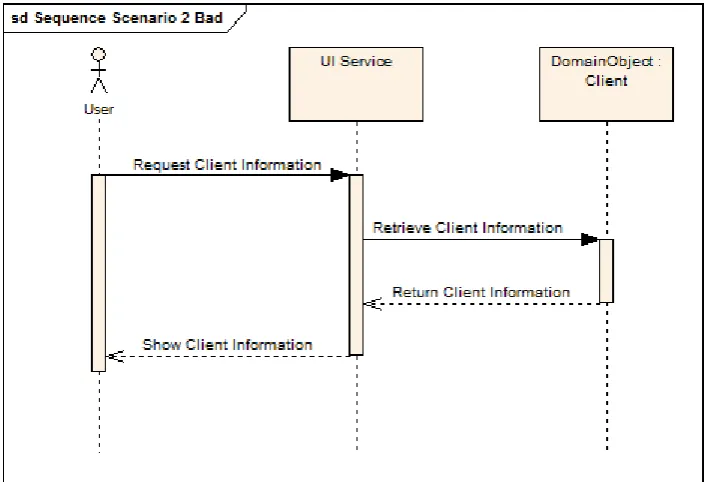
Figure 13: Sequence diagram of bypassed security checks in the UI service
If a different UI is required, the complete security code needs to be re-written in the new UI. This causes code duplication and extra work when expanding the application.
Code duplication refers to the fact that any change to the security rules needs to be done in multiple places. When not all UIs are updated correctly, bugs are introduced in the application. Code duplication conceals this if testing does not obtain full coverage.
4.2.3 Conclusion
Integrating security functionality into the UI service is a bad choice for the separation of concerns. Different domain-independent functionality should not be located in a single service. This combination of functionality creates a dependency between the UI and the security implementation, any change in security policy involves recalling all UI
implementations and updating them.
Glitches in the security implementation in the UI service represent a problem of the application that should be considered. If security methods are not checked, the UI service has a free passage into restricted domain functionality as shown in Figure 13. This scenario is not tamperproof; if the UI service methods are altered the domain classes do not know that executed actions are not allowed.
4.3 Scenario 3:
Security service encapsulating the domain model
This scenario provides for secure interactions between the services and the domain classes by intercepting all interactions originating from services. This should solve the issues with security described inScenario 1 and Scenario 2.
4.3.1 Usability and Features
Figure 14: Class diagram of security service as a layer above the domain model
In this scenario all services in the application are coupled to the security service. The security service relays all actions for the domain classes. This scenario allows imposing rules on other services and regulating their activities for a maximum security level.
When one of the regular services performs an action in the domain implementation, the security service checks the authentication and authorisation level of the caller. After the check the security service has to perform a number of different actions. Depending on the action and authorisation of the caller, the security service has to:
- Tunnel the function and procedure calls into the correct domain classes.
- Tunnel the function and procedure calls into the correct domain classes and filter the feedback afterwards.
- Call another, more restricted, function or procedure in the domain classes. - Block the function or procedure call and raise an exception.
- Relay events from the domain model towards other services.
Figure 15: The authorisation sequence with the security service as a layer
This scenario works in compliance with the DDD paradigm concerning the domain-related functionality and the separation of security functionality into a separate service. However, the security service does not only handle the authentication and authorisation, but also functions unrelated to security. These extra functions in the security service are not compliant with the DDD target situation as presented in section 3.3.
4.3.2 Concerns
In this scenario the security service acts like a broker of all interactions with the domain model. Managing all these interactions should not be the responsibility of the security service.
The security service contains a lot of methods mainly aimed at relaying information and requests to the other services.
Other effects of this design include that the security service needs to distinguish different services. A persistency service requesting a complete list of all users is completely
different from an UI requesting the same data. In this case the persistency service needs an authorisation level. This is not practical to implement because the main concern should be to authorise user actions.
Concerns regarding event handling arise; if services require reception of events
example is to notify the persistency service that a domain object is changed and needs to be stored. In this scenario the event or observable pattern should be intermediated by the security service, which is inefficient.
4.3.3 Conclusion
Compared to the implementation from section 3.2 this scenario has a lower coupling between the security implementation and the domain model. The remaining coupling is caused by checks performed by the security service that are based on the state of the domain model and the relaying of method invocations from all services.
In this scenario security is tight, as all interactions from all services towards the domain classes are checked. Authentication and authorisation work well when determining the security level between the UI service and the domain model. In order to implement this scenario, roles should be defined for services. Defining roles for specific services is more difficult. Each method invocation should be performed at the level of the lowest rights in the calling chain. Thus for different calls of the same method different roles must be provided by the service.
The security service has to perform too much tunnelling and intermediary work. Multiple tasks are performed by the security service. These tasks, security and performing intermediary work, should be separated.
4.4 Scenario 4:
Security service as a gateway for the UI
This scenario is based on the decision to let the security service only handle input from the UI service. By only authenticating and authorising the actions performed by the UI, other services do not have to be authorised and intermediated. This scenario is a
4.4.1 Usability and Features
Figure 16: Class diagram of the security service as a gateway for the UI
In this scenario the UI is only connected to the security service, all function and
procedure calls are directed at the security service. The input from the UI is transferred and checked by the security service. When the UI starts an interaction it needs to authenticate using the security service. Based on this authentication further actions initiated by the UI can be authorised. If another UI needs to be coupled to the domain, it can be linked to the already available security service, thus ensuring that the same restrictions apply to all the interfaces.
The location of the security service is based on the need to check the communication from the UI service with the domain model. Communication between the domain classes and the persistency service do not have to be checked because that service is only
reacting to changes in the domain classes and no outside parties (like an UI) are able to directly access the persistency service.
When the security service receives a request from the UI it checks the authorisation level. After the check the Security service has to perform four different actions.
- Tunnel the function and procedure calls into the correct domain classes.
- Tunnel the function and procedure calls into the correct domain classes and filter the feedback afterwards.
- Call another, more restricted, function or procedure in the domain classes. - Block the function or procedure call and raise an exception.
The security service also has to relay events from the domain classes towards the UI.
This scenario works in compliance with the DDD paradigm concerning the domain-related functionality and the separation of security functionality into a separate service. However, the security service does not only handle the authentication and authorisation, but also functions unrelated to security. These extra functions in the security service are not compliant with the DDD target situation as presented in section 3.3.
4.4.2 Concerns
The security service checks and relays all requests from the UI service; this includes requests unrelated to any security check. By handling all requests from the UI service the security service implements methods that only relay information between the domain model and the UI service. This is not a job that should be performed by the security service. Scalability problems arise, if the domain model is more complex, many methods are needed in the security service. A proxy or adapter pattern could be implemented to reduce this effect. With an adapter or proxy pattern, the adapter is responsible for the handling the tunnelling functions and the security functionality is only accesses when an interaction requires authorisation.
If the UI service is completely separated even from other services, the security service must also relay requests from the UI service towards other services. This also applies vice versa, i.e. events from other services must be redirected back to the UI service.
If another service requires authorisation checks, all interactions from this service must be handled by the security service to prevent unauthorised access.
4.4.3 Conclusion
Compared to the implementation from section 3.2 this scenario has a lower coupling between the security implementation and the domain model. The remaining coupling is caused by checks the security service performs that are based on the state of the domain model and the relaying of method invocations from the UI service.
This design presents a good step towards separation of concern by intercepting only the necessary method invocations. Only the pass-through functions should be separated from the security functionality, which enables better reuse of the security functions and classes.
4.5 Scenario 5:
Security service as an adapter for the UI
This scenario is an improvement on the decision to let the security service only handle input from the UI service. By only authenticating and authorising the actions performed by the UI service, actions of other services do not have to be handled by the security service.
same way this would yield the same functional result, as these are similar structural patterns [GOF95].
In its current form, this scenario leaves a choice to the designer. Either all services should be coupled to security adapters so their requests can be checked, or requests from the UI service towards the other services should be intercepted and checked. Checking requests towards other services means that adapters must be defined for interactions with these services.
4.5.1 Usability and Features
Figure 17: Class diagram of an adapter implementation
Figure 18: The authorisation sequence with the secure Client Adapter
Multiple services can use the same secure adapter if restricted access to the domain classes is needed. Security logic is separated into a separate service and all security rules are stored in the security service. This means there is one point where the security policy is defined.
If the repository is accessed by the UI service it should also return the security adapter objects instead of the domain objects.
By separating the security functionality into a standalone service, its focus retains the original purpose. The security service does not tunnel requests to the domain classes, the security functionality is only used when a method requires restricted access.
If the security adapter can not perform security checks because the security service is unavailable, the adapter blocks all restricted calls to the domain classes.
Only security adapters need to know the domain classes and generate coupling. In this scenario the security service still has to interact with the domain classes when security decisions are made that depend on the state of the domain classes.
The main benefit from this approach is that the base implementation of the security adapters can be generated. Points where security is applied are defined after this generation.
This scenario works in compliance with the DDD target situation concerning the
domain-related functionality and the separation of security functionality into a separate service. Depending on the placing of the adapters in the model this scenario is compliant with the DDD target situation as presented in section 3.3.
The adapters can not be placed inside the domain model. If the adapters are placed in the security service, the UI service does not interact directly with the domain
implementation.
4.5.2 Concerns
In order to function properly, assurances are needed that the UI service has no direct access to the domain classes.
Other services used by the UI service should also have no direct access to the domain classes, but only to the secure adapters.
If it is required that the UI service is completely separated even from other services, the security adapters must also relay requests from the UI service towards other services. This also applies vice versa, i.e. events from other services must be redirected back to the UI service.
4.5.3 Conclusion
Compared to the implementation from section 3.2 this scenario has a lower coupling between the security implementation and the domain model. The remaining coupling is caused by checks the security service performs that are based on the state of the domain model.
By moving the pass-through functions from the security service into adapters the actual security rules and logic are separated from the relaying of information. The security service regains the original concern of security.
4.6 Scenario 6:
Security service integrated by AOP with adapters
This scenario introduces Aspect-Oriented Programming (AOP) [AOP08] to the problem domain. By using AOP the UI service, adapters and the domain model do not have to be aware of the security service for authentication purposes. The UI service only requires knowing the security service for authentication and the definition of security exceptions. Aspect oriented programming defines aspects as pieces of code that have to be inserted in the source code at specific points. These aspects signify a crosscutting concern (aspect) of all the targeted methods in the source code.
AOP defines join points, point-cuts and advices to represent these places in the code [YASE07]. Join points represent locations, like method entries or property declarations, in the source code where AOP can hook in. Point-cuts define to which join points a specific a
![Figure 2: DDD Layer model by Eric Evans[EVAN03 p.68] [EVAN06 p. 29]](https://thumb-us.123doks.com/thumbv2/123dok_us/1029894.1128110/15.595.70.253.73.410/figure-ddd-layer-model-eric-evans-evan-evan.webp)