A Review on Java Frameworks for Web Applications
G. Raghavendra1, P. Pushpanjali2
1Department of MCA, A. Rangampeta, Tirupati, Andhra Pradesh, India
2Assistant Professor, Department of MCA, Sree Vidyanikethan Institute of Management A.Rangampeta, Tirupati, Andhra Pradesh, India
ABSTRACT
In this paper represents the web design frameworks as a conceptual methodology to expend the probabilities reuse in Web applications. Firstly I have presented the importance for construction abstract and reusable directional design structures, demonstrating with different kinds of Web information Systems. Hibernate Framework Technology as unique and well-organized resources to take immeasurable databases and also on how to implement persistent features in object-oriented system finished it. It provides a denotation of design patterns and frameworks and discovers the confederation between design patterns and Frame works. Java accepts N-tier framework of MVC Model in platform and uses EJB, Struts WEB Framework and Hibernate technology.
Keywords: Framework, Hibernate, J2EE, spring, Web Design
I.
INTRODUCTION
A study of the Java language expending the framework of abstract generous has been the subject of substantial research in the last decade. A main part of the enhancement of an avocation application involves the creation and supervision of the persistence layer used to assemble and retrieve objects from the database of choice. Hibernate phases in to fill this crack, provided that an easy-to-use and authorised object relational persistence Framework for Java applications. And Design patterns to identify, name and abstract frequent problems in software development and to identify best practice solutions. Tools and techniques for testing parallel Java programs are still under active research and include dynamic analysis, static analysis, model checking, and combinations of these techniques. The objective of this paper refer to a practical library and practise to model check Java programs for endorse simultaneous components without the essential to install other more convoluted tackles. The Spring
Framework provides perfect programming and configuration model for new Java-based enterprise applications - on any kind of deployment platform.
II.
SPRING FRAMEWORK ARCHITECTURE
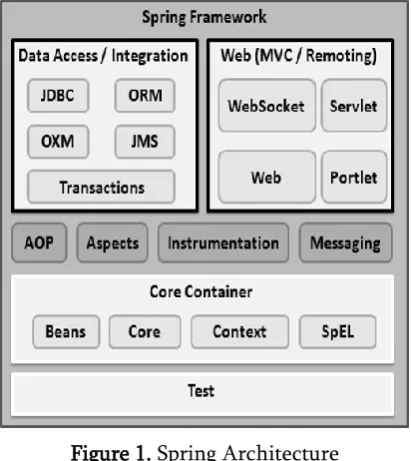
By adopting spring it is simple to create Java enterprise applications. It brings anything you need to embrace the Java language in an enterprise environment, with support for Groovy and Kotlin as alternative languages on the JVM, and with the flexibility to create many kinds of architectures depending on an application’s needs. The Spring Framework arrange for about 20 modules which can be used based on an application requirement.
Figure 1. Spring Architecture
In the spring architecture modules have placed in the top down approach. Core, Beans, Context and Expression modules are placed in the core container.
The elemental concept is Bean Factory is it provides a discharge of Factory Pattern which creates the bean as per the shape given by the developer in XML .XML developers can assign method-interceptors and point cuts to keep the concerns apart it is allowed by the Aspect Oriented Programming. The compilation step is skipped by arranging it at the run time.it is easier to maintain because it targets at declarative transaction management. The DAO module provides low level task of creating a connection, releasing it etc. It further maintains a ranking of essential barring instead of throwing heavy error codes from database vendors. It uses AOP manage transactions. Programmatically also transactions can be managed. Spring doesn’t provides its own ORM application but offers combination with famous Object Relational mapping tools like iBATIS SQL Maps, Hibernate, Oracle TopLink and JPA etc. The JEE module provides support for JMX, JCA, EJB and JMS etc. In lots of cases, JCA (Java EE Connection API) is much like JDBC, except where JDBC is focused on database JCA focus on connecting to legacy systems.
III. STRUTS FRAMEWORK ARCHITECTURE:
Struts framework extends the Java Servlet API and engages MVC architecture. It means Model View Controller .Model hold JavaBeans, EJB and View hold JSP files and Controller hold out by Actions. It gives you a chance to create formable web applications based on JSP pages, Java Beans and XML.
Struts architecture shown below
Figure 2. Struts framework architecture
an Action Forward to the controller after completing the request processing.
IV. HIBERNATE FRAMEWORK
ARCHITECTURE:
Hibernate is a technology and framework as well it is used to collaborate with database server this framework courage all the problems of JDBC. Professionally it maps Java classes to database tables. It is mostly connected with databases. it starts the transaction and ends the transaction as the part of Hibernate. to start the transaction and end the transaction Hibernate internally uses JTA. The Hibernate framework uses many objects session factory, session, transaction etc.
Figure 3. Hibernate Framework Architecture
We have to know about elements of Hibernate architecture to creation of hibernate application
Session Factory: The Session Factory is a factory of session. It holds second level cache data.
Session factory Interface: To get the object of Session. The session factory interface provides factory method.
Session object: The session object provides an interface between the application and data
stored in the database. It is factory of Transaction. It holds a first-level cache data.
Session Interface: To insert and update and delete the object the session interface provides method. It also provides factory methods for Transaction.
Transaction abject: The transaction object specifies the atomic unit of work. It is optional.
Transaction interface: The Transaction interface provides methods for transaction management.
Connection provider: The connection provider is a factory of JDBC connections.
It abstracts the application from Driver Manager or Data Source. It is optional.
Transaction factory: The transaction factory is a factory of Transaction. It is optional.
V.
JSP ARCHITECTURE:
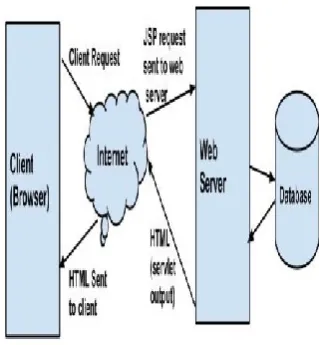
Java Server Pages are each of 3-tier architecture. Java Server Pages supported by the server. This server will mediate between client browser and a database. In MVC architecture JSP will works as a View component. To provide the runtime environment and other services which JSP needs, A JSP container works with the web server. The position of JSP container and JSP files in a Web application are as shown in the below diagram.
Your browser sends an HTTP request to the web server. The web server recognizes that the HTTP request and forwards it to a JSP engine. This will process by using the URL or JSP page which will be ends with .jsp. It converts it into servlet content when JSP engine Loades the JSP page from disk.
JSP engine forwards the original request to a servlet engine by compiling the servlet into an executable class. A part of the web server called the servlet engine loads the Servlet class and executes it. The servlet produces an output in HTML format during execution. The output is further passed on to the web server by the servlet engine inside an HTTP define in a general way video analysis methodologies implemented in software. Java-based Web improvement has been filled by frameworks of every kind. It has been ages since I ‘m saying a Web application being industrialized without any framework being recycled. Name it and there’s a Java framework that privileges to do it. Essentially there might two or three that do the same thing. In this article, I'll take a closer look at the framework approach to development and some of the more popular Java Web frameworks available.
Hibernates:
Hibernate is better than plain JDBC
Mapping of Domain object to relational
You want a group of taglibs that produce form fields and so forth, Struts is possibly the better choice. Our User Interface is typically click-driven and light on data and validation. It seems to me that peak individuals run into problems with Struts when they start touching a lot of data from HTTP into the mode. A strut is a refined framework contribution the easy to develop, structured view/presentation layer of the MVC applications. Advanced, strong and accessible view framework underpinning reuse and separation of concerns to certain extent.
Spring:
In spring, you just use annotation to add bean dependency.no need to write long code.
Testing is easy in IOC, since you can inject your own test code during unit testing.
Spring provides Aspect Oriented programming
It solves the separation of concerns at a much bigger level.
It allows the programmer to add the features at the declaration level.
Spring WEB framework has a MVC framework, it provides a great alternate to web framework.
Spring can eliminate the creation of the singleton and factory classes.
Spring framework is complete and modular.
VII.
CONCLUSIONS
debugging and testing the software.
VIII.
REFERENCES
[1]. B.Vasavi,Y.V.Sreevani,& Priya,G. (2011,June). HIBERNATE TECHNOLOGY FOR AN EFFICIENT BUSINESS APPLICATION EXTENSION. Journal of Global Research in Computer Science,2(6),118-125. Retrieved from www.jgrcs.info
[2]. Dashrath Mane,K. C. (2013,july). The Spring Framework: AN OPEN SOURCE JAVA PLATFORM FOR DEVELOPING ROBUST JAVA APPLICATIONS. International Journal of Innovative Technology and Exploring Engineering (IJITEE),3(2),138-143.
[3]. Dimitris K. Iakovidis,D. D. (2014,July). OPEN-ACCESS FRAMEWORK FOR EFFICIENT OBJECT-ORIENTED DEVELOPMENT OF VIDEO ANALYSIS SOFTWARE. Journal of Software Engineering and Applications,730-743. doi:10.4236/jsea.2014.78068
[4]. FURTUNĂ,C. F. (2006). ENTERPRISE APPLICATION INTEGRATION USING JAVA TECHNOLOGIES. Revista Informatics Economică,9-17.
[5]. (America) Marty Hall,Larry Brown. Core Servlet and Java Server Pages: Volume 1: Core Technologies 2nd Edition M]. PEARSON Prentice Hall,2004.
[6]. LI Gang. the actual practice of Lightweight Java EE enterprise application-Integration and development using Struts 2,Spring and Hibernate M]. Beijing: Electronic industry press,2007.
[7]. YANG Shabo. J2EE Project training- Hibernate frame technology M]. Beijing: Tsinghua university press,2008.
[8]. LIU Bin. Proficient in Java Web integration anddevelopment:JSP+AJAX+Strust+Hibernate M]. Electronic industry press,2007.11.
[9]. SHA Shixuan,WANG Shan. An introduction to database system (3rd Edition) M].Higher education press,2000.
[10]. KE Baicong. Ajax Development— conception,Case and the framework M].Electronic industry press,2006.5.
[11]. YANG Shulin,HU Jieping. The latest Java language practical case tutorial. Beijing: Tsinghua university press,2006.