Figure 1: The Error Annotation Tool
any part of the audio signal for playing back. Check boxes at various levels are provided to mark errors by simply tick the check box in the corresponding error column. Com-ments at any level are also possible. The following error types are considered as relevant: deletion, insertion, distor-tion, substitudistor-tion, spoken, stress and pause.
In comparison to other tools (e.g., EasyAlign (Goldman, 2011)), which display alignment and annotation on Praat TextGrid tiers, this annotation tool presents alignment and annotation in separate views. This is possible because alignment and annotation are stored in different files. Other useful features are also implemented:
• zooming the waveform in case there is not enough space to show each phoneme,
• playing the same sentence with native speech if avail-able and
• showing different diagrams such as spectrogram and pitch contours, enabling analysis from various views.
This tool uses the open source EHMM (Black and Lenzo, 2000) to perform force alignment, and MARY TTS (Schr¨oder et al., 2011), a DFKI open-source speech syn-thesis platform, as text analyser and speech signal proces-sor. Only the audio data and its transcriptions are needed as input. As output, the annotations are stored in XML for-mat, which is consistent with the schema used in MARY TTS. This tool is written in Java and can be deployed on any machine with JRE, and it is also accessible online with embedded Java Applet. More details about this tool can be found in (Ai and Charfuelan, 2014).
In order to test the tool and perform further experiments a corpus was collected. Gold standard English sentences were recorded by a female and a male teacher. A selected set of these sentences (96), were recorded as well by nine female and two male German learners of English. This cor-pus was segmented per sentences, forced aligned to the text, and currently is being annotated with the tool previously described.
2.2. Automatic Feedback
Feedback via Visualization The Sprinter system can provide a score by automatically comparing a sentence pro-nounced by a teacher and the learner, in order to give the learner an overall idea of her/his performance. Due to the forced alignment results from EHMM, the error can be ex-actly located to the phoneme section in the waveform. Var-ious graphs can be generated for the learner to compare the difference visually, e.g. by displaying the pitch contours of the teacher’s and learner’s voice, or the learner is shown at which section the tone should be lowered or raised as de-picted in Figure 2.
Advanced Audio Feedback As pointed out by (Flege, 1995), simple playback of the native and learner’s speech cannot help learners to perceive the difference between the sound they produced and the correct target sound. Hence we developed a more advanced type of audio feedback via prosody transplantation.
Figure 3: Web-based paraphrasing tool
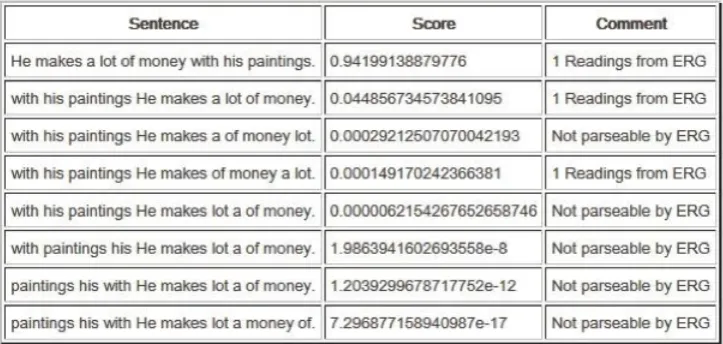
with results from the paraphraser. Feedback for the para-phraser’s suggestions can be provided as a rating on a 3-level scale as being good, acceptable (in special contexts) or just bad.
Currently, English and German are supported. The depen-dency parser and generator were trained on dependepen-dency versions of the Penn Treebank and the TIGER Treebank, respectively. The deep parsers for grammatical verifica-tion are based on HPSG grammars, the English Resource Grammar (ERG (Copestake and Flickinger, 2000)) and the German Grammar (GG (M¨uller and Kasper, 2000)), both in their actual versions from DELPH-IN2.
The system was evaluated with the data from 44 English ex-ercises. On average the system generated 3.8 paraphrases for these sentences. In nearly all cases, the original sen-tence was also reproduced as “best” linearization. We take this as an indication of high reliability of the analy-sis as well as of the sentence generation. Ungrammatical paraphrases were correctly identified by the English HPSG grammar in 63% of cases.
2http://moin.delph-in.net/
For the future, the inclusion of tree re-writing methods and lexical resources is planned to extend the system to other paraphrase types, such as lexical paraphrases, diathesis and dialog ellipsis.
4.
Dialogue for Language Learning
Sprinter offers an interactive dialogue training in a game-like exercise. In this exercise, users can train their con-versation abilities in special prototypical scenarios such as hotel room reservation or business phone calls through text-based or spoken chat with a software agent. In the interac-tive dialogue training, the users moreover can practise their language skills in general.Figure 4: Dialogue-Based Interactive Language Learning
Java 7 Websocket API.
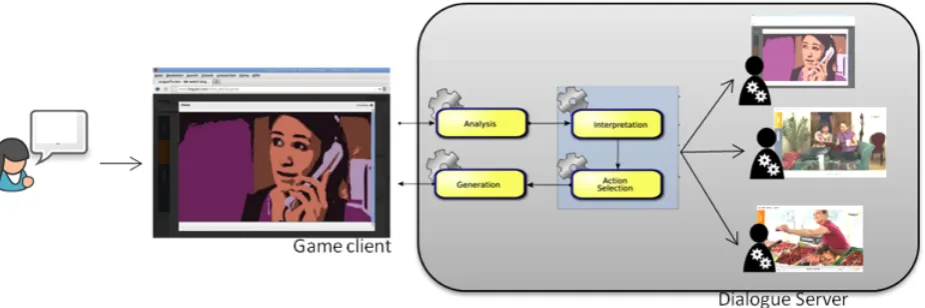
The dialogue agent architecture is independent of the actual scenario. Possible types of agents are the possible game scenarios such as “hotel room reservation” and “appoint-ment phone calls”. The dialogue server manages the classes of agents and the instantiated agent-objects. In the final sys-tem for every game started a new agent representing the se-lected scenario will be created. The agents all use the same dialogue system’s methods for analysis and generation, but differ in their dialogue models, which are scenario-specific. A dialogue model encodes the knowledge about a conver-sation for a specific scenario.
Dialogue models are learned from conversation data suc-cessively. Conversation data originates from the scripts of the LinguaTV videos and additional sources if available. For the current version of the system prototype, data from a Business English video lesson dealing with an appointment phone call was prepared and annotated with dialogue act, topic and sequence information. Additionally, data from the Verbmobil corpus was used. The final data set consists of 120 conversations.
The employed inventory of dialogue acts is a subset of the DIT++ set (Bunt, 2006; Bunt, 2011; Geertzen, 2009) aug-mented by an additional set for small-talk dialogue acts (Kl¨uwer, 2011). Topics are annotated using a specific on-tology for the appointment domain plus WordNet. Topics are URIs of the RDF versions of the knowledge bases.
From the annotated dialogue data, state graphs are learned that represent the dialogue models. Using standard methods for finite state automata, they are then integrated into the final dialogue system.
Figure 4 shows the communication pipeline of the game exercise. A user gives input to the game client. The game client delivers the input to the dialogue server via a Web-Socket connection. The server analyzes the incoming data, identifies or creates the dialogue agent for the scenario and retrieves an abstract answer using the agent’s dialogue model. Lastly, the dialogue system generates a response, which is sent back to the game client and there presented to the user.
5.
Conclusion
We have presented our research results, which will con-tribute to interactive and individualized language learning and to automatic generation of high quality learning con-tent.
• Our annotation tool for pronunciation errors provides a convenient way for identifying and annotating the error types of each corresponding phoneme via visu-alization of sound and audio playback
• The annotated resources enable a combination of vi-sualization feedback and advanced audio feedback via speech transplantation, which helps users to under-stand their errors and the ways to correct them
• The parse and generate method for paraphrasing heav-ily reuses existing resources (treebanks, grammars and parsers) in a combination of parsing and generation technology in a novel way for the automatic creation of learning content
• The dialogue-based game provides an interactive sit-uation based learning context where learners can be tested with various learning goals such as pragmat-ics, word and grammar. To this end it uses anno-tated dialogue data from video transcripts and existing resources such as dialogue-act inventories and Word-Nets.
By the number, variety and creative use of existing and new data and tools that were needed to realize novel features of a single application, the described research demonstrates the importance of language resources for product innovation.
6.
Acknowledgements
This research was partially supported by the German Fed-eral Ministry of Education and Research (BMBF) through the project Sprinter (contract 01IS12006A) and the project Deependance (contract 01IW11003).
7.
References
Black, Alan and Lenzo, Kevin. (2000). Building voices in the festival speech synthesis system.
Bunt, Harry. (2006). Dimensions in dialogue act anno-tation. In Proc. of LREC, volume 6, pages 919–924, Genoa, Italy.
Bunt, Harry. (2011). Multifunctionality in dialogue. Com-puter Speech & Language, 25(2):222–245.
Copestake, Ann and Flickinger, Dan. (2000). An open source grammar development environment and broad-coverage english grammar using HPSG. In Proc. of LREC, Athens, Greece.
Felps, Daniel, Bortfeld, Heather, and Gutierrez-Osuna, Ri-cardo. (2009). Foreign accent conversion in computer assisted pronunciation training. Speech communication, 51(10):920–932.
Flege, James E. (1995). Second language speech learning: Theory, findings, and problems. Speech perception and linguistic experience: Issues in cross-language research, pages 233–277.
Geertzen, J. (2009). The automatic recognition and predic-tion of dialogue acts. Ph.D. thesis, PhD Thesis, Tilburg University.
Goldman, Jean Philippe. (2011). Easyalign: An automatic phonetic alignment tool under Praat. In Interspeech, pages 3233–3236.
Kl¨uwer, Tina. (2011). i like your shirt-dialogue acts for en-abling social talk in conversational agents. InIntelligent Virtual Agents, pages 14–27. Springer.
Moulines, Eric and Charpentier, Francis. (1990). Pitch-synchronous waveform processing techniques for text-to-speech synthesis using diphones.Speech communica-tion, 9(5):453–467.
M¨uller, Stefan and Kasper, Walter. (2000). Hpsg analy-sis of german. InVerbmobil: Foundations of Speech-to-Speech Translation, pages 238–253. Springer.
Schr¨oder, Marc, Charfuelan, Marcela, Pammi, Sathish, Steiner, Ingmar, et al. (2011). Open source voice cre-ation toolkit for the mary tts platform. In12th Annual Conference of the International Speech Communication Association-Interspeech 2011, pages 3253–3256. Turk, Oytun and Schr¨oder, Marc. (2010). Evaluation of
expressive speech synthesis with voice conversion and copy resynthesis techniques. Audio, Speech, and Lan-guage Processing, IEEE Transactions on, 18(5):965– 973.
Volokh, Alexander and Neumann, G¨unter. (2012). Depen-dency parsing with efficient feature extraction. In KI 2012: Advances in Artificial Intelligence, pages 253– 256. Springer.