An Algorithm to Find Words from Definitions
Dominique Dutoit*, Pierre Nugues
† * Memodata, 17, rue Dumont d’Urville, 14000 Caen, France CRISCO, CNRS, Université de Caen, 14032 Caen Cedex, France[email protected] † Computer Science Department,
Lund University, LTH, Box 118 221 00 Lund, Sweden. [email protected]
Abstract
This paper presents a system to find automatically words from a definition or a paraphrase. The system uses a lexical database of French words that is comparable in its size to WordNet and an algorithm that evaluates distances in the semantic graph between hypernyms and hyponyms of the words in the definition. The paper first outlines the structure of the lexical network on which the method is based. It then describes the algorithm. Finally, it concludes with examples of results we have obtained.
1. Introduction
Le mot juste – the right word – consists in finding a word, and sometimes the only one, that describes the most precisely an object, a concept, an action, a feeling, or an idea. It is one of the most delicate aspects of writing. Generations of students, writers, or apprentice authors have probably experienced this. Unfortunately, we must too often content ourselves with approximations and circumlocutions.
The right word is also crucial to formulate accurately the elements of a problem and solve it. Naming a broken or defective part in a car or a bicycle is a challenge to any average driver when confronted with a mechanic. The right word is yet essential to find the part number in a database, order it, and have it replaced. This problem is even more acute when no human help is possible as for some e-commerce applications where access to information is completely automated.
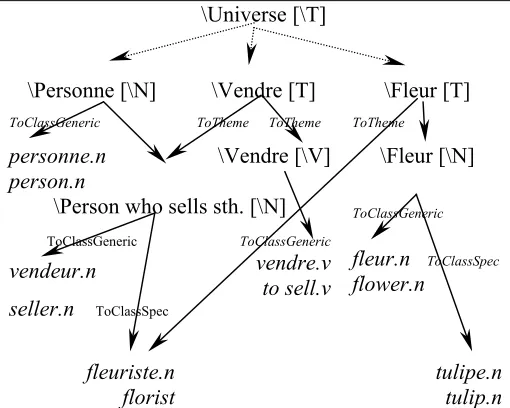
When the adequate vocabulary escapes us, a common remedy is to employ a circumlocution, a description made of more general words. Examples of such circumlocutions are dictionary definitions that conform to the Aristotelian tradition as in une personne qui vend des fleurs (a person that sells flowers) to designate a fleuriste (a florist) or la petite roue dentée au centre d’une roue de vélo (the small toothed wheel in the center of a bicycle wheel) for pignon (sprocket-wheel).
This kind of definitions consists of two parts. A first one relates the object, the idea in question, to a genus to which the object, the idea belong, here personne (person). Then, the second part specifies it with a differentia specifica, a property that makes the object particular, here qui vend des fleurs
(who sells flowers). A florist can thus be described as a species within the genus personne, with the differentia specifica “qui vend des fleurs.”
The description of the florist corresponds closely to its definition in the French Petit Robert dictionary: Personne qui fait le commerce des fleurs (a person who trades in flowers). In the Cambridge International Dictionary of English, the definition is slightly more restrictive: a person who works in a shop which sells cut flowers and plants for inside the house. However, the correspondence between
somebody’s wording of a concept and the word definition in a dictionary is not always as straightforward.
2. The Lexical Database
2.1. The Integral DictionaryThe Integral Dictionary – TID – (see Dutoit (1992) and Dutoit (2000) for details) is a semantic network associated to a lexicon. It is available mainly for French and it is currently being adapted to other languages notably English and German. Its size is comparable to that of major lexical networks available in English such as WordNet (Fellbaum, 1998) or MindNet (Richardson et al. 1998).
A subset of the Integral Dictionary forms the core of the French lexicon in the EuroWordNet database (Vossen 1999). Although the structure of the Integral Dictionary and WordNet do not map exactly, it was possible to derive TID data and feed them in a WordNet compatible structure. In addition, the TID structure will be used in the Balkanet European project to merge the word nets for Balkan languages (Greek, Turkish, Bulgarian, Romanian, Czech, and Serbian) in a single database (Balkanet 2000).
2.2. The Structure of The Integral Dictionary
The Integral Dictionary organizes words into varieties of concepts and uses semantic lexical functions. Concept definitions are based on the componential semantic theory (Pottier 1974; Greimas 1986) and the lexical functions are inspired by the Meaning-Text theory (Mel’cuk 1992).
Both lexical functions and componential semantics can be accessed in the Integral Dictionary using a Java application programming interface (API). There are more than 30 API functions with parameters for seven languages: English, French, Spanish, Italian, Dutch, German, and Portuguese. In this article, we use five functions.
2.2.1. A Graph of Concepts
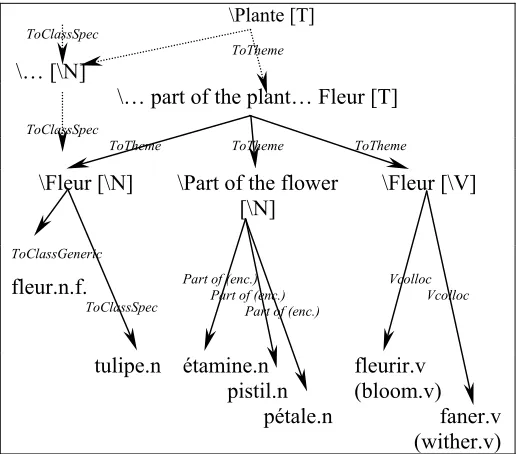
retaining the possibility to restrain the seme set to specific concepts (Figure 2).
\Universe [\T]
\Personne [\N] \Vendre [T] \Fleur [T]
ToClassGeneric ToTheme ToTheme ToTheme
personne.n person.n
\Vendre [\V] \Fleur [\N]
\Person who sells sth. [\N] ToClassGeneric
ToClassGeneric vendeur.n
seller.n ToClassSpec
ToClassGeneric vendre.v
to sell.v
fleur.n ToClassSpec flower.n
fleuriste.n florist
tulipe.n tulip.n
Figure 2 A part of the semantic decomposition of fleuriste.
2.2.4. Lexical Semantic Functions
Lexical semantic functions generate word senses from another word sense given as an input. Functions are divided into subsets. Amongst the most significant ones, a subset, S0, S1, and S2, carries out semantic derivations of verbs. These functions could be compared to nominalization in derivational morphology but they operate in the semantic domain and are applied to a specific verb case:
• S0(acheter/buy.v) = achat (morphological nominalization)
• S1(acheter) = acheteur/buyer (subject nominalization),
• S2(acheter) = {achat, marchandise, service}/{purchase, goods, service} (object nominalization),
The Integral Dictionary has implemented 66 lexical functions in total. It corresponds to 96,000 links between the words. The links between adjectives and nouns are amongst the most productive ones in the French part of the Integral Dictionary.
3. An Algorithm to Find Words from
Definitions
The algorithm searches words using two main mechanisms. The first one extracts sets of words from the database that delimit the search space. In the definition “a person who sells marguerites”, the algorithm extracts all the sets of persons.
The second mechanism computes a semantic distance between each candidate word in the person sets and the definition. This distance is asymmetric and is based on the structure of the differentia specifica and the semantic topology of TID.
As we can imagine, such sets can be very large. The sets corresponding to person cover more than 10,000 words in TID. When needed, a third mechanism prunes rapidly the search space (Bertholon 1998).
3.1. The Semantic Network
The Integral Dictionary superimposes two graphs. A first one forms an acyclic graph whose terminal nodes are the words, the other nodes are concepts, and where the arcs correspond to relations. A second one connects the words using and lexical functions. Figure 3 shows a simplified picture of this structure. The distance between two words or phrases is derived from the first graph.
R10 R1
\Universe
\A \B \C
W3
W5
R2 R3
R4
R5 R6R7 R9
\D \E \F
W1
W4
R11
W2
R12 R13 R14 R15 R16
LF2 LF1
LF3
R8
Figure 3. The graph of concepts, words, relations, and lexical functions.
In Figure 3, nodes beginning with a backslash ‘\’ are concepts while W1, W2, W3, etc. are words. The root node of the graph is the \Universe label, which is the ancestor of all the concepts. It has a three children respectively \A, \B, and \C, which can either classes or themes.
Arc labels Rn are relations linking the concepts and LFn are lexical functions. In Figure 3, W3 has two parents connected by arcs representing two different relations: R14(\E) = W3 and R15(\F) = W3. LF1 is a lexical function linking W3 to W4: LF1(W3) = W4. Inverse relations and lexical functions are implemented so that a parent can be found from its child.
The average number of parents of a word or a concept in the Integral Dictionary is 2.1. The average depth of the graph from the root is 15. From these numbers, we can evaluate the average number of concepts a word can be member of: 152.1
= 294.
3.2. A Semantic Distance
The distance between two words or phrases is derived from the graph topology as shaped by the relations. It is the sum of two terms that we call respectively the semantic activation distance and the semantic proximity distance. We describe here a simplified version of this distance.
3.2.1. The Semantic Activation
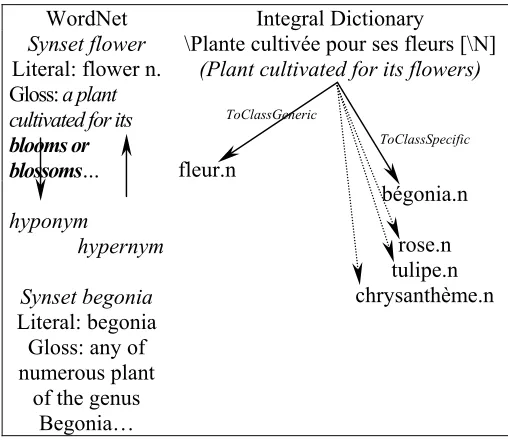
than in WordNet. Figure 4 shows the hyponymy relationships of flower.n in both lexical networks.
WordNet Integral Dictionary \Plante cultivée pour ses fleurs [\N]
(Plant cultivated for its flowers)
ToClassGeneric
ToClassSpecific
bégonia.n
rose.n tulipe.n chrysanthème.n
Synset flower
Literal: flower n. Gloss: a plant cultivated for its
blooms or blossoms…
hyponym
hypernym
Synset begonia
Literal: begonia Gloss: any of numerous plant
of the genus Begonia…
fleur.n
Figure 4 Hyponyms/hypernyms links in WordNet and in the Integral Dictionary.
Figure 4 shows that begonia is linked to flower by one single link in WordNet while the Integral Dictionary requires two symmetric links. The first one connects fleur.n to the class \plante cultivée pour ses fleurs [\N]. A second one connects this class to bégonia.n. This feature makes the search more complex but adds more flexibility to describe the lexicon. In the end, it is possible to extract sets of related words using a composition of hypernymy and hyponymy functions in both networks. In the Integral dictionary, it corresponds to the ToClassSpecific and ToClassGeneric functions.
ToClassSpecific ° ToClassGeneric (fleur.n) = {bégonia.n, rose.n, tulipe.n, …}
We call this composition Specific.
3.3.2. Ranking the Extracted Words
Then, to find answers from the query vendeur de fleurs (seller of flowers), we first extract all the words corresponding to salespeople in the lexical database:
Specific(vendeur.n) = {vendeur, boulanger, boucher, papetier, fleuriste, bouquetière, etc.}1
Using the measure of the semantic proximity, we compute:
1. The semantic proximity between vendeur de fleurs and the extracted words: d(vendeur de fleurs, X)
2. The semantic proximity between the extracted words and the phrase vendeur de fleurs: d(X, vendeur de fleurs)
1{shop assistant, baker, butcher, stationer, florist, female flower
seller, etc.}
where X is the extracted word for specific(vendeur).
Let’s show why we need both measures..
Let’s suppose that we only use the first asymmetric difference. As in the query vendeur de fleurs, we have no seme about the gender of the seller, it will be impossible to make a difference between the two specifics: fleuriste and
bouquetière. These two specific terms saturate all the semes of the query vendeur de fleurs. To differentiate between
fleuriste and bouquetière, we need to produce the two measures (2): d(fleuriste, vendeur de fleurs) and
d(bouquetière, vendeur de fleurs). With this second measure, we obtain that bouquetière has a seme (feminine gender) non saturated by the query. It is not the same for fleuriste, which has no non-saturated seme with this query. To solve our problem (to distinguish the specifics bouquetière and
fleuriste from seller of flower), the measure 2 was needed. As, in the answers seller or shop assistant we have no seme about what is selling, the measure (2) will say that any semes of seller or shop assistant are saturated by the queries
seller of flowers. To differentiate between fleuriste and one of these specifics, we need to produce the measure (1): d(vendeur de fleurs, fleuriste), d(vendeur de fleurs, seller),
d(vendeur de fleurs, shop assistant). ?? Il faudrait mieux mettre les mots en francais ??
If we compute these measures, we can observe that only
florist saturates the query vendeur de fleurs. To solve our problem (to distinguish the specifics seller and fleuriste from
seller of flowers), the measure 1 was needed. The figure 5 summarizes these results.
Query Vendeur fleur
?\fleur? ?\woman?
Answers fleuriste vendeur Bouquetière
Figure 5. The measure top to down (2) sees the distinctive seme
flower and eliminates vendeur, the measure down to top (1) sees the distinctive seme woman and eliminates bouquetière.
3.3.3. Complex Queries
In the previous sections, we have described queries using one term to distinguish between the specific terms. We have used in the last section some virtual points of the dictionary by adding the seme of different words (for example, a virtual point based on the points of seller and flower). Then, the calculation has compared this virtual point seller + flower to a lexical point, by example florist. It’s possible to use the same process with number of words in the query. Sometime, a horizon effect may appear. In this case, we use graph techniques to limit the effect. These techniques that use together LAA, LCA and offsets of the words will be not describe in the paper. We will suppose that it’s possible to add numerous semes in a semantic phrases to represent queries as complex as small-toothed wheel in the center of a bicycle wheel.
4. Results
The probability to select the good answer in our example (florist) is 1/10,000. As we can see, the algorithm provides other words close to the definition: flower grower, flower seller, horticulturist, etc. These terms are ranked by the proximity as indicator of relevance: the lower, the closer. Proximity is the average of the two measures given above.
Rank Word English translation Proximity 1 Fleuriste Florist 1.34 2 Floriculteur Flower grower 1.57 3 Vendeur Person who sells
something
1.77
4 Bouquetière Flower seller in a street
1.84
5 Horticulteur Horticulturist 2.21 6 Rosiériste Rose grower 2.35
Rank Word English translation Proximity 7 marchand Tradesman 2.57 8 Maraîcher Market gardener 2.71 9 Paysagiste Landscape painter 3.12 10 Fruiticulteur Fruit farmer 3.93
Table 2 Words corresponding to the phrase Personne qui vend des fleurs.
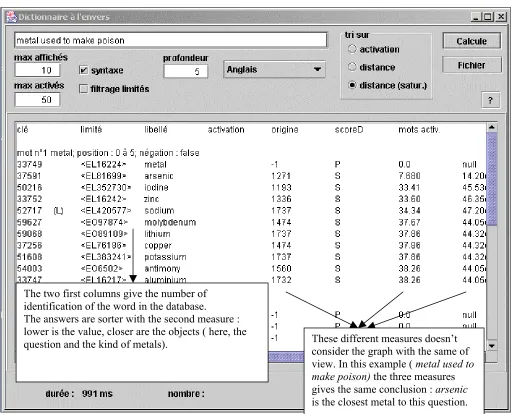
The next picture shows the interface of this API made by the five basic mechanisms.
In this screen, the question is given in English, and the answers are selected in English.
Figure 6. Finding words from definition API
These different measures doesn’t consider the graph with the same of view. In this example ( metal used to make poison) the three measures gives the same conclusion : arsenic
is the closest metal to this question. The two first columns give the number of
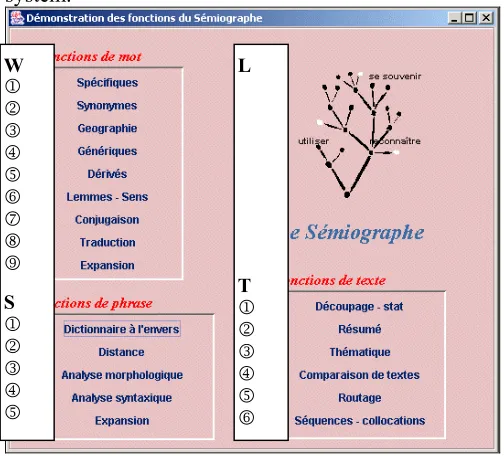
The figure 7 shows the main APIs of the complete system.
Figure 7. The main menu of the Semiograph
We give details to the APIs showed in French in the figure 7. The APIs with the one * was used in this paper. (*)
• W : Group the APIs based on the words.
o 1 : to obtain all the specifics (hyponyms) of a word or a word-meaning (*)
o 2 : to obtain synonyms of a word or a word-meaning (*)
o 3 : to obtain information about the topological and political geography
o 4 : to obtain all the generics (hypernyms) of a word or a word-meaning
o 5 : to obtain derived forms of a word or a word-meaning. There is more than 60 lexical functions in the dictionary.
o 6 : to obtain lemmas
o 7 : to obtain flexional form
o 8 : to obtain translation
o 9 : to make a batch with the previous APIs.
• S : Group the APIs based on the sentence (more than one word, and less than a complete text).
o 1 : the APIs if this article : finding words from definition
o 2 : various semantic distances (*) o 3 : morphological analysis (*)
o 4 : syntactical analysis (POS disambiguation)
(*)
o 5 : the same of W9, but with the integration of syntactical constrain on a sentence (Query expansion).
• L : The tree gives the access to many technical information about the system
• T : Group the APIs based on a complete text o 1 : to obtain statistics on a text
o 2 : to obtain automatic summarisation
o 3 : to obtain APIs to check the consistency of topics in a particular text
o 4 : to compare two texts
o 5 : to mail texts (push) to particular destination defined by the topics or syntactical patterns o 6 : to produce cluster information from a lot of
dimension of a text (morphological, syntactical or semantic dimensions
To conclude this presentation, we give some example of the results in the table 3.
Query Result Crier pour un dindon Glouglouter
Cry of a male turkey Goggles Vendeur de fleurs/magnolia/plantes Fleuriste Seller of flowers/magnolia/plants Florist Métal jaune Or/soufre Yellow metal Gold/Sulfur Métal de la finance Or/argent Metal of the finance Gold/silver Métal qui provoque des maladies Plomb/arsenic Metal which induces disease Lead/arsenic Petite roue dentée au centre d’une
roue de bicyclette
Pignon
Small-toothed wheel in the center of a bicycle wheel.
Sprocket-wheel
Table 3 Other results. The table shows only the word ranked first.
5. Discussion and Perspectives
We have described a lexical database and an algorithm to find words from definitions. We have presented examples of the results we obtained. The core of the algorithm rests on two functions, LCA and LAA, that query the database to find sets of semes describing similarities and differences between two words. In addition to finding words from definition, the LCA and LAA functions help us to check the consistency of the lexical network. These functions should report semes corresponding to word differences and similarities. When the semes don’t correspond, this generally indicates some faulty link in the network.
Currently, the algorithm has been applied mainly to the French part of the TID, but the functionalities are available for other languages, as the example of the figure 6 shows it.
W
1 2 3 4 5 6 7 8 9
S
1 2 3 4 5
L
T
The industrial application of these algorithms are numerous :
• accessing to key-words or descriptor terms
• finding answers from questions. In this algorithm, the searched things are words. But it’s easy to consider that, for one application, searched things are small texts. In this case, we have only to declare the texts as specific things of a generic defined by the application.
• In the same approach, finding pictures from there description is possible : in this case, we have only to index the description of the pictures in the graph, and the whole picture as a searched thing of this kind of application.
But the most important is not in these industrial applications. Our point of view is that the problem of finding word from definitions will be very important in the future of natural language processing for two main reasons. The first reason is that, for this application, the results are good or bad. It’s not the same in WSD for example. The second reason is that this application provide us a formidable tool to check the consistency of every electronic dictionary.
6. References
V. Aho, J. E. Hopcroft, J. D. Ullman, ‘On computing least common ancestors in trees’, Proc. 5th Annual ACM Symposium on Theory of Computing, 1973, pp. 253--265. ‘Balkanet Project’, IST-2000-29388, 2000.
Raphaël Berthelon, ‘Le Semiographe’, Rapport de stage, ISMRA, Caen, 1998.
Dominique Dutoit, ‘Quelques opérations sens!texte et texte!sens utilisant une sémantique linguistique universaliste a priori’, PhD thesis, Université de Caen, 2000.
Dominique Dutoit, ‘A Set-Theoretic Approach to Lexical Semantics’, Proceedings of COLING, 1992.
Umberto Eco, ‘Lector in fabula’, Bompiani, 1979.
Christiane Fellbaum (ed), ‘WordNet: An electronic lexical database,’ MIT Press, 1998
Ramon Ferrer I Cancho, Ricard V. Solé, ‘The small-world of human language’, Proceedings of the Royal Society of London, B 268, 2261-22661, 2001.
Algirdas Julien Greimas, ‘Sémantique structurale’, Coll. Champs sémiotiques, PUF, 1986.
Igor Mel’cuk, ‘Dictionnaire Explicatif et Combinatoire du français contemporain (DEC), Recherche Lexico-sémantiques III’, Presses de l’Université de Montréal, Québec, 1992.
Bernard Pottier, ‘Linguistique générale, Théorie et description’, Klincksieck, 1974.
James Pustejovsky, ‘The Generative Lexicon’, MIT Press, 1995
Stephen D Richardson, William B. Dolan, Lucy Vanderwende, ‘MindNet: acquiring and structuring semantic information from text’, Proceeding of COLING’98, 1998.