A Linguistic Resource for Discovering Event Structures and Resolving
Event Coreference
Cosmin Adrian Bejan and Sanda Harabagiu
Human Language Technology Research Institute The University of Texas at Dallas Richardson, TX 75083-0688, USA
{ady, sanda}@hlt.utdallas.edu
Abstract
In this paper, we present a linguistic resource that annotatesevent structures in texts. We consider an event structure as a collection of events that interact with each other in a given situation. We interpret the interactions between events as event relations. In this regard, we propose and annotate a set of six relations that best capture the concept of event structure. These relations are:subevent, reason, purpose, enablement, precedence and related. A document from this resource can encode multiple event structures and an event structure can be described across multiple documents. In order to unify event structures, we also annotate inter- and intra-document event coreference. Moreover, we provide methodologies for automatic discovery of event structures from texts. First, we group the events that constitute an event structure into event clusters and then, we use supervised learning frameworks to classify the relations that exist between events from the same cluster.
1.
The Problem
Text and human communication abounds with reference to events and their interrelations. Events can determine other events or states, they may culminate in accomplishments or they may cause states to terminate. In texts, events are commonly described by verbs or nominalizations. But ver-bal and nominalized predicates do not refer only to events. Vendler (1967) has derived a seminal categorization of predicates into states, processes or activities, accomplish-ments, and achievements. The events, processes, achieve-ments and states that occur in certain interrelations consti-tute anevent structure.
Knowledge about event structure is extremely important. Based on this knowledge, different forms of inference, in-cluding temporal, causal, and intentional inference, may be produced. Currently, such knowledge, although very needed, is not readily available in any linguistic resource. FrameNet (Baker et al., 1998) and WordNet (Fellbaum, 1998) annotate event relations at conceptual level. Prop-Bank (Kingsbury et al., 2002) and VerbNet (Kipper et al., 2000) encode only predicate argument structures in texts. TimeBank (Pustejovsky et al., 2003b) contains annotations with all the events from a given text, but only temporal rela-tions are considered, whereas the ACE corpus (LDC, 2005) focuses on a limited class of events that are annotated as complex structures involving entities, time expressions and values.
In order to discover event structures from texts, we have to determine: (1) which events belong to the same event structure; and (2) what relations exist between the events from the same structure. To address the first problem, we consider that the discovery of events from the same event structure is similar to the problem of event clustering. For example, given the event describing the arrest of a crimi-nal, we discover that events such as the search for the crim-inal, the accusation of a crime, his capture following by his
interrogation are part of the same event structure. Another
approach for building event structures is by mapping events
to semantic frames and linking them by using the frame re-lations that are encoded in FrameNet. However, since the frame relations are defined at conceptual level, it is difficult to capture all the events from an event structure in a given context.
To address the identification of relations between events, we have surveyed the literature for lists of relations between events, processes, states and achievements within the same event structure. Based on the theory of discourse relations (Hobbs, 1985; Mann and Thompson, 1988), the theory of cognitive semantics (Talmy, 2000), the theory of frame se-mantics (Fillmore, 1982) and the event ontology defined in (Sinha and Narayanan, 2005), we propose a set of six event relations that exist in an event structure. We also consider the temporal interpretation of each relation, such that we can employ event structures for temporal inference appli-cations.
In this paper, we describe a linguistic resource that encodes event structure annotations as well as methodologies for au-tomatic discovery of event structures from texts. In our representation, we consider that a document can encode multiple event structures. Also, the information about an event structure may be scattered across multiple documents and the unification of such information is granted whenever event coreference can be established. The result is a collec-tion of documents annotated with (1) events, which may belong to different event structures, (2) event relations that hold between events from the same event structure, and (3) inter- and intra-document event coreference.
2.
Discovering Event Clusters
A first step for discovering event structures and relations between events is the identification of event clusters. The task of clustering events that belong to the same event struc-ture was cast as a generative probabilistic model that en-codes latent event structures and makes possible recover-ing these structures usrecover-ing statistical inference. In particu-lar, the generative model that we employed is called Latent Dirichlet Allocation (LDA), which was introduced in (Blei et al., 2003). In our adapted model, the basic idea is that a document is expressed as a probabilistic mixture of event structures and an event structure has assigned a probability distribution over events.
In this model, an event is the basic unit of discrete data. We considered as events all the predicates that fulfill the TimeML specifications (Pustejovsky et al., 2003a). Ac-cording to TimeML annotation guidelines, events are clas-sified as: (1) REPORTING, (2) PERCEPTION, (3) AS
-PECTUAL, (4) I ACTION(intentional action), (5)I STATE
(states that refer to possible worlds), (6)STATEand (7)OC
-CURENCEevents.
More formally, we represent a document das a sequence of Ndevents, d = (e1, e2, . . . , eNd), and acorpus C as a collection ofM documents,C={d1, d2, . . . , dM}. We
as-sume that we haveSevent structures andEunique events in the corpusC. The assignment of an eventeito an event
structure is facilitated by a hidden variablezi, which takes
values from 1 toS. We use anE×S matrixΦto denote the distribution of events associated to each event structure and anS×M matrixΘto denote the distribution of event structures in each document. With these notations, the gen-erative process can be described as follows:
1. For each documentd∈ {d1. . . dM}:
1. Chooseθ(d)∼Dirichlet(α).
2. For each evente(id),i∈ {1. . . Nd}:
1. Given the documentd, choose an event struc-turezi(d)∼Multinomial(θ(d)).
2. Given the event structure zi(d), choose an evente(id)∼Multinomial(φz(id)).
Therefore, for each document d, the generative process is performed in three steps. First, a distribution over event structures,θ(d), is sampled from a prior Dirichlet distribu-tion with parameterα. Next, an event structure is assigned to each event in the document according to the sampled dis-tribution. Finally, an event is chosen from the multinomial distribution over events given the sampled event structure chosen in the previous step.
We experimented with this new method on 50 event struc-tures and trained the LDA model such that we could derive the probability of any new event to be assigned to any of the initial event structures. We also experi-mented with this event clustering method using the event annotations from TimeBank corpus. The event clusters were obtained by employing the lda-c tool, which is an implementation of the LDA model and is available
athttp://www.cs.princeton.edu/∼blei/lda-c/. To assess the quality of the model, we considered FrameNet-based sce-narios as baseline event clusters. We automatically built these scenarios by mapping the TimeBank events to seman-tic frames and by connecting them through frame-to-frame relations defined in FrameNet. The frame relations anno-tated in FrameNet are listed in Table 1. Each frame relation defined in FrameNet is asymmetric and holds between a more abstract frame, called the Super-Frame, and a more specific frame, called the Sub-Frame (Ruppenhofer et al., 2005).
Inheritance Subframe
Causative Of Inchoative Of
See Also Precedes Perspective On
Using
Table 1:The FrameNet frame relations.
Figure 1 illustrates a common employment scenario that is built using the FrameNet frame relations. For instance, the SUBFRAMErelation holds between a frame represent-ing a complex process and frames that characterize sub-processes of the complex process. In this example, Em-ployee’s scenariois a complex frame that has the following sub-frames: Get a job, Being employed andQuitting. A sub-frame can also be a complex frame for other frames. The PERSPECTIVEONrelation is used when at least two points of view are expressed with respect to a situation. For instance, in Figure 1, theGet a jobandHiringframes refer to the same situation, which corresponds to the Employ-ment start frame, butGet a job is considered from an em-ployee’s perspective whereasHiringis considered from an employer’s perspective.
P
Perspective on Subframe Inheritance Precedes
P P
P P
Employee’s
scenario Employer’sscenario continue
Employment Employment
end Employment
start
Get a job
Being
employed Hiring Employing Quitting Firing Employment
scenario
P P
Figure 1:Building FrameNet scenarios using frame relations.
The evaluation of the LDA-based event clustering method was performed by measuring the coverage of the event clus-ters over the FrameNet scenarios. Bejan (2008) details promising results obtained by this method.
3.
Recognizing Relations in Event
Structures
define an event structure. For example, no specific re-lations of ENABLEMENT/DISABLEMENT exist to capture
PRECONDITIONS, noEFFECTSare considered and no dis-tinction between CAUSALITY, PURPOSEand REASON is considered. Also, because they are defined at conceptual level, the scenarios defined by frame relations are too gen-eralized and therefore they cannot capture all the events happening in specific situations.
In our effort, we consider the following set of relations that capture the concept of event structure:
• SUBEVENT is similar with the SUBFRAME relation from FrameNet. It holds between an event Athat is part of a composite eventB. The composite eventB
can have multiple subevents and an subevent can be a composite event for other events. The hierarchy of events resulted using the SUBEVENTrelation can en-code complex semantic and temporal structures.
• REASONis a causal relation which happens between a reason event and a consequence event. When mul-tiple reason events cause one consequence event, this relation is applied repetitively. For example, in the fol-lowing sentence
(S1) Diego Montoya is accused of leading Norte del
Valle cartel and exporting tons of cocaine to the United States.
there is one REASON relation between leading and
accused and another one betweenexporting and ac-cused. In this context, the reason for the accused
event to happen is caused by theleadingandexporting
events.
• PURPOSEis a causal relation which represents the in-tention of an eventAto achieve a goal eventB. In mul-tiple cases, the presence of the signal word to between two consecutive events in the same sentence implies the existence of a PURPOSErelation between the two events:
(S2) FBI officials Monday were checking fingerprint
databases to confirm that it was, in fact, Montoya who was captured.
In this sentence, thecheckingevent happened with the purpose ofconfirmingby the FBI officials Montoya’s personal identity.
• ENABLEMENT relation is a causal relation for which an eventAallows an eventBto happen, but does not necessarily cause B. An example of ENABLEMENT re-lation holds betweencapturedandcheckingfrom sen-tenceS2. In this example, thecheckingevent will
hap-pen only if thecaptured event happened.
• PRECEDENCEis similar with the PRECEDESrelation from FrameNet. This relation determines a sequential ordering of two events belonging in the same event structure and does not hold between events from dif-ferent event structures.
• RELATED refers to events between which there is a weak connection. For example, a related relation ex-ists between a reporting event and an event mentioned in the reported statement.
It is worth mentioning that in many cases these relations depend on the context within which their corresponding events are used. For example, the two REASONrelations exist inS2only because leading a drug cartel and
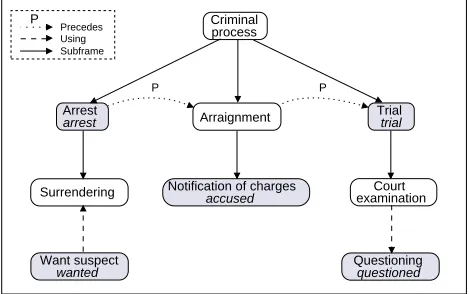
export-ing drugs are illegal activities. This is also the reason that this particular relation examples cannot be recovered using frame-to-frame relations. In our example, there is no con-nection between theLeadershipframe, which is evoked by the leading event, and theNotification of charges frame, which is evoked by theaccused event. Similarly, there is no connection betweenExporting, which is evoked by the
exportingevent, andNotification of charges.
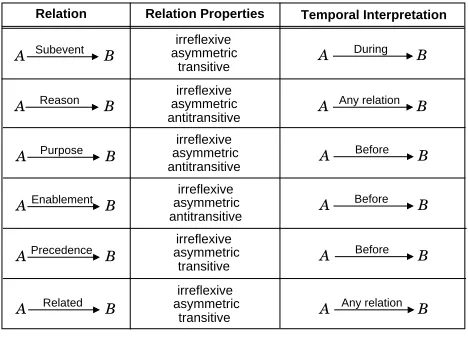
Table 2 lists various properties that hold for these binary relations. This table also shows the temporal interpretation associated for every event relation. For instance, if a
re-lation A SUBEVENT /
/B exists, then the time interval of the
eventAmust be included in the time interval associated to the composite eventB. The temporal relations correspond-ing to event relations allows us to build a chronological or-der of the events that belong to the same event structure.
asymmetric irreflexive
transitive
A Subevent B A During B
asymmetric irreflexive
antitransitive
A Reason B A Any relation B
asymmetric irreflexive
antitransitive
A Purpose B A Before B
asymmetric irreflexive
antitransitive
AEnablement B A Before B
asymmetric irreflexive
transitive
APrecedence B A Before B
asymmetric irreflexive
transitive
A Related B A Any relation B
Relation Relation Properties Temporal Interpretation
Table 2:Properties of event relations.
The annotation of event relations was performed by follow-ing the annotation procedure described in section 5. In or-der to automatically detect these relations, we assembled a supervised learning framework using support vector ma-chine (SVM) algorithm. Most of the features used in this framework are presented in the next section of this paper.
4.
Event Coreference
We have noticed that several portions of an event structure are mentioned in different documents or in different parts of the same document. In order to unify such information, we have to perform event coreference.
Figure 2 shows how two event structuresES1andES2can
be unified in ES12 if Event1 andEvent4 are identified
Event4
Event5
Event6
R1
Event3 Event2
Event1
Event1
Event6
Event2
Event3
Event5
R1 R3
R2
R1 R2
R3
R1
Coreference
ES2
ES1 ES12
Figure 2:Unifying event structures.
example, since an event cannot have more than one pur-pose/goal, after unifying two event structures based on a coreferring eventEi, which has two distinct PURPOSE
re-lations pointing toEj andEk, we may conclude thatEj
and Ek must be coreferring or must belong in the same
event structure as well. Furthermore, some relations from the event structure may be also consolidated. If from Ei
we have two distinct PRECEDENCErelations pointing toEj
andEk, we need to resolve their temporal precedence and
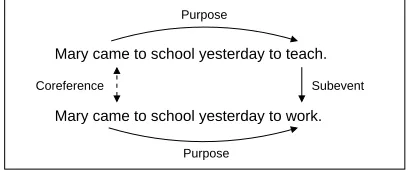
consolidate the PRECEDENCErelations accordingly. In the same way, contradictory information in the event structure may be detected and resolved. In order to identify event coreference between two events, we used the following list of requirements: (a) both events are expressed by the same predicate or their synonyms or hyponyms, and (b) when-ever specified, both predicates have the same arguments. An example that shows how event coreference relation helps in identifying event structure relations is illustrated in Figure 3. In this example, a coreference relation exists between came from the first sentence and came from the second sentence because the requirements mentioned above are fulfilled. This coreference relation together with the two PURPOSErelations impose a relation to hold between the
teach and work events. In this context, a SUBEVENT rela-tion is applied.
Mary came to school yesterday to teach.
Mary came to school yesterday to work. Subevent
Purpose Purpose
Coreference
Figure 3:Contribution of coreference relation for detecting event structure relations.
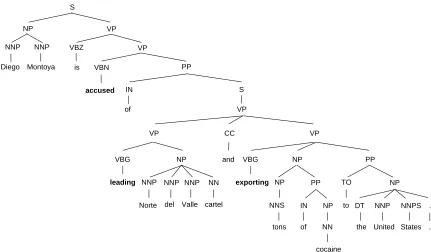
In order to detect event relations from the same event struc-ture and to solve inter- and intra-document event corefer-ence, we trained SVM multi-class classifiers in a supervised learning framework. In the data processing phase of this framework, we extracted syntactic parse trees for the anno-tated sentences using Collins’ parser (Collins, 1997). For example, Figure 4 shows the syntactic parse tree representa-tion associated to the sentenceS1with the annotated events
highlighted. The syntactic information encoded in these representations helps us explore the properties of event
re-lations. In the learning phase, we considered a learning instance as a pair of events, where each event is mapped to a constituent from a syntactic parse tree. The features that we extracted for an event pair(e1, e2)in our preliminary
experiments are:
• eWORD: The head word of the constituent associated to evente.
• e1+e2WORD: The combination of thee1WORDand
e2WORDfeatures.
• eSTEM: The stem word of theeWORDfeature.
• e1+e2 STEM: The combination of thee1 STEMand
e2STEMfeatures.
• eCLASS: The lexical class associated to the evente. This feature can take three values: verb, noun and ad-jective.
• e1+e2CLASS: The combination of thee1CLASSand
e2CLASSfeatures.
• ePOS: The head part of speech associated toe.
• e1+e2 POS: The combination of thee1 POS ande2 POSfeatures.
• SIGNAL WORDS: A set of binary features testing for the presence of words between the e1 ande2 events
such as: ’as a result’, ’and’, ’because’, ’while’, ’next’, etc. This feature is extracted only for pairs of events that belong in the same sentence.
• e PREVIOUS WORD: The first word preceding the
event expression.
• eNEXT WORD: The first word following the event ex-pression.
• IDENTICAL: Binary feature indicating whether thee1 STEMande2STEMfeatures are identical.
• SYNONYMOUS: Binary feature indicating whether the
e1STEMande2STEMfeatures are synonymous.
• NOMINALIZATION: Binary feature indicating whether one of the events is a nominalization of the other event.
• ADJACENT EVENTS: In case when they belong in the same sentence, this feature tests whethere1ande2are
adjacent.
• SAME CLAUSE: Binary feature testing whether the
two events belong in the same clause. This feature is extracted only for pairs of events from the same sen-tence.
• DIRECTED PARSE TREE PATH: The path in the
syntactic parse tree between the constituents asso-ciated to the e1 and e2 events. For example, the
path between the leading and accused events from the syntactic parse tree illustrated in Figure 4 is VBG↑VP↑VP↑S↑PP↑VP↓VBN. When the events be-long to different sentences, this feature is computed from the combination of the partial paths associated to
e1ande2. A partial path corresponding to an event is
NNPS
States PP
of VP
IN S
accused
VBN
VP
is VBZ
VP S
Valle NNP
del Norte
NNP
cartel NN NP
VP VP
exporting
VBG
PP
IN
of NP
NP
NNS
tons
cocaine NN NP
TO
to PP
.
. United
NNP NP
the DT VBG
leading
CC
and Montoya
Diego
NNP NNP
NP
NNP
Figure 4: Syntactic parse tree representation of the sentenceS1.
• UNDIRECTED PARSE TREE PATH: The same syntactic path asDIRECTED PARSE TREE PATHwithout preserv-ing the movement direction.
• SAME SENTENCE: Indicates whether the two events belong in the same sentence.
• SAME DOCUMENT: Indicates whether the two events belong in the same document.
• DISTANCE IN WORDS: If the events belong in the same sentence, this feature counts the number of words between the two events.
• DISTANCE IN SENTENCES: If the events belong in the same document, this feature counts the number of sen-tences between the two events.
• POSITION: Binary feature indicating whethere1
oc-curs before or aftere2. This feature is extracted only
for pairs of events that belong in the same document.
• SUBFRAME: When both events can evoke
seman-tic frames, this feature indicates whether their corre-sponding frames are connected through a SUBFRAME
relation. For those events that can evoke multiple se-mantic frames, a frame disambiguation task is applied (Bejan and Hathaway, 2007).
• SAME SEMANTIC ROLES: In order to establish
whether the two events share the same participating entities, happen at the same time and take place in the same location, we extracted a set of binary features from the semantic roles corresponding to these events. Therefore, we first extracted the semantic structures for the two events using our semantic parser (Bejan and Hathaway, 2007), and then test whether these structures share the same semantic roles or not.
5.
A Linguistic Resource for Event
Structure and Event Coreference
In order to use these methodologies for clustering events, for learning event relations and for solving event corefer-ence, we created a collection of documents with: (1) event annotations, (2) inter- and intra-document event corefer-ence annotations and (3) event relation annotations. The annotation procedure for this resource is performed in five steps:STEP1: Theme selection. The first question for building a linguistic resource is which documents to choose for annotation. We decided to choose web articles from Google News because it has the facility to clus-ter the articles by subject matclus-ter, and, therefore, it al-low us to annotate multiple parallel articles describ-ing the same event scenarios. In consequence, this op-tion has multiple advantages: (1) the cross-document identical events can be easily identified; (2) the event structures mentioned in one document can be unified with other events by using inter- and intra-document coreference annotations (see Figure 2); and (3) var-ious topics about specific events can be selected by using Google’s news archive search service. For our linguistic resource, we extracted articles using search keywords such as attack, death, earthquake,
catastro-phe, etc.
STEP2: Web documents processing. For each theme, we
extracted on average seven parallel articles. These web documents are manually cleaned and saved into files. The text files are further tokenized and splitted into sentences (one sentence per line).
questioned B extradited B trial
B
search B surrounded resistance
captured
B
search B surrounded resistance
captured
B B questioned B extradited B trial
escorted
limped
wearing
B
search B surrounded resistance
captured
B B checking B confirm
search B surrounded resistance
captured
B
accused B offered
wanted
planning
B B
hidding
accused B offered
wanted
planning
B B
escorted
limped
wearing
B
hidding B checking B confirm B Before
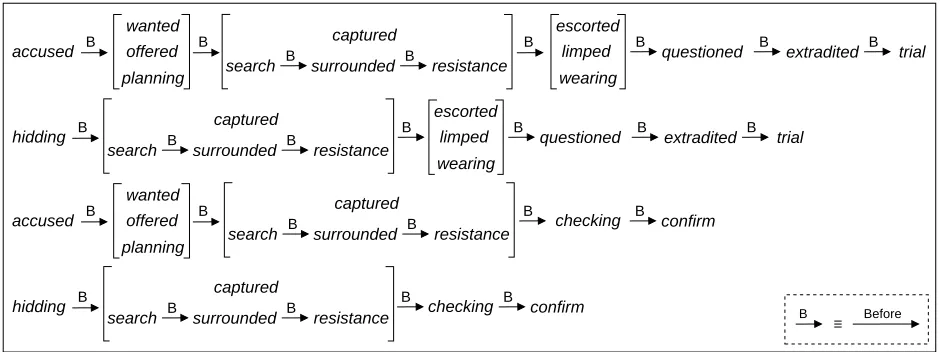
Figure 7: Deriving chronologies of events from event structures.
can derive event chronologies for the events that belong to the same event structure.
In addition, we described how the event structures can be recovered through a generative probabilistic model and pro-vided a supervised learning framework for classifying event relations and solving event coreference.
7.
References
Collin F. Baker, Charles J. Fillmore, and John B. Lowe. 1998. The Berkeley FrameNet project. In Proceedings
of the COLING-ACL.
Cosmin Adrian Bejan and Chris Hathaway. 2007. UTD-SRL: A Pipeline Architecture for Extracting Frame Se-mantic Structures. In Proceedings of the Fourth
Inter-national Workshop on Semantic Evaluations (SemEval-2007), pages 460–463.
Cosmin Adrian Bejan. 2008. Unsupervised Discovery of Event Scenarios from Texts. In Proceedings of the 21st
Florida Artificial Intelligence Research Society Interna-tional Conference (FLAIRS), Applied Natural Language Processing track.
David Blei, Andrew Ng, and Michael Jordan. 2003. La-tent Dirichlet Allocation. Journal of Machine Learning
Research, pages 993–1022.
Michael Collins. 1997. Three generative, lexicalized mod-els for statistical parsing. In Proceedings of the ACL–
EACL, pages 16–23.
Christiane Fellbaum. 1998. WordNet: An Electronic
Lexi-cal Database. MIT Press.
Charles J. Fillmore. 1982. Frame Semantics. In
Linguis-tics in the Morning Calm.
Jerry R. Hobbs. 1985. On the coherence and Structure of Discourse. In CSLI Technical Report 85–37.
Paul Kingsbury, Martha Palmer, and Mitch Marcus. 2002. Adding Semantic Annotation to the Penn TreeBank. In Proceedings of Human Language Technology
(HLT-2002).
Karin Kipper, Hoa Trang Dang, and Martha Palmer. 2000. Class-Based Construction of a Verb Lexicon. In
Pro-ceedings of the Seventeenth National Conference on Ar-tificial Intelligence (AAAI-2000), pages 691–696.
LDC. 2005. ACE (Automatic Content Extraction) En-glish Annotation Guidelines for Events, version 5.4.3 2005.07.01 edition.
William C. Mann and Sandra A. Thompson. 1988. Rhetor-ical structure theory: Toward a functional theory of text organization. Text, 8(3):243–281.
James Pustejovsky, Jose Castano, Bob Ingria, Roser Sauri, Rob Gaizauskas, Andrea Setzer, and Graham Katz. 2003a. TimeML: Robust Specification of Event and Temporal Expressions in Text. In Proceedings of
Com-putational Semantics Workshop (IWCS-5).
James Pustejovsky, Patrick Hanks, Roser Sauri, Andrew See, David Day, Lisa Ferro, Robert Gaizauskas, Marcia Lazo, Andrea Setzer, and Beth Sundheim. 2003b. The TimeBank Corpus. In Corpus Linguistics, pages 647– 656.
Josef Ruppenhofer, Michael Ellsworth, Miriam R. L. Petruck, and Christopher R. Johnson. 2005. FrameNet II: Extended Theory and Practice. Technical report, ICSI Berkeley.
Steve Sinha and Srini Narayanan. 2005. Model Based An-swer Selection. In Proceedings of Inference for Textual
Question Answering Workshop, AAAI 2005.
Leonard Talmy. 2000. Toward a Cognitive Semantics, vol.
I and II. The MIT Press, Cambridge, Massachussets,
USA.
Zeno Vendler. 1967. Linguistics in Philosophy.