Tagset Mapping and Statistical Training Data Cleaning-up
Felix Pîrvan, Dan Tufiş
Research Institute for Artificial Intelligence, Romanian Academy 13, Calea 13 Septembrie, 050711, Bucharest
[email protected], [email protected]
Abstract
The paper describes a general method (as well as its implementation and evaluation) for deriving mapping systems for different tagsets available in existing training corpora (gold standards) for a specific language. For each pair of corpora (tagged with different tagsets), one such mapping system is derived. This mapping system is then used to improve the tagging of each of the two corpora with the tagset of the other (this process will be called cross-tagging). By reapplying the algorithm to the newly obtained corpora, the accuracy of the underlying training corpora can also be improved. Furthermore, comparing the results with the gold standards makes it possible to assess the distributional adequacy of various tagsets used in processing the language in case. Unlike other methods, such as those reported in (Brants, 1995) or (Tufiş & Dragomirescu, 2004), which assume a subsumption relation between the considered tagsets, and as such they aim at minimizing the tagsets by eliminating the feature-value redundancy, this method is applicable for completely unrelated tagsets. Although the experiments were focused on morpho-syntactic (POS) tagging, the method is applicable to other types of tagging as well.
1.
Introduction
In processing parallel corpora, it is desirable to use the same encoding system for all the languages (e.g. Multext-East, http://nl.ijs.si/ME/V3/msd/html/msd.html, which is underlying all our multilingual resources). However, more often than not, the freely available train-ing data are ustrain-ing different and unrelated tagsets.
Given two different reference corpora (for the same language), each tagged with its own tagset and called from now on the gold standard for that tagset, one could ask several legitimate questions:
a. Is it possible to merge the two corpora and have the larger corpus confidently tagged with either of the tagsets?
b. Can the objective stated above be satisfacto-rily achieved by simply building a language model from one corpus and then use it to tag the other (using whatever tagger)?
c. Can the two gold standards be improved? We will describe a method showing that the answer to the first question is positive. Moreover, repeating the procedure for other pairs of corpora and tagsets would allow us to build a much larger corpus, tagged in parallel with all the tagsets of its initial components, and use it as a gold standard for each of those tagsets.
Concerning the second question, the positive answer depends on the dimensions of the two corpora used for building the language models; yet we argue that the method we will describe in this paper yields better results. Why? It is simply more informed, making use of the fact that the corpus to tag with a new tagset is already tagged with its own tagset.
The answer to the third question is again positive: the proposed method allows for re-tagging any of the gold standards with their original tagsets and, by comparing the two versions of the corpus, the systematic errors can be easily spotted and removed.
For the experiments reported herein, we used the “1984” MULTEXT-EAST reference multilingual corpus (the English component of it) and a comparable-size subset of the SemCor corpus (see Chapter 5).
2.
Overview
We will call direct tagging (DT) the usual process of tagging, where a language model learnt from a gold standard corpus is used in POS-tagging of a different corpus. Tagging the same corpus used for language model learning is called biased tagging (BT). With a consis-tently tagged gold standard, the biased tagging is expected to be almost identical to the one in the gold standard. We will use this observation to evaluate the gold standards improvements after applying our method.
The cross-tagging (CT) is a method that, given two corpora, each tagged with different tagsets, produces the two corpora tagged with the other one’s tagset, using a mapping system between the two tagsets. The cross-tagging is a stochastic process, it uses language models learnt from the corpora involved.
We denote by AGS(X) the A gold standard corpus which is tagged in terms of the X tagset and by BGS(Y) the Bgold standard corpus which is tagged in terms of the Y tagset.
With these notations, the processes of direct, biased and cross-tagging can be represented as below:
DT: AGS(X) + B Æ BDT(X)
BGS(Y) + A Æ ADT(Y)
BT: AGS(X) + A Æ ABT(X)
BGS(Y) + B Æ BBT(Y)
CT: AGS(X)+ADT(Y)+BGS(Y)+BDT(X)ÆACT(Y)+BCT(X)
We claim that the cross-tagged versions ACT(Y),
BCT(X) will be more accurate than the direct-tagged ones
ADT(Y) and BDT(X) respectively.
Figure 1. System Architecture
3.
Tagset Mapping
From two versions of the same corpus, each tagged with a different tagset, we will extract a map between the two tagsets. Having two corpora, we can obtain two such corpus-specific maps, which will then be merged into a single, and of higher confidence, global map. This process can be represented as below.
AGS(X)+ADT(Y)ÆMA(X,Y)&BGS(Y)+BDT(X)ÆMB(X,Y)
MA(X, Y) + MB(X, Y) Æ M(X, Y)
In the next two sections, we present the way we ob-tained the global map.
3.1. The Partial Maps
Let X = {x1, x2, …, xn} and Y = {y1, y2, …, ym} be the two
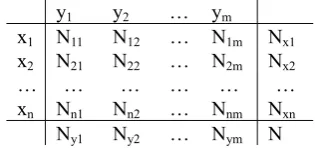
tagsets. For a corpus tagged with both X and Y tagsets, we can build the contingency table shown in Table 1.
y1 y2 … ym
x1 N11 N12 … N1m Nx1
x2 N21 N22 … N2m Nx2
… … … … … … xn Nn1 Nn2 … Nnm Nxn
Ny1 Ny2 … Nym N
Table 1. The <X,Y> Contingency Table
The symbols have the following meanings: Nij – the number of tokens tagged both with xi and yj;
Nxi – the number of tokens tagged with xi;
Nyj – the number of tokens tagged with yj;
N – the total number of tokens in the corpus.
For each tag x∈X, we define a subset of Y, let it be Yx⊆Y, that has the property that for any yj∈Yx and for any
yk∈Y–Yx, the probability of x conditioned by yj is
sig-nificantly higher than the probability of x conditioned by yk. We say that x is preferred by tags in Yx, or conversely,
that tags in Yxprefer x.
Let PSet(xi) be the set of probabilities of xi∈X,
con-ditioned by each y∈Y. It can be expressed as below. PSet(xi) = {p(xi|yj) | yj∈Y},
where p(xi|yj) = p(xi,yj) / p(yj) ≅ Nij / Nyj
Now, to find the values in PSet(xi) significantly higher
than the others means to divide PSet(xi) in two clusters.
The most significant cluster (MSC), i.e. the cluster con-taining the greater values, will give us Yx, as shown
be-low.
Yx = {y∈Y | p(x|y) ∈ MSC(P(x))}
The clustering algorithm chosen (but any other may be used) is of single-link type, based on the raw distance between the values. This type of algorithm offers a fast
top-down approach (remember that we only need two final clusters): sort the values in descending order, find the greatest distance between two consecutive values and split the values at that point. If more than one such greatest distance exists, the one between the smaller val-ues is chosen to split on. The elements Nij of the
contin-gency table define a sparse matrix, with most of the values to cluster being zero. However, at least one value will be non-zero. Thus the most significant cluster will never contain zeroes, but it may contain all the non-zero values. Let’s look at an example. From the fragment of con-tingency table in Table 2, we can deduce the following:
PSet(x1)={0.8, 0.05, 1}; MSC(P(x1))={0.8, 1} ⇒Yx1={y1, y3}
y1 y2 y3
x1 80 50 5 135
… … …
100 1000 5 1105
Table 2. A Contingency Table Example
The preference relation is a first level filtering of the tag mappings for which insufficient evidence is provided by the gold standard corpora. This filtering would elimi-nate several real wrong mappings (not all of them) but also could leave out correct mappings that occurred much less frequently than others did. We will address this issue in the next section.
A partial map from X to Y (denoted PMX) is defined
as the set of tag pairs (x,y)∈X×Y for which y prefers x. Similarly a partial map from Y to X (denoted by PMY) can
be defined. They can be expressed as below. PMX(X, Y) = {(x, y) ∈ X × Y | y∈Yx}
PMY(X, Y) = {(x, y) ∈ X × Y | x∈Xy}
3.2. The Global Map
The two partial maps for each corpus may be merged into a single global map. We want to filter out all the false positives the partial maps might contain, while reducing the false negatives as much as possible. We tried several methods and we came up with the following merging formulae.
MA(X, Y) = PMAX(X, Y) ∪ PMAY(X, Y)
MB(X, Y) = PMBX(X, Y) ∪ PMBY(X, Y)
M(X, Y) = MA(X, Y) ∩ MB(X, Y)
The maps computed in the first two formulae above will be referred as corpus-specific maps, while the other one is the targeted global map itself. The global map contains all the tag pairs for which one of the tags prefers the other, in both corpora. As this condition is a very strong one, several possibly correct mappings will be left out from M(X,Y) either because of insufficient data, or because of idiosyncratic behaviour of some lexical items. To correct this problem the global map is supplemented with the token maps.
3.3. The Token Maps
The global map expresses the preferences from one tag to another in a non-lexicalized way and it is used as a back-off mechanism when a more precise type of map-ping is not possible, namely the lexicalized mapmap-ping. The Mapping
System AGS(X)
ADT(Y)
BCT(X)
ACT(Y)
BDT(X)
data structures for lexicalized mappings are called token maps. They are built only for the token types, common to both corpora (except for happax legomena).
The tokens types that occur only in one corpus will be mapped via the global map. The global map is also used for dealing with token types occurring in one corpus in contexts dissimilar to any context of occurrence in the other corpus.
3.3.1. Provisional Token Maps
For each common token type, we first build a provisional token map the same way we built the global map, that is, build contingency tables, extract partial maps from them, and then merge those partial maps.
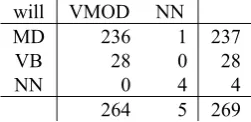
Example: Building a Provisional Token Map. The token type will has the contingency tables shown in Table 3 and Table 4. The full-zero rows and columns (i.e. tags never assigned to will) were dropped for convenience.
will MD VB NN
VMOD 170 1 1 172
NN 2 1 4 7
172 2 5 179
Table 3. Contingency table of will for the 1984 corpus
will VMOD NN
MD 236 1 237
VB 28 0 28
NN 0 4 4
264 5 269
Table 4. Contingency table of will for a fragment of the SemCor corpus
The tags have the following meanings: VMOD, MD – modal verb
NN (both tagsets) – noun VB – verb, base form
Each table has the rows marked with the tags from the gold standard version and the columns with the tags of the direct-tagged version.
The provisional token map extracted from these tables is:
Mwill(1984, SemCor) = {(VMOD, MD), (NN, NN)}
It can be observed that the tag VB of the SemCor tagset is not mapped in this phase.
A consistent tagged corpus assumes that a word oc-curring in similar contexts should be identically tagged. We say that a tag marks the class of contexts in which a word was systematically labelled by it.
If a word w of a two-way tagged corpus is tagged by the pair <x,y> and this pair belongs to Mw(X,Y) it means
that the there are contexts marked by x similar with some contexts marked by y. If <x,y> does not belong to Mw(X,Y) there are two possible situations:
a) either x or y (or both) are unmapped. b) both x and y are mapped to some other tags
In the next sub-section we discuss the first case. The second one will be addressed in section 4.1.
3.3.2. Unmapped Tags
A tag unmapped for a specific token type may mean one of two things: either none of the contexts it marks is ob-served in the other corpus, or the tag is wrongly assigned for that particular token type.
The second possibility brings up one of the goals of this paper, that is, to improve the quality of the gold standards.
If we decide that the unmapped tag was wrongly as-signed to the current token, the only thing to do is to trust the direct tagging and leave the tag unmapped.
In order to decide when it is likely to have a new con-text and when it is a wrong assignment, we relied on empirical observations that led us to the conclusion that the more frequent the token type appears in the other corpus, the less likely is for a tag, unmapped at token level, to mark a new context. To establish the threshold above which we considered a wrong assignment situation, we used the following empirical method. For each case of a tag unmapped at token level, we stored in an array the logarithm of the frequency of that token in the other corpus. The chosen threshold value is the one having the property that the sum of all smaller values in the array is closest to the sum of all greater values. The threshold frequency is the closest integer to the exponential of that value.
With the values in Table 3 for our example, the fre-quency of will in the 1984 corpus (179) is well above the threshold frequency (60). We therefore consider that all the contexts for will should have been observed and the unmapped tag VB does not mark a new context, but rather it represents a wrong assignment, so it is left unmapped.
The unmapped tags assigned to tokens with frequency below the threshold may signal the occurrence of the respective tokens in new contexts. If this is true, these tags will be mapped using the global map. To find out whether the new context hypothesis is acceptable, we use another heuristics based on the notion of tag sympathies.
3.3.3. Tag Sympathies
Given a tagged corpus, we define the sympathy be-tween two tags x1 and x2, of the same tagset, written
S(x1,x2), as the number of token types having at least one
occurrence tagged x1 and at least one occurrence tagged
x2. By definition, the sympathy between a tag and itself is
infinite. The relation of sympathy is symmetrical.
During the direct tagging, the tokens are usually tagged only with tags from the ambiguity classes learnt from the gold standard corpus. Therefore, if a specific token appears in context unseen during the LM construc-tion, it will be inevitably wrongly tagged during the direct tagging. This error would show up because this tag, x, and the one in the gold standard, y, are very likely not to be mapped to each other in the map of the current token. If y is not mapped at all in the token’s map, the algorithm checks if the tags mapped to y in the global map are sympathetic to any tag in the ambiguity class of the token type considered.
4.2.3. Contextual Probabilities
The contextual probabilities are obtained by linear inter-polation of unigram, bigram, and trigram probabilities, that is:
p(xi|x1,…,xi-1) = λ1p(xi) + λ2p(xi|xi-1) + λ3p(xi|xi-2,xi-1)
where λ1 + λ2 + λ3 = 1.
We estimated the values for the coefficients for each combination of unigram, bigram and trigram, met while traversing the corpus. As a general rule, we considered that the greater the observed frequency of an n-gram and the fewer (n+1)-grams beginning with that n-gram, the more reliable such an (n+1)-gram is.
We first estimated λ3. Let F(xi-2,xi-1) be the number of
occurrences for the bigram xi-2xi-1 in the training data. Let
N3(xi-2,xi-1) be the number of distinct trigrams beginning
with that bigram. Then the average number of occur-rences for a trigram beginning with xi-2,xi-1 is:
F3(xi-2, xi-1, •) = F(xi-2, xi-1) / N3(xi-2, xi-1)
Let 3max=max 3( i−2, i−1,•) i
x x F
F . We took λ3 to be:
λ3 = log(F3(xi-2, xi-1)) / log(F3max)
Similarly λ2 is computed as:
λ2 = (1 - λ3) log(F2(xi-1)) / log(F2max)
and λ1 = 1-λ2-λ3.
We have now completely defined the retagging algo-rithm and with it, the whole cross-tagging method. Does it improve the performance of the direct tagging? Our ex-periments show it does.
5.
Experiments and Evaluation
5.1. Resources
We used two English language corpora as gold standards. The 1984 corpus, having approximately 120,000 tokens, contains the George Orwell’s homonymous novel. It was automatically tagged, but it was thoroughly human vali-dated and corrected. The tagset used in this corpus is called the MTE tagset.
The second corpus was a fragment of the tagged SemCor corpus, of about the same length, referred to as SemCorP (partial). The full SemCor corpus, is 778,587 tokens in length and was created by the Princeton Uni-versity and is distributed with the Princeton WordNet. The texts included into SemCor represent a subset of the Brown corpus
(http://khnt.hit.uib.no/icame/manuals/brown/INDEX.HTM),
compiled in the ‘60s by W. Francis and H. Kucera of Brown University. The SemCor corpus was tagged with the Brill tagger and uses the Penn tagset (http://multisemcor.itc.it/semcor.php). In the SemCor corpus only the word forms are POS-tagged, therefore we assigned a different tag for each type of punctuation mark. As tagger of reference for our tagging experiments, we used the TnT tagger developed by T. Brants (Brants, 2000).
5.2. Experiment 1
After cross-tagging the two corpora described above, we compared the results with the direct-tagged versions: 1984DT(Penn) against 1984CT(Penn) and
Sem-CorPDT(MTE) against SemCorPCT(MTE). There were
6,391 differences for the 1984 corpus and 11,006 for the SemCorP corpus. As we did not have human-validated versions of the two corpora, tagged with each other’s
tagset, we randomly selected a sample of one hundred differences for each corpus and manually analyzed them. The result of this analysis is shown in Table 7.
Correct CTtags Correct DTtags
100 differences in 1984(Penn) 69 31 100 differences in SemCorP(MTE) 59 41
Table 7. Cross-tagging results
Overall, cross-tagging is shown to be more accurate than direct tagging. However, as one can see from Table 7, the accuracy gain is more significant for the 1984 corpus than for SemCorP. The explanation is the follow-ing:
Since the language model built from the 1984 corpus (used for direct tagging of SemCorP) is more accurate than the language model built from SemCorP (used for direct tagging of 1984), there were much more errors in 1984(Penn) than in SemCorP(MTE). The cross-tagging approach described in this paper has the ability to over-come some inconsistencies encoded into the supporting language models.
5.3. Experiment 2
We decided to improve the POS-tagging of the entire SemCor corpus. First, to keep track of the improvements of the corpus annotation, we computed the identity score between the original and the biased-tagged versions. Let S0(Penn) be the SemCor corpus in its original form, and
S0
BT(Penn) its biased tagged version.
Identity-score(S0(Penn), S0
BT(Penn)) = 93.81%
By cross-tagging the results of the first experiment, we obtained the double cross-tagged version of Sem-Cor(Penn) which we denote as S1(Penn).
Identity-score(S0(Penn), S1(Penn)) = 96.4%
These scores were unexpectedly low and after a brief analysis we observed some tokenization inconsistencies in the original SemCor, which we normalized. For in-stance, opening and closing double quotes were not sys-tematically distinguished (their number was equal); in this case we turned all the instances of `` and '' into the DBLQ character (”). Another example of inconsistency refered to various formulae denoted in SemCor some times by one token **f and some other times by a sequence of three tokens *, *, f; in the normalized version of the SemCor only the first type of tokenization was preserved. Let S2(Penn) denote the normalized version of S1(Penn).
Identity-score(S2(Penn), S2
BT(Penn)) = 97.41%
As one can see, the double cross-tagging and the normalization process resulted in a more consistent lan-guage model (the biased-tagging identity score improved with 3.6%).
At this point, we analyzed the tokens that introduce the most differences. For each such token, we identified the patterns corresponding to each of their tags and sub-sequently corrected the tagging to match these patterns. The tokens considered in this stage were: am, are, is, was, were, and that. Let S3 be this new version of the corpus.
Identity-score(S3(Penn), S3
BT(Penn)) = 97.61%
proper nouns and vice versa. We used regular expressions to make the necessary corrections and thus obtained a new version S4(Penn) of SemCor.
Identity-score(S4(Penn), S4
BT(Penn)) = 98.08%
Continuing the biased correction/evaluation cycle would probably further slightly improve the identity score, but the distinction between correct and wrong tags becomes less and less clear-cut. The overall improvement of the biased evaluation score (4.27%) and the observed difference types suggested that the POS tagging of the SemCor corpus reached a reasonable level of accuracy for making it a reliable training corpus.
To assess the improvements in S4(Penn) over the
normalized version of the initial SemCor corpus we ex-tracted the differences among the two versions. The 57,905 differences, were frequency-based sorted and resulted 10216 difference types, with frequencies ranging from 1910 to 1. The 10 most frequent difference types are shown in Table 8.
Double Cross-Tagging
Tag Token Original Tag Frequency
TO to VB 1910
VBN been VB 674
IN in RB 655
IN in VB 646
IN of RB 478
IN on VB 381
IN for VB 334
IN with VB 324
RBR more RB 314
DT the RB 306
Table 8. The first 10 most frequent differences between the double-cross tagging and the original tagging in
SemCor
The first 200 types, with frequencies ranging from 1910 to 40 and accounting for 25136 differences, were thoroughly evaluated. The results of this evaluation are shown in the Table 9.
# differences Double Cross-Tagging
OK Original tagging OK
25136 21224 (84.44%) 3912 (15.56%)
Table 9. Analysis for the most frequent 200 difference types among the initial and final versions of the SemCor
corpus
6.
Conclusions
In the light of the performed experiments, the cross-tagging showed useful for several purposes. The direct tagging of a corpus can be improved. Two tagsets can be compared from a distributional point of view. Errors in the training data may be spotted and corrected. Successively applying the method for different pairs of corpora tagged with different tagsets would permit the building of a much larger corpus, tagged in parallel with all those tagsets in a reliable manner.
The mapping system between two tagsets may prove useful in itself. It is composed of a global map, as well as
of many token maps, showing the way contexts marked by certain tags in one tagset overlap with contexts marked by tags of the other tagset. Furthermore, the mapping system can be applied not only to POS tags, but to other types of tags as well.
It is to be expected that using a better tagger or more accurately tagged gold standards, the mapping system will improve and hence the overall cross-tagging per-formance.
7.
References
Brants, Thorsten (2000). TnT – A Statistical Part-of-Speech Tagger. In Proceedings of the 6th Ap-plied NLP Conference. Seattle, WA, pp. 224-231.
Brants, Thorsten (1995). Tagset Reduction Without In-formation Loss. In Proceedings of the 33rd Annual Meeting of the ACL. Cambridge, MA, pp. 287-289.
Chen, Stanley F. & Goodman, Joshua (1996). An Em-pirical Study of Smoothing Techniques for Language Modeling. In Proceedings of the 34th Annual Meeting of the ACL. Santa Cruz, CA, pp. 310-318.
Church, Kenneth W. (1988). A Stochastic Parts Program and Noun Phrase Parser for Unrestricted Text. In 2nd Conference on Applied NLP. Austin, TX, pp. 136-143.
Gale, William A. & Sampson, Geoffrey (1995). Good-Turing Frequency Estimation Without Tears. In Journal of Quantitative Linguistics, 2/3, pp. 217-237.
Manning, Christopher D. & Schütze, Hinrich (1999). Foundations of Statistical Natural Language Process-ing, The MIT Press, Cambridge, MA, London, Eng-land.