A Semantic Composition Method for Deriving Sense Representations of Determinative-Measure Compounds in E-HowNet
Chia-hung Tai, Shu-Ling Huang, Keh-Jiann Chen Institute of Information Science, Academia Sinica
glaxy, josieh, kchen @iis.sinica.edu.tw
摘要
本篇論文利用定量複合詞為例,示範如何利用廣義知網的語意合成機制來推導複合詞的
語意及其表達式。首先我們定義了所有但有限數量的定詞跟量詞的廣義知網表達式,接
著我們利用語意合成的規則針對任何新的定量詞去產生候選的語意表達式。然後我們在
從調整語料集合去設計語意解歧規則,利用啟發式語意解歧規則跟參考上下文的詞來解
決定量詞的廣義知網表達式的歧異,實驗顯示在語意推導跟解歧之後有 88%的正確率。
Abstract
In this paper, we take Determinative-Measure Compounds as an example to demonstrate how the E-HowNet semantic composition mechanism works in deriving the sense representations for all determinative-measure (DM) compounds which is an open set. We define the sense of a closed set of each individual determinative and measure word in E-HowNet representation exhaustively. We then make semantic composition rules to produce candidate sense representations for any newly coined DM. Then we review development set to design sense disambiguation rules. We use these heuristic disambiguation rules to determine the correct context-dependent sense of a DM and its E-HowNet representation. The experiment shows that the current model reaches 88% accuracy in DM identification and sense derivation.
關鍵詞:語意合成,定量複合詞,語意表達,廣義知網,知網
Keywords: Semantic Composition, Determinative-Measure Compounds, Sense Representations, Extended How Net, How Net
1. Introduction
framework of E-HowNet, we intend to establish an automatic semantic composition mechanism to derive sense of compounds and phrases from lexical senses [2][3]. Determinative-Measure compounds (abbreviated as DM) are most common compounds in Chinese. Because a determinative and a measure normally coin a compound with unlimited versatility, the CKIP group does not define the E-HowNet representations for all DM compounds. Although the demonstrative, numerals, and measures may be listed exhaustively, their combination is inexhaustible. However their constructions are regular [4]. Therefore, an automatic identification schema in regular expression [4] and a semantic composition method under the framework of E-HowNet for DM compounds were developed.
In this paper, we take DMs as an example to demonstrate how the E-HowNet semantic composition mechanism works in deriving the sense representations for all DM compounds. The remainder of this paper is organized as follows. The section 2 presents the background knowledge of DM compounds and sense representation in E-HowNet. We’ll describe our method in the section 3 and discuss the experiment result in the section 4 before we make conclusion in the section 5.
2. Background
There are numerous studies on determinatives as well as measures, especially on the types of measures.1 Tai [5] asserts that in the literature on general grammar as well as Chinese grammar, classifiers and measures words are often treated together under one single framework of analysis. Chao [6] treats classifiers as one kind of measures. In his definition, a measure is a bound morpheme which forms a DM compound with the determinatives enumerated below. He also divides determinatives word into four subclasses:
i.Demonstrative determinatives, e.g. 這” this”, that”那”… ii.Specifying determinatives, e.g. 每”every”, 各” each”…
iii.Numeral determinatives, e.g. 二”two”, 百分之三”three percentage”, 四百五十” four hundred and fifty”…
iv.Quantitative determinatives, e.g. 一” one”, 滿” full”, 許多” many”…
Measures are divided into nine classes by Chao [6]. Classifiers are defined as ‘individual measures’, which is one of the nine kinds of measures.
i.classifiers, e.g. 本”a (book)”,
ii.classifier associated with V-O constructions, e.g. 手 “hand”, iii.group measures, e.g. 對”pair”,
iv.partitive measures, e.g. 些”some”, v.container measures, e.g. 盒“box”, vi.temporary measures, e.g. 身”body”, vii.Standard measures, e.g. 公尺”meter”, viii.quasi-measure, e.g. 國”country”,
ix.Measures with verb, e.g. 次”number of times”.
As we mentioned in the section of introduction, Chao considers that determinatives are listable and measures are largely listable, so D and M can be defined by enumeration, and that DM compounds have unlimited versatility. However, Li and Thompson [7] blend classifiers with measures. They conclude not only does a measure word generally not take a classifier, but any measure word can be a classifier. In Tai’s opinion [5], in order to better understand the nature of categorization in a classifier system, it is not only desirable but also necessary to differentiate classifiers from measure words. These studies on the distinction between classifiers and measures are not very clear-cut. In this paper, we adopt the CKIP DM rule patterns and Part-of-Speeches for morpho-syntactic analysis, and therefore inherit the definition of determinative-measure compounds (DMs) in [10]. Mo et al. define a DM as the composition of one or more determinatives together with an optional measure. It is used to determine the reference or the quantity of the noun phrase that co-occurs with it. We use the definition of Mo et al. to apply to NLP and somewhat different from traditional linguistics definitions.
2.1 Regular Expression Approach for Identifying DMs
Due to the infinite of the number of possible DMs, Mo et al. [10] and Li et al. [4] propose to identify DMs by regular expression before parsing as part of their morphological module in NLP. For example, when the DM compound is the composition of one determinative, e.g. for numerals in (1), roughly rules (2a), (2b) or (2c) will be first applied, and then rules (2d), (2e) or (2f) will be applied to compose complex numeral structures, and finally rules (2g) will generate the pos Neu of numeral structures. From the processes of regular expression, the numerals 534 and 319 in (1) is identified and tagged as Neu.2
(1) 鼓勵534人完成319鄉之旅
guli wubaisanshisi ren wancheng sanbaiyishijiu xiang zhi lu
encourage 534 persons to accomplish the travel around 319 villages
2 The symbol “Neu” stands for Numeral Determinatives. Generation rules for numerals are partially listed in
(2) a. NO1 = {○,一,二,兩,三,四,五,六,七,八,九,十,廿,卅,百,千,萬,億,兆,零,
幾};
b. NO2 = {壹,貳,參,肆,伍,陸,柒,捌,玖,拾,佰,仟,萬,億,兆,零,幾}; c. NO3 = {1,2,3,4,5,6,7,8,9,0,百,千,萬,億,兆}; d. IN1 -> { NO1*, NO3*} ;
e. IN2 -> NO2* ;
f. IN3 -> {IN1,IN2} {多,餘,來,幾} ({萬,億,兆}) ; g. Neu -> {IN1,IN2,IN3 } ;
Regular expression approach is also applied to deal with ordinal numbers, decimals, fractional numbers and DM compounds for times, locations etc.. The detailed regular expressions can be found in [4]. Rule patterns in regular expression only provide a way to represent and to identify morphological structures of DM compounds, but do not derive the senses of complex DM compounds.
2.2 Lexical Sense Representation in E-HowNet
Core senses of natural language are compositions of relations and entities. Lexical senses are processing units for sense composition. Conventional linguistic theories classify words into content words and function words. Content words denote entities and function words without too much content sense mainly serve grammatical function which links relations between entities/events. In E-HowNet, the senses of function words are represented by semantic roles/relations [11]. For example, ‘because’ is a function word. Its E-HowNet definition is shown in (1).
(1) because|因為 def: reason={};
which means reason(x)={y} where x is the dependent head and y is the dependent daughter of ‘因為’.
In following sentence (2), we’ll show how the lexical concepts are combined into the sense representation of the sentence.
(2) Because of raining, clothes are all wet. 因為下雨,衣服都濕了
In the above sentence, ‘濕 wet’, ‘衣服 clothes’ and ‘下雨 rain’ are content words while ‘都
that function words start with a relation but content words have under-specified relations. If a content word plays a dependent daughter of a head concept, the relation between the head concept and this content word will be established after parsing process. Suppose that the following dependent structure and semantic relations are derived after parsing the sentence (2).
(3) S(reason:VP(Head:Cb:因為|dummy:VA:下雨)|theme:NP(Head:Na:衣服) | quantity: Da:都 | Head:Vh:濕|particle:Ta:了)。
After feature-unification process, the following semantic composition result (4) is derived. The sense representations of dependent daughters became the feature attributes of the sentential head ‘wet|濕’.
(4) def:{wet|濕:
theme={clothing|衣物}, aspect={Vachieve|達成}, manner={complete|整}, reason={rain|下雨}}
In (3), function word ‘因為 because’ links the relation of ‘reason’ between head concept ‘濕
wet’ and ‘下雨 rain’. The result of composition is expressed as reason(wet|濕)={rain|下雨}, since for simplicity the dependent head of a relation is normally omitted. Therefore reason(wet|濕)={rain|下雨} is expressed as reason={rain|下雨}; theme(wet|濕)={clothing|衣 物} is expressed as theme={clothing|衣物} and so on.
2.3 The sense representation for determinatives and measures in E-HowNet
The sense of a DM compound is determined by its morphemes and the set of component morphemes are determinatives and measures which are exhaustively listable. Therefore in order to apply semantic composition mechanism to derive the senses of DM compounds, we need to establish the sense representations for all morphemes of determinatives and measures first. Determinatives and measure words are both modifiers of nouns/verbs and their semantic relation with head nouns/verbs are well established. We thus defined them by a semantic relation and its value like (5) and (6) bellowed.
(5) The definition of determinatives in E-HowNet this 這 def: quantifier={definite|定指} first首 def: ordinal={1}
one一 def: quantity={1}
sense representations are exemplified below:
(6) The definition of measure words in E-HowNet a) Measure words with content sense
bowl碗 def: container={bowl|碗} meter米 def: length={meter|公尺} month月 def: time={month|月}
b) Measure words without content sense
本copy def:{null}
間 room def:{null}
樣 kind def:{null}
3. Semantic Composition for DM Compounds
To derive sense representations for all DM compounds, we study how to combine the E-HowNet representations of determinative and measure words into a DM compound representation, and make rules for automatic composition accordingly. Basically, a DM compound is a composition of some optional determinatives and an optional measure. It is used as a modifier to describe the quantity, frequency, container, length…etc. of an entity. The major semantic roles played by determinatives and measures are listed in the Table 1.
The basic feature unification processes [12]:
If a morpheme B is a dependency daughter of morpheme A, i.e. B is a modifier or an
argument of A, then unify the semantic representation of A and B by the following steps.
Step 1: Identify semantic relation between A and B to derive relation(A)={B}. Note: the
possible semantic relations are shown in Table 1.
Step 2: Unify the semantic representation of A and B by insert relation(A)={B} as a
sub-feature of A.
It seems that a feature unification process can derive the sense representation of a DM compound, as exemplified in (7) and (8), once its morpheme sense representations and semantic head are known.
(7) one一 def:quantity={1} + bowl碗 def: container={bowl|碗} Æ
one bowl一碗 def: container={bowl|碗:quantity={1}} (8) this這def: quantifier={definite|定指} + 本copy def:{null} Æ
this copy這本 def: quantifier={definite|定指}
address e.g. 國、省、州、縣、鄉、村、鎮、鄰、里、郡、區、 站、巷、弄、段、號、樓、衖、市、洲、地、街
place e.g 部、司、課、院、科、系、級、股、室、廳
duration e.g陣(子)、會、會兒、下子
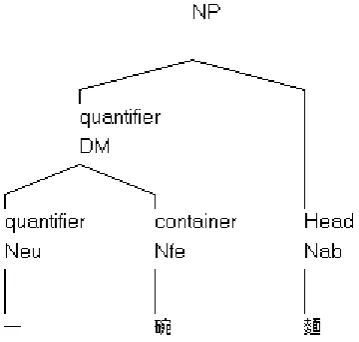
However there are some complications need to be resolved. First of all we have to clarify the dependent relation between the determinative and the measure of a DM in order to make a right feature unification process. In principle, a dependent head will take semantic representation of its dependent daughters as its features. Usually determinatives are modifiers of measures, such as 這碗, 一碗, 這一碗. For instance, the example (9) has the dependent relations of
NP(quantifier:DM(quantifier:Neu:一|container:Nfa:碗)|Head:Nab:麵)
Figure 1. The dependent relations of 一碗麵”a bowl of noddle”.
After feature unification process, the semantic representation of “一 def: quantity={1}” becomes the feature of its dependent head “碗def: container={bowl|碗} and derives the feature representation of “one bowl一碗 def: container={bowl| 碗 :quantity={1}}”. Similarly, “one bowl一碗” is the dependent daughter of “noodle|麵def:{noodle|麵}”. After unification process, we derive the result of (9).
(9)one bowl of noodle|一碗麵def:{noodle|麵:container={bowl|碗:quantity={1}}}
The above feature unification process written in term of rule is expressed as (10).
(10) Determinative + Measure (D+M) Æ def: semantic-role(M) = {Sense-representation(M): Representation(D)}
and a measure M is a unification of the feature representation of D as a feature of the sense representation of M as exemplified in (9).
However a DM compound with a null sense measure word, such as ‘this copy|這本’ , ‘ a copy|一本’, or without measure word, such as ‘this three|這三’, will be exceptions, since the measure word cannot be the semantic head of DM compound. The dependent head of determinatives become the head noun of the NP containing the DM and the sense representation of a DM is a coordinate conjunction of the feature representations of its morphemes of determinatives only.
For instance, in (8), ‘copy’ has weak content sense; we thus regard it as a null-sense measure word and only retain the feature representation of the determinative as the definition of “this copy|這本”. The unification rule for DM with null-sense measure is expressed as (11).
(11) Determinative + {Null-sense Measure} (D+M) Æ def: Representation(D);
If a DM has more than one determinative, we can consider the consecutive determinatives as one D and the feature representation of D is a coordinate conjunction of the features of all its determinatives. For instance, “this one|這一” and “this one|這一本” both are expressed as “quantifier={definite|定指}; quantity={1}”.
Omissions of numeral determinative are occurred very often while the numeral quantity is “1”. For instance, “這本” in fact means “this one|這一本”. Therefore the definition of (8) should be modified as:
這本 def: quantifier={definite|定指}; quantity={1};
The following derivation rules cover the cases of omissions of numeral determinative.
(12) If both numeral and quantitative determinatives do not occur in a DM, then the feature quantity={1} is the default value of the DM.
Another major complication is that senses of morphemes are ambiguous. The feature unification process may produce many sense representations for a DM compound. Therefore sense disambiguation is needed and the detail discussions will be in the section 3.1.
as themselves. For example, 5020 is expresses as quantity={5020} and will not further define what is the sense of 5020. Furthermore all non-Arabic forms will be convert into Arabic expression, e.g. “五千零二十” is defined as quantity={5020}.
The other problem is that the morphological structures of some DMs are not regular patterns. Take “兩個半two and half” as an example. “半half” is not a measure word. So we collect those word like “多many, 半half, 幾many, 上up, 大big, 來more” for modify the quantity definition. So we first remove the word “半” and define the “兩個” as quantity={2}. Because the word “半” means quantity={0.5}, we define the E-HowNet definition for “兩個 半” as quantity={2.5}. For other modifiers such as “多many, 幾many, 餘more, 來more”, we use a function over() to represent the sense of “more”, such as “十多個 more than 10” is represented as quantity={over(10)}
The appendix A shows the determinatives and measures used and their E-HowNet definition in our method. Now we have the basic principles for compositing semantics of DM under the framework of E-HowNet.
Below steps is how we process DMs and derive their E-HowNet definitions from an input sentence.
I. Input: a Chinese sentence.
II. Apply regular expression rules for DM to identify all possible DM candidates in the input sentence.
III.Segment DM into a sequence of determinatives and measure words. IV.Normalize numerals into Arabic form if necessary
V. Apply feature unification rules (10-12) to derive candidates of E-HowNet representations for every DM.
VI.Disambiguate candidates for each DM if necessary. VII. Output: DM Compounds in E-HowNet representation.
For an input Chinese sentence, we use the regular expression rules created by Li et al. [2006] to identify all possible DMs in the input sentence. Then, for every DM compound, we segment it into a sequence of determinatives and measures. If any numeral exists in the DM, every numeral is converted into decimal number in Arabic form. For every DM, we follow the feature unification principles to composite semantics of DM in E-HowNet representations and produce possible ambiguous candidates. The final step of sense disambiguation is described in the following section.
3.1 Sense Disambiguation
{頭|head}, such as “滿頭白髮 full head of white hairs” or the null sense in ”一頭牛 a cow”. Some DMs are inherent sense ambiguous and some are pseudo ambiguous. For instances, the above example “一頭” is inherent ambiguous, since it could mean “full head” as in the example of “一頭白髮 full head of white hairs” or could mean “one + classifier” as in the example of ”一頭牛 a cow”. For inherent ambiguous DMs, the sense derivation step will produce ambiguous sense representations and leave the final sense disambiguation until seeing collocation context, in particular seeing dependent heads. Some ambiguous representations are improbable sense combination. The improbable sense combinations should be eliminated during or after feature unification of D and M. For instance, although the determiner “一” has ambiguous senses of “one”, “first”, and “whole”, but “一公尺” has only one sense of “one meter”, so the other sense combinations should be eliminated.
The way we tackle the problem is that first we find all the ambiguous Ds and Ms by looking their definitions shown in the appendix A. We then manually design content and context dependent rules to eliminate the improbable combinations for each ambiguous D or M types. For instance, according to the appendix A, “頭” has 3 different E-HowNet representations while functions as determinant or measure, i.e. “def:{null}”, “def:{head|頭}”, and “def:ordinal={1}”. We write 3 content or context dependent rules below to disambiguate its senses.
(13) 頭”head”, Nfa, E-howNet: “def:{null}” : while E-HowNet of head word is “動 物({animate|生物}” and it’s subclass.
(14) 頭“head“, Nff, E-howNet: “def:{頭}” : while pre-determinant is一(Neqa)”one” or 滿”full” or全”all” or 整”total”.
(15) 頭”first”, Nes, E-howNet: “def:ordinal={1}” : while this word is being a demonstrative determinatives which is a leading morpheme of the compound.
The disambiguation rules are shown in appendix B. In each rule, the first part is the word and its part-of-speech. Then the E-HowNet definition of this sense is shown, and followed by the condition constraints for this sense. If there is still ambiguities remained after using the disambiguation rule, we choice the most frequent sense as the result.
4. Experiment and Discussion
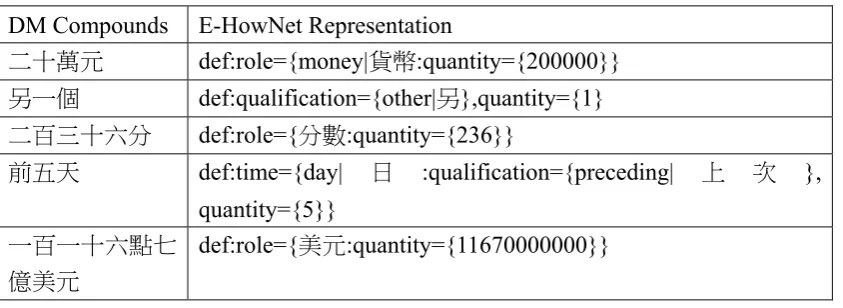
composition rules produce 1226 candidates of E-HowNet representation from 939 words. The program fails to produce E-HowNet representations for the rest of 61 words because of undefined morphemes. There are 162 words out of the 939 words having ambiguous senses. The result shows that the quality of candidates is pretty good. Table 2 gives some examples of the result. For testing the correctness of our candidates, we manually check the format of 1226 candidates. Only 5 candidates out of 1226 are wrong or meaningless representations. After disambiguation processes, the resulting 1000 DM words in E-HowNet representation are judged manually. There are 880 correct E-HowNet representations for 1000 DM words in both sense and format. It is an acceptable result. Among 120 wrong answers, 57 errors are due to undefined morpheme, 28 errors are unique sense but wrong answer and the number of sense disambiguation errors is 36. Therefore accuracy of sense disambiguation is (162-36)/162=0.778.
Table 2. The result of semantic composition for DM compounds. DM Compounds E-HowNet Representation
二十萬元 def:role={money|貨幣:quantity={200000}}
另一個 def:qualification={other|另},quantity={1}
二百三十六分 def:role={分數:quantity={236}}
前五天 def:time={day| 日 :qualification={preceding| 上 次 }, quantity={5}}
一百一十六點七 億美元
def:role={美元:quantity={11670000000}}
After data analysis, we conclude the following three kinds of error types. A.Unknown domain error:
七棒”7th batter”, 七局”7th inning”
Because there is no text related to baseball domain in development set, we get poor performance in dealing with the text about baseball. The way to resolve this problem is to increase the coverage of disambiguation rules for the baseball domain.
B.Undefined senses and morphemes:
每三個“each three”
We do not define the sense of 每 ”each” and we only define每 ”all”, so we have to add the sense of “each” in E-HowNet representation about每.
有三位 ”there are three persons”, 同一個 ”the same”
Because 有 “have” and同 ”the same” do not appear in our determinative list, it is not possible to composite their E-HowNet definitions.
C.Sense ambiguities:
minutes or twenty points”) . The E-HowNet representation of二十分”twenty minutes or twenty points” can be defined as “def:role={分數:quantity={20}}” or “def:time={分 鐘:quantity={20}}”. More context information is needed to resolve this kind of sense ambiguity.
For unknown domain error and undefined rule, the solution is to expand the disambiguation rule set and sense definitions for morphemes. For sense ambiguities, we need more information to disambiguate the true sense.
5. Conclusion
E-HowNet is a lexical sense representational framework and intends to achieve sense representation for all compounds, phrases, and sentences through automatic semantic composition processing. In this paper, we take DMs as an example to demonstrate how the semantic composition mechanism works in E-HowNet to derive the sense representations for all DM compounds. We analyze morphological structures of DMs and derive their morphological rules in terms of regular expression. Then we define the sense of all determinatives and measure words in E-HowNet definition exhaustively. We make some simple composition rules to produce candidate sense representations for DMs. Then we review development set to write some disambiguation rules. We use these heuristic rules to find the final E-HowNet representation and reach 88% accuracy.
The major target of E-HowNet is to achieve semantic composition. For this purpose, we defined word senses of CKIP lexicon in E-HowNet representation. Then we try to automate semantic composition for phrases and sentences. However there are many unknown or compound words without sense definitions in the target sentences. DM compounds are occurring most frequently and without sense definitions. Therefore our first step is to derive the senses of DM words. In the future, we will use similar methods to handle general compounds and to improve sense disambiguation and semantic relation identification processing. We intend to achieve semantic compositions for phrases and sentences in the future and we had shown the potential in this paper.
Acknowledgement:
This research was supported in part by the National Science Council under a Center Excellence Grant NSC 96-2752-E-001-001-PAE and Grant NSC96-2221-E-001-009.
References
[1] Zhendong Don & Qiang Dong, 2006, HowNet and the Computation of Meaning. World
Scientific Publishing Co. Pte. Ltd.
[3] Shu-Ling Huang, You-Shan Chung, Keh-Jiann Chen, 2008, E-HowNet- an Expansion of HowNet, The First National HowNet Workshop, Beijing, China.
[4] Li, Shih-Min, Su-Chu Lin, Chia-Hung Tai and Keh-Jiann Chen, 2006. A Probe into Ambiguities of Determinative-Measure Compounds, International Journal of Computational
Linguistics & Chinese Language Processing, Vol. 11, No. 3. pp.245-280.
[5] Tai, J. H-Y, Chinese classifier systems and human categorization, In Honor of William S-Y. Wang: Interdisciplinary Studies on Language and Language Change, ed. by M. Y. Chen
and O J.-L. Tzeng, Pyramid Press, Taipei, 1994, pp. 479-494.
[6] Chao, Y.-R., A grammar of Spoken Chinese, University of California Press, Berkeley,
1968.
[7] Li, C. N. and S. A. Thompson, Mandarin Chinese: A Functional Reference Grammar,
University of California Press, Berkeley, 1981.
[8] 何杰(He, J.),
現代漢語量詞研究,
民族出版社, 北京市, 2002.[9] 黃居仁, 陳克健, 賴慶雄(編著),
國語日報量詞典,
國語日報出版社, 台北, 1997. [10] Mo, R.-P., Y.-J. Yang, K.-J. Chen and C.-R. Huang, Determinative-Measure Compounds in Mandarin Chinese: Their Formation Rules and Parser Implementation, In Proceedings ofROCLING IV (R.O.C. Computational Linguistics Conference), 1991, National Chiao-Tung University, Hsinchu, Taiwan, pp. 111-134.
[11] Chen Keh-Jiann, Shu-Ling Huang, Yueh-Yin Shih, Yi-Jun Chen, 2005a,
Extended-HowNet- A Representational Framework for Concepts, OntoLex 2005 - Ontologies
and Lexical Resources IJCNLP-05 Workshop, Jeju Island, South Korea
[12] Duchier, D., Gardent, C. and Niehren, J. (1999a) Concurrent constraint programming in Oz for natural language processing. Lecture notes, http://www.ps.uni-sb.de/~niehren/
oz-natural-language-script.html.
Appendix A. Determinative and measure word in E-HowNet representation
定詞(Determinative word)
D1-> 這、那、此、該、本、貴、敝、其、某、諸 def: quantifier={definite|定 指};這些、那些def: quantifier={definite|定指}, quantity={some|些}
D2-> 第、首def: ordinal={D4}
D3-> 上 、 前 def: qualification={preceding| 上 次 } 、 下 、 後 def: qualification={next|下次}、頭、首def:ordinal={1}、末def: qualification={last| 最 後}、次def:ordinal={2}
不定指
D4-> 一、二、萬、雙... def: quantity={1、2、10000、2...} or def:ordinal={1、2、
10000、2...}
D5-> 甲、乙... def: ordinal={1、2...}
D6-> 其他、其餘、別、旁、他、另、另外def: qualification={other|另} D7-> 每、任何、一、全、滿、整、一切def: quantity={all|全}
D8-> 各def: qualification={individual|分別的}
D9-> 若干、有的、一些、部份、有些def: quantity={some|些} D10-> 半def: quantity={half|半}
D11-> 多少、幾多def: quantity={.Ques.} D12-> 何、啥、什麼def: fomal={.Ques.}
D13->數、許多、很多、好多、好幾、好些、多、許許多多、多數、大多數、
不少、泰半、半數、諸多def: quantity={many|多}、少許、少數、幾許、個把 def: quantity={few|少}
D14->餘、許、之多def: approximate()、足、整、正def: exact()、出頭、好幾、 開外、多 def: over();
量詞(Measure word)
有語意量詞(Measures with content sense )
Nff-> 暫時量詞—身、頭、臉、鼻子、嘴、肚子、手、腳 def:{身,頭, …} Nff-> 暫時量詞—桌子、院子、地、屋子、池、腔、家子def: position={桌子,
院子...:quantity={all|全}}
Nfe-> 容器量詞—盒(子)、匣(子)、箱(子)、櫃子、櫥(子)、籃(子)、簍(子)、爐 子、包(兒)、袋(兒)、池子、瓶(子)、桶(子)、聽、罐(子)、盆(子)、鍋(子)、 籠(子)、盤(子)、碗、杯(子)、勺(子)、匙(湯匙)、筒(子)、擔(子)、籮筐、 杓
(子)、茶匙、壺、盅、筐、瓢、鍬、缸def: container={盒,匣,...} Nfg-> 標準量詞—
表長度的,如:公厘、公分、公寸、公尺、公丈、公引、公里、市尺、營 造 尺、台尺、吋(inch)、呎(feet)、碼(yard)、哩(mile)、 (海)浬、庹、噚、 尺、里、釐、寸、丈、米、厘、厘米、海 哩、英尺、英里、英呎、英寸、 米突、米尺、微米、毫米、 英吋、英哩、光年。 def: length={公分,...}
表面積的,如:公畝、公頃、市畝、營造畝、坪、畝、分、甲、頃、平方 公里、平方公尺、平方公分、平方尺、平方英哩、英畝。def: size={公畝,...}
表重量的,如:公克、公斤、公噸、市斤、台兩、台斤(日斤)、盎司(斯)、 磅、公擔、公衡、公兩、克拉、斤、兩、錢、噸、克、英磅、英兩、公錢、 毫克、毫分、仟克、公毫。def: weight={公克,...}
表容量的,如:公撮、公升(市升)、營造升、台升(日升)、盎司、品脫(pint)、
加侖(gallon)、蒲式耳(bushel)、公斗、公石、公秉、公合、公勺、斗、毫
升、夸、夸特、夸爾、立方米、立方厘米、立方公分、立方公寸、立方公 尺、立分公里、立方英尺、石、斛、西西。def: volume={公撮,公升,...}
表時間的,如:微秒、釐秒、秒、秒鐘、分、分鐘、刻、刻鐘、點、點鐘、 時、小時、更、夜、旬、紀(輪, 12年) 、世紀、天(日)、星期(禮拜、週、 周) 、月、月份、季、年(載、歲) 、年份、晚、宿、。def:temporal={微 秒,月…}, 週年、周歲def:duration={年}
表錢幣的,如:分、角(毛)、元(圓)、塊、兩、先令、盧比、法郎(朗)、辨 士、馬克、鎊、盧布、美元、美金、便士、里拉、日元、台幣、港幣、人 民幣。def: role={分, …,money|貨幣, …盧布…}
其他:刀、打(dozen)、令、綸(十條)、蘿(gross)、大籮(great gross)、焦耳、 千卡、仟卡、燭光、千瓦、仟瓦、伏特、馬力、爾格(erg)、瓦特、瓦、卡 路里、卡、仟赫、位元、莫耳、毫巴、千赫、歐姆、達因、兆赫、法拉第、 牛頓、赫、安培、周波、赫茲、分貝、毫安培、居里、微居里、毫居里。
Nfh-> 準量詞—
指行政方面,如:部、司、課、院、科、系、級、股、室、廳。def: location={部,
司...}
指時間方面,如:世、輩、輩子、代、學期、學年、年代def: time={學期,
年代,...} 會、會兒、陣(子) 、下子def: duration={TimeShort|短時間}
指方向的,如:面(兒)、方面、邊(兒)、方。def: direction={EndPosition|
端}、頭(兒) def: direction={aspect|側}
指音樂的,如:拍、板、小節。def: quantity={拍,板...}
指頻率的,如:回、次、遍、趟、下、遭、響、圈、把、關、腳、巴掌、 掌、拳頭、拳、眼、口、刀、槌、槌子、板、版子、鞭、鞭子、棒、棍、 棍子、針、槍矛、槍、砲、度、輪、周、跤、回合、票。Def:frequency={D4, D15} 分 def:role={ 分 數 :quantity={D4,D15}} 、 步 def:{ 步 } 、 箭
def:role={箭:quantity={D4,D15}}、曲def:{曲:quantity={D4,D15}}
Nfc-> 群 體 量 詞— 對 、 雙 def:quantity={double| 複 }、 列 (系 列 )、 排
def:quantity={mass|眾:manner={ InSequence|有 序}}、 套 def:quantity={mass|
眾:manner={relevant|相 關}}、 串 def:quantity={mass|眾:dimension={linear|線}}、 掛、幫、群、伙(夥)、票、批def: quantity={mass|眾}、組def: quantity={mass| 眾: manner={relevant|相關}}、窩def: quantity={mass|眾:cause={assemble|聚集}}、 種 、 類、樣def: {kind({object|物體})} 、簇def:quantity={mass| 眾 :cause={assemble| 聚 集}}、疊def:quantity={mass|眾:cause={pile|堆放}}、紮 def:quantity={mass|
眾:cause={wrap|包紮}}、叢def:quantity={mass| 眾:cause={assemble|聚 集}}、 隊
def:quantity={mass|眾:manner={ InSequence|有序}}、式def:{kind({object|物體})}
Nfd->部分量詞—些def:quantity={some|些}、部分(份)、泡、綹、撮、股、灘、 汪、帶、截、節def: quantity={fragment|部}、團def: quantity={fragment|
部:shape={round|圓}}、堆def: quantity={ fragment|部:cause={pile|堆放}}、把def: quantity={ fragment|部:cause={hold|拿}}、層、重def: quantity={ fragment|
部:shape={layered|疊}}
無語意量詞(null-sense Measures)
Nfa-> 個體量詞—本、把、瓣、部、柄、床、處、期、齣、場、朵、頂、堵、
Nfc-> 群體量詞—宗、番、畦、餐、行、副(付)、蓬、筆、房、綑(捆)、胎、 嘟嚕、部、派、路、壟、落、束、席、色、攤、項。def: {null}
Nfd-> 部分量詞—口、塊、滴、欄、捧、抱、段、絲、點、片、縷、坨、匹、
疋、階、抔、波、道。def: {null}
Nfb-> 述賓式合用的量詞—通、口、頓、盤、局、番。def: {null}
Nfi-> 動量詞—回、次、遍、趟、下、遭、番、聲、響、圈、把、仗、覺、頓、
關、手、(巴)掌、拳(頭)、拳、眼、口、槌(子)、板(子)、鞭(子)、棒、棍(子)、 陣、針、箭、槍(矛)、槍、砲、場、度、輪、曲、跤、記、回合、票。def: {null} Nfh-> 準量詞
指書籍方面,如:版、冊、編、回、章、面、小節、集、卷。def: {null}
指筆劃方面,如:筆、劃(兒)、橫、豎、直、撇、捺、挑、剔、鉤(兒)、 拐、點、格(兒)。def: {null}
其他:
程、作(例:一年有兩作)、倍、成。def: {null}
厘(例:年利五厘、一分一厘都不能錯)。def: {null}
毫(萬分之一)、絲(十萬分之一)(例:一絲一毫都不差)。 圍、指、象限、度。def: {null}
開(指開金)、聯(例:上下聯不對稱)。def: {null}
軍、師、旅、團、營、伍、班、排、連、球、波、端。def: {null}
回合、折、摺、流、等、票、桿、棒、聲、次。def: {null} Appendix B. The rule for candidate disambiguation
head-based rule
e.g.一, Neu, def:quantity={1}, while part-of-speech of head word is Na, except the measure word is 身”body” or 臉”face” or 鼻 子”nose” or 嘴”mouth” or 肚 子”belly” or 腔”cavity” .
e.g.塊,Nfg,def:role={money|貨幣}, while E-HowNet representation of head word is “{money|貨幣}” or {null}, or head word is 錢”money” or 美金”dollar” or the s uffix of word is幣”currency” and previous word is not D1.
塊,Nfd,def:{null}, otherwise, use this definition.
面,Nfh,def:direction={aspect|側}, otherwise use this one.
e.g.頭,Nfa,def:{null}, while head word is Nab and E-HowNet representation of head word is “動物{animate|生物}” and it’s subclass.
頭,Nfh,def:direction={EndPosition|端} , if part-of-speech of head word is Na, do not use this definition. The previous word usually are 這”this” or 那”that” or
另”another”.
e.g.All Nfi, def:frequency={}, while part-of-speech of head word is Verb, i.e. E-HowNet representation of head word is {event|事件} and it’s subclass. Except POS V_2 and VG.
All Nfi,def:{null}, while part-of-speech of head word is Noun, i.e. E-HowNet of head word is {object|物體} and it’s subclass.
e.g.部, 股…,Nfh,def:location={ }, if part-of-speech of head word is Na or previous word is 這”this” or那”that” or每”every”, do not use this definition.
部,股…,Nfa,def:{null}, otherwise use this definition.
e.g. 盤 ,Nfe,def:container={plate| 盤 },while head word is food, i.e. E-HowNet representation of head word is {edible|食物} and it’s subclass.
盤,Nfb,def:{null},otherwise use this one.
e.g.分,Nfg, def:role={分}, while head word is 錢 “money”, i.e. E-HowNet representation of head word is {money|貨幣} and it’s subclass.
分,Nfg, def:size={分 }, while head word is 地 “land”, i.e. E-HowNet representation of head word is {land|陸地} and it’s subclass.
分,Nfa, def:{null}, while part-of-speech of head word is Na or Nv. For example:
一分耕耘;十分力氣;五分熟.
e.g.點,Nfh;Nfd,def:{null}, while part-of-speech of head word is Nab. If part-of-speech of head word is V, Naa or Nad, do not use this definition.
collocation-based rule
e.g.分,Nfg,def:time={minute|分鐘}, if the sentence contains the word時”hour” or鐘 頭”hour”.
e.g.兩,Nfg,def:weight={兩}, if the sentence contains the word 重”weight” or 重 量”weight”.
兩,Nfg,def:role={money|貨幣}, if the sentence contains the word 銀”sliver” or
錢”money” or 黃金”gold”
pre-determinant-based rule
e.g.頭, Nff,def:{head|頭}, while pre-determinant is 一(Neqa)”one” or 滿”full” or
全”all” or 整”total”.
e.g.腳, Nff,def:{leg|腳}, while pre-determinant is 一(Neqa)”one” or 滿”full” or 全
“all” or 整”total” and part-of-speech of head word is not Na.
腳, Nfi,def:frequency={}, while part-of-speech combination is V+D4,D15+腳. e.g.點,Nfg, def:time={點}, while part-of-speech of pre-determinant is D4 or D15(1~24) and part-of-speech of previous word is not D1 or previous word is not
有”have”.
e.g.輪,Nfg,def:time={輪}, while pre-determinant is 第 ” a function word placed in front of a cardinal number to form an ordinal number” or 首”first”.
determinative-based rule
e.g.一、二...1、2...兩..., Neu, def:ordinal={}, the determinant of word is第, 民國,
公元, 西元, 年號, 一九XX or 12XX, (four digits number).
一、二...1、2...兩..., Neu,def:quantity={}, otherwise use this definition. e.g.頭,Nes,def:ordinal={1},the word頭”head” is determinant word.
e.g.兩,Neu,def:quantity={}, the word 兩”a unit of weight equal to 50 grams” is determinant word.
measure word based rule
e.g.一,Neqa,def:quantity={all|全}, the part-of-speech of the measure word behind一