Translating Collocation using Monolingual and Parallel Corpus
4Ming-Zhuan Jiang, <0 Tzu-Xi Yen, =! Chung-Chi Huang,
;$ Mei-Hua Chen, ) Jason S. Chang
-"386,/
Dept of Computer Science National Tsing Hua Univ.
{raconquer, joseph.yen, u901571, chen.meihua, jason.jschang}@gmail.com
Abstract
In this paper, we propose a method for translating a given verb-noun collocation based on a parallel corpus and an additional monolingual corpus. Our approach involves two models to generate collocation translations. The combination translation model generates combined translations of the collocate and the base word, and filters translations by a target language model from a monolingual corpus, and the bidirectional alignment translation model generates translations using bidirectional alignment information. At run time, each model generates a list of possible translation candidates, and translations in two candidate lists are re-ranked and returned as our system output. We describe the implementation of using method using Hong Kong Parallel Text. The experiment results show that our method improves the quality of top-ranked collocation translations, which could be used to assist ESL learners and bilingual dictionaries editors.
Keyword: collocation, statistical machine translation, computer-assisted translation
1
INTRODUCTION
A collocation is a recurrent combination of words that co-occur more frequently than expected by chance. Collocations can be classified into lexical and grammatical by the nature of their constituents. Another way of classifying collocations uses word positions to distinguish between rigid collocations and elastic collocations. Typically, a collocation consists of a base word and a collocate. Since collocations are used extensively, knowing the a right collocate for the base word plays an important role in second language learning as well as in machine translation. Translation of collocations is difficult for English as Second Language learners (ESL) because collocations are not always translated literally. For instance, the English collocation “delegate authority” can not be translated into “7 :”.
More recently, the mainstream Statistical Machine Translation (SMT) system like Moses has been widely used in many translation tasks such as translating texts and sentences. Unfortunately, the traditional SMT system does not take into consideration of the structure of collocations including variable word forms and non-contiguous phrases. Little work has been done on improving the SMT system for finding flexible collocations translation as a tool to assist ESL learners or to help the task of compiling bilingual collocation dictionaries.
Consider the elastic collocation “delegate ~ authority” and its translations. The translations of “authority” can be “:”, “ ” and “.%” which are found in parallel corpus. The traditional SMT system can find “delegate some authority” as “
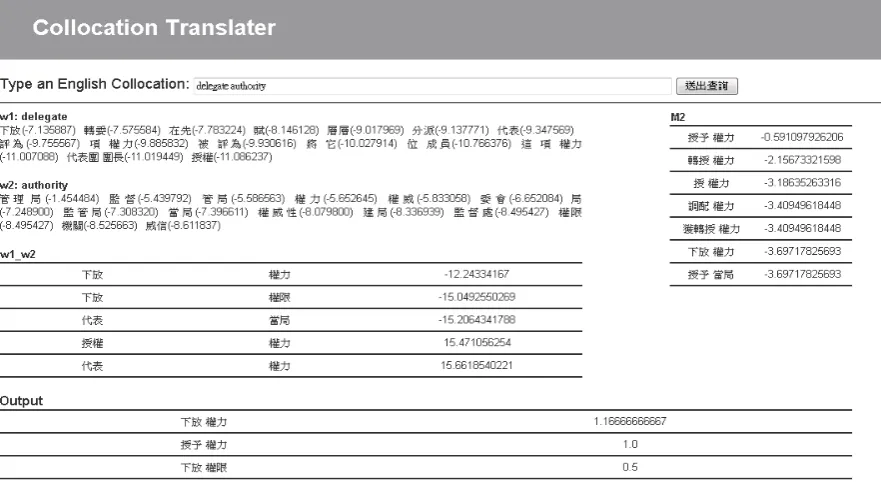
”, but usually there is no continuous “delegate authority” phrase translation in the parallel corpus. The SMT system might translate the collocation word by word, resulting in a incorrect translation, such as “7 :” (Figure 2). Intuitively, a English collocation translation should be also a Chinese collocation, and using an appropriate Chinese collocation set might filter out the incorrect translations, and leads to better translations such as “
”. As shown in Figure 1, Google Translate surely has a good translation in this example.
Figure 1. Submitting a English Collocation “delegate authority” to Google Translate
Figure 2. An example of translating “delegate authority”
At runtime, the given collocation is first decomposed into two parts as base words and collocates, in order to obtain a set of possible word translations. The combined translations of two words are then generated. The additional translations are also generated if available from the bidirectional alignment translation model. Finally, the top 3 Chinese translation candidates of these two models are combined, ranked and returned.
The rest of the paper is organized as follows. Chapter 2 reviews related works. Chapter 3 gives a formal statement of the problem that we attempt to resolve, and then present our method to extract translations from parallel corpus, involving generating translations by word alignment and filtering translation candidates using a dependency relation model. Chapter 4 describes the experimental settings and the data sets we utilize. In Chapter 5, we describe the evaluation results and present a further discussion. Finally, Chapter 6 gives the conclusion of this paper and points the future research direction.
2
RELATED WORK
structure of collocations and various word forms.
3.1
Problem Statement
We focus on finding translation equivalents of verb-noun collocation in a parallel corpus. These translations then are ranked and returned as output. The returned translations can be examined by a human user directly, or passed to an SMT system to improve translation quality. Therefore, our goal is to return a set of ranked collocation translations. We now formally state the problem we are addressing.
Problem Statement: We are given a verb-noun collocation (Vc, Nc) and a word-aligned parallel corpus PC, and a phrase table PT from a SMT system (e.g., Moses). Our goal is to retrieve a set of combined translations of the base word and the collocate CTcombine = {(Vt_comb,
Nt_comb)1, (Vt_comb, Nt_comb)2, …, (Vt_comb, Nt_comb)m} from PT, and another set of aligned collocation translations CTalign = {(Vt_align, Nt_align)1, (Vt_align, Nt_align)2, …, (Vt_align, Nt_align)n} from PC. These translations are finally ranked and returned as the system output.
In the rest of the paper, we describe the method for solving this problem in detail. First, we show the steps of extracting collocation translation from PC and building translation models (Section 3.2). Finally, we present how to generate collocation translations by these two models and ranks translation candidates at run time (Section 3.3).
3.2
Extracting Collocation Translation from Parallel Corpus
We attempt to find translations of verb-noun collocations from a parallel corpus, and filter translation candidates using a monolingual corpus. Our training process is showed in Figure 3.
(1) Generate word alignment from parallel corpus PC. (Section 3.2.1) (2) Build the combination translation model. (Section
3.2.2)
(3) Build the alignment translation model from word alignment. (Section
3.2.3)
Figure 3. Outline of the training process
3.2.1
Generate word alignment from parallel corpus
In the first stage of the training process (Step (1) in Figure 3.), we generate word alignment data for each sentence pair in a parallel corpus using a alignment tool.
The input for this stage of training is a parallel corpus, as we will describe in Section 4.1. For each sentence pair in the parallel corpus, we use a word alignment tool to align a source word to the corresponding target words. The same procedure is performed in the inverse direction, from the target language to the source language. The output of this stage is the alignment information in both directions.
translating verb-noun collocation. Next, we generate the target language model
VNPairsFrequency, consisting of the frequency of each verb-noun relation pair. The combination translation model is then generated by combining the word translation model and the target language model. We will describe the run time process of combination translation in Section 3.3.
3.2.3
Build the bidirectional alignment translation model
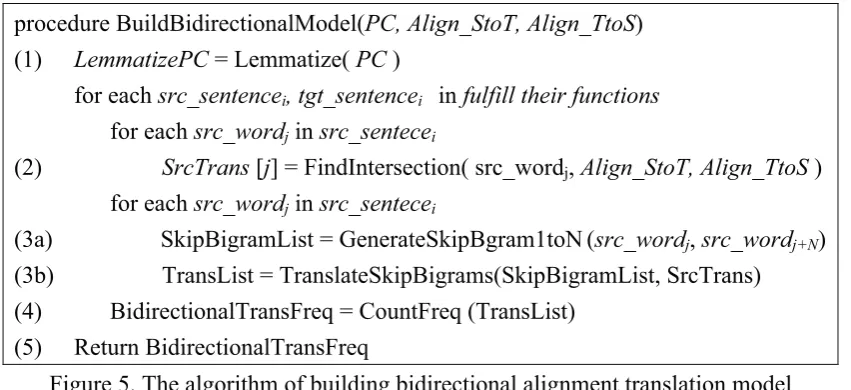
In the third and final stage of training, we address building a bidirectional alignment translation model from word alignment for translating collocations. The input to this stage is the alignment information of both directions Align_StoT and Align_TtoS, generated in the previous section (Section 3.2.1). The algorithm is shown in Figure 5.
procedure BuildBidirectionalModel(PC, Align_StoT, Align_TtoS) (1) LemmatizePC = Lemmatize( PC )
for each src_sentencei, tgt_sentencei in fulfill their functions for each src_wordj in src_sentecei
(2) SrcTrans [j] = FindIntersection( src_wordj, Align_StoT, Align_TtoS ) for each src_wordj in src_sentecei
(3a) SkipBigramList = GenerateSkipBgram1toN (src_wordj, src_wordj+N) (3b) TransList = TranslateSkipBigrams(SkipBigramList, SrcTrans)
(4) BidirectionalTransFreq = CountFreq (TransList)
(5) Return BidirectionalTransFreq
Figure 5. The algorithm of building bidirectional alignment translation model
In Step (1) of the algorithm, we first lemmatize all source sentences to generate the lemmatized parallel corpus LemmatizePC.
In Step (2) of the algorithm, we extract translations for each source word in each sentence pair. We first find target words aligned to the source word by the source to target alignment information. For each aligned target word, the target to source alignment information is then used to determine whether the source word is also aligned to this target word. We choose the target word as the translation of the source word if the source word is also aligned to it. The translations of each source word SrcTrans are generated.
In Step (3a), source skip bigrams are generated for each source sentence. A skip bigram is combined by the head word and the tail word of a phrase. In order to limit the amount of the data processed, we only consider phrases with the distance 1 to 4 words in generating skip bigram. Then, in Step (3b), we retrieve the corresponding translations for each skip bigram.
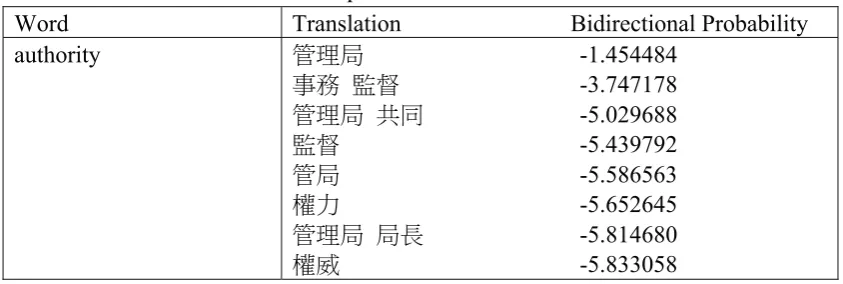
In Step (4), we count the frequency of each skip bigram translation pair. Since we focus on translating verb-noun collocation, we only deal with verb-noun bigram and translation pairs to reduce processing time. Table 1 shows examples related to the skip bigram “play role”
Finally, in Step (5), the frequency of skip bigram and translation pairs,
Table 2. An example of bidirectional alignment translation model Collocation Translation Frequency
play role
( & 1193
# 52 612
' 52 475
52 46
( 1 37
3.3
The Run Time Process
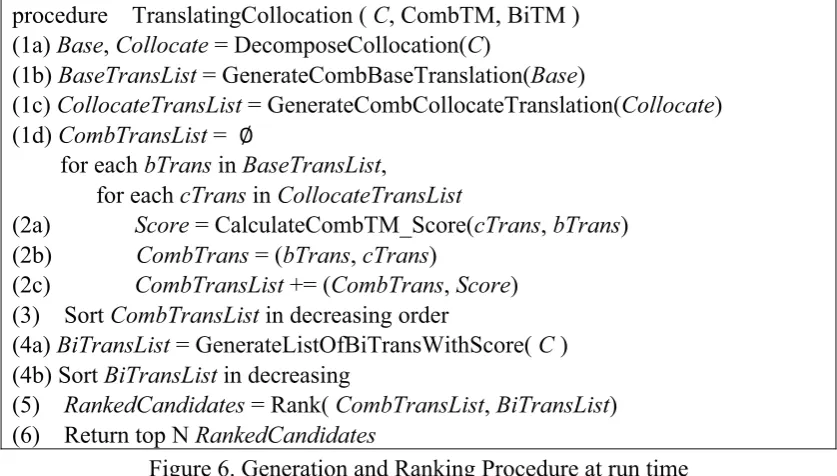
Once all collocation translation models are obtained, these models are combined and used to translate collocations. For a given collocation, we generate and evaluate translations using the procedure shown in Figure 6. In the following, we first present the translating process of the combination translation model, and then the bidirectional alignment model. Finally, we describe the ranking algorithm to output the collocation translations.
procedure TranslatingCollocation ( C, CombTM, BiTM ) (1a) Base, Collocate = DecomposeCollocation(C)
(1b) BaseTransList = GenerateCombBaseTranslation(Base)
(1c) CollocateTransList = GenerateCombCollocateTranslation(Collocate) (1d) CombTransList =
for each bTrans in BaseTransList, for each cTrans in CollocateTransList
(2a) Score = CalculateCombTM_Score(cTrans, bTrans) (2b) CombTrans = (bTrans, cTrans)
(2c) CombTransList += (CombTrans, Score) (3) Sort CombTransList in decreasing order
(4a) BiTransList = GenerateListOfBiTransWithScore( C ) (4b) Sort BiTransList in decreasing
(5) RankedCandidates = Rank( CombTransList, BiTransList) (6) Return top N RankedCandidates
Figure 6. Generation and Ranking Procedure at run time
3.3.1
Combination Translation Model
In Step (1a), we first decompose the given collocation into the base word and the collocate. Consider the collocation “delegate authority” for example, “authority” is the base word and “delegate” is the collocate. A set of the base word translations is generated as
BaseTransList, and translation list for the collocate CollocateTransList is also generated. We then generate possible collocation translations CombTransList using Cartesian product of each bTrans in BaseTransList and each cTrans in CombTransList. Each CombTrans (bTrans, cTrans) in CombTransList gets a word translation model score using the following formula:
where is the smoothing weight to cope with the data sparse problem,
. We combine the and by a weighting formula:
where is the model weight and .
We retrieve the translations and rank translations in descending order of ScoreCombTM. The N top-ranked translations of combination translation model are produced.
3.3.2
Bidirectional Alignment Model
In step (4a), we generate another set of translations using the bidirectional alignment model for the given collocation C. Translations of C are retrieved from the bidirectional alignment model, and each translation is scored as follows:
The generated translations are ranked in descending order of ScoreBiModel, and N top-ranked translations of bidirectional alignment model are retrieved.
Once all translations of two models are generated, we merge the N top-ranked translations of two models and re-rank them. The ranking algorithm we use aims at retrieving the translations that two models have in common. The score of the top N translation of each model is re-calculated as the formula:
where N means the output rank of a translation in a model. We then merge all translations, and if there is a translation that both in output of two models, we add two scores together. Finally, the merged translations are ranked with their merged score (Step 5), and the K top-ranked translations are returned as the final result produced by our method.
4
Experimental Setting and Results
retrieve a set of good translations to assist bilingual collocation dictionary editors, we evaluated our method on a group of English collocations, which are selected from an English collocation dictionary. Finally, since we do not have reference answers for such translation advising task, we will use human judges to evaluate the quality of our generated collocation translations.
In this chapter, we first present the details of training our system for the evaluation (Section 4.1). Then, Section 4.2 describes the alternative methods that we used in our comparison. Section 4.3 introduces the datasets used in our experiments and the evaluation metrics for evaluating the performance of our system, and Section 4.4 describe the tuning process of our system module. Section 4.5 reports the results of our experiment evaluations. Finally, in Section 4.6, we analyze the experimental results in detail.
4.1
Experimental Settings
In our bidirectional alignment translation model, we used the Hong Kong Parallel Text (HKPT; LDC2004T08) as the training data, which contains approximately 222,000 sentence pairs,. English sentences of HKPT were lower-cased and performed lemmatization using Nature Language Toolkit (NLTK), a suite of open source modules written in Python. Chinese sentences of HKPT were word-segmented by the CKIP Chinese word segmentation system (Ma and Chen, 2003). To obtain word alignment information of English and Chinese sentences, we used GIZA++ (Och and Ney, 2003) as the word alignment tool.
For word translation model of our combination translation model, the phrase table of HKPT was built by the state-of-the-art phrase-based SMT system, Moses (Koehn et al., 2007). Common settings are used to run Moses: GIZA++ was used for word alignment, grow-diagonal-final (Koehn et al., 2005) heuristics were used to combine bi-direction word alignment, and extract bilingual phrase (Koehn et al., 2005).
For the target language model of our combination translation model, we used Central News Agency (CNA) as the monolingual corpus, by using the CKIP Chinese Parser to produce dependency relations.
Our system uses some parameters during training. The parameters were tested with different values and finally the values were set as shown in Table 3. We did not test these values exhaustively and further tuning may improve the performance of our system.
Table 3. Parameter used in training
Parameter Value Description
minBidiretionProb -15.0 Minimum bidirectional translation
probability of the base word and the
collocate translation.
numWordTrans 100 Number of the base word and the
collocate translations used to generate
collocation translations.
4.2
Methods Compared
the Chinese translations of the collocation. The output of our system is a list of ranked translation candidates, which can either be shown to the user directly, or incorporated into the existing SMT systems.
In this paper, we have introduced a hybrid method for generating collocation translations from a parallel corpus and an additional target language monolingual corpus for a given collocation. Therefore, we compare the results of different translation retrieval methods from a parallel corpus.
We compared different methods for retrieving collocation translations from a parallel corpus, which are listed as follows:
— MOSES: The state-of-the-art SMT framework that are widely used recently. We
build the Moses translating system using the same HKPT parallel corpus with
default setting as our baseline system.
— Combination Translation Model (CTM): The system based on translating the base
word and the collocate separately and then combined them to generate candidates.
The candidates are filtered by the target language model as output.
— Bidirectional Alignment Translation Model (BTM): The system extracts
translation based on the bidirectional alignment information of a word-aligned
parallel corpus using GIZA++.
— Hybrid Translation Model (HYBRID): Our system based on both CTM and BTM
by combining the results of each model with the translation ranking scheme as
described in Section 3.3.
4.3
Evaluation Data Sets and Metrics
The evaluation of the traditional SMT systems usually base on the quality of translated texts. Bilingual Evaluation Understudy (BLEU; Papineni et al, 2002) is a mainstream automatically scheme to evaluate quality of the MT translations. The translation of the input texts is compared the similarity with human-translated reference answers. However, since our system aims at assisting user to find appropriate translations for bilingual collocation dictionaries editors, the lack of reference translations results in a difficult situation of translation equivalents.
To evaluate our system, we randomly selected 55 English verb-noun collocations from the Oxford Collocations Dictionary (OCD; Oxford University Press, 2009), which collects about 25,000 common collocations. All nouns of collocations were chose from Academic Word List (AWL; Coxhead 2003). The testing data consisted of 80 collocations, which were selected in the same way.
We used two human judges to examine the generated translations for each collocation in the data sets for evaluation. The human judges were asked to examine retrieved collocation translation one at a time, and judge each translation candidate as “correct”, “partial acceptable”, or “unacceptable” for the collocations.
By using the judgments from two human judges, we evaluate the translations using the
Definition 4.1. The Top-N accuracy of a translation model for K collocations in test data, in our definition, is the percentage of all collocations with translation results, where Top-N translations contain a correct translation.
Example 4.1. Consider top 3 translations returned by the system for 10 collocations in test data. If there are 3 collocations with correct translations at first place, 2 at second place, and 1 at third place, the Top-N accuracy of this system is (3+2+1)/10 = 60%.
We also compute Mean Reciprocal Rank (MRR), a measure of how much effort needed for a user to find a compatible translation in the returned order of collocation translations (Voorhees and Tice, 1999). The MRR value is a real number between 0 and 1, where 1 denotes the compatible translations always occur at first place. We report the MRR results to examine the effectiveness of our system being used to assist bilingual dictionaries editors.
Definition 4.2. The Reciprocal Rank for a system, for a input collocation c from the data set D, is defined as Rc-1, where Rc is the first rank of a translation judged as a correct translation for c. The Mean Reciprocal Rank (MRR) of the system is the average of the Reciprocal Rank values over all evaluated collocations in D.
Example 4.2. Consider a collocation c and the system outputs 5 translations for c. If three translations are judged correct and ranked at 2, 3, 5. The Reciprocal Rank for c is 2-1 = 0.5.
We also calculate Kappa statistics (Cohen, 1960) to evaluate the agreement between two human judges. Cohen’s Kappa coefficientis a statistical measure of the inter-judge agreement, which consider the agreement occurring by chance and the agreement of observed judgment result. If the judges are in complete agreement with each other for the classification totally, then =1. If there is no agreement between the judges, then 0.
Definition 4.3. The Cohen’s Kappa coefficient is calculated as the equation:
where Pr(a) is relative observed agreement between judges, and Pr(e) is the hypothetical probability of agreement by chance, which is calculated by using the observed judgments by each human judge.
4.4
Tuning Parameters
In this section, we describe the process of tuning the parameter (weight of word translation model in the combination translation model (CTM) ) by using the development data. Recall that the score of CTM is calculated as the following:
The different weights of determine whether the word translation model (WTM) or the target language model (TLM) has more influence on the collocation translations score
ScoreCombTM. A higher value of means that ScoreCombTM relies more on WTM than TLM. In contrast, TLM has more influence for a lower .
find the best MRR values by using development data. As the result. We make = 0.4 as our model weight.
4.5
Evaluation Results
In this section, we evaluate the performance of various systems in Section 4.2 using the testing data set and different metrics we described in Section 4.3.
For each compared system, we generated top 3 ranked translations for each collocation in the testing data. Samples of the system output for collocations in the testing data are listed in Appendix A. We first calculate the Kappa value to acquire the agreement between two judges. In order to calculate the Kappa value, we mixed all top 3 translations from various systems and generated a translation pool, which contains all generated translations from different systems for each collocation in test data. The human judges then evaluated on all 1451 translations in the translation pool, and we got the Kappa value , which indicates that the human judges have substantial agreement while judging translation results
Table 4. Top-N precision of different systems
Top-1 Top-2 Top-3 Top-4 Top-5
Moses (baseline) .55 .73 .77 .78 .82
BTM .49 .56 .59 .59 .60
CTM .67 .75 .80 .82 .83
Hybrid (CTM+BTM) .65 .81 .85 .88 .89
Table 5. MRR value for all translations for collocations in test data
by seeing “correct
System MRR
Moses (baseline) .72
BTM .55
CTM .76
Hybrid (CTM+BTM) .78
We report the top-N accuracies from top-1 to top-5 in Table 4. The results indicate that, except the top-1 accuracy, our Hybrid method has significantly better accuracy improvement than other three methods from top-2 to top-5. Compared with the baseline, our system improves 7% ~ 10% more accuracies. Hybrid, combined CTM and BTM, improves about more 6% accuracy than only CTM. This result indicates that although top-N accuracies of
BTM is the lowest since it suffers from low translation coverage, BTM still improves
Table 4 reports the MRR value for all compared methods. The reported MRR is an average value of the judgment by two judges. Hybrid has the best MRR 0.78 of all methods , which means that a correct answer can be found at the first 2 translations in ranked translation list by a human user. Also our HYBRID method, compared to the traditional SMT system
corpora. Proceedings of the 31st annual meeting on association for computational linguisticsAssociation for Computational Linguistics. 17 p.
[10] Loper E. and Bird S. 2002. NLTK: The natural language toolkit. Proceedings of the ACL-02 workshop on effective tools and methodologies for teaching natural language processing and computational linguistics-volume 1Association for Computational Linguistics. 63 p.
[11] Lü Y. and Zhou M. 2004. Collocation translation acquisition using monolingual corpora. Proceedings of the 42nd annual meeting on association for computational linguisticsAssociation for Computational Linguistics. 167 p.
[12] Marcu D. and Wong W. 2002. A phrase-based, joint probability model for statistical machine translation. In Proceedings of the ACL-02 conference on empirical methods in natural language processing-volume 10. Association for Computational Linguistics. 133 p.
[13] Ohmori K. and Higashida M. 1999. Extracting bilingual collocations from non-aligned parallel corpora. In Proeeding. of the 8th international conference on theoretical and methodological issues in machine translation (TMI99). Citeseer. 88 p.
[14] Oxford University Press. 2009. Oxford collocations dictionary 2nd . USA: Oxford University Press.
[15] Papineni K., Roukos S., Ward T. and Zhu W. J. 2002. BLEU: A method for automatic evaluation of machine translation. In Proceedings of the 40th annual meeting on association for computational linguistics, Association for Computational Linguistics. 311 p.
[16] J. Richard Landis and Gary G. Koch. 1977. The Measurement of Observer Agreement for Categorical Data. Biometrics, 33(1):159-174. International Biometric Society
[17] Seretan V. and Wehrli E. 2007. Collocation translation based on sentence alignment and parsing. Actes de la 14e conférence sur le traitement automatique des langues naturelles (TALN 2007). Citeseer. 401 p.
[18] Smadja F, McKeown KR, Hatzivassiloglou V. 1996. Translating collocations for bilingual lexicons: A statistical approach. Computational Linguistics 22(1):1-38.