Term Contributed Boundary Feature using Conditional Random
Fields for Chinese Word Segmentation Task
Tian-Jian Jiang†‡ Shih-Hung Liu*‡ Cheng-Lung Sung*‡ Wen-Lian Hsu†‡ †
Department of Computer Science, National Tsing-Hua University *
Department of Electrical Engineering, National Taiwan University ‡
Institute of Information Science, Academia Sinica
{tmjiang,journey,clsung,hsu}@iis.sinica.edu.tw
Abstract
This paper proposes a novel feature for conditional random field (CRF) model in Chinese
word segmentation system. The system uses a conditional random field as machine learning
model with one simple feature called term contributed boundaries (TCB) in addition to the
“BIEO” character-based label scheme. TCB can be extracted from unlabeled corpora
automatically, and segmentation variations of different domains are expected to be reflected
implicitly. The dataset used in this paper is the closed training task in CIPS-SIGHAN-2010
bakeoff, including simplified and traditional Chinese texts. The experiment result shows that
TCB does improve “BIEO” tagging domain-independently about 1% of the F1 measure
score.
Keywords: Term contributed boundary, Conditional Random fields, Chinese word segmentation.
1. Introduction
Word segmentation is a trivial problem for most Western language, since there are clear
delimiters (e.g. spaces) for individual words. However, for some Asia languages such as
Chinese, Japanese and other language do not have word delimiters, word segmentation
problem will be encountered if we want to do some further language processing, e.g.
information retrieval, summarization and so on. Thus, the Chinese word segmentation could
be viewed as a fundamental problem for natural language processing.
Chinese word segmentation is still a challenging issue, and there is contest held in
SIGHAN community [1]. The CIPS-SIGHAN-2010 bakeoff task of Chinese word
segmentation is focused on cross-domain texts [2]. The design of data set is challenging
particularly. The domain-specific training corpora remain unlabeled, and two of the test
corpora keep domains unknown before releasing, therefore it is not easy to apply ordinary
function might be value one when is the state B, is the state I, and is the
character “全”.
1
− t y
max
Y
t
y xt
Given such a model as defined in Eq. 1, the most probable labeling sequence for an input
sequence X is as follow.
)
|
(
arg
*
X
Y
P
y
=
Λ (2)Eq. 2 can be efficiently calculated by dynamic programming using Viterbi algorithm. The
more details about concepts of CRF and learning parameters could be refer to [7]. Figure 1
shows the CRF tagging, which is based on BIEO label training, in test phase when given the
un-segmented input.
Figure 1. Illustration of CRF prediction
3. Term Contributed Boundary
The word boundary and the word frequency are the standard notions of frequency in
corpus-based natural language processing, but they lack the correct information about the
actual boundary and frequency of a phrase’s occurrence. The distortion of phrase boundaries
and frequencies was first observed in the Vodis Corpus when the bigram “RAIL
ENQUIRIES” and trigram “BRITISH RAIL ENQUIRIES” were examined and reported by
O'Boyle [8]. Both of them occur 73 times, which is a large number for such a small corpus.
“ENQUIRIES” follows “RAIL” with a very high probability when it is preceded by
“BRITISH.” However, when “RAIL” is preceded by words other than “BRITISH,”
“ENQUIRIES” does not occur, but words like “TICKET” or “JOURNEY” may. Thus, the
bigram “RAIL ENQUIRIES” gives a misleading probability that “RAIL” is followed by
“ENQUIRIES” irrespective of what precedes it. This problem happens not only with
word-token corpora but also with corpora in which all the compounds are tagged as units
since overlapping N-grams still appear, therefore corresponding solutions such as Zhang et al.
We uses suffix array algorithm to calculate exact boundaries of phrase and their
frequencies [10], called term contributed boundaries (TCB) and term contributed frequencies
(TCF), respectively, to analogize similarities and differences with the term frequencies (TF).
For example, in Vodis Corpus, the original TF of the term “RAIL ENQUIRIES” is 73.
However, the actual TCF of “RAIL ENQUIRIES” is 0, since all of the frequency values are
contributed by the term “BRITISH RAIL ENQUIRIES”. In this case, we can see that
‘BRITISH RAIL ENQUIRIES’ is really a more frequent term in the corpus, where “RAIL
ENQUIRIES” is not. Hence the TCB of “BRITISH RAIL ENQUIRIES” is ready for CRF
tagging as “BRITISH/TB RAIL/TI ENQUIRIES/TI,” for example, “TB” means beginning of
the term contributed boundary and “TI” is the other place of term contributed boundary.
In Chinese, similar problems occurred as Lin and Yu reported [14, 15], consider the
following Chinese text:
“自然科學的重要” (the importance of natural science) and
“自然科學的研究是唯一的途徑” (the research on natural science is the only way).
In the above text, there are many string patterns that appear more than once. Some
patterns are listed as follows:
“自然科學” (natural science) and
“自然科學的” (of natural science).
They suggested that it is very unlikely that a random meaningless string will appear
more than once in a corpus. The main idea behind our proposed method is that if a Chinese
string pattern appears two or more times in the text, then it may be useful. However, not all the patterns which appear two or more times are useful. In the above text, the pattern “然科”
has no meaning. Therefore they proposed a method that is divided into two steps. The first
step is to search through all the characters in the corpus to find patterns that appear more than
once. Such patterns are gathered into a database called MayBe, which means these patterns
may be “Chinese Frequent Strings” as they defined. The entries in MayBe consist of strings
and their numbers of occurrences. The second step is to find the net frequency of occurrence
for each entry in the above database. The net frequency of occurrence of an entry is the
number of appearances which do not depend on other super-strings. For example, if the content of a text is “自然科學,自然科學” (natural science, natural science), then the net
frequency of occurrence of “自然科學” is 2, and the net frequency of occurrence of “自然科” is
zero since the string “自然科” is brought about by the string “自然科學.” They exclude the
appearances of patterns which are brought about by others; hence their method is actually
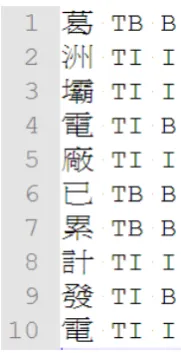
equivalent to the suffix array algorithm we apply for calculating TCB and TCF, and the annotated input string for CRF will be “自/TB 然/TI 科/TI 學/TI”. The Figure 2 demonstrates
4.2.1 Experiments of Comparison with BI, BIO and BIEO
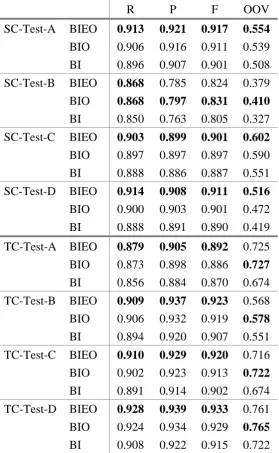
Experiments here evaluate the performance between three different label schemes “BI”, “BIO”
and “BIEO” for two types (SC and TC) in four domains (Test-A, Test-B, Test-C and Test-D).
The result shows in Table 1. The scheme “BIEO” outperforms “BI” and “BIEO” on F1
measure, except at SC-Test-B. The domain B is computer science and its test data mingles
many English words. In the end of section 4.2.2, we will deal with this problem using
post-processing for English words.
R P F OOV
SC-Test-A BIEO 0.913 0.921 0.917 0.554
BIO 0.906 0.916 0.911 0.539
BI 0.896 0.907 0.901 0.508
SC-Test-B BIEO 0.868 0.785 0.824 0.379
BIO 0.868 0.797 0.831 0.410
BI 0.850 0.763 0.805 0.327
SC-Test-C BIEO 0.903 0.899 0.901 0.602
BIO 0.897 0.897 0.897 0.590
BI 0.888 0.886 0.887 0.551
SC-Test-D BIEO 0.914 0.908 0.911 0.516
BIO 0.900 0.903 0.901 0.472
BI 0.888 0.891 0.890 0.419
TC-Test-A BIEO 0.879 0.905 0.892 0.725
BIO 0.873 0.898 0.886 0.727
BI 0.856 0.884 0.870 0.674
TC-Test-B BIEO 0.909 0.937 0.923 0.568
BIO 0.906 0.932 0.919 0.578
BI 0.894 0.920 0.907 0.551
TC-Test-C BIEO 0.910 0.929 0.920 0.716
BIO 0.902 0.923 0.913 0.722
BI 0.891 0.914 0.902 0.674
TC-Test-D BIEO 0.928 0.939 0.933 0.761
BIO 0.924 0.934 0.929 0.765
BI 0.908 0.922 0.915 0.722
4.2.2 Term Contributed Boundary Experiments with BI as Baseline
In this section, we evaluate the performance of term contributed boundary as a feature in CRF
model training. The label scheme “BI” of ground truth has been treated as baseline for
comparison with TCB features, which label scheme is also “BI”. There are several different
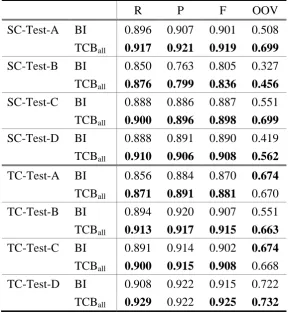
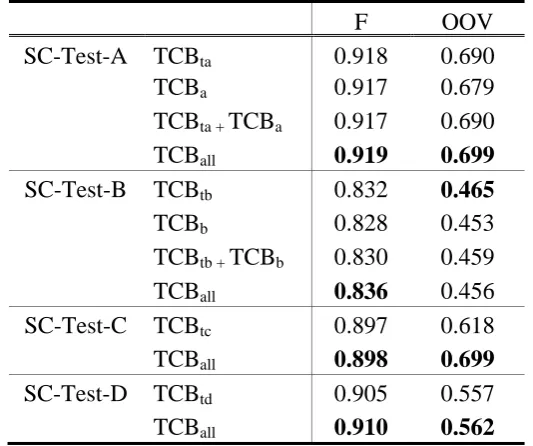
experiments that we have done which are showed in Table 2 and Table 3a and Table 3b. The
configuration is about the trade-off between data sparseness and domain fitness. For the sake
of OOV issue, TCBs from all the training and test corpora are included in the configuration of
results. For potentially better consistency to different types of text, TCBs from the training
corpora and/or test corpora are grouped by corresponding domains of test corpora. Table 2,
Table 3a and Table 3b provide the details, where the baseline is the character-based “BI”
tagging, and others are “BI” with additional different TCB configurations: TCBall stands for
the TCB extracted from all training data and all test data; TCBa, TCBb, TCBta, TCBtb, TCBtc,
TCBtd represents TCB extracted from the training corpus A, B, and the test corpus A, B, C, D,
respectively.
R P F OOV
SC-Test-A BI 0.896 0.907 0.901 0.508
TCBall 0.917 0.921 0.919 0.699
SC-Test-B BI 0.850 0.763 0.805 0.327
TCBall 0.876 0.799 0.836 0.456
SC-Test-C BI 0.888 0.886 0.887 0.551
TCBall 0.900 0.896 0.898 0.699
SC-Test-D BI 0.888 0.891 0.890 0.419
TCBall 0.910 0.906 0.908 0.562
TC-Test-A BI 0.856 0.884 0.870 0.674
TCBall 0.871 0.891 0.881 0.670
TC-Test-B BI 0.894 0.920 0.907 0.551
TCBall 0.913 0.917 0.915 0.663
TC-Test-C BI 0.891 0.914 0.902 0.674
TCBall 0.900 0.915 0.908 0.668
TC-Test-D BI 0.908 0.922 0.915 0.722
TCBall 0.929 0.922 0.925 0.732
F OOV
SC-Test-A TCBta 0.918 0.690
TCBa 0.917 0.679
TCBta + TCBa 0.917 0.690
TCBall 0.919 0.699
SC-Test-B TCBtb 0.832 0.465
TCBb 0.828 0.453
TCBtb + TCBb 0.830 0.459
TCBall 0.836 0.456
SC-Test-C TCBtc 0.897 0.618
TCBall 0.898 0.699
SC-Test-D TCBtd 0.905 0.557
TCBall 0.910 0.562
Table 3a. Simplified Chinese Domain-specific TCB vs. TCBall
F OOV
TC-Test-A TCBta 0.889 0.706
TCBa 0.888 0.690
TCBta + TCBa 0.889 0.710
TCBall 0.881 0.670
TC-Test-B TCBtb 0.911 0.636
TCBb 0.921 0.696
TCBtb + TCBb 0.912 0.641
TCBall 0.915 0.663
TC-Test-C TCBtc 0.918 0.705
TCBall 0.908 0.668
TC-Test-D TCBtd 0.927 0.717
TCBall 0.925 0.732
Table 3b. Traditional Chinese Domain-specific TCB vs. TCBall
Table 2 indicates that F1 measure scores can be improved by TCB about 1%,
domain-independently. Table 3a and Table 3b give a hint of the major contribution of
In order to deal with English words, we apply post-processing to the segmented data. It
simply recovers alphanumeric sequences according to their original segments in the training
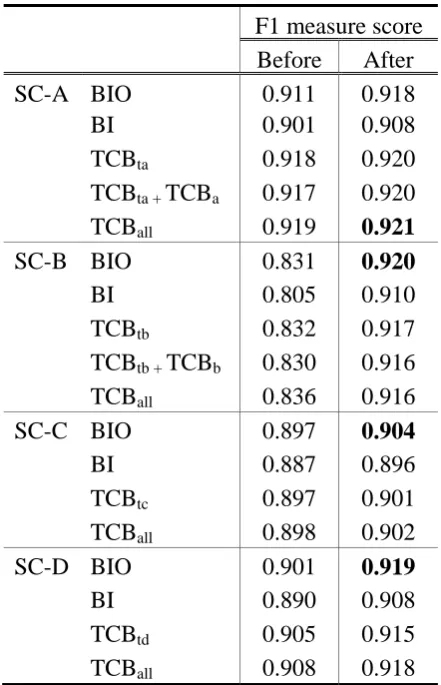
data. Table 4 shows the experiment result after post-processing. The performance has been
improved, especially on the domain B of computer science, since its data consists of a lot of
technical terms in English.
F1 measure score
Before After
SC-A BIO 0.911 0.918
BI 0.901 0.908
TCBta 0.918 0.920
TCBta + TCBa 0.917 0.920
TCBall 0.919 0.921
SC-B BIO 0.831 0.920
BI 0.805 0.910
TCBtb 0.832 0.917
TCBtb + TCBb 0.830 0.916
TCBall 0.836 0.916
SC-C BIO 0.897 0.904
BI 0.887 0.896
TCBtc 0.897 0.901
TCBall 0.898 0.902
SC-D BIO 0.901 0.919
BI 0.890 0.908
TCBtd 0.905 0.915
TCBall 0.908 0.918
Table 4. F1 scores before and after the English problem fixed
4.2.3 Term Contributed Boundary Experiments with BIO and BIEO
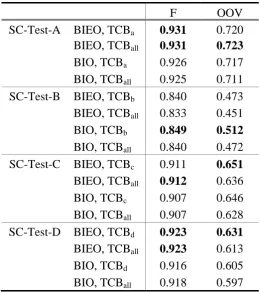
In this section we combine the TCB feature with “BIEO” to compare with “BIO”. Table 5a
and Table 5b show the experimental results. We find that our TCB feature is robustness,
which would not affected by different label scheme. This meets our conjecture, and the
F OOV SC-Test-A BIEO, TCBa 0.931 0.720
BIEO, TCBall 0.931 0.723
BIO, TCBa 0.926 0.717
BIO, TCBall 0.925 0.711
SC-Test-B BIEO, TCBb 0.840 0.473
BIEO, TCBall 0.833 0.451
BIO, TCBb 0.849 0.512
BIO, TCBall 0.840 0.472
SC-Test-C BIEO, TCBc 0.911 0.651
BIEO, TCBall 0.912 0.636
BIO, TCBc 0.907 0.646
BIO, TCBall 0.907 0.628
SC-Test-D BIEO, TCBd 0.923 0.631
BIEO, TCBall 0.923 0.613
BIO, TCBd 0.916 0.605
BIO, TCBall 0.918 0.597
Table 5a. Simplified Chinese Domain-specific TCB vs. TCBall with BIO and BIEO
F OOV
TC-Test-A BIEO, TCBa 0.909 0.747
BIEO, TCBall 0.908 0.743
BIO, TCBa 0.904 0.744
BIO, TCBall 0.906 0.744
TC-Test-B BIEO, TCBb 0.943 0.771
BIEO, TCBall 0.940 0.754
BIO, TCBb 0.945 0.804
BIO, TCBall 0.945 0.804
TC-Test-C BIEO, TCBc 0.931 0.737
BIEO, TCBall 0.930 0.730
BIO, TCBc 0.928 0.743
BIO, TCBall 0.929 0.745
TC-Test-D BIEO, TCBd 0.942 0.768
BIEO, TCBall 0.943 0.771
BIO, TCBd 0.944 0.778
BIO, TCBall 0.943 0.777
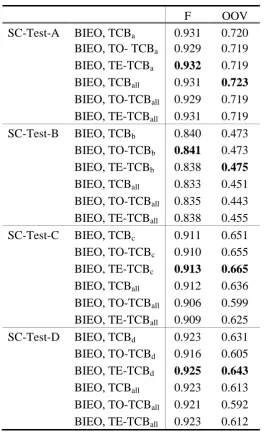
For the sake of consistency, we do extra experiments using label schemes either “BIEO”
or “BIO” to label TCB features, and denote them as TE-TCB and TO-TCB. In these schemes,
“TB,” “TI,” “TE” and “TO” are tags for the head of TCB, the middle of TCB, the tail of TCB,
and the single character word of TCB, respectively. TE-TCB uses all tags but TO-TCB
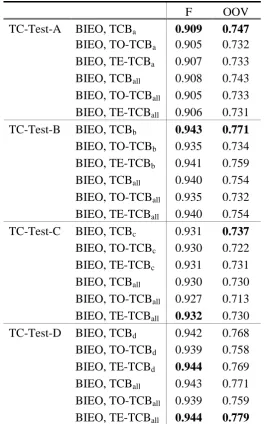
excludes the tag “TE.” Table 6a and Table 6b show the comparisons between the original
TCB, TO-TCB and TE-TCB. The result suggests that TO-TCB and TE-TCB may not have
stable and significant improvements to the original TCB scheme that consists of only “TB”
and “TI.” We suspect that it is because single character words of TCB and the tail character of
TCB sometimes conflict with the word boundaries of gold standard, after all the concept of
TCB is from suffix pattern, not from linguistic design.
F OOV
SC-Test-A BIEO, TCBa 0.931 0.720
BIEO, TO- TCBa 0.929 0.719
BIEO, TE-TCBa 0.932 0.719
BIEO, TCBall 0.931 0.723
BIEO, TO-TCBall 0.929 0.719
BIEO, TE-TCBall 0.931 0.719
SC-Test-B BIEO, TCBb 0.840 0.473
BIEO, TO-TCBb 0.841 0.473
BIEO, TE-TCBb 0.838 0.475
BIEO, TCBall 0.833 0.451
BIEO, TO-TCBall 0.835 0.443
BIEO, TE-TCBall 0.838 0.455
SC-Test-C BIEO, TCBc 0.911 0.651
BIEO, TO-TCBc 0.910 0.655
BIEO, TE-TCBc 0.913 0.665
BIEO, TCBall 0.912 0.636
BIEO, TO-TCBall 0.906 0.599
BIEO, TE-TCBall 0.909 0.625
SC-Test-D BIEO, TCBd 0.923 0.631
BIEO, TO-TCBd 0.916 0.605
BIEO, TE-TCBd 0.925 0.643
BIEO, TCBall 0.923 0.613
BIEO, TO-TCBall 0.921 0.592
BIEO, TE-TCBall 0.923 0.612
F OOV TC-Test-A BIEO, TCBa 0.909 0.747
BIEO, TO-TCBa 0.905 0.732
BIEO, TE-TCBa 0.907 0.733
BIEO, TCBall 0.908 0.743
BIEO, TO-TCBall 0.905 0.733
BIEO, TE-TCBall 0.906 0.731
TC-Test-B BIEO, TCBb 0.943 0.771
BIEO, TO-TCBb 0.935 0.734
BIEO, TE-TCBb 0.941 0.759
BIEO, TCBall 0.940 0.754
BIEO, TO-TCBall 0.935 0.732
BIEO, TE-TCBall 0.940 0.754
TC-Test-C BIEO, TCBc 0.931 0.737
BIEO, TO-TCBc 0.930 0.722
BIEO, TE-TCBc 0.931 0.731
BIEO, TCBall 0.930 0.730
BIEO, TO-TCBall 0.927 0.713
BIEO, TE-TCBall 0.932 0.730
TC-Test-D BIEO, TCBd 0.942 0.768
BIEO, TO-TCBd 0.939 0.758
BIEO, TE-TCBd 0.944 0.769
BIEO, TCBall 0.943 0.771
BIEO, TO-TCBall 0.939 0.759
BIEO, TE-TCBall 0.944 0.779
Table 6b. Comparisons between TCB and TX-TCB for Traditional Chinese test set
4.3 Error Analysis
The most significant type of error in our results is unintentionally segmented English words.
Rather than developing another set of tag for English alphabets, we applies post-processing to
fix this problem under the restriction of closed training by using only alphanumeric character
information. Table 4 compares F1 measure score of the Simplified Chinese experiment results
before and after the post-processing.
The major difference between gold standards of the Simplified Chinese corpora and the
Traditional Chinese corpora is about non-Chinese characters. All of the alphanumeric and the
punctuation sequences are separated from Chinese sequences in the Simplified Chinese
For example, a phrase “服用/simvastatin/(/statins類/的/一/種/),” where ‘/’ represents the word
boundary, from the domain C of the test data cannot be either recognized by “BIEO” and/or
TCB tagging approaches, or post-processed. This is the reason why Table 4 does not come along
with Traditional Chinese experiment results.
Some errors are due to inconsistencies in the gold standard of non-Chinese character, For
example, in the Traditional Chinese corpora, some percentage digits are separated from their
percentage signs, meanwhile those percentage signs are connected to parentheses right next to
them.
5. Conclusions
This paper introduces a simple CRF feature called term contributed boundaries (TCB) for
Chinese word segmentation. The experiment result shows that it can improve the basic
“BIEO” tagging scheme about 1% of the F1 measure score, domain-independently.
Further tagging scheme for non-Chinese characters are desired for recognizing some
sophisticated gold standard of Chinese word segmentation that concatenates alphanumeric
characters to Chinese characters.
Acknowledgement
The CRF model used in this paper is developed based on CRF++ version
0.49, http://crfpp.sourceforge.net/
The TCBs and TCFs are calculated by YASA (Yet Another Suffix Array) version 0.2.3,
http://yasa.newzilla.org/
6. References
[1] SIGHAN, http://sighan.cs.uchicago.edu/
[2] CIPS-SIGHAN-2010, http://www.cipsc.org.cn/clp2010/
[3] Ma, Wei-Yun and Keh-Jiann Chen, “Introduction to CKIP Chinese Word Segmentation
System for the First International Chinese Word Segmentation Bakeoff,” in Proceedings
of ACL, Second SIGHAN Workshop on Chinese Language Processing, pp. 168–171,
2003.
[4] Lawrence R. Rabiner, “A Tutorial on Hidden Markov Models and Selected Applications
in Speech Recognition,” in Proceedings of the IEEE, Vol. 77, No. 2, pp. 257–286, 1989.
Information Extraction and Segmentation,” in Proceedings of ICML, 2000.
[6] John Lafferty, Andrew McCallum, and Fernando Pereira, “Conditional Random Fields:
Probabilistic Models for Segmenting and Labeling Sequence Data,” in Proceedings of
ICML, pp. 591–598, 2001.
[7] Hanna M. Wallach, “Conditional Random Fields: An Introduction,” Technical Report
MS-CIS-04-21, Department of Computer and Information Science, University of
Pennsylvania, 2004.
[8] Peter O'Boyle, A Study of an N-Gram Language Model for Speech Recognition, PhD
thesis, Queen's University Belfast, 1993
[9] Ruiqiang Zhang, Genichiro Kikui, and Eiichiro Sumita, “Subword-Based Tagging by
Conditional Random Fields for Chinese Word Segmentation,” in Proceedings of the
Human Language Technology Conference of the NAACL, pp. 193–196, New York, USA,
2006.
[10] Cheng-Lung Sung, Hsu-Chun Yen, and Wen-Lian Hsu, “Compute the Term Contributed
Frequency,” in Proceedings of the 2008 Eighth International Conference on Intelligent
Systems Design and Applications, pp. 325–328, Washington, D.C., USA, 2008.
[11] Fuchun Peng and Andrew McCallum, “Chinese segmentation and new word detection
using conditional random fields,” in Proceedings of Coling-2004, pp. 562–568, Geneva,
Switzerland, 2004
[12] Huihsin Tseng, Pichuan Chang, Galen Andrew, Daniel Jurafsky, and Christopher
Manning, “A Conditional Random Field Word Segmenter for SIGHAN Bakeoff 2005,”
in Proceedings of the Fourth SIGHAN Workshop on Chinese Language Processing, Jeju,
Korea, 2005.
[13] Nianwen Xue and Libin Shen, “Chinese Word Segmentation as LMR Tagging,” in
Proceedings of the Second SIGHAN Workshop on Chinese Language Processing, 2003.
[14]Yih-Jeng Lin and Ming-Shing Yu, “Extracting Chinese Frequent Strings without a
Dictionary from a Chinese Corpus and its Applications,” Journal of Information Science
and Engineering, Vol. 17, pp. 805–824, 2001.
[15] Yih-Jeng Lin and Ming-Shing Yu, “The Properties and Further Applications of Chinese
Frequent Strings,” Computational Linguistics and Chinese Language Processing, Vol. 9,