
Detecting Errors in Semantic Annotation
Markus Dickinson, Chong Min Lee
Indiana University, Georgetown University [email protected], [email protected]
Abstract
We develop a method for detecting errors in semantic predicate-argument annotation, based on the variationn-gram error detection method. After establishing an appropriate data representation, we detect inconsistencies by searching for identical text with varying annotation. By remaining data-driven, we are able to detect inconsistencies arising from errors at lower layers of annotation.
1.
Introduction and Motivation
Corpora with semantic annotation (e.g., Baker et al., 1998; Palmer et al., 2005; Burchardt et al., 2006; Taul´e et al., 2005) are becoming increasingly relevant in natural lan-guage processing. Semantic role labeling—used for tasks such as information extraction (e.g., Surdeanu et al., 2003), machine translation (e.g., Komachi et al., 2006), and ques-tion answering (e.g., Narayanan and Harabagiu, 2004)— requires corpora annotated with predicate-argument struc-ture for training and testing data (see, e.g., Carreras and M`arquez, 2005; Carreras and M`arquez, 2004; Gildea and Jurafsky, 2002; Xue and Palmer, 2004; Toutanova et al., 2005; Pradhan et al., 2005). Not only, then, are there clear applications for predicate-argument structure, but as semantically-annotated corpora are generally built on top of syntactic annotation, such corpora have enormous potential as sources of linguistic data for theoretical research. However, annotating semantic corpora is non-trivial. Given the difficulty of determining certain predicate-argument re-lations, e.g., modifier (ArgM) predications in the Proposi-tion Bank (PropBank, Palmer et al., 2005), and of select-ing an underlyselect-ing theory (see, e.g., Burchardt et al., 2006), there is a need to support annotation endeavors by pro-viding feedback on the annotation schemes. Relatedly, in the process of annotating the corpus, annotation may have been inconsistently applied, leading to errors. These errors can affect the annotation’s uses: for other annotation types, errors can lower the performance of applications training on the corpora (e.g., van Halteren et al., 2001; Dickinson and Meurers, 2005b), prompting workarounds to deal with noisy data (e.g., Hogan, 2007; Banko and Moore, 2004). Moreover, we cannot accurately evaluate technology using a corpus with a significant number of errors as the “gold standard” (Padro and Marquez, 1998; Kvˇetˇon and Oliva, 2002). Furthermore, given that semantic annotation has generally been built on top of POS and syntactic layers of annotation, it is important to see how the layers interact, especially in terms of errors in one layer affecting another. Thus, there is a need to investigate the quality of annotation in semantically-annotated corpora.
While previous research has detected errors in part-of-speech and syntactically-annotated corpora (see Dickinson, 2005, ch. 1), to our knowledge there has been no work on automatically detecting errors in semantically-annotated corpora in a corpus-independent way. Yet this is vitally
im-portant. On the one hand, as mentioned, it is important to detect errors, as they are detrimental to semantic role la-beling tasks, and the process of error detection can provide feedback on the annotation scheme. On the other, investi-gating error detection for semantic annotation can provide insights into the use of this annotation. Additionally, it is important to know whether error detection methods will scale up to semantic annotation, as syntactic and seman-tic annotation seem to rely on different information. Thus, we develop an error detection method for semantic annota-tion, basing it on the variationn-gram method (Dickinson and Meurers, 2005a). In section 2., we outline this method, which detects items occurring multiple times in the corpus with varying annotation, and in section 3. we discuss how to extend it to semantic annotation. Section 4. provides re-sults showing the successfulness of this method.
2.
Background
The variation n-gram method (Dickinson and Meurers, 2003a,b, 2005a) detects items occurring multiple times in the corpus with varying annotation, and these are the so-called variation nuclei. A nucleus with its repeated sur-rounding context is avariationn-gram. Variations in anno-tation are classified as errors or genuine ambiguities using a basic heuristic requiring at least one word of context on each side of the nucleus.
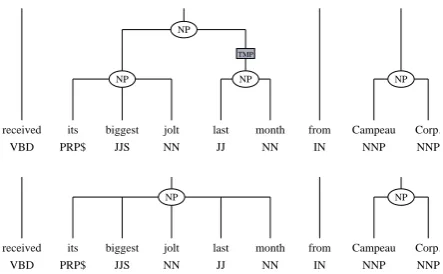
Following Dickinson and Meurers (2003b), we illustrate the variationn-gram approach using the Wall Street Jour-nal in the Penn Treebank (Taylor et al., 2003): the variation nucleusnext Tuesdayin the variation trigrammaturity next Tuesdayhas a labeling error, being twice labeled NP and once PP. A bracketing error occurs forjolt last month from, as shown in Figure 1: the variation nucleuslast month oc-curs twice in this local context, once with the label NP and once as a non-constituent, which we represent with the spe-cial label NIL.
Finally, because we want to cover every verb and its poten-tial arguments, we have to deal with cases where the verb contains more than one element, i.e., variation in phrasal verb (PV) identification. Although not annotated as such, the particle is implicitly an argument of the verb, and we thus created a special relation to capture these cases. For example, the particle verb combinationget backis re-coded as a PV relation betweengetandback, as in (3a), and we can thus find instances ofget backannotated differently, as in (3b).
(3) a. we couldget[P V back] to investing
b. an excuse for people toget[ArgM−ADV back]
to reality
3.3. Heuristics for disambiguating strings
The method as outlined so far generates far too many false positives, especially given the great number of discontinu-ous NIL strings which are clearly not comparable. To nar-row our search for comparable strings, we need some con-textual information. As a simple way to identify errors, we can require one word of identical context to surround every word in the variation nucleus in order to flag it as a poten-tial error (Dickinson and Meurers, 2005a). This “shortest non-fringe” heuristic, however, is rather strict.
Thus, in order to increase recall, we experiment with an-other heuristic. Since we are dealing with errors in the re-lation between the verb and the argument, we have to ask what is the most crucial information. Recall that there are really two potential ways that something can be erroneous: an error in the labeling (or non-labeling) of the argument, or an error in the identification of the argument. The iden-tification of the verb is not really a major issue, given that verbs are generally only a single word and that they drive the analysis. Thus, the context surrounding the argument is more important. Indeed, once we know the verb and the (supposed) argument, we can wonder whether any context around the verb is necessary; knowing that it is potentially related to the argument may be sufficient.
In (4), for example, the nucleussubstantially reducedoes not depend on what follows the verb; the relation between the verb and the argument is context enough.
(4) a. That could [Arg2−M N R substantially] reduce
the value of the television assets .
b. the proposed acquisition could [ArgM−M N R
substantially]reducecompetition ...
Likewise, what kind of court ruling in (5) is at issue is not important to determining whethercourtis an argument of
ruling(5a) or not (5b).
(5) a. from a [Arg0court]rulingon a tax dispute
b. stems from a courtrulingthat *T* found ...
As for argument context, consider (6)4: in (6a),officialshas no modifier, but in (6b) it does, making it a different argu-ment. Thus, we need identical context around the argument to avoid false positives in argument identification.
b. 4
*T*,*, and0refer to empty elements inserted by annotators.
(6) a. Finnair would receive SAS shares valued * at the same amount , [Arg0officials]said0 *T* .
... [Arg0government officials]said0 they had
n’t noticed any surge in the filings .
Thus, to increase recall, we require one word of context around the argument, but not the verb. We refer to this as theargument context heuristic.
One final point is in order about the argument context heuristic. It is possible to find variation in identifying the verbal head of the semantic relationship, in which case it is not prima facie clear where to add additional context since we are only adding context around the argument. Our so-lution is to use the argument context heuristic for either po-tential arguments, and identify the one which still results in variation. For example, in (7), bothcontinuedand strength-eningcan be the verbal head, and so we search for context around either potential head. In this case, both have identi-cal surrounding context, so the argument context heuristic identifies nothing more than the shortest non-fringe heuris-tic.
(7) a. the dollar ’s [ArgM−M N R continued]
strengthening reduced world-wide sales
growth by three percentage points
b. the dollar ’scontinued[Arg1strengthening]
re-duced world-wide sales growth by three per-centage points
In practice, this situation almost never occurs—in fact, this example is the only case out of 947 variations (see sec-tion 4.2.) where there is variasec-tion in identifying the verb. This example, however, points out one potentially useful quirk about our method—this variation occurs within the same sentence, i.e., for the same tokens. One might con-sider filtering these cases out from the method, but given the traditional assumption that only one element may be the head of a dependency, flagging these cases can high-light non-traditional aspects of the annotation scheme, and so we do nothing to remove them.
While we would like to abstract the nucleus to even more general properties, e.g., POS categories (cf. Boyd et al., 2007), given that the labeling is highly verb-dependent, we cannot abstract the verb to anything other than a lemma. That is, distributional categories even seem to be too coarse, although there might be more semantically meaningful ab-stractions to consider.
4.
Evaluation
et al., 2005; Xue and Palmer, 2004), we use PropBank in our error detection work.
4.1. Annotation-specific issues
Before we turn to the results, we need to discuss the for-mat of the annotation for our case study. First is the issue of function labels, or secondary predications, in PropBank. As described above, these labels indicate additional infor-mation about the argument’s relation to the verb. For er-ror detection for syntactic annotation on the Penn Treebank (Dickinson and Meurers, 2003b), such function labels are removed from consideration. In that context, the removal of function labels was motivated by the fact that the variation nucleus contained no information about the word the con-stituent was dependent upon. We, however, retain function labels, or secondary predications, in the PropBank labels: our variation nucleus consists of a verb and its argument, giving the information we need to make a decision about the function.
Secondly, PropBank uses null elements to encode non-local relations such as traces of movement and right node rais-ing, as well as other complex linguistic phenomena. We opt for the simplest treatment here, filtering out any nu-clei with null elements, to avoid positing variation between truly different arguments since null elements give no indi-cation of the semantics (cf. Dickinson and Meurers, 2003b). In the future, one could consider working through a chain of traces to get to the real words serving as a semantic argu-ment, in cases where the anaphora relations are clearly laid out. Even if this is done, however, it is not clear how one is to treat the context, and thus we leave it for future work.
4.2. Results and insights
After removing null element nuclei, we find 43,825 vari-ation nuclei, an enormous number of varivari-ations, most of which are acceptable, as the contexts are truly different. Requiring context surrounding the whole nucleus (i.e., the shortest fringe heuristic) results in 369 shortest non-fringe variation nuclei, but this reduces the variation set too much. While the precision is likely high, the recall can be improved.
The expanded heuristic of only requiring a single word of context around the argument (the argument context heuris-tic) turns up 947 variation nuclei, increasing recall nearly threefold. Of the 947 variation nuclei, 835 cases involve ar-gument identification variation, i.e., NIL labels, and only 127 feature variation between labels;5 we discuss below the reasons for a higher number of identification inconsis-tencies. From this set of 947 variations, we sampled 100 cases, and we find that 69% point to errors, or inconsisten-cies. This heuristic thus successfully increases error detec-tion recall, using only very simple pieces of informadetec-tion. The local context of the argument seems to be generally sufficient context, given that the verb is already known, and this expansion could thus potentially also be used for de-pendency annotation.
5This adds up to 962 because 15 variations have variation both
in identification and in labeling.
Discussion The method turns up many cases which raise
issues for the annotation scheme, e.g., the determination of modifiers (ArgM), as in example (4) above, where substan-tiallymodifiesreduce, but it is not clear exactly how. An overwhelming number of inconsistencies, however, arise from lower-layer annotation errors propagating to the PropBank layer, leading to erroneous NIL strings (i.e., ar-gument identification inconsistencies). Only verbs are an-notated in PropBank, but many words were inconsistently POS-annotated. For example, the phrase in (8) varies in the tagging of coming, between JJ (adjective) and VBG (-ing
verb), and every JJ case is left unmarked in PropBank, as in (8b), whereas the VBG cases have an argument, as in (8a). In fact, of the 69 inconsistent cases, a full 29 of them (42%) are due to erroneous POS annotation.
(8) a. coming/VBG [Arg1months] ,
b. coming/JJ months ,
This happens at the syntactic layer, too, as 13 of the 69 in-consistencies (19%) are due to syntactic errors that have propagated to the semantic level. This is shown in (9), where a difference in PP identification leads to a difference in argument identification.
(9) a. The following ... are tentatively scheduled* [Arg2−f or[P P for sale]] this week
b. The following ... are tentatively scheduled* [Arg2−f or[P P for [N P sale this week]]]
From this, we can see the dangers of building annotation on top of erroneous annotation: putting POS and syntactic an-notation together, 61% of the inconsistencies (42/69) stem from erroneous annotation at lower levels. To detect these problematic cases, it is important to maintain a mapping directly from the data to the semantic annotation, i.e., not rely on syntactic or POS annotation. Being data-driven in this way thus nicely complements the techniques in Babko-Malaya et al. (2006), which rely on detecting inconsisten-cies between syntactic and semantic annotation (cf. also Dickinson and Meurers, 2005b), since our inconsistencies feature agreement between the layers of annotation. The method has its limitations, however, which we discuss here. First, some verbs are ambiguous in whether they take arguments and what type of arguments they take. For in-stance,havecan be a main verb, as in (10a), which takes ar-guments, or an auxiliary, which does not, as in (10b), where the main verbexpectedtakes the subject argument.
(10) a. [Arg1Analysts]hadmixed responses to the
re-sults .
b. [Arg1Analysts] hadexpectedConsolidated to
post a slim profit ...
to rule out such false positives, but as we have already seen, there are many syntactic errors.
(11) a. which had beenseeking[Arg1a buyer] [P Pfor
several months]
b. seeking[Arg1a buyer for only its shares]
Finally, some argument relations depend upon the sense of the verb, which in turn depends upon the other argu-ments the verb has. We can see this illustrated in example (12), where two different senses ofreturnresult in differ-ent labeling of he, despite the very coarse label set. For languages with verbs which change their subcategorization frames and annotation schemes which match the shifts, er-ror detection may likely overflag more cases.
(12) a. [Arg0he] willreturnKidder to prominence
b. [Arg1he] willreturnto his old bench
Although it would decrease recall, the shortest non-fringe heuristic could successfully rule out many of these false positives, as it would in (12). A complete solution to these problems, however, requires significantly more technology than we employ. Yet, without such a solution, we still find a significant number of errors with good precision.
5.
Summary and Outlook
We have investigated an approach to error detection for se-mantic annotation, which relies on identical text varying in annotation, and we have found the method to be quite suc-cessful. While the non-parallel nature of semantic annota-tion presented challenges, once we were able to define units of data for comparison, it was relatively straightforward to search for variation. Using a more relaxed heuristic resulted in a clear gain in error detection recall. We discovered in the process that many inconsistencies stemmed from erro-neous annotation at lower layers.
To validate the method further, one would want to test it on additional corpora. As mentioned above, a corpus such as FrameNet would be ideal, in order to determine the effect of more fine-grained distinctions in the set of argument labels. Another avenue of future research would be to increase re-call, perhaps by using distributional categories instead of words (Boyd et al., 2007). However, the nature of semantic annotation is such that POS tags are less informative for it than for syntactic annotation.
More informative are the actual words involved in the se-mantic relations. In fact, it seems that only the heads of arguments are the relevant items for determining what the label is. Thus, to increase recall further for argument la-beling error detection and to sidestep issues of ambiguous argument identification (as in (11)), one can consider us-ing only the heads of arguments to see if they are consis-tently annotated. For example (11), for instance, the nu-cleus would beseeking buyer, highlighting that both cases should be Arg1, and bypassing issues of how the following PP should attach. Such an extension would also likely be more useful for identifying variation in sense annotation, as one could consider more arguments together.
References
Babko-Malaya, Olga (2005). PropBank Annotation Guide-lines. Tech. rep.
Babko-Malaya, Olga, Ann Bies, Ann Taylor, Szuting Yi, Martha Palmer, Mitch Marcus, Seth Kulick and Libin Shen (2006). Issues in Synchronizing the English Tree-bank and PropBank. In Proceedings of the Workshop on Frontiers in Linguistically Annotated Corpora 2006. Sydney, pp. 70–77.
Baker, Collin F., Charles J. Fillmore and John B. Lowe (1998). The Berkeley FrameNet Project. InProceedings of ACL-98. Montreal, pp. 86–90.
Banko, Michele and Robert C. Moore (2004). Part-of-Speech Tagging in Context. InProceedings of COLING 2004. Geneva, Switzerland, pp. 556–561.
Boyd, Adriane, Markus Dickinson and Detmar Meurers (2007). Increasing the Recall of Corpus Annotation Er-ror Detection. InProceedings of the Sixth Workshop on Treebanks and Linguistic Theories (TLT 2007). Bergen, Norway, pp. 19–30.
Burchardt, Aljoscha, Katrin Erk, Anette Frank, Andrea Kowalski, Sebastian Pado and Manfred Pinkal (2006). The SALSA corpus: a German corpus resource for lexi-cal semantics. InProceedings of LREC-06. Genoa.
Carreras, Xavier and Llu´ıs M`arquez (2004). Introduction to the CoNLL-2004 Shared Task: Semantic Role La-beling. In Hwee Tou Ng and Ellen Riloff (eds.), HLT-NAACL 2004 Workshop: Eighth Conference on Com-putational Natural Language Learning (CoNLL-2004). Boston, Massachusetts, USA: Association for Computa-tional Linguistics, pp. 89–97.
Carreras, Xavier and Llu´ıs M`arquez (2005). Introduction to the CoNLL-2005 Shared Task: Semantic Role Labeling. In Proceedings of CoNLL-2005. Ann Arbor, Michigan, pp. 152–164.
Dickinson, Markus (2005). Error detection and correction in annotated corpora. Ph.D. thesis, The Ohio State Uni-versity.
Dickinson, Markus and W. Detmar Meurers (2003a). De-tecting Errors in Part-of-Speech Annotation. In Proceed-ings of EACL-03. Budapest, pp. 107–114.
Dickinson, Markus and W. Detmar Meurers (2003b). De-tecting Inconsistencies in Treebanks. InProceedings of TLT-03. V¨axj¨o, Sweden, pp. 45–56.
Dickinson, Markus and W. Detmar Meurers (2005a). De-tecting Errors in Discontinuous Structural Annotation. In
Proceedings of ACL-05. pp. 322–329.
Gildea, Daniel and Daniel Jurafsky (2002). Automatic La-beling of Semantic Roles. Computational Linguistics
28(4), 245–288.
Hogan, Deirdre (2007). Coordinate Noun Phrase Disam-biguation in a Generative Parsing Model. InProceedings of ACL-07. Prague, pp. 680–687.
Komachi, Mamoru, Masaaki Nagata and Yuji Matsumoto (2006). Phrase Reordering for Statisitcal Machine Trans-lation Based on Predicate-Argument Structure. In Pro-ceedings of the International Workshop on Spoken Lan-guage Translation. Kyoto, Japan, pp. 77–82.
Kvˇetˇon, Pavel and Karel Oliva (2002). Achieving an Al-most Correct PoS-Tagged Corpus. In Petr Sojka, Ivan Kopeˇcek and Karel Pala (eds.), Text, Speech and Dia-logue (TSD). Heidelberg: Springer, no. 2448 in Lecture Notes in Artificial Intelligence (LNAI), pp. 19–26.
Mintz, Toben H. (2002). Category induction from distribu-tional cues in an artificial language. Memory & Cogni-tion30, 678–686.
Mintz, Toben H. (2003). Frequent frames as a cue for gram-matical categories in child directed speech.Cognition90, 91–117.
Morante, Roser and Antal van den Bosch (2007). Memory-Based Semantic Role Labeling of Catalan and Spanish. InProceedings of RANLP-07. pp. 388–394.
Narayanan, Srini and Sanda Harabagiu (2004). Question Answering based on Semantic Structures. In Interna-tional Conference on ComputaInterna-tional Linguistics (COL-ING 2004). Geneva, Switzerland.
Padro, Lluis and Lluis Marquez (1998). On the Evaluation and Comparison of Taggers: the Effect of Noise in Test-ing Corpora. InCOLING/ACL-98.
Palmer, Martha, Daniel Gildea and Paul Kingsbury (2005). The Proposition Bank: An Annotated Corpus of Seman-tic Roles. Computational Linguistics31(1), 71–105.
Pradhan, Sameer, Kadri Hacioglu, Valerie Krugler, Wayne Ward, James H. Martin and Daniel Jurafsky (2005). Sup-port Vector Learning for Semantic Argument Classifica-tion. Machine Learning60(1), 11–39.
Surdeanu, Mihai, Sanda Harabagiu, John Williams and Paul Aarseth (2003). Using Predicate-Argument Struc-tures for Information Extraction. InProceedings of ACL-03.
Taul´e, M., J. Aparicio, J. Castellv´ı and M.A. Mart´ı (2005). Mapping syntactic functions into semantic roles. In Pro-ceedings of TLT-05. Barcelona.
Taylor, Ann, Mitchell Marcus and Beatrice Santorini (2003). The Penn Treebank: An Overview. In Anne Abeill´e (ed.), Treebanks: Building and using syntacti-cally annotated corpora, Kluwer, pp. 5–22.
Toutanova, Kristina, Aria Haghighi and Christopher Man-ning (2005). Joint LearMan-ning Improves Semantic Role La-beling. InProceedings of ACL-05. Ann Arbor, Michigan, pp. 589–596.
van Halteren, Hans, Walter Daelemans and Jakub Zavrel (2001). Improving Accuracy in Word Class Tagging through the Combination of Machine Learning Systems.
Computational Linguistics27(2), 199–229.
![Bis(μ pyridinium 2 carboxylato κ2O:O′)bis[triaqua(sulfato κO)manganese(II)]](data:image/gif;base64,R0lGODlhAQABAIAAAP///wAAACH5BAEAAAAALAAAAAABAAEAAAICRAEAOw==)