Building a Node of the Accessible Language Technology Infrastructure
Bartosz Broda, Michał Marci ´
nczuk, Maciej Piasecki
Institute of Informatics, Wrocław University of Technology,
[email protected], [email protected] [email protected]
Abstract
We present a limited prototype of the CLARIN Language Technology Infrastructure (LTI) node, which provides several types of web services for Polish. The functionality encompasses morpho-syntactic processing, shallow semantic processing of corpus on the basis of the SuperMatrix system and plWordNet browsing. We take the prototype as the starting point for the discussion on requirements that must be fulfilled by the LTI. Some possible solutions are proposed for less frequently discussed problems, e.g. streaming processing of language data on the remote processing node. We experimentally investigate how to tackle with several requirements from many discussed. Such aspects as processing large volumes of data, asynchronous mode of processing and scalability of the architecture to large number of users got especial attention in the prototype. Results of the performance tests are presented.
1.
Widely Accessible Language Technology
The pace of Language Technology (henceforth LT) de-velopment is high and the number of standards, formats and solutions for language resources and tools is grow-ing cf (Carlson et al., 2010). There are attempts to build large Language Technology (henceforth LT) infrastructures (LTIs) which collect elements of LT in one network (Váradi et al., 2008; CLARIN, 2010a). Accessibilityand usabil-ityof the created technical architecture are key issues for each LTI. Accessibility encompassestechnicalandlegal as-pects of access to LT. Technical access is typically based on downloading language tools and language resources to the user’s computer and perform all processing locally. As this scenario requires from the final users spending time on solving a lot of technical problems from the outside of the domain of their research, the LTI CLARIN (CLARIN, 2010a; Váradi et al., 2008) promotes combining distributed language tools by the means of Web Services (WSs). How-ever, two aspects of this approach are often neglected, namely: processing huge language resources and coping with a large number of users working simultaneously. The legal aspects of the accessibility together with solutions in the area of authorisation are well studied and several licens-ing models have been proposed. However, the distributed processing model creates the need for the introduction of a yet another, new licensing model, namely: a model offering a possibility of processing resources licensed to particular users on remote computing nodes to which the resources are only temporarily transmitted for the time of processing. More generally speaking, new types of licenses are needed for this distributed processing model, on the basis of which several tools and resources of different locations and own-ership can be temporarily and virtually combined to get the final result. An LTI providing a network-wide model of au-thorisation should help resolving these dilemma.Providing access to remote language tools does not solve all problems of the technical accessibility. The increas-ing number of users accessincreas-ing remote processincreas-ing nodes results with the increasing need for computing power and network capacity. It is caused by the large number of
re-Work financed by the CLARIN project 7FP GRANT NR 212230
quests and huge amounts of language data that start to be used in research, e.g. Leipzig Linguistic Services which are comprised of 18 web services served about 70 millions of requests (mostly short dictionary lookups) since their in-stallation in 2004 till the October 2008 (Büchler and Heyer, 2009).
The basis of the LTI usability is a good understanding of users‘ goals, tasks, and also their background knowledge and technical skills. Concerning LTI usability, the diversity of LT formats and standards is not the only problem of the users. The other is lack of knowledge about the ways of using language tools, constraints on their application and interpretation of the obtained results.
Our ultimate goal is the construction of a node of CLARIN LTI. The node is focused on Polish LTs, both existing and emerging. In this paper, we want to discuss selected issues of LTI from the perspective of the ongoing practical exper-iment in building a node prototype on the basis of Service Oriented Architecture implemented as a complex of WSs.
2.
Architecture
pro-cessing huge volumes of data sent to its services and ex-pected as the result of processing. Moreover, in the case of a successful LTI, we should expect a large number of users working simultaneously within it. When both requirements are combined, we may not be able to guarantee an imme-diate, real-time response for every request. Tracking user requests and their status becomes a necessity.
We need an architecture based on an asynchronous process-ing model, in which the time by which the result will be returned by services (or a sequence of services) is unspec-ified. The picture gets complicated, as the technology of WSs is based on the connection-less model of communi-cation. So, there is no intrinsic mechanism of coupling user requests and the result produced several hours later. Nevertheless, such a mechanism must be implemented in LTI, used in processing chains and next taken into account while implementing processing chains consisting of lan-guage tools run on different LTI nodes.
However, the asynchronous model may not suite all needs, e.g., in the case of relatively simple requests that carry little amounts of data (e.g., a dictionary look-up) one could ex-pect immediate response of a WS call run in a synchronous mode style. Some users can also apply LTI services in in-teractive applications. So, the synchronous processing path should be offered by a LTI, too.
Popular LTI nodes which are heavy loaded by user requests must utilise such techniques like parallel, distributed pro-cessing of requests orchestrated by a WS interface agent or scheduling user requests according to some priorities or prior reservation in order to offer faster tracks for particular users (e.g., those who made earlier some kind of reserva-tion) or requests of specific kinds (e.g., a short one). Not only component services can be distributed across LTI nodes, but the services will be very often separated from the language resources which they process. The technical as-pects of data transfer are encompassed by the requirement of mass data processing, however the issue of IPR protec-tion comes to play when language resources are temporar-ily transferred to a remote processing node. That kind of temporary presence of the resources on processing nodes is not often foreseen by the existing IPR licenses that mostly exclude creation of resource copies. A possible solution for this problem could be based on a kind ofstreaming process-ingof language data – in analogy to streaming multimedia broadcasting and playing – in which chunks of language data are sequentially transmitted for processing, and the li-cence guarantees that the data are not stored on the process-ing site, only the results of processprocess-ing, e.g., the extracted statistics.
Many perspective LTI users from the area of Humanities and Social Sciences (HSS) will not have detailed linguis-tic knowledge. LTI should deliver means of far going as-sistance in selecting language tools and combining them into processing chains according to user’s goal. Automatic support in combining tools requires automatic compatibil-ity checking of the tools on the basis of metadata describing them. As even tiny differences in data types can matter, we need some form of semantic annotation of WS, e.g., (Kün-gas and Matskin, 2006b; Kün(Kün-gas and Matskin, 2006a). Several WSs and WS-based systems in the area of LT have
been constructed, most of them are publicly accessible, and at least some of them can be perceived as prototypes of the perspective LTI nodes. The majority of the WS-based LT systems have been already included into the network of the CLARIN centres. Most LT centres are based on the SOAP1 technology, cf (Agatonovich et al., 2009).
Leipzig Linguistic Services (LLS) is a set of 18 WSs oper-ating since 2004 and providing access to several language resources and tools, to name a few: German dictionaries, text corpora, co-occurrence statistics or extraction of simi-lar words on the basis of their co-occurrence profiles. The access to LLS is based on the SOAP protocol.
Recently, LLS have been included with the help of the We-bLicht2environment (Hinrichs et al., 2009) into a large net-work of LT WSs developed in the D-SPIN project (D-SPIN, 2009) – a German scientific project associated to CLARIN. WebLicht provides user-oriented mechanisms for the in-tegration of distributed LT WSs with standardized access from the level of programming languages. The range of German language tools integrated in WebLicht encom-passes: text preprocessing, morphological analysis, mor-phosyntactic tagging and parsing. WebLicht user interface allows for combining individual WSs into a chain of lin-guistic applications. The selection of WSs for the subse-quent steps of processing is constrained by the WS profiles. In the current profile matching mechanism it is assumed that each services consist of a single operation invoked via the REST protocol3.
A complex framework facilitating integration of heteroge-neous LT tools on the basis of component-based meta-date description was constructed under the name of ALPE (Au-tomatic Linguistic Processing Environment) (Cristea et al., 2007). ALPE is focused on free integration of language tools via transformation of the XML-based input/output data. The framework supports both types of the language tools: run locally and invoked via remote WSs.
RACAI services offer (RACAI, 2009; Tufiž et al., 2008) a complete chain of morphosyntactic processing for Roma-nian and English, as well, as several other WSs. The WSs are accessible via SOAP protocol. The set includes, e.g., WSs for: language identification, Named Entity Recog-nition implemented on the basis on regular expressions, searching Romanian Wikipedia and Romanian WordNet lookup. The last WS provides functionality for browsing through two aligned wordnets: Princeton 2.0 WordNet and
RoWordnet– the Romanian WordNet.
The family of IULA Statistical Web Services (SWS) per-forms statistical tasks on a corpus provided by the user in a text file, cf (Agatonovich et al., 2009). Functionality for uploading a corpus, concordance and co-occurrence extrac-tion, distribution analysis, and morphosyntactic process-ing (for selected languages) are provided (CLARIN, 2010b; IULA UPF, 2010). As operations on the corpus can be very lengthy, SWS supports also asynchronous queries. A query sent by the user is stored in the data base at the server node and a ticket number is returned to the user. The user must use a dedicated WS to get the status of his request.
1Simple Object Access Protocol(Gudgin et al., 2007) 2Short for:Web-Based Linguistic Chaining Tool.
We gave above several examples of LT WSs. However, the domain of LT WSs is quickly developing and new LT WSs are continuously emerging. For other WSs that are not de-scribed here, cf e.g. CLARIN reports (Agatonovich et al., 2009; CLARIN, 2010b) and the CLARIN site (CLARIN, 2010a).
3.
User Perspective
WSs are only intermediate products. We cannot expect that researches from HSS, who do not have any knowledge in programming, will be able to use the WSs directly, as this requires at least some basic programming skills. Thus, we believe that WSs should be accompanied by access applica-tions to allow non-technical users to utilise the LTI, e.g. in a form of web-based applications free from the download-first requirement. The preferred solution seems to be a web-based application, as it makes users free from downloading and installing the tools. Moreover, users are not forced to use some specific operating system. The developers do not loose time on developing multi-platform applications. The development of applications on the top of WSs does not solve all the accessibility problems. One of the stum-bling block is connected to the linguistic knowledge re-quired for successful application of the very specialised lan-guage tools, e.g., appropriate setting of parameters for the extraction of the semantic relations between named enti-ties from a large corpus that requires knowledge concern-ing both: the language tools used for annotatconcern-ing the corpus and the behaviour of the extraction algorithm in relation to the frequency and diversity of the annotated occurrences of the lexico-syntactic relations. In some cases the knowledge required for the fruitful application of the tools can be quite extensive. Knowledge concerning the internal algorithms of a tool may be necessary for its full use, or for the inter-pretation of the results obtained. Thus, the high level appli-cations have to operate on the level of user scientific tasks and offer functionality specific for a given domain, e.g., for a sociologist aiming at investigating virtues associated with a list of notions a perspective LTI should offer an applica-tion, which would automatically produce lists of semantic associations of words on the basis of the target words deliv-ered to the system (possibly in any form, e.g. a simple list) and a corpus (including documents produced by a certain community) – the user should not be bothered with select-ing specific algorithms for text preprocessselect-ing or association extraction. This can be achieved, e.g., by the application of the SuperMatrix system (Broda and Piasecki, 2008) which was earlier configured appropriately to this specific task. A WS for SuperMatrix is now in development for the needs of CLARIN LTI, see the following sections.
4.
Plans
For the needs of the initial phase of the CLARIN project we wanted to perform an experimental design study by con-structing a pilot version of the LTI node. We intended to analyse several different aspects of the architecture in a practical implementation, e.g., typical processing chains vs specialised language tools, frequent requests with small amount of data (short computation time) vs data intensive
operations (computation lasting many hours), and also ac-cess to structured language resources. As a result, we con-structed WSs providing the following functionality:
• a basic morphosyntactic processing chain for natural languages – the Polish language in our case,
• a service giving access to the very large scale statisti-cal analysis of text,
• and an access to a highly structured resource – plWordNet (Piasecki et al., 2009).
4.1. TaKIPI WS
Basic processing chains are represented by a WS giving access to the set of morphosyntactic tools for Polish, that are included the TaKIPI morphosyntactic tagger of Polish, cf. (Broda et al., 2008). The chain utilises a morphologi-cal analyser morphologi-calledMorfeusz(Woli´nski, 2006). Due to its character, we expect that the TaKIPI WS will be used for processing both: short requests including up to several sen-tences and requests including large text files or even cor-pora. The TaKIPI WS is discussed in details in the next section.
4.2. SuperMatrix WS
The complex WS based on the SuperMatrix system is an example of a general but specialised and unique language tool, cf. (Broda and Piasecki, 2008) for detailed description and the comparison of the SuperMatrix system with several similar systems. SuperMatrix supports automatic acquisi-tion of lexical semantic relaacquisi-tions from corpora for Polish and English. It enables extraction of coincidence matrices from large amount of text. The words in the matrices can be described by the whole range of means: from simple co-occurrences to instances of lexico-syntactic relations iden-tified with the help of lexico-morphosyntactic constraints, in the case of Polish, or shallow syntactic processing, in the case of English. The constructed matrices can be next fil-tered and transformed (according to several different algo-rithms). Finally, different measures of semantic relatedness can be obtained by the means of several well known and unique algorithms. SuperMatrix can be combined with the clustering tool called CLUTO (Karypis, 2002) and word-nets, e.g., plWordNet (Piasecki et al., 2009). It can be used also in the reverse way to extract statistical semantic simi-larity of text documents. The present version of the system works for Polish and English.
can be simply defined by a list of words (for counting co-occurrence with the words being described), but also by the specification of complex lexicalised morphosyntactic con-straints written in the JOSKIPI language or by the use a shallow parser, e.g. MiniPar (Lin, 1993). The expressive power of the constraints allows for the extraction of word pairs which are potentially instances of certain semantic re-lations, cf. (Piasecki et al., 2009, ch. 4).
We want also to implement applications supporting several scenarios acquired from HSS, e.g.,
• construction of language profiles for selected flag words on the basis of the corpora and list delivered by the user – in this case all SuperMatrix parame-ters will be set to the default values preselected for this scenario on the basis of the previous experiments, cf (Pawłowski et al., 2009),
• re-implementation of the HAL technique (Lund and Burgess, 1996) for the needs of psychological exper-iments performed on corpora delivered by the user, e.g., (Kruszy´nski and R ˛aczaszek-Leonardi, 2006),
• extraction of a thesaurus for words or word senses spe-cific in the given domain or for word senses spespe-cific in the domain which is defined by a corpus delivered by the user,
• extraction of associations between expressions repre-senting certain concepts, proper names, trademarks and common words as made by people in some do-main; if one delivers to the WS a list of words which express sentiment polarity, then he will get a kind of sentiment analysis of the proper names on the basis of the given corpus.
4.3. plWordNet WS
The plWordNet WS provides an access to the Polish word-net called plWordNet 1.0 (Derwojedowa et al., 2009; Pi-asecki et al., 2009) – a semi-automatically created network of lexical-semantic relations between lexical units. plWord-Net 1.0 is a example of a static and highly structured re-source. The primary function of the plWordNet WS is to provide means for browsing and retrieving lexical units and their relations. The results are returned in one out of the two following formats:
• WordNet-LMF (KYOTO WP2, 2009) – an XML-based lexical data format for wordnets (selected here to increase the interoperability of our WS and porta-bility of the data between different systems that accept this kind of data);
• and a composition of nested programming language objects in the sense of structures used in a program-ming languages that can be easily manipulated in other applications.
We are planning to develop functions for finding semantic paths between given words, measuring similarity and gen-erating a list of word pairs being in a given relation.
Database
MySQL
Interface
PHP
Daemon #1 C++
Daemon #2 C++
.. .
Daemon #n C++
requests
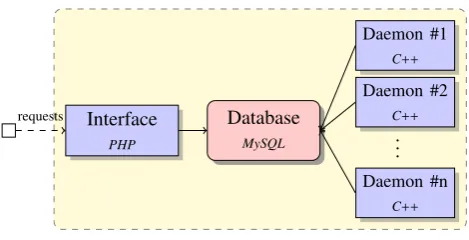
Figure 1: TaKIPI-WS architecture
5.
Case Study - TaKIPI Web Service
5.1. OverviewTaKIPI WS4 is a good testing bed to investigate possi-ble propossi-blems with the construction of WSs for large vol-umes of data. TaKIPI is a morphosyntactic tagger for Pol-ish available as a standalone application5, it accepts Pol-ish text on its input and produces morphosyntactically dis-ambiguated XML document in ICS PAS variant of XCES format (Przepiórkowski, 2004). Under the hood, TaKIPI performs the following tasks:morphological analysis, sen-tence boundary detection, tokenisation(including finding complex tokens like dates or URLs (Broda et al., 2008) ) and finallydisambiguation. As any of those steps can be of use for a processing chain, we decided to make them all available as intimidate steps for users. Each of the intimi-date steps is available through the TaKIPI and TaKIPI WS, too. However, we observed that it is lemmatisation which is the most frequently used TaKIPI WS function by re-searchers from HSS. Our earlier contacts with people from humanities showed us that often not whole process of tag-ging is of use – lemmatisation is also an important feature. while originally, in TaKIPI, lemmas have to be extracted from the XML-based output format, while in TaKIPI WS the lemmatisation became one of its functions.
5.2. Architecture
The TaKIPI-WS is a system with a three-layer architec-ture, anasynchronous modelof request handling and multi-agent-based processing.
5.3. Three-layer architecture
The TaKIPI-WS consists of three layers: WS Interface,
DatabaseandDaemons.
The WS Interface is responsible for receiving and queu-ing user requests, storqueu-ing and retrievqueu-ing data from the
Database. In case of a new request it may communicate with the Daemons in order to notify them about the new request.
The Databaseis the central part of the system. The role of theDatabaseis to store and exchange data between the
Interface and the Daemons. It stores the requests, text transferred, produced results and information concerning the available Daemons. TheDaemonsare responsible for
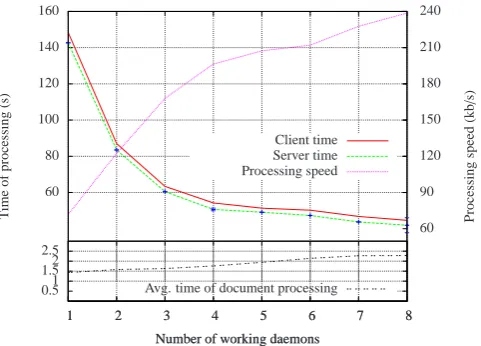
Dea-should be put on a separate piece of hardware (preferably a computing cluster). Secondly, we should use row-level locking rather then table-level locking. Alternatively we could redesign the database schema so that all the data that must be locked for serving a single request would be mini-mized and moved to a separate table. Last but not least, we should use a dedicated web server for handling the SOAP requests (receiving, scheduling and responding to user re-quests).
We performed also an additional experiment to test TaKIPI-WS in a yet another scenario, in which an user has a corpus consisting of many large documents, that differ in size. We used a part of the IPI PAN Corpus (Przepiórkowski, 2004), which can be described as documents related to the law do-main, consisting of 1874 documents (49 MB of raw text). In order to put additional stress on our architecture, we as-sumed in this scenario that the user wants to process the corpus as quickly as possible, so he submits many (20 in our case) requests at the same time. After receiving results of processing of any of the requests user submits next doc-ument for processing. We tested a configuration with 4 pro-cessing daemons as the introduction of additional daemons did not yield significant improvement in performance. The total time of corpus tagging was13 minutes. In compari-son – the off-line version of TaKIPI required27 minutesto process the corpus.
During our experiments we observed that for large requests we got a very big XML file as a result (more then 90 MB for 2.5 MB of raw text input). This is not a problem for the daemons, but it presents a problem for a single Apache process, as it needs to load the whole tagged document to the memory when the user wants to download it. As there can be a multitude of processes on the web server, so pre-process memory usage has to be limited. This results in a situation in which a user can submit large requests, but can-not download them. Fortunately, this problem is fairly easy to be amended, as the XML files are written in the IPI PAN variant of XCES encoding (Przepiórkowski, 2004). This format can be compressed easily – we observed that com-pressed files are on average 20 times smaller using standard bzip2 compression algorithm.
6.
Conclusions
LTI is successful when it is effectively used by many users. Contemporary language resources achieve very large vol-umes. Thus LTI must be planned and built for user interest and language data of that scale. LTI can represent high us-ability when designed with focus on users and their tasks. We will need an intermediate layer between the user tasks and formal description of LT WSs, i.e. higher level WSs being close to the application level.
We presented a limited prototype of a LTI node including several types of services which was intended to illustrate the identified requirements and possible solutions. In this way we experimentally investigate how to tackle with sev-eral requirements identified. Such aspects as processing large volumes of data, asynchronous mode of processing and scalability of the architecture to large number of users got especial attention in the prototype.
7.
References
Milan Agatonovich, Nuria Bel, Santi Bel, Marco Büch-ler, Dan Cristea, Fabienne Fritzinger, Erhard Hinrichs, Marie Hinrichs, Radu Ion, Marc Kemps-Snijders, Yana Panchenko, Victor Rodriguez, Helmut Schmid, Pe-ter Wittenburg, Uwe Quasthoff, Martha Villegas, and Thomas Zastrow. 2009. Requirements specification web services and workflow systems. Deliverable d2r-6, Clarin, July.
M. Baroni, S. Bernardini, A. Ferraresi, and E. Zanchetta. 2009. The WaCky wide web: a collection of very large linguistically processed web-crawled corpora. Language Resources and Evaluation, 43(3):209–226.
Bartosz Broda and Maciej Piasecki. 2008. SuperMatrix: a general tool for lexical semantic knowledge acquisi-tion. In G. Demenko, K. Jassem, and S. Szpakowicz, editors, Speech and Language Technology, volume 11, pages 239–254. Polish Phonetics Assocation.
Bartosz Broda, Maciej Piasecki, and Adam Radziszewski. 2008. Towards a set of general purpose morphosyntactic tools for Polish. In M. A. Kłopoteket. al., editor, Pro-ceedings of the International IIS’08, Zakopane, Poland, June, 2008, pages 441–450. EXIT.
Marco Büchler and Gerhard Heyer. 2009. Leipzig linguis-tic services – a 4 years summary of providing linguislinguis-tic web services. InProceeding of TMS 2009 Conference, Leipzig, Germany.
Rolf Carlson, Tommaso Caselli, Kjell Elenius, Bertrand Gaiffe, David House, Erhard Hinrichs, Valeria Quochi, Kiril Simov, and Iris Vogel. 2010. Language resources and tools survey and taxonomy and criteria for the qual-ity assessment. Clarin-d5c-2, CLARIN.
CLARIN WP2. 2009. CLARIN centres. CLARIN
project document published on the project
Web Page: http://www.clarin.eu/files/
centres-CLARIN-ShortGuide.pdf, February.
CLARIN. 2010a. Clarin – common language resources and technology infrastructure. The Web Page of the CLARIN project (EC FP7 project no. 212230), WWW:
http://www.clarin.eu, March.
CLARIN. 2010b. Linguistic processing chains as Web Services: Initial linguistic considerations. Clarin-2009-d5r-3a, CLARIN. Editors: Maciej Ogrodniczuk, Adam Przepiórkowski.
Dan Cristea, Ionut Pistol, and Corina Forˇascu. 2007. ALPE as LT4eL processing chain environment. In
RANLP Workshop Natural Language Processing and Knowledge Representation for eLearning Environments, Borovets, 26. September 2007.
D-SPIN. 2009. D-SPIN – a German infrastructure for language resources and tools. Web Page of the D-SPIN project, WWW: http://weblicht.sfs.
uni-tuebingen.de/englisch/index.shtml,
March.
Roy T. Fielding and Richard N. Taylor. 2002. Principled design of the modern web architecture. ACM Transac-tions on Internet Technology, 2(2):115–150.
Martin Gudgin, Marc Hadley, Noah Mendelsohn, Jean-Jacques Moreau, Henrik Frystyk Nielsen, Anish Kar-markar, and Yves Lafon. 2007. SOAP version 1.2 part 1: Messaging framework (second edition). TR REC-soap12-part1-20070427, W3C, April.
Erhard Hinrichs, Marie Hinrichs, Thomas Zastrow, Ger-hard Heyer, Volker Boehlke, Uwe Quasthoff, Helmut Schmid, Ulrich Heid, Fabienne Fritzinger, Alexander Siebert, and Jörg Didakowski. 2009. WebLicht: Web-based LRT services for German. In GSCL Workshop: Linguistic Processing Pipelines (Book of Abstracts), pages 11–14, Potsdam, Germany, September.
IULA UPF. 2010. Statistical web services. Web Page of the Statistical Web Services IULA UPF, WWW:http:
//gilmere.upf.edu/WS/, March.
George Karypis. 2002. CLUTO a clustering toolkit. Tech-nical Report 02-017, Department of Computer Science, University of Minnesota.
Bartosz Kruszy´nski and Joanna R ˛aczaszek-Leonardi. 2006. Mi ˛edzy strukturalistyczn ˛a a psychologiczn ˛a reprezentacj ˛a znaczenia: wielowymiarowa przestrze´n semantyczna (HAL). In P. Stalmaszczyk, editor,
Metodologie j ˛ezykoznawstwa. Podstawy teoretyczne, pages 282–295. Wydawnictwo Uniwersytetu Łódzkiego, Łód´z.
Peep Küngas and Mihhail Matskin. 2006a. Semantic Web Service composition through a P2P-based multi-agent environment. InProceedings of the Fourth International Workshop on Agents and Peer-to-Peer Computing (in conjunction with AAMAS 2005), AP2PC 2005, Utrecht, Netherlands, July 26, 2005, volume 4118 ofLNCS, pages 106–119.
Peep Küngas and Mihhail Matskin. 2006b. Web Services analysis: Making use of Web Service composition and annotation. InProceedings of 1st Asian Semantic Web Conference, ASWC’06, Beijing, China, September 3-7, 2006, volume 4185 ofLNCS, pages 501–515. Springer-Verlag.
KYOTO WP2. 2009. Database models and data for-mats deliverable nr. 1wp nr. 2. KYOTO project document published on the project Web Page:
http://www2.let.vu.nl/twiki/pub/Kyoto/WP02: SystemDesignD2.1_Database_Models_and_Data_
Formats_v3.1.pdf, October.
Dekang Lin. 1993. Principle-based parsing without over-generation. InAnnual Meeting of the ACL. Proceedings of the 31st annual meeting on Association for Computa-tional Linguistics, pages 112–120.
K. Lund and C. Burgess. 1996. Producing high-dimensional semantic spaces from lexical co-occurence.
Behavior Research Methods, Instrumentation, and Com-puters, 28:203–208.
Adam Pawłowski, Maciej Piasecki, and Bartosz Broda. 2009. Automatic extraction of word-profiles from text corpora. on the example of polish collective symbols. In Reinhard Köhler, editor, Issues in Quantitative
Lin-guistics, volume 5 ofStudies in Quantitative Linguistics, pages 88–105. RAM-Verlag.
Maciej Piasecki, Stanisław Szpakowicz, and Bartosz Broda. 2009. A Wordnet from the Ground Up. Oficyna Wydawnicza Politechniki Wrocławskiej, Wrocław. Adam Przepiórkowski, Rafał L. Górski, Barbara
Lewandowska-Tomaszyk, and Marek Łazi´nski. 2008. Towards the national corpus of polish. In N. Calzolari
et. al., editor, Proceedings of the Sixth International Language Resources and Evaluation (LREC’08), Marrakech, Morocco, May. ELRA. http:// www.lrec-conf.org/proceedings/lrec2008/.
Adam Przepiórkowski. 2004. The IPI PAN Corpus, Pre-liminary Version. Institute of Computer Science PAS. RACAI. 2009. RACAI Web Services. Web Page of
RACAI Web Services, WWW: http://www.racai.
ro/webservices/, March.
Dan Tufiž, Radu Ion, Alexandru Ceaužu, and Dan łtefã-nescu. 2008. Racai’s linguistic web services. In Pro-ceedings of the 6th Language Resources and Evaluation Conference - LREC 2008. ELRA - European Language Resources Association, May.
Tamás Váradi, Steven Krauwer, Peter Wittenburg, Mar-tin Wynne, and Kimmo Koskenniemi. 2008. Clarin: Common language resources and technology infras-tructure. In Nicoletta Calzolari, Khalid Choukri, Bente Maegaard, Joseph Mariani, Jan Odjik, Stelios Piperidis, and Daniel Tapias, editors,Proceedings of the Sixth International Language Resources and Evaluation (LREC’08), Marrakech, Morocco, May. European Lan-guage Resources Association (ELRA). http:// www.lrec-conf.org/proceedings/lrec2008/.