Proceedings of Recent Advances in Natural Language Processing, pages 139–148,
Sentence-Level Multilingual Multi-modal Embedding for
Natural Language Processing
Iacer Calixto
ADAPT Centre Dublin City University
Glasnevin, Dublin 9
Qun Liu
ADAPT Centre Dublin City University
Glasnevin, Dublin 9
Abstract
We propose a novel discriminative rank-ing model that learns embeddrank-ings from multilingual and multi-modal data, mean-ing that our model can take advantage of images and descriptions in multiple lan-guages to improve embedding quality. To that end, we introduce an objective func-tion that uses pairwise ranking adapted to the case of three or more input sources. We compare our model against differ-ent baselines, and evaluate the robustness of our embeddings on image–sentence ranking (ISR), semantic textual similar-ity (STS), and neural machine translation (NMT). We find that the additional mul-tilingual signals lead to improvements on all three tasks, and we highlight that our model can be used to consistently im-prove the adequacy of translations gener-ated with NMT models when re-ranking
n-best lists.
1 Introduction
Distributional semantic models (DSMs) compute word vector representations from text based on word co-occurrence patterns. However, these models suffer from an obvious limitation since the meaning of a word is derived entirely from con-nections to other words, i.e. they do not take extra-linguistic modalities into account and thus lack grounding (Glenberg and Robertson, 2000). This is the case not only of widely adopted word-level DSMs, e.g. word2vec (Mikolov et al.,2013), but also of sentence-level DSMs, e.g. skip-thought vectors (Kiros et al.,2015).
In this work, we address this issue and expand on the idea of training sentence-level multi-modal embeddings (Kiros et al., 2014; Socher et al.,
2014), introducing a model that can be trained not only on images and their monolingual descriptions but also on additional multilingual image descrip-tions when these are available. We believe that having multiple descriptions of one image, regard-less of its language, is likely to increase the cov-erage and variability of ideas described in the im-age, which may lead to a better generalisation of the depicted scene semantics. Moreover, a similar description expressed in different languages may differ in subtle but meaningful ways.
To that end, we introduce an objective function that uses pairwise ranking (Cohen et al., 1999) adapted to the case of three or more input sources, i.e. an image and multilingual sentences (§3). Our objective function links images and multiple sen-tences in an arbitrary number of languages, and we validate our idea in experiments where we use the Multi30k data set (§4).
We evaluate our embeddings in three different tasks: an image–sentence ranking (ISR) task (§6), in both directions, where we find that multilin-gual signals improve ISR to a large extent, i.e. the median ranks for English are improved from 8 to 5 and for German from 11 to 6, although the impact on ranking sentences given images is less conclusive; two sentence textual similarity (STS) tasks (§7), finding consistent improvements over a comparable monolingual baseline and outper-forming the best published SemEval results; a neu-ral machine translation (NMT) task (§8), where we use our model to re-rankn-best lists generated by different NMT models and report consistent im-provements. Our main contributions are:
• we introduce a novel ranking-based objective function to train a discriminative model that utilises not onlymulti-modal but also multi-lingualdata;
• we compare our proposed multilingual multi-modal embedding (MLMME) to embeddings
trained on only one language (Kiros et al.,
2014) on three different tasks (ISR, STS and NMT), as well as the Skip-Thought vectors when applicable (Kiros et al., 2015), and find that our model consistently improves over comparable monolingual baselines in all tasks but ranking sentences given images, where results are mixed.
2 Background and Related work
Multi-modal distributional semantic models try to expand DSMs and include inputs from additional modalities other than text as a means to address the grounding problem (Glenberg and Robertson,
2000). At the word level, Bruni et al. (2014) propose deriving word and image vectors, where the word vector representations are based on co-occurrence counts in text corpora, and the im-ages are represented using a bag-of-visual-words method with Scale-Invariant Feature Transform (SIFT) vectors (Lowe,1999,2004) extracted from a data set of tagged images. These two represen-tations are concatenated and merged using Sin-gular Value Decomposition. Silberer and Lapata
(2014) use stacked auto-encoders to map words and images to one same shared multi-modal em-bedding space. Their image representation is ob-tained using attribute classifiers that predict visual attributes (e.g., has wings, made of wood) for given words, proposed inFarhadi et al.(2009).
Lazaridou et al.(2015) expand the word2vec skip-gram (Mikolov et al., 2013) into a multi-modal
skip-grammodel by incorporating image features extracted from pre-trained Convolutional Neural Networks (CNNs). Visual features obtained with pre-trained CNNs are widely used in transfer learning scenarios, such as in visual question an-swering (Zhang et al.,2016), to train multi-modal word embeddings (Lazaridou et al., 2015) or in multi-modal neural machine translation (Calixto et al.,2017).
All these DSMs have in common that they learn models at the word-level. Nonetheless, there are many models that propose to learn sentence-level (Kiros et al., 2015; Arora et al., 2017) or even paragraph-level vector representations (Le and Mikolov,2014). Similarly to their word-level counterparts, these models are trained based on text signals only.
At the sentence level, Kiros et al. (2014) pro-pose a multi-modal embedding model trained to
map sentences and images into one shared multi-modal embedding space, where the sentences are encoded using Recurrent Neural Networks (RNN). In a similar vein, Socher et al. (2014) utilised Recursive Neural Networks, i.e. RNNs that operate on parse trees, as their sentence en-coder. They both utilised pre-trained CNNs to ex-tract image features and a pairwise ranking func-tion to train their multi-modal embeddings.
We build on previous work and extend the idea of training multi-modal sentence-level em-beddings to the scenario where the training data is not onlymulti-modal, but alsomultilingual. We thus put forward a model that integrates images and an arbitrary number of descriptions in differ-ent languages.
3 Multilingual and multi-modal embeddings (MLMME)
Our model has two main components: one
tex-tual and one visual. In the textual component, we have K different languages Lk, k ∈ [1, K], and for each language we use a recurrent neu-ral network (RNN) with gated recurrent units (GRU) (Cho et al., 2014) as a sentence encoder. LetSk ={wk
1, . . . , wkNk}denote sentences com-posed of word indices in a language Lk, and
Xk= (xk
1,xk2,· · · ,xkNk)the corresponding word embeddings for these sentences, whereNk is the
sentence length. An RNN Φk
enc reads Xk word by word, from left to right, and generates a se-quence of annotation vectors (hk
1,hk2,· · ·,hkNk) for each embeddingxk
i,i∈[1, Nk]. For any given input sentence, we use the corresponding encoder RNN’s last annotation vector hk
Nk for that lan-guage Lk as the sentence representation, hence-forthvk.
In our visual component we use publicly avail-able pre-trained models for image feature extrac-tion. Simonyan and Zisserman (2014) trained deep CNNs for classifying images into one out of 1000ImageNet classes (Russakovsky et al.,2015).
We use their 19-layer VGG network (VGG19)
to extract feature vectors for all images in our dataset. More specifically, we useglobalfeatures extracted from the penultimate fully-connected layer of the VGG19 network, which consists of a 4,096D feature vector, henceforth FC7.
Each training example consists of a tuple (i)
a training instance, we retrieve the embeddings
Xk ={xk
1, . . . ,xkNk}for each sentenceSkusing one separate word embedding matrix for each languagek. A sentence embedding representation vk is then obtained by applying the encoder Φk
enc onto each embedding xk1:Nk and using the last annotation vector hk
Nk of each RNN, after it has consumed the last token in each sentence. An image feature vector q∈R4096 is extracted
using the VGG19 CNN so that d=WI·q is
an image embedding and WI is a model
param-eter. Also, image embeddings d and sentence
embeddings vk, ∀k ∈ [1, K] are normalised to unit norm and have the same dimensionality. Finally, si(d,vk) =d>·vk,k∈[1, K] is a function that computes the similarity between images and sentences in any language, and
ss(vk,vl) = (vk)>·vl,∀k, l∈[1, K], k6=l, computes the similarity between sentences in two different languages.1
We now describe two pairwise ranking func-tions used in our objective, one that scores sen-tences and images, and another one that scores sentences in two different languages. Our model takes into consideration not only the relation be-tween sentences in a given language and images computed by the si(·,·) function, but also sen-tences in different languages in relation to each other, computed byss(·,·). Our sentence–image,
multi-modalranking function is given in (1):
RMM= X
d X
r
max{0, α−si(d,vk) +si(d,vrk)}+ X
vk
X
r
max{0, α−si(vk,d) +si(vk,dr)},
k∈K, (1)
wherevk
r (subscriptrforrandom) is a contrastive or non-descriptive sentence embedding in lan-guageLkfor image embeddingdand vice-versa, andαis a model parameter, i.e. themargin. RMM learns to rank a sentence embedding vk in lan-guage Lk, k ∈ K, against an image embedding d, and vice-versa. Our sentence–sentence, multi-lingualranking function is (2):
RML=X
vk
X
r
max{0, α−ss(vk,vl) +ss(vk,vlr)}+
X
vl
X
r
max{0, α−ss(vl,vk) +ss(vl,vrk)},
k∈K, l∈K, l6=k, (2)
wherevk
r is a contrastive or non-descriptive
sen-1In this work, boths
iandssare implemented as the dot
product, but they could be any other suitable function.
tence embedding in language Lk for sentence vl in languageLl, and vice-versa. In both RMM and RML, contrastive terms are chosen randomly from the training set and resampled at every epoch.
Finally, our optimisation function in Equa-tion (3) minimises the linearly weighted combina-tion of RMMand RML:
min
θk,WIβRMM+ (1−β)RML,∀k∈K,
0≥β≥1, (3)
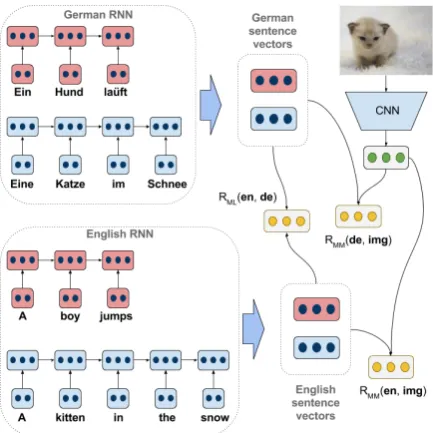
whereθkincludes all the encoder RNNs parame-ters for languageLk, andWIis the image transfor-mation matrix. β is a model hyperparameter that controls how much influence a particular similar-ity (multi-modalormultilingual) has in the overall cost. We illustrate the model in Figure1.
Figure 1: Multilingual multi-modal embedding trained with images and their English and German descriptions. The sentences in red denote con-trastive examples, whereas the sentences in blue are descriptive of the image.
The two extreme scenarios are β= 0, in which case only the multilingual similarity is used, andβ
=1, in which case only the multi-modal similarity is used. If the number of languages K = 1 and
β = 1, our model computes the Visual Semantic Embedding (VSE) ofKiros et al.(2014).
4 Datasets
English German
Skip-T. paperVSEcurrent β=1 β=.75 Ours β= 0.5 β= 0.25 currentVSE β=1 β=.75Ours β= 0.5 β= 0.25
Sentence to image
r@1 18.2 16.8 16.5 23.0(+6.2) 24.9(+8.1) 22.3(+5.5) 21.3(+4.5) 13.5 21.6(+8.1) 20.3(+6.8) 20.3(+6.8) 19.5(+6.0) r@5 41.9 42.0 41.9 49.3(+7.3) 52.3(+10.3) 48.3(+6.3) 45.5(+3.5) 36.6 48.8(+12.2) 45.0(+8.4) 43.7(+7.1) 43.0(+6.4) r@10 53.5 56.5 54.4 61.1(+4.6) 63.6(+7.1) 58.4(+1.9) 56.7(+0.2) 49.0 59.5(+10.5) 56.6(+7.6) 55.4(+6.4) 54.4(+5.4)
mrank 9 8 9 6 5 6 7 11 6 7 8 8
Image to sentence
r@1 26.8 23.0 30.7 33.1(+2.4) 30.7(+0.0) 27.4(−3.3) 26.7(−4.0) 30.5 32.3(+1.7) 24.9(−5.6) 23.0(−7.5) 21.8(−8.7) r@5 54.9 50.7 57.8 57.2(−0.6) 55.4(−2.4) 54.5(−3.3) 51.4(−6.4) 56.0 58.6(+2.6) 52.3(−3.7) 48.4(−7.6) 49.8(−6.2) r@10 67.5 62.9 70.6 68.7(−1.9) 65.6(−5.0) 64.0(−6.6) 61.9(−8.7) 68.9 68.1(−0.8) 63.6(−5.3) 62.8(−6.1) 61.3(−7.6)
mrank 5 5 4 4 4 4 5 4 4 5 6 6
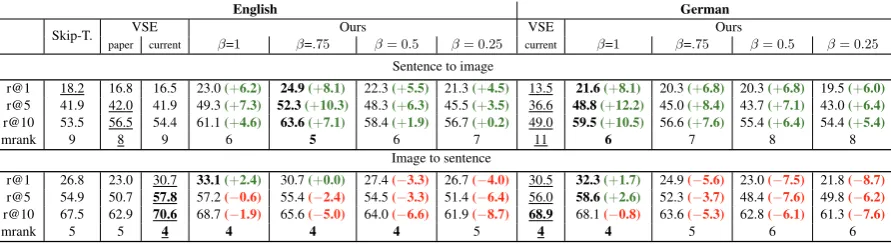
Table 1: We show results for our MLMME model evaluated on the M30kC test set when trained using different values ofβ, and two monolingual baselines: the Skip-thought vectors (Skip-T.) ofKiros et al.
(2015) and the VSE model ofKiros et al.(2014), wherepaperare the results reported in their paper and
currentwere obtained when re-training their model. Best monolingual results are underlined and best overall results appear in bold. We show improvements over the best monolingual baseline in parenthesis.
data set (Elliott et al.,2016), which consists of two expansions of the Flickr30k.
To train NMT models (§8) we use the trans-lated Multi30k, henceforth M30kT, where for each of the 30k images in the original Flickr30k, one of its English descriptions is manually translated into German by a professional translator. Train-ing, validation and test sets contain 29k, 1014 and 1k images respectively, each accompanied by one translated sentence pair in English and German. In all other experiments (§6 and§7), we use the
comparable Multi30k, henceforth M30kC, an ex-pansion of the Flickr30k where 5 German descrip-tions were collected for each image in the original Flickr30k independently from the English descrip-tions. Training, validation and test sets contain 29k, 1014 and 1k images respectively, each ac-companied by 5 English and 5 German sentences. We split the M30kC’s validation set in two and use the first 500 images and their corresponding bilingual sentences for model selection and the re-maining 514 images and bilingual sentences for model evaluation. Source and target languages were estimated over the entire vocabulary, i.e.
∼22English and∼34German tokens.
5 MLMME experimental setup
For each language we train a separate 1024D encoder RNN with GRU. Word embeddings are 620D and trained jointly with the model. All non-recurrent matrices are initialised by sampling from a GaussianN(0,0.01), recurrent matrices are ran-dom orthogonal and bias vectors are all initialised to zero. We apply dropout (Srivastava et al.,2014) with a probability of 0.5 in both text and image
representations, which are in turn mapped onto a 2048D multi-modal embedding space. We set the marginα=0.2. Our models are trained using stochastic gradient descent with Adam (Kingma and Ba,2015) with minibatches of 128 instances.
As our main baseline, we retrain Kiros et al.
(2014) monolingual models separately on the M30kC’s English and German sentences (+im-ages), whereas model MLMME is trained on the entire M30kC.
When processing English sentences and im-ages, we additionally use the pre-trained Skip-Thought vectors (Kiros et al.,2015), more specifi-cally the4800Dcombine-skipvectors as a second baseline. We follow the authors description2 on how to do it:(i)we use their pre-trained encoders to compute the English sentence representations, i.e. a4800D vector;(ii) we train their model on the M30kCtraining set using their image–sentence ranking model;(iii)we select the model with the best performance of the M30kCvalidation set and use it to compute results in the test set.
6 Image↔Sentence Ranking
In Table 1, we show results for the monolin-gual English Skip-thought vectors ofKiros et al.
(2015), the monolingual VSE English and German models of Kiros et al. (2014) and our MLMME models on the M30kC data set and evaluated on images and bilingual sentences. Recall-at-k(r@k) measures the mean number of times the correct re-sult appear in the top-kretrieved entries andmrank
is the median rank.
First, we note that multilingual models show consistent improvements in ranking images given sentences. All our models, regardless of the value of the hyperparameterβ (=.25, .5, .75,1), show strong improvements in recall@k (up to +12.2) and median rank (in English, the mrank is reduced from 8 to 5 and in German from 11 to 6 in com-parison to the best model byKiros et al.(2014)). Nevertheless, when ranking sentences given im-ages, results are less conclusive. The best results achieved by our multilingual models, for both lan-guages, are observed when β = 1, with the re-call@k slightly deteriorating as we include more multilingual similarity, i.e. β=.75, .5, .25, and the median rank also slightly increasing for En-glish (from 4 to 5) and German (from 4 to 6). In short, model MLMME consistently improves over all baselines when ranking images given sen-tences, and applying model MLMME withβ=1to rank sentences given images performs comparably to the monolingual VSE baseline and clearly im-proves over using the Skip-Thought model on the same task.
6.1 Discussion
Using image features are crucial ingroundingthe sentence vector representations. We note that us-ing β=0 in Equation 3 is equivalent to using only multilingual similarity scores (eq.2), and no multi-modal similarities (eq. 1). However, in the training data there are multiple sentences describ-ing one same image, and by not usdescrib-ing the multi-modal similarity the model loses the ability to gen-eralise and project semantically similar sentences, i.e. sentences that describe one same image, close together. In other words, the model has no way of mapping the comparable sentences that describe one same image together, since the link between these sentences are the image they describe.
In practice, we noted that usingβ = 0leads to a model that cannot learn to rank sentences given images and vice-versa, i.e. the results for median ranks in Table1whenβ = 0drop to chance lev-els. For that reason, we do not includeβ = 0 in our hyperparameter search for the experiments we report in Sections7and8.
7 Semantic Textual Similarity
In the semantic textual similarity task, we use our model to compute the distance between a pair of sentences (distances are equivalent to cosine
Test set VSE β=1 β=.Our model75 β=.5 β=.25 SemEvalbest
in-domain data
IMG1 .791 .797 .819 .826 .817 .821
IMG2 .834 .880 .882 .885 .886 .864
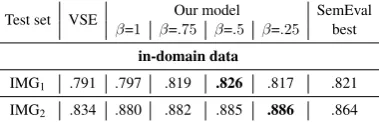
Table 2: Pearson rank correlation scores for se-mantic textual similarities in two different Se-mEval test sets. IMG1: image descriptions (2014), IMG2: image descriptions (2015).
similarity and therefore lie in the [0,1]interval). Gold standard scores for all tasks are given in the [0,5] interval, where 0 means complete dissimi-larity and 5 complete similarity. We simply use the cosine similarity distance and scale it by 5, directly comparing it to the gold standard scores. There is no SemEval data set including the Ger-man language, therefore we only use our English encoders to compute embedding vectors for both sentences in each entry in the test set. We report results for the two in-domain similarity tasks in SemEval, specifically the image description simi-larity tasks from years 2014 (Agirre et al.,2014) and 2015 (Agirre et al.,2015).
In Table 2, we note that our MLMME model
consistently improves on the monolingual baseline ofKiros et al.(2014) in the two in-domain similar-ity tasks, and our best models also outperform the best published SemEval results.
We note that we only use the English side of our models (+images) in these two evaluations, but we do not directly use our German encoders since there are no German sentences in the SemEval STS task. Nonetheless, training on additional Ger-man sentences—incorporated in our model via the German encoder—clearly increases the quality of the English encoder, specially for lower values of
β as can be seen in Table2. These are interest-ing results, showinterest-ing that the additional multilin-gual data brings holistic effects to the entire model and makes the overall model better.
8 Neural Machine Translation (NMT)
multi-modal NMT model on the same data set usually takes many days.
In order to evaluate how VSE and MLMME models perform inn-best list re-ranking, we train NMT baselines based on the model ofBahdanau et al. (2015) using different hyper-parameter set-tings. All NMT models have an encoder bidirec-tional RNN with GRU (one 1024D single-layer forward RNN and one 1024D single-layer back-ward RNN). Source and target word embeddings are 620D each and both are trained jointly. All non-recurrent matrices are initialised by sampling from a Gaussian(µ= 0, σ= 0.01), recurrent ma-trices are orthogonal and bias vectors are all ini-tialised to zero. The decoder is an attention-based RNN with GRU and is a neural LM (Bengio et al.,
2003).
NMT models are trained using stochastic gra-dient descent with Adadelta (Zeiler, 2012) and minibatches of size 40, where each training in-stance consists of one English sentence, one Ger-man sentence and one image. We apply early stop-ping for model selection based on BLEU scores. We evaluate our models’ translation quality quan-titatively in terms of BLEU4 (Papineni et al.,
2002), METEOR (Denkowski and Lavie, 2014), and TER (Snover et al.,2006) and we compute sta-tistical significance using approximate randomi-sation computed with the MultEval toolkit (Clark et al.,2011).
8.1 NMT baselines
We train one weak model, one regular model
and one optimised NMT model on the
trans-lated Multi30k training data set (without im-ages) to translate from English into Ger-man. In order to train these three different models, we search for the best dropout and L2 regularisation weight combination by ob-serving model performance on the validation set. The search space for the dropout hyper-parameter is the set {0.0,0.1,0.2, . . . ,0.9,1.0}, and for the L2 regularisation weight is the set
{0.0,1e−1,1e−2, . . . ,1e−9,1e−10}.
Weak model Our weak model is the text-only NMT baseline model trained with no regulari-sation, i.e. L2 regularisation weight is 0.0 and dropout probability is 0.0. It corresponds to the model with the worst performance on the trans-lated Multi30k validation set.
Regular model Ourregularmodel is a text-only NMT baseline model with medium-performance regularisation. Specifically, from the hyper-parameter search on the translated Multi30k val-idation set, we use a weight of1e−8 to scale the L2 regularisation term and a dropout of0.5; Optimised model Our optimised model is the text-only NMT baseline model that has the best performance on the translated Multi30k validation set, according to our dropout and L2 regularisation hyper-parameters search. This corresponds to the model with no L2 regularisation, i.e. L2 weight is 0.0, and dropout with probability0.2.
8.2 N-best re-ranker
We first use the three different NMT models we have just described to generate n-best lists (n ∈ {20,50}) for each entry in the M30kT validation and test sets. Second, we use the monolingual VSE model (Kiros et al., 2014) trained on Ger-man sentences and images to compute the distance between translations into German and images, for all entries in the M30kT validation and test sets. We also use our MLMME models trained with
β ∈ {.25, .5, .75,1} to compute the distance be-tween German and English sentences withss(·,·), and between a German sentence and an image us-ingsi(·,·), for all entries in the M30kTvalidation and test sets.
We then train an n-best list re-ranker on the M30kTvalidation set’s20-best (50-best) lists with k-best MIRA (Crammer and Singer,2003;Cherry and Foster,2012), and use the new distances as ad-ditional features to the original MT log-likelihood
p(Y |X). We finally apply the optimised weights to re-rank the test set’s20-best (50-best) lists.
8.3 Results
In Tables3and4, we show results obtained with the weak, theregular, and the optimised models when used to re-rank20-best and50-best lists, re-spectively. We compute20- and50-best lists to be able to observe whether the different models we use in ranking generate consistent results, re-gardless of the size of then-best lists.
BLEU METEOR TER Weak NMT model
baseline 25.7 43.1 56.1
+ VSE 25.8 (+0.1) 43.2 (+0.1) 56.1 (-0.0) + MLMME,β= 1 26.1 (+0.4) 44.4†‡ (+1.3) 55.5 (-0.6) + MLMME,β= 0.75 26.1 (+0.4) 44.3†‡ (+1.2) 55.9 (-0.2) + MLMME,β= 0.5 26.0 (+0.3) 43.9†‡ (+0.8) 55.9 (-0.2) + MLMME,β= 0.25 26.3†‡ (+0.6) 44.3†‡ (+1.2) 55.2†‡ (-0.9)
oracle 33.1 51.4 46.5 Regular NMT model
baseline 32.4 50.7 51.9
+ VSE 32.2 (-0.2) 50.7 (+0.0) 52.6 (+0.7) + MLMME,β= 1 33.8†‡ (+1.4) 51.4†‡ (+0.7) 49.0‡ (-2.9) + MLMME,β= 0.75 33.5‡ (+1.1) 51.3†‡ (+0.6) 49.0‡ (-2.9) + MLMME,β= 0.5 33.8†‡ (+1.4) 51.4†‡ (+0.7) 48.6†‡ (-3.3) ! + MLMME,β= 0.25 33.7‡ (+1.3) 51.4†‡ (+0.7) 49.4‡ (-2.5)
oracle 41.9 59.3 41.2 Optimised NMT model
baseline 35.3 52.3 44.9
+ VSE 32.3 (-3.0) 49.8 (-2.5) 46.5 (+1.6) + MLMME,β= 1 35.3‡ (+0.0) 52.7†‡ (+0.4) 44.5‡ (-0.4) + MLMME,β= 0.75 35.2‡ (-0.1) 52.6‡ (+0.3) 44.6‡ (-0.3) + MLMME,β= 0.5 35.1‡ (-0.2) 52.3‡ (+0.0) 44.9‡ (-0.0) + MLMME,β= 0.25 35.7‡ (+0.4) 52.7‡ (+0.4) 44.5‡ (-0.4)
oracle 43.2 59.7 37.8
Table 3: MT evaluation metrics computed for 1 -best translations generated with three NMT base-lines, and for 20-best lists re-ranked using VSE and MLMME as discriminative features. Results improve significantly over the corresponding 1-best baseline (†) or over the translations obtained with the VSE re-ranker (‡) withp= 0.05.
BLEU METEOR TER
Weak NMT model
baseline 25.7 43.1 56.1
+ VSE 25.8 (+0.1) 43.5† (+0.4) 56.1 (-0.0)
+ MLMME,β= 1 26.2 (+0.5) 44.6†‡ (+1.5) 55.4 (-0.7) + MLMME,β= 0.75 26.4† (+0.7) 44.5†‡ (+1.4) 55.6 (-0.5) + MLMME,β= 0.5 25.9 (+0.2) 43.9† (+0.8) 55.9 (-0.0) + MLMME,β= 0.25 26.4†‡ (+0.7) 44.5†‡ (+1.4) 55.0†‡ (-1.1)
oracle 36.2 53.8 43.4
Regular NMT model
baseline 32.4 50.7 51.9
+ VSE 32.7 (-0.3) 50.8 (+0.1) 51.4 (-0.5)
+ MLMME,β= 1 34.2†‡ (+1.8) 51.6†‡ (+0.9) 48.3‡ (-3.6) + MLMME,β= 0.75 34.1†‡ (+1.7) 51.6†‡ (+0.9) 47.6†‡ (-4.3) + MLMME,β= 0.5 34.0†‡ (+1.6) 51.4†‡ (+0.7) 47.3†‡ (-4.6) + MLMME,β= 0.25 34.1†‡ (+1.7) 51.6†‡ (+0.9) 48.5‡ (-3.4)
oracle 46.6 61.8 34.1
Optimised NMT model
baseline 35.3 52.3 44.9
+ VSE 30.7 (-4.6) 47.9 (-4.4) 48.6 (+3.7)
+ MLMME,β= 1 35.4‡ (+0.1) 52.7†‡ (+0.4) 44.4†‡ (-0.5) + MLMME,β= 0.75 35.2‡ (-0.1) 52.5‡ (+0.2) 44.7‡ (-0.2) + MLMME,β= 0.5 35.1‡ (-0.2) 52.3‡ (+0.0) 44.7‡ (-0.2) + MLMME,β= 0.25 35.6‡ (+0.3) 52.6‡ (+0.3) 44.4†‡ (-0.5)
oracle 46.3 61.9 34.9
Table 4: MT evaluation metrics computed for 1 -best translations generated with three NMT base-lines, and for 50-best lists re-ranked using VSE and MLMME as discriminative features. Results improve significantly over the corresponding 1-best baseline (†) or over the translations obtained with the VSE re-ranker (‡) withp= 0.05.
5.3/9.3 TER, for the20-best and50-best lists re-spectively. Nevertheless, the difference between the oracle scores for then-best lists generated by the regular and the optimised model is not nearly as high: 1.2/−0.3 BLEU,0.0/0.1METEOR, and 3.4/0.8TER, again for the20-best and50-best lists respectively. However, when we analyse the met-rics scores obtained by re-ranked models, we see a considerable difference between the improve-ments brought by VSE and MLMME features to the regular and optimised models.
Weak model First of all, using VSE features to re-rankn-best lists generated by the weak model practically does not change translations. MLMME features have a strong impact on METEOR scores, suggesting that they are making translations more adequate by improving their word-level recall. Us-ing MLMME features to re-rank significantly im-proves METEOR in relation to the baseline and to the translations obtained with the VSE-features re-ranked model, for all values ofβand for alln-best list sizes.
The model re-ranked with MLMME features withβ = 0.25performs best in this scenario. It is the only model that significantly improves on the three automatic metrics over both the1-best base-line and the VSE-features re-ranked model, for all
n-best lists sizes (p= 0.05).
Regular model Again, using VSE features to re-rank n-best lists generated by the regular model does not change translations in practice. Never-theless, VSE re-ranked models are the only ones to show some small deterioration in relation to the baseline, even though these differences are not statistically significant. Models re-ranked with MLMME features are consistently better than the baseline, for all values of β and n ∈ {20,50}. They also show strong improvements on ME-TEOR scores in relation to both the baseline and to the translations obtained with the VSE-features re-ranked model, suggesting that they are still mak-ing translations more adequate by improvmak-ing their word-level recall.
When applied to re-rank50-best lists, MLMME features also significantly improve BLEU scores in relation to the baseline and to the translations obtained with the VSE-features re-ranked model, in spite of the values ofβ.
features becomes harder when applied to n-best lists generated by the optimised model. From looking at the results, perhaps the most appar-ent outcome is the poor results obtained when us-ing VSE features in this scenario. Usus-ing the ad-ditional VSE features to re-rank consistently and significantly deteriorate translations, for alln-best lists sizes (n = {20,50}). The same does not happen when using MLMME features to re-rank
n-best lists. MLMME features lead to transla-tions that consistenly improve over those obtained with the VSE-features re-ranked model, for all
dif-ferent configurations of MLMME models (β =
{0.25,0.5,0.75,1.0}).
Model MLMME with β = 0.25 or β = 1.0
obtain the best results regardless of then-best list sizes. These are the only two models that also significantly improve on the corresponding1-best baseline according to at least one of the metrics.
8.4 Final Remarks
In this set of experiments we evaluated how well VSE (Kiros et al., 2014) and MLMME models perform when used to compute features to re-rank
n-best lists. We found that VSE features do not affect translations whenn-best lists are generated by less optimised NMT models, but they become less attractive as the baseline NMT models used to generate n-best lists gets better, getting to the point of significantly harming BLEU, METEOR and TER in the case of a highly optimised model. In general, MLMME features outperformed VSE features across different scenarios, and seem to have a stronger impact on re-rankingn-best lists generated with the regular model compared to the weak and optimised models. Nonetheless, when applied to translations generated with the opti-mised model, MLMME models withβ = 0.25or
β = 1.0achieve the best results. They consistently and significantly increase METEOR scores, for all
n-best lists sizes (n ∈ {20,50}), which is an im-portant finding since NMT models are known to suffer from adequacy issues (Tu et al.,2016).
Finally, MLMME models take considerably less time to train compared to a fully fledged multi-modal NMT model: training MLMME models take∼3–6hours, whereas training a text-only attention-based NMT model should take∼3–
4 days.3 Likewise, using MLMME models to
3This is the case of training an English–German
transla-tion model, evaluated in this work, on the Multi30k data set.
compute features at inference time is fast: it takes the time to encode the source and target sen-tences with the corresponding source- and target-language RNNs, the image with the pre-trained CNN, and then performing three dot products: source·target, target·image, and source·image.
Arguably, our results puts MLMME models as attractive candidates to be included in an NLP pipeline for processing image descriptions.
9 Conclusions
We propose a new discriminative ranking model that incorporates both multilingual and multi-modal similarities, and obtain promising results in three different NLP tasks. We train our models us-ing an objective function based on pairwise rank-ing. When applied to the task of image–sentence ranking, our model consistently outperforms all baselines when ranking images given sentences; our model whenβ=1performs comparably to the monolingual VSE baseline, and the more weight we add to the multilingual similarity in the train-ing objective, the worse the model ranks sentences given images. However, when applied to the task of Semantic Textual Similarity, our model outper-forms the best published SemEval models in two image description similarity tasks, and when ap-plied to re-rankn-best lists generated with differ-ent NMT models, they consistdiffer-ently improve trans-lations as measured by three different MT met-rics. We note that it has a consistent impact on METEOR, which is a recall-oriented metric that emphasises theadequacyof translations, which is precisely a problem that NMT models are known to suffer from (Tu et al., 2016). In the future we will train our model on a many-languages setting, with images and descriptions in∼10 languages.
Acknowledgments
This project has received funding from Science Foundation Ireland in the ADAPT Centre for
Dig-ital Content Technology (www.adaptcentre.
ie) at Dublin City University funded under
References
Eneko Agirre, Carmen Banea, Claire Cardie, Daniel Cer, Mona Diab, Aitor Gonzalez-Agirre, Weiwei Guo, Inigo Lopez-Gazpio, Montse Maritxalar, Rada Mihalcea, German Rigau, Larraitz Uria, and Janyce Wiebe. 2015. SemEval-2015 Task 2: Seman-tic Textual Similarity, English, Spanish and Pilot on Interpretability. In Proceedings of the 9th In-ternational Workshop on Semantic Evaluation (Se-mEval 2015). Denver, Colorado, pages 252–263. http://www.aclweb.org/anthology/S15-2045. Eneko Agirre, Carmen Banea, Claire Cardie, Daniel
Cer, Mona Diab, Aitor Gonzalez-Agirre, Weiwei Guo, Rada Mihalcea, German Rigau, and Janyce Wiebe. 2014. Semeval-2014 task 10: Multilingual semantic textual similarity. InProceedings of the 8th International Workshop on Semantic Evalua-tion (SemEval 2014). Dublin, Ireland, pages 81–91. http://www.aclweb.org/anthology/S14-2010. Sanjeev Arora, Yingyu Liang, and Tengyu Ma. 2017.
A Simple but Tough-to-Beat Baseline for Sentence Embeddings. InInternational Conference on Learn-ing Representations, ICLR 2017. Toulon, France. https://openreview.net/pdf?id=SyK00v5xx.
Dzmitry Bahdanau, Kyunghyun Cho, and Yoshua Bengio. 2015. Neural Machine Translation by Jointly Learning to Align and Translate. In International Conference on Learning Repre-sentations, ICLR 2015. San Diego, California. http://arxiv.org/abs/1409.0473.
Yoshua Bengio, R´ejean Ducharme, Pascal Vincent, and Christian Janvin. 2003. A Neural Probabilistic Lan-guage Model. J. Mach. Learn. Res. 3:1137–1155. http://dl.acm.org/citation.cfm?id=944919.944966. Elia Bruni, Nam Khanh Tran, and Marco
Ba-roni. 2014. Multimodal distributional se-mantics. J. Artif. Int. Res. 49(1):1–47. http://dl.acm.org/citation.cfm?id=2655713.2655714. Iacer Calixto, Daniel Stein, Evgeny Matusov, Pintu
Lo-har, Sheila Castilho, and Andy Way. 2017. Using images to improve machine-translating e-commerce product listings. In Proceedings of the 15th Con-ference of the European Chapter of the Associ-ation for ComputAssoci-ational Linguistics: Volume 2, Short Papers. Valencia, Spain, pages 637–643. http://www.aclweb.org/anthology/E17-2101. Colin Cherry and George Foster. 2012. Batch
tuning strategies for statistical machine transla-tion. In Proceedings of the 2012 Conference of the North American Chapter of the Association for Computational Linguistics: Human Language Technologies. Montr`eal, Canada, pages 427–436. http://aclweb.org/anthology/N12-1047.
Kyunghyun Cho, Bart van Merrienboer, Caglar Gul-cehre, Dzmitry Bahdanau, Fethi Bougares, Hol-ger Schwenk, and Yoshua Bengio. 2014. Learn-ing Phrase Representations usLearn-ing RNN Encoder– Decoder for Statistical Machine Translation. In
Proceedings of the 2014 Conference on Em-pirical Methods in Natural Language Process-ing (EMNLP). Doha, Qatar, pages 1724–1734. http://www.aclweb.org/anthology/D14-1179.
Jonathan H. Clark, Chris Dyer, Alon Lavie, and Noah A. Smith. 2011. Better hypothesis testing for statistical machine translation: Controlling for optimizer instability. In Proceedings of the 49th Annual Meeting of the Association for Computational Linguistics: Human Lan-guage Technologies: Short Papers - Volume 2. Association for Computational Linguistics, Stroudsburg, PA, USA, HLT ’11, pages 176–181. http://dl.acm.org/citation.cfm?id=2002736.2002774.
W. W. Cohen, R. E. Schapire, and Y. Singer. 1999. Learning to order things. Journal of Artificial In-telligence Research10:243–270.
Koby Crammer and Yoram Singer. 2003. Ultracon-servative online algorithms for multiclass problems. Journal of Machine Learning Research3:951–991. https://doi.org/10.1162/jmlr.2003.3.4-5.951.
Michael Denkowski and Alon Lavie. 2014. Meteor Universal: Language Specific Translation Evalua-tion for Any Target Language. In Proceedings of the Ninth Workshop on Statistical Machine Trans-lation. Baltimore, Maryland, USA, pages 376–380. http://www.aclweb.org/anthology/W/W14/W14-3348.
Desmond Elliott, Stella Frank, Khalil Sima’an, and Lucia Specia. 2016. Multi30K: Multilin-gual English-German Image Descriptions. In Proceedings of the 5th Workshop on Vision and Language, VL@ACL 2016. Berlin, Ger-many. http://aclweb.org/anthology/W/W16/W16-3210.pdf.
Ali Farhadi, Ian Endres, Derek Hoiem, and David Forsyth. 2009. Describing objects by their attributes. In Proceedings of the IEEE Computer Society Conference on Com-puter Vision and Pattern Recognition (CVPR. Miami, Florida, USA, pages 1778–1785. https://doi.org/10.1109/CVPR.2009.5206772.
A. Glenberg and D. Robertson. 2000. Sym-bol grounding and meaning: A comparison of high-dimensional and embodied theories of meaning. Journal of Memory and Language http://psych.wisc.edu/glenberg/.
Diederik P. Kingma and Jimmy Ba. 2015. Adam: A method for stochastic optimization. In Inter-national Conference on Learning Representations, ICLR 2015. San Diego, California.
Ryan Kiros, Yukun Zhu, Ruslan Salakhutdi-nov, Richard S. Zemel, Antonio Torralba, Raquel Urtasun, and Sanja Fidler. 2015. Skip-thought Vectors. In Proceedings of the 28th International Conference on Neural Informa-tion Processing Systems. MIT Press, Cam-bridge, MA, USA, NIPS’15, pages 3294–3302. http://dl.acm.org/citation.cfm?id=2969442.2969607.
Angeliki Lazaridou, Nghia The Pham, and Marco Baroni. 2015. Combining language and vi-sion with a multimodal skip-gram model. In Proceedings of the 2015 Conference of the North American Chapter of the Association for Computational Linguistics: Human Language Technologies. Denver, Colorado, pages 153–163. http://www.aclweb.org/anthology/N15-1016.
Quoc Le and Tomas Mikolov. 2014. Distributed repre-sentations of sentences and documents. In Proceed-ings of the 31st International Conference on Ma-chine Learning (ICML-14).
David G. Lowe. 1999. Object Recognition from Lo-cal SLo-cale-Invariant Features. In Proceedings of the International Conference on Computer Vision-Volume 2 - Vision-Volume 2. IEEE Computer Society, Washington, DC, USA, ICCV ’99, pages 1150–. http://dl.acm.org/citation.cfm?id=850924.851523.
David G. Lowe. 2004. Distinctive Im-age Features from Scale-Invariant Key-points. Int. J. Comput. Vision 60(2):91–110. https://doi.org/10.1023/B:VISI.0000029664.99615.94.
Tomas Mikolov, Ilya Sutskever, Kai Chen, Greg Corrado, and Jeffrey Dean. 2013. Distributed Representations of Words and Phrases and their Compositionality. In Proceedings of the 26th International Conference on Neural In-formation Processing Systems, NIPS. Lake Tahoe, Nevada, NIPS’13, pages 3111–3119. http://dl.acm.org/citation.cfm?id=2999792.2999959.
Kishore Papineni, Salim Roukos, Todd Ward, and Wei-Jing Zhu. 2002. BLEU: a Method for Automatic Evaluation of Machine Transla-tion. In Proceedings of 40th Annual Meeting of the Association for Computational Linguistics. Philadelphia, Pennsylvania, USA, pages 311–318. https://doi.org/10.3115/1073083.1073135.
Olga Russakovsky, Jia Deng, Hao Su, Jonathan Krause, Sanjeev Satheesh, Sean Ma, Zhiheng Huang, An-drej Karpathy, Aditya Khosla, Michael Bernstein, Alexander C. Berg, and Li Fei-Fei. 2015. Ima-geNet Large Scale Visual Recognition Challenge. International Journal of Computer Vision (IJCV) 115(3):211–252. https://doi.org/10.1007/s11263-015-0816-y.
Carina Silberer and Mirella Lapata. 2014. Learn-ing Grounded MeanLearn-ing Representations with Autoencoders. In Proceedings of the 52nd
Annual Meeting of the Association for Com-putational Linguistics (Volume 1: Long Pa-pers). Baltimore, Maryland, pages 721–732. http://www.aclweb.org/anthology/P14-1068. K. Simonyan and A. Zisserman. 2014. Very deep
con-volutional networks for large-scale image recogni-tion. arXiv preprint arXiv:1409.1556.
Matthew Snover, Bonnie Dorr, Richard Schwartz, Lin-nea Micciulla, and John Makhoul. 2006. A study of translation edit rate with targeted human annota-tion. InIn Proceedings of Association for Machine Translation in the Americas. Cambridge, MA, pages 223–231.
Richard Socher, Karpathy Andrej, Q Le, Chris Man-ning, and Andrew Ng. 2014. Grounded Composi-tional Semantics for Finding and Describing Images with Sentences. Transactions of the Association for Computational Linguistics2:207–218.
Nitish Srivastava, Geoffrey Hinton, Alex Krizhevsky, Ilya Sutskever, and Ruslan Salakhutdinov. 2014. Dropout: A simple way to prevent neural networks from overfitting. Journal of Machine Learning Research 15:1929–1958. http://jmlr.org/papers/v15/srivastava14a.html. Zhaopeng Tu, Zhengdong Lu, Yang Liu,
Xiao-hua Liu, and Hang Li. 2016. Modeling Cov-erage for Neural Machine Translation. In Pro-ceedings of the 54th Annual Meeting of the As-sociation for Computational Linguistics (Volume 1: Long Papers). Berlin, Germany, pages 76–85. http://www.aclweb.org/anthology/P16-1008. Peter Young, Alice Lai, Micah Hodosh, and Julia
Hockenmaier. 2014. From image descriptions to visual denotations: New similarity metrics for se-mantic inference over event descriptions. Transac-tions of the Association for Computational Linguis-tics2:67–78.
Matthew D. Zeiler. 2012. ADADELTA: an adap-tive learning rate method. CoRR abs/1212.5701. http://arxiv.org/abs/1212.5701.