Survey on VANET using Green Computing System with Energy
Consumption
*1T. Sendhilkumar, #2S. Deepika, #2J. Esther, #2K. Gayathri *1Assistant Professor, #2UG Scholar
Department of Computer Science and Engineering, Christ College of Engineering and Technology, Puducherry, Tamil Nadu, India
ABSTRACT
VANET could be a taxonomic group of MANET that is employed for conveyance communications. the foremost promising conveyance communication application is that the VANET, it's primarily based upon the
Intelligent transportation (ITS). VANET doesn’t rely upon any fastened design and therefore the nodes square
measure extremely quality. therefore the topology of the network may be modified chop-chop. during this paper, we tend to mentioned regarding the characteristics and behavior of the routing protocol in VANET. the quantity of cars is participated within the VANET and every act as wireless routers. If any node is take off from
the network and another node may be joined in it. VANET doesn’t have any stable path for reaching destination. therefore Link Stability ought to maintain stable path and multicast the packets to their neighbour nodes.
Keywords : VANET, MANET, MACT, AODV, RREP, Intelligent transportation
I. INTRODUCTION
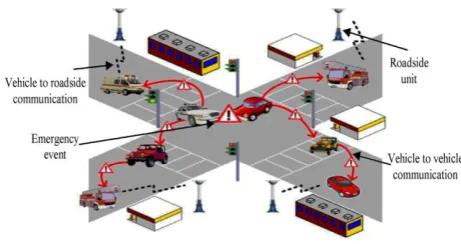
VANET may be a technology for sterilization the drivers regarding the standing of the roads, traffic collision and directions regarding the security and to manage the vehicle flow. For achieving this technology, we must always grasp correct data regarding the vehicles. Fig one shows a transport impromptu network for addressing the higher than downside.
VANET technology ought to avoid the traffic collision at the time of accident by providing the data to the opposite vehicles. This technology ought to grasp all data regarding the traffic usability on the road facet that ar traffic density, collision, directions of road and speed of the vehicles and conjointly regarding the climatic conditions. This data ar
gathered by mistreatment lay to rest vehicle ad vehicle to margin communications technologies. This data ar helpful to forestall the traffic and accidents happened in road sides.
VANET may be a new rising techniques that integrates the new generation of wireless networks into the vehicles for the communication. the most of VANET is one. To provides continuous affiliation between the vehicles a pair of provides the link for different vehicles a pair of. Provides the link for different vehicles for transferring the data like conference meeting, video chatting. 3. economical
wireless communication between vehicles, doesn’t
packets and codes ar transmit and receive through wireless network.
Fig. 1. Vehicular adhocnetwork.
This wireless network devices can give the data regarding the accidents, flooding, traffic jams to the drivers and passengers through VANET technology by obtaining this data on a time, drivers build correct choices and avoid
mishaps.
The features which are described in VANET are similar to the technology of a MANET. It integrates the self organization, self management, it reduces the bandwidth and able to share the radio transmission. The link stability provides in MANET which multicasting the routing path. But in VANET the link stability is based on the reverse based multicast routing which clears the routing traffic.
This type of designed protocol is efficiently useful for the fast mobility in the VANET nodes. This paper mainly focus on the major issues about the routing protocol for VANET. The most important objective of this paper is to achieve the short communication time when we using the less as a simulation which shows the performance of the VANET.
The main objective of this paper is to comprehensive study of VANET and presents new method about the link stability based on multicast routing. The good comparative of the protocols are position based routing and geo-casting are the more relevant than
important protocol is infrastructure-based routing protocols which are useful for identify the direction.
Table 1. Comparison between MANET and VANET
Parameters MANET VANET Cost of
production
Cheap Expensive
Change in network
topology
Slow Frequent and very fast
Frequently topology change
Low High
Node density Sparse Dense and frequently variable Reliability Medium High Moving pattern
of nodes
Random Regular
Addressing scheme
Attribute-based Location-based
II. Overview of VANET routing protocols
There wide range of routing protocols in VANET. These protocols are mainly aim to increase the throughput range when the packet loss occur. The main goal is to provide the energy efficient routing protocol in VANET.
VANET require a new type of routing protocol for communication. Now, the current VANET routing protocols are consider two types of VANET communication architecture. They are :
2.1 Vehicle -to- vehicle (V2V)
This protocol is useful to perform vehicle to vehicle
communication, it mainly doesn’t focus on the fixed
basestation on roadsides. It contains five main categories of routing protocols. They are:
(i) Topology based (ii) Position based (iii) Cluster based (iv) Geo-cast based (v) Multicast based (vi) Broadcast based
2.1.1 Topology-based(adhoc) routing protocols
This class of routing protocols employs the link information that exists in the network to execute packet forwarding.
2.1.2. Position-based routing protocols
In position-based routing protocols, all nodes recognize their own locations and their neighbor node geographic locations through position-pointing devices such as GPS. It does not manage any routing table or exchange any information related to the link state with the neighbor nodes.
2.1.3. Cluster-based routing protocols
Generally, cluster-based routing protocols are more suitable for network cluster topology. Every cluster has one cluster head which is responsible for intra- and inter-cluster management purposes.
2.1.4. Geo cast-based routing protocols
Fundamentally, the geo cast-based routing is a position-based multicast routing employed to forward a message to all the vehicles in a fixed to graphical area. The main goal of this approach is to distribute the packet from the source node to all the
other nodes in a particular geographical area or zone of relevance(ZOR).
2.1.5. Multicast-based routing protocols
Multicast transmission in the VANET is typically a transmission from a single source to multiple destinations within a specific geographic region and is usually conducted via geo cast routing.
2.1.6. Broadcast-based routing protocols
Broadcast-based routing is normally used in VANET to share information about road conditions, the climate, and urgent situa- tions with vehicles, and for advertising and announcements.
2.2 Vehicle –to- Infrastructure (V2I)
This protocol is useful to perform vehicle to infrastructure communication, it mainly focus on the fixed base station on road sides. It contains two main categories of infrastructure. They are:
(i) Static infrastructure (ii) Mobile infrastructure
2.2.1 Static infrastructure-based routing protocols Placing the fixed RSUs, which are linked to the backbone network in precise positions, is necessary for communication. The number and distribution of RSUs depend on the communication protocol which has to be employed.
2.2.2 Mobile infrastructure routing protocols
III. Route Discovery in VANET
3.1 AODV
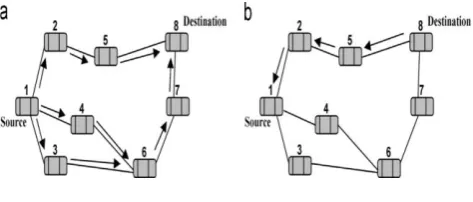
In Ad hoc on demand vector, Hello beacons are used to initiate the source node of the routing protocol which are helpful to detect the neighbour node.
Fig. 2. MAODV join operation : (a)RREQ message, (b)RREP message, and (c) MACT message.
Here the request message will be send to find the path for destination by the source node, which broadcast the route request packet (RREQ), then the packet will be broadcast RREQ by the neighbouring nodes to their neighbouring nodes to their neighbouring nodes to their neighbouring nodes until it should reach their sink node.
The IP address of the source node should be carried by the RREQ packets. It also carries current sequence number, IP address of the destination node.
Fig. 3. AODV routing protocol : (a)propagation of RRE Qand (b)RREP's path to the source.
When the RREQ packets are received then the nodes are registered their address in the routing table. After reaching the sink node, a route reply packet (RREP) is sent through the path from backward learning process to the source node.
3.2 Dynamic Source Routing:
It is one of the most important routing protocol. It is based on source routed protocol, which is an on-demand algorithm. Source routing means that the header of each packet carries the complete sequence list of nodes through which the packet should transmit. This routing protocol consists of two basic phases: route discovery and route maintenance.
IV.
CONCLUSION
Vehicle communication technology has become crucial in designing vehicles for the future. VANET offers communication services among vehicles or with road side infrastructure. In this study, we discussed the prospective applications and the problems involved in designing routing protocol in VANETs as well as surveyed and analyzed a large number of routing protocols. We also proposed taxonomy of protocols based on the VANET features and classified these protocols into two main categories: (1) vehicle-to-vehicle-based routing protocols and(2)vehicle-to- infrastructure-based routing protocols. This study discussed the characteristics, routing metrics and routing philosophies of each of these protocols selected from a class of similar approaches, which can reflect state-of-the-art research on VANET routing protocols. The classification of the primary routing selection principles can simplify the task of a network designer in deciding the VANET routing strategies to be
V.
REFERENCES
[1]. Rajashekhar Biradar, Sunilkumar Manvi , Mylara
Reddy , "Link stability based multicast routing scheme in MANET", Computer Networks 54 (2010).
[2]. Ahmed,S ,KanereSS.SKV "scalable knowledge-based routing architecture for public transport networks." In:Proceedings of the 3rd international workshop on vehicularadhocnetworks;2006.p.92-3.
[3]. A. Khandani, J. Abounadi, E. Modiano, and L. Zheng, "Cooperative routing in static wireless networks," IEEE Trans. Commun., vol. 55,no. 11, pp. 2185-2192, Nov. 2007.
[4]. Hui Cheng, Jiannong Cao, Xingwei Wang, "A fast and efficient multicast algorithm for QoS
group communications in heterogeneous
network", Computer Communications 30 (2007) 2225-2235.
[5]. H. Shen and S. Kalyanaraman, "Asynchronous cooperative MIMO communication," in Proc. IEEE WiOpt, Limassol, Cyprus, Apr. 2007,pp. 1-9.
[6]. I. Hen, "MIMO architecture for wireless communication," Intel Technol. J., vol. 10, no. 2, pp. 157-165, May 2006.
[7]. Y. Yuan, M. Chen, and T. Kwon, "A novel cluster-based cooperative MIMO scheme for multi-hop wireless sensor networks," EURASIP J.Wireless Commun. Netw., vol. 2006, no. 2, pp. 38-38, Apr. 2006
[8]. P. Herhold, E. Zimmermann, and G. Fettweis, "Cooperative multi-hop transmission in wireless networks," Comput. Netw., vol. 49, no. 3, pp. 299-324, Oct. 2005.
[9]. A. Stefanov and E. Erkip, "Cooperative
information transmission in wireless networks," in Proc. Asian-Eur. Workshop Inf. Theory, Breisach, Germany, Jun. 2002, pp. 90-93.
Cite this article as :
T. Sendhilkumar, S. Deepika, J. Esther, K. Gayathri, "Survey on VANET using Green Computing System with Energy Consumption", International Journal of Scientific Research in Computer Science, Engineering and Information Technology (IJSRCSEIT), ISSN : 2456-3307, Volume 3 Issue 8, pp. 393-397, November-December 2018.