Automatically Generated Online Dictionaries
Enik˝o H´eja, D´avid Tak´acs
Dept. of Language Technology, Research Institute for Linguistics, HAS P.O.Box. 360 H-1394, Budapest
[email protected], [email protected]
Abstract
The aim of our software presentation is to demonstrate that corpus-driven bilingual dictionaries generated fully by automatic means are suitable for human use. Need for such dictionaries shows up specifically in the case of lesser used languages where due to the low demand it does not pay off for publishers to invest into the production of dictionaries. Previous experiments have proven that bilingual lexicons can be created by applying word alignment on parallel corpora. Such an approach, especially the corpus-driven nature of it, yields several advantages over more traditional approaches. Most importantly, automatically attained translation probabilities are able to guarantee that the most frequently used translations come first within an entry. However, the proposed technique have to face some difficulties, as well. In particular, the scarce availability of parallel texts for medium density languages imposes limitations on the size of the resulting dictionary. Our objective is to design and implement a dictionary building workflow and a query system that is apt to exploit the additional benefits of the method and overcome the disadvantages of it.
Keywords:Parallel corpus, multi word expressions, dictionary query system
1.
Introduction
The objective of this research has been to investigate to what extent LT methods are capable of supporting the cre-ation of bilingual dictionaries. Need for such dictionar-ies shows up specifically in the case of lesser used lan-guages where it does not pay off for publishers to invest into the production of dictionaries due to the low demand. The targeted size of the dictionaries is between 15,000 and 25,000 entries. Since the completely automatic generation of clean bilingual resources is not possible according to the state of the art, we have decided to provide lexicogra-phers with bilingual resources that can facilitate their work. These kind of lexical resources will be referred to as proto-dictionarieshenceforward.
After investigating some alternative approaches e.g. hub-and-spoke model (Martin, 2007), alignment of WordNets, we have decided to use word alignment on parallel corpora. Former experiments (H´eja, 2010) have proven that word alignment is not only able to help the dictionary creation process itself, but the proposed technique also yields some definite advantages over more traditional approaches. The main motivation behind our choice was that the corpus-driven nature of the method decreases the reliance on hu-man intuition during lexicographic work. Although the careful investigation of large monolingual corpora might have the same effect, being tedious and time-cosuming it is not affordable in the case of lesser used languages. In spite of the fact that word alignment has been widely used for more than a decade within the NLP community to produce bilingual lexicons e.g. Wu and Xia (1994) and several experts claimed that such resources might also be useful for lexicographic purposes e.g. Bertels et al. (2009), as far as we know, this technique has not been exploited in large-scale lexicographic projects, yet e.g. Atkins and Rundell (2008).
Our earlier experiments has shown that although word alignment has definite advantages over more traditional
ap-proaches, there are also some difficulties that have to be dealt with: The method in itself does not handle multi-word expressions and the proto-dictionaries comprise in-correct translation candidates, as well. In fact, in a given parallel corpus the number of incorrect translation candi-dates strongly depends on the size of the proto-dictionary, as there is a trade-off between precision and recall. Accordingly, our recent objective is two-fold. First, a proof-of-concept experiment is presented to confirm that the treatment of MWEs is possible within this framework. Secondly, a dictionary query system is described that is apt to exploit the additional benefits of the method and over-come the disadvantages of it. According to our expectations such a system renders the proto-dictionaries helpful for not only lexicographers, but also for ordinary dictionary users. In Section 2. the basic generation process is introduced along with the difficulties we have to deal with. In Section 3. a proof-of-concept experiment is described to confirm that the treatment of MWEs is possible within the proposed framework. The various features of the Dictionary Query System are detailed in Section 4. Finally, a conclusion is given and future work is listed in Section 5.
The proto-dictionaries are available at: http://efnilex.efnil.org
2.
Generating Proto-Dictionaries –
One-Token Translation Pairs
2.1. Input data
Expressionsource Expressiontarget ptr Fs Ft
prendre m´edicament=obj
neem-in genees-middel=obj 0.377 53 32
gebruik genees-middel=obj 0.102 53 21
start gebruik=met:cmp met:cmp-van 0.097 53 28 sta onder-invloed=particle drug=van:cmp 0.05 53 11
Table 3: A sample entry from the French-Dutch verbal proto-dictionary.
to detect and merge the verbal structures into one-token-expressions so that they could serve as input to GIZA++. The preprocessing comprised three phases. In the first phase the deep-syntatctic analysis of each side of the Dutch-French parallel corpus was performed. Then the re-sulting phrase structures were converted to partial depen-dencies which is the required input format of the next step, where monolingual verbal structures were extracted from each side of the parallel corpus.
Thirdly, the selected verbal structures were merged into one-token expressions in both side of the parallel corpus so that they could serve as input to the alignment algorithm. The Dutch corpus was parsed by means of Alpino (Bouma et al., 2001) while the French corpus was parsed with the hybrid TIG/TAG parser (Villemonte de la Clergerie, 2010). The extraction technique starts out from the presupposi-tion that the whole verbal structure lies within one clause. Hence, the input corpus has to have clause boundary anno-tation. Moreover, for a number of reasons the extraction of relevant complementation frames presupposes that noun phrase information is also present in the corpus. On the one hand, we need to know which constituent is the head noun, since it is usually one of the head nouns that is a bound element in the verbal structure, if there is any at all. On the other hand, syntactic markers (prepositions, case suf-fixes, special syntactic positions) between head nouns and the verb, being part of the complementation frame, should also be detected.
One important decision was made when selecting the fea-tures of the deep syntactic annotation that should be taken into account when extracting verbal structures. Two contra-dictory requirements had to be met: First, the more features are to be considered, the more detailed characterization of the verbal structures is possible. Secondly, exploiting too many features might significanty diminish the results, for irrelevant syntactic labels increase the diversity of the data. Thus, we have experimented with two different feature set.
1. The verb and the head of the direct dependents were kept. Adjectives and complements dependent on the head were also preserved, while determiners were omitted.
2. Only the verbal lemma and the head of the direct ob-ject were taken into account. Verbal structures only with different verbal lemma or different direct object were kept separately, otherwise they were merged and the corpus frequencies were recounted.
3.3. Results
The experiment started from the hypothesis that more oc-currences of the translated structures in the corpus results in
a higher recall with the same precision by setting the trans-lational probability to lower value. Conversely, cutting at the same translational probability, more available data leads to greater precision.
To test this assumption word alignment and dictionary building was run against two different datasets.
The evaluation of the first dataset (whole verbal comple-mentation patterns) resulted in these figures: Cutting at a minimal probability of 0.44 and a minimal source lemma frequency of 100, 46% of the source structures was as-signed at least one correct translation and 54% of them was assigned only at least incomplete translations.
In the case of the second dataset with the same parameter setting 60% of the evaluated source lemmata had at least one correct and complete translation. 31% of the source lemmata was assigned only incomplete equivalents, while 9% of the source lemmata had only wrong translations. Our hypothesis proved to be correct only in the case of complete verbal structures, since somewhat surprisingly, the propor-tion of the correct but incomplete translapropor-tions dropped sig-nificantly in the second case.
4.
Dictionary Query System
As earlier has been mentioned, the proposed method has several benefits compared to more traditional approaches:
1. A parallel corpus of appropriate size guarantees that the most relevant translations be included in the dic-tionary.
2. Based on the translational probabilities it is possible to rank translation candidates ensuring that the most likely used translation variants go first within an entry.
3. All the relevant example sentences from the paral-lel corpora are easily accessible facilitating the selec-tion of the most appropriate translaselec-tions from possible translation candidates.
Accordingly, the Dictionary Query System presents some novel features. On the one hand, users can select the best proto-dictionary for their purposes on the Cut Board Page. On the other hand, the innovative representation of the gen-erated bilingual information helps to find the best transla-tion for a specific user in the Dictransla-tionary Browser Window.
4.1. Customizable proto-dictionaries: the Cut Board Page
Figure 1: The customized dictionary: the distribution of the Lithuanian-Hungarian translation candidates. Logarith-mic frequency of the source words on thex-axis, translation probability on they-axis.
Figure 2: The customized dictionary: the distribution of the candidates. Logarithmic frequency ratio of the source and target words on the x-axis, translation probability on the y-axis.
1. Plot 1 visualizes the distribution of the logarithmic fre-quency of the source words and the relevant translation probability for each word pair, selected by the given custom criteria.
2. Plot 2 visualizes the distribution of the logarithmic frequency ratio of the target and source words and the corresponding translation probability for each word pair, selected by the given custom criteria.
Proto-dictionaries are customizable by the following crite-ria:
1. Maximum and minimum ratio of the relative frequen-cies of the source and target words (left and right boundary on Plot 1).
2. Overall minimum frequency of either the source and the target words (left boundary on Plot 2).
3. Overall minimum translation probability (bottom boundary on both plots).
4. Several more cut off intervals can be defined in the space represented by Plot 2: Word pairs falling in rect-angles given by their left, right and top boundaries are cut off.
After submitting the given parameters the charts are re-freshed giving a feedback to the user and the parameters are stored for the session, i. e. the dictionary page shows only word pairs fitting the selected criteria.
4.2. Dictionary Browser
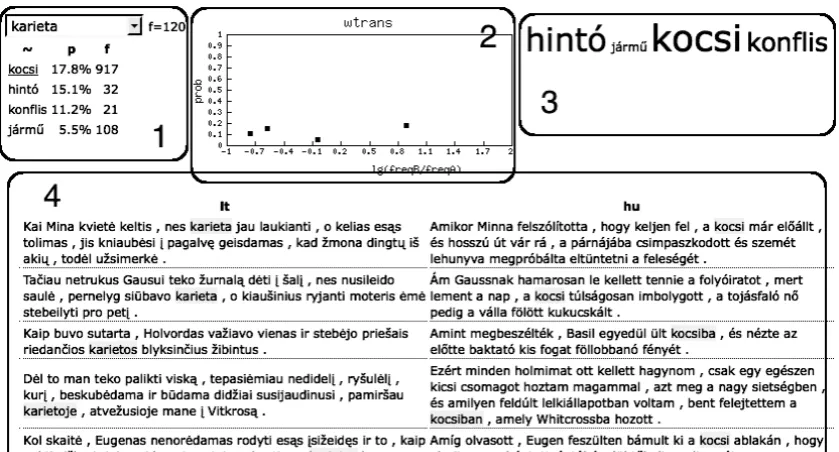
As Figure 3 illustrates, the Dictionary Browser displays four different types of information.
1. List of the translation candidates ranked by their trans-lation probabilities. This guarantees that most often used translations come first in the list (from top to bot-tom). Absolute corpus frequencies are also displayed.
2. A plot displaying the distribution of the possible trans-lations of the source word according to translation probability and the ratio of corpus ferquency between the source word and the corresponding translation can-didate.
3. Word cloud reflecting semantic relations between source and target lemmata. Words in the word cloud vary in two ways.
First, theirsizedepends on their translation probabili-ties: the higher the probability of the target word, the bigger the font size is.
Secondly, colours are assigned to target words ac-cording to their frequency ratios relative to the source word: less frequent target words are cool-coloured (dark blue and light blue) while more frequent target words are warm-coloured (red, orange). Target words with a frequency close to that of the source word get gray colour.
4. Provided example sentences with the source and target words highlighted, displayed by clicking one of the translation candidates.
Figure 3: The Dictionary Browser
Figure 4: Querying bigrams
Verbal structures of the form verb + objectwere also up-loaded into the query system. As a result, both French and Dutch verbal structures can be queried. As Figure 4 shows, the French wordfiche”sheet” and ”plug” has two different Dutch translations: stekker ”pin contact, male connector” andfiche ”sheet”. Moreover, the dictionary browser also displays the verbs of which the French nounficheis a fre-quent object complement. The relevant translations and the concordance can be displayed by clicking any of them.
4.3. Implementation
The online research tool is based on the LAMP web ar-chitecture. We use a relational database to store all the data: the multilingual corpus text, sentences and their trans-lations, the word forms and lemmata and all the relations between them. The implementation of such a data structure and the formulation of the queries is straightforward and efficient. The data displayed in the dictionary browser as well as the distributional dataset presented on the charts is
selected on-the-fly. The size of the database is linear with the size of the corpus.
5.
Conclusions and Future Work
Previous experiments have proven that corpus-driven bilin-gual resources generated fully by automatic means are apt to facilitate lexicographic work when compiling bilingual dictionaries. In our work this method has been extended to verbal structures and evaluated in two different experi-mental setup. According to our first results this thread of research looks promising. Given the great variety of possi-ble multiword expressions which can be lexicographically interesting, a more sophisticated approach has to be devel-oped.
We think that the proto-dictionaries generated by this tech-nique with various settings match well different user needs, and consequently, beside lexicographers, they might also be useful for end users, both for language learners and for pro-fessional translators. A possible future work is to further evaluate the dictionaries in real world use cases.
Some new assumptions can be formulated which connect the statistical properties of the translation pairs, e.g. their frequency ratios and the cross-language semantic relations between them. Based on the generated dictionaries such hypotheses may be further examined in the future.
In order to demonstrate the generated proto-dictionaries, we have designed and implemented an online dictionary query system, which exploits the advantages of the data-driven nature of the applied technique. It provides differ-ent visualizations of the possible translations based on their translation probabilities and frequencies, along with their relevant contexts in the corpus. By presetting different se-lection criteria the contents of the dictionaries are customiz-able to suit various usage scenarios.
6.
Acknowledgements
The work presented here is part of the pilot project EFNILEX financed by EFNIL. Our thanks go to Eric Ville-monte de la Clergerie and Kata G´abor for the syntactic analysis of the French texts. We are also grateful to Judit Kuti and Piroska Lendvai, Justina Lukaseviciute and Beat-rix T¨olgyesi for their contribution to the manual evaluation.
7.
References
Beryl T. Sue. Atkins and Michael Rundell. 2008. The Ox-ford Guide to Practical Lexicography. OUP OxOx-ford. Ann Bertels, C´edrick Fairon, J¨org Tiedemann, and Serge
Verlinde. 2009. Corpus parall`eles et corpus cibl´es au secours du dictionnaire de traduction. InCahiers de lex-icologie, number 94 in Revues, pages 199–219. Clas-siques Garnier.
Gosse Bouma, Gertjan van Noord, and Robert Malouf. 2001. Alpino: wide-coverage computational analysis of dutch. Computational Linguistics in the Netherlands 2000. Selected Papers from the 11th CLIN Meeting., pages 45–59.
Enik˝o H´eja, D´avid Tak´acs, and B´alint Sass. 2011. Igei b˝ov´ıtm´enykeretek ford´ıt´asi ekvivalenseinek kinyer´ese p´arhuzamos korpuszb´ol (extracting verbal structures and their translation candidates from parallel corpus ). In At-tila Tan´acs and Veronika Vincze, editors,VIII. Magyar Sz´am´ıt´og´epes Nyelv´eszeti Konferencia Tanulm´anyk¨otete (Poceedings of the 8th Hungarian Conference on Com-putational Linguistics), pages 47–59, Szeged, Hungary, december.
Enik˝o H´eja. 2010. The role of parallel corpora in bilin-gual lexicography. In Nicoletta Calzolari (Conference Chair), Khalid Choukri, Bente Maegaard, Joseph Mar-iani, Jan Odijk, Stelios Piperidis, Mike Rosner, and Daniel Tapias, editors,Proceedings of the Seventh Inter-national Conference on Language Resources and Eval-uation (LREC’10), Valletta, Malta, may. European Lan-guage Resources Association (ELRA).
Lieve Macken, Julia Trushkina, Hans Paulussen, Lidia Rura, Piet Desmet, and Willy Vandeweghe. 2007. Dutch parallel corpus : a multilingual annotated corpus. In Pro-ceedings of Corpus Linguistics 2007.
Willy Martin. 2007. Government policy and the planning and production of bilingual dictionaries : The dutch ap-proach as a case in point. International Journal of Lexi-cography, 20(3):221–237.
Franz Josef Och and Hermann Ney. 2003. A system-atic comparison of various statistical alignment models. Computational Linguistics, 29(1):19–51.
Csaba Oravecz and P´eter Dienes. 2002. Efficient stochas-tic part-of-speech tagging for hungarian. InProceedings of the Third International Conference on Language Re-sources and Evaluation, pages 710–717, Las Palmas. B´alint Sass. 2009. A Unified Method for Extracting
Sim-ple and Multiword Verbs with Valence Information. In Recent Advances in Natural Language Processing (RANLP 2009), pages 399–403, Borovec, Bulgaria. D´aniel Varga, L´aszl´o N´emeth, P´eter Hal´acsy, Andr´as
Ko-rnai, Viktor Tr´on, and Viktor Nagy. 2005. Parallel
cor-pora for medium density languages. InRecent Advances in Natural Language Processing (RANLP 2005), pages 590–596.
Eric Villemonte de la Clergerie. 2010. Convertir des d´erivations TAG en d´ependances. In 17e Conf´erence sur le Traitement Automatique des Langues Naturelles - TALN.
Dekai Wu and Xuanyin Xia. 1994. Learning an english-chinese lexicon from a parallel corpus. InIn Proceedings of the First Conference of the Association for Machine Translation in the Americas, pages 206–213.