A Generalized Fra
m
ework for Hierarchical Word Sequence Language
Model
Xiaoyi Wu, Kevin Duh, Yujimatsumoto Nara Institute of Science and Technology
Computational Linguistics Laboratory 8916-5 Takayama, Ikoma, Nara Japan
{xiaoyi-w,kevinduh,matsu}@is.naist.jp
Abstract
Languagemodeling is a fundamental research problem that has wide application formany NLP tasks. For estimating probabilities of nat-ural language sentences,most research on lan-guagemodeling use n-grambased approaches to factor sentence probabilities. However, the assumption under n-gram models is not robust enough to cope with the data sparseness prob-lem, which affects the final performance of languagemodels.
At the point, Hierarchical Word Sequence (ab-breviated as HWS) language models can be viewed as an effective alternative to normal n-gram method. In this paper, we generalize HWSmodels into a framework, where differ-ent assumptions can be adopted to rearrange word sequences in a totally unsupervised fash-ion, which greatly increases the expandability of HWSmodels.
For evaluation, we compare our rearranged word sequences to conventional n-gramword sequences. Both intrinsic and extrinsic exper-iments verify that our framework can achieve better performance, proving that ourmethod can be considered as a better alternative for n-gramlanguagemodels.
1 Introduction
Probabilistic Language Modeling is a fundamental research direction of Natural Language Processing. It is widely used in various application such asm a-chine translation (Brown et al., 1990), spelling cor-rection (Mays et al., 1990), speech recognition
(Ra-biner and Juang, 1993), word prediction (Bickel et al., 2005) and so on.
Most research about Probabilistic Language Mod-eling, such as Katz back-off (Katz, 1987), Kneser-Ney (Kneser and Kneser-Ney, 1995), andmodified Kneser-Ney (Chen and Goodman, 1999), only focus on smoothingmethods because they all take the n-gram
approach (Shannon, 1948) as a default setting for
modeling word sequences in a sentence. Yet even with 30 years worth of newswire text, more than one third of all trigrams are still unseen (Allison et al., 2005), which cannot be distinguished ac-curately even using a high-performance smoothing
method such as modified Kneser-Ney (abbreviated as MKN).
An alternative solution is to factor the language
model probabilities such that the number of unseen sequences are reduced. It is necessary to extract themin another way, instead of only using the in-formation of left-to-right continuous word order.
In (Guthrie et al., 2006), skip-gram (Huang et al., 1993)1is proposed to overcome the data sparse-ness problem. For each n-gram word sequence, the skip-gram model enumerates all possible word combinations to increase valid sequences. This has truly helped to decrease the unseen sequences, but we should not neglect the fact that it also brings a greatly increase of processing time and redundant contexts.
In (Wu and Matsumoto, 2014), a heuristic ap-proach is proposed to convert any raw sentence into a hierarchical word sequence (abbreviated as
1The k-skip-n-grams for a sentencew
1, ...wmis defined as the set{wi1, wi2, ...win|Σnj=1ij−ij−1< k}.
size as small as that of n-gram. In (Wu and Mat-sumoto, 2015) (Wu et al., 2015), instead of only us-ing the information of word frequency, the inform a-tion of direca-tion and word associaa-tion are also used to construct higher quality HWS structures. How-ever, they are all specificmethods based on certain heuristic assumptions. For the purpose of further im -provements, it is also necessary to generalize those
models into one unified structure.
This paper is organized as follows. In Section 2, we review the HWS language model. Then we present a generalized hierarchical word sequence structure (GHWSS) in Section 3. In Section 4, we present two strategies for rearranging word se-quences under the framework of GHWSS. In Sec-tions 5 and 6, we show the effectiveness of our
model by both intrinsic experiments and extrinsic experiments. Finally, we summarize our findings in Section 7.
2 Review of HWS Language Model
In (Wu and Matsumoto, 2014), the HWS structure is constructed fromtraining data in an unsupervised way as follows:
Suppose that we have a frequency-sorted vocab-ulary list V = {v1, v2, ..., vm}, where C(v1) ≥
C(v2)≥...≥C(vm)2.
According to V, given any sentence
S=w1, w2, ..., wn, the most frequently
used word wi∈S(1≤i≤n) can be
se-lected3 for splitting S into two substrings
SL=w1, ..., wi−1 and SR=wi+1, ..., wn. Sim
-ilarly, for SL and SR, wj ∈SL(1≤j ≤i−1)
and wk∈SR(i+ 1≤k≤n) can also be
se-lected, by which SL and SR can be splitted
into two smaller substrings separately. Ex-ecuting this process recursively until all the substrings become empty strings, then a tree
T = ({wi, wj, wk, ...},{(wi, wj),(wi, wk), ...})
can be generated, which is defined as an HWS structure(Figure 1).
In an HWS structureT, assuming that each node depends on its preceding n-1 parent nodes, then
spe-2C(v)represents the frequency ofvin a certain corpus. 3Ifw
iappearsmultiple times inS, then select the first one.
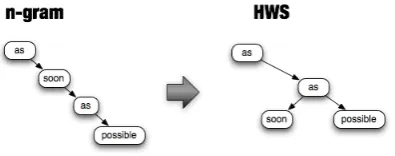
Figure 1: A comparison of structures between HWS and n-gram
cial n-grams can be trained. Such kind of n-grams are defined asHWS-n-grams.
The advantage of HWSmodels can be considered as discontinuity. Taking Figure 1 as an example, since n-gram model is a continuous languagemodel, in its structure, the second ‘as’ depends on ‘soon’, while in the HWS structure, the second ‘as’ depends on the first ‘as’, forming a discontinuous pattern to generate the word ‘soon’, which is closer to our lin-guistic intuition. Rather than ‘as soon ...’, taking ‘as ... as’ as a pattern ismore reasonable because ‘soon’ is quite easy to be replaced by other words, such as ‘fast’, ‘high’, ‘much’ and so on. Consequently, even using 4-gram or 5-gram, sequences consist-ing of ‘soon’ and its nearby words tend to be low-frequency because the connection of ‘as...as’ is still interrupted. On the contrary, the HWS model ex-tracts sequences in a discontinuous way, even ‘soon’ is replaced by another word, the expression ‘as...as’ won’t be affected. This is how the HWSmodels re-lieve the data sparseness problem.
The HWS model is essentially an n-gram lan-guage model based on a different assumption that a word depends upon its nearby high-frequency words instead of its preceding words. Different from other special n-gram language models, such as class-based languagemodel (Brown et al., 1992), factored languagemodel(FLM) (Bilmes and Kirch-hoff, 2003), HWS languagemodel doesn’t use any specific linguistic knowledge or any abstracted cate-gories. Also, differs fromdependency tree language
models (Shen et al., 2008) (Chen et al., 2012), HWS languagemodel constructs a tree structure in an un-supervised fashion.
In HWS structure, word sequences are adjusted so that irrelevant words can be filtered out from
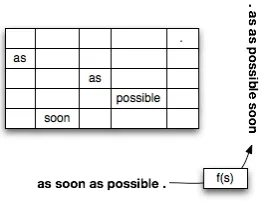
Figure 2: An Example of Generative Hierarchical Word Sequence Structure
for predicting the next word, which make it more effective and flexible in relieving the data sparse-ness problem. On this point, it has something in common with structured language model (Chelba, 1997), which firstly introduced parsing into lan-guagemodeling. The significant difference is, struc-tured language model is based on CFG parsing structures, while HWS model is based on pattern-oriented structures.
3 Generalized Hierarchical Word Sequence Structure
Suppose we are given a sentences=w1, w2, ..., wn
and a permutation functionf :s →s, wheres =
w1, w2, ..., wnis a permutation of s. For each word indexi(1≤i≤n, wi∈s), there is a corresponding
reordered indexj(1≤j≤n, wj ∈s, wj =wi).
Then we create ann×nmatrixA. For each row
j, we fill cell Aj,i with wi. We define the matrix
A as thegeneralized hierarchical word sequence structure(abbreviated asGHWSS) of the sentence
s. An example is shown in Figure 2.
In a GHWSS, given any word w ∈ {Aj,i|wj =
wi}, the words in its higher rows are X =
{Ak,m|k < j,1 ≤ m ≤ n, wk = wm}, in which the nearest two neighbors ofwareˆl=Akl,mˆl(kl<
j,mˆl = argmin
1≤m<i(i−m)) and rˆ = Akr,mˆr(kr <
j,mˆr = argmin
i<m≤n(m−i))respectively
4. Then we
as-sume thatwdepends onwˆ = ˆlifkl > krorwˆ = ˆr
ifkl < kr. For example, in Figure 2, given the word ‘soon’, its higher rowsX ={as, as, possible, .}, in which the nearest neighbors of ‘soon’ areˆl=asand
4There is noˆlwheni= 1, while norˆwheni=n.
ˆ
r=as, since the second ‘as’ is closer to ‘soon’ ver-tically, we assume ‘soon’ depends the second ‘as’ in this GHWSS.
Further, for the wordA1,i, we define that it
de-pends on symbol ‘s’. We also use the symbol ‘/s’ to represent the end of generation.
For each wordw=Aj,i, if we assume that it only
depends on its previous few words in its dependency chain, then we can achieve special n-grams under the GHWSS. Taking Figure 2 as the example, we can train 3-grams like {(s, s, .), (s, ., as), (., as, as), (as, as, possible), (as, possible,/s), (as, as, soon), (as, soon,/s)}.
In (Wu and Matsumoto, 2015), it is verified that the performance of HWS model can be further im -proved by using directional information. Thus, in this paper, we defaultly use directional information tomodel word sequences. Then the above 3-grams should be {(s, s, .), (s, .-R, /s), (s, .-L, as), (.-L, as-L, /s), (.-L, as-R, as), (as-R, as-L, soon), (as-L, soon-L, /s), (as-L, soon-R, /s), (as-R, as-R, possible), (as-R, possible-L,/s), (as-R, possible-(as-R,/s) and the probability of the whole sentence ‘as soon as possible .’ can be estimated by the product of conditional probabilities of all these word sequences.
4 Two Strategies for constructing GHWSS
Once a permutation functionf is implemented, the GHWSS of any sentence can be constructed. Thus, the performance of GHWSS is totally determined by how to implement the functionf for rearranging word sequences.
Since n-gram models assume that a word depends on its previous n-1 words, the functionf of n-gram methods can be considered as the identity perm uta-tion. For each wordwi, we fill cellAi,iwithwi, then the n-gram method is a special case of GHWSS.
In this section, we propose two kinds ofmethods for implementing functionf under GHWSS.
4.1 Word Frequency Based Method
Step 1. Calculate word frequencies from training data and sort all words by their frequency. Assume we get a frequency-sorted listV ={v1, v2, ..., vm}, whereC(vj)> C(vj+1),1≤j≤m−1.5
5C(v
j)represents the frequency ofvj.
1 2 n
w1, w2, ..., wn(wk = vx, wk+1 = vy,1 ≤ k ≤
n−1,1≤x≤y≤m).
Then the GHWSS constructed by the perm uta-tionsis equivalent to that of frequency-based HWS
method.
4.2 Word Association Based Method
Step 1. For each sentencesin corpusD, we convert it intos, in which each word only appear once.
Step 2. For each word wi in the corpus D = {si|1 ≤ i ≤ |D|}, we count its frequency C(wi)
and its cooccurrence with another wordC(wi, wj).
Step 3. For each original sentence s ∈ D, we initiate an empty listXand set the beginning symbol ‘s’ as the initial contextc6.
Step 4. For each word w ∈ s, we calculate its word association score with contextc. In this paper, we use T-score7as the word associationmeasure.
T(c, w) = (C(c, w)−C(c)×VC(w))÷C(c, w) (1) Then we add the i-th wordwˆwith themaximum
score to list X8 and use it to split sinto two sub-stringssl =w1, ..., wi−1andsr =wi+1, ..., wn.
Step 5. We setwˆas the new contextc. For each word insl, we calculate its word association score
withc and add the word with themaximumscore to list X9 and use it to divide sl into two smaller
substrings. Then we apply the same process to the substringsr.
Execute Step4 and Step5 recursively until
any-more substrings cannot be divided, then the original sentencesis permuted as listX, by which GHWSS ofscan be constructed.
5 Intrinsic Evaluation
We use two different corpus:British National Cor-pusandEnglish Gigaword Corpus.
6Since s appears only once in each sentence, we set
C(s)as the size of corpus.
7V stands for the total number of words in corpus. 8Ifwˆappearsmultiple times ins, then select the first one. 9If the context wordc also appears ins
l, then we regard it as the word with themaximumscore and add it toXdirectly.
ken English froma wide range of sources. We use all the 6,052,202 sentences (100million words) for the training data.
English Gigaword Corpus11consists of over 1.7 billion words of English newswire from 4 distinct international sources. We choose thewpb engpart (162,099 sentences, 20million words) for the test data.
As preprocessing of the training data and the test data, we use the tokenizer of NLTK (Natural Lan-guage Toolkit)12to split raw English sentences into words. We also converted all words to lowercase.
To ensure the openness of our research, the source code used in the following experiments is available on the internet.13
As intrinsic evaluation of languagemodeling, per-plexity (Manning and Sch¨utze, 1999) is the most common metric used formeasuring the usefulness of a languagemodel. However, since we unsuper-visedly ‘parse’ the test sentence s into a GHWSS structure before we estimate its probability, its con-ditional entropy is actuallyH(s|T(s)), whereT(s) represents the GHWSS assigned to the test sentence
s. Consequently, our method hasmuch lower per-plexity. It’s not appropriate to directly compare the perplexity of GHWSS-based models to that of n-gram models.
Also, perplexity is not necessarily a reliable way of determining the usefulness of a language model since a language models with low perplexity may not work well in a real world application. Thus, for intrinsic evaluation, we evaluatemodels only based on how much they can actually relieve the data sparseness problem(reduce the unseen sequences).
In (Wu and Matsumoto, 2014), coverage score
are used to perform this kind of evaluation. The word sequencesmodeled fromtraining data are de-fined as TR, while that of test data as TE, then the coverage score is calculated by Equation (2). Obvi-ously, the higher coverage score a languagemodel can achieve, themore it can relieve the data sparse-ness problem(reduce the unseen sequences).
10http://www.natcorp.ox.ac.uk
11https://catalog.ldc.upenn.edu/LDC2011T07 12http://www.nltk.org
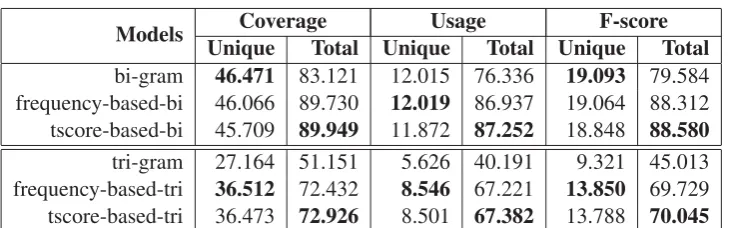
Table 1: Performance of Various Word Sequences
Models Coverage Usage F-score Unique Total Unique Total Unique Total
bi-gram 46.471 83.121 12.015 76.336 19.093 79.584 frequency-based-bi 46.066 89.730 12.019 86.937 19.064 88.312 tscore-based-bi 45.709 89.949 11.872 87.252 18.848 88.580
tri-gram 27.164 51.151 5.626 40.191 9.321 45.013
frequency-based-tri 36.512 72.432 8.546 67.221 13.850 69.729 tscore-based-tri 36.473 72.926 8.501 67.382 13.788 70.045
scorecoverage= |T R
T E
|
|T E| (2)
If all possible word combinations are enum er-ated as word sequences, then considerable coverage score can be achieved. However, the processing ef-ficiency of a model become extremely low. Thus,
usage score(Equation (3)) is also necessary to
esti-mate howmuch redundancy is contained in amodel.
scoreusage = |T R
T E|
|T R| (3)
A balancedmeasure between coverage and usage is calculated by Equation (4).
F-Score= 2coverage×coverage+×usageusage (4)
In this paper, we use the samemetric to compare word sequencesmodeled under GHWSS framework with normal n-gramsequences.
The result is shown in Table 1 14. According to the results, for total word sequences, which actu-ally affect the final performance of languagem od-els, GHWSS-based methods have obvious advan-tage over the normal bi-gram model. As for tri-grams, the GHWSS-based methods can even im -prove around 25%.
6 Extrinsic Evaluation
For the purpose of examining how ourmodels work in the real world application, we also performed ex-trinsic experiments to evaluate ourmethod. In this
14“Unique”means counting each word sequence only once in spite of the amount of times it really occurs.
paper, we use the reranking of n-best translation can-didates to examining how languagemodels work in a statisticalmachine translation task.
We use the French-English part of TED talk par-allel corpus for the experiment dataset. The training data contains 139,761 sentence pairs, while the test data contains 1,617 sentence pairs. For training lan-guagemodels, we set English as the target language. As for statistical machine translation toolkit, we useMoses system15 to train the translation model and output 50-best translation candidates for each French sentence of the test data. Then we use 139,761 English sentences to train language m od-els. With these models, 50-best translation candi-dates are reranked. According to these reranking re-sults, the performance ofmachine translation system
is evaluated, which alsomeans, the languagemodels are evaluated indirectly. In this paper, we use the fol-lowingmeasures for evaluating reranking results16.
BLEU(Papineni et al., 2002): BLEU scorem ea-sures howmany words overlap in a given candidate translation when compared to a reference transla-tion, which provides some insight into how good the fluency of the output froman engine will be.
METEOR (Banerjee and Lavie, 2005): ME-TEOR score computes a one-to-one alignment be-tweenmatching words in a candidate translation and a reference.
TER(Snover et al., 2006): TER scoremeasures the number of edits required to change a system out-put into one of the references, which gives an indi-cation as to howmuch post-editing will be required
15http://www.statmt.org/moses/
16We use open source tool multeval (https://github.com/jhclark/multeval) to perform the evalu-ation.
Models BLEU METEOR TER
tri-gram 31.3 33.5 49.0
frequency-based-tri 31.5 33.6 48.6
tscore-based-tri 31.7 33.6 48.5
on the translated output of an engine.
We use GHWSS word rearranging strategies to performexperiments and compared themto the
nor-mal n-gram strategy. For estimating the probabil-ities of translation candidates, we use the m odi-fied Kneser-Ney smoothing (MKN) as the sm ooth-ingmethod of all strategies. As shown in Table 2, GHWSS based strategies outperformthat of n-gram
on each score.
7 Conclusion
In this paper, we proposed a generalized hierarchi-cal word sequence framework for language m odel-ing. Under this framework, we presented two dif-ferent unsupervised strategies for rearranging word sequences, where the conventional n-gramstrategy as one special case of this structure.
For evaluation, we compared our rearranged word sequences to conventional n-gram word sequences and performed intrinsic and extrinsic experiments. The intrinsic experiment proved that our methods can greatly relieve the data sparseness problem, while the extrinsic experiments proved that SMT tasks can benefit from our strategies. Both veri-fied that languagemodeling can achieve better per-formance by using our word sequences rearranging strategies, which also proves that our strategies can be used as better alternatives for n-gram language
models.
References
B. Allison, D. Guthrie, L. Guthrie, W. Liu, and Y Wilks. 2005. Quantifying the Likelihood of Unseen Events: A further look at the data Sparsity problem. Awaiting publication.
S. Banerjee and A. Lavie. 2005. Meteor: An
auto-maticmetric formt evaluation with improved correla-tion with human judgments. InProceedings of the acl workshop on intrinsic and extrinsic evaluation mea-sures for machine translation and/or summarization, pages 65–72.
S. Bickel, P. Haider, and T. Scheffer. 2005. Predicting sentences using n-gramlanguagemodels. In Proceed-ings of the conference on Human Language Technol-ogy and Empirical Methods in Natural Language Pro-cessing, pages 193–200.
J. A. Bilmes and K. Kirchhoff. 2003. Factored language
models and generalized parallel backoff. In Proceed-ings of the 2003 Conference of the North American Chapter of the Association for Computational Linguis-tics on Human Language Technology, volume 2, pages 4–6.
P.F Brown, J Cocke, S.A Pietra, V.J Pietra, F Jelinek, J.D Lafferty, R.L Mercer, and P.S Roossin. 1990. A statis-tical approach tomachine translation. Computational linguistics, 16(2):79–85.
P. F. Brown, P. V. Desouza, R. L. Mercer, V. J. D. Pietra, and J. C. La. 1992. Class-based n-gram models of nat-ural language. Computational linguistics, 18(4):467– 479.
C. Chelba. 1997. A structured languagemodel. In Pro-ceedings of ACL-EACL, pages 498–500.
S. F. Chen and J. Goodman. 1999. An empirical study of smoothing techniques for languagemodeling. Com-puter Speech and Language, 13(4):359–393.
W. Chen, M. Zhang, and H Li. 2012. Utilizing depen-dency language models for graph-based dependency parsing models. InProceedings of the 50th Annual Meeting of the Association for Computational Linguis-tics, volume 1, pages 213–222.
D. Guthrie, B. Allison, W. Liu, and L. Guthrie. 2006. A closer look at skip-gram modeling. InProceedings of the 5th international Conference on Language Re-sources and Evaluation, pages 1–4.
X. Huang, F. Alleva, H.W. Hon, M.Y. Hwang, and K. F. Lee. 1993. The sphinx-ii speech recognition system: an overview. 7(2):137–148.
S. Katz. 1987. Estimation of probabilities fromsparse data for the language model component of a speech recognizer. Acoustics, Speech and Signal Processing, 35(3):400–401.
R. Kneser and H. Ney. 1995. Improved backing-off for
m-gramlanguagemodeling. Acoustics, Speech, and Signal Processing, 1:181–184.
C. D. Manning and H. Sch¨utze. 1999. Foundations of statistical natural language processing. MIT Press. E. Mays, F. J. Damerau, and R. L. Mercer. 1990. Context
based spelling correction. Information Processing and Management, 27(5):517–522.
K. Papineni, S. Roukos, T. Ward, and W.J. Zhu. 2002. Bleu: amethod for automatic evaluation ofmachine translation. InProceedings of the 40th annual meet-ing on association for computational lmeet-inguistics, pages 311–318.
L. Rabiner and B.H. Juang. 1993. Fundamentals of Speech Recognition. Prentice Hall.
C. E. Shannon. 1948. Amathematical theory of comm u-nication. The Bell System Technical Journal, 27:379– 423.
L. Shen, J. Xu, and R.M. Weischedel. 2008. A new string-to-dependency machine translation algorithm
with a target dependency language model. In ACL, pages 577–585.
M. Snover, B. Dorr, R. Schwartz, L. Micciulla, and J. Makhoul. 2006. A study of translation edit rate with targeted human annotation. InProceedings of associ-ation for machine translassoci-ation in the Americas, pages 223–231.
X. Wu and Y. Matsumoto. 2014. A hierarchical word sequence languagemodel. InProceedings of The 28th Pacific Asia Conference on Language, pages 489–494. X. Wu and Y. Matsumoto. 2015. An improved hierarchi-cal word sequence language model using directional information. InProceedings of The 29th Pacific Asia Conference on Language, pages 453–458.
X. Wu, Y. Matsumoto, K. Duh, and S. Hiroyuki. 2015. An improved hierarchical word sequence language
model using word association. InStatistical Language and Speech Processing, pages 275–287.