Optimal Signcryption from Any Trapdoor Permutation
Yevgeniy Dodis† Michael J. Freedman† Stanislaw Jarecki‡ Shabsi Walfish†
January 28, 2004
Abstract
We build several highly-practical and optimized signcryption constructions directly from trapdoor per-mutations, in the random oracle model. All our constructions share features such as simplicity, efficiency, generality, near-optimal exact security, flexible and ad-hoc key management, key reuse for sending/receiving data, optimally-low message expansion, “backward” use for plain signature/encryption, long message and associated data support, the strongest-known qualitative security (so-calledIND-CCAandsUF-CMA) and, finally, complete compatibility with the PKCS#1 infrastructure. While some of these features are present in previous works to various extents, we believe that our schemes improve on earlier proposals in at least several dimensions, making the overall difference quite noticeable in practice.
Concretely, we present three methods generally based on what we call Parallel, Sequential, and eXtended sequential Padding schemes (P-Pad, S-Pad, X-Pad). P-Pad offers parallel “signing” and “encrypting”, opti-mal exact security, and minimum ciphertext length twice as long as the length of aTDP, while still maintain-ing optimal bandwidth. S-Pad loses parallelism and some exact security, but has minimal ciphertext length equal to that of aTDP. Any S-Pad can also be used as a “universal padding” scheme. X-Pad is similar to S-Pad, but regains optimal exact security at the expense of a marginally-longer minimum ciphertext length. Moreover, to unify various padding options, we construct a single versatile padding schemePSEPwhich, by simply adjusting the lengths of the parameters, can work optimally as either a P-Pad, S-Pad or X-Pad.
Keywords: Signcryption, universal padding schemes, Feistel Transform, extractable commitments.
†{dodis,mfreed,walfish}@cs.nyu.edu
. Department of Computer Science, New York University.
‡
1
Introduction
Signcryption. Until recently, the two main building-blocks of modern public-key cryptography — encryption and signature schemes — have been considered as distinct entities that may be composed in various ways to ensure message privacy and authentication. From a design and analysis standpoint, this evolution makes sense, as encryption and signatures serve fundamentally different purposes. In practice, however, many centrally-important applications use both primitives, for example, secure electronic mail. Thus, it seems justified to invest special effort into designing a tailored and efficient solution to implement a “joint signature and encryp-tion” primitive. Additionally, such a primitive may simplify and improve the design of complex protocols which require both privacy and authenticity. For instance, the following is a very simple signcryption-based authenti-cated key-exchange (AKE) protocol: sender Alice sends a fresh nonce N to the receiver Bob, who chooses a session keyKand signcryptsKto Alice usingN as a label (see Section 3).1 This protocol both simplifies and generalizes a similar protocol from [21, §8.1], which used a specific “encrypt-then-sign” implementation of (labeled) signcryption [1], and also had to explicitly worry about low-level details such as user identities (which get abstracted away by the powerful signcryption primitive).
Motivated by these reasons, Zheng [23] introduced a new primitive called signcryption. While several papers [23, 24, 19, 12] offered security arguments about various signcryption schemes, the first formal investigations appeared only recently [2, 1]. Both works define signcryption as a multi-user primitive which simultaneously satisfies chosen ciphertext security for privacy and existential unforgeability for authenticity. In terms of con-structions, Baek et al. [2] showed that the original “discrete log-based” proposal of Zheng [23] indeed can be proven secure in the random oracle (RO) model under the so-called Gap Diffie-Hellman assumption. Zheng’s signcryption scheme is quite elegant and achieves very good efficiency in the discrete-log setting, but has the disadvantage that all parties must agree on the same public parameters, such as the common discrete log group. Thus, for example, any changes to the security parameter or signcryption scheme requires consensus. Addition-ally, the security of [2] is based on a specific and somewhat non-standard assumption. On the other hand, An
et al. [1] examined generic composition methods of building signcryption from any secure signature and
en-cryption scheme. These composition paradigms are general and give rise to a variety of signen-cryption schemes. Additionally, users can easily change their public keys or their favorite signature/encryption scheme, and still be able to seamlessly communicate with other users. While these generic schemes validate that signcryption can be built from ordinary signature and encryption, they are inefficient unless the latter are efficiently implemented.
Our Motivation. In practice, truly-efficient signature and encryption schemes, such asOAEP[4],OAEP+[22],
PSS-R[5], are typically built from trapdoor permutations (TDPs), such as RSA, and are analyzed in the RO model. We call such schemes TDP-based. Even with these efficient implementations, however, the generic schemes have several drawbacks. For example, users have to maintain independent keys for signature and for encryption, the message bandwidth is suboptimal (due to two independent “paddings” and additional overhead for identity fraud protection), and the scheme’s “exact security” is not tight. Thus, given that practical schemes are already built from trapdoor permutations, it is natural to ask whether we can build optimized direct sign-cryption constructions from trapdoor permutations (in the RO model)2 that resolve the inefficiencies of the “black-box” composition.
We resolve this question in the affirmative: This paper presents several optimized signcryption constructions, all of which share features such as simplicity, efficiency, generality, near-optimal exact security, flexible and ad-hoc key management, key reuse for sending/receiving data, optimally-low message expansion, “backward”
1
Unlike Diffie-Hellman AKE, this protocol does not enjoy forward secrecy, but allows to build efficient AKE protocols under different assumptions than Diffie-Hellman, such as RSA.
2As we stated, all truly efficient plain signature and encryption schemes are analyzed in the RO model, so there seems to be little
use for plain signature/encryption, long message and associated data support, the strongest-known qualitative security (so called IND-CCA and sUF-CMA) and, finally, complete compatibility with the PKCS#1 infras-tructure [20]. While some of these attractive features are already present in several previous works to various extents, we believe that our schemes improve on earlier proposals in at least several dimensions, making the overall difference quite noticeable in practice. Note that we do not claim any improvement in the
computa-tional efficiency of signcryption based on TDPs, since in practice the computational overhead is completely dominated by the time required to compute and invertTDPs. In particular, our signcryption schemes will re-quire exactly one computation of the “receiver’s TDP” (for “encryption”) and one inverse computation of the “sender’s TDP” (for “authentication”), which is clearly optimal forTDPbased signcryption (and can already be achieved with generic compositions in the RO model). Nevertheless, we will see in Table 1 that our schemes have many other advantages.
Overview of Our Results. Unlike generic TDP-based schemes, in our model each user U independently picks a single trapdoor permutationfU(together with its trapdoor, denotedfU−1) and publishesfU as its public
signcryption key. Similar to TDP-based signature and encryption schemes, our schemes use some padding
schemePadon messagembefore passing the result through correspondingTDPs. However, our schemes use only a single, specialized padding scheme, rather than two independent padding schemes. This design results in noticeable practical savings in both quantitative and qualitative security, as well as improves the message bandwidth and randomness utilization.
Specifically, to send a short message3 m from S to R, we offer three options to S, depending on what padding scheme is more convenient in a given application:
• P-Pad (Parallel Padding) will producePad(m) =wks, andSwill outputfR(w)kfS−1(s).
• S-Pad (Sequential Padding) will producePad(m) =wks, andSwill outputfR(fS−1(wks)).
• X-Pad (eXtended sequential Padding) will producePad(m) =wks, andSwill outputfR(fS−1(w))ks.
As we can see, P-Pad provides parallel application of “signing” fS−1 and “encrypting”fR, which can result in
efficiency improvements on parallel machines. However, the ciphertext length is twice as large as compared to S-Pad, although the message bandwidth remains as good as S-Pad by using messages twice as long. On the other hand, the exact security offered by S-Pad is not as tight as that of P-Pad. Finally, X-Pad regains the optimal exact security of P-Pad, while maintaining ciphertext length nearly equal to the length of theTDP(by achieving quite shorts).
Furthermore, we construct a single versatile padding scheme (called PSEP2) which, by simply adjusting some length parameters, can work optimally as either P-Pad, S-Pad or X-Pad! In addition, since each paradigm can naturally yield a regular signature/encryption by settingfS/fRequal to the identity permutation (i.e. it is a
“universal padding” [6]), this versatile padding scheme is truly applicable for anyTDP-based public-key usage.
Our Padding Constructions. We observe that all popular padding schemes with message recovery currently used for ordinary signature or encryption, such asOAEP[3], OAEP+[22], OAEP++[15], PSS-R[5], and “scramble all, encrypt small” [13] (in the future denotedSAP), actually consist of two natural components w
and s. Moreover, thesewand sare always obtained through an application of the Feistel Transform [17] — using a random oracle as the round function — to some more “basic” pair hd, ci. Thus, rather than defining such specific paddings for our new application, we follow a more general approach. We define some simple, easily verified properties ofhd, ci, such that applying one or two rounds of the Feistel Transform to any such
hd, ci, we obtain the desired padding scheme. We show that the needed conditions onhd, ciare that they form an extractable commitment scheme, which is indeed a trivial condition to check and satisfy in the RO model.
3
For example, setting c = H(mkr),d = (mkr), we get a commitment scheme which defines PSS-R, while settingc= (H(r)⊕m)kH′(r),d=r, we get a commitment scheme which leads toOAEP.
As special cases of our one general theorem, we not only obtain that analogs of OAEP, PSS-R, SAP, etc. are good for our new signcryption application, but: (1) get many of the previous results about signature and encryption as one special case of our general framework; (2) isolate and abstract the usefulness of the Feistel Transform in constructing TDP-based schemes; (3) design new padding schemes (without needing new proofs!) which may be specially tailored for particular situations. As an example of the last benefit, we introduce two new padding schemes that we call Probabilistic Signature-Encryption Paddings (PSEP).
PSEP1 is a P-Pad scheme that is a “hybrid” of the standard PSS-R and OAEP paddings that also offers optimal message bandwidth in our setting. PSEP2is a versatile padding scheme based onPSEP1capable of achieving optimal bandwidth in all of our constructions.
Finally, our S-Pad schemes imply a general construction of universal padding schemes [6] from any trapdoor permutation. In particular, they generalize two of the three specific constructions in [16], which used a special case ofPSS-R-based padding. OurPSEP2scheme is also a universal padding with optimal bandwidth.
Organization. The rest of this paper is structured as follows. Section 2 reviews the literature on padding schemes, Section 3 introduces our notation and security definitions, Section 4 introduces our padding con-structions, Section 5 uses these construction to build the newPSEPpadding schemes, and Section 6 uses our padding schemes to build a full-fledged signcryption scheme that supports associated data and long messages.
2
Related Work
While padding schemes are very popular in the design of ordinary encryption and signature schemes (e.g., [3, 5, 22, 9]), the most relevant previous works are those of [1, 18, 6, 16].
Comparing with [1]. We already mentioned that our main improvement over the generic methods from [1] come in much improved message bandwidth, key reuse, better exact security, and better qualitative security ([1] cannot achieve bothsUF-CMA- andIND-CCA-security, but achieves slightly weaker notions; see [1]). To best illustrate it, we consider theTDP-based implementation of the “commit-then-encrypt-and-sign” (CtE&S) from [1] and compare it to our parallel P-Pad approach. InCtE&S, one first applies any commitment scheme to transform a modified messagem′, consisting ofmand hashes of two public keys, into a pairhd, ci, and then
encryptsdand signsc. For the encryption and signature one applies two new, independent padding schemes to
dandcto obtainwands, and only then applies a correspondingTDPtowands. Thus, the message is padded
four times (hash of keys, commitment, signature and encryption). In fact, for currently best-knownTDP-based encryption methods, one either has to lose exact security [22] or has to pad the message to be longer than the length of theTDP[15]. In contrast, we commit tomonce, directly gettinghd, ci, and then apply a deterministic, length-preserving Feistel Transform (where the public keys are only hashed into the round function, and do not affect bandwidth) to obtain the required wand s. Moreover, we are guaranteed to always obtain tight exact security.
Comparing with [18]. This work usesPSS-Rpadding for sequential signcryption with RSA. Namely, to transmit RSAR(RSA−S1(wks)), where wksis the result of PSS-R applied to the message m, and RSAU
is the RSA key of user U. Thus, it is similar to our S-Pad paradigm, albeit restricted to RSA and PSS-R. Unfortunately, PSS-Rdoes not happen to be a good S-Pad for generalTDPs, and even with RSA the authors obtain very poor exact-security guarantees. For example, their results do not imply practical security guarantees even when using a2048-bit RSA modulus. In addition, the work of [18] considers a much weaker notion of security for signcryption than we use. Interestingly, our work implies that applying one more Feistel round to
Comparing with [6, 16]. Our S-Pads are similar in spirit to the “universal padding” schemes defined by Coron
et al. [6]. However, in their application, one applies such a padding to either a plainTDP-based signature or a plain TDP-based encryption, but not to simultaneous signature and encryption (i.e., signcryption). While [6] constructed one concrete universal padding scheme (PSS-R), with poor exact security and only specific to RSA, [16] gave three concrete padding schemes with nearly-optimal exact security for anyTDP.
Our work shows that universal paddings schemes are special cases of our S-Pad/X-Pad schemes. In fact, as we mentioned before, two special cases of our S-Pad/X-Pad constructions yield two constructions from [16]. However, some extra care needs to be taken to build S-Pads/X-Pads (for signcryption) from mere universal padding schemes (e.g., to prevent “identity fraud” attacks [1]).
We note that both [6, 16] explicitly considered the question of key reuse for their plain “signature-encryption” application (as did the earlier work of [11]). However, their results do not imply similar results in our more complicated signcryption setting (and, anyway, we consider generalized padding schemes instead of proving key reuse on a case-by-case basis). For similar reason, they cannot be directly applied to conclude key reuse in theTDP-based generic composition methods of [1].
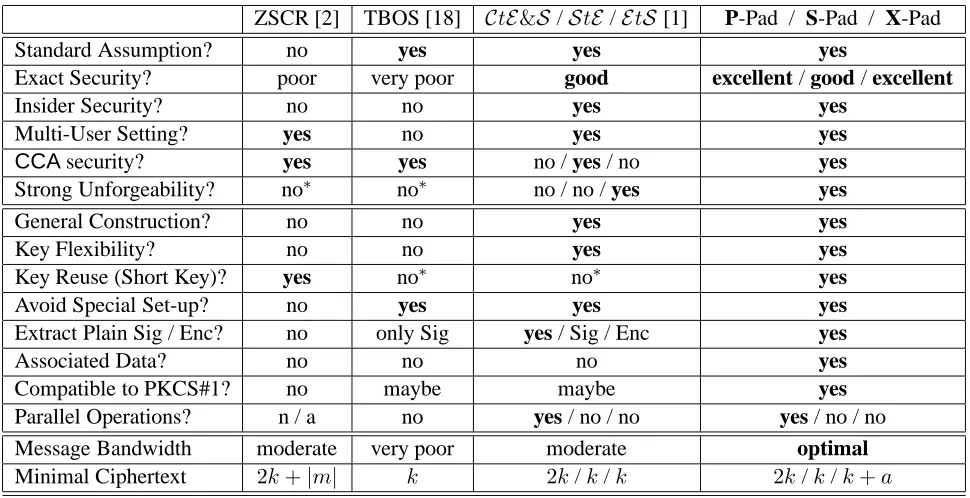
Summary of comparisons. Table 1 summarizes the features of our constructions as compared to some of the previous work. Overall, we believe that our methods noticeably improve all previously-proposed signcryption schemes, both from practical and theoretical perspectives. We plan to propose our schemes as a basis for a new standard for public-key signcryption.
ZSCR [2] TBOS [18] CtE&S /StE/EtS[1] P-Pad / S-Pad / X-Pad
Standard Assumption? no yes yes yes
Exact Security? poor very poor good excellent / good / excellent
Insider Security? no no yes yes
Multi-User Setting? yes no yes yes
CCAsecurity? yes yes no / yes / no yes
Strong Unforgeability? no∗ no∗ no / no / yes yes
General Construction? no no yes yes
Key Flexibility? no no yes yes
Key Reuse (Short Key)? yes no∗ no∗ yes
Avoid Special Set-up? no yes yes yes
Extract Plain Sig / Enc? no only Sig yes / Sig / Enc yes
Associated Data? no no no yes
Compatible to PKCS#1? no maybe maybe yes
Parallel Operations? n / a no yes / no / no yes / no / no
Message Bandwidth moderate very poor moderate optimal
Minimal Ciphertext 2k+|m| k 2k/k/k 2k/k/k+a
Table 1: Comparison to prior schemes. A star∗ signifies that the question was not explicitly considered. For min ciphertext,k,|m|, aare the lengths of the public-key domain, the message, and the security parameter.
3
Preliminaries
3.1 Signcryption
Our modeling of signcryption is based on [1], except we generalize the latter definitions to include support for associated data (intuitively, a public label which is bound to the ciphertext), in order to provide more useful functionality and more general results.
Syntax. A signcryption scheme with associated dataℓconsists of the algorithms(Gen,SigEnc,VerDec). In the multi-party setting, theGen(1λ)algorithm for user U generates the key-pair(SDK
U,VEKU), whereλis
the security parameter, SDKU is the signing/decryption key that is kept private, and VEKU is the
verifica-tion/encryption key made public. Without loss of generality, we assume thatVEKUis determined fromSDKU.
The randomized signcryption algorithm SigEncfor user U implicitly takes as input the user’s secret key SDKU and explicitly takes as input the messagem ∈ M, the labelℓand the identity of the recipient, in order
to compute and output the signcryptionΠ. For simplicity, we consider this identityIDto be a public keyVEK. Thus, we write this algorithm asSigEncℓSDKU(m,VEKR), or simplySigEncℓU(m,VEKR).
Similarly, userU’s deterministic de-signcryption algorithmVerDecimplicitly takes the user’s privateSDKU
and explicitly takes as input the signcryptionΠ˜, the labelℓand the senders’ identity. We writeVerDecℓSDKU(Π,
VEKS), or simply VerDecℓU(Π,VEKS). The algorithm outputs some message m˜, or ⊥ if the signcryption
does not verify or decrypt successfully. Correctness ensures that for any usersSandR,VerDecℓR(SigEncℓS(m,
VEKR),VEKS) =m, for anymandℓ.
Security. In this paper, we only use the strongest possible notion of Insider security for multi-user signcryp-tion [1]. The security nosigncryp-tions for our labelled algorithms are similar to those of standard signcrypsigncryp-tion [1], with the added requirement thatℓis considered part of the ciphertext (for the purposes of CCAdecryption oracle queries), and must be authenticated. However, there is no hiding requirement forℓ.
As expected, the security for signcryption consists onIND-CCAand sUF-CMAcomponents when attack-ing some user U. Both games with the adversary, however, share the following common component. After
(SDKU,VEKU) ← Gen(1λ) is run and A gets VEKU, A can make up to qS adaptive signcryption queries
SigEncℓU(m,VEKR) for arbitrary VEKR, as well as up to qD de-signcryption queries VerDecℓU(Π,VEKS),
again for arbitraryVEKS. (Of course,m,Π, ℓcan be arbitrary too).
TheIND-CCAsecurity of signcryption requires that noPPTadversaryAcan find some pairm0, m1 and a labelℓfor which he can distinguishSigEncℓS(m0,VEKU)fromSigEncℓS(m1,VEKU). Notice, to create “valid”
signcryptions that Amust differentiate between, A must output the secret key SDKS of the party S sending
messages toU. While seemingly restrictive, this is a much stronger guarantee than ifAdid not know the key
of the sender. A good way to interpret this requirement is to say that even when compromisingS,Astill cannot “understand” messages that S sent to U. In fact, we allow Ato even cook up the secret keySDKS without
necessarily generating it viaGen! Formally, for anyPPTArunning in timet,
Pr "
b= ˜b
(m0, m1, ℓ,SDKS, α)← ASigEnc
(·)
U(·,·),VerDec
(·)
U(·,·)(VEK
U,find), b
R
← {0,1},
Π←SigEncℓS(mb,VEKU), ˜b← ASigEnc
(·)
U(·,·),VerDec
(·)
U(·,·)(Π, ℓ; α,guess) #
≤ 1
2 +εCCA
whereεCCAis negligible in the security parameterλ, and(SDKU,VEKU)←Gen(1λ)is implicitly called at the
beginning. In theguessstage, Aonly has the natural restriction of not queryingVerDecU with(Π,VEKS, ℓ),
but can still use, for example,(Π,VEKS′, ℓ)forVEKS′ 6=VEKSor(Π,VEKS, ℓ′)forℓ6=ℓ′.
ForsUF-CMAsecurity, noPPTAcan forge a “valid” pair(Π, ℓ)(of some messagem) fromU to any user
R, provided thatΠwas not previously returned from a query toSigEncℓU. Again, in order to define “valid”, we strengthen the definition by allowingAto come up with the presumed secret keySDKRas part of his forgery.
Formally, for anyPPTArunning in timet,
PrhVerDecℓR(Π,VEKU)6=⊥
(Π, ℓ,SDKR)← A
SigEnc(U·)(·,·),VerDec
(·)
U(·,·)(VEK
U)
i
where εCMA is negligible in the security parameter λ, Gen(1λ) is implicit, and A did not obtain (Π, ℓ) in response to anySigEncℓU(m,VEKR, ℓ)query. We call any scheme satisfying these properties a(t, εCCA, εCMA,
qD, qS)-secure signcryption scheme.
3.2 TDPs and claw-free permutations
Trapdoor permutations. A family of trapdoor permutations (TDPs) is a family of permutations such that it is easy to randomly select a permutation f and some “trapdoor” associated withf. Furthermore, f is easy to compute and, given the trapdoor information, so is its inversef−1. However, without the trapdoor,f is “hard” to invert on random inputs: NoPPTadversaryA, giveny =f(x)for randomx, can findxwith probability greater thanεTDP, which is negligible in the security parameterλof the generation algorithm.
Claw-free permutations. To improve the exact security of authentication in our constructions, we introduce a general class ofTDPs — those induced by a family of claw-free permutation pairs [10]. In this context, the generation algorithm outputs (f, f−1, g), wheregis another efficient permutation over the same domain asf. The task of thePPTadversaryBnow is to find a “claw”(x, z)such thatf(x) =g(z), which it succeeds at with probability at mostεclaw, which negligible inλ. It is trivial to see that omittinggfrom the generation algorithm induces aTDPfamily withεTDP≤εclaw(the reduction invokesAon a randomg(z)). All knownTDPfamilies, such as RSA, Rabin, and Paillier, are easily seen to be induced by some claw-free permutation families with
εclaw =εTDP. Thus, a tight reduction to “claw-freeness” of such families implies a tight reduction to inverting them. On the other hand, it was shown by [8] that our restriction to claw-free permutations is necessary for tight signature reductions which we will achieve in this paper. We also remark that claw-free permutations are more general than “homomorphicTDPs” used by [16] for a similar reason.
3.3 Extractable Commitments
Our constructions for padding schemes all make use of extractable commitment schemes. Such commitments have usual properties of standard commitments, but with the additional twist that there exists an extraction algorithm which can extracts a unique decommitment from any valid commitment with high probability, by using some “trapdoor information”. In the random oracle model,which is the model we consider here, such information consists of all the random oracle queries made to produce this valid commitment string.
Syntax. An extractable commitment scheme C consists of a triple of algorithms(Commit,Open,Extract). Given a message m ∈ Mand some random coins r, Commit(m;r) outputs a pair(c, d), both kbits long, wherecrepresenting the commitment tomanddis a corresponding decommitment. As a shorthand, we write
(c, d) ← Commit(m). Open(c, d)outputsmif(c, d)is a valid commitment/decommitment pair form, or⊥
otherwise. Correctness requiresOpen(Commit(m)) =mfor allm∈ M.
We require this commitment scheme to satisfy two security properties:
Hiding. NoPPTadversary can distinguish the commitment of any messages of its choice from ak-bit random string R. More formally, no PPTadversary Arunning in time tcan distinguish between the following two games with probability greater than εhide, which is negligible in the secuirty parameterλ. In both games A chooses some messagem, but gets either a properly generated commitmentc(m), or a random stringR.
Extractability. There exists a deterministic poly-time algorithmExtractwhich can extract the “correct” de-commitment from any valid de-commitment, given access to a transcriptT of all RO queries previously issued by the adversary. Formally, for anyPPTArunning in time at mostt,
where T is a complete transcript of the RO queries made byA and εextract is negligible in λ. For syntactic convenience, we defineExtractto output a random value in the event that the extraction algorithm “fails”.
This completes the definition. A commitment schemeCis a(t, εhide, εextract)-secure extractable commitment if it satisfies the above properties. We note that the “standard” notion of a commitment requires a binding property, instead of extractability. However, it is easy to see that a very strong form of binding is implied by extractability, as stated below (see Appendix A for the proof).
Lemma 1 (Binding property of extractable commitments) It is computationally hard to produce (c, d, d′)
such that (c, d) and (c, d′) are valid commitment pairs andd 6= d′. Specifically, callingεbind the maximum
probability of the adversary to come up with such(c, d, d′)in timet, we haveε
bind≤2εextract.
When appropriate, we directly use εbind for conceptual clarity and because εbind may in fact be tighter than
2εextract. Notice, in the above Lemma the adversary cannot even come up with alternative decommitments to the same messagem.
We will also use the following property of(t, εhide, εextract)-secure extractable commitments: It is hard to find a commitmentcfor which a random decommitmentdwill be valid with non-negligible probability:
Lemma 2 ∀ Arunning in timet,Pr[Open(c, d) 6=⊥ |c← A(1k);d R
← {0,1}k] def≤ε
rand ≤εextract+ 2−k. We make use ofεrandfor conceptual clarity and as, in fact,εrand may be tighter. See Appendix A for the proof.
4
Our Constructions
In this section, we construct tailored padding schemes with which one can apply bothTDPsfRandfS−1directly
to a single padded message to signcrypt it, i.e., to simultaneously “encrypt” and “sign” the message by operating on a single padding. As explained in the Introduction, our direct methods considerably reduce the overhead introduced by the padding as compared to previous generic approaches in [1].
Our Padding Schemes. We consider three general paradigms for signcryption paddings. The first padding scheme, which we call P-Pads (short for Parallel Paddings), produces a pair (w, s), such that a signcryption is computed asfR(w)kfS−1(s). Note that the expensiveTDPoperationsfR(w)andfS−1(s)may be computed
in parallel. The second type of padding scheme, which we call S-Pads (Sequential Paddings), outputs a single stringwks, such that a signcryption is computed asfR(fS−1(wks)). Although these S-Pads lose parallelism, the
minimum length of a signcryptext is much shorter, and the structure conforms more closely to classical padding schemes for signature and encryption. Finally, the third type of padding scheme, which we call X-Pads (eX-tended sequential Paddings), is a variant of the S-Pad and outputs a pair of strings(w, s)such that signcryption is computed as(fR(fS−1(w)), s). It also loses parallelism, and its minimum length of a signcryptext is slightly
longer than that of S-Pad, but it will allow us to achieve somewhat better exact security than that of S-Pad.
Framework Based on Feistel Transforms. We base the structure of our padding schemes on the well-known Feistel Transform. A Feistel Transform is an operation on a pair of left and right inputs (L, R)which makes use of a “round function”F. Applying a single round of the Feistel Transform on a pair(L, R) gives a new pair(L′, R′)such thatL′=RandR′=F(R)⊕L. The transform is very efficient in practice, and is invertible even ifF is not (in particular, we can invert by computingL=F(L′)⊕R′ andR =L′). Feistel Transforms
are often used in multiple rounds with different keyed round functions, and have been especially useful in the design of block ciphers. In our application, the round function will be public, and will be modeled by the random oracle.
commitment pair (per Section 3) as the input to the first round: the decommitmentdas the left hand input and the commitmentcas the right hand input. This will allow us to achieve a very high level of generality, and will also abstract away and emphasize the usefulness of the Feistel Transform in our constructions. Additionally, it will show that applying two rounds of the Feistel Transform results in what we call versatile padding: by simply varying the lengths of cand d, the same padding can serve as P-Pad, S-Pad, X-Pad, and even as the padding for plain signature or encryption!
For technical reasons — notably, the possibility of “identity fraud” attacks — we specially format all inputs to the random oracleGthat serves as the first Feistel round function. We do this by prepending a meta-data string
L to the oracle input, whereL contains the public keys of the intended sender and recipient (VEKS,VEKR,
respectively), as well as any desired associated dataℓ. For simplicity, we useGˆ(·)to denoteG(L,·), where one can viewGˆ as an RO that is uniquely determined byL. UsingGˆ as our round function rather thanG‘binds” the padded message to the meta-data, ensuring that no identity fraud has occurred and that the associated data
ℓhas not been altered. Note that this technique represents a further optimization over the generic composition paradigm [1], which requires that a collision-resistant hash of the meta-data be included along with the message as input to the padding schemes.
We now describe our constructions and the corresponding security claims. In all definitions, we assume that the signcryption Genalgorithm generates a (t, εTDP)-secureTDPpair
fU, fU−1
given to the honest userU. For security intuition, it is also instructive to think of the senderS and the recipient R as acting maliciously (since we are in the Insider-security model [1]).
4.1 P-Pad Schemes
We now describe a generic construction for a class of provably secure P-Pad schemes in the RO model, based on a single round of the Feistel Transform applied to any extractable commitment.
Definition 1 (Feistel P-Pad) LetC= (Commit,Open,Extract)be any secure Extractable Commitment scheme. Furthermore, letG:{0,1}∗ → {0,1}|d|be a RO. The Feistel P-Pad PadL(m)→(w, s)(the padding of mes-sagemusing meta-dataL) induced byCis given by:
(c, d) ← Commit(m)
w ← c
s ← Gˆ(c)⊕d
where Gˆ(·) def= G(L,·). The corresponding decoding operation DePadL(w, s) can be computed by first ob-tainingd= ˆG(w)⊕sandc=w, and then returningOpen(c, d).
Note that (w, s)represents a Feistel Transform on inputhd, ciusing Gˆ as the round function. The following theorem states our main security claim about Feistel P-Pads, namely thatfR(w)kfS−1(s)is a secure signcryption
with support for associated data, provided that properly-formed meta-dataLis used in the padding.
Theorem 1 (Signcryption from Feistel P-Pads) Let C be any (t, εhide, εextract)-secure extractable
commit-ment scheme, andPad(and the corresponding DePad) be the Feistel P-Pad induced byC. Define theSigEnc
andVerDecalgorithms as follows:
SigEncℓ(m,VEKR=fR) → (ψ=fR(w)kσ =fU−1(s)) where (w, s)←PadL(m)
VerDecℓ(ψkσ,VEKS=fS) → DePadL(wks) wherewks=fU−1(ψ)kfS(σ)
We require that, at a minimum, the meta-data Lmust contain the associated dataℓ, as well as the published
Against any adversary allowed at mostqGqueries to theGoracle, this signcryption scheme is a(t′, εCCA, εCMA, qD, qS)
-secure signcryption, where
t′ = t−O((qG+qS)·Tf)
εCCA ≤ εTDP+ (qS+ 2)·((qS+qG)·2−|c|+εhide) +qD·εrand+εbind
εCMA ≤ qG·εTDP+qS·((qS+qG)·2−|c|+εhide) + (qD+ 2)·εrand+ 3εextract
IffU is taken from a family of(t, εclaw)-secure claw-free permutations, we can improve the bound onεCMA:
εCMA≤εclaw+qS·((qS+qG)·2−|c|+εhide) + (qD+ 2)·εrand+ (qG+ 2)·εextract
The proof of Theorem 1 is given in Appendix B.
We note that, by a simple argument, the above theorem also implies that a modified syntax fR(w)kscan
be used as a secure encryption, provided the meta-data somehow indicates that plain encryption is the desired mode of operation. In a similar manner,wkfS−1(s)can be used as a secure signature. IfS andR haveTDPs with different input lengths, it is generally a simple matter to adjust the sizes of the(c, d)pairs and the output length of theGoracle, to accommodate the mismatch without any significant loss of exact security.
4.2 S-Pad and X-Pad Schemes
Unfortunately, our previous construction for Feistel P-Pads does not suffice to produce an S-Pad (which is strictly harder to achieve than a P-Pad). For example, we will see in Section 5 that theOAEP padding is a special case of our P-Pad construction, and yet it was shown to be potentially insecure when used as a single padding, by the result of [22]. On the positive side, we now show that it is easy (and efficient) to convert any Feistel P-Pad into an S-Pad by merely adding a second round of the Feistel Transform applied to thehd, cipair.
Definition 2 (Feistel S-Pad) LetC= (Commit,Open,Extract)be any secure Extractable Commitment scheme. Furthermore, letG:{0,1}∗ → {0,1}|d|andH :{0,1}∗ → {0,1}|c|be ROs. The Feistel S-Pad PadL(m)→
wks(the padding of messagemusing meta-dataL) induced byCis given by:
(c, d) ← Commit(m)
w ← Gˆ(c)⊕d s ← H(w)⊕c
where Gˆ(·) def= G(L,·). The corresponding decoding operation DePadL(wks) can be computed by first ob-tainingc=H(w)⊕sandd= ˆG(c)⊕w, and then returningOpen(c, d).
Note that(w, s)represents a two round Feistel Transform on inputhd, ciusingGˆas the first round function and
H as the second round function. The following theorem states our main security claim about Feistel S-Pads, namely thatfR(fS−1(wks))is a secure signcryption with support for associated data, provided that
properly-formed meta-dataLis used in the padding.
Theorem 2 (Signcryption from Feistel S-Pads) Let C be any (t, εhide, εextract)-secure extractable
commit-ment scheme, andPad(and the corresponding DePad) be the Feistel S-Pad induced byC. Define theSigEnc
andVerDecalgorithms as follows:
SigEncℓ(m,VEKR=fR) → Π =fR(fU−1((wks)) wherewks←PadL(m)
We require that, at a minimum, the meta-data Lmust contain the associated dataℓ, as well as the published
TDPs of the sender and intended recipient of the message (fS andfRrespectively).
Against any adversary allowed at mostqGandqH queries toGandHoracles (respectively), this
signcryp-tion scheme is a(t′, εCCA, εCMA, qD, qS)-secure signcryption, where
t′ = t−O((qG+qS+qH ·qG)·(Tf +Textract))
εCCA ≤ εTDP+ (qH +qG+qS)2·2−|d|+ (qS+qD)·((2qG+qS)·2−|c|+εhide+εextract) + 3qG·εhide
εCMA ≤ qG·εTDP+ (qH+qG+qS)2·2−|d|+ (qS+qD)·((qG+qS)·2−|c|+εhide+ 4εextract)
IffU is taken from a family of(t, εclaw)-secure claw-free permutations, we can improve the bound onεCMA:
εCMA≤εclaw+ (qH +qG+qS)2·2−|d|+ (qS+qD)·((qG+qS)·2−|c|+εhide+ 3εextract) +qG·εextract
The proof of Theorem 2 is given in Appendix C. Interestingly, the proof uses a novel “trick” involving the meta-data input to theGoracle (beyond its usage for identity fraud protection) which does not work for the seemingly symmetric casefS−1(fR(wks)), and thus the order in which theTDPs are applied is significant.4 We note that,
by the same argument used for P-Pads, the above theorem also implies thatfR(wks)(resp. fS−1(wks)) can be
used as a secure encryption (resp. signature). That is, a Feistel S-Pad can also be used as a standard universal padding scheme as described in [6, 16]. Furthermore, it is easy to show that any Feistel S-Pad can be used also as a Feistel P-Pad— i.e., by computing fR(w)kfS−1(s)— and thus can achieve the same exact security
as P-Pads. As the cost of an additional Feistel round is minimal, we recommend the S-Pad construction for implementations, since they can be used in either paradigm, as the situation demands.
X-Pads: Improving the exact security of Feistel S-Pads. Unfortunately, in the sequential paradigm, S-Pads lose a potentially-significant amount of exact security (for theIND-CCAsecurity guarantee only) when com-pared to P-Pads. This is due to the substantial increase in the IND-CCA reduction’s running time, which requires time proportional to qH ·qG (underlined in the statement of Theorem 2). We notice that the same
loss of exact security (or worse) occurs in all known padding schemes for regular encryption, which place the entire padding inside the input of aTDP(as in [22]). However, if we are willing to place a small portion of the padding outside theTDP(as was done by [15] forOAEP++encryption) — which slightly increases the min-imum ciphertext length — we can avoid this loss of security. Conveniently, we can merely reuse our existing Feistel S-Pad construction as an X-Pad, for which we have a signcryption of the formfR(fS−1(w))ks, wheres
is short. In particular, define a Feistel X-Pad to be a Feistel S-Pad with length parameters chosen appropriately for X-Pads.
Theorem 3 (Signcryption from Feistel X-Pads) Let C = (Commit,Open,Extract) be a (t, εhide, εextract)
-secure extractable commitment scheme, andPad(and the correspondingDePad) be the Feistel X-Pad induced byC. Define theSigEncandVerDecalgorithms as follows:
SigEncℓ(m,VEKR=fR) → Π =fR(fU−1((w))ks where (w, s)←PadL(m)
VerDecℓ(Π =ψks,VEKS=fS) → DePadL(w, s) wherew=fU−1(fS(ψ))
We require that, at a minimum, the meta-data Lmust contain the associated dataℓ, as well as the published
TDPs of the sender and intended recipient of the message (fS andfRrespectively). This signcryption scheme
4
w s
d c
’
r m2
2
m r
1
m
K
K
^
G
’
w c
G
s H
w
K K
m1
r m2
2
m r
d c
^
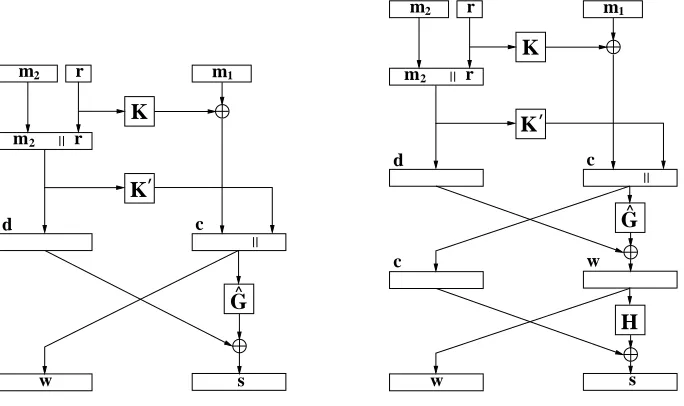
Figure 1: Schema forPSEP1andPSEP2on inputm=m1km2
has the same exact security bounds as those of the Feistel S-Pads of Theorem 2 for bothTDPs and claw-free permutations, but with an improvement in the running time of the reduction such that
t′=t−O((qG+qS+qH)·(Tf +Textract))
The proof of Theorem 3 is given in Appendix C. The practical costs of this small increase in the minimum ci-phertext length for X-Pads are generally not significant, but the resulting increase in exact security is substantial enough to warrant the application of Feistel X-Pad instead of Feistel S-Pad in most situations.
5
Probabilistic Signature and Encryption Padding (
PSEP
)
In this section, we instantiate our constructions with two new padding schemes we call Probabilistic Signature
and Encryption Paddings (PSEP) which are designed to provide optimal bandwidth and flexibility. These two paddings, PSEP1and PSEP2, are constructed by applying the P-Pad and S-Pad constructions (respec-tively) to the following extractable commitment scheme, using random oracles K :{0,1}∗ → {0,1}|m1|and
K′ :{0,1}∗ → {0,1}|c|−|m1|,
c ← m1⊕K(r)
kK′(m
2kr)
d ← (m2kr)
The scheme is parameterized by the selection of the lengths ofc,d,m1,m2(denoted|c|,|d|,|m1|,|m2|,resp.). The following Lemma gives exact security for the commitment scheme used in PSEP, in terms of the relevant selectable parameters. See Appendix D for the proof.
Lemma 3 The commitment schemehd=m2kr, c= (m1⊕K(r))kK′(m2kr)idefiningPSEPsatisfies:
εhide≤(qK+qK′)·2−(|d|−|m2|) ; εextract ≤(q2K′+1)·2−(|c|−|m1|) ; εbind≤2·εextract ; εrand ≤2−(|c|−|m1|)
Using this commitment pair hd, ci, we can apply a single round of the Feistel Transform to yield PSEP1:
D
w←c; s←Gˆ(w)⊕dE, as shown in Figure 1.PSEP1is sufficient for use as a Feistel P-Pad for signcryp-tion. Interestingly, it can be seen that bothOAEP[3] andPSS-R[5] are special cases ofPSEP1for appropri-ate selections of the commitment scheme parameters. The parameters corresponding toOAEP(|m1|= 0) and PSS-R(|m2|= 0), however, are not bandwidth-optimal for P-Pads (where one wants to “balance”|c|and|d|). For example, if|c|=|d|=k, bothOAEPandPSS-Rwould require to set|m| ≤k, while the total length2k
ofPSEP1potentially allows one to fit|m| ≈2k, which we can indeed do by splittingmalmost evenly. Rather than instantiating PSEP1, we recommend applying a second round of Feistel (a very inexpensive operation). This yields the scheme PSEP2, also shown in Figure 1. PSEP2can be used in any of the three modes discussed in Section 4, i.e., it can be used as a P-Pad, S-Pad, or X-Pad. Appropriate selection of the commitment scheme parameters can be used to achieve optimal bandwidth in any of these modes — for any desired level of exact security for the extractable commitment.
Note that although thePSEP2scheme would be rather difficult to analyze directly, in our general framework the proof of simple Lemma 3 is all one needs to obtain many useful results. Namely, by leveraging the Theorems in Section 4 we get tight exact security bounds forPSEP2showing that it can be used as a P-Pad, S-Pad, or
X-Pad for signcryption. Moreover, it is also a secure universal padding scheme (for either plain signature or
encryption), and it is safe to reuse public keys with any combination of these primitives for both sending and receiving.
6
Signcrypting Long Messages
Using the “concealment” approach described in [7], we can extend any short-message signcryption scheme with support for associated data to include support for long messages. Although arbitrary concealment schemes will suffice, for efficiency purposes we consider concealments utilizing any one-time (t, εOTE)-secure symmetric encryption scheme(E, D)5as advocated in [7]. There are many very efficient such symmetric encryptions, i.e.,
M⊕F(τ)works whenF is a RO (but there are many RO-free encryptions to choose from as well; see [7]). Specifically, letSC= (Gen,SigEnc,VerDec)be any signcryption scheme onˆn-bit messages or longer, with support for associated data, and (E, D) be any one-time encryption scheme with keysize nˆ (thus, nˆ ≈ 128
suffices). We define a signcryption schemeSC′ = (Gen,SigEnc′,VerDec′)on long messages with support for associated data as follows. Let SigEnc′ℓ(M) = πkSigEncL(τ), where π = Eτ(M), L = ℓkπ, and τ is a
randomnˆ-bit string. Similarly,VerDec′ℓ(πkΠ) =Dτ(π), whereτ =VerDecL(Π)andL=ℓkπ.
Theorem 4 IfSCis(t, εCCA, εCMA, qD, qS)-secure and(E, D)is(t, εOTE)-secure (with encryption/decryption
timeTOTE), thenSC′is(t−O((qD +qS)·TOTE), εCCA+εOTE, εCMA, qD, qS)-secure.
The proof of this theorem (adapted from [7] for signcryption, with exact security) is given in Appendix E. This result implies that our signcryption constructions — and indeed the separate signature and encryption constructions that they induce — can easily support long messages: Simply apply any symmetric key encryption to the message, and signcrypt the symmetric key while including the encrypted message inside the meta-data
L. Additionally, it is possible to move a portion of the message into the padding alongside the encryption key to save otherwise wasted space. The final result is that the overhead for long messages is the same as that for short messages plus the length of the symmetric key, which will typically be approximately128-bits.
5I.e., no distinguisher in timetcan tellE
τ(M0)fromEτ(M1)for any two messages(M0, M1)with probability greater thanεOTE.
References
[1] Jee Hea An, Yevgeniy Dodis, and Tal Rabin. On the security of joint signature and encrytion. In Lars Knudsen, editor,
Advances in Cryptology—EUROCRYPT 2002, Lecture Notes in Computer Science. Springer-Verlag, 28 April–2
May 2002. Available fromhttp://eprint.iacr.org/2002/046/.
[2] Joonsang Baek, Ron Steinfeld, and Yuliang Zheng. Formal proofs for the security of signcryption. In David Nac-cache and Pascal Pailler, editors, 5th International Workshop on Practice and Theory in Public Key Cryptosystems
— PKC 2002, volume 2274 of Lecture Notes in Computer Science. Springer-Verlag, February 2002.
[3] Mihir Bellare and Phillip Rogaway. Random oracles are practical: A paradigm for de-signing efficient protocols. In Proceedings of the 1st ACM Conference on Computer
and Communication Security, pages 62–73, November 1993. Revised version appears in
http://www-cse.ucsd.edu/users/mihir/papers/crypto-papers.html.
[4] Mihir Bellare and Phillip Rogaway. Optimal asymmetric encryption. In Alfredo De Santis, editor, Advances in
Cryptology—EUROCRYPT 94, volume 950 of Lecture Notes in Computer Science, pages 92–111. Springer-Verlag,
1995, 9–12 May 1994. Revised version available fromhttp://www-cse.ucsd.edu/users/mihir/.
[5] Mihir Bellare and Phillip Rogaway. The exact security of digital signatures: How to sign with RSA and Rabin. In Ueli Maurer, editor, Advances in Cryptology—EUROCRYPT 96, volume 1070 of Lecture
Notes in Computer Science, pages 399–416. Springer-Verlag, 12–16 May 1996. Revised version appears in http://www-cse.ucsd.edu/users/mihir/papers/crypto-papers.html.
[6] Jean-S´ebastian Coron, Marc Joye, David Naccache, and Pascal Pailler. Universal padding schemes for RSA. In Moti Yung, editor, Advances in Cryptology—CRYPTO 2002, Lecture Notes in Computer Science. Springer-Verlag, 18–22 August 2002. Available fromhttp://eprint.iacr.org/2002/115/.
[7] Yevgeniy Dodis and Jee Hea An. Concealment and its applications to authenticated encryption. In Eli Biham, editor,
Advances in Cryptology—EUROCRYPT 2003, Lecture Notes in Computer Science. Springer-Verlag, 4 May–8 May
2003.
[8] Yevgeniy Dodis and Leonid Reyzin. On the power of claw-free permutations. In Conference on Security in
Com-munication Networks, 2002.
[9] Eiichiro Fujisaki, Tatsuaki Okamotoi, David Pointcheval, and Jacques Stern. RSA-OAEP is secure under the RSA assumption. In Kilian [14], pages 260–274.
[10] Shafi Goldwasser, Silvio Micali, and Ronald L. Rivest. A digital signature scheme secure against adaptive chosen-message attacks. SIAM Journal on Computing, 17(2):281–308, April 1988.
[11] Stuart Haber and Benny Pinkas. Combining public key cryptosystems. In Pierangela Samarati, editor, Eighth ACM
Conference on Computer and Communication Security. ACM, November 5–8 2001.
[12] W. He and T. Wu. Cryptanalysis and improvement of petersen-michels signcryption schemes. IEEE Computers and
Digital Communications, 146(2):123–124, 1999.
[13] Markus Jakobsson, Julien P. Stern, and Moti Yung. Scramble all, encrypt small. In Lars Knudsen, editor, Fast
Software Encryption: 6th Internation Workshop, FSE1999, volume 1636 of Lecture Notes in Computer Science,
pages 95–111. Springer-Verlag, 1999.
[14] Joe Kilian, editor. Advances in Cryptology—CRYPTO 2001, volume 2139 of Lecture Notes in Computer Science. Springer-Verlag, 19–23 August 2001.
[15] Kazukuni Kobara and Hideki Imai. Oaep++ : A very simple way to apply oaep to deterministic ow-cpa primitives. Cryptology ePrint Archive, Report 2002/130, 2002.
[17] Michael Luby and Charles Rackoff. How to construct pseudorandom permutations from pseudorandom functions.
SIAM Journal on Computing, 17(2):373–386, 1988.
[18] Wenbo Mao and John Malone-Lee. Two birds one stone: Signcryption using RSA. In Marc Joye, editor, Progress
in Cryptology — CT-RSA 2003, Lecture Notes in Computer Science. Springer-Verlag, 13–17 April 2003.
[19] H. Petersen and M. Michels. Cryptanalysis and improvement of signcryption schemes. IEEE Computers and Digital
Communications, 145(2):140–151, 1998.
[20] PKCS #1: RSA Encryption Standard. Version 1.5. RSA Laboratories, November 1993. Available from http://www.rsa.com/rsalabs/pubs/PKCS/.
[21] Victor Shoup. On formal models for secure key exchange. Cryptology ePrint Archive, Report 1999/012, 1999.
[22] Victor Shoup. OAEP reconsidered. In Kilian [14], pages 240–259.
[23] Y. Zheng. Digital signcryption or how to achieve cost(signature & encryption)≪cost(signature) + cost(encryption). In Burton S. Kaliski Jr., editor, Advances in Cryptology—CRYPTO ’97, volume 1294 of Lecture Notes in Computer
Science, pages 165–179. Springer-Verlag, 17–21 August 1997.
[24] Y. Zheng and H. Imai. Efficient signcryption schemes on elliptic curves. Information Processing Letters, 68(6):227– 233, December 1998.
A
Properties of Extractable Commitments
We now offer proofs for the binding and randomness properties of extractable commitments.
Proof of binding property (Lemma 1).
Proof: Consider a reductionBagainst the extractability property of the commitment scheme as follows. Bruns
Aand obtains(c, d, d′)ifAsucceeds. Bthen randomly outputs(c, d)or(c, d′)with equal probability. Since Extract(c,T)is a deterministic value, it matches the output ofBwith probability at most1/2. In the event that it does not match,Bhas broken the extractability property. Since this must happens with probability at most
εextract, we find thatAsucceeds with probability at most2εextract.
Proof of random decommitment property (Lemma 2).
Proof: Consider a reduction B against the extractability property of the commitment scheme as follows. B
runsAand obtains c ← A(1k), chooses aduniformly at random, and returns (c, d). The probability that B
succeeds is at least the probability thatAsucceeds minus the probability thatd = Extract(c,T). Since dis chosen randomly, the probability thatd=Extract(c,T)is2−k. The lemma follows.
B
Feistel P-Pad Proof
The proof of security requires us to establish bounds for bothεCCA andεCMA (the maximum success proba-bilities forPPTadversaries in theIND-CCA andsUF-CMAgames, respectively). We first prove the bound onεCCA. Recall thatfU will represent the key of the honest party (i.e., it is the only key not controlled by the
adversary). In particular, fU is the key of recipient in theIND-CCAgame, and the key of the sender in the
B.1 BoundingεCCA
Consider an adversary ACCA against theIND-CCA security of the scheme. We show the bound onACCA’s success probability by proceeding through a sequence of gamesG0, . . . ,G4, whereG0is the unmodified IND-CCA attack game. We define the event Si to be the probability that ACCA is successful in Gi. Each new
gameGi will have a corresponding analysis bounding the difference betweenPr[Si]andPr[Si−1]. The final
bound onACCA’s advantage inG0will follow from the success probabilityPr[S4], and the bound onPr[S4]−
Pr[S0]which can be established from the relative bounds on the intermediate games. Throughout the following analysis we will useΠ∗ =ψ∗kσ∗ =fU(w∗)kfS−1(s∗)to denote the challenge ciphertext corresponding tomb
(where bis the challenge bit) that is issued toACCA in theIND-CCA attack game in response the challenge oracle query (L∗ will be used to denote the corresponding meta-data, which depends on the adversary’s choice of senderfSand associated dataℓ∗used for the challenge query).
GameG1:
LetG1 be the same asG0(the unmodified IND-CCAattack game), except we replace the random oracles and theSigEncandVerDecoracles with the following simulations:
Random oracle simulation forIND-CCAproof. For each queryACCAmakes toG, of the formG(L, c), the simulation first checks to see ifG(L, c)was previously defined. If so, the simulation replies with the previously defined value. Otherwise, it examinesLto determine whetherfUis specified as the recipient (if not, the oracle
simulation proceeds in the standard fashion).
If fU is the recipient, the simulation chooses a random x ∈ {0,1}|d| and defines G(L, c) to be x. The
simulation then records the pair (fU(c), c) in a lookup table for future reference (used in the VerDecoracle
simulation), and returnsx.
Note that the distribution of values returned by this random oracle simulation is still uniformly random, so this simulation is perfectly “honest”. However, it now takes time approximately Tf to compute before
responding to each query.
VerDec oracle simulation for IND-CCA proof. When a query VerDecℓ(Π, fS) is issued, the simulation
parsesΠ = ψkσ. If the query was of the formψ∗kσ, the oracle immediately returns⊥(i.e., when adversary
attempts to reuse the first portion of its challenge ciphertext in a query with an altered second portion). If the query was not of this form, the simulation then searches the lookup table to find a matchingψin a pair(ψ, c). If no such pair exists, the simulation returns⊥, otherwise it properly formsLand returnsDePadL(c, fS(σ)).
We note that if the lookup succeeds, we indeed have thatc=w =fU−1(ψ), so that theDePadwill return the correct output.
SigEncoracle simulation forIND-CCAproof. When a querySigEncℓ(m, fR)is issued, the simulation
prop-erly formsLand computes the response as follows:
• Choose a randomx∈ {0,1}|d|, and computey=f
U(x).
• Compute(c, d)←Commit(m).
• DefineG(L, c)to bey⊕d. Fail ifG(L, c)was already defined.
• ReturnfR(c)kx.
Observe, if the procedure does not fail, it returns a valid response to theSigEncquery, asx=fU−1(G(L, c)⊕d). This completes the definitions of the oracle simulations whichG1 uses to replace the functionality of the
corresponding oracles fromG0. Provided that these oracle simulations do not fail,G0 is identical toG1, so
TheVerDecoracle simulation can only fail by incorrectly returning ⊥when queried on a valid ciphertext. There are two possible scenarios where this occurs: eitherACCAqueried a valid ciphertext containing awfor which it did not issue a corresponding G(L, c) oracle query (and thusACCA could not have any information about the corresponding s), orACCAqueried a valid ciphertext that reused theψ∗ =fU(w∗)portion from the
IND-CCAgame challenge ciphertext with someσ6=σ∗.
In the first case, since G(L, c) was never queried, it is random and independent of the queried ciphertext, which means that the correspondingd=G(L, c)⊕swill be random. By definition, the probability that such a randomdrepresents a valid decommitment forcis bounded byεrand. Thus the total probability that a failure of this type occurs afterqDqueries to theVerDecoracle simulation is at mostqD·εrand. The second kind of failure can only occur ifACCA can finds 6= s∗ such thatDePad(w∗, s) 6= ⊥. However, since s 6= s∗, this implies that ACCAfound somed6= d∗ that is a valid decommitment forc∗ = w∗. Since both(c∗, d∗)and(c∗, d) are valid commitment/decommitment pairs, ACCA would have to break the binding property of the commitment scheme to cause this kind of failure. Thus the total probability that theVerDecsimulation fails is bounded by
qD·εrand+εbind.
TheSigEncoracle simulation fails only if there is a “collision” between a freshly generated commitmentc
and one of the inputsc′for whichG(L, c′)has already been defined. We note there are at mostqS+qGof such
previously defined inputs. Ifcwere generated randomly, the probability that it would collide with a previously defined value during one of the queries to theSigEncsimulation would be at mostqS·(qS+qG)·2−|c|. Sincec
is indistinguishable from random with all but probabilityεhide(by definition), we find the total probability that theSigEncoracle simulation fails after at mostqSqueries to beqS·((qS+qG)·2−|c|+εhide). Thus, we have now established the bound:
Pr[S1]−Pr[S0]≤qD·εrand+εbind+qS·((qS+qG)·2−|c|+εhide) (1)
GameG2:
GameG2 isG1 modified to halt in the event thatACCAqueriesG(L, w∗)for any meta-dataL. We denote
the event that gameihalts prematurely in this fashion byHalti. SinceG2is identical toG1unlessHalt2occurs, we have:
Pr[S2]−Pr[S1]≤Pr[Halt2] (2)
GameG3:
GameG3is the same asG2, but modified so that the second component of the challenge ciphertext returned
toACCA, (i.e.,σ∗) is replaced by a random string. We note that the game halts ifACCAqueriesG(L, w∗)for anyL, so that while the game is being playedACCAlearns nothing about the value ofG(L∗, w∗). In particular, this means that if we replaces∗ by a randoms, we can imagine thatG(L∗, w∗)was defined “correctly” to be
s⊕d∗ and thusG3 has the same exact distribution asG2.
Pr[S3] = Pr[S2]≤Pr[Halt2] (3)
GameG4:
GameG4isG3 modified so that the entire challenge ciphertextΠ∗ is replaced by a random string. That is,
we replace ψ∗ by a random string, implying thatc∗ = w∗ = fR−1(ψ∗) is now a random string as well. We note that the challenge ciphertext in G3 does not provide ACCAwith any information aboutd∗, since σ∗ was
replaced by a random string. Thus, by the hiding property of commitments, the probability of distinguishing
G4fromG3is bounded byεhide. In particular, this means that:
and
Pr[Halt4]−Pr[Halt2]≤εhide (5)
However, it is clear that since the challenge ciphertext was replaced by a random string, it no longer depends the challenge bitb. Thus,ACCAmust guess the bit correctly with probability1/2in gameG4when it plays to completion (i.e., when it does not halt):
Pr[S4]≤1/2 + Pr[Halt4] (6)
Finally, we bound the probability thatG4 halts by observing that the entire game can be run by a simulator
with no knowledge of the secret trapdoor fU−1. Such a simulator can act as a reduction to the security of the underlying TDP. The reduction accepts a TDP inversion challenge y∗ as an input, and then runs G
4 with ACCA. However, rather than replacingψ∗ by an arbitrary random string, the reduction will supply y∗ as the first component of the challenge ciphertext. The game will halt ifACCAissues a query of the formG(L, x∗) such thatfU(x∗) = y∗. Thus, if the game halts, the reduction can then simply output the this pre-imagex∗, a
successful inversion of theTDP. This upper boundsPr[Halt4]byεTDP(the maximum probability of inverting theTDP). Combining this bound onPr[Halt4]with (1) - (6) gives the desired result:
εCCA= Pr[S0]−1/2≤εTDP+ 2εhide+qD·εrand+εbind+qS·((qS+qG)·2−|c|+εhide) (7)
B.2 BoundingεCMA
To establish a bound onεCMA, we will construct a reductionBthat uses anyACMAbreakingsUF-CMAsecurity of the signcryption scheme to break the security of the underlying TDP. The reduction will run a modified
sUF-CMAattack game againstACMA, simulating the random oracles, aSigEncoracle, and aVerDecoracle, in similar fashion to the simulations introduced in gameG1 used in theεCCAbound analysis. The reduction B
takes an inversion challengey∗as input and finds a pre-imagex∗such thaty∗=f
U(x∗).
RO simulation for sUF-CMAproof. At the start of the simulation, a random integer i ∈ {1, . . . , qG} is
selected. Thei-th query to the random oracle simulation is treated as a special case (in particular, we will hope thatACMAoutputs a forged signcryption corresponding to thei-th query). The random oracle simulation handles queries of the formG(L, c)exactly as in the random oracle simulation for theIND-CCAproof, unless it happens to be the i-th query to the Goracle. In this case, if the meta-data Lalso indicates that fU is the
sender, the simulation defines G(L, c) to be y∗ ⊕Extract(c,T) and returns the defined value. Notice that
y∗ will thus correspond to s∗ = G(L, c) ⊕d where d is the extracted decommitment, so that the correct
correspondingσ∗ =fU−1(s∗) =fU−1(y∗). Furthermore, the distribution of outputs for this special case is still uniformly random and independent provided that the inversion challengey∗is random. Thus the random oracle simulation remains “honest” in all cases.
VerDecoracle simulation for sUF-CMAproof. This oracle simulation is identical to the simulation from theIND-CCAproof. Notice that there is no challenge ciphertext in this game, so the oracle only outputs⊥on ciphertexts for whichG(L, c)was not queried, orOpen(c, d)legitimately returns⊥.
SigEncoracle simulation forsUF-CMAproof. This oracle simulation is identical to the simulation from the
IND-CCAproof.
described in the IND-CCAproof. Similarly, theSigEncoracle fails with the same probability as in the IND-CCAproof. The total probability ofSimBadoccurring is thus bounded as follows:
Pr[SimBad]≤qD·εrand+qS·((qS+qG)·2−|c|+εhide) (8)
Provided that none of the simulations fail (i.e., conditioned on¬SimBad), the game will play out honestly and
ACMAwill output a valid forgery tuple(Π, ℓ, fR−1)with probabilityεCMA.
Let us writeForgeBadto denote the eventACMAoutputs a validΠ =ψkσsuch that either (1)ACMAreused one of theψvalues returned by aSigEncoracle query, but with a differentσ; or (2), the case (1) did not happen but G(L, c) was not first queried by ACMA. In case (1) it is clear that ACMA has either broken the binding property of the commitment by reusing c = fR−1(w) with a different d = fU−1(σ), or ACMA has changed one of the public keys involved, causing the meta-data Lto change, which in turn causes dto be randomly defined. Since a randomly chosendis valid with probability at mostεrand, the total probability thatACMAcan construction a such a forgery is at most εrand +εbind. For case (2) we note that sincew = c = fR−1(ψ) was never queried along with properly formed meta-dataLto theGoracle, the value ofG(L, c)will be randomly defined which also implies thatd =fU(σ)⊕G(L, c)will be randomly defined, and thus the probability that
(c, d)represents a valid pair is bounded byεrand. This gives:
Pr[ForgeBad]≤2εrand+εbind (9)
Conditioned on¬ForgeBad, aG(L, c)oracle query was made byACCAcorresponding to the output forgery. By definition, with probability1/qG, this also happened to be thei-th query. In this case, if theExtractalgorithm
was successful, the oracle simulation responded to query withy∗⊕d, wheredis the decommitmentACCAused in constructing the forgery. Note, the Extractalgorithm fails with probability at mostεextract, by definition. Thus we have thatσ =fU−1(s) =fU−1(G(L, c)⊕d) =fU−1(y∗). Indeed,σis a valid pre-image fory∗, and the reductionBsucceeds by returningσ. We can now establish a lower bound onB’s success probability in terms ofACMA’s success probability:
Pr[Bsucceeds] ≥ (Pr[Asucceeds∧ ¬ForgeBad]−εextract)/qG
≥ (Pr[Asucceeds]−Pr[ForgeBad]−εextract)/qG
≥ (Pr[Asucceeds| ¬SimBad]−Pr[SimBad]−Pr[ForgeBad]−εextract)/qG
≥ (εCMA−Pr[SimBad]−Pr[ForgeBad]−εextract)/qG (10)
and by definition of(t, εTDP)-secureTDPs, we also have that
Pr[Bsucceeds]≤εTDP (11)
Combining (8)-(11), rearranging the terms and upper bounding, we obtain the final bound onεCMA:
εCMA≤qG·εTDP+qD ·εrand+qS·((qS+qG)·2−|c|+εhide) + 2εrand+εbind+εextract (12)
Observe that the runtime for the simulations (and thus the reductions corresponding to each of the games in
IND-CCAproof, as well as the reduction in thesUF-CMAproof) isO((qG+qS)·Tf)whereTf is the time to
compute a singleTDPoperation, and the space required isO(k·(qH +qG+qS))wherekis the input length
of theTDPs.
B.3 Tighter Bound onεCMAfor Claw-Free Permutations
IffU is induced by a(t, εclaw)-secure claw-free permutation. where the claw-free pair is denotedhfU, gUi, we
find claws forhfU, gUi. The reductionB′uses a modified random oracle simulation, but is otherwise identical
to the reductionBuntilACMAhas output a forgery (which will now be used to produce a claw, rather than an inversion).
RO simulation forsUF-CMAproof using claw-free permutations . The RO simulation handles queries
G(L, c)by examining the meta-dataLto see iffU is specified as the sender. If not, the standard honest
simula-tion is performed. If so, the simulasimula-tion performs the following procedure:
• Choose a randomx∈ {0,1}|d|and computey=gU(x).
• DefineG(L, c)to bey⊕Extract(c,T).
• Record the pair(y, x)in a lookup table.
The simulation then returns the defined value ofG(L, c). The distribution of outputs is still uniformly random since y is random. Notice that if Extract outputs the correct value d, a properly formed ciphertext Π =
fR(c)kfU−1(G(L, c) ⊕d) will give fU−1(y) as the second component. In particular, the pair
fU−1(y), x
is a claw, sincefU(fU−1(y)) =y=gU(x).
Most of the analysis proceeds as before. The eventsSimBadandForgeBadare defined identically, and their analysis is identical. The only significant change is that whenACCA outputs a forgery corresponding to one of theG(L, c) queries, unlessACCA has broken the extractability property, it is now always possible for the reduction to output a valid claw, since there is no longer a single specially programmed query. In particular, provided thatACCAdid not break extractability, and thatACCAoutput a forgery tuple(Π = ψkσ, ℓ, fR−1)and
ForgeBaddid not happen, the reduction always succeeds by computing y = fU(σ) and finding(y, x) in the
lookup table, then outputtinghσ, xias the claw. The only subtlety is thatACCAmay now break extractability for any one among theqGqueries toG, so that we now loseqG·εextractrather thanεextract. The final bound for
(t, εclaw)-securehfU, gUiis now
εCMA≤εclaw+qD·εrand+qS·((qS+qG)·2−|c|+εhide) + 2εrand+εbind+qG·εextract (13)
The runtime of this reduction isO((qG+qS)·(Tf +Textract)).
C
Feistel S-Pad Proof
This proof is similar to the proof of security for Feistel P-Pads, and thus we will follow the syntactical conven-tions of that proof.
C.1 Bounding εCCA
We use the same approach as in the previous proof, however the precise details of the games will be different (and slightly more complicated). We begin with the new simulations required forG1.
RO simulations forIND-CCAproof. Oracle queries toHare simulated honestly in the standard fashion. For each query ACCA makes toG, of the formG(L, c), the simulation first checks to see if G(L, c) was previously defined. If so, the simulation replies with the previously defined value. Otherwise, it examinesL
to determine whether fU is specified as the recipient (if not, the oracle simulation proceeds in the standard
fashion).
IffUis the recipient, the simulation parses the specified sender keyfSfromLand then performs the