An extended abstract of this paper appears in Advances in Cryptology – ASIACRYPT ’04, Lecture Notes in Computer Science Vol. ??, P. J. Lee ed., Springer-Verlag, 2004. This is the full version.
Towards Plaintext-Aware Public-Key Encryption
without Random Oracles
Mihir Bellare∗ Adriana Palacio†
September 2004
Abstract
We consider the problem of defining and achieving plaintext-aware encryption without ran-dom oracles in the classical public-key model. We provide definitions for a hierarchy of notions of increasing strength: PA0, PA1 and PA2, chosen so that PA1+IND-CPA → IND-CCA1 and PA2+IND-CPA → IND-CCA2. Towards achieving the new notions of plaintext awareness, we show that a scheme due to Damg˚ard [14], denoted DEG, and the “lite” version of the Cramer-Shoup scheme [13], denoted CS-lite, are both PA0 under the DHK0 assumption of [14], and PA1 under an extension of this assumption called DHK1. As a result, DEG is the most efficient proven IND-CCA1 scheme known.
Keywords: Encryption theory, plaintext awareness, chosen-ciphertext attacks, random-oracle model.
∗Dept. of Computer Science & Engineering, University of California at San Diego, 9500 Gilman Drive, La Jolla,
California 92093, USA. E-Mail: [email protected]. URL:http://www-cse.ucsd.edu/users/mihir. Supported in part by NSF grants CCR-0098123, ANR-0129617 and CCR-0208842, and by an IBM Faculty Partnership Development Award.
†Dept. of Computer Science & Engineering, University of California at San Diego, 9500 Gilman Drive, La Jolla,
Contents
1 Introduction 3
1.1 Background . . . 3
1.2 Our goals and motivation . . . 4
1.3 Definitions . . . 4
1.4 Relations . . . 5
1.5 Constructions . . . 6
2 Notation and standard definitions 7 3 New notions of plaintext awareness 8 4 Relations among notions 12 4.1 Proof of Theorem 4.1 . . . 12
4.2 Proof of Theorem 4.2 . . . 15
4.3 Proof of Theorem 4.3 . . . 18
4.4 Proof of Theorem 4.4 . . . 20
4.5 Proof of Theorem 4.5 . . . 21
5 Constructions 22 5.1 A lemma . . . 25
5.2 Proof of Theorem 5.3 . . . 26
5.3 Proof of Theorem 5.4 . . . 28
References 29
1
Introduction
The theory of encryption is concerned with defining and implementing notions of security for encryp-tion schemes [24, 25, 19, 27, 29, 17]. One of the themes in its history is the emergence of noencryp-tions of security of increasing strength that over time find applications and acceptance.
Our work pursues, from the same perspective, a notion that is stronger than any previous ones, namely plaintext awareness. Our goal is to strengthen the foundations of this notion by lifting it out of the random-oracle model where it currently resides. Towards this end, we provide definitions of a hierarchy of notions of plaintext awareness, relate them to existing notions, and implement some of them. We consider this a first step in the area, however, since important questions are left unresolved. We begin below by reviewing existing work and providing some motivation for our work.
1.1 Background
Intuitively, an encryption scheme is plaintext aware (PA) if the “only” way that an adversary can produce a valid ciphertext is to apply the encryption algorithm to the public key and a message. In other words, any adversary against a PA scheme that produces a ciphertext “knows” the corresponding plaintext.
Random-Oracle model work. The notion of PA encryption was first suggested by Bellare and Rogaway [7], with the motivation that PA+IND-CPA should imply IND-CCA2. That is, security against chosen-plaintext attack coupled with plaintext awareness should imply security against adap-tive chosen-ciphertext attack. The intuition, namely, that if an adversary knows the plaintext cor-responding to a ciphertext it produces, then a decryption oracle must be useless to it, goes back to [9, 10]. Bellare and Rogaway [7] provided a formalization of PA in the random oracle (RO) model. They asked that for every adversaryA taking the public key and outputting a ciphertext, there exist an extractor that, given the same public key and a transcript of the interaction of A with its RO, is able to decrypt the ciphertext output byA. We will refer to this notion as PA-BR.
Subsequently, it was found that PA-BR was too weak for PA-BR+IND-CPA to imply IND-CCA2. Bellare, Desai, Pointcheval and Rogaway [4] traced the cause of this to the fact that PA-BR did not capture the ability of the adversary to obtain ciphertexts via eavesdropping on communications made to the receiver. (Such eavesdropping can put into the adversary’s hands ciphertexts whose decryptions it does not know, lending it the ability to create other ciphertexts whose decryptions it does not know.) They provided an appropriately enhanced definition (still in the RO model) that we denote by PA-BDPR, and showed that PA-BDPR+IND-CPA →IND-CCA2.
Plaintext awareness is exploited, even though typically implicitly rather than explicitly, in the proofs of the IND-CCA2 security of numerous RO-model encryption schemes, e.g., [18, 30, 8].
PA and the RO model. By restricting the above-mentioned RO-model definitions to schemes and adversaries that do not query the RO, one obtains natural counterpart standard (i.e., non-RO) model definitions of PA. These standard-model definitions turn out, however, not to be achievable without sacrificing privacy, because the extractor can simply be used for decryption. This indicates that the use of the RO model in the definitions of [7, 4] is central.
Indeed, PA as per [7, 4] is “designed” for the RO model in the sense that the definition aims to capture certain properties of certain RO-model schemes, namely, the fact that possession of the transcript of the interaction of an adversary with its RO permits decryption of ciphertexts formed by this adversary. It is not clear what counterpart this intuition has in the standard model.
In that case, what property are these instantiated schemes even supposed to possess? There is no definition that we might even discuss as a target.
PA via key registration. PA without ROs was first considered by Herzog, Liskov and Micali [23], who define and implement it in an extension of the usual public-key setting. In their setting, the sender (not just the receiver) has a public key, and, in a key-registration phase that precedes encryption, proves knowledge of the corresponding secret key to a key-registration authority via an interactive proof of knowledge. Encryption is a function of the public keys of both the sender and the receiver, and the PA extractor works by extracting the sender secret key using the knowledge extractor of the interactive proof of knowledge.
Their work also points to an application of plaintext-aware encryption where they claim the use of the latter is crucial in the sense that IND-CCA2-secure encryption does not suffice, namely to securely instantiate the ideal encryption functions of the Dolev-Yao model [16].
1.2 Our goals and motivation
The goal of this work is to provide definitions and constructions for plaintext-aware public-key encryp-tion in the standard and classical setting of public-key encrypencryp-tion, namely the one where the receiver (but not the sender) has a public key, and anyone (not just a registered sender) can encrypt a message for the receiver as a function of the receiver’s public key. In this setting there is no key-registration authority or key-registration protocol akin to [23].
Motivations include the following. As in the RO model, we would like a tool enabling the construc-tion of public-key encrypconstruc-tion schemes secure against chosen-ciphertext attack. We would also like to have some well-defined notion that can be viewed as a target for instantiated RO-model PA schemes. (One could then evaluate these schemes with regard to meeting the target.)
Additionally, we would like to enable the possibility of instantiating the ideal encryption functions of the Dolev-Yao model [16] without recourse to either random oracles or the key-registration model. (The last is an application where, as per [23], PA is required and IND-CCA2 does not suffice. However, see also [1].)
As we will see later, consideration of PA in the standard model brings other benefits, such as some insight, or at least an alternative perspective, on the design of existing encryption schemes secure against chosen-ciphertext attack. Let us now discuss our contributions.
1.3 Definitions
The first contribution of this paper is to provide definitions for plaintext-aware encryption in the standard model and standard public-key setting.
Overview. We provide a hierarchy consisting of three notions of increasing strength that we denote by PA0, PA1 and PA2. There are several motivations for this. One is that these will be seen (in conjunction with IND-CPA) to imply security against chosen-ciphertext attacks of different strengths. Another is that, as will become apparent, PA is difficult to achieve, and progress can be made by first achieving it in weaker forms. Finally, it is useful, pedagogically, to bring in new definitional elements incrementally.
IND-CPA IND-CCA1 IND-CCA2
PA0+IND-CPA PA1+IND-CPA PA2+IND-CPA
4.1
4.2 4.4
4.3
4.5
Figure 1: An arrow is an implication, and, in the directed graph given by the arrows, there is a path from A to B if and only if A implies B. The hatched arrows represent separations. Solid lines represent results from this paper, while dashed lines represent results from prior work [4, 17]. The number on an arrow or hatched arrow refers to the theorem in this paper that establishes this relationship. Absence of a number on a solid arrow means the result is trivial.
An important element of the above framework is that the extractor gets as input the same public key as the ciphertext creator, as well as the coin tosses of the ciphertext creator. This reflects the intuition that the extractor is the “subconscious” of the adversary, and begins with exactly the same information as the adversary itself.
We say that an encryption scheme is PA0 (respectively, PA1) if there exists a successful extractor for any ciphertext creator that makes only a single oracle query (respectively, a polynomial number of oracle queries).
Eavesdropping capability in PA2 is captured by providing the ciphertext creator C with an ad-ditional oracle that returns ciphertexts, but care has to be taken in defining this oracle. It does not suffice to let it be an encryption oracle because we want to model the ability of the adversary to obtain ciphertexts whose decryptions it may not know. Our formalization of PA2 allows the additional oracle to compute a plaintext, as a function of the query made to it and coins unknown to C, and return the encryption of this plaintext toC.
Formal definitions of PA0, PA1 and PA2, based on the above ideas,are in Section 3, which includes a discussion of how these definitions compare to the earlier RO-model ones.
1.4 Relations
PA by itself is not a notion of privacy, and so we are typically interested in PA coupled with the min-imal notion of privacy, namely IND-CPA [24, 25]. We consider six notions, namely, PA0+IND-CPA, PA1+IND-CPA and PA2+IND-CPA, on the one hand, and the standard notions of privacy IND-CPA, IND-CCA1 [27] and IND-CCA2 [29], on the other. We provide implications and separations among these six notions in the style of [4, 17]. The results are depicted in Figure 1. For notions A, B, an implication, represented by A→B, means that every encryption scheme satisfying notion A also satis-fies notion B, and a separation, represented by A6→B, means that there exists an encryption scheme satisfying notion A but not satisfying notion B. (The latter assumes there exists some encryption scheme satisfying notion A, since otherwise the question is vacuous.)
Figure 1 shows a minimal set of arrows and hatched arrows, but the relation between any two notions is resolved by the given relations. For example, IND-CCA1 6→ PA1+IND-CPA, because, otherwise, there would be a path from IND-CCA2 to PA0+IND-CPA, contradicting the hatched arrow labeled 4.3. Similarly, we get PA0 6→ PA1 6→ PA2, meaning the three notions of plaintext awareness are of increasing strength.
target for definitions of PA, the PA2+IND-CPA→IND-CCA2 result provides some validation for the definition of PA2.
Among the separations, we note that IND-CCA2 does not imply PA0, meaning even the strongest form of security against chosen-ciphertext attack is not enough to guarantee the weakest form of plaintext awareness.
1.5 Constructions
The next problem we address is to find provably-secure plaintext-aware encryption schemes.
Approaches. A natural approach to consider is to include a non-interactive zero-knowledge proof of knowledge [15] of the message in the ciphertext. However, as we explain in Section 5, this fails to achieve PA.
As such approaches are considered and discarded, it becomes apparent that achieving even the weaker forms of PA in the standard (as opposed to RO) model may be difficult. We have been able to make progress, however, under some strong assumptions that we now describe.
DHK assumptions. Let G be the order q subgroup of Z∗
2q+1, where q,2q+ 1 are primes, and let
g be a generator of G. Damg˚ard [14] introduced and used an assumption that states, roughly, that an adversary given ga and outputting a pair of the form (gb, gab) must “know” b. The latter is
captured by requiring an extractor that given the adversary coins and inputs can output b. We call our formalization of this assumption (cf. Assumption 5.2) DHK0.1 We also introduce an extension of
this assumption called DHK1 (cf. Assumption 5.1), in which the adversary does not just output one pair (gb, gab), but instead interacts with the extractor, feeding it such pairs adaptively and each time
expecting back the discrete logarithm of the first component of the pair.
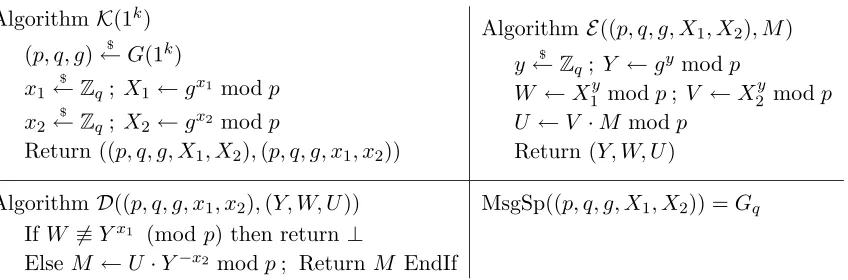
The DEG scheme. Damg˚ard presented a simple ElGamal variant that we call DEG. It is efficient, requiring only three exponentiations to encrypt and two to decrypt.
We prove that DEG is PA0 under the DHK0 assumption and PA1 under the DHK1 assump-tion. Since DEG is easily seen to be IND-CPA under the DDH assumption, and we saw above that PA1+IND-CPA→ IND-CCA1, a consequence is that DEG is IND-CCA1 assuming DHK1 and DDH. DEG is in fact the most efficient IND-CCA1 scheme known to date to be provably secure in the standard model.
Damg˚ard [14] claims that DEG meets a notion of security under ciphertext attack that we call RPR-CCA1, assuming DHK0 and assuming the ElGamal scheme meets a notion called RPR-CPA. (Both notions are recalled in Appendix A, and are weaker than IND-CCA1 and IND-CPA, respectively). As we explain in Appendix A, his proof has a flaw, but his overall approach and intuition are valid, and the proof can be fixed by simply assuming DHK1 in place of DHK0. In summary, our contribution is (1) to show that DEG meets a stronger and more standard notion of security than RPR-CCA1, namely IND-CCA1, and (2) to show it is PA0 and PA1, indicating that it has even stronger properties, and providing some formal support for the intuition given in [14] about the security underlying the scheme.
CS-lite. CS-lite is a simpler and more efficient version of the Cramer-Shoup encryption scheme [13] that is IND-CCA1 under the DDH assumption. We show that CS-lite is PA0 under the DHK0 assumption
1
and PA1 under the DHK1 assumption. (IND-CPA under DDH being easy to see, this again implies CS-lite is IND-CCA1 under DHK1 and DDH, but in this case the conclusion is not novel.) What we believe is interesting about our results is that they show that some form of plaintext awareness underlies the CS-lite scheme, and this provides perhaps an alternative viewpoint on the source of its security. We remark, however, that DEG is more efficient than CS-lite.
Warning and discussion. DHK0 and DHK1 are strong and non-standard assumptions. As pointed out by Naor [26], they are not efficiently falsifiable. (However, such assumptions can be shown to be false as exemplified in [5]). However standard-model schemes, even under strong assumptions, might provide better guarantees than RO model schemes, for we know that the latter may not provide real-world security guarantees at all [11, 28, 20, 3]. Also, PA without random oracles is challenging to achieve, and we consider it important to “break ground” by showing it is possible, even if under strong assumptions.
Open questions. The eavesdropping capability provided to an adversary in the PA2 setting seems to render the task of finding constructions significantly harder. We have not been able to find any, and leave as an open problem to find an IND-CPA+PA2 scheme provably secure under some plausible assumption. We suggest, in particular, that an interesting question is whether the Cramer-Shoup scheme, already known to be IND-CCA2, is PA2 under some appropriate assumption. (Intuitively, it seems to be PA2.) It would also be nice to achieve PA0 or PA1 under weaker and more standard assumptions than those used here.
2
Notation and standard definitions
We let N ={1,2,3, . . .}. We denote by ε the empty string, by |x| the length of a string x, by ¯x the bitwise complement ofx, by “k” the string-concatenation operator, and by 1kthe string ofk∈Nones.
We denote by [ ] the empty list. Given a list L and an element x, L@x denotes the list consisting of the elements in L followed by x. If S is a randomized algorithm, then S(x, y, . . .;R) denotes its output on inputsx, y, . . .and coins R;s←$ S(x, y, . . .) denotes the result of pickingR at random and setting s=S(x, y, . . .;R); and [S(x, y, . . .)] denotes the set of all points having positive probability of being output by S on inputs x, y, . . .. Unless otherwise indicated, an algorithm is randomized. Encryption schemes. We recall the standard syntax. An asymmetric (also called public-key) encryption scheme is a tupleAE = (K,E,D,MsgSp) whose components are as follows. The polynomial-time key-generation algorithm K takes input 1k, where k∈N is the security parameter, and returns
a pair (pk,sk) consisting of a public key and matching secret key. The polynomial-time encryption algorithm E takes a public key pk and a message M to return a ciphertext C. The deterministic, polynomial-time decryption algorithm D takes a secret key sk and a ciphertextC to return either a message M or the special symbol ⊥ indicating that the ciphertext is invalid. The polynomial-time computable message-space function MsgSp associates to each public key pk a set MsgSp(pk) called the message space ofpk. It is required that for every k∈N
Prh(pk,sk)← K$ (1k) ; M ←$ MsgSp(pk) ; C ← E$ (pk, M) : D(sk, C) =Mi = 1.
Experiment Exppa1AE,-Cd,D(k) (pk,sk)← K$ (1k) ; x $
←CD(sk,·)(pk) ; d←$ D(x) ; Returnd Experiment Exppa1AE,-Cx,D,C∗(k)
(pk,sk)← K$ (1k) ; Choose coinsR[C], R[C∗] forC,C∗, respectively ; St[C∗]←(pk, R[C]) RunC on inputpk and coins R[C] until it halts, replying to its oracle queries as follows:
– If C makes query Qthen
(M,St[C∗])←C∗(Q,St[C∗];R[C∗]) ; Return M toC as the reply EndIf Letx denote the output ofC; d←$ D(x) ; Returnd
Figure 2: Experiments used to define PA1 and PA0.
Experiment ExpindAE-,Xaaa-b(k) (pk,sk)← K$ (1k) ; (M
0, M1,St)
$
←XO1(·)(find,pk) ; C ← E$ (pk, M
b)
d←XO2(·)(guess, C,St) ; Return d
where
If aaa = cpa then O1(·) =ε and O2(·) =ε
If aaa = cca1 then O1(·) =Dsk(·) and O2(·) =ε
If aaa = cca2 then O1(·) =Dsk(·) and O2(·) =Dsk(·)
In each case it is required that M0, M1 ∈ MsgSp(pk) and |M0| = |M1|. In the case of IND-CCA2,
it is also required that X not query its decryption oracle with ciphertext C. We call X an ind-aaa-adversary. Theind-aaa-advantage ofX is
AdvindAE-,Xaaa(k) = Pr h
ExpindAE-,Xaaa-1(k) = 1 i
−PrhExpindAE-,Xaaa-0(k) = 1 i
.
For AAA∈ {CPA, CCA1, CCA2}, AE is said to be IND-AAA secure if AdvAEind-,Xaaa(·) is negligible for every polynomial-time ind-aaa-adversaryX.
3
New notions of plaintext awareness
In this section we provide our formalizations of plaintext-aware encryption. We provide the formal definitions first and explanations later. We begin with PA1, then define PA0 via this, and finally define PA2.
Definition 3.1 [PA1] Let AE = (K,E,D,MsgSp) be an asymmetric encryption scheme. Let C be an algorithm that has access to an oracle, takes as input a public key pk, and returns a string. Let D be an algorithm that takes a string and returns a bit. Let C∗ be an algorithm that takes a string and some state information, and returns a message or the symbol ⊥, and a new state. We call C a ciphertext-creator adversary, D a distinguisher, and C∗ a pa1-extractor. Fork ∈ N, we define the
experiments shown in Figure 2. Thepa1-advantage ofC relative toD andC∗ is Advpa1AE,C,D,C∗(k) = Pr
h
Exppa1AE,-Cd,D(k) = 1 i
−PrhExppa1AE,-Cx,D,C∗(k) = 1 i
.
Experiment Exppa2AE,-Cd,P,D(k) (pk,sk)← K$ (1k) ; Clist←[ ]
Choose coinsR[C], R[P] forC,P, respectively ; St[P]←ε
RunC on inputpk and coins R[C] until it halts, replying to its oracle queries as follows: – If C makes query (dec, Q) then
M ← D(sk, Q) ; Return M toC as the reply EndIf – If C makes query (enc, Q) then
(M,St[P])←P(Q,St[P];R[P]) ; C ← E$ (pk, M) ; Clist←Clist@C ReturnC toC as the reply EndIf
Letx denote the output ofC; d←$ D(x) ; Returnd Experiment Exppa2AE,-Cx,P,D,C∗(k)
(pk,sk)← K$ (1k) ; Clist←[ ]
Choose coinsR[C], R[P], R[C∗] forC,P,C∗, respectively ; St[P]←ε; St[C∗]←(pk, R[C]) RunC on inputpk and coins R[C] until it halts, replying to its oracle queries as follows:
– If C makes query (dec, Q) then
(M,St[C∗])←C∗(Q,Clist,St[C∗];R[C∗]) ; ReturnM toC as the reply EndIf – If C makes query (enc, Q) then
(M,St[P])←P(Q,St[P];R[P]) ; C ← E$ (pk, M) ; Clist←Clist@C ReturnC toC as the reply EndIf
Letx denote the output ofC; d←$ D(x) ; Returnd
Figure 3: Experiments used to define PA2.
Definition 3.2 [PA0] Let AE be an asymmetric encryption scheme. We call a ciphertext-creator adversary that makes exactly one oracle query apa0 ciphertext creator. We call a pa1-extractor for a pa0 ciphertext creator a pa0-extractor. We say thatAE isPA0 secure if for any polynomial-time pa0 ciphertext creator there exists a successful polynomial-time pa0-extractor.
We now explain the ideas behind the above formalisms. The core of the formalization of plain-text awareness of asymmetric encryption scheme AE = (K,E,D,MsgSp) considers a polynomial-time ciphertext-creator adversary C that takes input a public key pk, has access to an oracle and returns a string. The adversary tries to distinguish between the cases that its oracle is D(sk,·), or it is an extractor algorithmC∗ that takes as input the same public keypk. PA1 security requires that there exist a polynomial-time C∗ such that C’s outputs in the two cases are indistinguishable. We allow C∗ to be stateful, maintaining state St[C∗] across invocations. Importantly, C∗ is provided with the coin tosses of C; otherwise, C∗ would be functionally equivalent to the decryption algorithm and thus could not exist unless AE were insecure with regard to providing privacy. We remark that this formulation is stronger than one not involving a distinguisher D, in which C simply outputs a bit representing its guess, since C∗ gets the coins ofC, but not the coins of D.
PA0 security considers only adversaries that make asingle query in their attempt to determine if the oracle is a decryption oracle or an extractor.
an algorithm that takes a string and some state information, and returns a message and a new state. Let D be an algorithm that takes a string and returns a bit. Let C∗ be an algorithm that takes a string, a list of strings and some state information, and returns a message or the symbol⊥, and a new state. We call C a ciphertext-creator adversary, P a plaintext-creator adversary, D a distinguisher, and C∗ apa2-extractor. Fork∈N, we define the experiments shown in Figure 3. It is required that,
in these experiments, C not make a query (dec, C) for which C ∈ Clist. The pa2-advantage of C relative toP,D and C∗ is
Advpa2AE,C,P,D,C∗(k) = Pr h
Exppa2AE,-Cd,P,D(k) = 1 i
−PrhExpAEpa2,-Cx,P,D,C∗(k) = 1 i
.
We say that C∗ is a successful pa2-extractor for C if for every polynomial-time plaintext creator P and distinguisherD, the functionAdvpa2
AE,C,P,D,C∗(·) is negligible. We sayAE isPA2 secure if for any polynomial-time ciphertext creator there exists a successful polynomial-time pa2-extractor.
In the definition of PA2, the core setting of PA1 is enhanced to model the real-life capability of a ciphertext creator to obtain ciphertexts via eavesdropping on communications made by a third party to the receiver (cf. [4]). Providing C with an encryption oracle does not capture this because eavesdropping puts intoC’s hands ciphertexts of which it doesnot know the corresponding plaintext, and, although we disallowC to query these to its oracle, it might be able to use them to create other ciphertexts whose corresponding plaintext it does not know and on which the extractor fails.
Modeling eavesdropping requires balancing two elements: providingC with a capability to obtain ciphertexts of plaintexts it does not know, yet capturing the fact thatCmight have partial information about the plaintexts, or control of the distribution from which these plaintexts are drawn. We introduce a companion plaintext-creator adversary P who, upon receiving a communication from C, creates a plaintext and forwards it to an encryption oracle. The ciphertext emanating from the encryption oracle is sent to both C and C∗. C has some control over P via its communication to P, but we ensure this is not total bydenyingC andC∗ the coin tosses ofP, and also by asking thatC∗depend on C but not on P.
The extractor C∗ is, as before, provided with the coin tosses of C. Two types of oracle queries are allowed to C. Via a query (dec, Q), it can ask its oracle to decrypt ciphertextQ. Alternatively, it can make a query (enc, Q) to call P with argument Q, upon which the latter computes a message M and forwards it to the encryption oracle, which returns the resulting ciphertext to C, andC∗ in the case that C’s oracle is C∗. We observe that if an asymmetric encryption scheme is PA2 secure then it is PA1 secure, and if it is PA1 secure then it is PA0 secure.
Comparison. The RO-model definitions PA-BR [7] and PA-BDPR [4] differ from ours in the following ways.
The RO-model definitions did not give the extractor the coins of the ciphertext creator. As we indicated above, in the absence of ROs, providing the extractor with the coins of the ciphertext creator is necessary for the non-triviality of PA, since otherwise the extractor can be used for decryption and the scheme will not be IND-CPA secure. Furthermore, the basic intuition is that the extractor is the subconscious of the ciphertext creator, and thus should have all the inputs of the latter, meaning it should be given the public key and the coins that were given to the ciphertext creator.
The RO-model definitions only consider ciphertext creators that output a single ciphertext which the extractor must decrypt, while we have considered an oracle-based formulation, corresponding to ciphertext creators that adaptively create multiple ciphertexts for the extractor to decrypt.
The most important changes are with regard to modeling eavesdropping. In PA-BDPR [4], eaves-dropping capability was modeled by providing the ciphertext creator with an encryption oracle but denying it and the extractor the so-called indirect random-oracle queries, namely those made by the encryption oracle. Adopting this approach in the absence of ROs would reduce to providing the ci-phertext creator with an encryption oracle, which, as we discussed above, does not correctly model eavesdropping because the ciphertext creator knows the decryptions of ciphertexts it obtains via an encryption oracle, and we want to provide it a means of obtaining ciphertexts whose decryptions it may not know. In particular, the encryption-oracle-based notion seems too weak to prove Theorem 4.2. We have used the plaintext creator instead.
The plaintext extractor in PA-BDPR [4] is black box, meaning there is a single extractor that works for all ciphertext creators, upon being given the transcript of interactions of the ciphertext creator with its oracles. We have weakened this requirement, allowing the extractor code to depend non-uniformly on the code of the ciphertext creator. Again, this was done in order to increase the possibility of finding constructions. Evidence of the power of non-black-box formulations is provided, in another context, by [2].
We note that it is easy to “lift” our standard-model definitions to counterpart RO-model definitions following the paradigm of [6]. Call these PA0-RO, PA1-RO and PA2-RO. Given the above, we suggest that these make more suitable RO model notions than the existing PA-BR [7] and PA-BDPR [4] ones, since they are rooted in the standard model rather than being RO-model definitions with no standard-model counterparts. We remark that PA-BR implies PA0-RO and PA-BDPR implies PA2-RO, which says that we have weakened the definitions. Yet we are still in line with the original intuition and have preserved the important implications and application potential.
Statistical PA.Stronger versions of our definitions of PA0, PA1 and PA2 are obtained by requiring that the outputs of the ciphertext creator, in the case where its oracle is the decryption algorithm and in the case where it is the extractor, are statistically rather than computationally indistinguishable. Formally, this can be captured by simply allowing the distinguisher to be computationally unlimited. In other words, let us say AE is sPA1 secure if for any polynomial-time ciphertext creator C there exists a polynomial-time extractor C∗ such that the function Advpa1
AE,C,D,C∗(·) is negligible for every (not necessarily polynomial time) distinguisher D. We can define sPA0 and sPA2 analogously.
The statistical versions of our definitions amount simply to saying that the extractor must return the correct decryption of any ciphertext it is given, except with negligible probability. Accordingly, this could certainly have been formulated in a simpler way without introducing distinguishers at all, and, indeed, it may have been pedagogically preferable to begin with this simpler and stronger definition and only then get to our current ones. We preferred the current distinguisher-based approach because it allows us to fit the computational and statistical settings into a common definitional framework.
4
Relations among notions
We now state the formal results corresponding to Figure 1, beginning with the two motivating appli-cations of our notions of plaintext awareness. The proof of the following is in Section 4.1.
Theorem 4.1 [PA1+IND-CPA ⇒ IND-CCA1]LetAE be an asymmetric encryption scheme. If AE is PA1 secure and IND-CPA secure, then it is IND-CCA1 secure.
The proof of the following is in Section 4.2.
Theorem 4.2 [PA2+IND-CPA ⇒ IND-CCA2]LetAE be an asymmetric encryption scheme. If AE is PA2 secure and IND-CPA secure, then it is IND-CCA2 secure.
It is natural to ask whether the converse of Theorem 4.2 (respectively, Theorem 4.1) is true, namely whether an asymmetric encryption scheme that is IND-CCA2 (respectively, IND-CCA1) secure is also PA2 (respectively, PA1) secure. (It is, of course, IND-CPA secure). The answer is no. The following theorem implies that PA2 (respectively, PA1) security (in conjunction with IND-CPA security) is a strictly stronger requirement than IND-CCA2 (respectively, IND-CCA1) security, unless there simply do not exist any IND-CCA2-secure schemes. The proof is in Section 4.3.
Theorem 4.3 [IND-CCA26⇒ PA0+IND-CPA]Assume there exists an IND-CCA2-secure asym-metric encryption scheme. Then there exists an IND-CCA2-secure asymasym-metric encryption scheme that is not PA0 secure.
We remind the reader that each notion of PA in the absence of IND-CPA security is trivial to achieve. (In particular, the encryption scheme in which the encryption function sets the ciphertext equal to the plaintext is PA2 secure, but not IND-CPA secure.) Thus the fact that the scheme guaranteed by Theorem 4.3 is IND-CPA secure is important.
To complete the picture of implications and separations between the PA+IND-CPA notions and the IND-AAA notions, we now show that PA1 security (in conjunction with IND-CPA security) is not sufficient to achieve IND-CCA2 security, and PA0 security (in conjunction with IND-CPA security) is not sufficient to achieve IND-CCA1 security. The proof of the following is in Section 4.4.
Theorem 4.4 [PA1+IND-CPA 6⇒ IND-CCA2] Assume there exists a PA1 secure and IND-CPA-secure asymmetric encryption scheme. Then there exists a PA1 secure and IND-IND-CPA-secure asymmetric encryption scheme that is not IND-CCA2 secure.
The proof of the following is in Section 4.5.
Theorem 4.5 [PA0+IND-CPA 6⇒ IND-CCA1] Assume there exists a PA0 secure and IND-CPA-secure asymmetric encryption scheme. Then there exists a PA0 secure and IND-IND-CPA-secure asymmetric encryption scheme that is not IND-CCA1 secure.
4.1 Proof of Theorem 4.1
Assume that AE is PA1 secure and IND-CPA secure, and let X be a polynomial-time ind-cca1-adversary attacking AE. We construct a polynomial-time ciphertext creator C forAE, based on X, and letC∗ be a successful polynomial-time pa1-extractor for it. Then we construct a polynomial-time ind-cpa-adversaryY forAE, based onX andC∗. Finally, we construct polynomial-time distinguishers D0 and D1 forC, and prove that for everyk∈N
AdvindAE-,Xcca1(k) ≤ AdvindAE-,Ycpa(k) +Adv
pa1
AE,C,D0,C∗(k) +Adv
pa1
Ciphertext creator C(pk;R[C])
RunX(find,·) on inputpk and coins R[C] until it halts, replying to its oracle queries as follows: – If X(find,·) makes query Qthen
Make queryQ; Upon receiving a responseM, returnM toX(find,·) as the reply EndIf Let (M0, M1,St) denote the output ofX(find,·)
Return (M0, M1,St,pk)
AdversaryY(find,pk;R[Y])
ParseR[Y] asR[C]kR[C∗] ; St[C∗]←(pk, R[C])
RunX(find,·) on inputpk and coins R[C] until it halts, replying to its oracle queries as follows: – If X(find,·) makes query Qthen
(M,St[C∗])←C∗(Q,St[C∗];R[C∗]) ; Return M toX(find,·) as the reply EndIf Let (M0, M1,St) denote the output ofX(find,·)
Return (M0, M1,St)
AdversaryY(guess, C,St) d←X(guess, C,St) Returnd
Distinguisher D0(x) Distinguisher D1(x)
Parsex as (M0, M1,St,pk) Parsex as (M0, M1,St,pk)
C← E$ (pk, M0) ; d←X(guess, C,St) C
$
← E(pk, M1) ; d←X(guess, C,St)
Return ¯d Return d
Figure 4: Ciphertext-creator adversary C, ind-cpa-adversary Y, and distinguishers D0,D1 for the proof of Theorem 4.1.
The assumption thatAE is PA1 secure and IND-CPA secure implies that AdvindAE-,Xcca1(·) is negligible, and thus thatAE is IND-CCA1 secure. We proceed to the constructions and analysis.
The four algorithms we construct are defined in Figure 4. Clearly, they all run in polynomial time. Ciphertext-creator adversary C is essentially the same asX(find,·), except that it returns the public key along with M0, M1,St. By the assumption that AE is PA1 secure, there is a successful
polynomial-time pa1-extractorC∗ forC.
A random tapeR[C]kR[C∗] for ind-cpa-adversaryY has two parts, one being a random tape for C (equivalently, for X) and the other being a random tape for C∗. Y(find,·) initializes and then maintains state forC∗. It runsX(find,·), and if the latter makes a query, then Y(find,·) runsC∗ to compute a reply, which it returns to X(find,·). WhenX(find,·) stops,Y(find,·) returns the former’s output. Y(guess,·) is identical toX(guess,·).
Consider distinguishersD0 and D1. Intuitively, forb∈ {0,1}, when Db is run on the output ofC after the latter has interacted with the decryption oracle,D0computes the complement of the outcome of experiment ExpindAE-,Xcca1-0(k), andD1 computes the outcome of experiment ExpindAE-,Xcca1-1(k).
We claim that Equation (1) holds for all k ∈N. To prove this, fix k∈ N. We state four claims,
the decryption oracle, in experiment Exppa1AE,-Cd,Db(k). Claim 4.6 Pr£
ExpindAE-,Xcca1-1(k) = 1 ¤
= PrhExppa1AE,-Cd,D1(k) = 1
i .
Claim 4.7 Pr£
ExpindAE-,Xcca1-0(k) = 1 ¤
= 1−PrhExppa1AE,-Cd,D0(k) = 1
i .
The other claims relate the probability that Y guesses the value of challenge bit b, in each of its experiments, to the probability that distinguisherDbreturns 1 when it is run on the output ofCafter the latter has interacted with pa2-extractorC∗, in experimentExppa1-x
AE,C,Db,C∗(k). Claim 4.8 PrhExpindAE-,Ycpa-1(k) = 1
i
= PrhExppa1AE,-Cx,D1,C∗(k) = 1 i
.
Claim 4.9 PrhExpindAE-,Ycpa-0(k) = 1 i
= 1−PrhExpAEpa1,-Cx,D0,C∗(k) = 1 i
.
Applying these claims, we obtain Equation (1) as follows: AdvindAE-,Xcca1(k) = Pr
h
ExpindAE-,Xcca1-1(k) = 1 i
−PrhExpindAE-,Xcca1-0(k) = 1 i
= PrhExppa1AE,-Cd,D1(k) = 1
i
−³1−PrhExpAEpa1,-Cd,D0(k) = 1
i´
= ³PrhExpAEpa1,-Cx,D1,C∗(k) = 1
i
+Advpa1AE,C,D1,C∗(k)
´ −1 +³PrhExpAEpa1,-Cx,D0,C∗(k) = 1
i
+Advpa1AE,C,D0,C∗(k)
´
= PrhExppa1AE,-Cx,D1,C∗(k) = 1
i
−³1−PrhExpAEpa1,-Cx,D0,C∗(k) = 1
i´
+Advpa1AE,C,D0,C∗(k) +Advpa1AE,C,D1,C∗(k) = PrhExpindAE-,Ycpa-1(k) = 1
i
−PrhExpindAE-,Ycpa-0(k) = 1 i
+Advpa1AE,C,D0,C∗(k) +Adv
pa1
AE,C,D1,C∗(k)
= AdvindAE-,Ycpa(k) +Adv
pa1
AE,C,D0,C∗(k) +Adv
pa1
AE,C,D1,C∗(k).
It remains to prove the four claims above.
Proof of Claim 4.6: LetScca1-1 denote the sample space underlying ExpAEind-,Xcca1-1(k). A member of this space is a string specifying coin tosses for all algorithms involved, which in this case means the coins of the key-generation algorithm, the random tape of X itself, and the coins used by the encryption algorithm.
A member of the sample space Spa1-d-1 underlying ExpAEpa1,-Cd,D1(k) is a string specifying the coins of
the key-generation algorithm, the random tape of C, and the random tape of D1. Claim 4.6 follows once we observe that by the definitions ofC and D1,Spa1-d-1 is equal to Scca1-1 (The random tape of C consists of coins forX, and the random tape ofD1 consists of coins for the encryption algorithm.), and ExpindAE-,Xcca1-1(k) = 1 if and only ifExp
pa1-d
AE,C,D1(k) = 1.
Proof of Claim 4.7: Similarly to the proof of Claim 4.6, it is easy to see that the sample space underlying ExpindAE-,Xcca1-0(k) is identical to the sample space underlying Exp
pa1-d
AE,C,D0(k), and ExpindAE-,Xcca1-0(k) = 1 if and only ifExp
pa1-d
Proof of Claim 4.8: LetSpa1-x-1denote the sample space underlyingExpAEpa1,-Cx,D1,C∗(k). A member
of this space is a string specifying the coins of the key-generation algorithm, the random tape of C, the random tape of C∗, and the random tape of D1. The latter consists of coins for the encryption algorithm.
A member of the sample space Scpa-1 underlying ExpindAE-,Ycpa-1(k) is a string specifying the coins of the key-generation algorithm, the random tape ofY, and the coins used by the encryption algorithm. The random tape ofY consists of coins forC and coins forC∗. HenceScpa-1 =Spa1-x-1. We observe that ExpindAE-,Ycpa-1(k) = 1 if and only if Exp
pa1-x
AE,C,D1,C∗(k) = 1. Claim 4.8 follows.
Proof of Claim 4.9: Similarly to the proof of Claim 4.8, it is easy to see that the sample space underlying ExpindAE-,Ycpa-0(k) is identical to the sample space underlyingExp
pa1-x
AE,C,D0,C∗(k), and
ExpindAE-,Ycpa-0(k) = 1 if and only ifExp
pa1-x
AE,C,D0,C∗(k) = 0.
4.2 Proof of Theorem 4.2
Assume that AE is PA2 secure and IND-CPA secure, and let X be a polynomial-time ind-cca2-adversary attacking AE. We construct a polynomial-time ciphertext creator C forAE, based on X, and polynomial-time plaintext creators P0 and P1, and letC∗ be a successful polynomial-time pa2-extractor forC. Then we construct a polynomial-time ind-cpa-adversary Y forAE, based onX and C∗. Finally, we construct polynomial-time distinguishersD0 and D1 forC, and prove that for every k∈N
AdvindAE-,Xcca2(k) ≤ AdvindAE-,Ycpa(k) +Adv
pa2
AE,C,P0,D0,C∗(k) +AdvAEpa2,C,P1,D1,C∗(k). (2) The assumption thatAE is PA2 secure and IND-CPA secure implies that AdvindAE-,Xcca2(·) is negligible, and thus thatAE is IND-CCA2 secure. We proceed to the constructions and analysis.
The six algorithms we construct are defined in Figure 5. Clearly, they all run in polynomial time. Ciphertext creator C is essentially the same as X, except that instead of outputting (M0, M1,St), it calls a plaintext creator with argument (M0, M1) and, upon receiving a response C, it continues
the execution of X by running X(guess,·) on input C,St. Plaintext creator P0 takes input a pair of messages, and selects the first message. Plaintext creator P1 takes input a pair of messages, and selects the second message. We observe that for b ∈ {0,1}, since in experiment Expind-cca2-b
AE,X (k), X does not query its decryption oracle with ciphertext C, in experiments Exppa2-d
AE,C,Pb,Db(k) and Exppa2AE,-Cx,Pb,Db,C∗(k), C does not make a query (dec, Q) for which Q ∈ Clist. By the assumption that AE is PA2 secure, there is a successful polynomial-time pa2-extractorC∗ forC.
A random tapeR[C]kR[C∗] for ind-cpa-adversaryY has two parts, one being a random tape for C (equivalently, for X) and the other being a random tape for C∗. Y(find,·) initializes and then maintains state for C∗. It runs X(find,·), and if the latter makes a query, then Y(find,·) runs C∗ to compute a reply, which it returns to X(find,·). When X(find,·) outputs (M0, M1,St) and stops, Y(find,·) computes some state information St0 that is used by Y(guess,·) and returns (M0, M1,St0). Y(guess,·) runs X(guess,·), and if the latter makes a query, then Y(guess,·) runs C∗ to compute a reply, which it returns toX(guess,·). WhenX(guess,·) stops,Y(guess,·) returns the former’s output. DistinguisherD0 returns the bitwise complement of its input and D1 computes the identity func-tion.
We claim that Equation (2) holds for all k ∈N. To prove this, fix k∈ N. We state four claims,
Ciphertext creator C(pk;R[C])
RunX(find,·) on inputpk and coins R[C] until it halts, replying to its oracle queries as follows: – If X(find,·) makes query Qthen
Make query (dec, Q) ; Upon receiving a responseM, returnM toX(find,·) as the reply EndIf
Let (M0, M1,St) denote the output ofX(find,·)
Make query (enc,(M0, M1)) ; Upon receiving a response C,
runX(guess,·) on inputC,St, until it halts, replying to its oracle queries as follows: – If X(guess,·) makes queryQ then
Make query (dec, Q) ; Upon receiving a responseM, returnM toX(guess,·) as the reply EndIf
Letddenote the output ofX(guess,·) Returnd
Plaintext creator P0(Q,St[P];R[P]) Plaintext creatorP1(Q,St[P];R[P]) ParseQas (M0, M1) ParseQ as (M0, M1)
Return (M0,St[P]) Return (M1,St[P])
AdversaryY(find,pk;R[Y])
ParseR[Y] asR[C]kR[C∗] ; St[C∗]←(pk, R[C])
RunX(find,·) on inputpk and coins R[C] until it halts, replying to its oracle queries as follows: – If X(find,·) makes query Qthen
(M,St[C∗])←C∗(Q,St[C∗];R[C∗]) ; Return M toX(find,·) as the reply EndIf Let (M0, M1,St) denote the output ofX(find,·)
St0 ←(St,St[C∗], R[C∗]) Return (M0, M1,St0)
AdversaryY(guess, C,St0) Parse St0 as (St,St[C∗], R[C∗])
RunX(guess,·) on inputC,St until it halts, replying to its oracle queries as follows: – If X(guess,·) makes queryQ then
(M,St[C∗])←C∗(Q,St[C∗];R[C∗]) ; Return M toX(guess,·) as the reply EndIf Letddenote the output ofX(guess,·)
Returnd
Distinguisher D0(x) Distinguisher D1(x)
Return ¯x Return x
Figure 5: Ciphertext-creator adversaryC, plaintext-creator adversariesP0,P1, ind-cpa-adversary Y, and distinguishers D0,D1 for the proof of Theorem 4.2.
that distinguisher Db returns 1 when it is run on the output ofC after the latter has interacted with the decryption oracle, in experiment Exppa2AE,-Cd,Pb,Db(k).
Claim 4.10 Pr£
ExpindAE-,Xcca2-1(k) = 1 ¤
= PrhExppa2AE,-Cd,P1,D1(k) = 1 i
Claim 4.11 Pr£
ExpindAE-,Xcca2-0(k) = 1 ¤
= 1−PrhExpAEpa2,-Cd,P0,D0(k) = 1 i
.
The other claims relate the probability that Y guesses the value of challenge bit b, in each of its experiments, to the probability that distinguisherDbreturns 1 when it is run on the output ofCafter the latter has interacted with pa2-extractorC∗, in experimentExppa2-x
AE,C,Pb,Db,C∗(k). Claim 4.12 PrhExpindAE-,Ycpa-1(k) = 1
i
= PrhExppa2AE,-Cx,P1,D1,C∗(k) = 1
i .
Claim 4.13 PrhExpindAE-,Ycpa-0(k) = 1 i
= 1−PrhExppa2AE,-Cx,P0,D0,C∗(k) = 1
i .
Applying these claims, we obtain Equation (2) as follows: AdvindAE-,Xcca2(k) = Pr
h
ExpindAE-,Xcca2-1(k) = 1 i
−PrhExpindAE-,Xcca2-0(k) = 1 i
= PrhExppa2AE,-Cd,P1,D1(k) = 1 i
−³1−PrhExpAEpa2,-Cd,P0,D0(k) = 1 i´
= ³PrhExppa2AE,-Cx,P1,D1,C∗(k) = 1 i
+Advpa2AE,C,P1,D1,C∗(k) ´
−1 +³PrhExppa2AE,-Cx,P0,D0,C∗(k) = 1
i
+Advpa2AE,C,P0,D0,C∗(k) ´
= PrhExppa2AE,-Cx,P1,D1,C∗(k) = 1 i
−³1−PrhExpAEpa2,-Cx,P0,D0,C∗(k) = 1 i´
+Advpa2AE,C,P0,D0,C∗(k) +Adv
pa2
AE,C,P1,D1,C∗(k)
= PrhExpindAE-,Ycpa-1(k) = 1 i
−PrhExpindAE-,Ycpa-0(k) = 1 i
+Advpa2AE,C,P0,D0,C∗(k) +Adv
pa2
AE,C,P1,D1,C∗(k)
= AdvindAE-,Ycpa(k) +Adv
pa2
AE,C,P0,D0,C∗(k) +Adv
pa2
AE,C,P1,D1,C∗(k).
It remains to prove the four claims above.
Proof of Claim 4.10: LetScca2-1 denote the sample space underlying ExpAEind-,Xcca2-1(k). A member of this space is a string specifying the coins of the key-generation algorithm, the random tape of X, and the coins used by the encryption algorithm.
A member of the sample space Spa2-d-1 underlying Exppa2AE,-Cd,P1,D1(k) is a string specifying the coins of the key-generation algorithm, the random tape of C, the random tape of P1, the coins used by the encryption algorithm across its invocations, and the random tape ofD1. Claim 4.10 follows once we observe that by the definitions of C,P1 and D1,Spa2-d-1 is equal toScca2-1 (The random tape of C consists of coins forX; P1 and D1 are deterministic, so their random tapes have length 0; and in Exppa2AE,-Cd,P1,D1(k), the encryption algorithm is invoked once.), and Exp
ind-cca2-1
AE,X (k) = 1 if and only if Exppa2AE,-Cd,P1,D1(k) = 1.
Proof of Claim 4.11: Similarly to the proof of Claim 4.10, it is easy to see that the sample space underlying ExpindAE-,Xcca2-0(k) is identical to the sample space underlying Exp
pa2-d
AE,C,P0,D0(k), and
ExpindAE-,Xcca2-0(k) = 1 if and only ifExp
pa2-d
AE,C,P0,D0(k) = 0.
Proof of Claim 4.12: Let Spa2-x-1 denote the sample space underlying Exppa2AE,-Cx,P1,D1,C∗(k). A
of C, the random tape of P1, the random tape of C∗, the coins used by the encryption algorithm across its invocations, and the random tape of D1. We observe that P1 and D1 are deterministic, so their random tapes have length 0, and that in Exppa2AE,-Cx,P1,D1,C∗(k), the encryption algorithm is
invoked once.
A member of the sample space Scpa-1 underlying ExpindAE-,Ycpa-1(k) is a string specifying the coins of the key-generation algorithm, the random tape ofY, and the coins used by the encryption algorithm. The random tape ofY consists of coins forC and coins forC∗. HenceScpa-1 =Spa2-x-1. We observe that ExpindAE-,Ycpa-1(k) = 1 if and only if Exp
pa2-x
AE,C,P1,D1,C∗(k) = 1. Claim 4.12 follows.
Proof of Claim 4.13: Similarly to the proof of Claim 4.12, it is easy to see that the sample space underlying ExpindAE-,Ycpa-0(k) is identical to the sample space underlying Exp
pa2-x
AE,C,P0,D0,C∗(k),
and ExpindAE-,Ycpa-0(k) = 1 if and only ifExp
pa2-x
AE,C,P0,D0,C∗(k) = 0.
4.3 Proof of Theorem 4.3
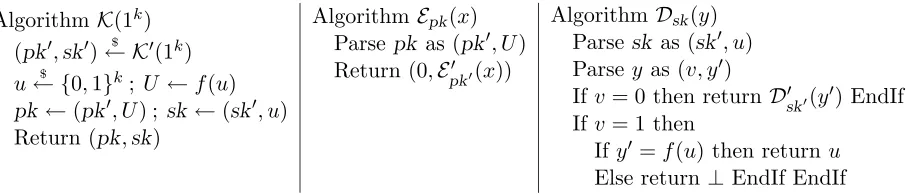
LetAE0 = (K0,E0,D0) be an CCA2-secure asymmetric encryption scheme. We construct an IND-CCA2-secure asymmetric encryption schemeAE = (K,E,D) that is not PA0 secure. Letf :{0,1}∗→ {0,1}∗ be a length preserving one-way function. (This exists assuming IND-CCA2-secure asymmetric encryption schemes exist.) The algorithms constituting AE are defined as follows:
Algorithm K(1k)
(pk0,sk0)← K$ 0(1k)
u← {$ 0,1}k; U ←f(u) pk ←(pk0, U) ; sk ←(sk0, u) Return (pk,sk)
Algorithm Epk(x) Parse pk as (pk0, U) Return (0,E0
pk0(x))
Algorithm Dsk(y) Parse sk as (sk0, u) Parse y as (v, y0)
If v= 0 then returnD0sk0(y0) EndIf If v= 1 then
Ify0=f(u) then returnu Else return ⊥EndIf EndIf
To prove that AE is not PA0 secure, we proceed by contradiction. Assume that AE is PA0 secure and consider the pa0 ciphertext creator C depicted in Figure 6. Notice that C is deterministic and it runs in polynomial time. Let C∗ be a successful polynomial-time pa0-extractor for it. We define a polynomial-time distinguisher D for C and a polynomial-time inverter I for function f as shown in Figure 6. Fix k∈N. The probability thatI is successful can be computed as follows.
PrhU ← {0,1}k; u0 ←$ I(U) : f(u0) =U i = PrhExppa1-x
AE,C,D,C∗(k) = 1 i
= PrhExppa1AE,-Cd,D(k) = 1 i
−Advpa1AE,C,D,C∗(k) = 1−Advpa1AE,C,D,C∗(k).
Since C∗ is a successful pa0-extractor, Advpa1
AE,C,D,C∗(·) is negligible and hence the probability of success ofI is not negligible. This contradicts the one-wayness off, as desired.
Ciphertext creator C(pk;R[C])
Parsepk as (pk0, U) ; Make query (1, U) ; Upon receiving a responseu0, Return (pk0, U, u0)
Distinguisher D(x)
Parsex as (pk0, U, u0) ; Iff(u0) =U then return 1 else return 0 EndIf Inverter I(U)
k← |U|; (pk0,sk0)← K$ 0(1k) ; pk ←(pk0, U)
Choose coinsR[C∗] forC∗; St[C∗]←(pk, ε) ; (u0,St[C∗])←C∗((1, U),St[C∗];R[C∗]) Returnu0
AdversaryX0(find,pk0;R[X0])
ParseR[X0] asukR[X], whereu∈ {0,1}k; U ←f(u) ; pk←(pk0, U)
RunX(find,·) on inputpk and coins R[X] until it halts, replying to its oracle queries as follows: – If X(find,·) makes query (v, y0) then
Ifv= 0 then
Make query y0; Upon receiving a responseM, returnM toX(find,·) as the reply EndIf Ifv= 1 then
Ify0 =U then return utoX(find,·) as the reply
Else return ⊥toX(find,·) as the reply EndIf EndIf EndIf Let (M0, M1,St) denote the output ofX(find,·)
St0 ←(St, u, U) Return (M0, M1,St0)
AdversaryX0(guess, C0,St0)
Parse St0 as (St, u, U) ; C ←(0, C0)
RunX(guess,·) on inputC,St until it halts, replying to its oracle queries as follows: – If X(guess,·) makes query (v, y0) then
Ifv= 0 then
Make query y0; Upon receiving a responseM, returnM toX(guess,·) as the reply EndIf Ifv= 1 then
Ify0 =U then return utoX(guess,·) as the reply
Else return ⊥toX(guess,·) as the reply EndIf EndIf EndIf Letddenote the output ofX(guess,·)
Returnd
Figure 6: Ciphertext-creator adversaryC, distinguisherD, inverter I, and ind-cca2-adversaryX0 for the proof of Theorem 4.3.
queries of the latter. Clearly, X0 runs in polynomial time. Furthermore, for b∈ {0,1}and k∈N, the
replies that experiment ExpindAE-0,cca2X0 -b(k) computes toX0’s queries allow this adversary to respond to X’s queries exactly as experimentExpindAE-,Xcca2-b(k) does. Therefore,Advind-cca2
AE0,X0 (k) =AdvindAE-,Xcca2(k). The assumption that AE0 is IND-CCA2 secure implies that Advind-cca2
AdversaryX(find,pk;R[X]) Return (0,1, ε)
Adversary X(guess, C,St) ParseC as (r, C0)
Make query (¯r, C0) ; Let M denote the response IfM = 0 thend←0 else d←1 EndIf
Returnd Ciphertext creator C0(pk;R[C0])
RunC on inputpk and coins R[C0] until it halts, replying to its oracle queries as follows: – If C makes query (r, y0) then
Make queryy0; Upon receiving a responseM, returnM toC as the reply EndIf Letx denote the output ofC; Return x
pa1-extractorC∗(Q,St[C∗];R[C∗])
ParseQas (r, y0) ; (M,St[C0∗])←C0∗(y0,St[C∗];R[C∗]) ; Return (M,St[C0∗]) AdversaryY0(find,pk;R[Y0])
Parse R[Y0] asrkR[Y], wherer ∈ {0,1} (M0, M1,St)
$
←Y(find,pk;R[Y]) ; St0 ←(St, r) Return (M0, M1,St0)
AdversaryY0(guess, C0,St0) Parse St0 as (St, r) ; C ←(r, C0) d←Y(guess, C,St)
Return d
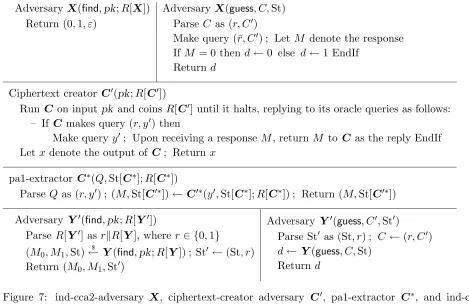
Figure 7: ind-cca2-adversary X, ciphertext-creator adversary C0, pa1-extractor C∗, and ind-cpa-adversaryY0 for the proof of Theorem 4.4.
AdvindAE-,Xcca2(·) is negligible. Hence AE is IND-CCA2 secure.
4.4 Proof of Theorem 4.4
Let AE0 = (K,E0,D0) be a PA1 secure and IND-CPA-secure asymmetric encryption scheme. We construct a PA1 secure and IND-CPA-secure asymmetric encryption scheme AE = (K,E,D) that is not IND-CCA2 secure. Notice that the key-generation algorithm is the same. The encryption and decryption algorithms are defined as follows:
AlgorithmEpk(x) r← {$ 0,1}
Return (r,E0 pk(x))
AlgorithmDsk(y)
Parsey as (r, y0) ; x← D0 sk(y
0)
Returnx
To prove thatAE is not IND-CCA2 secure, we define an ind-cca2-adversaryX attackingAE as shown in Figure 7. Clearly, X runs in polynomial time andAdvindAE-,Xcca2(k) = 1 for everyk∈N.
To prove thatAE is PA1 secure, letC be a polynomial-time ciphertext creator attackingAE. We define a ciphertext creator C0 attacking AE0 as shown in Figure 7. Clearly, C0 runs in polynomial time. By the assumption that AE0 is PA1 secure, there is a successful polynomial-time pa1-extractor C0∗ for C0. We construct a pa1-extractorC∗ for C, based on C0∗ as shown in Figure 7. It is clear that C∗ runs in polynomial time. Let D be a polynomial-time distinguisher for C, and fix k∈N. It
is easy to see that
PrhExppa1AE,-Cd,D(k) = 1 i
= PrhExppa1AE0-,dC0,D(k) = 1 i
and PrhExppa1AE,-Cx,D,C∗(k) = 1
i
= PrhExppa1AE0-,xC0,D,C0∗(k) = 1 i
Therefore,
Advpa1AE,C,D,C∗(k) = Adv
pa1
AE0,C0,D,C0∗(k).
SinceC0∗ is a successful pa1-extractor forC0, for every polynomial-time distinguisher D, the function Advpa1AE0,C0,D,C0∗(·) is negligible and hence for every polynomial-time distinguisher D, the function Advpa1AE,C,D,C∗(·) is negligible. ThusC∗ is a successful pa1-extractor for C, andAE is PA1 secure.
To prove thatAE is IND-CPA secure, letY be an ind-cpa-adversary attacking AE. Consider the ind-cpa-adversary Y0 attacking AE0 depicted in Figure 7. A random tape rkR[Y] for adversary Y0 has two parts. The first part is a bit that Y0 uses to compute the challenge ciphertext C forY. The second part is a random tape forY. Y0 runsY and returns the output of the latter. Clearly,Y0 runs in polynomial time and AdvindAE-0,cpaY0(k) =Adv
ind-cpa
AE,Y (k) for every k∈N. The assumption that AE 0 is IND-CPA secure implies that the ind-cpa-advantage of Y0 is negligible, and hence it follows that the ind-cpa-advantage of Y is negligible. Thus AE is IND-CPA secure.
4.5 Proof of Theorem 4.5
Let AE0 = (K,E0,D0) be a PA0 secure and IND-CPA-secure asymmetric encryption scheme. We construct a PA0 secure and IND-CPA-secure asymmetric encryption scheme AE = (K,E,D) that is not IND-CCA1 secure. Its constituent algorithms are defined as follows:
AlgorithmK(1k ) (pk0,sk0)← K$ 0(1k
)
u← {$ 0,1}|sk0|
; sk←(sk0, u) Return (pk0,sk)
AlgorithmEpk(x)
Return (0,E0 pk(x))
AlgorithmDsk(y)
Parsesk as (sk0, u) Parsey as (v, y0) Ifv= 0 then returnD0
sk0(y0) EndIf
Ifv= 1 then
Ify0 = 0 then returnu
Else returnu⊕sk0 EndIf EndIf
To prove thatAE is not IND-CCA1 secure, we define an ind-cca1-adversaryX attackingAE as shown in Figure 8. Clearly, X runs in polynomial time andAdvindAE-,Xcca1(k) = 1 for everyk∈N.
To prove that AE is PA0 secure, let C be a polynomial-time pa0 ciphertext creator attacking AE. We define a pa0 ciphertext creator C0 attacking AE0 as shown in Figure 8. Clearly, C0 runs in polynomial time. By the assumption that AE0 is PA0 secure, there is a successful polynomial-time pa0-extractorC0∗forC0. We construct a pa0-extractorC∗ forC, based onC0∗as shown in Figure 8. It is clear that C∗ runs in polynomial time. Let D be a polynomial-time distinguisher forC, and fix k∈N. It is easy to see that
PrhExppa1AE,-Cd,D(k) = 1 i
= PrhExppa1AE0-,dC0,D(k) = 1 i
and PrhExppa1AE,-Cx,D,C∗(k) = 1
i
= PrhExppa1AE0-,xC0,D,C0∗(k) = 1 i
.
Therefore,
Advpa1AE,C,D,C∗(k) = Advpa1AE0,C0,D,C0∗(k).
SinceC0∗ is a successful pa0-extractor forC0, for every polynomial-time distinguisher D, the function Advpa1AE0,C0,D,C0∗(·) is negligible and hence for every polynomial-time distinguisher D, the function Advpa1AE,C,D,C∗(·) is negligible. ThusC∗ is a successful pa0-extractor for C, andAE is PA0 secure.
![Figure 1: An arrow is an implication, and, in the directed graph given by the arrows, there is a path from A topaper, while dashed lines represent results from prior work [4, 17]](https://thumb-us.123doks.com/thumbv2/123dok_us/1842589.1238841/5.612.115.489.44.118/figure-implication-directed-arrows-topaper-dashed-represent-results.webp)