Toward a quantitative theory of belief change:
Structure, difficulty, and likelihood
(A progress report)
Jon Doyle∗ JON [email protected]
Department of Computer Science, North Carolina State University Raleigh, NC 27695-8206 USA
Abstract
Effective persuasion requires identification and selection of points of leverage in the belief system of the person or population being addressed. This paper describes a model in which personal beliefs are held and changed through a combination of reasoned, rational, and reflexive means, and in which the same attempts at persuasion can yield different outcomes in different people. The model is used first to interpret a logic of possible changes of belief, and second to develop mechanical and economic measures of the difficulty and probability of different changes of belief.
Contents
1 The problem of changing minds 4
1.1 Approach . . . 4
1.2 Background . . . 5
2 Believers 5 2.1 Individuals . . . 5
2.2 Groups . . . 5
2.3 Group individuals . . . 6
3 Belief and mental states 6 3.1 States . . . 7
3.2 Belief content distinctions . . . 7
3.3 Belief ascriptions . . . 8
3.3.1 Binary ascription . . . 8
3.3.2 Graded ascription . . . 10
3.3.3 Translating between ascriptions . . . 10
3.4 States and mental configurations . . . 11
3.4.1 Definite configuration states . . . 12
3.4.2 Indefinite configuration states . . . 12
3.4.3 Distributional configuration states . . . 14
4 The structure of belief configurations 14 4.1 Coherence of beliefs . . . 15
4.1.1 Consistency and closure . . . 15
4.1.2 Connections between beliefs . . . 16
4.2 Grounding of beliefs . . . 19
4.2.1 Grounding configurations . . . 19
4.2.2 Local grounding . . . 20
4.2.3 Global grounding . . . 21
4.2.4 Grounded extensions . . . 22
4.3 Preference among beliefs . . . 23
4.3.1 Epistemic preferences . . . 24
4.3.2 Grounds for preferences . . . 24
5 The structure of belief change 25 5.1 Accomodative change . . . 26
5.1.1 Coherent accomodation . . . 26
5.1.2 Preferential accomodation . . . 28
5.1.3 Conservative accomodation . . . 29
5.2 Motivated change . . . 30
5.3 Rational change . . . 31
5.4 Mechanical change . . . 32
5.4.1 Mass, position, mechanical configuration . . . 32
5.4.3 Force . . . 34
5.4.4 Elastic accomodation and reason forces . . . 35
5.4.5 Inertial change . . . 37
6 The difficulty of belief change 38 6.1 Qualitative comparison via entrenchment . . . 38
6.1.1 Entrenchment from foundations and preferences . . . 39
6.1.2 Entrenchment modalities . . . 41
6.2 Quantitative comparison via mechanical work . . . 42
7 The likelihood of belief change 45 7.1 Probability of change . . . 45
7.2 Expected difficulty of change . . . 46
8 The logic of belief change 46
1. The problem of changing minds
Sometimes it is easy to persuade someone to change his mind; sometimes it is hard. Contrast “Brave, brave, Sir Robin” with “Hier stehe ich nicht; ich kann nicht anders.”
If one has no idea why someone thinks the way he does, one can only use appearances or other knowledge to identify populations to which the person belongs and then try methods based on models of how people think who belong to those populations. The more one knows about the specifics of how a person thinks, the more leverage one can bring to bear in choosing methods that will best influence that individual. However, persuading someone to change how he thinks can be very difficult despite detailed knowledge of why he thinks the way he does. Indeed, changing one’s own beliefs can be very difficult, even for people seemingly very aware of why they believe as they do.
In line with these observations, we develop a mathematical model of belief and belief change that provides formal means for comparing and measuring the difficulty of different changes and the likelihood of different changes via different means for influencing beliefs. Applying these measure-ments to models of the beliefs specific to particular populations or individuals of known or assumed character, one can identify changes of minimal expected effort, to gauge risk by identifying changes of minimal and maximal effort, to distinguish changable beliefs from unchangeable ones, and to identify the best point of leverage for producing a desired change. We do not address here the prob-lem of how one identifies the belief or character of a specific individual or population, a probprob-lem already studied in decision analysis and social psychology with methods adaptable to the model presented here.
1.1 Approach
Our model involves a rich conception of belief and belief change in which belief states can exhibit some ambiguity about what is actually believed, and in which beliefs can be influenced by rational incentives for change, by new information that changes assumptions or triggers predictable habits of thought, and by motivations internal to the individual. To address these aspects, our model involves desires, preferences, intentions, motives, habits, and logical, structural, and habitual connections in characterizing possible belief states and changes. The structures considered here encompass supports or foundations of beliefs, the inherent constitution of mental and belief states, and the organization of belief states into locales or substates corresponding to mental subagencies. The preferences considered here differentiate beliefs and changes according to their sources, content, foundations, and history, among other things.
The main elements of the model developed here are quite abstract and cover a considerable range of models of belief. We augment these with some more specific elements that remain quite abstract but support several important means for analyzing the difficulty and likelihood of belief changes, and that point the way for how to extend the model to handle other models of belief.
in the same way, and our model provides means for characterizing individuals who differ in, for example, constitutive degrees of mental integrity and inferential capacity.
1.2 Background
The model presented here draws on numerous extant theories. Epistemology and economic theo-ries study belief change in terms of idealized conceptions of logical or economic rationality that presume epistemic omniscience and consistency, as in modal logics of belief and knowledge [33]; instantaneous and complete assimilation of new information, as in Bayesian conditionalization [52]; and effortless, instantaneous deliberative reasoning in microeconomic and game-theoretic theories of individual and group action [36, 57]. Despite their ideal character, however, these theories have limitations. Bayesian updating, for example, does not address learning of new information that contradicts current beliefs. That case is addressed by theories of epistemic entrenchment [31], in which one belief is more entrenched than another if it is given up before the other when faced with contradictory information, but these theories in turn do not seek to characterize why or how one belief becomes more entrenched than another, and so provide little or no predictive power.
The investigation reported here attempts to study a more realistic conception of change in which the degree of logical and economic rationality is limited by structural or informational properties of the believer. The aim is to better understand belief and belief change when inconsistency and ignorance can persist with indefinite duration, in which learning takes time, and slows as habits accumulate, in which reasoning requires concentrated effort, in which change requires motivation and acceptance, and in which resistance to change can be passive or active. This portion of the model draws on prior work on truth or reason maintenance systems (TMS/RMS) [9, 20]; on related theories of nonmonotonic logics [41] and reasoned assumptions [11, 19]; on theories of econom-ically rational belief revision [17, 16]; on theories of reflective and argument-oriented dialectical deliberation [7, 10, 13]; and on cognitive mechanics [21, 22]. We also draw on work in progress by Wicker [60] to formalize the notion of influence mechanism, by which individuals or groups engender different kinds of changes on the beliefs of others.
2. Believers
2.1 Individuals
We begin by considering a setUofindividuals. For the moment, we make no assumptions regarding the nature of these individuals, whether they be humans, legal persons, or artificial agents. The following will focus mainly on finite sets of individuals, but many aspects of our formalization also cover the case of infinite sets of individuals, as are studied in economic theories of markets with a continuum of individuals [3].
We assume that each individual falls into one or more of a finite set oftypesT1, . . . , Tn. Within
U, we identify the individuals of typeT byT(U), which we also denoteUT. We writeT vT0when
T is a subtype ofT0. We require thatT(U)⊆T0(U)whenT vT0, and thatvis transitive. 2.2 Groups
We regard agroupg⊆ U as a set of individuals. The setU itself constitutes the largest group, and the empty set of individuals∅constitutes the smallest group. We sometimes treat singleton groups
We writeGto denote the set of all groups. More generally, we follow Noll’s notion of material universe [43] or materially-ordered set [45] and assume thatGforms a Boolean lattice of subsets of Uin which the lattice meet and join of groupsgandg0are respectively the maximal group contained in and the minimal group containing both of them. We call the lattice complementge theexterior
orsocial environmentofg.
For finite U, we normally assume that every subset of U forms a group, so G consists of the power set 2U. In this case, meet and join are just set intersection and union, respectively, and
ge =U \g.
For infiniteU, we often will assume thatU carries a topology and concomitant notions of topo-logical interiors and closures. Different assumptions about the nature of groups motivate different topological definitions of groups. If singleton sets of individuals are to be degenerate groups, it is natural to regard Gas the set of all subsets of U, that is, to assume thatU carries the discrete topology. If groups are conceived as containing all the neighbors of each individual in them, one might regardGas the set of regularly open subsets ofU, that is, sets which are the interiors of their closures, that is,g= int clog.
As with individuals, we assume that each group falls into one or more group typesT1, . . . , Tm, and writeT v T0 to mean thatT is a subtype of T0. We writeT(G) orGT to denote the set of groups of typeT, and require thatT(G)⊆T0(G)ifT vT0.
2.3 Group individuals
It is sometimes natural to regard the individuals of some type as forming a group. Conversely, it is also natural to regard some individuals, such as legal persons, corporations, organizations, and clans, as consisting of groups of other individuals. We thus partitionU into a subsetAofatomic
individuals and the remainder set C = U \ A of corporate or group individuals, and assume a membership functionmembers:C→ G. It is natural to extendmembersto all ofU by defining
members(i) =∅for each atomici. We assume that the membership hierarchy contains no cycles, and that the depth of the hierarchy is bounded by some finite number.
We do not identify group individuals with the set of their members, so two different corporate groups may happen to have the same set of members without being the same group individual. Indeed, we do not require that group individuals have any members at all. We therefore cannot use lack of members as distinguishing corporate from atomic individuals. In particular, such an extensional view of corporations would make all atomic individuals the same, as each has the same (empty) set of members.
Membership alone is a crude proxy for the great variety of different roles that individuals play in a realistic organizations, but it is all that will be considered here. Doyle [13] treats a simple case of individuals that represent others in the political sense, and Wicker [60] presents a related formalism for analyzing social change that provides for individuals standing in different relations to each other, as means to understanding the influences that groups exert on individuals and each other.
3. Belief and mental states
these issues (Section 3.2), the forms of ascription of belief to individuals in different states or con-figurations (Section 3.3), and the ways in which states of individuals relate to mental concon-figurations (Section 3.4). The following section treats details of the primary forms of mental configurations, including logical and constitutive connections between beliefs that underlie the notion of coherence (Section 4.1), grounding of beliefs via reasons and arguments (Section 4.2), and preferences guiding choices among alternative assumptions (Section 4.3).
3.1 States
We assume that for each individuali∈ U, one identifies a setΨiof all thestatesthatimight inhabit at each time of interest. We assume that groups inhabit states similarly, withΨg denoting the set of possible states of groupg ∈ G. Ifg ⊆ g0, we assume that states of the more inclusive group determine states of the less inclusive group. We can thus describe this determination in terms of a projection mappingπΨ(g, g0) : Ψg →Ψg0. In the simplest setting, it is natural to assume thatΨgis isomorphic to the productQ
i∈gΨi of the constituent individual states. Even if group states do not take this simple product form, we will assume that ifg={i}, thenΨgis isomorphic toΨi. We will sometimes write as ifΨg = Ψiin this case. We make no assumptions here about the state of a group individual, other than that a group individual typically inhabits states that need not be identical to the product state of its members.
We do not assume that the states so identified are Markovian, that is, we make no general assumption that the behavior of an individual depends only on the instantaneous state inhabited by the individual regardless of what prior states preceded the current one. Instead, we allow that changes occurring at some time might depend on past or even future states, although in the cases examined here changes will depend at most on the very recent past (first or second derivatives).
We also do not assume that the states inΨi are strictly mental ones, but do not treat questions of physical embodiment in the following. If states have both mental and physical components, one can expect some degree of indeterminacy in considering mental and physical states, with distinct physical states corresponding to the same mental state, or with distinct mental states corresponding to the same physical state, depending on how one regards the relation between mind and body. 3.2 Belief content distinctions
We writeBi to denote a set chosen to distinguish the contents of different beliefs that one might ascribe to an individuali∈ U. For simplicity, we also will use the same setBacross all individuals, even though differences in the conceptual apparatus of individuals, such as languages of thought, are important in contexts not treated here. We need not assume that every belief inBcan be ascribed to each individual; indeed, we might obtainBas the unionS
i∈UBi.
We assume thatBis finite or countably infinite and can be represented by a recursive set using a suitable grammar to express the content of beliefs. In most instances, we will proceed as though Bis the set of sentences in a first-order predicate or modal logic.
beliefs form the elements of a Lindenbaum algebra in which each belief constitutes an equivalence class of logically equivalent statements.
As mentioned previously, understanding realistic notions of belief change requires consideration of additional aspects of mental states besides belief. In the following, we identify roles for other types of mental attitudes, namely desires, preferences, and intentions, and for structural aspects of mind related to belief change, such as reasons or structural connections between beliefs. To provide a uniform but abstract framework for considering mental states containing these other elements as well as beliefs, we phrase the development in terms of a set D that containsB as well as other attitudes and mental elements we find cause to consider, such as setsDof desires and preferences, Iof intentions, andRof inference policies we call reasons. In simple cases, one can regardDas the simple unionB∪D∪I∪R∪. . . of the sets of possible beliefs, preferences, reasoning policies, arguments, and other mental attitudes. More generally, we can regardDas a set of mental elements or properties such that particular elements or properties can constitute more than one mental attitude. 3.3 Belief ascriptions
We regard belief ascriptions as observable properties of individuals and groups. We make no as-sumptions about the methods by which one might ascribe beliefs in the absence of knowledge of the specific forms of mental states examined in the following, but we do consider two possible form of such ascriptions,binaryascription, in which one ascribes a set of beliefs to the individual, and
gradedascription, in which one ascribes degrees to which the individual holds each possible belief. Most of our attention in Sections 4, 5, and 6 will be on binary belief ascriptions, turning to focus on graded ascriptions in Section 7.
3.3.1 BINARY ASCRIPTION
In the binary form of ascription, one ascribes a set bel∗i(ψ) ⊆ D to individual i. We use RMS terminology [9] to say thatb∈ DisIn(the set of held beliefs) ifb∈bel∗i(ψ), and isOutotherwise. Because we assume that the set of possible beliefs is closed under negation, we obtain four possible states of binary ascriptions regarding each beliefb, as depicted in Figure 1: either (1)bis
Inand¬bisOutthe set of ascribed beliefs, (2)¬bisInandbisOut; (3) bothband¬bareIn; or (4) bothband¬bareOut. The first two of these states represent the normal mode of unambiguous belief in eitherbor its negation. The third state represents the unfortunate condition of having conflicting or inconsistent beliefs. The fourth state represents the common condition of having no opinion on
bor its negation. These four states of affairs form the basis of some relevance logics for belief first developed by Dunn [26] and Belnap [4], and for some of the bilattices studied by Ginsberg [32].
The following development describes the sets of beliefs and other mental elements of interest in two different but equivalent ways: as sets in 2D and as vectors in the binary vector space of characteristic functions overD. Formally, we writeDto denote the binary vector spaceZD2 overZ2. By the natural vector-set correspondence that reads 1 as meaning that the corresponding element of DisInthe set and reads 0 meaning that the element isOutof the set, each vector inDcorresponds to a subset ofD.
In(b),Out(¬b) Out(b),In(¬b)
Out(b),Out(¬b)
In(b),In(¬b)
H H H H H H Y
*
*
H H H H H H Y
Figure 1: Fourfold states of information regarding a beliefb, in which a belief and its contrary can be held or not independently of each other. The state at the head of each arrow contains more information than the state at the tail.
multiplication corresponds to intersection, so thatxycorresponds tox∩y. We obtain the difference
x\yasxyand the unionx∪yas the sum of productsxy+xy+xy.
A binary belief ascriptionbel∗i : Ψi → D, as just described, constitutes acompleteascription; not complete in the logical sense that every possible belief is either held or its contrary is held, but in the sense that every possible belief is either known to hold or to not hold. Although such complete ascriptions seem natural when considering ascribing beliefs to humans, they seem less natural when considering ascriptions to artificial computational individuals that build up beliefs by computing sets of beliefs in piecemeal fashion. In ascribing beliefs to such individuals, it can be useful to consider partial ascriptions that do not indicate whether a belief is held or not.
An incomplete binary ascriptionbel∗i : Ψi → D×D specifies In and Out labels for some proper subset ofB, and says nothing about whether the remaining possible beliefs are held or not. We characterize partial binary ascriptions in terms of pairs(x, y) inD×D, also writingx \\ y, read as “xwithouty”, as an alternative to the pair notation. The first componentxof such a pair characterizes the set ofInbeliefs, the second componentycharacterizes the set ofOutbeliefs, and beliefs in neither set, that is, beliefs inx¯y¯, constitute beliefs that are neitherInnorOut, a status we callNyl, for “not yet labeled”. Ify=x, thenx\\xindicates a complete binary ascription.
Ifxy6=0inx\\y, the two sets overlap and thus constitute an inconsistent ascription. We could avoid consideration of inconsistent ascriptions by instead regarding a partial ascription as assigning one of the three labelsIn,Out, andNylto each element ofD. Doing so, however, complicates the algebraic structure of the set of possible ascriptions The spaceD×D, likeD, is a vector space over Z2, but phrasing a three-valued ascription directly in vector terms would mean replacing the vector spaceDwith spaces based onZD3 orD⊥={0,1,⊥}DoverZ2.
3.3.2 GRADED ASCRIPTION
In thegradedform of ascription, one ascribes to each belief a numerical grade or degree inR. We writeGto denote the vector space RD overR, and writegrade∗i : Ψi → Gto denote a graded ascription function.
Most approaches to graded belief ascription focus on grades taking values in the interval[0,1]
that represent probability values or fuzzy truth values, but we do not restrict attention to functions in[0,1]Dbecause portions of the subsequent development require thatGconstitutes a vector space, and the functions in[0,1]Ddo not form a vector space overRorZ2 in the obvious algebras.
Graded ascriptions might be made partial in many different ways, from simple omission of grades for some beliefs, to arbitrary bits of information about individual grades themselves. The most straightforward analog of the preceding approach to partial binary ascriptions is to regard a partial graded ascriptiongrade∗i : Ψi →G×Gas specifying a subinterval ofRfor each potential belief, that is, a pair of functions(x, y) ∈ G×Gin which we interpretx(b)as providing a lower bound on the grade ofbandy(b)as providing an upper bound on the grade ofb. In this approach, the improper subintervalRprovides no information about the grade, while a degenerate subinterval
[γ, γ]ties the grade down exactly. Of course, such interval grades cannot express all forms of partial information about grades. In particular, no element ofG×Grepresents the improper intervalR. 3.3.3 TRANSLATING BETWEEN ASCRIPTIONS
Summarizing the preceding, we assume that one can ascribe complete or incomplete binary or graded beliefs to states:
Ψi
bel∗i
−→ D
Bel∗i
−→ D×D
grade∗i
−→ G
Grade∗i
−→ G×G
(1)
We do not assume or require any specific relation between binary and graded ascriptions to the same individual, and in Section 3.4 regard such relations as characteristic of different types of indi-viduals. The subsequent development will consider some translations that make sense for specific mental structures under consideration. For the moment, we merely sketch some of the most obvious possibilities and problems.
One can, for example, translate a complete binary ascription into a graded one by reinterpreting the0,1values of vectors inDas the0,1values of vectors inG, and so obtain the translation
grade∗(ψ)(b) = bel∗(ψ)(b). (2) This same formula serves to define the translation for partial binary ascriptions into partial graded ascriptions by assigning the interval [1,1] to In elements, assigning [0,0] to Out elements, and assigning[0,1]to allNylelements. These translations need not be appropriate for conceptions of the grading spaceGdifferent than the one considered here, and need not always be appropriate even for the grading space treated here.
[1,1], assigningOutto all elements graded[0,0], but then one has many choices for how to label the remaining elements, the simplest being to label each of them withNyl. In this case, starting with a partial binary ascription, translating to a partial graded ascription, and then back to a partial binary ascription yields the same as one started with, but a double translation starting from a partial graded ascription will generally not return to the initial ascription. But withGnot restricting grades to the unit interval, even the preceding range of translations need not apply.
3.4 States and mental configurations
If belief ascriptions constitute observable properties of individuals, states and mental configurations characterize the underlying reality of individuals under observation. Mental configurations consti-tute the internal mental structures characteristic of the individual, and serve as the primary notion of mental structure that shapes belief ascription and belief change. States, in contrast, express and limit indeterminacy or uncertainty about configurations and changes of configurations of individuals.
Conceptions of mental configurations are as numerous as conceptions of mind. Most of the conceptions of mental configurations considered in the following involve more complex structures overD than mere binary or graded belief ascriptions. The few varieties considered here seek to understand belief change by distinguishing sets of base beliefs from conclusion beliefs, by picking out arguments supporting conclusion beliefs, and by identifing recent changes to beliefs. We write
Φi to denote the set of mental configurations possible for individuali, and provide candidates for what such sets might contain in Section 4.
We assume that each type of mental configuration supports both binary and graded belief ascrip-tions, either partial or complete. That is, we require the identification of binary ascription functions
beli : Φi → D orBeli : Φi → D×D and graded ascription functions gradei : Φi → Gor
Gradei : Φi →G×G, which we summarize as
Φi
beli
−→ D
Beli
−→ D×D
gradei
−→ G
Gradei
−→ G×G
(3)
It is easily seen that each complete binary or graded ascription function can be recast in the form of a partial ascription function and, as noted earlier, each binary ascription function can be recast as a graded ascription function, so these multiple requirements do not represent different constraints. Nevertheless, we will focus on binary ascriptions in the following.
In the following, we consider individuals characterized by three types of relations between states of the individual in Ψi and mental configurations in Φi, namely definite states that correspond to specific configurations inΦi, indefinite states that correspond to sets of configurations in 2Φi, and distributional states that correspond to probability distributions over possible configurations in
Pr[Φi]. Writingβito represent the function associating the configurational structures of individuali with states of individuali, we summarize the relations between states and configurations as follows.
Ψi βi
−→
Φi
2Φi
Pr[Φi]
Complementing the function βi that interprets states in terms of configurations, we assume ascription-combination functions β∗beli,β∗Beli β∗gradei, andβ∗Gradei that ascribe beliefs to the configurational representations of states, that is, functions
Φi
2Φi
Pr[Φi]
β∗beli
−→ D
β∗Beli
−→ D×D
β∗grade i
−→ G
β∗Gradei
−→ G×G
(5)
such that the beliefs ascribed to states directly match those assigned to configurational structures in the sense that
bel∗i(ψ) = β∗beli(βi(ψ)) (6)
Bel∗i(ψ) = β∗Beli(βi(ψ)) (7)
grade∗i(ψ) = β∗gradei(βi(ψ)) (8)
Grade∗i(ψ) = β∗Gradei(βi(ψ)), (9) or schematically, Ψi βi −→ Φi
2Φi
Pr[Φi]
β∗beli
−→ D bel
∗ i
←−
β∗Beli
−→ D×D Bel ∗ i
←−
β∗gradei
−→ G grade
∗ i
←−
β∗Gradei
−→ G×G Grade
∗ i ←−
Ψi. (10)
3.4.1 DEFINITE CONFIGURATION STATES
An individual has definite configuration states when its states determine mental configurations uniquely, in which case the association of configurations with states takes the form of a function
βi : Ψi → Φi. If we seek to simplify the analysis by identifying definite states with the configura-tions they determine, then we haveΨi = Φi andβi is the identify map onΦi. In this case we can simplify the earlier equations to obtain
bel∗i(φ) = β∗beli(φ) (11)
Bel∗i(ψ) = β∗Beli(φ) (12)
grade∗i(ψ) = β∗gradei(φ) (13)
Grade∗i(ψ) = β∗Gradei(φ) (14) 3.4.2 INDEFINITE CONFIGURATION STATES
Nonmonotonic logics and other approaches involving grounded belief configurations such as those treated in Section 4.2 provide the most common motivation for considering indefinite belief individuals. The simplest conception of grounded belief configuration regards each mental config-urationφ∈Φas a pair(m, x) ∈D×Din whichmconsists of a set of base elements inD, andx
consists of a set of conclusion elements inD. One typically can have different sets of conclusions grounded in the same set of base beliefs. In this setting, one assumes that each mental configuration determines a unique set of base beliefs, and that the set of possible belief states consist of the set of “expansions” of the belief base.
Unlike the case of definite configuration states, in which we can obtain ascriptions to states directly from ascriptions to configurations, many alternatives exist for constructing or defining as-criptions to states from asas-criptions to sets of configurations. Indeed, we regard the relation between these types of ascriptions, as expressed in the functionsβ∗beli,β∗Beli,β∗gradei, andβ∗Gradei as characteristic of the individual, as part of its constitution, so that one finds different relations characteristic of different individuals. We will identify some such relations characteristic of special types of believing individuals in Section 7, but otherwise leave the question open.
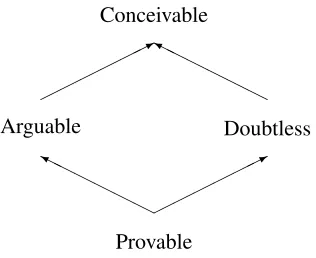
Consider first indefinite ascriptions based on complete binary ascriptions. Borrowing terminol-ogy from [41] introduced in the context of grounded belief, we say thatb isarguable iff there is someφ∈βi(ψ)such thatb∈beli(φ)and thatbisprovableiffb∈beli(φ)for eachφ∈βi(ψ). We also say thatbisdoubtlessiff there is noφ∈βi(ψ)such that¬b∈beli(φ)and thatbisconceivable iff¬b /∈ beli(φ)for someφ ∈βi(ψ). In definite belief individuals,bisIniffbis arguable iffbis provable. We can depict the inclusions between these classes of beliefs as in Figure 2.
Arguable Doubtless
Provable Conceivable
H H H H H H Y
*
*
H H H H H H Y
Figure 2: Inclusion relationships between classes of beliefs distinguished by the appearance of a belief and its contrary in alternative mental configurations. The class at the head of each arrow includes the class at the tail.
3.4.3 DISTRIBUTIONAL CONFIGURATION STATES
An individual hasdistributionalconfiguration states when its states determine probability distribu-tions over all possible mental configuradistribu-tions, in which case the association of configuradistribu-tions with states takes the form of a functionβi: Ψi →Pr[Φi], wherePr[Φi]denotes the set of all probability distributions over mental configurations inΦi. Definite belief individuals form a special case of distributional belief individuals, in which each state assigns probability 1 to one configuration and probability 0 to all others.
We do not attempt to examine here all possibilities for definingβ∗beli,β∗Beli,β∗gradei, and
β∗Gradeifor distributional individuals. There are 16 cases to consider, namely complete or incom-plete binary or graded ascriptions to states derived from comincom-plete or incomincom-plete binary or graded ascriptions to configurations. More importantly, different types of individuals might reasonably ex-hibit different constitutions, in which case there is no single definition for all cases. At this point we only illustrate two of the possibilities for defining ascriptions to states based on ascriptions to configurations, and return to this question later to consider additional possibilities.
First, one might derive complete graded ascriptions from complete binary ascriptions as follows. When combined with a complete binary belief ascription, each probability distributionPrΦ : Φ→
[0,1]over mental configurations induces a measureβ∗grade :D → Rover elements inDby the definition
β∗grade(b) =
Z
PrΦ({φ∈Φ|b∈bel(φ)}), (15) which we abbreviate by writingPr(b) to meanβ∗grade(b). These induced measures are not in general probability measures in the absence of assumptions about the completeness and consistency of the possible belief ascriptions, for without such assumptions, one can havePr(b) +Pr(¬b)<1
orPr(b) +Pr(¬b)>1. In particular, for definite belief individuals,Pr(b) = 1ifbisIn,Pr(b) = 0
ifbisOut, andPr(b) +Pr(¬b)can take the values 0, 1, or 2.
Second, one might derive incomplete graded ascriptions to states from incomplete binary as-criptions to configurations as follows. In this case, we derivedβ∗grade:D →(R×R)by
β∗grade(b) =
Z
PrΦ({x\\y∈Φ|b∈x}), Z
PrΦ({x\\y∈Φ|b /∈y})
, (16) in which the lower bound in this confidence interval is the probability of only the beliefs inxbeing
In, and the upper bound is the probability of only the beliefs inybeingOut. 4. The structure of belief configurations
We distinguish three dimensions along which approaches to the study of belief change differ. These dimensions represent different assumptions about the properties required of mental configurations. We do not claim these represent the only ways of distinguishing approaches, only that they represent distinctions clearly visible in current approaches.
• Foundation: Rather than consisting of a set of beliefs related only by coherence criteria, beliefs might admit a division into base beliefs and those beliefs derived or constructed from the basis beliefs.
• Optimality:Rather than only depending on beliefs, mental configurations might represent the result of choices among alternatives based on preferences among beliefs and mental configu-rations.
The following will present representatives of some alternatives along each of these dimensions in some detail.
4.1 Coherence of beliefs
Quine painted a picture of mental change in his image of the “web of belief” [48, 47], in which changes of belief are restrained or shaped by a network of connections between beliefs, such that the overall change resulting from some sets of pokes and tugs satisfies his principle ofminimum mu-tilation[46], in which the resultant change is the “smallest” change that accomodates the perturbing pokes and tugs.
Philosophy and artificial intelligence have explored connections between beliefs of several types, including notions of logical entailment and consistency that connect beliefs through their meanings, and notions of nonmonotonic and nonlogical inference that connect beliefs through what one might think of as habits of thought or patterns of plausible reasoning. These types of connec-tion between beliefs certainly do not exhaust the ideas relevant to understanding belief change. For example, logical and reasoning dependencies between beliefs do not touch on temporal connections between beliefs, the most prominent of which is the persistence of memory, in which a belief con-cluded at some point in the past is believed currently only because nothing worked to remove it. Nor do logical and reasoning dependencies reflect certain kinds of active dependence in which motives maintain beliefs by constant action that resists change and restores their targets. We consider these types of connections between beliefs in subsequent sections.
Formalizing notions of coherence requires only a very simple conception of mental configura-tion, namely as a complete or partial set of beliefs and other mental elements, that is, configurations of typeDor of typeD2. The belief ascription functions for each of these is obviously the identity, that is,bel(φ) =φforφ∈DandBel(φ) =φforφ∈D2, the former being complete ascriptions and the latter partial.
Of course, not every subset need be considered coherent, so we identify assumptions about the mental constitution [13, 19] that can (but need not) restrict coherent configurations to including only some elements ofDorD2.
4.1.1 CONSISTENCY AND CLOSURE
This section considers constitutive assumptions requiring that beliefs ascribed to mental configura-tions must satisfy logical consistency and closure condiconfigura-tions. For example, one type of constitution might rule out overtly inconsistent sets of beliefs by restricting the individual to beliefs that never include bothband¬b; another might require that the beliefs containbandcif it contains a belief expressing “bandc.”
particular logical language. A Scott information system overDis chararacterized formally by three items(D,Con,`), in whichDconstitutes the set of atomic “propositions”. The setConconsists of the finite subsets ofDthat are “consistent”, that is, that satisfy the constitutive consistency condi-tion, and the relation`onCon× Dconsists of the finite “entailments” inherent in the constitutive inference conditions, writingx ` ato mean(x, a)is in`. To capture what we would think of as actual consistency and entailment conditions,Conand`must satisfy the following conditions.
The conditions on consistency are that subsets of consistent sets are consistent, or formally, that
x∈ Conifx⊆y ∈Con; and that each element is itself consistent, or formally, that{a} ∈Conif
a∈ D. We say that a setx ⊆ Disconsistentiff each finite subsety⊆xis consistent according to
Con.
The conditions on entailment state that addition of entailed elements preserves consistency, or formally, thatx∪ {a} ∈Conifx `a; that consistent sets entail their own members, or formally, thatx `aifa∈x; and that entailment is transitive, or formally, thaty `aify ` bfor allb∈ x, andx` a. We say thatxis(inferentially) closed iffa∈xwhenevery ⊆xandy `a. We extend the notation of entailment in the natural way to say thatx ` yiffx ` afor eacha ∈ y, in which case the transitivity of entailment condition can be rewritten asx` Zwheneverx` yandy` Z. We then introduce aclosureoperatorθ, definingθ(x)to be the least closed superset ofx. We also broaden the notationx`ato meana∈θ(x).
To apply the notion of inherent logic to mental configurations of typeDor typeD2, we require that the setInelements ascribed to the configuration be consistent and closed. For configurations of typeD, this means the setx∈D, and for configurations of typeD2, this means the first component of(x, y)∈D2.
These abstract notions of consistency and closure cover many possibilities, ranging from the ordinary logical notions of ideal consistency and entailment to individuals who enjoy no nontrivial powers to identify inconsistencies or entailments, for which case one considers every finite set to be consistent, and for entailment to be just simple containmentx ` aiffa ∈ x, so that every subset ofD is both consistent and closed. These notions also provide the means to require that sets of conclusions always contain certain elements, in that an entailment∅ `arequires thatabe in every closed set.
4.1.2 CONNECTIONS BETWEEN BELIEFS
Logical consistency and closure notions do not exhaust the properties relevant to coherence of be-liefs. In particular, consistency and closure are incapable of expressing nonmonotonic connections between beliefs, such as a requirement thatbshould be held if¬bis not.
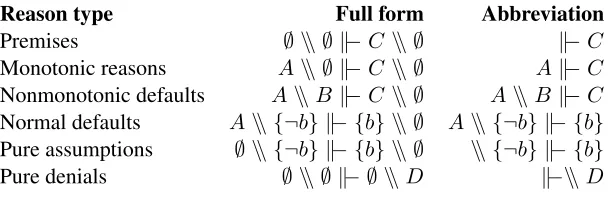
Reason type Full form Abbreviation
Premises ∅ \\ ∅ k−C\\ ∅ k−C
Monotonic reasons A\\ ∅ k−C\\ ∅ Ak−C
Nonmonotonic defaults A\\B k−C\\ ∅ A\\B k−C
Normal defaults A\\ {¬b} k− {b} \\ ∅ A\\ {¬b} k− {b} Pure assumptions ∅ \\ {¬b} k− {b} \\ ∅ \\ {¬b} k− {b}
Pure denials ∅ \\ ∅ k− ∅ \\D k−\\D
Figure 3: Special cases of interval conditionals and their abbreviations.
reasoning, a comprehensive theory of coherence must augment the logically monotonic notions of consistency and closure with means for characterizing nonmonotonic constraints between beliefs.
In line with these motivations, we focus on reasons that can be phrased as conditionals written in the formA\\B k−C\\D, forA, B, C, D ⊆ D, read as “antecedentsA withoutdefeatersB
givesconsequencesCwithoutdenialsD,” meaning that each element of the consequencesCmust beInand each element of the exclusionsDmust beOutif each element ofAisInand each element ofB isOut. For example, one could cast the requirement “Hold (c) ‘Sasha can fly’ if (a) ‘Sasha is a bird’ is not held, and (b) ‘Sasha cannot fly’ is held” as the reason{a} \\ {b} k− {c} \\ {}.
Formally, each such reason corresponds to a coherence condition on mental configurations. We write [[A \\ B k− C \\ D]] to denote the meaning of this condition, namely the set of mental configurations satisfying the condition. For configurations of typeD, the satisfying configurations are given by
[[A\\B k−C\\D]] ={x∈D|Ax+Bx=0→Cx+Dx=0}, (17) and for configurations of typeD2, the configurations satisfying a reason are given by
[[A\\B k−C\\D]] ={(x, y)∈D2 |Ax+By=0→Cx+Dy =0}. (18) We say a reasonA\\B k−C\\Disvalidwith respect to configurationsxor(x, y)if its antecedent conditions hold, that is, ifAx+Bx=0orAx+By =0.
Figure 3 lists several special cases of such conditional reasons corresponding to common uses in automated reasoning systems. Premise reasons can be used to stipulate axioms or other re-quired conclusions. Records of ordinary logical inferences take the form of monotonic reasons, but monotonic reasons in general need not be logically sound. Nonmonotonic default reasons state con-ditional assumptions and commonly represent heuristic or plausible inferences by making assump-tions absent information that would contradict or defeat the assumpassump-tions. Nonmonotonic default reasons cannot forbid the presence of elements in mental states. Normal defaults represent a com-mon form of simple noncom-monotonic assumptions, and pure assumptions represent the unconditional form of normal defaults. Pure denials are used to mark contradictions in the dependency-directed backtracking methods of Sussman and Stallman [56, 55] and [9].
and then regarding each disjunct as either a positive interval conditionalA\\B k−C\\Dor as a negative interval conditionalA\\B k− ¬(C \\D). Positive interval conditionals have the con-ceptual advantage of relating to individual beliefs either in a positive way (appearance inC) or a negative way (appearance inD), as opposed to general conditions in which the relation need not be either purely positive or negative. Positive interval conditionals also express definite constraints on beliefs, in contrast to negative interval conditionals, which express possibly ambiguous disjunctive constraints.
Consistency and closure represent global coherence conditions not tied to individual beliefs. If we also regard the set of cognitive connections as static, we obtain a view of belief akin to that taken in Reiter’s [49] default logic, which augments ordinary logical closure and consistency with a fixed set ofdefaultsthat correspond to interval conditional schema without denials. In that setting, the default and logical inference combine to yield sets of conclusions via grounding definitions akin to those described in Section 4.2. In considering active reasoners, however, one finds attitudes that are naturally regarded as intentions or habits that state policies that constrain the structure of mental states and the conduct of reasoning, such as nonmonotonic reasoning rules discussed presently. Such policies can be themselves adopted or abandoned in the course of reasoning, unlike global notions of logical consistency and closure. In such cases, it is natural to regard an interval conditional as a mutable element of the mental state, as an elementr ∈ Dthat constrains states to fall in the set[[r]] = [[Ar \\ Br k− Cr \\ Dr]]for some setsAr, Br, Cr, Dr ⊆ D. We can extend this interpretation to all state elements, even ones that are not intended to constitute reasons, by interpreting non-conditional elements as the vacuous conditional∅ \\ ∅ k− ∅ \\ ∅, which has the unconstraining meaning[[∅ \\ ∅ k− ∅ \\ ∅]] = Dfor configurations of typeDand the meaningD2 for configurations of typeD2.
With identifications of the (possibly trivial) connective meaning of every element ofD, we can formulate an expanded notion of coherence as follows.
We say that a configuration x ∈ Disself-satisfyingjust in case it satisfies the conditions ex-pressed by each of its Inelements, that is, just in case x ∈ [[e]]for eache ∈ x. We extend the meaning function to a function over sets of reasons by defining[[∅]] = Dand[[x]] = Te∈x[[e]]for each nonzerox ∈D, so thatxis self-satisfying iffx ∈[[x]]. A configuration (x, y) ∈D2, in turn, isself-satisfyingjust in case it satisfies the conditions expressed by each of itsInelements, that is, just in case(x, y)∈[[e]]for eache∈x. We extend this meaning function as well to a function over sets of reasons by defining[[∅]] = D2 and[[x]] = Te∈x[[e]]for each nonzerox ∈ D, so that(x, y) is self-satisfying iff(x, y) ∈[[x]]. In either case, therefore, a configuration is self-satisfying just in case it respects the consequences and denials of each of its validInreasons.
Summing up, we obtain a more comprehensive notion of coherence of beliefs by augmenting satisfaction of global consistency and closure conditions with satisfaction of all connective condi-tionals present in the state. We say that configurationsxof typeDor(x, y)of typeD2 iscoherent just in case itsInelements are consistent and closed, that is, thatθ(x) =x, and that the configura-tion as a whole is self-satisfying, that is, thatx ∈ [[x]]. The subset of coherent vectors inDorD2 need not form a vector space.
the defeat of the conditionalA\\B k−C \\D, which one then interprets as
r =A\\B∪ {defeated(r)} k−C \\D. (19)
4.2 Grounding of beliefs
G¨ardenfors [29, 30] distinguishes two types of theories of belief, those in which the set of beliefs is derived from some set of stipulated foundational or basis beliefs, and those in which the set of beliefs subsists on its own without any notion of foundation. Both types of theories regard beliefs as consistent and closed with respect to some logic of belief. In the ungrounded orcoherencetheories the consistency and closure constraints are the only assumptions made about the set of beliefs, while in the grounded orfoundationstheories the set of beliefs must satisfy additional constraints regarding derivation or construction from the stipulated foundation or basis [14]. For example, one might regard the basis to be some arbitrary set of beliefs, and the definite beliefs resulting to be the closure of this set under entailment in a classical logic, such as the modal logic of belief K4. If the logic of belief is a nonmonotonic one, such as Moore’s [42] autoepistemic logic, the same base beliefs can generate a set of possible belief configurationss, corresponding to an indefinite belief state.
Our exemplar for foundational systems is that of truth or reason maintenance systems (TMS/RMS) [9], in which the base structures are called justifications or reasons, and in which reasoning is organized to systematically add reasons that represent steps of reasoning as they are made, for example, through chunking or similar notions. To obtain a belief set that contains some specific belief, one adds a new reason to the RMS base that draws the target belief as a conclusion. RMS reasons persist in memory until explicitly expunged, so the new conclusion persists as well barring further changes to the set of base reasons. To remove an existing belief, one changes the base so that it no longer draws the target belief as a conclusion. This could be done by finding and removing some base reason underlying the target belief, but RMS reasons are nonmonotonic, so that one can defeat some conclusion by adding new reasons that defeat the reasons formerly supporting the target. Removing some conclusion indirectly can require defeating more than one underlying reason, as RMS retains consequences that have alternate support.
The notion of constructive belief applies even with different notions of base beliefs. For exam-ple, one might take the base structure to consist of Bayesian networks or artificial neural networks and regard constructive beliefs as derived by means of probabilistic or neural-element thresholds. For simplicity, we focus on constructive schemes starting and ending with the elements ofD intro-duced in the preceding.
4.2.1 GROUNDING CONFIGURATIONS
Standard theories of nonmonotonic reasoning focus on the possible states of conclusions derivable from base beliefs and nonmonotonic inference rules, calling these setsextensionsor “expansions” or “answer sets”. We treat such extensions presently, but develop them by considering first the notion ofgrounding configurationsthat identify the different ways in which conclusions can be grounded in base beliefs.
distinguish a set of conclusions reached by one set of arguments from the same set of conclusions reached by a different set of arguments. In this setting, a new set of beliefs constructed following a change to base beliefs might, in some cases, be the same as the previous set of constructive beliefs, in which case we regard the two belief states as having both different base beliefs and different internal configurations.
Distinguishing configurations from conclusions yields a formalization closer to the structure of computational systems like RMS than to the structure of a plain nonmonotonic logic. Configura-tional structure played a key role in the original RMS implementations, with a belief state consisting of both a labeling of conclusions asInandOutand an assignment of supports, such as supporting reasons, to each conclusion labeledIn.
WritingSto denote the space of functions(D →D), we define a complete belief configuration to be a triple(m, s, x) ∈ D×S×D, in which we regardmas the basis set,xas the constructed set, andsas picking out a set of supports for each mental element. Naturally, a complete belief ascription of a configuration of this type consists of the third component, that is,bel((m, s, x)) =x. We define a partial belief configuration similarly to be a quadruple(m, s, x, y) ∈ D×S×D2, in which the componentsxandycharacterize theInandOutconclusions separately, so that we have the natural partial belief ascription given byBel((m, s, x, y)) = (x, y).
The notion of coherent configuration described previously reflects one half of the basic RMS stability principle by requiring that state elements beIn(orOut) if a valid reason requires them to be so. The simplest notion of grounding reflects the other half of the stability principle, that state elements beInonly if they have a valid reason for being held. The notion oflocal groundingplaces no restriction on the valid reasons used to justify holding a belief, whereas the notion of global groundingrequires that the justifying reasons form part of a noncircular argument for holding the belief. We treat these grounding varieties in turn, and define both only in terms of configurations of typeD×S×D2, as complete grounding configurations correspond to a subset of these satisfying the same definitions under the constraint thaty=x.
4.2.2 LOCAL GROUNDING
We say that a configuration(m, s, x, y)islocally grounded, or thatslocally grounds(x, y)inm, if the presence or absence of conclusions in(x, y)exactly corresponds to the existence of supporting reasons insthat are valid with respect to(x, y)andm. Formally,(m, s, x, y)is locally grounded iffxis coherent (consistent, closed, and self-satisfying), and for eache∈ D,x(e) = 1(that is,eis
In) iff
1. ∅ ⊆s(e)⊆m∪(x\ {e})ands(e)`e, or
2. ∅ ⊂s(e)⊆m∪xand for eachr ∈s(e), there areA, B, C, Dsuch thatr =A\\B k−C\\
D,Ax+By=0, ande∈C,
The first of these conditions requires that every element ofmbe inxbecause{e}is by assumption consistent and entails its own element. If we sayeisstipulatedinxwith respect tomjust in case
e∈m, then a state element is locally grounded just in case it is either stipulated, logically derivable from otherInelements, or is a required conclusion of someInreason.
self-supporting cycles in locally grounded extensions. Figure 4 displays a situation in which three base reasons support two beliefs in three distinct locally grounded configurations.
Base reasons Conclusions k−a a
+ ak−c a,c
+ ck−a a,c
Conclusion Supports
c ak−c
and
a k−a; or
ck−a; or k−a,ck−a
6
a c
'
?
Figure 4: Three distinct configurations with same conclusions.
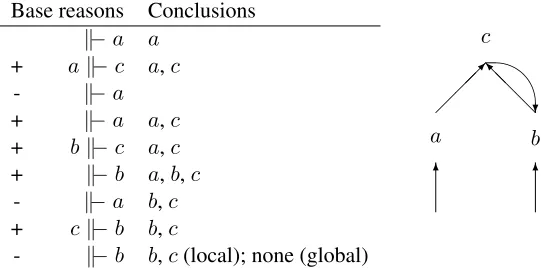
Locally grounded configurations permit self-supporting cycles, mutually supporting beliefs that arise easily in reasoning about equality or logically equivalent statements. For example, starting from any two of the equalitiesX =Y,Y = Z, andX =Z, one might infer the other. A simple example is displayed in Figure 5, in which one starts with no base beliefs and adds and removes various reasons, some of which connect beliefs, and others of which stipulate the presence of beliefs. At the end, one has left only the connective reasonsak− c,bk− c, andck− b. This set of reasons plays into two distinct locally grounded configurations, one in which bothbandcare held, and one in which neither is held. The latter is also a globally grounded configuration, as discussed presently.
Base reasons Conclusions k−a a
+ ak−c a,c
- k−a
+ k−a a,c
+ bk−c a,c
+ k−b a,b,c
- k−a b,c
+ ck−b b,c
- k−b b,c(local); none (global)
6 6
a b
c
@ @ @ I
$
?
Figure 5: Local versus global grounding of conclusions. The conclusion sets are obtained by start-ing with an empty set of reasons and addstart-ing and removstart-ing reasons.
4.2.3 GLOBAL GROUNDING
answer-set programming systems. In contrast to the extensions admissible in locally-grounded beliefs, grounded stable extensions omit self-supporting cycles of the sort seen in Figure 5.
We say that a configuration(m, s, x, y)isglobally groundedif the presence or absence of con-clusions in x exactly corresponds to the existence of noncircular supporting arguments starting fromm. Formally,(m, s, x, y)is globally grounded iff(m, s, x, y)is locally grounded and there is a well-ordering<onDsuch that for eache∈ D, either
1. ∅ ⊆s(e)⊆m∪x<eands(e)`e, wherex<e def
= {b∈x| b < e}, or
2. ∅ ⊂s(e)⊆m∪x<eand for eachr ∈s(e), there areA, B⊆x<esuch thatr=A \\B k−
C\\D,Ax+Bx=0, ande∈C.
These conditions parallel those defining locally grounded configurations, but require that the sup-porting inferences or reasons be developed prior to the conclusion they support. Globally grounded extensions thus omit self-supporting cycles of the sort seen in Figure 5, requiring instead at least one noncircular derivation from base beliefs by either logic or reasons.
We say that a locally or globally grounded configuration (m, s, x, y) is minimal if elements obtained by entailment have minimal supporting sets, that is, if s0 6` e whenever s(e) ` eand
s0 ⊂ s(e). We say that the configuration isfunctionaljust in case the support functionsidentifies exactly one supporting reason for every element inx, that is, if for each e ∈ x, ifs(e) 6 ` e, then |s(e)|= 1. The original RMS [9] and related systems relied on functional globally grounded states, in which one of the possible valid reasons for a belief was distinguished as the supporting reason. 4.2.4 GROUNDED EXTENSIONS
For each locally or globally grounded configuration, we say that the complete or incomplete sets of conclusions of the configuration constitute a groundedextensionof the base beliefs of the configu-ration. Thusxwould be a grounded extension ofmgiven a grounded configuration(m, s, x), and
x \\ywould be a grounded extension ofmgiven a grounded configuration(m, s, x, y). We write
αL(m)to denote the set of all locally grounded extensions ofm, andαG(m)to denote the set of all
globally grounded extensions ofm.
When all reasons are monotonic, there is one and only one globally grounded extension. There may be more than one locally grounded extensions, but in this case there is one locally grounded extension that contains all the others as proper subsets.
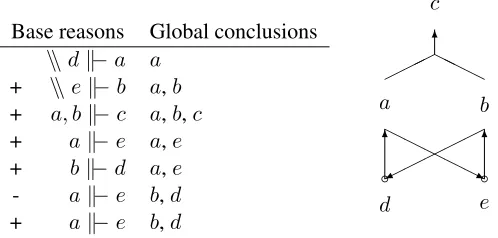
A different situation prevails when some reasons are nonmonotonic. Nonmonotonic logics char-acteristically exhibit multiple extensions in which a set of base reasons can support zero, one, or more grounded extensions, none of which need include the others. Figure 6 displays a simple case in which the full set of reasons supports an extension in whichais believed butbis not, and another in whichbis believed andais not. Moreover, reasoning exhibits hysteresis, in that adding a reason that defeats one extension but is later removed can lead to an extension other than the one originally entertained. As the accompanying table indicates, adding and removing base reasons one at a time can determine which of the extensions one has in hand. The first extension{a, e}found will persist under such sequential revision until defeated, at which time the other extension{b, d}will be held, even if the the reason that originally defeated it is restored.
Base reasons Global conclusions \\dk−a a
+ \\ek−b a,b
+ a, bk−c a,b,c
+ ak−e a,e
+ bk−d a,e
- ak−e b,d
+ ak−e b,d
6 b
6 b
a b
c
d e
H H H 6
H H
H H
H j
Figure 6: Two incompatible extensions, with sequential revision exhibiting hysteresis
depending on the presence or absence of a belief and its contrary in the beliefs ascribed to the extensions inα(m). When the logic of belief includes first-order logic, all these inclusions shown in Figure 2 are proper.
Dung [25, 5] develops a theory of abstract arguments and “attack” relationships between them that provides a general framework for formalization of multiple extensions grounded in basis beliefs. Local and global grounding need not exhaust the possible notions of grounding. One can con-sider intermediate forms in which beliefs are grouped into different “regions” and concon-sider regional grounding in which grounding is acyclic within each region but may be cyclic among regions, as in the rational distributed reason maintenance system of [20]. That treatment had in mind regions representing “subagencies” of a single mind, but one might use the same ideas in considering beliefs that are regionally grounded within subtheories corresponding to different subject matters (religious, moral, political, scientific, etc.) or authorities.
4.3 Preference among beliefs
Some theories of belief augment coherence or grounding conditions with optimality conditions, such as Rescher’spreferred maximal consistent subsetsof conflicting beliefs [50], that require that belief configurations be the best of those available, according to some standard of comparison.
Abstractly, theories of preferred configurations posit a weak preference relation∼≺ on mental configurations, that is, a complete (φ∼≺φ0 orφ0 ∼≺φ) and transitive (ifφ∼≺ φ0andφ0 ∼≺ φ00, then
φ∼≺φ00) ordering of mental configurations, for which we define indifference∼byφ∼φ0iffφ∼≺φ0
andφ0 ∼≺φ, and define strict preference≺byφ≺φ0iffφ∼≺φ0 andφ0 6∼≺φ.
IfΦ0is a set of mental configurations, we say that a configurationφ∈Φ0isoptimalormaximally preferredwith respect toΦ0 and≺iff there is noφ0 ∈Φ0 such thatφ0 ≺φ.
Adding the requirement of optimality to the theory of belief does not restrict the generality of the theory in any way, as one can choose∼≺to be the full relation in whichφ∼≺φ0 for everyφ, φ∈Φ. This trivial preference order makes all states equally desirable, and hence makes all states optimal with respect to any set of states.
Simply assuming that beliefs are optimal with respect to a preference order says nothing about from whence the preferences issue. This includes silence on whether the preference order constitutes a fundamental character of the believer that remains the same as beliefs change or instead changes over time. The idea of optimal belief also is silent on what aspects of the form or content of beliefs are distinguished by the preferences. We will consider presently a number of familiar grounds for preferences, and begin with types of preferences that one can regard as expressed within the mental states themselves.
4.3.1 EPISTEMIC PREFERENCES
One can interpret nonmonotonic reasons as expressing preferences over mental configurations in a natural way [24]. In particular, we interpret the reasonA \\ B k− C \\ Das expressing the preference
ABCD < ABCD < ABCD (20)
for configurations satisfyingABCDto configurations satisfyingABCD,ceteris paribus[23], and for configurations satisfying either of those conditions to agnostic configurations satisfyingABCD,
ceteris paribus. That is, ifxandx0 contain all elements ofA, no elements ofD, and agree on all elements not inA∪B∪C∪D, butxcontains all elements ofBand none ofCwhilex0contains all elements ofCbut none ofB, thenx∼≺x0.
Adding optimality with respect to default preferences need not change the conception of belief states, however. In particular, adding optimality with respect to reason preferences to the theory of globally grounded mental configurations described in Section 4.2.3 leaves the sets of extensions invariant, for one can prove that grounded mental configurations are optimal with respect to reason preferences [12].
4.3.2 GROUNDS FOR PREFERENCES
We expect that preferences among beliefs stem from differences in the sources, forms, and content of beliefs, as well as the source and form of the interaction giving rise to the change.
Sources: Preferences based on the sources of information are numerous and familiar. Information influencing belief might come from oneself, through reasoning or perception, or through different modalities within reasoning and perception. Information can also come from other individuals, who stand in various social relationships to the believer, and who act as either authorities in respect to different questions or as observer or informant media through which different types of information flows.
Information influencing belief might also come from groups as well as individuals, most com-monly groups to which the believer has a specified relationship. Within this category of sources, one can distinguish information coming from group leaders or non-leader group members; from co-equals, neighbors, friends, family, tribal relations, priests, and religious relations.
differ-ently than information related to sacred, ideological, political, legal, economic, scientific, medical, or fashion. These categories need not exhaust the types of differentiation, either with respect to range of coverage or with respect to more specific subcategories of importance to preferential dis-criminations.
The psychological content of information might also serve to shape preferences, in that prefer-ences might differ depending on whether the new information comes as a direct change to beliefs or in the form of a change to intentions, desires, or preferences.
Form: Preferences might depend on the form or structure of beliefs as well as the source and content. For example, preferences might depend on the grounding of a belief, with a belief derived strictly from fundamental beliefs preferred to a belief derived strictly from ephemeral beliefs, or derived loosely from a beliefs of mixed character. Within these, preferences might distinguish between conclusions inherent in the logic of belief consistency and closure from those dependent on content-dependent inferences. Preferences might distinguish inferences in one subject area from inferences in another when the abilities of the reasoner differ from one subject to another, perhaps reflecting different dimensions of intelligence. Here one can distinguish the form and content of the grounding from the sources of this form and content.
Preferences might also depend on other aspects of the form of beliefs and mental states, such as whether the belief is an assumption or a derived conclusion, and whether the belief is a component of some identified subtheory or another.
Governmental role: Some preferences will serve to govern conflicts that arise between other preferences. The model here is the occasional conflict between the legal principles of lex supe-rior(follow the higher venue) andlex posterior(follow the later ruling) in precedence-based legal systems. These two useful principles do not have a definitive outcome when applied to a recent low court ruling that is now seen to conflict with an older high court ruling, so a conflict-breaking metapreference is adopted saying thatlex superioroverrideslex posteriorin such cases.
Although one might expect that a well-structured believer might employ a system of prefer-ences and metapreferprefer-ences that always yields a determinate conclusion, achieving such a system of preferences is not at all trivial. It requires substantial manual labor in construction to ensure that no unresolved conflicts result, or some system of automatic conflict resolution that handles all prob-lems in some systematic way. Unfortunately, the latter approach seems to be impossible in general, for the problem of combining multidimensional epistemic preferences of the kind envisioned here produces a version of the group decision problem shown to be unsolvable by Arrow’s impossibility theorem [2, 24].
5. The structure of belief change
We divide changes in beliefs into what we will call motivated and accomodative parts, and dif-ferentiate different kinds of such changes according to various qualities, including internality, of rationality, and consciousness.
even at the cost of making beliefs inconsistent,contractionthat removesafrom the current set of beliefs, andrevisionthat addsawhile preserving consistency of beliefs, all under the assumption that mental configurations are closed under entailmentx=Cn(x), with these operations related by the Levi identity.
Addition: x+a=Cn(x∪ {a})
Contraction: x−. aremovesafromxif possible Revision: x+. aconsistently addsatox
Levi: x+. adef= (x− ¬. a) +a.
In this setting, we regard the propositionaas the motivated change, and identify the accomodative part of the belief change as those changes not stipulated by the motivated part, but which must be made in order to transform the result of enforcing the motivated change into an admissible mental configuration. In the AGM case, beliefs are required to be logically consistent and consequentially closed, so the accomodative change needed when replacing a current belief b is replaced by its contrary¬bconsists of removing other beliefs, such as the belief thatb∧b.
Each of these motivated and accomodative parts of belief change have their own origins and character. We first consider various forms of accomodative change, which we regard as completely internal to the individual or determined by the very constitution of the individual, and then turn to examine the broader forms of motivated change, which we regard as stemming from internal and external sources.
5.1 Accomodative change
The simplest and least problematic form of accomodation corresponds to the addition opera-tion menopera-tioned above, in which one augments beliefs with some new belief and all the conse-quences flowing from it together with the prior beliefs. In a probabilistic conception of belief, the corresponding operation is Bayesian conditionalization, in which following the stipulation that Pr(e) = 1, one replaces the prior probabilityPr(b)of each beliefbwith the conditional probability Pr(b|e).
The applicability of these easy forms of accomodation is limited, however, because, having thought about matters in the past, individuals are likely to have beliefs inconsistent with the new belief. In this case, logical addition produces an inconsistent set of beliefs, and Bayesian condition-alization is undefined, as the required conditioncondition-alization by a zero probability proposition would require division by zero.
If one is to not abandon all belief upon discovering an inconsistency of new information with old, one needs to retain some, if not most, current beliefs in changing to account for the new infor-mation, and must settle on some principles or means for deciding what beliefs are retained and what beliefs are abandoned.
5.1.1 COHERENT ACCOMODATION
problem of determining what beliefs persist and what beliefs need changing has been called the “frame” problem in early studies of automated planning [40, 51, 34].
In the simplest conception of accomodation, one retains all beliefs save those that have been explicitly removed. This is hardly a useful conception of accomodation, as it can leave in place beliefs that singly or jointly imply the removed belief. One thus looks for revisions that move to belief configurations that satisfy the relevant logical and connective coherence criteria.
To characterize coherent belief change with respect to a purely logical conception of coherence, Alchourr´on, G¨ardenfors, and Makinson (AGM) [1, 29] present the following eight axioms about the notion of contraction, in which the term “theory” refers to a set of beliefs closed under logical entailment.
(−.1) A−. ais a theory wheneverAis (closure)
(−.2) A−. a⊆A (inclusion)
(−.3) Ifa /∈Cn(A), thenA−. a=A (vacuity)
(−.4) If6`a, thena /∈Cn(A−. a) (success)
(−.5) If`a↔b, thenA−. a=A−. b (equivalence)
(−.6) A⊆Cn((A−. a) +a)wheneverAis a theory (recovery)
(−.7) (A−. a)∩(A−. b)⊆A−. (a∧b)wheneverAis a theory
(−.8) Ifa /∈A−. (a∧b), thenA−. (a∧b)⊆A−. awheneverAis a theory
These axioms mainly state fairly intuitive conditions, for example, thatA −. ais always included inA(−.2); that contraction leavesAunchanged ifa /∈Cn(A)(−.3); that the contraction omitsaas long as6` a(−.4); that contractions by equivalent statements yield the same result (−.5); and that addingato the result of contracting byaonly yields conclusions present prior to the contraction (−.6).
Alchourr´on, G¨ardenfors, and Makinson also present eight axioms paralleling these that charac-terize the notion of revision, and show that the two sets of axioms are equivalent when connnected by the Levi identity. They also show that these axioms are satisfied by a number of forms of belief revision.
Consider, for example, the set
A↓adef= max
⊆ ({B ⊆A|B 6`a}), (21)
consisting of the maximal subsets of beliefsAthat do not contradict an unwanted beliefa, where
max
⊆ (A) def
= {x∈X| ∀y ∈X. yRx}. (22)