Web exclusive
|
Research
This article has been peer reviewed.
Can Fam Physician 2012;58:e337-43
Implementing an evidence-informed
faculty development program
Alanna D. Danilkewich MD CCFP Jennifer Kuzmicz MD CCFP Gail Greenberg MSW Adam Gruszczynski MD CCFP
Jason Hosain MD CCFP Meredith McKague MD CCFP Deidre Bonnycastle Shari McKay MA
Vivian R. Ramsden RN PhD
Abstract
Objective To establish an evidence-informed faculty development program.
Design Survey derived from a needs-assessment tool.
Setting Department of Academic Family Medicine at the University of Saskatchewan, which is geographically dispersed across the province.
Participants Full-time faculty members in the Department of Academic Family Medicine at the University of Saskatchewan.
Main outcome measures Creation of an evidence-informed faculty development program.
Results The response rate was 77.3% (17 of 22). The data were stratified by 2 groups: faculty members with less than 5 years of experience and those with 5 or more years of experience. Those with less than 5 years of experience rated the following as their top priorities: teaching, developing scholarly activities, and career development. Those with 5 or more years of experience rated the following as their top priorities: administration and leadership, teaching, and information technology. Although there were differences in overall priorities, the 2 groups identified 17 out of 54 skills as important to faculty development.
Conclusion The results of the needs-assessment tool were used to shape a dynamic, evidence-informed faculty development program with full-time faculty in the Department of Academic Family Medicine at the University of Saskatchewan. Future programs will continue to be dynamic, faculty-centred, and evidence-informed.
EDITOR’S KEY POINTS
• This study used the principles of
transformative research, which engaged full-time faculty members and gave them the opportunity to influence and shape the creation of a faculty development program.
• Evidence-informed learning should be a
priority in faculty development programs, and needs assessments of learning should be undertaken on a regular basis.
• Great effort is needed to facilitate
Instauration d’un programme de
perfectionnement des professeurs basé sur des
données probantes
Alanna D. Danilkewich MD CCFP Jennifer Kuzmicz MD CCFP Gail Greenberg MSW Adam Gruszczynski MD CCFP
Jason Hosain MD CCFP Meredith McKague MD CCFP Deidre Bonnycastle Shari McKay MA
Vivian R. Ramsden RN PhD
Résumé
Objectif Mettre en place un programme de perfectionnement des professeurs basé sur des données probantes.
Type d’étude Enquête à partir d’un outil d’évaluation des besoins.
Contexte Le département universitaire de médecine familiale de l’Université de la Saskatchewan, qui est dispersé un peu partout dans la province.
Participants Les professeurs plein temps du département universitaire de médecine familiale de l’Université de la Saskatchewan.
Principal projet à l’étude La création d’un programme de perfectionnement des professeurs basé sur des données probantes.
Résultats Le taux de réponse était de 77,3 % (17 sur 22). Les données ont été réparties entre 2 groupes : les professeurs ayant moins de 5 ans d’expérience et ceux qui avaient au moins 5 ans d’expérience. Ceux qui avaient moins de 5 ans d’expérience choisissaient comme principales priorités : enseignement, développement d’activités de recherche et développement de la carrière. Ceux qui avaient au moins 5 ans d’expérience avaient comme principales priorités : administration et leadership, enseignement et technologies de l’information. Malgré certaines différences pour l’ensemble des priorités, les 2 groupes identifiaient 17 compétences sur 54 comme importantes pour le développement des professeurs.
Conclusion Les résultats de l’outil d’évaluation des besoins ont servi à façonner un programme de perfectionnement des professeurs basé sur des données probantes, et ce, de concert avec les professeurs plein temps du département universitaire de médecine familiale de l’Université de la Saskatchewan. Les programmes futurs continueront d’être dynamiques, axés sur les professeurs et basés sur des données probantes.
POINTS DE REPèRE Du RéDacTEuR
• Cette étude a utilisé les principes de la
recherche transformative, qui a recours à des professeurs plein temps et leur fournit l’occasion d’influencer la création d’un programme de perfectionnement pour les professeurs et d’y contribuer.
• L’apprentissage basé sur des données
probantes devrait être une priorité dans les programmes de perfectionnement des professeurs, et l’évaluation des besoins d’apprentissage devrait être refaite périodiquement.
• Il y a lieu de consacrer beaucoup
d’efforts à la création d’un programme de perfectionnement des professeurs qui soit basé sur des données probantes et qui s’inspire des forces des professeurs pour ensuite leur procurer des occasions d’acquérir et d’améliorer des habiletés en lien avec leur travail.
Implementing an evidence-informed faculty development program
|
Research
F
aculty development programs in academic family medicine are not novel. Many North American aca-demic family medicine programs facilitate access to workshops in developing teaching skills and to career development support from a centralized source. The programs available have most often been created by drawing from the literature on adult education and, in particular, that of medical education. The process has tended to have a somewhat paternalistic, “top-down” feel to it, with the institution playing the role of parent or educational expert.1 However, a centralized,prede-termined faculty development program is unlikely to meet the unique needs of academic family medicine programs in the presence of ever expanding distributed medical education.
As the field of faculty development in academic fam-ily medicine has evolved, findings have demonstrated the need for consultation with faculty members.2,3 Quirk
et al determined that faculty members in academic fam-ily medicine request “a more evidence-based approach to faculty development.”4 Atchison described the
impor-tance of incorporating the “intangible” aspects of an organization’s membership, such as mission and val-ues, into program development to help facilitate the pro-cess.5 If the “tangibles” or “black and white” elements
guide the process, it might lead to a loss of richness for membership, which in turn leads to less commitment to a change in concepts or programs.5
Context
The Department of Academic Family Medicine at the University of Saskatchewan is geographically dispersed (Saskatoon, Regina, and Rural Program) and comprises 6 divisions (Saskatoon, Regina, Rural and Regional Program, Emergency Medicine Program, Northern Medical Services, and the Research Division).6 Faculty
members consist of family physicians and researchers who teach postgraduate residents.
The Standards for Accreditation of Residency Training Programs indicate that faculty members should be knowledgeable about the principles of experiential learning and other appropriate educational theory and techniques, and this must be ensured through an effec-tive program of faculty development.7 The document
goes on to indicate that departments of family medicine must plan and implement faculty development activities that are appropriate to the context of their development and to the department’s mission, goals, and objectives.7
Thus, faculty development should be faculty-centred and based on the needs of full-time faculty, and should encourage a commitment to the faculty’s self-directed and lifelong learning.7 Subsequent to this, faculty
devel-opment should be actively supported and promoted by ensuring that appropriate faculty development opportu-nities are available.
To integrate the Standards for Accreditation of Residency Training Programs into the context of the College of Medicine and the University of Saskatchewan, the Department of Academic Family Medicine faculty developed a strategic plan in which the fifth strategic direction stated the following: “We will increase our emphasis on faculty development.”8 Faculty
develop-ment, in this case, involves promoting growth of faculty members and enabling them to obtain and enhance job-related skills in the areas of clinical practice, teaching, scholarly activity, and administration.9,10 Before the
cess began, it was believed that the skills training pro-vided would lead to capacity building only if the faculty members were partners in the process of developing a curriculum that recognized each faculty member as an expert regarding his or her own self-learning needs.11-13
If faculty development programs do not meet the needs and identified concerns of the individuals that they were designed to serve, they will be disregarded.14 Great
efforts are needed to facilitate the process of producing an evidence-informed faculty development program that builds on strengths and subsequently provides oppor-tunities for the full-time faculty members to acquire the desired skills.14
Participation in the development of the curriculum by full-time faculty is critical for meaningful faculty devel-opment programs.15 On the other hand, unclear goals
for faculty development in combination with a lack of transparency about the process stimulate resistance to faculty development.14
The combination of action research, participatory evaluation, and engagement of faculty members in designing an evidence-informed faculty development program is integral to enhancing skill development, while at the same time addressing the accreditation standards and requirements.13,14,16 Reflective practice,
which includes the process of action and reflection, facil-itates the ongoing evaluation required to ensure that skill acquisition continues to meet the needs of full-time faculty members over time. The empowerment resulting from this provides each faculty member with a feeling of mastery over their personal development.16,17
The purpose of this research endeavour was to estab-lish an evidence-informed faculty development pro-gram with full-time faculty members in the Department of Academic Family Medicine at the University of Saskatchewan.
METhODS
This endeavour used the process and principles of transformative action research.13 Transformative action
influence and shape a program that results from reflec-tion upon their data and, subsequently, to have these results put into action (in this case the design of an evidence-informed faculty development program).13,18
The assessment of learning needs has been identi-fied as the starting point in designing formalized edu-cational systems for professional improvement.18 The
needs-assessment tool, from the Faculty Development Department at the University of Toronto in Ontario, was circulated to the members of the Faculty Development Committee to establish relevance and clarity, which resulted in it being adapted. Before the implementa-tion of the assessment tool, permission was sought and an exemption obtained from the University of Saskatchewan’s Behavioural Research Ethics Board. Subsequently, the assessment tool was distributed to all full-time faculty members at the Faculty Development Retreat in the fall of 2007, and it was electronically cir-culated to those who were unable to attend the retreat. Faculty members were invited to rate and rank their perceived needs on the scales provided and return the assessment tool in a brown envelope or send it elec-tronically to the Research Division.
Academic competence can be defined as a multidi-mensional construct composed of the learner’s behav-iour, attitudes, and skills that contribute to academic success.19 The concept of academic competencies
implies the development of abilities via learning, intel-lectual discourse, and the successful achievement of these competencies that are judged according to mea-surable outcomes.20 In the needs-assessment
instru-ment, 54 skills were grouped under 5 competency categories: teaching and learning; developing scholarly activity; information technology; administration and leadership; and career development. Eight other broad competencies that reflected the nature of the program and the context were also included: international med-ical graduate education; distributed education; core competency curriculum for learners; core competency for family medicine educators; clinical skills; aborigi-nal health education; needs of rural and underserved populations; and multiculturalism, immigrant health, or global health.
Faculty members were asked to rate each skill on a 3-point scale (1 = very important; 2 = somewhat impor-tant; 3 = unimportant). They could also rate the item as not applicable to themselves. They were also asked to rank the 5 competencies and the overall “other” cate-gory in order of importance to them.
Data were entered into SPSS, version 15, for descrip-tive analysis by the Research Division at the univer-sity. The analysis was done with all the participants (aggregated) and then with the faculty members in the Department of Academic Medicine divided into 2 catego-ries: members who had had their faculty appointments
for less than 5 years and members who had had their faculty appointments for 5 or more years.
RESuLTS
At the time of the survey, there were 22 full-time fac-ulty members in the department. The participation rate was 77.3% (17 of 22). Of the participants, 52.9% (9 of 17) were faculty members with less than 5 years of academic experience, and 47.1% (8 of 17) were faculty members with 5 or more years of academic experience.
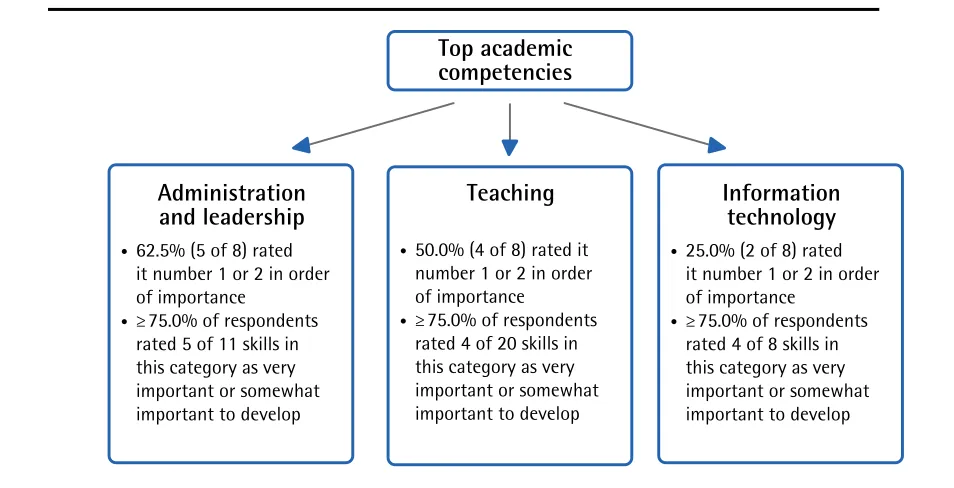
Figures 1 and 2 show the top 3 academic competencies identified as important by the 2 groups and include the number of skills within each competency that at least 75.0% of respondents rated as very important or some-what important to develop.
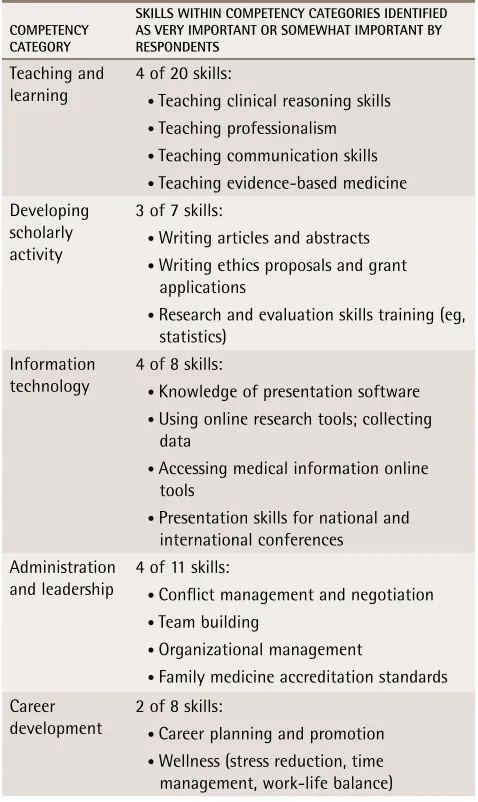
The skills identified as very important or somewhat important to develop by at least 75.0% of the group as a whole are shown in Table 1. In total, 17 of the 54 skills in the competency categories were considered impor-tant by both groups. In addition, 75.0% of faculty staff with less than 5 years of experience identified 37 of 54 skills as important to develop relative to 16 of 54 of the skills identified as important by faculty members with 5 or more years of experience.
With respect to the ratings of the other academic competencies, most faculty members in both groups indicated that these were very important or somewhat important (Table 2), with the exception of clinical skills among respondents with 5 or more years of experience.
DIScuSSION
The results showed that there were differences in per-sonal priorities and the desire for skill acquisition within the faculty. In terms of overall competencies, the pri-orities were different for new faculty and senior faculty; however, teaching remained a priority for faculty over the years. As would be expected, administration and leadership took on a higher priority with advancement in the academy.
Implementing an evidence-informed faculty development program
|
Research
acquired, and who might require guidance with setting priorities for their own career development. At the same time, addressing the changing needs of more senior fac-ulty might contribute to the development of leadership
within the department and help identify skills that are considered “lifelong” across the career of a faculty mem-ber that need to be addressed more frequently in the curriculum.
Figure 1.
Top 3 academic competencies identified by faculty members with less than
5 years of academic experience:
N=9.
Teaching
•
66.7% (6 of 9) rated it
number 1 or 2 in order
of importance
•
≥
75.0% of respondents
rated 17 of 20 skills in
this category as very
important or somewhat
important to develop
Top academic
competencies
Developing scholarly
activities
•
55.6% (5 of 9) rated it
number 1 or 2 in order
of importance
• ≥
75.0% of respondents
rated 6 of 7 skills in
this category as very
important or somewhat
important to develop
Career
development
•
44.4% (4 of 9) rated it
number 1 or 2 in order
of importance
• ≥
75.0% of respondents
rated 6 of 8 skills in
this category as very
important or somewhat
important to develop
Figure 2.
Top 3 academic competencies identified by faculty members with 5 or more
years of academic experience:
N=8.
Administration
and leadership
•
62.5% (5 of 8) rated
it number 1 or 2 in order
of importance
•
≥
75.0% of respondents
rated 5 of 11 skills in
this category as very
important or somewhat
important to develop
Top academic
competencies
Teaching
•
50.0% (4 of 8) rated it
number 1 or 2 in order
of importance
•
≥
75.0% of respondents
rated 4 of 20 skills in
this category as very
important or somewhat
important to develop
Information
technology
•
25.0% (2 of 8) rated
it number 1 or 2 in order
of importance
•
≥
75.0% of respondents
With respect to the other competencies that relate to this unique faculty and context, it was clear that the faculty rated them as highly important. The achievement of consensus as to the importance of these competen-cies was necessary in order to continue to work toward many of the department objectives that were based on these competencies.
To date, the evidence-informed professional improve-ment program that resulted from this needs-assessimprove-ment process and that was subsequently implemented facil-itated access to the development of skills in the fol-lowing areas: teaching (eg, examination of learners in difficulty, using the RIME [reporter, interpreter, manager, educator] method of student evaluation, integrating CanMEDS–Family Medicine competencies, knowledge of conflict resolution, and marking of simulated office orals and short-answer management problems); admin-istration and leadership (eg, interpersonal effectiveness, authentic leadership); and developing scholarly activi-ties (eg, scholarly activity retreats for residents and fac-ulty members).
Each of the professional improvement programs was evaluated. In addition to this, a second assessment of learning needs will be done in the fall of 2012.
The learning needs assessment was facilitated by faculty and staff in the Department of Academic Family Medicine. The design and implementation of the evidence-informed faculty development program were made possible through funding from the Department of Academic Family Medicine and Faculty Affairs of the College of Medicine at the University of Saskatchewan. This was an important collaboration, as many of the desired speakers and facilitators were from outside of Saskatchewan.
We are currently in the process of engaging the community faculty in a similar process; thus, devel-oping a faculty-centred, evidence-informed faculty development program that is designed to enhance the skills needed by the community faculty in the
Department of Academic Family Medicine at the University of Saskatchewan.
Table 1.
Skills in competency categories identified as
very important or somewhat important to develop by
at least 75.0% of respondents
CoMPeteNCy CAteGoRy
SKIllS WItHIN CoMPeteNCy CAteGoRIeS IDeNtIFIeD AS VeRy IMPoRtANt oR SoMeWHAt IMPoRtANt By ReSPoNDeNtS
Teaching and
learning 4 of 20 skills:• Teaching clinical reasoning skills
• Teaching professionalism
• Teaching communication skills
• Teaching evidence-based medicine
Developing scholarly activity
3 of 7 skills:
• Writing articles and abstracts
• Writing ethics proposals and grant
applications
• Research and evaluation skills training (eg,
statistics) Information
technology 4 of 8 skills:• Knowledge of presentation software
• Using online research tools; collecting
data
• Accessing medical information online
tools
• Presentation skills for national and
international conferences Administration
and leadership
4 of 11 skills:
• Conflict management and negotiation
• Team building
• Organizational management
• Family medicine accreditation standards
Career development
2 of 8 skills:
• Career planning and promotion
• Wellness (stress reduction, time
management, work-life balance)
Table 2
. Percentage of respondents who indicated that various academic competencies were very important or
somewhat important
CoMPeteNCy
% oF ReSPoNDeNtS WHo INDICAteD tHAt tHe CoMPeteNCy WAS VeRy oR SoMeWHAt IMPoRtANt
ReSPoNDeNtS WItH < 5 yeARS’ exPeRIeNCe (N = 9)
ReSPoNDeNtS WItH ≥ 5 yeARS’ exPeRIeNCe (N = 8)
International medical graduate education 100.0 87.5
Distributed education 88.9 75.0
Core competency curriculum for learners 88.9 100.0
Clinical skills 77.8 37.5
Aboriginal health education 100.0 100.0
Needs of rural and underserved populations 88.9 87.5
Implementing an evidence-informed faculty development program
|
Research
limitations
The limitation of this study is that the results are not generalizable; however, the processes are transferable.
Conclusion
The results of the learning needs assessment were used to shape a dynamic, evidence-informed faculty develop-ment program with full-time faculty in the Departdevelop-ment of Academic Family Medicine at the University of Saskatchewan. Future programs will continue to be dynamic, faculty-centred, and evidence-informed.
Dr Danilkewich is Associate Professor, Dr Kuzmicz is Assistant Professor,
Ms Greenberg is Clinical Faculty, Dr Gruszczynski is Assistant Professor,
Dr Hosain is Assistant Professor, and Dr McKague is Associate Professor, all in the Department of Academic Family Medicine at the University of Saskatchewan in Saskatoon. Ms Bonnycastle is Clinical Teaching Development Coordinator for the Education Support and Development pro-gram at the University of Saskatchewan. Ms McKay is Coordinator, Research Division, and Dr Ramsden is Associate Professor and Director, Research Division, both in the Department of Academic Family Medicine at the University of Saskatchewan.
Acknowledgment
The design and implementation of the evidence-informed faculty develop-ment program were made possible through funding from the Departdevelop-ment of Academic Family Medicine and Faculty Affairs of the College of Medicine at the University of Saskatchewan.
Contributors
Dr Danilkewich made substantial contributions to the concept of the study, the collection of data, and reviews of the manuscript. Dr Kuzmicz made substantial contributions to the concept of the study, the writing of the manuscript, and reviews of the manuscript. Ms Greenberg,Dr Gruszczynski, Dr Hosain, Dr McKague, and Ms Bonnycastle made substantial contributions to the concept of the study and reviews of the manuscript. Ms McKay made substantial con-tributions to data entry, data analysis, writing aspects of the manuscript, and reviews of the manuscript. Dr Ramsden was involved in all aspects of the proj-ect, from conception of the study to writing of the manuscript.
Competing interests None declared Correspondence
Dr Vivian R. Ramsden, Department of Academic Family Medicine, University of Saskatchewan, West Winds Primary Health Centre, 3311 Fairlight Dr, Saskatoon, SK S7M 3Y5; telephone 306 655-4214; fax 306 655-4895; e-mail [email protected]
References
1. Wilkerson L, Irby DM. Strategies for improving teaching practices: a comprehen-sive approach to faculty development. Acad Med 1998;73(4):387-96.
2. Harris DL, Krause KC, Parish DC, Smith MU. Academic competencies for medical faculty. Fam Med 2007;39(5):343-50.
3. McLeod PJ, Steinert Y, Conochie L, Nasmith L. A faculty-development needs assessment at one medical school. Acad Med 1997;72(6):558-9.
4. Quirk M, Lasser D, Domino F, Chuman A, Devaney-O’Neil S. Family medi-cine educators’ perceptions of the future of faculty development. Fam Med
2002;34(10):755-60.
5. Atchison TA. Managing change. Front Health Serv Manage 1999;16(1):3-29. 6. University of Saskatchewan [website]. Sites and divisions. Saskatoon, SK:
University of Saskatchewan; 2011. Available from: www.medicine.usask.ca/ family/sites-and-divisions. Accessed 2010 Aug 12.
7. College of Family Physicians of Canada. Standards for accreditation of residency training programs: family medicine; emergency medicine; enhanced skills; pallia-tive medicine. Mississauga, ON: College of Family Physicians of Canada; 2006. Available from: www.cfpc.ca/uploadedFiles/Education/Red%20Book%20 Sept.%202006%20English.pdf. Accessed 2012 May 3.
8. University of Saskatchewan [website]. Strategic plan. An introduction to the stra-tegic plan (2007-2012) for the Department of Academic Family Medicine. Saskatoon, SK: University of Saskatchewan; 2007. Available from: www.medicine.usask. ca/family/strategic-plan. Accessed 2009 Apr 25.
9. Alstete JW. Post-tenure faculty development: building a system for faculty improve-ment and appreciation. Vol. 27. No. 4. New York, NY: Jossey-Bass; 2000. 10. University of Saskatchewan [website]. Transforming teaching. Saskatoon, SK:
University of Saskatchewan; 2012. Available from: www.usask.ca/gmcte/ courses/transforming. Accessed 2012 May 4.
11. Clark M, Lester H, Glasby J. From recruitment to dissemination. The experience of working together from service user to professional perspectives. In: Lowes L, Hulatt I, editors. Involving service users in health and social care research. Oxford, UK: Routledge; 2005. p. 76-84.
12. Lowes L, Hulatt I, editors. Involving service users in health and social care research. Oxford, UK: Routledge; 2005.
13. Ramsden VR; Integrated Primary Health Services Model Research Team. Learning with the community. Evolution to transformative action research. Can Fam Physician 2003;49:195-7 (Eng), 200-2 (Fr).
14. Stigmar M. Faculty development through an educational action programme.
High Educ Res Dev 2008;27(2):107-20.
15. Marton F, Morris P, editors. What matters? Discovering critical conditions of class-room learning. Göteborg, Sweden: Acta Universitatis Göthoburgenus; 2002. 16. Rissel C. Empowerment: the holy grail of health promotion? Health Promot Int
1994;9(1):39-47.
17. Steinert Y. Faculty development: from workshops to communities of practice.
Med Teach 2010;32(5):425-8.
18. Grant J. Learning needs assessment: assessing the need. BMJ
2002;324(7330):156-9.
19. Elliott SN, DiPerna JC. Assessing the academic competence of college students: validation of a self-report measure of skills and enablers. J Postsecondary Educ Disabil 2002;15(2):87-100.