Analysis of chosen plaintext attacks on the WAKE Stream Cipher
Marina Pudovkina [email protected]
Moscow Engineering Physics Institute (Technical University) Department of Cryptology and Discrete Mathematics
Abstract. Stream ciphers are an important class of encryption algorithms, which are widely used in practice. In this paper the security of the WAKE stream cipher is investigated. We present two chosen plaintext attacks on this cipher. The complexities of these attacks can be estimated as 1019.2 and 1014.4.
Keywords. WAKE. Stream Cipher. Cryptanalysis.
1 Introduction
Symmetric cryptosystems can be subdivided into block and stream ciphers. Block ciphers operate with a fixed transformation on large blocks of plaintext data; stream ciphers operate with a time-varying transformation on individual plaintext digits. Typically, a stream cipher consists of a keystream generator whose pseudo-random output sequence is added modulo 2 to the plaintext bits. A major goal in stream cipher design is to efficiently produce random-looking sequences. But the keystream can be generated efficiently; there certainly exists such a simple description.
WAKE is the Word Auto Key Encryption algorithm, invented by David Wheeler [1]. It has a very simple description and produces a stream of 4n-bit words, which can be XORed with a plaintext stream to produce ciphertext, or XORed with a ciphertext stream to produce plaintext. It is fast on most modern computers, and relies on repeated table use and having a large state space. WAKE works in CFB mode; the previous ciphertext word is used to generate the next key word. It is being used in the current version of Dr. Solomon’s Anti-Virus program [5]. It is known that WAKE is insecure against a chosen plaintext or chosen ciphertext attack but descriptions and complexities of these attacks are unknown.
The aim of this paper is to describe two chosen plaintext attacks on WAKE that are intrinsic to the design principles of WAKE and are independent of the key scheduling. The complexities of these attacks can be estimated as 24n+28n for first and 24n+26n for second. Our algorithms become infeasible for n>8.
The paper is organized as follows. In section 2 we give a description of WAKE. In section 3 we discuss some properties of WAKE. Section 4 describes attacks on WAKE. We conclude in section 5.
2 Description of WAKE
uses a table T={T[0],…,T[2n-1] } of 2n 4n-bit words. This table T has a special property: the high-order n-bit of all the entries is a permutation of all possible n-bit words, and the low-high-order 3n-bit words are random.
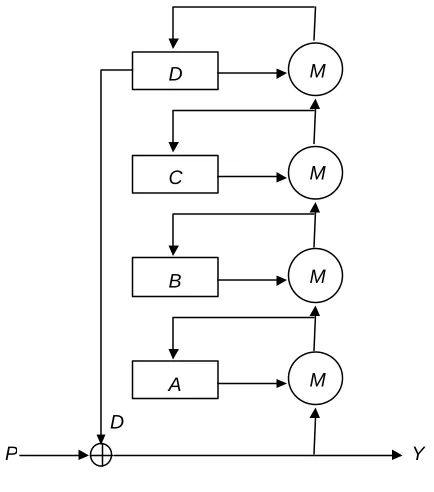
The internal state of WAKE at time t consists of four 4n-bit words at, bt, ct, dt. The table T and initial a0, b0, c0, d0 are generated from the key.
Let P=p1, p2,…, pL be a plaintext and Y=y1, y2,…, yL be a ciphertext The next-state and output functions of WAKE for every t are defined by The next-state function F
ai = M(ai-1,yi-1, T) bi = M(bi-1,ai, T) ci = M(ci-1,bi, T) di = M(di-1,ci, T)
The output-function zi = di
Encryption yi = zi⊕ pi Dencryption pi = zi⊕ ci
Thus, we have yi=F(yi-1, ai-1, bi-1, ci-1, di-1).
The transformation M(x, y, T) is an invertible transformation defined by: M(x, y, T) = (x + y) >> n ⊕ T[(x + y)(mod 2n)]. This is shown in Figure 1. The operation >> is a right shift, not a rotation.
D
Y P
A M
B M
C M
D M
3 Properties of WAKE
In this section we describe some properties of WAKE, which are important in the description of chosen plaintext attacks on this cipher.
Proposition 1
The transformation F(k, ai-1, bi-1, ci-1, di-1 ,T) where k∈{0,…,24n-1} is a permutation on {0,…,24n-1}.
Proof.
Note that M(x, y, T), where y∈{0,…,24n-1}, is a permutation on {0,…,24n-1} because if (x + y1) >> n ⊕ T[(x + y1)(mod 2n)]= (x + y2) >> n ⊕ T[(x + y2)(mod 2n)], where y1, y2∈{0,…,24n-1}, y1≠y2, then
T[(x + y1)(mod 2n)]= T[(x + y2)(mod 2n)], and
(x + y1) >> n=(x + y2) >> n. It follows that y1=y2.
Note that F(k, ai-1, bi-1, ci-1, di-1 ,T) is a composition of permutation and can be represented as follows:
F(k, ai-1, bi-1, ci-1, di-1 ,T)=M(ci-1, M(di-1, M( bi-1, M( ai-1, k)))). Therefore, F is a permutation on {0,…,24n-1}.
The proposition is proved.
Let ai(pi-k,pi-k+1,…, pi-1), bi(pi-k,pi-k+1,…, pi-1), ci(pi-k,pi-k+1,…, pi-1), di(pi-k,…, pi-1) be meanings of A, B, C, D registers at time i providing that pi-k,pi-k+1,…, pi-1 have been ciphered. Let yi(pi-k,…, pi-1, pi) be a ith word of a ciphertext at time i which is obtained after being ciphered pi-k,pi-k+1,…, pi.
Proposition 2
Let α∈Z n
2 .
1. The number of elements j such that di[j]>>3n=T[α] is 23n.
2. The number of elements j such that ci[j]>>3n=di[j]>>3n= T[α] is 22n.
3. The number of elements j such that bi[j]>>3n=ci[j]>>3n=di[j]>>3n= T[α] is 2n.
4. The number of elements j such that ai[j]>>3n=bi[j]>>3n=ci[j]>>3n=di[j]>>3n= T[α] is 1.
Proof.
Let us remark that by proposition 1
− −
] 1 2 [ ... ] [ ... ] 0 [
1 2 ... ...
0
4 4
n i i
i
n
d j
d d
j
is a permutation of all possible 4n-bit and the high-order n-bit of all the entries of T is a permutation of all possible n-bit
Thus, the number of elements j such that di[j]>>3n=T[α] is 23n =24n/2n. If ci[j]>>3n=di[j]>>3n=T[α], then
di[j]=( ci[j]+di-1) >> n ⊕ T[α],
α=(ci[j]+di-1) (mod 2n),
therefore, the second-order n-bit and the third-order n-bit of ci[j] are arbitrary. Thus, the number of elements j such that ci[j]>>3n=di[j]>>3n= T[α] is 22n.
If bi[j]>>3n =ci[j]>>3n=di[j]>>3n=T[α], then
ci[j]=( bi[j]+ci-1) >> n ⊕ T[α],
and the third-order n-bit of ci[j] is arbitrary, hence third-order n-bit of bi[j] is also arbitrary. It follows that the number of elements j such that bi[j]>>3n=ci[j]>>3n=di[j]>>3n= T[α] is 2n.
It is obvious that if ai[j]>>3n=bi[j]>>3n =ci[j]>>3n=di[j]>>3n=T[α], then there is the only bi[j]. The proposition is proved.
Proposition 3
The high-order n-bit of di(k+23n),…,di(k+r⋅23n),…,di(k+(2n-1)⋅23n) is a permutation on {0,…,2n-1}.
Proof.
Note that
ai(k+r⋅23n)=( k+r⋅23n+ai-1)>>n ⊕ T[(k+r⋅23n+ai-1)(mod 2n)]=( k+r⋅23n+ai-1)>>n ⊕ T[(k+ai-1)(mod 2n)]. Thus, ai(k+r⋅23n) (mod 22n)= ai(k+23n) (mod 22n), ai(k+r⋅23n)>>3n= ai(k+23n) >>3n, r=0…2n-1, and the third-order n-bit of ai(k+23n),…,ai(k+r⋅23n),…,ai(k+(2n-1)⋅23n) is a permutation on {0,…,2n-1}.
By
bi(k+r⋅23n)=(ai(k+r⋅23n)+bi-1)>>n ⊕ T[(ai(k+r⋅23n)+bi-1)(mod 2n)],
it follows that bi(k+r⋅23n) (mod 2n)= bi(k+23n) (mod 2n), bi(k+r⋅23n)>>3n= bi(k+23n) >>3n, r=0…2n-1. Using
ci(k+r⋅23n)=(bi(k+r⋅23n)+ci-1)>>n ⊕ T[(bi(k+r⋅23n)+ci-1)(mod 2n)], we get ci(k+r⋅23n)>>3n= ci(k+23n) >>3n, r=0…2n-1.
Let us remark that (ci(k+23n)+di-1)(mod 2n),…,(ci(k+r⋅23n)+di-1)(mod 2n),…,(ci(k+(2n-1)⋅ 23n)+di-1)(mod 2n) are all various, therefore the high-order n-bit of di(k+23n),…,di(k+r⋅23n),…, di(k+(2n-1)⋅23n) are different.
The proposition is proved.
Proposition 4
The high-order n-bit of ci(k+22n),…,ci(k+r⋅22n),…,ci(k+(2n-1)⋅22n) is a permutation on {0,…,2n-1}.
Proof.
By
ai(k+r⋅22n)=( k+r⋅22n+ai-1)>>n ⊕ T[(k+r⋅22n+ai-1)(mod 2n)], bi(k+r⋅22n)=(ai(k+r⋅22n)+bi-1)>>n ⊕ T[(ai(k+r⋅22n)+bi-1)(mod 2n)], ci(k+r⋅22n)=(bi(k+r⋅22n)+ci-1)>>n ⊕ T[(bi(k+r⋅22n)+ci-1)(mod 2n)], where r∈
n Z
2
, it follows that
ai(k+r⋅22n) (mod 2n)= ai(k+22n) (mod 2n), ai(k+r⋅22n)>>3n= ai(k+22n) >>3n, bi(k+r⋅22n)>>3n= bi(k+22n) >>3n,
and (bi(k+22n)+ci-1)(mod 2n),…,(bi(k+r⋅22n)+ci-1)(mod 2n),…,(bi(k+(2n-1)⋅ 22n)+ci-1)(mod 2n) are all various, therefore the high-order n-bit of ci(k+22n),…,ci(k+r⋅22n),…, ci(k+(2n-1)⋅22n) are different. The proposition is proved.
Remark
4 Attacks on WAKE
In this section we describe two chosen plaintext attacks on WAKE stream cipher.
First let us carry out an estimation of the unicity distance DWAKE of WAKE. Recall that the unicity distance is the number of keystream symbols that need to be observed in a known plaintext attack before the key can be uniquely determined. Note that the number of various states of WAKE is equal to 216n⋅
( ) n n 2
4
2 . Then we get that 216n⋅( ) n n 2
4
2 »(24n)DWAKE. Therefore, DWAKE »4+2n . Let pj (k) be a jth word of a plaintext which is equal to k, i.e. pj(k)=k. Let us denote with mark "*" elements of an output sequence {zi*} produced on a guessed state and the guessed table Ò. The method consists of three steps.
The first attack
Step 1
Choosek1, k2. (For example, k1=0, k2=0) 1. Encrypt p1(k1) to obtain y1(k1).
2. Determine d0= p1(k1) ⊕ y1(k1).
3. Encrypt p2(0), p2(1),…,p2(t),…,p2(24n-1) to obtain y2(k1, 0), y2(k1, 1),…., y2(k1, t),…, y2(k1, 24n-1).
4. Compute d1(k1)=y2(k1, 0) ⊕ p2(0).
5. Encrypt p3(0) to obtain y3(k1, 0, 0), y3(k1,1, 0),…., y3(k1, j, 0),…, y3(k1, 24n-1, 0). 6. Compute d2(k1, j)= y3(k1, j, 0) ⊕ p3(0), for j=1…2n.
Step 2
1. Guess c1(k1).
2. Compute α( k, c)= (d0+ c1(k1)) mod 2n.
3. Compute T[α(k, c)]= d1(k1) ⊕ (d0+ c1(k1))>>n. 4. Find jt, t=1…23n, such that d2(k1, jt)>>3n=T[α(k, c)].
5. Use d2(k1, jt)=(c2(k1, jt)+d1(k1))>>n ⊕ T[α(k, c)] to determine c2(k1, jt), where t=1…23n. 6. Find rt, t=1…22n, such that c2(k1, rt)>>3n=T[α(k, c)], rt∈{ j1,…, j23n}.
7. Use c2(k1, rt)=(b2(k1, rt)+c1(k1))>>n ⊕ T[α(k, c)] to determine b2(k1, rt). 8. Find βt, t=1…2n, such that b2(k1, βt)>>3n=T[α(k, c)], βt∈{ r1,…,r22n}.
9. Guess a1(k1).
10. Find β such that α(k, c)=(β+a1(k1)) (mod 2n). 11. Compute a2(k1, β)=(a1(k1)+β)>>n ⊕ T[α(k, c)].
Step 3 (Restoration of T)
1. Use a3(k1, βt)=( βt + a2(k1, k2+ k t
j ⋅22n+ k t
r ⋅23n))>>n ⊕ T[β3i + a2(k1, k2+ k t
j ⋅22n+ k t
r ⋅23n) (mod 2n)], i=1…2n, to determine T[0],…,T[2n-1].
2. Compute the first L = DWAKE of elements of the output sequence z1*, z2*,… zL*. If z1*= z1, z2*= z2,…zL*= zL, then we have found the correct initial state of the cryptosystem, otherwise return to step 2.
First note that in step 1 we compute 24n plaintexts and in step 2 the average of guessed elements is estimated 24n⋅24n=28n. Therefore, the complexity of the method is estimated Tm≈24n+28n.
We stress that the complexity of the brute force attack is equal to Tbr=216n⋅( ) n n 2
4
2 .
For n=8 used in practice the complexities are Tm≈1019.2 and Tbr≈3⋅102504.
Now we describe another attack on WAKE. The complexity of this attack is smaller than the complexity of the previous attack but the number of used plaintexts is larger.
The method also consists of three steps.
The second attack
Step 1
Choosek1, k2. (For example, k1=0, k2=0) 1. Encrypt p1(k1) to obtain y1(k1).
2. Determine d0= p1(k1) ⊕ y1(k1).
3. Encrypt p2(k2), p2(k2+23n),…,p2(k2+r⋅23n),…,p2(k2+(2n-1)⋅23n), p2(k2+22n), p2(k2+22n +23n),…, p2(k2+22n+r⋅23n),…,p2(k2+22n+(2n-1)⋅23n),…,p2(k2+j⋅22n+23n),…,p2(k2+j⋅22n+r⋅23n),…,p2(k2+ j⋅22n+(2n-1)⋅23n),…,p2(k2+(2n-1)⋅22n+23n),…,p2(k2+(2n-1)⋅22n+r⋅23n),…,p2(k2+(2n-1)⋅22n+(2n -1)⋅23n) to obtain y2(k1, k2+j⋅22n+r⋅23n) for all j, r∈
n Z
2
. (We have encrypted 22n of words.) 4. Compute d1(k1)=y2(k1, k2) ⊕ p2(k2).
5. Encrypt p3(0), p3(1),…,p3(t),…,p3(24n-1) to obtain y3(k1, k2+j⋅22n+r⋅23n, 0), y3(k1, k2+j⋅22n+r⋅23n, 1),…., y3(k1, k2+j⋅22n+r⋅23n, t),…, y3(k1, k2+j⋅22n+r⋅23n, 24n-1) for all j, r∈
n Z
2 . 6. Compute d2(k1, k2+j⋅22n+r⋅23n)= y3(k1, k2+j⋅22n+r⋅23n, 0) ⊕ p3(0) for all j, r∈
n Z
2 .
7. Encrypt p4(0) to obtain y4(k1, k2+j⋅22n+r⋅23n, 0, 0), y4(k1, k2+j⋅22n+r⋅23n,1, 0),…., y4(k1, k2+j⋅22n+r⋅23n, j, 0),…, y4(k1, k2+j⋅22n+r⋅23n, 24n-1, 0) for all j, r∈
n Z
2 .
8. Compute d3(k1, k2+j⋅22n+r⋅23n, t)= y4(k1, k2+j⋅22n+r⋅23n, t, 0) ⊕ p4(0), for all j, r, t∈ n Z
2 .
Step 2
1. Guess c1(k1).
2. Compute α( k, c)= (d0+ c1(k1)) mod 2n.
3. Compute T[α(k, c)]= d1(k1) ⊕ (d0+ c1(k1))>>n.
4. Find jt, rt, t=1…2n, such that d2(k1, k2+jt⋅22n+rt⋅23n)>>3n=T[α(k, c)].
5. Use d2(k1, k2+jt⋅22n+rt⋅23n)=(c2(k1, k2+jt⋅22n+rt⋅23n)+d1(k1))>>n ⊕ T[α(k, c)] to determine c2(k1, k2+jt⋅22n+rt⋅23n), where t=1…2n.
6. Find k t
j , k t
r such that c2(k1, k2+ k t
j ⋅22n+ k t
r ⋅23n)>>3n=T[α(k, c)], k t
j ∈{ j1,…, j2n},
k t
r ∈{ r1,…, r2n}. (By proposition 3 and proposition 4
k t j , k t r exist.) 7. Use c2(k1, k2+
k t
j ⋅22n+ k t
r ⋅23n)=(b2(k1, k2+ k t
j ⋅22n+ k t
r ⋅23n)+c1(k1))>>n ⊕ T[α(k, c)] to determine b2(k1, k2+
k t
j ⋅22n+ k t
r ⋅23n). 8. Find β1s, s=1…23n such that d3(k1, k2+
k t
j ⋅22n+ k t
9. Use d3(k1, k2+ k t j ⋅22n+
k t
r ⋅23n, β1s)=(c3(k1, k2+ k t j ⋅22n+
k t
r ⋅23n, β1s)+d2(k1, k2+ k t j ⋅22n+
k t
r ⋅23n))>>n ⊕ T[α(k, c)] to determine c3(k1, k2+ k t
j ⋅22n+ k t
r ⋅23n, β1s), where s=1…23n. 10. Find β2i, i=1…22n, such that c3(k1, k2+
k t
j ⋅22n+ k t
r ⋅23n, β2i)>>3n=T[α(k, c)], β2i∈{ β11,…,
β123n}.
11. Use c3(k1, k2+ k t
j ⋅22n+ k t
r ⋅23n,β2i)=(b3(k1, k2+ k t
j ⋅22n+ k t
r ⋅23n, β2i)+ c2(k1, k2+ k t
j ⋅22n+
k t
r ⋅23n))>>n ⊕ T[α(k, c)] to determine b3(k1, k2+ k t
j ⋅22n+ k t
r ⋅23n, β2i), where i=1…22n. 12. Find β3i, i=1…2n, such that b3(k1, k2+
k t
j ⋅22n+ k t
r ⋅23n, β3i)>>3n=T[α(k, c)], β3i∈{ β21,…,
β2 2n 2 }.
13. Use b3(k1, k2+ k t j ⋅22n+
k t
r ⋅23n,β3i)=(a3(k1, k2+ k t j ⋅22n+
k t
r ⋅23n, β3i)+ b2(k1, k2+ k t j ⋅22n+
k t
r ⋅23n))>>n ⊕ T[α(k, c)] to determine a3(k1, k2+ k t
j ⋅22n+ k t
r ⋅23n, β3i), where i=1…2n. 14. Find β4 such that a3(k1, k2+
k t
j ⋅22n+ k t
r ⋅23n, β4)>>3n=T[α(k, c)], β4∈{ β31,…, β3 n 2 }. 15. Use a3(k1, k2+
k t
j ⋅22n+ k t
r ⋅23n,β4)=( β4+ a2(k1, k2+ k t
j ⋅22n+ k t
r ⋅23n))>>n ⊕ T[α(k, c)] to determine a2(k1, k2+
k t
j ⋅22n+ k t
r ⋅23n).
Step 3 (Restoration of T) 1. Use a3(k1, k2+
k t
j ⋅22n+ k t
r ⋅23n,β3i)=(β3i + a2(k1, k2+ k t
j ⋅22n+ k t
r ⋅23n))>>n ⊕ T[β3i + a2(k1, k2+
k t
j ⋅22n+ k t
r ⋅23n) (mod 2n)], i=1…2n, to determine T[0],…,T[2n-1].
2. Compute the first L = DWAKE of elements of the output sequence z1*, z2*,… zL*. If z1*= z1, z2*= z2,…zL*= zL, then we have found the correct initial state of the cryptosystem, otherwise return to step 2.
Let us estimate the complexity of the method. Note that in step 1 we compute 26n plaintexts and in step 2 the average of guessed elements is estimated 24n. Therefore, the complexity of the method is estimated Tm≈24n+26n. For n=8 used in WAKE the complexities are Tm≈1014.4 and Tbr≈3⋅102504.
5 Conclusion
We have presented two chosen plaintext attacks on the WAKE stream cipher. The complexity of fist attack is 1019.2 and the second attack is 1014.4 but the complexity of the brute force attack is 3⋅102504.
Our results are intrinsic to the design principles of WAKE and are independent of the key scheduling. We believe improvements to these attack are possible. Although the attacks are by far not practical, it gives new intrinsic insight into the algorithm.
References
[2] Clapp C., “ Optimizing a Fast Stream Cipher for VLIW, SIMD, and Superscalar Processors”, Fast Software Encryption (Ed. S. Vaudenay), LNCS 1372, Springer-Verlag, 1998.
[3] Pudovkina M. “Cryptanalysis of the Vesta-2M Stream Cipher ”, presented at the Rump Session, Eurocrypt’2001, Innsbruck, Tyrol, Austria, May 6-10, 2001
[4] Varfolomeev A.A., Zhukov A.E., Pudovkina M., ''Analysis of Stream Ciphers '', Moscow, 2000. [5] Schneier B. Applied Cryptography, John Wiley&Sons,1996.
[6] Varfolomeev, A.A., Pudovkina M. “A Cycle Structure of the Solitaire Keystream Generator”. 3nd International Workshop on Computer Science and Information Technologies CSIT’2001, YFA, 2001