BACTERIOPHAGE LAMBDA
11. A MUTATION WHICH CAUSES HOT SPOT ACTIVITY
STEPHEN T. LAMI, MARY M. STAHL, KENNETH D. McMILIN2
AND FRANKLIN W. STAHL
Institute of Molecular Biology, Uniuersity of Oregon, Eugene, Oregon 97403
Manuscript received December 28, 1974
ABSTRACT
Crosses have been performed which identify phage mutants (chi) which cause recombinational hot spot activity in A. The hot spot activity is found i n crosses of red- gam- chi- strains in rec+ hosts; i n the crosses reported here, both the chi- mutations and the hot spot are located near the right end of the chromosome. The hot spot occurs in standard crosses as well as under conditions which block DNA synthesis, and is dependent on a functional host reCB gene. -The chi mutation is shown to be dominant, but the tests do not show whether chi is a gene or a site.
G E N E T I C recombination in bacteriophage A proceeds via three different sys- tems; the host ( E . coli) Rec system, and the phage Red and Int systems. Rec and Red are general recombination systems, while Int is site-specific (SIGNER
1971).
MCMILIN and Russo (1972) developed a technique for conducting genetic crosses of h in the almost complete absence of DNA duplication-a combined effect of mutations in the host dnaB gene and either the 0 o r P gene of the phage. This technique of “double-block” crosses was used by MCMILIN, STAHL and
STAHL (1974) to survey for Rec-mediated recombinational hot spot activity in A.
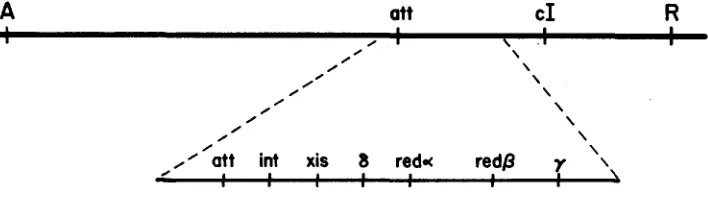
To single out the Rec system, they used phage strains which had the entire h
recombination region deleted (Figure 1 ) and were phenotypically Spi- ( LIN-
A
att CIR
I 0 t \ I -I
0 \
0
0 \
0
, \
0 \
0° att int xis 8 red& redp y \
/ 1 I I I 1
I I I I I
FIGURE 1.-Map of phage A. Genes int through y constitute the recombination region.
Present address: Biology Department, University of Utah, Salt Lake City, Utah.
426 s. T. LAM et al.
DAHL et a1 1970). Their results with pure deletion (as opposed to insertion-dele- tion) phage show recombinational hot spot activity located near the right end of the h chromosome.
Several years ago, however,
D. HENDERSON
(personal communication) de- scribed a mutation which has the primary phenotype of conferring large plaque size on Spi- deletion mutants. He observed that his Spi- mutants were small plaque formers when first isolated, but that standard techniques inevitably re- sulted in stocks which were composed of large plaque forming phage-phage which carried HENDERSON’S Spi--associated mutation.Thus, HENDERSON’S mutation should have been present in the deletion strains which exhibited recombinational hot spot activity near the right end of the chromosome, and the present work confirms its occurrence in the b1453 strains of MCMILIN, STAHL and STAHL (1974). For reasons outlined in the DISCUSSION, we considered it likely that
HENDERSON’S
mutation was in fact responsible for the recombinational hot spot activity. I n the present paper we test this notion and further characterize the properties of HENDERSON’S mutation.Our first technical hurdle was to construct nearly isogenic phage strains, one set of which contained HENDERSON’S mutation, the other set of which did not. This was facilitated by an observation which had earlier been made in this lab- oratory.
JEAN
CRASEMANN (personal communication) noted that, grown in a nSu- host, a red3 gam210 point mutant would pick up a mutation-presumably
HENDERSON’S mu tation-which converts the strain to a large plaque former.
This led us to suspect that red- gam- strains carrying HENDERSON’S mutation would in addition exhibit recombinational hot spot activity. On thr? other hand, it is possible to maintain red3 gam210 strains on a Su+ host and keep them free of HENDERSON’S mutation (see STAHL et al. 1974).
In every experiment reported here, all of the phage strains carried the red3 gam210 mutations-though the reader will not always be reminded of this fact. I n the basic experiment, a pair of strains, each carrying HENDERSON’S mutation, is crossed under conditions such that hot spot activity could be observed; simul- taneously, a second pair of strains, each free of HENDERSON’S mutation, is sim- ilarly crossed. The observation of hot spot activity involves a measurement of the fraction of J+-R+ recombinants occurring in the cl-R interval as compared with the fraction occurring in the J-cl interval. The latter interval includes att,
the site of action of the Int system. Interpretation of some of the results must bear this in mind.
Following the Greek tradition of lambdologists, we shall hereafter refer to
HENDERSON’S mutation as chi (which can be thought of as the crossover hot-spot instigator). Thus wild-type phage are chi+, and chi- phage carry the mutation.
MATERIALS A N D METHODS
Bacterial strains: The Escherichia coli strains used in this work are described in the companion papers or in Table 1. All dnaB- strains carry a temperature-sensitive mutation in the dnaB gene and were grown at 26”. In addition, TO40 was grown in the dark.
Chi
TABLE 1
Bacterial strains used and not described in cosmpanion papers
E . coli strain Properties Reference Source FA22 Su+, r e c B f , d d - FANGMAN and NOVICK 1968 NOVICK
TO22 Su-, reCB+, d d - IRA HERSKOWITZ IRA HEFLSEOWITZ
TO40 Su-, recB-, dnaB- JEAN CRASEMANN and JEAN CRASEMANN
(personal communication)
IRA HEFSKOWITZ
(personal communication)
STAHL and STAHL (1974). Phage carrying red3 gam210 exhibit the Spi- and Fec- phenotypes in Su- hosts. The chi41 and chi22 mutations arose spontaneously and independently in the
b1453 strains of MCMILIN, STAHL and STAHL (1974).
The strains tsAl4 red3 gam210 cl26 amp80 and red3 gam210 amp80 tsR2 were constructed by UV-stimulated crosses (Table 2, line 1). The construction of chi- analogs of these strains proceeded as follows: Strains tsAl4 b1453 cl26 amp80 chi41 and b1453 amp80 tsR2 chi22
(from KEN MCMILIN) were crossed with red3 gam210 phage which had been UV-irradiated. Unconditional Fec- recombinants (i.e., b1453) were selected against by plating on a Su+ recA-
host, facilitating the recovery of the desired recombinants (Table 2, line 2). P+ derivatives of these chi- strains were obtained by picking revertants which plated on a Su- host (Table 2, line 3 ) . P f derivatives of the chi+ strains were constructed by recombination (Table 2, line 4).
In order to construct the strain tsAl4 red3 gam210 c126 amp80 chi22 (Table 2, line 5), the strain tsAl4 red3 gam210 cl26 amp80 tsR2 chi22 was first constructed from a UV-stimulated cross. An R+ revertant of the double t s mutant was then selected by plating a t 37", taking ad- vantage of the fact that tsA14 plates at 37" (though not at 42"), while tsR2 does not.
I n order to construct the strain red3 gam210 amp80 tsR2 chi41 (Table 2, line 5 ) , the strains
tsA14 red3 gam210 amp80 tsR2 chi41 and red3 gam210 cl26 amp80 chi41 were first constructed. The recombinant progeny from a UV-stimulated cross of these latter two strains yielded the desired strain.
The chi+ strains were a t all times maintained on Su+ hosts. All phage stocks were made on C600, except for the density labeled stocks used in Figure 2, which were made by our standard techniques (see the companion papers).
Execution of experiments: Crosses in which DNA synthesis was blocked were performed as described in STAHL et al. (1974) and MCMILIN, STAHL and STAHL (1974) (see also MCMILIN and Russo 1972). Crosses in which DNA synthesis was not blocked differed in that a lO4-fold dilution was carried out after the adsorption period. All crosses in temperature sensitive dn&-
hosts were carried out at 39"; in dnaB+ hosts at 37". The lysates were plated on bacterial strain
C600. The total phage platings were incubated at 30"; the tsf recombinant phage platings a t 42".
TABLE 2
Phage genoiypes used
1 . tsA14 cl26 amp80 amp80 tsR2
2. tsAl4 e126 amP8O chi41 amP80 tsR2 chi22
3. tsAl4 cl26 chi41 tsR2 chi22
4. isAI4 e126 tsR2
5 . tsAl4 cl26 amP8O chi22 amP80 tsR2 chi41
In addition to the indicated mutations, all of the phage strains listed here carried red3 gam210.
428 s. T. LAM et al.
RESULTS
The chi mutation causes recombinational hot spot activity
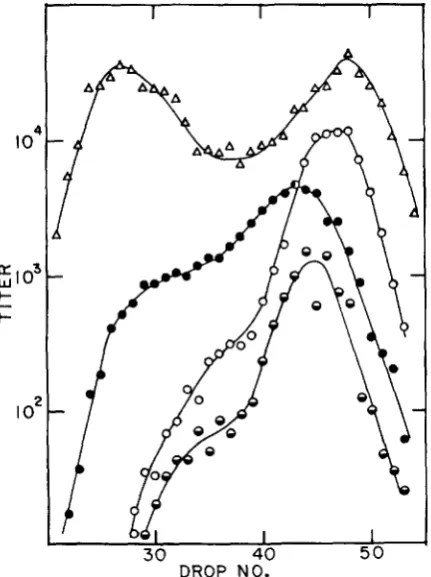
Our first task was to determine whether or not recombinational hot spot ac- tivity actually occurred with red3 gam210 chi- strains and if so, to determine the location of the hot spot. Figure 2 presents the results of a heavy-by-light cross designed to survey the chromosome between genes A and R for a possible recom- binational hot spot; synthesis was blocked by the double-block technique. Den- sity labeled tsA cl chi41 was crossed with non-labeled tsR chi22. The skewed distribution of A+ R+ recombinants indicates recombinational hot spot activity located near the right end of the chromosome, predominantly in the cl-R inter- val.
Is the chi mutation responsible for the recombinational hot spot activity? To
answer this question, a pair of double-deck crosses were carried out in FA77,
one cross being chi+ (tsA cl x tsR), the other chi- ( t s A c l chi41 x tsR chi22).
FIGURE 2.-Cesium density gradient of the lysate from a double-block cross in FA77 of t d
cl chi41 x tsR chi22. The total phage ( A ) were assayed at 30"; IS+ phage at 42". Clear IS+ phage
( a )
correspond to A 4 interval recombinants, turbid is+ ( 0 ) correspond to cl-R in- terval recombinants, and mottled ts+ (@) correspond to events a t the cl locus. The c-R/A-clTABLE 3
cl-RIA-cl ratio
I.hc number Host DNA synthesis chi+ chi-
1 FA7 7 double block 0.26 4.8
2 594 P- block 0.22 3.8
3 594 no block 0.15 1.6
4 C60.0 no block 0.18 0.59
5 FA22 dnaB- block 0.39 1.3
All experiments were crosses of tsA cI X tsR in parallel with tsA cl chi41 X tsR chi22, with one exception. In FA22 the chi- cross was tsA cI chi22
x
tsR chi22. In addition, the phage were always red3 gam210 and occasionally amP80, as indicated in the text. Among the ts+ recombi- nants in each lysate, the ratio of turbids to clears (cI-R/A-cI ratio) is taken as a measure of thecl-R interval recombinational hot spot activity. Please note, however, that this measure of the hot spot activity has a potential flaw. Above a certain level it might fail to reflect increases in the “absolute” level of the hot spot activity. This follows from the fact that the hot spot activity appears to extend to the left of the CI marker, so that, above a cxtain level, an increase in the level of the cI-R interval crossovers might be accompanied by a proportionate increase in the
A-cl interval crossovers,
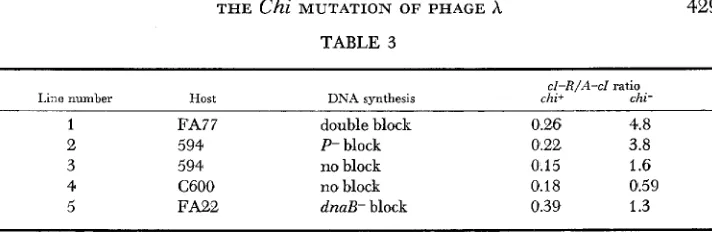
From each cross the resulting ts+ recombinants were scored as clear ( c l - ) and turbids ( c l + ) , corresponding, respectively to A-cl and cl-R interval crossovers. The ratio of turbids to clears (cl-&’A-cl ratio) is taken as a measure of the re- combinational hot spot activity. The results (Table 3, line 1 ) indicate that the chi mutation is essential for this recombinational hot spot activity. Strictly speak- ing, the experiments presented here show only that the chi mutation or some other mutation inherited with it during the strain construction is responsible for hot spot activity. Experiments by JEAN CRASEMANN (manuscript in prepara- tion), however, show that chi- mutations can occur at widely scattered points on the h chromosome and that recombinational hot spot activity in their imme- diate vicinity is always observed. The ratio cl-R/A-cl of the physical lengths of the intervals is roughly 0.2 or 0.3; the chi+ ratio is that expected for a uniform distribution of crossovers; the chi- ratio corresponds to roughly an 18-fold excess of cl-R interval crossovers.
Two crosses identical to those above were repeated, with the exception that the host was 594 and D N A synthesis was blocked solely by the h a m p 8 0 muta- tion. The results (Table 3, line 2) confirm that the chi mutation is essential for the recombinational hot spot activity,
Since it is known that under certain ( r e d + ) conditions, the absence of
D N A
synthesis causes a non-uniform distribution of recombination events ( STAHLet a2 1972b), we wanted to know if the effect of the chi mutation would persist when extensive D N A synthesis is allowed. To answer this question, P + phage strains were constructed as described in MATERIALS AND METHODS. Crosses iden- tical to those described above, but now using the P+ strains, were carried out in 594. The data (Table 3, line 3 ) show nearly a n 1 1 -fold increase in the chi-cI-R/
A-cl ratio over the chi+ ratio; the chi mutation apparently causes recombina- tional hot spot activity even in the presence of extensive D N A synthesis.
430 s. T. LAM et al.
TABLE 4
cl-R/A-cl ratio
Host DNA synthesis recB chi+ chi-
TO22 double block
+
0.82 3.9TOW double block - 0.26 0.33
JC4693 no block
+
0.16 1.8JC4695 no block
-
0.13 0.18All chi+ crosses were tsA cl X tsR. The double-block chi- crosses were tsA cl chi22
x
tsR chi22.The "no block" chi- crosses were tsA cl chi41
x
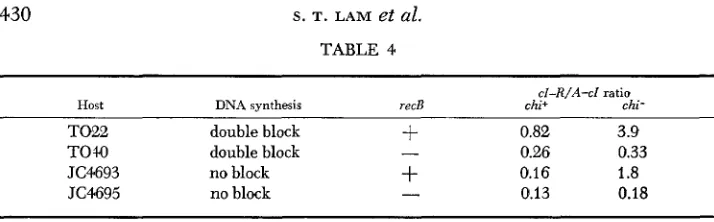
tsR chi22. In addition, the red3 gam210 mutations were always present, and the a d 8 0 mutation was present in the double block crosses. Among thets+ recombinants in each lysate, the ratio of turbids to clears (cl-R/A-cl ratio) is taken as a measure of the cl-R interval recombinational hot spot activity.
to know if the effect of the chi mutation would persist when the gam gene is ex- pressed. Two variations on our basic experiment provide our answer to this ques- tion. In one, the host was C600, in the other, FA22. In C600 there was no block to DNA synthesis; in FA22, the dnaB block. In each case, the gam210 mutation was suppressed, making the cross phenotypically red- gam+. (The susP80 phage strains were used here, but this mutation too was suppressed.) The results (Table 3, lines
4
and 5 ) indicate that the presence of gam product tends to reduce therecombinational hot spot activity. Since gam product is known to inhibit the ac- tivity of the recB-recC DNase ( S A K A K I et al. 1973) this result suggests a require- ment for a functional reCB gene in the hot spot activity.
To pursue this possibility, crosses were done in recB- hosts, with simultaneous
reCB+ control crosses. Two sets of experiments were performed, one set under double-block conditions, the other set under conditions where DNA synthesis was not blocked. The data (Table
4)
show that similar results were obtained for both sets: the effect of chi on the ratio of recombinants was lost when the recB gene was not functional.Crosses in which only one parent has the chi mutation
In order to test the chi mutation for dominance, crosses were carried out in which only one of the phage parent strains was chi-. The data are shown in
Table 5. The fully chi- control is represented by the cross tsA chi41 X tsR chi22. Two crosses o f the type tsA chi+ X tsR chi- were carried out-one employing
TABLE 5
tsA chi+ tsA chi41 isA chi22
tsR chi+ tsR chi22 tsR chi41
0.12 0.72 0.69
2.8 2.8
2.6
chi22, the other chi41. In both cases the
cl-R/A-cl
ratio is essentially identical to the fully chi- control. Similarly, two crosses of the typetsA
chi- XtsR
chi+
were carried out-employing alternately chi22 and chi41. Both of these crosses yield essentially the sameCZ-R/A-cl
ratio, which is somewhat reduced from that of the fully chi- control, but nevertheless quite distinct from that of the control where both parents were chi+. Taken all together, these results indicate that chi- is dominant over chi+, and they suggest that there might be an asymmetry inthe chi-instigated recombination process. That is, the apparent hot spot activity, judged from the
cl-R/A-cl
ratio, is greater if only thetsR
parent ischi-,
then it is if only thetsA
parent is chi-, in crosses of the typetsA
cl XtsR.
It was noticed when scoring the
A+R+
recombinants, that plaques from the crossestsA
X tsR,tsA
XtsR
chi22, andtsA
XtsR
chi41 were predominantly small, while those from the crossestsA
chi41 XtsR
chi22,tsA
chi4l XtsR,
andtsA
chi22 X tsR were predominantly large. Presumably, a small plaque pheno- type indicates a chi+ genotype, and a large plaque phenotype indicates a chi- genotype. Therefore, almost all the crossovers that generatedA+R+
recombi- nants occurred to the left of the chi mutation-be it chi22 or chi41. Thus, both chi22 and chi41 map near theR
gene. Deletion mapping has confirmed the loca- tion of these two chi mutations nearR
(J.
CRASEMANN,
personal communica- tion).DISCUSSION
In the accompanying paper
(MCMILIN,
STAHL and STAHL (1974) it is shown that Spi- deletion phage strains exhibit Rec-mediated recombinational hot spot activity near the right end of the chromosome. The present report shows that similar hot spot activity in red-gam- point mutant strains is caused by a mutation(HENDERSON’S
mutation) which we have named chi. By implication, the hot spot activity associated with the Spi- deletions was probably caused by chi mu- tations.We conclude that the hot spot activity is Rec-mediated because
(1)
the phage Red system is eliminated by mutation, and(2)
the phage Int system acts only at the att site and thus could not contribute tocl-R
interval crossovers. Furthermore, we have demonstrated that the hot spot activity is lost in the absence of a func- tional recB gene. This suggests that the effect of chi in producing recombinational hot spot activity is mediated through the RecBC pathway, as opposed to the possibility that chi activates some minor recombination pathway which is inde- pendent of the recB gene. While ruling out the notion that chi-stimulated recombination is independent of recB, our experiments fail to determine whether the residual generalized recombination in reCB- crosses (or gam+ crosses) involv- ing chi is concentrated in thecl-R
interval. Analagous crosses using phage which are additionally i n t are in progress to explore this question.432 s. T. LAM et al.
Finally. we wish to consider what the role of the chi mutation might be in increasing the plaque size of red- gam- mutant strains. In particular, does the recombinational hot spot activity have anything to do with the plaque size in- crease? We believe the answer to be Yes. Growing in RecA- recB+ hosts, red- gam- phage mature an abnormally small fraction of the DNA which they syn- thesize (ENQUIST and
SKALKA
1973) and do not form plaques (ZISSLER, SIGNERand SCHAEFER 1971). Under these conditions the DNA is apparently trapped as a monomer, since both the recombination and rolling circle routes to multimer Iormation are blocked, and normal h DNA cannot mature from a monomer
(SZPIRER and
BRACHET
1970; STAHL et al. 1972a; ENQUIST and SKALKA 1973;FREIFELDER, CHUD and LEVINE 1974; FEISS and MARQULIES 1973). I n r e d + recB+ hosts, however, the Rec system apparently produces enough multimers that red-gam- (chi+) phage grow and € o m plaques, but the plaques are typically very small. We suspect that the small size of these plaques is due to the low level of maturable, multimeric DNA produced by the Rec system under these condi- tions. In the presence of the chi mutation, however, the Rec system produces a greater level of maturable DNA. We imagine that either the absolute level of Rec recombination is greater under chi- as compared to chi+ conditions, or else the products of chi- recombination are inherently more maturable than are the products of chi+ recombination.
We wish to thank DAVID HENDERSON, DHRUBA CHATTORAJ, JEAN CRASEMANN, DARYL FAULDS, JEFF HAEMER, BOB MALONE and JEFF SIEGEL for their enthusiastic support. This work was sup- ported by Research grant number GB8109 from the National Science Foundation and by Pro- gram Project grant number GM15423 (AARON NOVICK, Project Director) from the National Institutes of Health. K. D. M. is a Predoctoral Trainee on Training grant number GM 00715 from the National Institutes of Health. Most of the experiments reported herein are from a thesis submitted by ST.L. in partial fulfillment of requirements for a B.A. degree from the Honors College, University of Oregon.
LITERATURE CITED
ENQUIST. L. W. and A. SKALKA, 1973 Replication of bacteriophage X DNA dependent on the function of host and viral genes. I. Interaction of red, gam and rec. J. Molec. Biol. 75: 185- 212.
FANGMAN. W. and A. NOVICK, 1968 Characterization of two bacterial mutants with tempera- ture-sensitive synthesis of DNA. Genetics 60: 1-17.
FEISS, M. and T. MARGULIES, 1973 On maturation of the bacteriophage lambda chromosome. Molec. Gen. Genet. 127: 285-295.
FREIFELDER, D., L. G u n and E. LEVINE, 1974 Requirement for maturation of Escherichia coli
bacteriophage lambda. J. Mol. Biol. 83: 503-509.
LINDAHL. G., G. SIRONI, H. Bialy and R. CALENDAR, 1970 Bacteriophage lambda; abortive in- fection of bacteria lysogenic for phage P2. Proc. Natl. Acad. Sci. U.S. 66: 587-594. MCMILIN, K. D. and V. E. A. RUSSO, 1972 Maturation and recombination of bacteriophage
lambda DNA molecules in the absence of DNA duplication. J. Molec. Biol. 68: 49-55. MCMILIN. K. D., M. M. STAHL and F. W. STAHL, 1974 Rec-mediated recombinational hot spot
SAKAKI, Y., A. E. KARU, S. LINN and H. ECHOLS, 1973 Purification and properties of the y-pr3tein specified by bacteriophage A: an inhibitcc of the host recBC recombination en- zyme. Proc. Natl. Acad. U.S. 70: 2215-2219.
SIGNER, E., 1971 General recombination, pp. 139-174. In: T h e Bacteriophage Lambda. Edited by A. D. HERSHEY. Cold Spring Harbor Laboratory.
STAHL, F. W., K. D. MCMILIN, M. M. STAHL, R. E. MALONE, Y. Nozu and V. E. A. Russo, 1972a A role for recombination in the production of “free-loader” lambda bacteriophage particles. 5. Molec. Biol. 68: 57-67.
STAHL, F. W., K. D. MCMILAN, M. M. STAHL and Y. Nozu, 1972b An enhancing role for DNA synthesis in formation of bacteriophage lambda recombinants. Proc. Natl. Acad. Sci. U.S. 69: 3598-3601.
The dis- STAHL, F. W., K. D. MCMILIN, M. M. STAHL, J. M. CRASEMANN and S. LAM, 1974
tribution of crossovers along unreplicated lambda bacteriophage chromosomes. Genetics 77: . . - . . .
SZPIRER, J. and PH. BRACHET, 1970
ZISSLER, J., E. SIGNER and F. SCHAEFER, 1971
Relations physiologiques entre les phages temp&& 1 e t W30. Molec. Gen. Genet. 108: 78-92.
The role of recombination in growth of bacterio- phage lambda. I. The gamma gene. pp. 465-468. The Bacteriophage Lambda. Edited by A. D. HERSHEY. Cold Spring Harbor Laboratory.