
with Sequences of Games
Bruno Blanchet and David Pointcheval
CNRS, ´Ecole Normale Sup´erieure, Paris –{blanchet,pointche}@di.ens.fr
Abstract. This paper presents the first automatic technique for proving not only protocols but also primitives in the exact security computational model. Automatic proofs of crypto-graphic protocols were up to now reserved to the Dolev-Yao model, which however makes quite strong assumptions on the primitives. On the other hand, with the proofs by reductions, in the complexity theoretic framework, more subtle security assumptions can be considered, but security analyses are manual. A process calculus is thus defined in order to take into account the probabilistic semantics of the computational model. It is already rich enough to describe all the usual security notions of both symmetric and asymmetric cryptography, as well as the basic computational assumptions. As an example, we illustrate the use of the new tool with the proof of a quite famous asymmetric primitive: unforgeability under chosen-message attacks (UF-CMA) of the Full-Domain Hash signature scheme under the (trapdoor)-one-wayness of some permutations.
1
Introduction
There exist two main frameworks for analyzing the security of cryptographic protocols. The most fa-mous one, among the cryptographic community, is the “provable security” in the reductionist sense [8]: adversaries are probabilistic polynomial-time Turing machines which try to win a game, specific to the cryptographic primitive/protocol and to the security notion to be satisfied. The “computational” security is achieved by contradiction: if an adversary can win such an attack game with non-negligible probability, then a well-defined computational assumption is invalid (e.g., one-wayness, intractabil-ity of integer factoring, etc.) As a consequence, the actual securintractabil-ity relies on the sole validintractabil-ity of the computational assumption. On the other hand, people from formal methods defined formal and ab-stract models, the so-called Dolev-Yao [21] framework, in order to be able to prove the security of cryptographic protocols too. However, these “formal” security proofs use the cryptographic primitives as ideal blackboxes. The main advantage of such a formalism is the automatic verifiability, or even provability, of the security, but under strong (and unfortunately unrealistic) assumptions. Our goal is to take the best of each framework, without the drawbacks, that is, to achieve automatic provability under classical (and realistic) computational assumptions.
showing that if such an adversary can win with significant probability, within reasonable time, then a well-defined problem can be broken with significant probability and within reasonable time too. Such an intractable problem and the reduction will quantify the security of the cryptographic protocol.
Indeed, in both symmetric and asymmetric scenarios, most security notions cannot be uncondi-tionally guaranteed (i.e. whatever the computational power of the adversary). Therefore, security generally relies on a computational assumption: for instance, the existence of one-way functions, or permutations, possibly trapdoor. A one-way function is a functionf which anyone can easily compute, but giveny=f(x) it is computationally intractable to recover x(or any pre-image of y). A one-way permutation is a bijective one-way function. For encryption, one would like the inversion to be possible for the recipient only: a trapdoor one-way permutation is a one-way permutation for which a secret information (the trapdoor) helps to invert the function on any point.
Given such objects, and thus computational assumptions about the intractability of the inversion (without trapdoors), we would like that security could be achieved without any additional assump-tions. The only way to “formally” prove such a fact is by showing that an attacker against the cryptographic protocol can be used as a sub-part in an algorithm (the reduction) that can break the basic computational assumption.
Observational Equivalence and Sequence of Games. Initially, reductionist proofs consisted in pre-senting a reduction, and then proving that the view of the adversary provided by the reduction was (almost) indistinguishable to the view of the adversary during a real attack. Such an indistinguishabil-ity was quite technical and error-prone. Victor Shoup [38] suggested to prove it by small changes [11], using a “sequence of games” (a.k.a. the game hopping technique) that the adversary plays, starting from the real attack game. Two consecutive games look either identical, or very close to each other in the view of the adversary, and thus involve a statistical distance, or a computational one. In the final game, the adversary has clearly no chance to win at all. Actually, the modifications of games can be seen as “rewriting rules” of the probability distributions of the variables involved in the games. They may consist of a simple renaming of some variables, and thus to perfectly identical distributions. They may introduce unlikely differences, and then the distributions are “statistically” indistinguishable. Finally, the rewriting rule may be true under a computational assumption only: then appears the computational indistinguishability.
In formal methods, games are replaced with processes using perfect primitives modeled by function symbols in an algebra of terms. “Observational equivalence” is a notion similar to indistinguishability: it expresses that two processes are perfectly indistinguishable by any adversary. The proof technique typically used for observational equivalence is however quite different from the one used for computa-tional proofs. Indeed, in formal models, one has to exploit the absence of algebraic relations between function symbols in order to prove equivalence; in contrast to the computational setting, one does not have observational equivalence hypotheses (i.e.indistinguishability hypotheses), which specify security properties of primitives, and which can be combined in order to obtain a proof of the protocol.
Related Work. Following the seminal paper by Abadi and Rogaway [1], recent results [32, 18, 25] show the soundness of the Dolev-Yao model with respect to the computational model, which makes it possible to use Dolev-Yao provers in order to prove protocols in the computational model. However, these results have limitations, in particular in terms of allowed cryptographic primitives (they must satisfy strong security properties so that they correspond to Dolev-Yao style primitives), and they require some restrictions on protocols (such as the absence of key cycles).
verification tool ProVerif [12] for verifying protocols in this framework. Lincoln, Mateus, Mitchell, Mitchell, Ramanathan, Scedrov, and Teague [29–31, 36, 33] developed a probabilistic polynomial-time calculus for the analysis of cryptographic protocols. Dattaet al[19] have designed a computationally sound logic that enables them to prove computational security properties using a logical deduction system. These frameworks can be used to prove security properties of protocols in the computational sense, but except for [17] which relies on a Dolev-Yao prover, they have not been automated up to now, as far as we know.
Laud [26] designed an automatic analysis for proving secrecy for protocols using shared-key en-cryption, with passive adversaries. He extended it [27] to active adversaries, but with only one session of the protocol. This work is the closest to ours. We extend it considerably by handling more primi-tives, a variable number of sessions, and evaluating the probability of an attack. More recently, he [28] designed a type system for proving security protocols in the computational model. This type system handles shared- and public-key encryption, with an unbounded number of sessions. This system relies on the Backes-Pfitzmann-Waidner library. A type inference algorithm is sketched in [2].
Barthe, Cerderquist, and Tarento [7, 40] have formalized the generic model and the random oracle model in the interactive theorem prover Coq, and proved signature schemes in this framework. In contrast to our specialized prover, proofs in generic interactive theorem provers require a lot of human effort, in order to build a detailed enough proof for the theorem prover to check it.
Halevi [24] explains that implementing an automatic prover based on sequences of games would be useful, and suggests ideas in this direction, but does not actually implement one.
Our prover, which we describe in this paper, was previously presented in [13, 14], but in a more restricted way. It was indeed applied only to classical, Dolev-Yao-style protocols of the literature, such as the Needham-Schroeder public-key protocol. In this paper, we show that it can also be used for the proof of security of cryptographic primitives. [13, 14] considered only asymptotic proofs. In this paper, we have extended the prover for providing exact security proofs. We also extend it to the proof of authentication properties, while [13, 14] considered only secrecy properties. Finally, we also show how to model a random oracle.
Achievements. As in [13, 14], our goal is to fill the gap between the two usual techniques (com-putational and formal methods), but with a direct approach, in order to get the best of each: a computationally sound technique, which an automatic prover can apply. More precisely, we adapt the notion of observational equivalence so that it corresponds to the indistinguishability of games. To this aim, we also adapt the notion of processes: our processes run in time t and work with bit-strings. Furthermore, the process calculus has a probabilistic semantics, so that a measure can be defined on the distinguishability notion, or the observational equivalence, which extends the “perfect indistin-guishability”: the distance between two views of an adversary. This distance is due to the application of a transformation, which is purely syntactic. The transformations are rewriting rules, which yield a game either equivalent or almost equivalent under a “computational assumption”. For example, we define a rewriting rule, which is true under the one-wayness of a specific function. The automatic prover tries to apply the rewriting rules until the winning event, which is executed in the original attack game when the adversary breaks the cryptographic protocol, has totally disappeared: the ad-versary eventually has a success probability 0. We can then upper-bound the success probability of the adversary in the initial game by the sum of all gaps.
Our prover also provides a manual mode in which the user can specify the main rewriting steps that the prover has to perform. This allows the system to prove protocols in situations in which the automatic proof strategy does not find the proof, and to direct the prover towards a specific proof, for instance a proof that yields a better reduction, since exact security is now dealt with.
2
A Calculus for Games
2.1 Description of the Calculus
proof of cryptographic protocols easier. One should note that the main addition from previous mod-els [33, 28] is the introduction of arrays, which allow us to formalize the random oracle model [9], but also the authenticity (unforgeability) in several cryptographic primitives, such as signatures, message authentication codes, but also encryption schemes. Arrays allow us to have full access to the whole memory state of the system, and replace lists often used in cryptographic proofs. For example, in the case of a random oracle, one generally stores the input and output of the random oracle in a list. In our calculus, they are stored in arrays.
Contrarily to [13, 14], we adopt the exact security framework [10], instead of the asymptotic one. The cost of the reductions, and the probability loss will thus be precisely determined. We also adapt the syntax of our calculus, in order to be closer to the usual syntax of cryptographic games.
In this calculus, we denote by T types, which are subsets of bitstring⊥ =bitstring∪ {⊥}, where bitstring is the set of all bit-strings and⊥is a special symbol. A type is said to befixed-length when it is the set of all bit-strings of a certain length. A type T is said to be large when its cardinal is large enough so that we can consider collisions between elements ofT chosen randomly with uniform probability quite unlikely, but still keeping track of the small probability. Such an information is useful for the strategy of the prover. The boolean type is predefined:bool ={true,false}, wheretrue= 1 and
false= 0.
The calculus also assumes a finite set of function symbolsf. Each function symbolf comes with a type declarationf : T1×. . .×Tm → T. Then, the function symbolf corresponds to a function,
also denotedf, fromT1×. . .×Tm toT, such thatf(x1, . . . , xm) is computable in timetf, which is
bounded by a function of the length of the inputsx1, . . . , xm. Some predefined functions use the infix
notation:M =N for the equality test (taking two values of the same typeT and returning a value of typebool),M ∧N for the boolean and (taking and returning values of typebool).
Let us now illustrate on an example how we represent games in our process calculus. As we shall see in the next sections, this example comes from the definition of security of the Full-Domain Hash (FDH) signature scheme [9]. This example uses the function symbolshash, pkgen, skgen, f, andinvf
(such thatx7→invf(sk, x) is the inverse of the functionx7→f(pk, x)), which will all be explained later in detail. We define an oracleOgenwhich chooses a random seedr, generates a key pair (pk, sk) from this seed, and returns the public keypk:
Ogen() :=r ←R seed;pk ←pkgen(r);sk ←skgen(r);return(pk)
The seedris chosen randomly with uniform probability in the typeseed by the construct r ←R seed. (The typeseed must be a fixed-length type, because probabilistic bounded-time Turing machines can choose random numbers uniformly only in such types. The set of bit-stringsseed is associated to a fixed value of the security parameter.)
Next, we define a signature oracleOSwhich takes as argument a bit-stringmand returns its FDH signature, computed as invf(sk,hash(m)), wheresk is the secret key, so this oracle could be defined by
OS(m:bitstring) :=return(invf(sk,hash(m)))
where m : bitstring means that m is of type bitstring, that is, it is any bit-string. However, this oracle can be called several times, say at mostqS times. We express this repetition byforeachiS≤ qS doOS, meaning that we make availableqS copies ofOS, each with a different value of the index iS∈[1, qS]. Furthermore, in our calculus, variables defined in repeated oracles are arrays with a cell for each call to the oracle, so that we can remember the values used in all calls to the oracles. Here, m is then an array indexed by iS. Along similar lines, the copies of the oracle OS itself are indexed byiS, so that the caller can specify exactly which copy ofOS he wants to call, by callingOS[iS] for a specific value ofiS. So we obtain the following formalization of this oracle:
foreachiS≤qS doOS[iS](m[iS] :bitstring) :=return(invf(sk,hash(m[iS]))) (1)
Note thatsk has no array index, since it is defined in the oracleOgen, which is executed only once. We also define a test oracleOT which takes as arguments a bit-stringm0
and a candidate signature s of typeD and executes the event forge when sis a forged signature of m0
signature ofm0
and the signature oracle has not been called onm0
. The test oracle can be defined as follows:
OT(m0
:bitstring,s:D) :=if f(pk,s) =hash(m0 )then
findu≤qS suchthat(defined(m[u])∧m0=m[u])then end
else eventforge
(2)
It first tests whetherf(pk, s) = hash(m0), as the verification algorithm of FDH would do. When the equality holds, it executes the then branch; otherwise, it executes the else branch which is here omitted. In this case, it ends the oracle, as if it executed end. When the test f(pk, s) = hash(m0) succeeds, the process performs an array lookup: it looks for an index uin [1,qS] such that m[u] is defined and m0 =m[u]. If such an u is found, that is, m0 has already been received by the signing oracle, we simply end the oracle. Otherwise, we execute the eventforgeand implicitly end the oracle. Arrays and array lookups are crucial in this calculus, and will help to model many properties which were hard to capture.
Finally, we add a hash oracle, which is similar to the signing oracle OS but returns the hash of the message instead of its signature:
foreachiH≤qH do OH[iH](x[iH] :bitstring) :=return(hash(x[iH]))
To lighten the notation, some array indexes can be omitted in the input we give to our prover. Precisely, when xis defined underforeach i1 ≤n1. . .foreachim≤nm, xis always an array with
indexesi1, . . . , im, so we abbreviate all occurrences ofx[i1, . . . , im] byx. Here, all array indexes inOS
andOH can then be omitted.
We can remark that the signature and test oracles only make sense after the generation oracle Ogenhas been called, since they make use of the keyspkandskcomputed byOgen. So we defineOS andOTafterOgenby a sequential composition. In contrast,OSandOT are simultaneously available, so we use a parallel compositionQS|QT whereQS andQT are the processes (1) and (2) respectively.
Similarly,OH is composed in parallel with the rest of the process. So we obtain the following game which models the security of the FDH signature scheme in the random oracle model:
G0=foreachiH≤qH doOH(x :bitstring) :=return(hash(x))
|Ogen() :=r ←R seed;pk ←pkgen(r);sk←skgen(r);return(pk);
(foreachiS ≤qS doOS(m :bitstring) :=return(invf(sk,hash(m)))
|OT(m0
:bitstring,s :D) :=if f(pk,s) =hash(m0 )then
findu≤qS suchthat(defined(m[u])∧m0
=m[u])then end
else eventforge)
Our calculus obviously also has a construct for calling oracles. However, we do not need it explicitly in this paper, because oracles are called by the adversary, not by processes we write ourselves.
As detailed in [13, 14], we require some well-formedness invariants to guarantee that several def-initions of the same oracle cannot be simultaneously available, that bit-strings are of their expected type, and that arrays are used properly (that each cell of an array is assigned at most once during execution, and that variables are accessed only after being initialized). The formal semantics of the calculus can be found in [13].
2.2 Observational Equivalence
We denote by Pr[Q a] the probability that the answer ofQto the oracle callOstart() isa, where Ostartis an oracle called to start the experiment. We denote by Pr[Q E] the probability that the processQexecutes exactly the sequence of eventsE, in the order ofE, when oracleOstart() is called. In the next definition, we use a context C to represent an algorithm that tries to distinguish Q from Q0
parallel with some other processQ0
contained inC, possibly hiding some oracles defined inQ, so that, when consideringC0
[C[Q]],C0
cannot call these oracles. This will be detailed in the following of this section.
Definition 1 (Observational equivalence). Let Q and Q0
be two processes that satisfy the well-formedness invariants.
A contextCis said to be acceptableforQif and only ifC does not contain events,C andQhave no common variables, andC[Q]satisfies the well-formedness invariants.
We say that Q andQ0 are observationally equivalent up to probabilityp, written Q≈
pQ0, when
for all t, for all contexts C acceptable for Qand Q0 that run in time at mostt, for all bit-strings a, |Pr[C[Q] a]−Pr[C[Q0] a]| ≤p(t)andP
E|Pr[C[Q] E]−Pr[C[Q
0] E]| ≤p(t).
This definition formalizes that the probability that an algorithmCrunning in timetdistinguishes the gamesQandQ0 is at mostp(t). The context C is not allowed to access directly the variables of Q(usingfind). We say that a contextCruns in timet, when for all processesQ, the time spent inC in any trace ofC[Q] is at mostt, ignoring the time spent inQ. (The runtime of a context is bounded. Indeed, we bound the length of messages in calls or returns to oracle O by a value maxlen(O,argi)
or maxlen(O,resi). Longer messages are truncated. The length of random numbers created by C is
bounded; the number of instructions executed byCis bounded; and the time of a function evaluation is bounded by a function of the length of its arguments.)
Definition 2. We say thatQexecutes eventewith probability at mostpif and only if for allt, for
all contextsC acceptable for Qthat run in time t, PE,e∈EPr[C[Q] E]≤p(t).
The above definitions allow us to perform proofs using sequences of indistinguishable games. The following lemma is straightforward:
Lemma 1. 1. ≈p is reflexive and symmetric.
2. If Q≈pQ0 andQ0≈p0 Q00, thenQ≈p+p0 Q00.
3. If Q executes event e with probability at most p and Q ≈p0 Q0, then Q0 executes event e with
probability at mostp+p0.
4. IfQ≈pQ0 andC is a context acceptable forQandQ0 that runs in timetC, thenC[Q]≈p0 C[Q0]
wherep0(t) =p(t+t
C).
5. If Qexecutes event ewith probability at most pandC is a context acceptable for Q that runs in timetC, then C[Q] executes eventewith probability at most p0 wherep0(t) =p(t+tC).
Properties 2 and 3 are key to computing probabilities coming from a sequence of games. Indeed, our prover will start from a game G0 corresponding to the initial attack, and build a sequence of
observationally equivalent games G0 ≈p1 G1 ≈p2 . . . ≈pm Gm. By Property 2, we conclude that
G0≈p1+...+pm Gm. By Property 3, we can bound the probability thatG0executes an event from the
probability thatGmexecutes this event.
The elementary transformations used to build each game from the previous one can in particular come from an algorithmic assumption on a cryptographic primitive. This assumption needs to be specified as an observational equivalenceL≈pR. To use it to transform a gameG, the prover finds a
contextCsuch that G≈0C[L] by purely syntactic transformations, and builds a gameG0 such that
G0 ≈
0 C[R] by purely syntactic transformations. C is the simulator usually defined for reductions.
By Property 4, we haveC[L]≈p0 C[R], so G≈p0 G0. The contextC typically hides the oracles ofL
andRso that they are visible fromC but not from the adversary C0 against G≈
p0 G0. The context
C0[C[ ] ] then defines the adversary against the algorithmic assumptionL≈
pR.
If the security assumptions are initially not in the form of an equivalenceL ≈p R, one needs to
manually prove such an equivalence that formalizes the desired security assumption. The design of such equivalences can be delicate, but this is a one-time effort: the same equivalence can be reused for proofs that rely on the same assumption. For instance, we give below such an equivalence for one-wayness, and use it not only for the proof of the FDH signature scheme, but also for proofs of encryption schemes as mentioned in Section 4.2. Similarly, the definition of security of a signature (UF
of a protocol using a signature scheme, we use a manual proof of an equivalence that corresponds to that definition, done once forUF-CMAin Appendix B.3.
The prover automatically establishes certain equivalencesG0≈pGmas mentioned above. However,
the user can give only the left-hand side of the equivalenceG0; the right-hand sideGm is obtained
by the prover. As a consequence, the prover is in general not appropriate for proving automatically propertiesL≈pRin whichLandR are both given a priori: the right-hand side found by the prover
is unlikely to correspond exactly to the desired right-hand side. On the other hand, the prover can check security properties on the right-hand sideGmit finds, for example that the eventforgecannot
be executed byGm. UsingG0≈pGm, it concludes thatG0executesforgewith probability at mostp.
3
Characterization of One-wayness and Unforgeability
In this section, we introduce the assumption (one-wayness) and the security notion (unforgeability) to achieve.
3.1 Trapdoor One-Way Permutations
Most cryptographic protocols rely on the existence of trapdoor one-way permutations. They are fam-ilies of permutations, which are easy to compute, but hard to invert, unless one has a trapdoor.
The Computational Model. A family of permutations P onto a set D is defined by the three
following algorithms:
– Thekey generation algorithm kgen (which can be split in two sub-algorithms pkgenand skgen). On input a seedr, the algorithmkgenproduces a pair (pk,sk) of matching public and secret keys. The public keypk specifies the actual permutationfpk onto the domainD.
– Theevaluation algorithm f. Given a public keypk and a valuex∈D, it outputsy=fpk(x).
– Theinversion algorithm invf. Given an elementy, and the trapdoorsk, invf outputs the unique pre-imagexofy with respect to fpk.
The above properties simply require the algorithms to be efficient. The “one-wayness” property is more intricate, since it claims the “non-existence” of some efficient algorithm: one wants that the success probability of any adversaryA within a reasonable time is small, where this success is commonly defined by
SuccowP (A) = Pr "
r←R seed,(pk,sk)←kgen(r), x←R D, y←f(pk, x), x0← A(pk, y) :x=x0
# .
Eventually, we denote bySuccowP (t) the maximal success probability an adversary can get within time t.
Syntactic Rules. Let seed be a large, fixed-length type, pkey, skey, and D the types of public
keys, secret keys, and the domain of the permutations respectively. A family of trapdoor one-way permutations can then be defined as a set of four function symbols: skgen : seed → skey generates secret keys;pkgen:seed→pkeygenerates public keys;f:pkey×D→Dandinvf:skey×D→D, such that, for eachpk, x7→ f(pk, x) is a permutation of D, whose inverse permutation is x7→invf(sk, x) whenpk=pkgen(r) andsk=skgen(r).
The one-wayness property can be formalized in our calculus by requiring thatLRexecutesevent invertwith probability at mostSuccowP(t) in the presence of a context that runs in time t, where
LR=Ogen() :=r0
R
←seed;x0
R
←D;return(pkgen(r0),f(pkgen(r0), x0));
Oeq(x0
:D) :=if x0
foreachik≤nkdor
R
←seed; (Opk() :=return(pkgen(r)) |foreachif ≤nf dox
R
←D; (Oy() :=return(f(pkgen(r), x)) |foreachi1≤n1 doOeq(x0:D) :=return(x0=x)
|Ox() :=return(x)))
≈powforeachik≤nkdor←R seed; (Opk() :=return(pkgen0(r))
|foreachif ≤nf dox
R
←D; (Oy() :=return(f0(pkgen0(r), x)) |foreachi1≤n1 doOeq(x0:D) :=
if defined(k)then return(x0=x)else return(false) |Ox() :=k←mark;return(x)))
(3)
Fig. 1.Definition of one-wayness
Indeed, the eventinvertis executed when the adversary, given the public keypkgen(r0) and the image
of somex0byf, manages to findx0 (without having the trapdoor).
In order to use the one-wayness property in proofs of protocols, our prover needs a more general formulation of one-wayness, using “observationally equivalent” processes. We thus define two pro-cesses which are actually equivalent unlessLRexecuteseventinvert. We prove in Appendix B.2 the equivalence of Figure 1 where pow(t) =n
k×nf ×SuccowP (t+ (nknf−1)tf + (nk−1)tpkgen), tf is the
time of one evaluation off, and tpkgen is the time of one evaluation ofpkgen. In this equivalence, the function symbolspkgen0 :seed →pkey andf0 :pkey×D→D are such that the functions associated to the primed symbolspkgen0,f0 are equal to the functions associated to their corresponding unprimed symbolpkgen,f, respectively. We replace pkgen and f with pkgen0 and f0 in the right-hand side just to prevent repeated applications of the transformation with the same keys, which would lead to an infinite loop.
In this equivalence, we consider nk keys pkgen(r[ik]) instead of a single one, and nf antecedents
off for each key, x[ik, if]. The first oracleOpk[ik] publishes the public key pkgen(r[ik]). The second
group of oracles first picks a newx[ik, if], and then makes available three oracles:Oy[ik, if] returns the
image ofx[ik, if] by f,Oeq[ik, if, i1] returns true when it receivesx[ik, if] as argument, andOx[ik, if]
returnsx[ik, if] itself. The one-wayness property guarantees that whenOx[ik, if] has not been called,
the adversary has little chance of finding x[ik, if], so Oeq[ik, if, i1] returns false. Therefore, we can
replace the left-hand side of the equivalence with its right-hand side, in whichOx[ik, if] records that it
has been called by definingk[ik, if], andOeq[ik, if, i1] always returnsfalsewhenk[ik, if] is not defined,
that is, whenOx[ik, if] has not been called.
In the left-hand side of the equivalences used to specify primitives, the oracles must consist of a single return instruction. This restriction allows us to model many equivalences that define crypto-graphic primitives, and it simplifies considerably the transformation of processes compared to using the general syntax of processes. (In order to use an equivalenceL≈pR, we need to recognize processes
that can easily be transformed intoC[L] for some context C, to transform them intoC[R]. This is rather easy to do with such oracles: we just need to recognize terms that occur as a result of these oracles. That would be much more difficult with general processes.)
Sincex7→f(pkgen(r), x) andx7→invf(skgen(r), x) are inverse permutations, we have:
∀r:seed,∀x:D,invf(skgen(r),f(pkgen(r), x)) =x (4) Sincex7→f(pk, x) is injective,f(pk, x) =f(pk, x0) if and only ifx=x0:
∀pk:pkey,∀x:D,∀x0:D,(f(pk, x) =f(pk, x0)) = (x=x0) (5)
automatic proof, we give a more restricted formulation of this result:
foreachik≤nk dor
R
←seed; (Opk() :=return(pkgen(r))
|foreachif≤nf do x
R
←D; (Oant() :=return(invf(skgen(r),x)) |Oim() :=return(x)))
≈0foreachik≤nk dor
R
←seed; (Opk() :=return(pkgen(r))
|foreachif≤nf do x
R
←D; (Oant() :=return(x)
|Oim() :=return(f(pkgen(r),x))))
(6)
which allows to perform the previous replacement only whenx is used in calls to invf(skgen(r), x), whereris a random number such thatroccurs only inpkgen(r) andinvf(skgen(r), x) for some random numbersx.
3.2 Signatures
The Computational Model. A signature schemeS= (kgen,sign,verify) is defined by:
– Thekey generation algorithm kgen (which can be split in two sub-algorithms pkgenand skgen). On input a random seedr, the algorithmkgenproduces a pair (pk,sk) of matching keys.
– Thesigning algorithm sign. Given a message mand a secret keysk,signproduces a signature σ. For sake of clarity, we restrict ourselves to the deterministic case.
– Theverification algorithmverify. Given a signatureσ, a messagem, and a public keypk,verifytests whetherσis a valid signature of mwith respect topk.
We consider here (existential) unforgeability under adaptive chosen-message attack (UF-CMA) [23], that is, the attacker can ask the signer to sign any message of its choice, in an adaptive way, and has to provide a signature on a new message. In its answer, there is indeed the natural restriction that the returned message has not been asked to the signing oracle.
When one designs a signature scheme, one wants to computationally rule out existential forgeries under adaptive chosen-message attacks. More formally, one wants that the success probability of any adversaryAwith a reasonable time is small, where
SuccufS−cma(A) = Pr "
r←R seed,(pk,sk)←kgen(r),(m, σ)← Asign(·,sk)(pk) : verify(m,pk, σ) = 1
# .
As above, we denote bySuccufS−cma(ns, `, t) the maximal success probability an adversary can get within
timet, after at mostns queries to the signing oracle, where the maximum length of all messages in
queries is`.
Syntactic Rules. Letseed be a large, fixed-length type. Letpkey,skey, andsignature the types of
public keys, secret keys, and signatures respectively. A signature scheme is defined as a set of four function symbols:skgen : seed → skey generates secret keys; pkgen: seed →pkey generates public keys;sign:bitstring×skey →signaturegenerates signatures; andverify:bitstring×pkey×signature→ bool verifies signatures.
The signature verification succeeds for signatures generated bysign, that is,
According to the previous definition ofUF-CMA, the following processLRexecuteseventforgewith probability at mostSuccufS−cma(ns, `, t) in the presence of a context that runs in time t, where
LR=Ogen() :=r←R seed;pk←pkgen(r);sk←skgen(r);return(pk);
(foreachis≤ns doOS(m:bitstring) :=return(sign(m, sk))
|OT(m0
:bitstring, s:signature) :=if verify(m0
, pk, s)then
findus≤nssuchthat(defined(m[us])∧m0=m[us])
then end else eventforge)
(7)
and`is the maximum length ofmandm0
. This is indeed clear sinceeventforgeis raised if a signature is accepted (by the verification algorithm), while the signing algorithm has not been called on the signed message.
4
Examples
4.1 FDH Signature
The Full-Domain Hash (FDH) signature scheme [9] is defined as follows: Letpkgen,skgen,f,invf de-fine a family of trapdoor one-way permutations. Let hash be a hash function, in the random ora-cle model. The FDH signature scheme uses the functions pkgen and skgen as key-generation func-tions, the signing algorithm is sign(m, sk) = invf(sk,hash(m)), and the verification algorithm is
verify(m0, pk, s) = (
f(pk, s) =hash(m0)). In this section, we explain how our automatic prover finds the well-known bound forSuccufS−cma for the FDH signature scheme.
The input given to the prover contains two parts. First, it contains the definition of security of primitives used to build the FDH scheme, that is, the definition of one-way trapdoor permutations (3), (4), (5), and (6) as detailed in Section 3.1 and the formalization of a hash function in the random oracle model:
foreachih≤nhdoOH(x:bitstring) :=return(hash(x)) [all]
≈0foreachih≤nhdoOH(x:bitstring) :=
findu≤nh suchthat(defined(x[u],r[u])∧x =x[u])then return(r[u])
elser ←R D;return(r)
(8)
This equivalence expresses that we can replace a call to a hash function with a random oracle, that is, an oracle that returns a fresh random number when it is called with a new argument, and the previously returned result when it is called with the same argument as in a previous call. Such a random oracle is implemented in our calculus by a lookup in the array xof the arguments ofhash. When ausuch that x[u], r[u] are defined andx=x[u] is found,hash has already been called with x, at call number u, so we return the result of that call, r[u]. Otherwise, we create a fresh random numberr. (The indication [all] on the first line of (8) instructs the prover to replace all occurrences ofhashin the game.)
Second, the input file contains as initial game the process G0 of Section 2.1. As detailed in
Sec-tion 3.2, this game corresponds to the definiSec-tion of security of the FDH signature scheme (7). An im-portant remark is that we need to add to the standard definition of security of a signature scheme the hash oracle. This is necessary so that, after transformation ofhashinto a random oracle, the adversary can still call the hash oracle. (The adversary does not have access to the arrays that encode the values of the random oracle.) Our goal is to bound the probabilityp(t) thateventforgeis executed in this game in the presence of a context that runs in timet:p(t) =SuccufS−cma(qS, `, t+tH)≥Succuf
−cma
S (qS, `, t) wheretH is the total time spent in the hash oracle and`is the maximum length ofm andm0.
Given this input, our prover automatically produces a proof that this game executeseventforge
with probabilityp(t)≤(qH+qS+ 1)SuccowP (t+ (qH+qS)tf+ (3qS+ 2qH+qS2+ 2qSqH+qH2)teq(`)) where` is the maximum length of a bit-string inm, m0
findfor each value of the indexes, so here the lookup in an array of sizenof bit-strings of length ` is considered as taking time n×teq(`), although there are in fact more efficient algorithms for this particular case of array lookup.) If we ignore the time of bit-string comparisons, we obtain the usual upper-bound [10] (qH +qS + 1)SuccowP (t+ (qH +qS)tf). The prover also outputs the sequence of games that leads to this proof, and a succinct explanation of the transformation performed between consecutive games of the sequence. The input and output of the prover, as well as the prover itself, are available athttp://www.di.ens.fr/~blanchet/cryptoc/FDH/; the runtime of the prover on this example is 14 ms on a Pentium M 1.8 GHz. The prover has been implemented in Ocaml and contains 14800 lines of code.
We sketch here the main proof steps. Starting from the initial gameG0 given in Section 2.1, the
prover tries to apply all observational equivalences it has as hypotheses, that is here, (3), (6), and (8). It succeeds applying the security of the hash function (8), so it transforms the game accordingly, by replacing the left-hand side with the right-hand side of the equivalence. Each call tohashis then replaced with a lookup in the arguments of all calls tohash. When the argument ofhashis found in one of these arrays, the returned result is the same as the result previously returned byhash. Otherwise, we pick a fresh random number and return it.
The obtained game is then simplified. In particular, when the argumentm0
ofOT is found in the argumentsm of the call to hash in OS, the find in OT always succeeds, so its else branch can be removed (that is, whenm0
has already been passed to the signature oracle, it is not a forgery). Then, the prover tries to apply an observational equivalence. All transformations fail, but when applying (6), the game containsinvf(sk, y) while (6) expectsinvf(skgen(r), y), which suggests to remove assignments to variableskfor it to succeed. So the prover performs this removal: it substitutesskgen(r) for sk and removes the assignment sk ← skgen(r). The transformation (6) is then retried. It now succeeds, which leads to replacing rj with f(pkgen(r), rj) and invf(skgen(r), rj) with rj, where rj
represents the random numbers that are the result of the random oracle. (The termf(pkgen(r), rj)
can then be computed by oracleOy of (3) andrj can be computed by Ox.) More generally, in our
prover, when a transformationT fails, it may return transformationsT0
to apply in order to enable T [14, Section 5]. In this case, the prover applies the suggested transformations T0
and retries the transformationT.
The obtained game is then simplified. In particular, by injectivity of f (5), the prover replaces terms of the formf(pk, s) =f(pkgen(r), rj) withs=rj, knowingpk=pkgen(r). (The test s=rj can
then be computed by oracleOeq of (3).)
The prover then tries to apply an observational equivalence. It succeeds using the definition of one-wayness (3). This transformation leads to replacingf(pkgen(r), rj) withf0(pkgen
0
(r), rj),rj with
kj ←mark;rj, ands=rj withfinduj ≤N suchthat(defined(kj[uj])∧true)thens=rj elsefalse.
The difference of probability ispow(t+t0) =n
k×nf×SuccowP (t+t 0+ (n
knf−1)tf+ (nk−1)tpkgen) =
(qH +qS + 1)SuccowP (t+t
0 + (qH +qS)tf) where n
k = 1 is the number of key pairs considered,
nf=qH+qS+ 1 is the number of antecedents off, andt0= (3qS+ 2qH+qS2+ 2qSqH+qH2)teq(`)
is the runtime of the context put around the equivalence (3).
Finally, the obtained game is simplified again. Thanks to some equational reasoning, the prover manages to show that the find in OT always succeeds, so its else branch can be removed. The prover then detects that the forge event cannot be executed in the resulting game, so the desired property is proved, and the probability that forge is executed in the initial game is the sum of the differences of probability between games of the sequence, which here comes only from the application of one-wayness (3).
4.2 Encryption Schemes
Besides proving the security of many protocols [14], we have also used our prover for proving other cryptographic schemes. For example, our prover can show that the basic Bellare-Rogaway construc-tion [9] without redundancy (i.e.E(m, r) =f(r)khash(r)xorm) isIND-CPA, with the following manual proof:
crypto f r apply the security of f(3) with random seed r crypto xor * apply the security of xoras many times as possible success check that the desired property is proved
These manual indications are necessary because (3) can also be applied without removing the assign-ments topk, but with different results:f(pk, x) is computed by applyingfto the results of oraclesOpk andOxif assignments topkare not removed, and by oracleOy if assignments topkare removed.
With similar manual indications, it can show that the enhanced variant with redundancyE(m, r) =
f(r)khash(r)xormkhash0(hash(r)xorm, r) isIND-CCA2. With an improved treatment of the equational theory ofxor, we believe that it could also show thatE(m, r) =f(r)khash(r)xormkhash0(m, r) isIND
-CCA2.
5
Conclusion
We have presented a new tool to automatically prove the security of both cryptographic primitives and cryptographic protocols. As usual, assumptions and expected security notions have to be stated. For the latter, specifications are quite similar to the usual definitions, where a “bad” event has to be shown to be unlikely. However, the former may seem more intricate, since it has to be specified as an observational equivalence. Anyway, this has to be done only once for all proofs, and several specifications have already been given in [13–15]: one-wayness, UF-CMA signatures, UF-CMA mes-sage authentication codes, IND-CPA symmetric stream ciphers, IND-CPA and IND-CCA2 public-key encryption, hash functions in the random oracle model,xor, with detailed proofs for the first three. Thereafter, the protocol/scheme itself has to be specified, but the syntax is quite close to the notations classically used in cryptography. Eventually, the prover provides the sequence of transformations, and thus of games, which lead to a final experiment (indistinguishable from the initial one) in which the “bad” event never appears. Since several paths may be used for such a sequence, the user is allowed (but does not have) to interact with the prover, in order to make it follow a specific sequence. Of course, the prover will accept only if the sequence is valid. Contrary to most of the formal proof techniques, the failure of the prover does not lead to an attack. It just means that the prover did not find an appropriate sequence of games.
Acknowledgments We thank Jacques Stern for initiating our collaboration on this topic and the
anonymous reviewers for their helpful comments. This work was partly supported by ARA SSIA Formacrypt.
References
1. M. Abadi and P. Rogaway. Reconciling two views of cryptography (the computational soundness of formal encryption). Journal of Cryptology, 15(2):103–127, 2002.
2. M. Backes and P. Laud. A mechanized, cryptographically sound type inference checker. InWorkshop on Formal and Computational Cryptography (FCC’06), July 2006. To appear.
3. M. Backes and B. Pfitzmann. Symmetric encryption in a simulatable Dolev-Yao style cryptographic library. InCSFW’04. IEEE, June 2004.
4. M. Backes and B. Pfitzmann. Relating symbolic and cryptographic secrecy. In26th IEEE Symposium on Security and Privacy, pages 171–182. IEEE, May 2005.
5. M. Backes, B. Pfitzmann, and M. Waidner. A composable cryptographic library with nested operations. InCCS’03, pages 220–230. ACM, Oct. 2003.
6. M. Backes, B. Pfitzmann, and M. Waidner. Symmetric authentication within a simulatable cryptographic library. InESORICS’03, LNCS 2808, pages 271–290. Springer, Oct. 2003.
7. G. Barthe, J. Cederquist, and S. Tarento. A machine-checked formalization of the generic model and the random oracle model. InIJCAR’04, LNCS 3097, pages 385–399. Springer, July 2004.
8. M. Bellare. Practice-Oriented Provable Security. InISW ’97, LNCS 1396. Springer, 1997.
10. M. Bellare and P. Rogaway. The Exact Security of Digital Signatures – How to Sign with RSA and Rabin. InEurocrypt ’96, LNCS 1070, pages 399–416. Springer, 1996.
11. M. Bellare and P. Rogaway. The Game-Playing Technique and its Application to Triple Encryption, 2004. Cryptology ePrint Archive 2004/331.
12. B. Blanchet. Automatic proof of strong secrecy for security protocols. InIEEE Symposium on Security and Privacy, pages 86–100, May 2004.
13. B. Blanchet. A computationally sound mechanized prover for security protocols. Cryptology ePrint Archive, Report 2005/401, Nov. 2005. Available athttp://eprint.iacr.org/2005/401.
14. B. Blanchet. A computationally sound mechanized prover for security protocols. InIEEE Symposium on Security and Privacy, pages 140–154, May 2006.
15. B. Blanchet and D. Pointcheval. Automated security proofs with sequences of games. Cryptology ePrint Archive, Report 2006/069, Feb. 2006. Available athttp://eprint.iacr.org/2006/069.
16. R. Canetti. Universally composable security: A new paradigm for cryptographic protocols. InFOCS’01, pages 136–145. IEEE, Oct. 2001. An updated version is available at Cryptology ePrint Archive, http: //eprint.iacr.org/2000/067.
17. R. Canetti and J. Herzog. Universally composable symbolic analysis of cryptographic protocols (the case of encryption-based mutual authentication and key exchange). Cryptology ePrint Archive, Report 2004/334, 2004. Available athttp://eprint.iacr.org/2004/334.
18. V. Cortier and B. Warinschi. Computationally sound, automated proofs for security protocols. In
ESOP’05, LNCS 3444, pages 157–171. Springer, Apr. 2005.
19. A. Datta, A. Derek, J. C. Mitchell, V. Shmatikov, and M. Turuani. Probabilistic polynomial-time semantics for a protocol security logic. InICALP’05, LNCS 3580, pages 16–29. Springer, July 2005.
20. W. Diffie and M. E. Hellman. New Directions in Cryptography. IEEE Transactions on Information Theory, IT–22(6):644–654, November 1976.
21. D. Dolev and A. C. Yao. On the Security of Public-Key Protocols. IEEE Transactions on Information Theory, 29(2):198–208, 1983.
22. S. Goldwasser and S. Micali. Probabilistic Encryption.Journal of Computer and System Sciences, 28:270– 299, 1984.
23. S. Goldwasser, S. Micali, and R. Rivest. A Digital Signature Scheme Secure Against Adaptative Chosen-Message Attacks. SIAM Journal of Computing, 17(2):281–308, April 1988.
24. S. Halevi. A plausible approach to computer-aided cryptographic proofs. Cryptology ePrint Archive, Report 2005/181, June 2005. Available athttp://eprint.iacr.org/2005/181.
25. R. Janvier, Y. Lakhnech, and L. Mazar´e. Completing the picture: Soundness of formal encryption in the presence of active adversaries. InESOP’05, LNCS 3444, pages 172–185. Springer, Apr. 2005.
26. P. Laud. Handling encryption in an analysis for secure information flow. InESOP’03, LNCS 2618, pages 159–173. Springer, Apr. 2003.
27. P. Laud. Symmetric encryption in automatic analyses for confidentiality against active adversaries. In
IEEE Symposium on Security and Privacy, pages 71–85, May 2004.
28. P. Laud. Secrecy types for a simulatable cryptographic library. InCCS’05, pages 26–35. ACM, Nov. 2005. 29. P. D. Lincoln, J. C. Mitchell, M. Mitchell, and A. Scedrov. A probabilistic poly-time framework for
protocol analysis. InCCS’98, pages 112–121, Nov. 1998.
30. P. D. Lincoln, J. C. Mitchell, M. Mitchell, and A. Scedrov. Probabilistic polynomial-time equivalence and security protocols. InFM’99, LNCS 1708, pages 776–793. Springer, Sept. 1999.
31. P. Mateus, J. Mitchell, and A. Scedrov. Composition of cryptographic protocols in a probabilistic polynomial-time process calculus. InCONCUR 2003, LNCS 2761, pages 327–349. Springer, Sept. 2003. 32. D. Micciancio and B. Warinschi. Soundness of formal encryption in the presence of active adversaries. In
TCC’04, LNCS 2951, pages 133–151. Springer, Feb. 2004.
33. J. C. Mitchell, A. Ramanathan, A. Scedrov, and V. Teague. A probabilistic polynomial-time calculus for the analysis of cryptographic protocols. Theoretical Computer Science, 353(1–3):118–164, Mar. 2006. 34. M. Naor and M. Yung. Universal One-Way Hash Functions and Their Cryptographic Applications. In
STOC’89, pages 33–43. ACM Press, 1989.
35. C. Rackoff and D. R. Simon. Non-Interactive Zero-Knowledge Proof of Knowledge and Chosen Ciphertext Attack. InCrypto ’91, LNCS 576, pages 433–444. Springer, 1992.
36. A. Ramanathan, J. Mitchell, A. Scedrov, and V. Teague. Probabilistic bisimulation and equivalence for security analysis of network protocols. InFOSSACS’04, LNCS 2987, pages 468–483. Springer, Mar. 2004. 37. V. Shoup. OAEP Reconsidered.Journal of Cryptology, 15(4):223–249, September 2002.
38. V. Shoup. Sequences of games: a tool for taming complexity in security proofs, 2004. Cryptology ePrint Archive 2004/332.
40. S. Tarento. Machine-checked security proofs of cryptographic signature schemes. InESORICS’05, LNCS 3679, pages 140–158. Springer, Sept. 2005.
Appendix
A
Syntax of the Process Calculus
M, N::= terms
i replication index
x[M1, . . . , Mm] variable access
f(M1, . . . , Mm) function application
Q::= oracle definitions
0 nil
Q|Q0 parallel composition
foreachi≤ndoQ ncopies ofQin parallel
newOracleO;Q restriction for oracles
O[i1, . . . , im](x1[i1, . . . , im] :T1, . . . , xk[i1, . . . , im] :Tk) :=P oracle definition
P::= oracle body
return(N1, . . . , Nk);Q return
end end
x[i1, . . . , im]
R
←T;P random number generation
x[i1, . . . , im] :T ←M;P assignment
(x1[i1, . . . , im] :T1, . . . , xk0[i1, . . . , im] :Tk0)←O[M1, . . . , Ml](N1, . . . , Nk);P elseP0
oracle call if defined(M1, . . . , Ml)∧M thenP elseP0 conditional
find(Lmj=1uj1[ei]≤nj1, . . . , ujmj[ei]≤njmj suchthat(defined(Mj1, . . . , Mjlj)∧Mj)thenPj)
elseP array lookup
evente;P event
C::= contexts
[ ] hole
C|Q parallel composition
Q|C parallel composition
newOracleO;C restriction for oracles
Fig. 2.Syntax of the process calculus
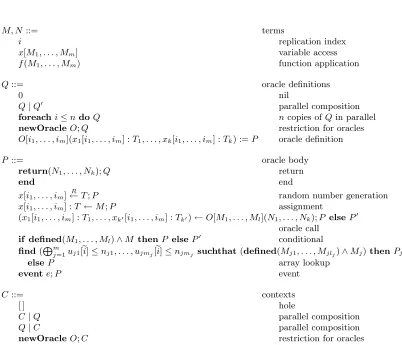
The syntax of our calculus is summarized in Figure 2. It distinguishes two categories of processes: oracle definitionsQconsist of a set of definitions of oracles, while oracle bodiesP describe the content of an oracle definition. Oracle bodies perform some computations and return a result. After returning the result, they may define new oracles. (An oracle definition Q follows the return(N1, . . . , Nk)
instruction.)
The nil oracle definition 0 defines no oracle. The constructnewOracleO;Qhides oracleOoutside Q; oracleOcan be called only insideQ. The other constructs for oracle definitions have been presented in Section 2.1.
The oracle call (x1[i1, . . . , im] :T1, . . . , xk0[i1, . . . , im] :Tk0)←O[M1, . . . , Ml](N1, . . . , Nk);P else
P0
calls oracle O[M1, . . . , Ml] with arguments N1, . . . , Nk. When this oracle returns a result by
return(N0
1, . . . , N
0
k0), this result is stored inx1[i1, . . . , im], . . . , xk0[i1, . . . , im] and the process
exe-cutes P. When the oracle O[M1, . . . , Ml] terminates by end, the process executesP0. (Returning a
result byreturncorresponds to the normal termination of the oracleO, while terminating withend
This paper [13, 14] foreachi≤ndoQ !i≤nQ
newOracleO;Q newChannelc;Q
O[ei](x1[ei] :T1, . . . , xk[ei] :Tk) :=P c[ei](x1[ei] :T1, . . . , xk[ei] :Tk);P
return(M1, . . . , Mk);Q c[ei]hM1, . . . , Mki;Q
end yieldhi
x[ei]←R T;P newx[ei] :T;P x[ei] :T ←M;P letx[ei] :T=M inP
In equivalences that define security assumptions
O(x1:T1, . . . , xk:Tk) :=return(M) (x1 :T1, . . . , xk:Tk)→M
Fig. 3.Differences of syntax with [13, 14]
The general syntax of an array lookup is find(Lmj=1uj1[ei]≤nj1, . . . , ujmj[ei]≤njmj suchthat
(defined(Mj1, . . . , Mjlj)∧Mj)thenPj)elseP, whereeidenotes a tuplei1, . . . , im0. This process tries
to find a branch j in [1, m] such that there are values of uj1, . . . , ujmj for whichMj1, . . . , Mjlj are
defined andMj is true. In case of success, it executesPj. In case of failure for all branches, it executes
P. More formally, it evaluates the conditionsdefined(Mj1, . . . , Mjlj)∧Mjfor eachjand each value of
uj1[ei], . . . , ujmj[ei] in [1, nj1]×. . .×[1, njmj]. If none of these conditions is 1, it executesP. Otherwise,
it chooses randomly with (almost) uniform probability onej and one value ofuj1[ei], . . . , ujmj[ei] such
that the corresponding condition is 1, and executes Pj. (When the number of possibilities is not a
power of 2, a probabilistic bounded-time Turing machine cannot choose these values exactly with uniform probability, but it can choose them with a probability distribution as close as we wish to uniform.)
The process if defined(M1, . . . , Ml)∧M then P else P0 is syntactic sugar for find suchthat
(defined(M1, . . . , Ml)∧M)thenP elseP0.
To lighten notations, ∧trueanddefined()∧ may be omitted in conditions ofif andfind. More-over, else end, a trailing 0, or a trailing end may be omitted. When oracle O returns nothing, the oracle call to oracleO can be abbreviated O[M1, . . . , Ml](N1, . . . , Nk);P else P0. Types may be
omitted when they can be inferred. Some array indexes can be omitted: when x is defined under
foreach i1 ≤ n1. . .foreach im ≤ nm, x is always an array with indexes i1, . . . , im, so we
abbre-viate all occurrences of x[i1, . . . , im] by x, and more generally if x is defined under foreach i1 ≤
n1. . .foreachim≤nmand used underforeachi1≤n1. . .foreachik≤nk (k≤m), we abbreviate
x[i1, . . . , ik, uk+1, . . . , um] by x[uk+1, . . . , um]. Similarly, an oracle definition O[i1, . . . , im](. . .) := P
underforeachi1≤n1. . .foreachim≤nmis abbreviatedO(. . .) :=P.
In the equivalences that serve as security assumptions in the prover, we also write foreachi ≤ ndo x1
R
← T1;. . . xm R
←Tm;Q as an abbreviation forforeachi ≤ndo O() :=x1
R
←T1;. . . xm R
←
Tm;return;Q, whereOis a fresh oracle name. (The same oracle names are used in both sides of the
equivalences.)
A context is a process with a hole. In this paper, we consider only evaluation contexts, generated by the grammar given at the bottom of Figure 2 and that do not contain events.
correspond to oracle bodies. As shown in Figure 3, [13, 14] also used a different syntax for copies of oracles, random number generation, and assignments, with exactly the same meaning. In equivalences that define security assumptions, [13, 14] used functions (x1:T1, . . . , xk :Tk)→M, while this paper
uses oracle definitionsO(x1:T1, . . . , xk :Tk) :=return(M).
B
Manual Proofs
Before proving the correctness of our formalizations of one-wayness and of unforgeability, let us present a few simple lemmas, which will be used in these proofs.
B.1 Preliminary Lemmas
The next lemma is Shoup’s lemma [37], where we consider a processQwhich contains an evente(e.g. a “bad” event). In this lemma, the notationQ{P0
/P} means that, in the process Q, we substitute any occurrence of the subprocessP by the processP0
.
Lemma 2. If Q executes event e with probability at most p, then we have Q{P0
/event e.P} ≈p
Q{P00/evente.P}.
We denote byn×Qthe process obtained by addingforeachi≤ndo in front ofQand by adding the indexiat the beginning of each sequence of array indexes and each sequence of indexes of oracles inQ, for some fresh replication indexi. The processn×Qencodesnindependent copies ofQ. The following lemma can be proved by choosing randomly the copy ofQthat executes evente, and simulating all other copies ofQ.
Lemma 3. IfQexecutes eventewith probability at mostpandQruns in timetQ, thenn×Qexecutes
eventewith probability at most p0 wherep0(t) =n×p(t+ (n−1)t
Q).
B.2 Proof of the Definition of One-wayness as an Equivalence
Proof (of (3)). We expand the abbreviations foreach ik ≤ nk do r
R
← seed into foreach ik ≤
nk doOgr() :=r
R
←seed;returnand foreachif≤nf dox
R
←D intoforeachif ≤nf do Ogx() :=
x←R D;return, and rename the oracleOeqof (3) intoOeq0
, in order to avoid confusion with the oracle Oeq of the process LR defined in Section 3.1. Then, in order to prove (3), we show that L≈pow R,
where
L=foreachik ≤nk doOgr() :=r
R
←seed;return;
(Opk() :=return(pkgen(r))
| foreachif ≤nf doOgx() :=x
R
←D;return;
(Oy() :=return(f(pkgen(r), x))
| foreachi1≤n1 doOeq0(x0 :D) :=return(x0=x)
| Ox() :=return(x)))
R=foreachik ≤nk doOgr() :=r
R
←seed;return;
(Opk() :=return(pkgen0(r))
| foreachif ≤nf doOgx() :=x
R
←D;return;
(Oy() :=return(f0(pkgen0(r), x))
| foreachi1≤n1 doOeq0(x0 :D) :=
if defined(k)then return(x0
Let
LR0
=Ogr() :=r←R seed;pk←pkgen(r);return; (Opk() :=return(pk)
| foreachif ≤nf doOgx() :=x
R
←D;y←f(pk, x);return; (Oy() :=return(y)
| foreachi1≤n1 doOeq0(x0 :D) :=
if defined(k)then return(x0
=x)else if x0
=xthen eventinvertelse return(false)
| Ox() :=k←mark;return(x))) and fora∈[1, nf],
Ca =newOracleOgen;newOracle Oeq; ([ ]
|Ogr() := (pk, y)←Ogen();return; (Opk() :=return(pk)
| foreachif≤nf doOgx() :=
if if =athen return;
(Oy() :=return(y)
| foreachi1≤n1 doOeq0(x0 :D) :=Oeq(x0)else return(false))
elsex←R D;return;
(Oy() :=return(f(pk, x))
| foreachi1≤n1 doOeq0(x0 :D) :=return(x0=x)
| Ox() :=return(x)))) Next, we show thatLR0 executes event
invert with probability at most nf×SuccowP (t+tCa) in the
presence of a context that runs in time t, where Ca runs in time tCa = (nf−1)tf.
1 By definition
of one-wayness, the process LR defined in Section 3.1 executes event invert with probability at most SuccowP (t). By Lemma 1, Property 5, Ca[LR] executes event invert with probability at most
SuccowP (t+tCa). LetCbe a context acceptable forLR
0
that runs in timet. Consider a trace ofC[LR0 ] that executes event invert. Let a ∈ [1, nf] such that the first time event invert is executed in this
trace,if =a. Then the prefix of this trace up to the point at which it executes eventinvert for the
first time can be simulated exactly by a trace of the same probability ofC[Ca[LR]]. More precisely,
the simulation proceeds as follows:
– When oracleOgris called, LR0 picks a new seedr. Correspondingly,C
a[LR] also picks a seedr0
by calling oracleOgenofLR. It also chooses a random valuex0, so a single configuration ofLR0
of probability pcorresponds to|D| configurations ofCa[LR] that differ only by the value of x0,
each of probabilityp/|D|. BothLR0 andC
a[LR] return an empty message.
– When oracleOpkis called,LR0 returns
pkgen(r). Correspondingly,Ca[LR] returns the public key
pk=pkgen(r0).
– When oracle Ogx[if] is called, LR0 picks a random value x[if]. Correspondingly, Ca[LR] either
picks a random value x[if] if if 6= a, or reuses the value of x0 previously chosen by LR when
if =a. In the latter case, before executing this step, a single configuration ofLR0 of probabilityp
corresponded to|D|configurations ofCa[LR] that differed only by the value ofx0, each of
proba-bilityp/|D|; after executing this step, each configuration ofLR0 of probabilityp/|D|corresponds to a single configuration ofCa[LR], in which the chosen value ofx0is the value ofx[a] inLR0. Both
configurations have the same probabilityp/|D|. BothLR0 andC
a[LR] return an empty message.
1 As usual in exact security proofs, we consider only the runtime of function evaluations and array lookups,
– When oracleOy[if] is called,LR0returnsf(pkgen(r), x[if]). Correspondingly,Ca[LR] returns either
f(pk, x[if]) whenif 6=a, or y=f(pk, x0) whenif =a.
– When Oeq0
[if, i1](x0) is called, LR0 returns x0 = x[if] when if 6= a (since it never executes
eventinvertwithif6=ain the considered trace prefix), executeseventinvertwhenx0=x[if] and
if =a, and returns falsewhen x0 6=x[if] andif =a. (Since the considered trace prefix executes
eventinvert withif =aat the end of this prefix,k[a] is not defined at the end of this prefix, so
k[a] is not defined at any point in this trace prefix.) Correspondingly, Ca[LR] returnsx0 =x[if]
whenif 6=aand callsLRwhen if =ain order to execute event invertwhen x0 =x0; when LR
ends, it returnsfalse.
– When oracleOx[if] is called, we haveif 6=asincek[a] is not defined at any point in the considered
trace prefix, as mentioned above, andLR0 returnsx[i
f]. Correspondingly,Ca[LR] returnsx[if] in
this case.
Hence PE,invert∈EPr[C[LR
0] E] ≤P
a∈[1,nf]
P
E,invert∈EPr[C[Ca[LR]] E] ≤Pa∈[1,nf]Succ
ow P (t+ tCa) =nf×Succ
ow
P (t+tCa). SoLR
0
executeseventinvertwith probability at mostnf×SuccowP (t+tCa).
By Lemma 3, nk ×LR0 executes event invert with probability at most nk×nf ×SuccowP (t+ tCa + (nk −1)tLR0), where tLR0 = tpkgen +nftf. Let t
0
= tCa + (nk −1)tLR0 = (nknf −1)tf +
(nk −1)tpkgen and pow(t) = nk×nf ×SuccowP(t+t 0
). By Lemma 2, we have the equivalence (nk×
LR0
){return(true)/eventinvert} ≈pow (nk×LR0){return(false)/eventinvert}.
The processif x0
=xthen return(true)else return(false) can be replaced withreturn(x0
=x), the processfind. . .then return(x0
=x)else return(x0
=x) can be replaced withreturn(x0 =x), and the assignments topk andy can be expanded without changing the behavior of the process, so (nk×LR0){return(true)/eventinvert} ≈0L. The testifx0 =xthen return(false)else return(false)
can be replaced with return(false), and the assignments to pk and y can be expanded, so (nk ×
LR0){return(
false)/eventinvert} ≈0R. Hence L≈pow R.
B.3 Definition of Security of Signatures
Lemma 4. Let skgen0 :seed →skey, pkgen0 :seed →pkey,sign0 :bitstring×skey →signature, and
verify0 :bitstring×pkey×signature→bool such that the functions associated to the primed symbols
skgen0, pkgen0, sign0, verify0 are equal to the functions associated to their corresponding unprimed symbolskgen,pkgen,sign,verify. We have the following equivalence:
1. foreachik≤nk dor
R
←seed; 2. (Opk() :=return(pkgen(r))
3. |foreachis≤nsdo OS0(m:bitstring) :=return(sign(m,skgen(r))))
4. |foreachiv≤nv doOV(m0:bitstring, y:pkey, s:signature) :=return(verify(m0, y, s)) [all]
5. ≈puf−cma
6. foreachik≤nk dor
R
←seed; 7. (Opk() :=return(pkgen0(r))
8. |foreachis≤nsdo OS0(m:bitstring) :=return(sign
0
(m,skgen0(r))))
9. |foreachiv≤nv doOV(m0:bitstring, y:pkey, s:signature) :=
10. finduk≤nk, us≤nssuchthat(defined(r[uk], m[uk, us])∧
11. y=pkgen0(r[uk])∧m0 =m[uk, us]∧verify
0 (m0
, y, s))then return(true)else
12. finduk≤nk suchthat(defined(r[uk])∧y=pkgen0(r[uk]))then return(false)else
13. return(verify(m0
, y, s))
where puf−cma(t) = n
k×Succuf
−cma
S (ns,max(`s, `v), t+ (nk−1)(tpkgen +tskgen+nstsign(`s)) + (nk +
`pkey is the maximum length of a key in pkey; `s = maxik∈[1,nk],is∈[1,ns]length(m[ik, is]); and `v =
maxiv∈[1,nv]length(m
0 [iv]).
As for one-wayness, this equivalence considers nk keys instead of a single one. We denote by ns the
number of signature queries for each key and bynv the total number of verification queries. We use
primed function symbols to avoid the repeated application of the transformation of the left-hand side into the right-hand side. Note that we use verify and not verify0 at line 13 in order to allow a repeated application of the transformation with a different key. The first three lines of each side of the equivalence express that the generation of public keys and the computation of the signature are left unchanged in the transformation. The verification of a signatureverify(m0
, y, s) is replaced with a lookup in the previously computed signatures: if the signature is verified using one of the keys
pkgen0(r[uk]) (that is, if y=pkgen0(r[uk])), then it can be valid only when it has been computed by
the signature oraclesign0(m,skgen0(r[uk])), that is, whenm0=m[uk, us] for someus. Lines 10-11 try
to find such uk and us and return true when they succeed. Line 12 returns false when no such us
is found in lines 10-11, but y = pkgen0(r[uk]) for some uk. The last line handles the case when the
keyy is notpkgen0(r[uk]). In this case, we verify the signature as before. The indicationall at line 4
instructs the prover to transform all occurrences of functionverifyinto the corresponding right-hand side.
Proof. We denote byLthe left-hand side of the equivalence above and byRits right-hand side, after expanding the abbreviationforeach ik ≤nk do r
R
←seed into foreach ik ≤ nk do Ogr() := r
R
← seed;return, and show that L≈puf−cma R.
By definition of UF-CMA, the process LRdefined in Section 3.2 executesevent forgewith prob-ability at most SuccufS−cma(ns, `, t) in the presence of a context that runs in time t where ` is the
maximum length ofmandm0
. By Lemma 3,nk×LRexecutes eventforgewith probability at most
nk×SuccufS−cma(ns,max(`0s, `
0
v), t+ (nk−1)tLR), wheretLR=tpkgen+tskgen+nstsign(`0s) +tverify(`
0
v) +
tfind(ns, `0v),`0s= maxik∈[1,nk],is∈[1,ns]length(m[ik, is]), and`
0
v = maxik∈[1,nk]length(m
0[i
k]).
nk×LR=foreachik≤nk do
Ogen() :=r←R seed;pk←pkgen(r);sk←skgen(r);return(pk);
(foreachis≤ns doOS(m:bitstring) :=return(sign(m, sk))
|OT(m0:bitstring, s:signature) :=if verify(m0, pk, s)then
findus≤ns suchthat(defined(m[ik, us])∧m0=m[ik, us])then end else eventforge)
Let
C=newOracleOgen;newOracleOS;newOracleOT; ([ ]
|foreachik≤nk doOgr() :=pk←Ogen[ik]();return;
(Opk() :=return(pk)
| foreachis≤nsdo OS0(m:bitstring) :=s←OS[ik, is](m);return(s))
| foreachiv≤nv doOV(m0:bitstring, y:pkey, s:signature) :=
finduk≤nk suchthat(defined(pk[uk])∧y=pk[uk])then
if verify(m0
, y, s)then
findus≤ns suchthat(defined(m[uk, us])∧m0=m[uk, us])then return(true)elseOT[uk](m0, s)
else return(false)
else return(verify(m0 , y, s)))
By Lemma 1, Property 5,C[nk×LR] executeseventforgewith probability at mostnk×Succuf
−cma S (ns,
max(`s, `v), t+(nk−1)tLR+tC) whereCruns in timetC=nv(tverify(`v)+tfind(nk, `pkey)+tfind(ns, `v)).
Lett0
nvtfind(nk, `pkey), since`0s ≤`s and `0v ≤`v. Let puf−cma(t) = nk×SuccufS−cma(ns,max(`s, `v), t+t0).
Let
LR00
=foreachik ≤nk doOgr() :=r
R
←seed;return;
(Opk() :=return(pkgen(r))
| foreachis≤nsdoOS0(m:bitstring) :=return(sign(m,skgen(r))))
|foreachiv ≤nv doOV(m0:bitstring, y:pkey, s:signature) :=
finduk≤nk suchthat(defined(pk[uk])∧y=pk[uk])then
if verify(m0
, y, s)then
findus≤nssuchthat(defined(m[uk, us])∧m0=m[uk, us])then
return(true)else event forge
else return(false)
else return(verify(m0, y, s))
By inlining the calls to oracles Ogen, OS, and OT, we can easily see that each prefix of a trace C[nk×LR] until the first execution of event forgecan be simulated byLR00, and conversely. Indeed,
whenC callsOT[uk](m0, s),Chas checked thatsis a forged signature ofm0 under the keypk[uk], so
nk×LRalways executes eventforge when receiving this call. ThereforeLR00 executes eventforge
with probability at mostpuf−cma. By Lemma 2, LR00
{return(true)/eventforge} ≈puf−cma LR00{return(false)/eventforge}.
The processfind. . .then return(true)else return(true) can be replaced withreturn(true), the pro-cessif verify(m0, y, s)then return(
true)else return(false) can be replaced withreturn(verify(m0, y, s)), and the processfind. . .then return(verify(m0, y, s))else return(
verify(m0, y, s)) can be replaced
with return(verify(m0, y, s)) without changing the behavior of the process, so we have the
equiva-lence LR00{return(
true)/event forge} ≈0 L. By reorganizing finds, we can prove the equivalence
LR00{return(
false)/eventforge} ≈0R. Hence L≈puf−cma R.
C
Automatic Proof of the FDH Signature Example
In this appendix, we give detailed explanations on the proof automatically generated by our prover for the FDH example. Starting from the initial gameQ0 given in Section 2.1, the prover first tries
to apply a cryptographic transformation. It succeeds applying the security of the hash function (8). Then each argument of a call tohashis first stored in an intermediate variable,x19form0,x21 form,
andx23forx, and each occurrence of a call tohashis replaced with a lookup in the three arrays that
contain arguments of calls tohash,x19,x21, andx23. When the argument ofhash is found in one of
these arrays, the returned result is the same as the result previously returned byhash. Otherwise, we pick a fresh random number and return it. Therefore, we obtain the following game. (In this game, the identifiers @ik are generated by the prover. We use the special character @ just to distinguish
them from identifiers chosen by the user.) (
foreachiH13≤qH do
OH(x :bitstring) := x23:bitstring←x;
find suchthat defined(x19,r18)∧(x23=x19)then
return(r18)
⊕@i29≤qS suchthat defined(x21[@i29],r20[@i29])∧(x23=x21[@i29])then return(r20[@i29])
⊕@i28≤qH suchthat defined(x23[@i28],r22[@i28])∧(x23=x23[@i28])then return(r22[@i28])
r22
R
←D;
return(r22)
|
Ogen() := r ←R seed;
pk :pkey←pkgen(r); sk:skey←skgen(r);
return(pk); (
foreachiS14≤qS do
OS(m :bitstring) := x21:bitstring←m;
find suchthat defined(x19,r18)∧(x21=x19)then
return(invf(sk,r18))
⊕@i27≤qS suchthat defined(x21[@i27],r20[@i27])∧(x21=x21[@i27])then return(invf(sk,r20[@i27]))
⊕@i26≤qH suchthat defined(x23[@i26],r22[@i26])∧(x21=x23[@i26])then return(invf(sk,r22[@i26]))
else
r20
R
←D;
return(invf(sk,r20))
|
OT(m0
:bitstring,s :D) := x19:bitstring←m0;
1 find suchthat defined(x19,r18)∧(x19=x19)then
if (f(pk,s) =r18)then
findu≤qS suchthat defined(m[u])∧(m0 =m[u])then
end else
eventforge
2 ⊕@i25≤qS suchthat defined(x21[@i25],r20[@i25])∧(x19=x21[@i25])then
3 if (f(pk,s) =r20[@i25])then
4 findu≤qS suchthat defined(m[u])∧(m0
=m[u])then end
else
eventforge
⊕@i24≤qH suchthat defined(x23[@i24],r22[@i24])∧(x19=x23[@i24])then if (f(pk,s) =r22[@i24])then
findu≤qS suchthat defined(m[u])∧(m0 =m[u])then
end else
eventforge
else
r18
R
←D;
if (f(pk,s) =r18)then
findu≤qS suchthat defined(m[u])∧(m0
=m[u])then end
else
eventforge
) )
This game is automatically simplified as follows: The test at line 1 always fails sincer18is not defined
![Fig. 3. Differences of syntax with [13, 14]](https://thumb-us.123doks.com/thumbv2/123dok_us/1853062.1240541/15.612.168.445.73.175/fig-dierences-of-syntax-with.webp)
