Research
editor’s key points
• Problem-based learning (PBL) is comparable to lectures with regard to knowledge improvement in postgraduate and continuing medical education, and there is limited evidence that PBL in continuing education enhances physicians’ performance or improves health outcomes.
• Online PBL is perceived to be an effective educational strategy by physicians. Educators need to consider all factors, including cost effectiveness, when implementing PBL methodology in continuing education.
This article has been peer reviewed. Can Fam Physician 2014;60:157-65
Abstract
Objective To investigate the effects of problem-based learning (PBL) in continuing medical education.
Data sources PubMed, MEDLINE, EMBASE, CINAHL, and ERIC databases were searched for randomized controlled trials published in English from January 2001 to May 2011 using key words problem-based learning, practice-based, self-directed, learner-centered, and active learning, combined with continuing medical education, continuing professional development, post professional, postgraduate, and adult learning.
Study selection Randomized controlled trials that described the effects of PBL on knowledge enhancement, performance improvement, participants’ satisfaction, or patients’ health outcomes were selected for analysis.
Synthesis Fifteen studies were included in this review: 4 involved postgraduate trainee doctors, 10 involved practising physicians, and 1 had both groups. Online learning was used in 7 studies. Among postgraduate trainees PBL showed no significant differences in knowledge gain compared with lectures or non–case-based learning. In continuing education, PBL showed no significant difference in knowledge gain when compared with other methods. Several studies did not provide an educational intervention for the control group. Physician performance improvement showed an upward trend in groups participating in PBL, but no significant differences were noted in health outcomes.
Conclusion Online PBL is a useful method of delivering continuing medical education. There is limited evidence that PBL in continuing education would enhance physicians’ performance or improve health outcomes.
Problem-based learning in continuing
medical education
Review of randomized controlled trials
points de repère du rédacteur
• L’utilisation de l’apprentissage par problème (APP) pour la formation médicale continue et postdoctorale est aussi efficace que les cours traditionnels pour améliorer les connaissances; toutefois, il y a peu d’indication que son utilisation améliore la performance des médecins ou la santé des patients.
• Il semble que l’APP en ligne soit une stratégie éducationnelle efficace pour le médecin. Les enseignants devraient prendre en compte tous les facteurs, incluant le rapport coût-bénéfice, avant de recourir à l’APP en formation médicale continue.
Résumé
Objectif Déterminer l’efficacité de l’apprentissage par problèmes (APP) en formation médicale continue.
Sources des données On a recherché les essais randomisés de langue anglaise publiés entre janvier 2001 et mai 2011 dans les banques de données PubMed, Medline, Embase, CINAHL et ERIC, à l’aide des rubriques problem-based learning, practice-based, self-directed, learner-centered et active learning combinées à continuing medical education, continuing professional development, post professional, postgraduate et adult learning.
Choix des études Ont été retenues pour analyse les essais randomisés décrivant les effets de l’APP sur l’amélioration des connaissances et de la performance, sur la satisfaction des participants ou sur les issues de santé pour les patients.
Synthèse Sur les 15 études retenues, 4 portaient sur des médecins en formation postdoctorale, 10 sur des médecins en pratique et une sur ces deux groupes. Sept études utilisaient l’apprentissage en ligne. Dans le cas des stagiaires postdoctoraux, il n’y avait pas de différence significative entre l’APP et les cours traditionnels ou l’apprentissage non centré sur des problèmes pour ce qui est de l’amélioration des connaissances. Dans le cas de la formation médicale continue, il n’y avait pas de différence significative entre l’APP et les autres formes d’apprentissage, pour ce qui est de l’amélioration des connaissances. Plusieurs études n’utilisaient pas un autre type d’apprentissage pour le groupe témoin. On notait une certaine amélioration de la performance des médecins participants à l’APP, mais pas de différence significative dans le cas de la santé des patients.
Conclusion L’APP en ligne est une méthode utile pour la formation médicale continue. Il y a toutefois peu de preuves établissant que l’utilisation de l’APP en formation continue améliore la performance des médecins ou la santé des patients.
L’apprentissage par problèmes
en éducation médicale continue
Revue d’essais randomisés avec témoins
Hilal Al-Azri
MD MRCGPSavithiri Ratnapalan
MB BS MRCP MEd FRCPCProblem-based learning in continuing medical education
|
Research
P
roblem-based learning (PBL) was developed about 50 years ago to teach medical students basic sci-ences in the clinical context. It is recognized as a successful innovative learning method in undergraduate medical education.1Problem-based learning was definedas “an instructional (and curricular) learner-centered approach that empowered learners to conduct research, integrate theory and practice, and apply knowledge and skills to develop a viable solution to a defined problem.”2
Long-term effects of PBL on undergraduate education include positive changes in physicians’ competency after graduation, emphasizing the validity of PBL in enhanc-ing practice performance.3
The attractiveness of PBL as a learner-centred, inter-active educational approach has prompted many to adopt this method in postgraduate and continuing medi-cal education (CME), even though the evidence for its effectiveness in CME is lacking.2,4,5 Previous systematic
reviews have not been able to prove that PBL is supe-rior in terms of knowledge gain to traditional methods of teaching, such as lectures, in higher medical educa-tion. Further, physicians who learned through lectures performed better in examinations.6,7 On the other hand,
physicians preferred PBL and considered it a challenging and enjoyable learning method.7
A systematic review on the effectiveness of PBL in CME that included all randomized controlled trials on PBL in CME published from 1974 to 2000 found lim-ited evidence of the effectiveness of PBL in increas-ing knowledge, enhancincreas-ing performance, or improvincreas-ing health outcomes.7 This study found moderate evidence
that medical practitioners were more satisfied with the PBL method.7
Several advances are being made toward innovation in postgraduate education and CME, and many countries worldwide are engaged in examining and updating their educational strategies; PBL involving tutor-facilitated, problem-based learning sessions, usually conducted in small groups, is an attractive concept for continuing education.
Problem-based learning can be a resource-intensive method of delivering CME on a regular basis for insti-tutions or organizations that offer CME. The CME land-scape has changed considerably over the past 10 years, and the last review of the effectiveness of PBL in CME was done more than a decade ago. There have also been concerns that PBL has been oversold, and its value in continuing education to change physician behaviour and patient outcomes has been questioned.5 As such,
there is a knowledge gap related to the effectiveness of PBL in CME.
The objective of this review was to investigate the usefulness of PBL in improving knowledge, performance, and satisfaction of medical practitioners who participate in CME.
Methods
Data sources
PubMed, MEDLINE, EMBASE, CINAHL, and ERIC data-bases were searched for studies published between January 2001 and May 2011. The key words problem-based learning, practice-based, self-directed, learner-centered, and
active learning were used for the search. The search results were combined with those of another search performed using the key words continuing medical education, continu-ing professional development, post professional, postgraduate,
and adult learning. The search was limited to randomized controlled trials published in English.
Study selection
Studies that examined PBL were scanned and catego-rized according to their reported outcomes; studies that described the effect of PBL on knowledge enhancement, performance improvement, participants’ satisfaction, or patients’ health outcomes were selected.
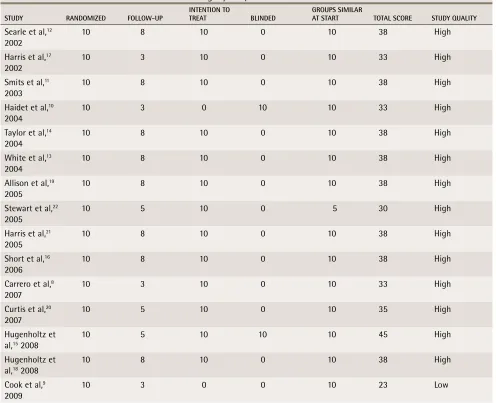
The selected studies were analyzed using 5 main quality criteria: randomization, follow-up, blindness, intention to treat, and group similarity at the start of the study.7 Each criterion was scored on a scale of 1 to 10,
with a maximum total score of 50. Studies that scored 25 or more were considered to be of high quality, and those that scored less than 25 were considered to be of low quality, as was the case in the previous review in 2002.7 Both authors independently assessed the quality
of each selected study.
The studies were categorized based on whether the participants were postgraduate trainees, practising physicians, or both, and each study was reviewed to extract the identified outcome variables (participants’ knowledge, performance, satisfaction, and patients’ health outcomes). The effect of each variable was cat-egorized as positive, negative, or no effect. Traditional learning methods or no intervention were used as the control in many studies.
resuLts
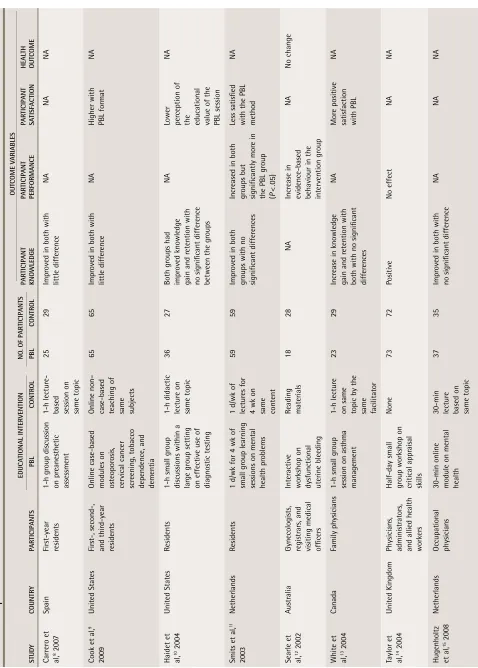
A total of 15 randomized controlled studies were included in this review (Table 1).8-22 All the studies involved
case-based or active learning, and the participants comprised postgraduate trainees in 4 studies,8-11 practising
physi-cians and postgraduate trainees in 1 study,12 and
practis-ing physicians in the remainpractis-ing 10 studies.13-22 Of these,
14 studies (93%) were of high quality (Table 2),8-22 as
compared with only 2 of the 6 studies (33%) included in the previous review conducted in 2002 with the same quality analysis criteria.7 Out of 15 studies reviewed, 7
Contin
ued on
page
161
table 1.
Description of included studies
ED u CA tion AL int ER vE ntion n o. o F PAR ti Ci PA nt S o ut Co ME v AR iABLES Stu Dy Count Ry PAR ti Ci PA nt S PBL Cont Ro L PBL Cont Ro L PAR ti Ci PA nt know LEDGE PAR ti Ci PA nt PERF o RMA n CE PAR ti Ci PA nt SA ti SFAC tion H EAL tH out Co ME Carr er o et al,
8 200
7 Spain Fir st-year residents 1-h gr oup discussion on pr eanesthetic assessment 1-h lectur
e-based session on same topic
25
29
Impr
oved in both with
little differ
ence
NA
NA
NA
Cook et al,
9 2009 United States Fir st-, second-, and thir d-year residents
Online case-based modules on osteopor
osis,
cervical cancer screening, tobacco dependence, and dementia Online non– case-based teaching of same subjects
65
65
Impr
oved in both with
little differ
ence
NA
Higher with PBL format
NA
Haidet et 10al,
2004
United States
Residents
1-h small gr
oup
discussions within a large gr
oup setting
on effective use of diagnostic testing 1-h didactic lectur
e on same topic 36 27 Both gr oups had impr oved knowledge
gain and r
etention with
no significant differ
ence
between the gr
oups
NA
Lower per
ception of
the educational value of the PBL session
NA
Smits et al,
11
2003
Netherlands
Residents
1 d/wk for 4 wk of small gr
oup learning
sessions on mental health pr
oblems
1 d/wk of lectur
es for
4 wk on same content
59
59
Impr
oved in both
gr
oups with no
significant differ
ences
Incr
eased in both
gr
oups but
significantly mor
e in
the PBL gr
oup
(P
<
.05)
Less satisfied with the PBL method
NA
Searle et 12al,
200
2
Austr
alia
Gynecologists, registr
ar
s, and
visiting medical officer
s
Inter
active
workshop on dysfunctional uterine bleeding Reading materials
18
28
NA
Incr
ease in
evidence-based behaviour in the intervention gr
oup
NA
No change
White et 13al,
2004
Canada
Family physicians
1-h small gr
oup
session on asthma management
1-h lectur
e
on same topic by the same facilitator
23
29
Incr
ease in knowledge
gain and r
etention with
both with no significant differ
ences
NA
Mor
e positive
satisfaction with PBL
NA
Taylor et 14al,
2004
United Kingdom
Physicians, administr
ator
s,
and allied health worker
s
Half-day small group workshop on critical appr
aisal skills None 73 72 Positive No effect NA NA
Hugenholtz et al, 15 2008
Netherlands
Occupational physicians 30-min online module on mental health 30-min lectur
e
based on same topic
37
35
Impr
oved in both with
no significant differ
ence
NA
NA
Problem-based learning in continuing medical education
|
Research
Table 1 Contin ued from page 160 ED u CA tion AL int ER vE ntion n o. o F PAR ti Ci PA nt S o ut Co ME v AR iABLES Stu Dy Count Ry PAR ti Ci PA nt S PBL Cont Ro L PBL Cont Ro L PAR ti Ci PA nt know LEDGE PAR ti Ci PA nt PERF o RMA n CE PAR ti Ci PA nt SA ti SFAC tion H EAL tH out Co MEShort et al,
16 2006 United States Primary car e physicians 4-h asynchr onous
online multimedia sessions on intimate partner violence
None 23 29 Positive Positive Positive NA
Harris et 17al,
200 2 United States Primary car e physicians, emer gency
physicians, and orthopedic surgeons
2-h online pr
ogr
am
on domestic violence
None 28 37 Positive No effect Positive NA
Hugenholtz et al, 18 2008
Netherlands
Occupational physicians 3 half-days over 2 wk of small gr
oup
learning with 1
0
PBL sessions on evidence-based medicine
None 49 59 Impr oved Positive Per ceived as
valuable; no impr
ovement
in per
ceived
self-efficacy
NA
Allison et 19al,
2005
United States
Primary car
e
physicians
4 multimodal online modules on chlamydia scr
eening
Online flat text education on women’
s
health
96
95
NA
Positive; decline in chlamydia scr
eening
tests was less in the intervention gr
oup
NA
NA
Curtis et 20al,
200
7
United States
Primary car
e
physicians, rheumatologists
3 online inter
active
modules on glucocorticoid- induced osteopor
osis
Online text- based teaching on chr
onic
illness other than osteopor
osis
78
75
NA
No statistically significant differ
ence although
the intervention group conducted mor
e scr
eening tests
and interventions
NA
No significant differ
ence
Harris et 21al,
2005
Canada
Primary car
e
physicians
8, 1-h teleconfer
ence and
online diabetes education sessions
None
43
47
NA
Effect positive in some aspects
Positive
Impr
oved
categorization of patients with diabetes but no change in final outcome of reducing HbA
1c
Stewart et 22al,
2005
Canada
Family physicians
2 case-based online learning modules each lasting 2 wks on type 2 diabetes and pr
eventive car
e
in family pr
actice None 27 31 Positive Positive NA NA HbA 1c — hemoglobin A 1c
, NA—not assessed, PBL—pr
PBL method9,15-17,19,20,22; 1 study used a moderator and
described online group discussions.22
Postgraduate education
Four studies examined PBL compared with didactic learning in postgraduate medical education using pre-test-posttest assessments and showed similar increases in knowledge gain or knowledge application with both methods of learning. These teaching sessions included clinical skills such as preanesthetic assessment,8
spe-cific disease management and preventive health,9
clini-cal reasoning in effective use of diagnostic testing,10 and
management of mental health problems.11
One of the studies incorporated principles of PBL in large group settings. Students worked in small groups within the larger group for 30 minutes and then had some content delivery during discussion; this was com-pared with a traditional 60-minute lecture to make the
best use of tutors’ time and to increase the number of learners. This study found that learners’ perceptions of their engagement, the value of the session, and whether learning objectives were met were higher in the PBL group.10 In another study, students preferred the
case-based format of online PBL compared with online learn-ing without patient scenarios.9 It should be noted that all
the resources for learning the content were provided as Web-based links in this study.
Students perceived PBL to have less educational value than a lecture-based format when content was covered by engaging students in small group sessions 1 day a week for 4 weeks.11 This study used self-reported
performance indicators to measure performance in practice and found no significant difference between the 2 groups.
An Australian study randomized specialist and trainee physicians providing gynecology services in 6 public
table 2.
Quality of studies: Each criterion was scored on a scale of 1 to 10, with a maximum total score of 50; studies
that scored 25 or more were considered to be of high quality.
StuDy RAnDoMizED FoLLow-uP intEntion to tREAt BLinDED GRouPS SiMiLAR At StARt totAL SCoRE StuDy QuALity
Searle et al,12
2002
10 8 10 0 10 38 High
Harris et al,17
2002 10 3 10 0 10 33 High
Smits et al,11
2003 10 8 10 0 10 38 High
Haidet et al,10
2004
10 3 0 10 10 33 High
Taylor et al,14
2004
10 8 10 0 10 38 High
White et al,13
2004
10 8 10 0 10 38 High
Allison et al,19
2005 10 8 10 0 10 38 High
Stewart et al,22
2005 10 5 10 0 5 30 High
Harris et al,21
2005 10 8 10 0 10 38 High
Short et al,16
2006
10 8 10 0 10 38 High
Carrero et al,8
2007
10 3 10 0 10 33 High
Curtis et al,20
2007 10 5 10 0 10 35 High
Hugenholtz et
al,15 2008
10 5 10 10 10 45 High
Hugenholtz et
al,18 2008
10 8 10 0 10 38 High
Cook et al,9
2009
Problem-based learning in continuing medical education
|
Research
hospitals to receive either no intervention or to attend a PBL workshop on hysteroscopies and dilation and curettage in women younger than 40 years of age with dysfunctional uterine bleeding. They evaluated perfor-mance using a questionnaire with clinical scenarios and practice audits.12 This study found that practice change
did not occur when the actual practice was audited, although evidence-based behaviour change was present in the intervention group with the survey.12
Continuing education
Three studies focused on the effectiveness of PBL in knowledge enhancement for practising physicians: 2 studies randomized physicians to a PBL intervention group or a control group (didactic lectures) to examine knowledge improvement in asthma management13 and
critical appraisal skills.14 Knowledge uptake
regard-ing asthma management was similar in both groups; the subjective assessment of the educational value of the session was higher in the PBL group compared with the lecture-based group (4.36 vs 3.93, P = .04).13
The critical appraisal teaching study analyzed the cost of introducing small group workshops and concluded that educators should consider cost-effectiveness when planning educational interventions.14 The PBL
group had a slightly higher knowledge score in critical appraisal skills training but there was no difference in participants’ attitude toward evidence or their ability to critically appraise literature when both groups were compared.14 When delivered as short online case-based
learning, PBL for mental health education produced knowledge improvement similar to that of lecture-based learning.15
Two studies showed that physicians’ knowledge, and self-reported confidence and self-efficacy in managing domestic violence improved significantly (P < .05) after PBL delivered as Internet-based self-study, compared with controls with no intervention.16,17 Another study
com-pared PBL delivered as 3 half-day sessions over 2 weeks with facilitated case method learning with no interven-tion. The authors found improvement in self-reported professional performance in the intervention group com-pared with the controls, but no difference in self-efficacy or job satisfaction was noted between groups.18
Effect of PBL on physicians’
performance and health outcomes
A multicomponent online PBL program to increase chlamydia screening showed that screening rates were higher in the intervention group compared with the control group with no intervention.19 Online PBL on
glucocorticoid-induced osteoporosis management com-bined with performance audit and feedback showed no significant effect on the quality of osteoporosis care, although physicians who completed all the PBL modules
showed a trend toward higher rates of screening and prescribing treatment for osteoporosis.20
Problem-based learning on diabetes education delivered by teleconferencing, compared with a con-trol group with no intervention, did not improve overall patient glycemic levels but led to improvement in cat-egorizing patients with diabetes to the correct glycemic categories and increased the number of patients treated with insulin.21 Another study examining PBL delivered
online to improve preventive care and diabetes manage-ment employed chart audits and standardized patients to evaluate the effects of the PBL and compared out-comes with those of a control group with no inter-vention. The intervention group showed no significant differences in practice with the standardized patients but showed improvement in knowledge and improve-ment of patient care for diabetes manageimprove-ment accord-ing to chart audits.22
discussion
The original definition and the mode of delivery of PBL for postgraduate and continuing education seems to have evolved to accommodate the growing needs for distance education by using modern technology such as online learning. As such, there was considerable expert or teacher involvement in building the modules and pro-viding the resources. The objective of this study was not to assess online PBL. However, online PBL emerged as a popular method of delivering CME and it needs to be evaluated further, as it could be very useful for physi-cians in remote areas.
Nearly all the studies involving residents indicated less positive perceptions of the value of PBL, which is not unexpected, as the control groups almost always consisted of another method of education, often with face-to-face contact with an expert; most of the stud-ies examining CME did not have expert lectures for the comparison group. This factor should also be taken into consideration when comparing perceptions of postgrad-uate trainees with those of practising physicians.
One of the studies describes active PBL in large group settings where students worked in small groups within the large group setting for 30 minutes and then had some content delivery during discussion.10 This
interac-tive method of incorporating principles of PBL in large group settings might be a good way to maximize tutors’ time and increase the number of learners in CME.
strategy for the optimum use of available information. Barriers that would need to be addressed include the financial costs of maintaining and updating modules and intellectual property tied to building PBL modules.
Previous studies have concluded that PBL can pos-itively enhance clinical reasoning.23-25 However, they
indicated that the improvement was in backward rea-soning rather than forward rearea-soning.24,25 A study
con-ducted among undergraduate medical students showed that diagnostic accuracy was higher in the group who had backward reasoning.26 There is a lack of studies
examining the effectiveness of backward reasoning in CME, and assessment of the effectiveness among prac-tising physicians is limited. Examination of clinical rea-soning among practising physicians and the effects of PBL are potential areas of study for future research.
Previous reviews have demonstrated that PBL could effectively enhance competencies and clinical perfor-mance.26,27 Social and cognitive competencies such as
dealing with uncertainty, recognizing ethical issues related to health care, communication skills, and self-directed learning are more likely to be improved by PBL methods.3,27 A cohort study in undergraduate
medical education comparing PBL with lecture-based learning found no significant difference in clinical competencies after graduation.28 We found no studies
demonstrating improvement in clinical competencies with PBL in CME.
Although participants’ satisfaction with PBL was graded as high in the review conducted in 2002,7 our
findings showed that satisfaction was moderate and more participants were satisfied with online PBL meth-ods. There was dissatisfaction with online PBL among residents, as participants perceived that PBL had a low educational value and did not meet learning objec-tives.10,11 The new learning environment, the possible
discomfort working with new peers, and reduced con-tact with the teacher might have led to low perceived value of PBL among residents.
A cross-sectional study conducted among physicians attending a CME activity indicated that although most participants recognized the effectiveness of interactive, case-based methods to retain information and change practice, most preferred lecture-based teaching.29 Other
studies showed that online CME was more favourable than small group interactive PBL.30,31 These studies
con-cluded that Internet-based CME is substantially simi-lar to or superior to interactive group CME with regard to knowledge gain.30,31 This point should be considered
when planning CME activities in PBL formats.
Few studies measured health outcomes, an impor-tant measure of the effectiveness of teaching methods.32
More research is needed to examine the long-term effects of PBL, as physicians’ behaviour change and health outcomes are influenced by a multitude of other
factors such as the strength of evidence for guidelines, system factors, targeting behaviour, expected health outcomes, and the measurements used to evaluate these outcomes.
Limitations
Only randomized controlled trials that investigated the effect of PBL on CME over the past 10 years were included, and other relevant studies might have been excluded. Resident education studies were included, as they were the only available studies to look at certain outcomes such as knowledge acquisition with PBL; however, the motivations and constraints are different for postgradu-ate education and CME. The effect sizes, if reported, were small and were often not analyzed or reported.
The assessment tool to evaluate the quality of selected studies was chosen because it was used in the previous review on the topic. As with the previ-ous review, this review also showed that many studies did not have comparable educational interventions for control groups, and many control groups had no edu-cational interventions. As such, their assessment would have represented an evaluation of the education as well as the mode of delivery and cannot be assumed to be an evaluation of only the PBL methodology. The reliability and validity of the assessment tools were not described well in several studies, and confounding factors for the outcomes were not discussed.
Conclusion
Online PBL is perceived to be an effective educational strategy by physicians. There is limited evidence that PBL in continuing education enhances physicians’ performance or improves health outcomes. Thus, it is recommended that educators consider all factors, including cost effective-ness and the role in distance learning when implementing PBL methodology in continuing education.
Dr Al-Azri was an academic fellow in the Department of Family and Community Medicine at the University of Toronto in Ontario and is currently practising as a consultant family physician in Alakdhar, Oman. Dr Ratnapalan
is Associate Professor in the Department of Paediatrics and the Dalla Lana School of Public Health at the University of Toronto and a staff physician in the Division of Emergency Medicine, Clinical Pharmacology, and Toxicology at the Hospital for Sick Children in Toronto.
acknowledgment
We thank librarians Rita Shaughnessy and Iveta Lewis from the Department of Family Medicine at the University of Toronto in Ontario.
Contributors
Both authors contributed to the literature review and analysis, and to preparing the manuscript for submission.
Competing interests
None declared
Correspondence
Dr Savithiri Ratnapalan, Division of Emergency Medicine, Clinical Pharmacology and Toxicology, Hospital for Sick Children, 555 University Ave, Toronto, ON M5G 1X8; telephone 416 813-7532; fax 416 813-5043; e-mail
references
Problem-based learning in continuing medical education
|
Research
2. Savery JR. Overview of problem-based learning: definitions and distinctions.
Interdiscip J Probl Based Learn 2006;1(1):9-20.
3. Koh GC, Khoo HE, Wong ML, Koh D. The effects of problem-based learning during medical school on physician competency: a systematic review. CMAJ
2008;178(1):34-41.
4. Colliver JA. Effectiveness of problem-based learning curricula: research and theory. Acad Med 2000;75(3):259-66.
5. Norman GR, Schmidt HG. Effectiveness of problem-based learning curricula: theory, practice and paper darts. Med Educ 2000;34(9):721-8.
6. Vernon DT. Does problem-based learning work? A meta-analysis of evalua-tive research. Acad Med 1993;68(7):550-63.
7. Smits PB, Verbeek JH, de Buisonje CD. Problem based learning in con-tinuing medical education: a review of controlled evaluation studies. BMJ
2002;324(7330):153-6.
8. Carrero E, Gomar C, Penzo W, Rull M. Comparison between lecture-based approach and case/problem-based learning discussion for teaching pre-anaesthetic assessment. Eur J Anaesthesiol 2007;24(12):1008-15.
9. Cook DA, Thompson WG, Thomas KG. Case-based or non-case-based ques-tions for teaching postgraduate physicians: a randomized crossover trial.
Acad Med 2009;84(10):1419-25.
10. Haidet P, Morgan RO, O’Malley K, Moran BJ, Richards BF. A controlled trial of active versus passive learning strategies in a large group setting. Adv Health Sci Educ Theory Pract 2004;9(1):15-27.
11. Smits PB, de Buisonje CD, Verbeek JH, van Dijk FJ, Metz JC, ten Cate OJ. Problem-based learning versus lecture-based learning in postgraduate medi-cal education. Scand J Work Environ Health 2003;29(4):280-7.
12. Searle J, Grover S, Santin A, Weideman P. Randomised trial of an integrated educational strategy to reduce investigation rates in young women with dys-functional uterine bleeding. Aust N Z J Obstet Gynaecol 2002;42(4):395-400. 13. White M, Michaud G, Pachev G, Lirenman D, Kolenc A, FitzGerald JM.
Randomized trial of problem-based versus didactic seminars for disseminat-ing evidence-based guidelines on asthma management to primary care physi-cians. J Contin Educ Health Prof 2004;24(4):237-43.
14. Taylor RS, Reeves BC, Ewings PE, Taylor RJ. Critical appraisal skills training for health care professionals: a randomized controlled trial [ISRCTN46272378]. BMC Med Educ 2004;4(1):30.
15. Hugenholtz NI, de Croon EM, Smits PB, van Dijk FJ, Nieuwenhuijsen K. Effectiveness of e-learning in continuing medical education for occupational physicians. Occup Med (Lond) 2008;58(5):370-2.
16. Short LM, Surprenant ZJ, Harris JM Jr. A community-based trial of an online intimate partner violence CME program. Am J Prev Med 2006;30(2):181-5. 17. Harris JM Jr, Kutob RM, Surprenant ZJ, Maiuro RD, Delate TA. Can
Internet-based education improve physician confidence in dealing with domestic vio-lence? Fam Med 2002;34(4):287-92.
18. Hugenholtz NI, Schaafsma FG, Nieuwenhuijsen K, van Dijk FJ. Effect of an EBM course in combination with case method learning sessions: an RCT on professional performance, job satisfaction, and self-efficacy of occupational physicians. Int Arch Occup Environ Health 2008;82(1):107-15.
19. Allison JJ, Kiefe CI, Wall T, Casebeer L, Ray MN, Spettell CM, et al. Multicomponent Internet continuing medical education to promote chla-mydia screening. Am J Prev Med 2005;28(3):285-90.
20. Curtis JR, Westfall AO, Allison J, Becker A, Melton ME, Freeman A, et al. Challenges in improving the quality of osteoporosis care for long-term glucocorticoid users: a prospective randomized trial. Arch Intern Med
2007;167(6):591-6.
21. Harris SB, Leiter LA, Webster-Bogaert S, Van DM, O’Neill C.
Teleconferenced educational detailing: diabetes education for primary care physicians. J Contin Educ Health Prof 2005;25(2):87-97.
22. Stewart M, Marshall JN, Østbye T, Feightner JW, Brown JB, Harris S, et al. Effectiveness of case-based on-line learning of evidence-based practice guidelines. Fam Med 2005;37(2):131-8.
23. Scaffa ME, Wooster DM. Effects of problem-based learning on clinical rea-soning in occupational therapy. Am J Occup Ther 2004;58(3):333-6. 24. Albanese MA, Mitchell S. Problem-based learning: a review of literature on
its outcomes and implementation issues. Acad Med 1993;68(1):52-81. 25. Thomas RE. Problem-based learning: measurable outcomes. Med Educ
1997;31(5):320-9.
26. Norman GL, Brooks LR, Colle CL, Hatala RM. The benefit of diagnostic hypotheses in clinical reasoning: experimental study of an instructional inter-vention for forward and backward reasoning. Cogn Instr 1999;17(4):433-48. 27. Neville AJ. Problem-based learning and medical education forty years on. A
review of its effects on knowledge and clinical performance. Med Princ Pract
2009;18(1):1-9.
28. Cohen-Schotanus J, Muijtjens AM, Schonrock-Adema J, Geertsma J, van der Vleuten CP. Effects of conventional and problem-based learning on clinical and general competencies and career development. Med Educ
2008;42(3):256-65.
29. Stephens MB, McKenna M, Carrington K. Adult learning models for large-group continuing medical education activities. Fam Med 2011;43(5):334-7. 30. Fordis M, King JE, Ballantyne CM, Jones PH, Schneider KH, Spann SJ, et
al. Comparison of the instructional efficacy of Internet-based CME with live interactive CME workshops: a randomized controlled trial. JAMA
2005;294(9):1043-51.
31. Wutoh R, Boren SA, Balas EA. eLearning: a review of Internet-based con-tinuing medical education. J Contin Educ Health Prof 2004;24(1):20-30. 32. Curran VR, Fleet L. A review of evaluation outcomes of Web-based