Cryptographic Agents: Towards a Unified Theory of
Computing on Encrypted Data
Shashank Agrawal∗ Shweta Agrawal † Manoj Prabhakaran‡
Abstract
We provide a new framework ofcryptographic agentsthat unifies various modern “cryp-tographic objects” — identity-based encryption, fully-homomorphic encryption, functional encryption, and various forms of obfuscation – similar to how the Universal Composition framework unifies various multi-party computation tasks like commitment, coin-tossing and zero-knowledge proofs. These cryptographic objects can all be cleanly modeled as “schemata” in our framework.
Highlights of our framework include the following:
• We use a newindistinguishability preserving(IND-PRE) definition of security that in-terpolates indistinguishability and simulation style definitions, which (often) sidesteps the known impossibilities for the latter. IND-PRE-security is parameterized by the choice of the “test” family, such that by choosing different test families, one can obtain different levels of security for the same primitive (including various standard definitions in the literature).
• We present a notion of reduction from one schema to another and a powerful composition theoremwith respect toIND-PREsecurity. We show that obfuscation is a “complete” schema under this notion, under standard cryptographic assumptions. We also provide a stricter notion of reduction (∆-reduction) that composes even when security is only with respect to certain restricted test families of importance. • Last but not the least, our framework can be used to model abstractions like the generic group model and the random oracle model, letting one translate a general class of constructions in these heuristic models to constructions based onstandard model assumptions.
We also illustrate how our framework can be applied to specific primitives like obfus-cation and functional encryption. We relate our definitions to existing definitions and also give new constructions and reductions between different primitives.
∗
University of Illinois, Urbana-Champaign. Email: [email protected].
†
Indian Institute of Technology, Delhi. Email: [email protected].
‡
Contents
1 Introduction 3
2 Preliminaries 8
3 Defining Cryptographic Agents 10
4 Reductions and Compositions 12
5 Restricted Test Families: ∆, ∆∗ and ∆det 14
6 Generic Group Schema 16
7 Obfuscation Schema 18
8 Functional Encryption 19
8.1 Functional Encryption without Function Hiding . . . 19
8.2 Function-Hiding Functional Encryption . . . 21
9 Fully Homomorphic Encryption 21 10 On Bypassing Impossibilities 22 11 Conclusions and Open Problems 23 A Related Work 29 B Composition and Reduction for ∆ family 31 C Obfuscation Schema is Complete 32 C.1 Construction for Non-Interactive Agents . . . 33
C.2 General Construction for Interactive Agents . . . 34
D Obfuscation 36 D.1 Indistinguishability and Differing Inputs Obfuscation . . . 36
D.2 Relation to existing notions of Obfuscation . . . 37
D.3 Adaptive Differing Inputs Obfuscation . . . 39
D.4 Impossibility of IND-PRE obfuscation for general functionalities . . . 40
E.1 Traditional Definition of Functional Encryption . . . 41
E.2 ∆-reduction from Functional Encryption to Obfuscation . . . 42
E.3 Indistinguishability Secure FE vs. Secure Schemes for FE Schema. . . 43
E.4 Constructions for Function Hiding FE . . . 44
E.4.1 Function Hiding FE for Inner-Product from Generic Group Schema . 44 E.4.2 General Construction from Obfuscation . . . 45
F Fully Homomorphic Encryption 47 G Property Preserving Encryption 47 G.1 Definitions. . . 47
G.2 PPE as a schema . . . 48
1
Introduction
Over the last decade or so, thanks to remarkable breakthroughs in cryptographic techniques, a wave of “cryptographic objects” — identity-based encryption, fully-homomorphic encryption, functional encryption, and most recently, various forms of obfuscation — have opened up exciting new possibilities for computing on encrypted data. Initial foundational results on this front consisted of strong impossibility results. Breakthrough constructions, as they emerged, often used specialized security definitions which avoided such impossibility results. However, as these objects and their constructions have become numerous and complex, often building on each other, the connections among these disparate cryptographic objects — and among their disparate security definitions — have become increasingly confusing.
A case in point is functional encryption (FE) [23]. FE comes in numerous flavors — public key or symmetric [23, 3], with or without function hiding [34,56], public or private index [19], bounded or unbounded key [31, 73, 86]. Each flavor has several candidate security definitions — indistinguishability based [28, 23], adaptive simulation based [19], non-adaptive simulation [42], unbounded simulation [61], fully-adaptive security [6], box/non
black-box simulation [53] to name a few. In addition, FE can be constructed from obfuscation
[10] and can be used to construct property preserving encryption [47], each of which have numerous security definitions of their own [2,29,70]. It is unclear how these definitions relate, particularly as primitives are composed, resulting in a landscape cluttered with similar yet different definitions, of different yet similar primitives.
The goal of this work is to provide a clean and unifying framework for diverse cryptographic objects and their various security definitions, equipped with powerfulreductionsand composi-tion theorems. In our framework, security is parametrized by a family of “test” functions — by choosing the appropriate family, we are able to place known security definitions for a given object on the same canvas, enabling comparative analysis. Our framework is general enough to model abstractions like the generic group model, letting one translate a general class of constructions in these heuristic models to constructions based onstandard model assumptions.
Why A Framework? A unifying framework like ours has significant potential for affecting the future course of development of the theory and practice of cryptographic objects. The most obvious impact is on the definitional aspects – both positive and negative results crucially hinge on the specifics of the definition. Our framework allows one to systematically explore different definitions obtained by instantiating each component in the framework differently. We can not only “rediscover” existing definitions in this way, but also discover new definitions, both stronger and weaker than the ones in the literature. As an example, we obtain a new notion of “adaptive differing-inputs obfuscation” that leads to significant simplifications in constructions using “differing-inputs obfuscation”.
The framework offers a means to identify what is common to a variety of objects, to compare them against each other by reducing one to another, to build one from the other by using our composition theorems. In addition, one may more easily identify intermediate objects of appropriate functionality and security that can be used as part of a larger construction. Another important contribution of the framework is the ability to model computational assumptions suitable for these constructions at an appropriate level of abstraction1.
1cf. in secure multi-party computation, the existence of a semi-honest OT protocol is a more appropriate
Why A New Framework? One might wonder if an existing framework for secure multi-party computation (MPC) — like the Universal Composition (UC) framework — cannot be used, or repurposed, to handle cryptographic objects as well. While certain elements of these frameworks (like the real/ideal paradigm) are indeed relevant beyond MPC, there are several differences between MPC and cryptographic objects which complicates this approach (which indeed was the starting point for our framework). Firstly, there is a strict syntactic requirement on schemes implementing cryptographic objects — namely, that they are non-interactive — which is absent for MPC protocols; indeed, MPC frameworks typically do not impose any constraints on the number of rounds, let alone rule out interaction. Secondly, and more importantly, the security definition in general-purpose MPC frameworks typically follow a simulation paradigm2. Unfortunately, such a strong security requirement is well-known to be unrealizable — e.g., the “virtual black-box” definition of obfuscation is unrealizable [29]. To be relevant, it is very important that a framework for modeling obfuscation and other objects admits weaker security definitions.
Finally, a simple framework for cryptographic objects need not model various subtleties of protocol execution in a network that the MPC frameworks model. These considerations lead us to a bare-bones framework, which can model the basic security requirements of cryptographic objects (but little else).
Cryptographic Agents Framework. Our unifying framework, called theCryptographic Agents framework models one or more (possibly randomized, stateful) objects that interact with each other, so that a user with access to their codes can only learn what it can learn from the output of these objects. As a running example, functional encryption schemes could be considered as consisting of “message agents” and “key agents.”
To formalize the security requirement, we use a real-ideal paradigm, but at the same time rely on an indistinguishability notion (rather than a simulation-based security notion). We informally describe the framework below.
B
Test Ideal
User
O E
Test Ideal
User Honest Real User
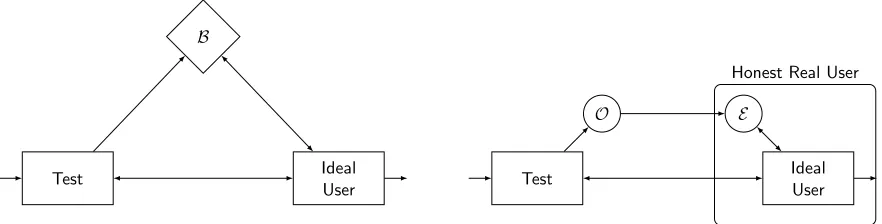
Figure 1: The ideal world (on the left) and the real world with an honest user.
• Ideal Execution. The ideal world consists of two (adversarially designed) entities —
a User and aTest — who can freely interact with each other. (See the left-hand side
ofFigure 1.) User is given access, via handles, to a collection of “agents” (interactive
Turing Machines), maintained byB (a “blackbox”). User andTest are both allowed to
2
add agents to the collection maintained byB, but the class of agents that they can add are restricted by aschema.3 TheUser can feed inputs to these agents, and also allow a
set of them to interact with each other, in a “session.” At the end of this interaction, the user obtains all the outputs from the session, and also additional handles to the agents with updated states.
Example: In a schema capturing public-key functional encryption, there are two kinds of agents – “message agents” and “key agents.” A message agent simply sends out (i.e.,
copies into its communication tape) an inbuilt message, every time it is invoked. A
key agent reads a message from its incoming communication tape, applies an inbuilt function to it, and copies the result to itsoutput tape. The user can add only message
agents to the collection maintained byB;Test can add key agents as well. Note that
the outputs that the user receives from a session involving a message agent and a key agent is the output produced by the key agent (the message agent produces no output; it only communicates its message to the key agent). 4
• Real Execution. The real execution also consists of two entities, the (real-world) user (or an adversaryAdv) andTest. The latter is in fact the same as in the ideal world. But in the real world, whenTest requests adding an agent to the collection of agents, the user is handed a cryptographically generated object – a “cryptographic agent” – instead of a handle to this agent. Thecorrectness requirementis that an honest user should be able to perform all the operations anyUser can in the ideal world (i.e., add new agents to the collection, and execute a session of agents, and thereby update their states) using an “execution” operation applied to the cryptographic agents. InFigure 1, O indicates
the algorithm for encoding, andE indicates a procedure that applies an algorithm for
session executions, as requested by theUser. (However, an adversarial user Advin the real world may analyze the cryptographic agents in anyway it wants.)
• Security Definition. We defineIND-PRE (for indistinguishability preserving) security, which requires thatifaTestis such that a certain piece of information about it (modeled as an input bit) remains hidden from every user in the ideal world,thenthat information should stay hidden from every user that interacts withTest in the real world as well. Note that we do not require that the view in the real world can be simulated in the ideal world.
In the real world we require all entities to be computationally bounded. But in the
ideal world, we may consider users that are computationally bounded or unbounded (possibly with a limit on the number of sessions it can invoke). Another variable in our definition is the family of tests: by default, we considerTests that are PPT; but we may considerTests from a family Γ, in which case the resulting security definition is termed Γ-IND-PRE security. These choices allow us to model different levels of security, which translate to various natural notions of security for specific schemata.
Our Contributions. Our main contribution is a new model of cryptographic computation, that unifies and extends primitives for computing on encrypted data such as obfuscation,
3Here, a schemais analogous to afunctionalityin UC security. Thus different primitives like functional
encryption and fully-homomorphic encryption are specified by different schemata.
4For functional encryption, neither inputs to agents nor their states are relevant, as the message and
functional encryption, fully homomorphic encryption, property preserving encryption, and such others. One can consider our framework analogous to the now-standard approach
in secure multi-party computation (MPC) (e.g., following [76, 49]) that uses a common
paradigm to abstract the security guarantees in a variety of different taskslike commitments, zero-knowledge proofs, coin-flipping, oblivious-transfer, etc. While we anticipate several refinements and extensions to the framework presented here, we consider that, thanks to its simplicity, the current model already provides important insight about the “right” security notions for the primitives we capture, and opens up a wealth of new questions and connections for further investigation.
The list of technical results in this paper could be viewed in two parts: contributions to the foundational aspects of cryptographic objects, and contributions to specific objects of interest (mainly, obfuscation, functional encryption and assumptions related to (bi/multi-linear) groups). Some of our specific contributions to the foundational aspects of this area are as follows.
• We first define a general framework of cryptographic agents that can be instantiated for different primitives using differentschemata. The resulting security definition, called Γ-IND-PRE-security is parameterized by a test family Γ.
For natural choices of Γ, these definitions tend to be not only stronger than standard definitions, but also easier to work with in larger constructions (see next). For some schemata, like obfuscation and functional encryption, choosing Γ to be the family of all PPT tests can lead to definitions that are known to be impossible to realize. But more restricted test families can be used to capture existing definitions (with candidate constructions) exactly: we identify ∆, ∆det and ∆∗ (defined later) as important test families that do this for obfuscation and/or functional encryption.
∆-IND-PRE-security is of particular interest, because for each of the example primitives we consider in this paper — obfuscation, functional encryption, fully-homomorphic
encryption and property-preserving encryption — ∆-IND-PRE-security for the
corre-sponding schema implies the standard security definitions (that are not known to be impossible to realize) in the literature, and yet, is not known to be impossible to realize.
• We present a notion of reduction from one schema to another5, and a composition
theorem. This provides a modular means to build and analyze secure schemes for a complicated schema based on those for simpler schemata. Further, reduction provides a way to study, in abstract, relative complexity of different schemata: e.g., general purpose obfuscation turns out to be a “complete” schema under this notion.
• The notion of reduction mentioned above composes for Γppt-IND-PRE-security where Γppt is the class of all probabilistic polynomial time (PPT) tests. Unfortunately, obfuscation (and hence, any other complete schema) can be shown to be unrealizable under this definition. Hence, we present a more structured notion of reduction, called ∆-reduction, that composes with respect to ∆-IND-PRE-security as well.
These basic results have several important implications to specific primitives of interest.
5
In this paper, we initiate the study of a few such primitives in our framework (and leave others to future work).
• Functional Encryption. Our framework provides a unified method to capture all variants of FE using just a few basic schemata by employing different test families. For concreteness, below we focus on public-key FE.
– Defining FE With and Without Function-Hiding. Function-hiding (public-key) FE had proved difficult to define satisfactorily [34,35,56]. TheIND-PRE framework provides a way to obtain a natural and general definition of this primitive. We present a simple schemaΣfh-feto capture the security guarantees of function-hiding
FE; a similar schemaΣfe captures FE without function-hiding.
– Hierarchy of Security Requirements. By using different test families, we ob-tain a hierarchy of security notions for FE (with and without function-hiding), ∆det-IND-PRE ⇐ ∆-IND-PRE ⇐ IND-PRE ⇐ SIM (see Footnote 5). Of these, ∆det-IND-PREsecurity for FE without function-hiding is equivalent to the standard
notion of security used currently [28, 23]. The strongest one, SIM security, is impossible for general function families [19,53,61].
– Constructions. We present new constructions for ∆-IND-PREsecure FE (both with and without function hiding) for all polynomial-time computable functions. We also
present anIND-PRE secure FE for the inner product functionality. Two of these
constructions are in the form of reductions (a ∆-reduction to an obfuscation schema, and a (standard) reduction to a “bilinear generic group” schema, which are described below). Also, the first two constructions crucially rely on ∆-IND-PRE-security of obfuscation (i.e., adaptive differing-inputs obfuscation), thereby considerably simplifying the constructions and the analysis compared to those in recent work [44,20] which use (non-adaptive) differing-inputs obfuscation.
• Obfuscation. We study in detail, the various notions of obfuscation in the literature,
and relate them to Γ-IND-PRE-security for various test families Γ. Our strongest
definition of this form, which considers the family of all PPT tests, turns out to be impossible. Our definition is conceptually “weaker” than the virtual black-box simulation definition (in that it does not require a simulator), but the impossibility result of Barak et al. [29] continues to apply to this definition. To circumvent the impossibility, we identify three test families, ∆, ∆∗ and ∆det, such that ∆det-IND-PRE-security isequivalent to indistinguishability obfuscation, ∆∗-IND-PRE-security is equivalent to differing inputs obfuscation, and ∆-IND-PRE-security implies both the above. We state a new definition for the security of obfuscation –adaptive differing-inputs obfuscation– which is equivalent ∆-IND-PRE-security. Informally, it is the same as differing inputs obfuscation, but an adversary is allowed tointeract with the “sampler” (which samples two circuits one of which will be obfuscated and presented to the adversary as a challenge), even after it receives the obfuscation. Such a notion was independently introduced in [27].
albeit in a broad manner (by considering arbitrary tests). Indeed, for random oracles, such an assumption is implied by (for instance) virtual black-box secure obfuscation of point-functions, a primitive that has plausible candidates in the literature.
The generic group schema (as well as its bilinear version) is a highly versatile resource used in several constructions, including that of cryptographic objects that can be modeled
as schemata. Such constructions can be considered asreductionsto the generic group
schema. Combined with our composition theorem, this creates a recipe for standard model constructions under a strong, but simple to state, computational assumption.
We give such an example for obtaining a standard modelfunction-hidingpublic-key FE
scheme for inner-product predicates (for which a satisfactory general security definition has also been lacking).
• Other Primitives. Our model is extremely flexible, and can easily capture most cryptographic objects for which an indistinguishability security notion is required. This includes witness encryption, functional witness encryption, fully homomorphic encryption (FHE), property-preserving encryption (PPE) etc. We discuss a couple of them – FHE and PPE – to illustrate this. We can model FHE using (stateful) cryptographic agents. The resulting security definition, even with the test family ∆det, implies the standard definition in the literature, with the additional requirement that a ciphertext does not reveal how it was formed, even given the decryption key. For PPE, we show that an ∆det-IND-PREsecure scheme for the PPE schema is in fact equivalent to a scheme that
satisfies the standard definition of security for PPE.
Related Work. Recently, there has been a tremendous amount of work on objects we model,
including FE and obfuscation. We discuss some of it inAppendix A and also at appropriate
points in the rest of this paper.
2
Preliminaries
To formalize the model of cryptographic agents, we shall use the standard notion of probabilistic interactive Turing Machines (ITM) with some modifications (see below). To avoid cumbersome formalism, we keep the description somewhat informal, but it is straightforward to fully formalize our model. We shall also not attempt to define the model in its most generality, for the sake of clarity.
In our case an ITM has separate tapes for input, output, incoming communication, outgoing communication, randomness and work-space.
Definition 1 (Agents and Family of Agents). An agent is an interactive Turing Machine, with the following modifications:
• There is a special read-only parameter tape, which always consists of a security parameter κ, and possibly other parameters.
• There is an a priori restriction on the size of all the tapes other than the randomness tape (including input, communication and work tapes), as a function of the security
• There is a specialblocking state such that if the machine enters such a state, it remains there if the input tape is empty. Similarly, there are blocking states which let the machine block if any combination of the communication tape and the input tape is empty.
An agent family is a maximal set of agents with the same program (i.e., state space and
transition functions), but possibly different contents in their parameter tapes. We also allow an agent family to be the empty set ∅.
We can allownon-uniform agentsby allowing an additional advice tape. Our framework
and basic results work in the uniform and non-uniform model equally well.
Note that an agent who enters a blocking state can move out of it if its configuration is changed by adding a message to its input tape and/or communication tape. However, if the agent enters a halting state, it will not move out of that state. An agent who never enters a blocking state is called anon-reactive agent. An agent who never reads or writes from a communication tape is called anon-interactive agent.
Definition 2 (Session). A session maps a finite ordered set of agents, their configurations and inputs, to outputs and (updated) configurations of the same agents, as follows. The agents are initialized with the given inputs on their input tapes, and then executed together until they are deadlocked.6 The result of applying the session is defined as the collection of outputs and configurations of the agents when the session terminates (if it terminates; if not, the result is left undefined).
We shall be restricting ourselves to collections of agents such that sessions involving them are guaranteed to terminate. Note that we have defined a session to have only an initial set of inputs, so that the outcome of a session is well-defined (without the need to specify how further inputs would be chosen).
Next we define an important notion in our framework, namely that of an ideal agent
schema, or simply, a schema. A schema plays the same role as a functionality does in the Universal Composition framework for secure multi-party computation. That is, it specifies what is legitimate for a user to do in a system. A schema defines the families of agents that a “user” and a “test” (or authority) are allowed to create.
Definition 3 (Ideal Agent Schema). A (well-behaved) ideal agent schema Σ= (Pauth,Puser)
(or simply schema) is a pair of agent families, such that there is a polynomialpoly such that for any session of agents belonging toPauth∪ Puser(with any inputs and any configurations, with the same security parameterκ), the session terminates withinpoly(κ, t) steps, where t is the number of agents in the session.
Other Notation. IfX andY are a family of binary random variables (one for each value of
κ), we write X≈Y if there is a negligible function negl such that |Pr[X= 1]−Pr[Y = 1]| ≤
negl(κ). For two systemsM andM0, we sayM uM0 if the two systems are indistinguishable to an interactive PPT distinguisher.
6
3
Defining Cryptographic Agents
In this section we define what it means for a cryptographic agent scheme to securely implement a given ideal agent schema. Intuitively, the security notion is ofindistinguishability preservation: if two executions using an ideal schema are indistinguishable, we require them to remain indistinguishable when implemented using a cryptographic agent scheme. While it consists of several standard elements of security definitions, indistinguishability preservation as defined here is novel, and potentially of broader interest.
Ideal World. The ideal system for a schemaΣconsists of two parties Test andUser and a fixed third party B[Σ] (for “black-box”). All three parties are probabilistic polynomial time (PPT) ITMs, and have a security parameterκ built-in. We shall explicitly refer to their random-tapes asr, sandt. Testreceives a “secret bit”bas input andUserproduces an output bitb0. The interaction betweenUser,Test andB[Σ] can be summarized as follows:
• Uploading agents. LetΣ= (Pauth,Puser) where we associatePtest:=Pauth∪ Puserwith
Test and Puser with User. Test and User can, at any point, choose an agent from its
agent family and send it toB[Σ]. More precisely,User can send a string to B[Σ], and
B[Σ] will instantiate an agent Puser, with the given string (along with its own security parameter) as the contents of the parameter tape, and all other tapes being empty. Similarly,Testcan send a string and a bit indicating whether it is a parameter forPauth
orPuser, and it is used to instantiate an agentPauthor Puser, accordingly 7. Whenever an agent is instantiated,B[Σ] sends a unique handle (a serial number) for that agent to
User; the handle also indicates whether the agent belongs to Pauth orPuser.
• Request for Session Execution. At any point in time,Usermay request an execution of a session, by sending an ordered tuple of handles (h1, . . . , ht) (from among all the
handles obtained thus far from B[Σ]) to specify the configurations of the agents in the session, along with their inputs. B[Σ] reports back the outputs from the session, and also gives new handles corresponding to the configurations of the agents when the session terminated.8 If an agent halts in a session, no new handle is given for that agent.
Observe that onlyUser receives any output fromB[Σ]; the communication betweenTestand
B[Σ] is one-way. (SeeFigure 1.)
We define the random variableidealhTest(b) |Σ|Useri to be the output ofUser in an execution of the above system, whenTest getsb as input. We writeidealhTest|Σ|Useri in the case when the input toTestis a uniformly random bit. We also defineTimehTest|Σ|Useri
as the maximum number of steps taken by Test (with a random input), B[Σ] and User in
total.
Definition 4. We say that Test ishiding w.r.t. Σif ∀ PPT party User,
idealhTest(0)|Σ|Useri ≈idealhTest(1)|Σ|Useri.
7In fact, for convenience, we allow TestandUserto specify multiple agents in a single message toB[Σ]. 8
Note that if the same handle appears more than once in the tuple (h1, . . . , ht), it is interpreted as multiple
When the schema is understood, we shall refer to the property of being hiding w.r.t. a schema as simply being ideal-hiding.
Real World. A cryptographic scheme(or simply scheme) consists of a pair of (possibly stateful and randomized) programs (O,E), whereO is an encoding procedure for agents in
Ptest andE is an execution procedure. The real world execution for a scheme (O,E) consists ofTest, a user that we shall generally denote asAdv and the encoder O. (E features as part of an honest user in the real world execution: seeFigure 1.) Test remains the same as in the ideal world, except that instead of sending an agent toB[Σ], it sends it to the encoderO. In turn,Oencodes this agent and sends the resulting cryptographic agent to Adv.
We define the random variable realhTest(b) | O | Advi to be the output of Adv in an
execution of the above system, when Test gets b as input; as before, we omit b from the
notation to indicate a random bit. Also, as before, TimehTest | O |Useri is the maximum
number of steps taken byTest (with a random input), O andUser in total.
Definition 5. We say that Test ishiding w.r.t. O if ∀ PPT party Adv,
realhTest(0)| O |Advi ≈realhTest(1)| O |Advi.
Note that realhTest | O |Advi =realhTest◦ O | ∅ |Advi where ∅ stands for the null
implementation. Thus, instead of saying Test is hiding w.r.t. O, we shall sometimes say
Test◦ O is hiding (w.r.t. ∅). Also, when O is understood, we may simply say that Test is
real-hiding.
Syntactic Requirements on (O,E). (O,E) may or may not use a “setup” phase. In the latter case we call it asetup-free cryptographic agent scheme, andO is required to be a memory-less program that takes an agentP ∈ Ptestas input and outputs a cryptographic agent that is sent toAdv. If the scheme has a setup phase, O consists of a triplet of memory-less programs (Osetup,Oauth,Ouser): in the real world execution, first Osetup is run to generate a secret-public key pair (MSK,MPK);9 MPK is sent toAdv. Subsequently, whenO receives an agentP ∈ Pauth it will invokeOauth(P,MSK), and when it receives an agentP ∈ Puser, it will invokeOuser(P,MPK), to obtain a cryptographic agent that is then sent toAdv.
E is required to be memoryless as well, except that when it gives a handle to aUser, it can record a string against that handle, and later whenUser requests a session execution,E can access the string recorded for each handle in the session. There is acompactness requirement
that the size of this string isa priori bounded (note that the state space of the ideal agents are alsoa priori bounded). If there is a setup phase, E can also accessMPK each time it is invoked.
IND-PRE Security. Now we are ready to present the security definition of a cryptographic agent scheme (O,E) implementing a schemaΣ. Below, thehonest real-world user,
correspond-ing to an ideal-world user User, is defined as the composite program E ◦User as shown in
Figure 1.
Definition 6. A cryptographic agent scheme Π = (O,E) is said to be a Γ-IND-PRE-secure schemefor a schema Σ if the following conditions hold.
• Correctness. ∀PPT User and ∀Test∈Γ, idealhTest|Σ|Useri ≈realhTest| O | E ◦
Useri. If equality holds, (O,E) is said to have perfect correctness.
9
B[Σ]
Test Adv
S
(a)
B[Σ∗]
O E
Test Ideal
User Honest Real User
(b)
O∗ E∗ O E
Test Ideal
User Honest Real User
(c)
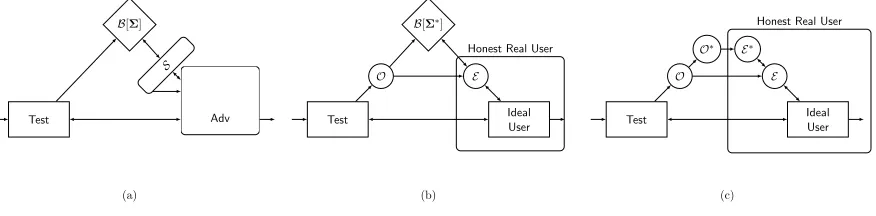
Figure 2: (O,E) in (b) is a reduction from schema ΣtoΣ∗. The security requirement is that
no adversaryAdv in the system (a) can distinguish that execution from an execution of the
system in (b) (withAdv taking the place of honest real user). The correctness requirement is that the idealUser in (b) behaves the same as the idealUser interacting directly withB[Σ] (as inFigure 1(a)). (c) shows the composition of the hybrid scheme (O,E)Σ∗ with a scheme (O∗,E∗) thatIND-PRE-securely implementsΣ∗.
• Efficiency. There exists a polynomial poly such that,∀ PPT User, ∀Test∈Γ,
TimehTest| O | E ◦Useri ≤poly(TimehTest|Σ|Useri, κ).
• Indistinguishability Preservation. ∀Test∈Γ,
Test is hiding w.r.t. Σ⇒Test is hiding w.r.t. O.
WhenΓis the family of all PPT tests – denoted by Γppt, we simply say that Π is anIND-PRE
-secure scheme for Σ.
4
Reductions and Compositions
A fundamental question regarding (secure) computational models is that of reduction: which tasks can be reduced to which others. In the context of cryptographic agents, we ask which
schemata can be reduced to which other schemata. We shall use a strongsimulation-based
notion of reduction. While a simulation-based security notion for general cryptographic agents or even just obfuscations (i.e., virtual black-box obfuscation) is too strong to exist, it is indeed possible to meet a simulation-based notion for reductions between schemata. This isanalogous to the situation in Universally Composable security, where sweeping impossibility results exist for UC secure realizations in the plain model, but there is a rich structure of UC secure reductions among functionalities.
A hybrid scheme(O,E)Σ∗ is a cryptographic agent scheme in whichO and E have access to B[Σ∗], as shown in Figure 2 (in the middle), where Σ∗ = (Pauth∗ ,Puser∗ ). If O has a setup phase, we require that Ouser uploads agents only in Puser∗ (but Oauth can upload any agent inP∗
auth∪ Puser∗ ). In general, the honest user would be replaced by an adversarial user
Adv. Note that the output bit of Adv in such a system is given by the random variable
idealhTest◦ O | Σ∗ | Advi, where Test◦ O denotes the combination of Test and O as in
Definition 7 (Reduction). We say that a (hybrid) cryptographic agent scheme Π = (O,E) reducesΣ toΣ∗ with respect toΓ, if there exists aPPT simulator S such that ∀ PPT User,
1. Correctness: ∀Test∈Γppt, idealhTest|Σ|Useri ≈idealhTest◦ O |Σ∗ | E ◦Useri.
2. Simulation: ∀Test∈Γ,idealhTest|Σ| S ◦Useri ≈idealhTest◦ O |Σ∗ |Useri.
If Γ = Γppt, we simply say Π reduces Σto Σ∗. If there exists a scheme that reduces Σ toΣ∗, then we say Σreduces toΣ∗. (Note that correctness is required for allPPT Test, and not just in Γ.)
Figure 2illustrates a reduction. It also shows how such a reduction can be composed with anIND-PRE-secure scheme forΣ∗. Below, we shall use (O0,E0) = (O ◦ O∗,E∗◦ E) to denote the composed scheme inFigure 2(c).10
Theorem 1 (Composition). For any two schemata, Σ and Σ∗, if (O,E) reduces Σ to Σ∗ and (O∗,E∗) is anIND-PRE secure scheme forΣ∗, then (O ◦ O∗,E∗◦ E)is an IND-PREsecure scheme for Σ.
Proof sketch: Let (O0,E0) = (O ◦ O∗,E∗◦ E). Also, let Test0 =Test◦ O andUser0 =E ◦User. To show correctness, note that for any User, we have
realhTest| O0 | E0◦Useri=realhTest0 | O∗| E∗◦User0i
(a)
≈ idealhTest0|Σ∗ |User0i
=idealhTest◦ O |Σ∗ | E ◦Useri
(b)
≈ idealhTest|Σ|Useri
where (a) follows from the correctness guarantee of IND-PRE security of (O∗,E∗), and (b) follows from the correctness guarantee of (O,E) being a reduction of ΣtoΣ∗. (The other equalities are by regrouping the components in the system.)
It remains to prove that for allPPT Test, ifTest is hiding w.r.t. ΣthenTestis hiding w.r.t. O0.
Firstly, we argue thatTest is hiding w.r.t. Σ⇒Test0 is hiding w.r.t. Σ∗. SupposeTest0 is not hiding w.r.t. Σ∗. This implies that there is someUsersuch thatidealhTest0(0)|Σ∗|Useri
6≈ idealhTest0(1) | Σ∗ | Useri. But, by security of the reduction (O,E) of Σ to Σ∗,
idealhTest0(b)|Σ∗|Useri ≈idealhTest(b)|Σ| S◦Useri, forb= 0,1. Then,idealhTest(0)|Σ| S◦
Useri 6≈idealhTest(1)|Σ| S ◦Useri, showing that Testis not hiding w.r.t.Σ. Thus we have,
Test is hiding w.r.t. Σ⇒Test0 is hiding w.r.t. Σ∗
⇒Test0 is hiding w.r.t. O∗
⇒Test is hiding w.r.t. O0,
where the second implication is due to the fact that (O∗,E∗) is an IND-PRE secure imple-mentation of Σ∗, and the last implication follows by observing that for any Adv, we have
realhTest0| O∗ |Advi=realhTest| O0 |Advi (by regrouping the components).
10If (O,E) and (O∗ ,E∗
) have a setup phase, then it is implied thatO0
auth=Oauth◦ O∗auth,O 0
user=Ouser◦ Ouser∗ ;
invokingO0
Note that in the above proof, we invoked the security guarantee of (O∗,E∗) only with respect to tests of the form Test◦ O. Let Γ◦ O = {Test◦ O|Test ∈Γ}. Then we have the following generalization.
Theorem 2 (Generalized Composition). For any two schemata, Σand Σ∗, if (O,E) reduces Σto Σ∗ and (O∗,E∗) is a(Γ◦ O)-IND-PRE secure scheme for Σ∗, then (O ◦ O∗,E∗◦ E) is a
Γ-IND-PRE secure scheme for Σ.
Theorem 3 (Transitivity of Reduction). For any three schemata, Σ1,Σ2,Σ3, ifΣ1 reduces
to Σ2 andΣ2 reduces to Σ3, then Σ1 reduces to Σ3.
Proof sketch: If Π1 = (O1,E1) and Π2 = (O2,E2) are schemes that carry out the reduction of
Σ1 to Σ2 and that ofΣ2 toΣ3, respectively, we claim that the scheme Π = (O1◦ O2,E2◦ E1)
is a reduction ofΣ1 to Σ3. The correctness of this reduction follows from the correctness
of the given reductions. Further, if S1 and S2 are the simulators associated with the two
reductions, we can define a simulatorS for the composed reduction as S2◦ S1.
5
Restricted Test Families:
∆
,
∆
∗and
∆
detIn order to capture various notions of security, we define various corresponding families of test functions. For some schemata of interest, such as obfuscation, there exist noIND-PREsecure schemes (seeAppendix D.4for details). Restricted test families are also useful to bypass these impossibilities.
We remark that one could define test families specifically adapted to the existing security definitions of various primitives, but our goal is to provide general test families that apply meaningfully to all primitives, and also, would support a composable notion of reduction. Towards this we propose the following sub-class of PPT tests, called ∆. Intuitively ∆ is a set of tests that reveal everything about the agents it sends to the user except for one bitb. This exactly captures indistinguishability style definitions such as indistinguishability obfuscation, differing inputs obfuscation, indistinguishability style FE and such others.
We formalize this intuition as follows: for Test ∈ ∆, each time Test sends an agent to
B[Σ], it picks two agents (P0, P1). Both the agents are sent toUser, andPb is sent to B[Σ]
(where bis the secret bit input to Test). Except for selecting the agent to be sent to B[Σ],
Test is oblivious to the bit b. It will be convenient to represent Test(b) (for b ∈ {0,1}) as
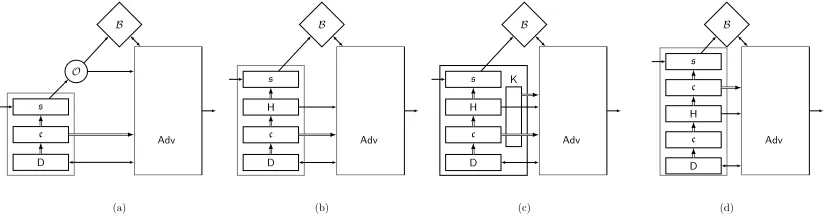
D◦c◦s(b), where Dis a PPT party which communicates withUser, and outputs pairs of the form (P0, P1) toc; csends both the agents to User, and also forwards them tos; s(b) forwards
Pb toB[Σ] (and sends nothing toUser).
As we shall see, for both obfuscation and functional encryption, ∆-IND-PRE-security is indeed stronger than all the standard indistinguishability based security definitions in the literature.
B O s c D Adv (a) B s H c D Adv (b) B s H c D K Adv (c) B s c H c D Adv (d)
Figure 3: Illustration of ∆ and the extra requirements on ∆-reduction. (a) illustrates the structure of a test in ∆; the double-arrows indicate messages consisting of a pair of agents. The first condition onH is that (a) and (b) are indistinguishable toAdv: i.e.,H can mimic the message fromOwithout knowing the input bit to s. The second condition is that (c) and (d) are indistinguishable: i.e.,K should be able to simulate the pairs of agents produced byH,
based only on the input toH(copied byctoAdv) and the messages fromH toAdv.
At a high-level, we shall require O to have some natural additional properties that would let us convertTest◦ O back to a test in ∆, ifTest itself belongs to ∆.
Combining Machines: Some Notation. Before defining ∆-reduction and proving the related composition theorems, it will be convenient to introduce some additional notation.
Note that the machinesc and sabove, as well as the program O, have three communication
ports (in addition to the secret bit that sreceives): in terms of Figure 3, there is an input port below, an output port above and another output port on the right, to communicate withUser. (Dis also similar, except that it has no input port below, and on the right, it can
interact withUser by sending and receiving messages.) For such machines, we use M1◦M2
to denote connecting the output port aboveM1 to the input port of M2. The message from
M1◦M2 toUser is defined to consist of the pair of messages fromM1 andM2 (formatted into
a single message).
We shall also consider adding machines to the right of such a machine. Specifically, we use M / K to denote modifying M using a machine K that takes as input the messages output byM toUser (i.e., to its right), and to each such message mayappend an additional
message of its own. Recall that for two systems M and M0, we say M u M0 if the two
systems are indistinguishable to an interactive PPT distinguisher. Using this notation, we define ∆-reduction.
Definition 8 (∆-Reduction). We say that a (hybrid) obfuscated agent scheme Π = (O,E) ∆-reducesΣ toΣ∗ if
1. Π reducesΣ toΣ∗ with respect to∆ (as in Definition 7), and
2. there exists PPT Hand K such that
(a) for allDsuch that D◦c◦s is hiding w.r.t. Σ, D◦c◦s(b)◦ O uD◦c◦H◦s(b), for b∈ {0,1};
(b) c◦H◦cuc◦H/K.
Informally, condition (a) allows us to move O “below” s(b): note that H will need to
send any messagesO used to send toUser, without knowingb. Condition (b) requires that
sending a copy of the pairs of agents output byH (by addingc “above”H) is “safe”: it can be simulated byK, which only sees the pair of agents that are given as input to H. ∆-reduction
allows us to extend the composition theorem to ∆-IND-PRE security. We prove the following
theorems inAppendix B.
Theorem 4 (∆-Composition). For any two schemata, Σ andΣ∗, if (O,E) ∆-reduces Σ to Σ∗ and (O∗,E∗) is a ∆-IND-PRE secure implementation of Σ∗, then (O ◦ O∗,E∗ ◦ E) is a ∆-IND-PRE secure implementation ofΣ.
Theorem 5 (Transitivity of ∆-Reduction). For any three schemata, Σ1, Σ2, Σ3, if Σ1
∆-reduces to Σ2 andΣ2 ∆-reduces to Σ3, then Σ1 ∆-reduces to Σ3.
Other Restricted Test Families. We define two more restricted test families, ∆∗ and ∆det, which are of great interest for the obfuscation and functional encryption schemata. Both
of these are subsets of ∆.
The family ∆det simply consists of all deterministic tests in ∆. Equivalently, ∆det is the class of all tests of the formD◦c◦s, whereDis a deterministic polynomial time party which communicates withUser, and outputs pairs of the form (P0, P1) to c.
The family ∆∗ consists of all tests in ∆ which do not read any messages from User.
Equivalently, ∆∗ is the class of all tests of the formD◦c◦s, whereDis a PPT party which may send messages toUser but does not accept any messages fromUser, and outputs pairs of the form (P0, P1) to c. As described inAppendix B, the composition theorem for ∆,Theorem 4,
extends to ∆∗ as well.
6
Generic Group Schema
Our framework provides a method to convert a certain class of constructions — i.e., secure schemes for primitives that can be modeled as schemata — that are proven secure in heuristic models like the random oracle model [54] or the (bilinear) generic group model [16,40], into secure constructions in the standard model.
To be concrete, we consider the case of the generic group model. There are two important observations we make:
• Proving that a cryptographic scheme for a given schemaΣis secure in the generic group
model typically amounts to areduction from Σto a “generic group schema”Σgg.
• The assumption that there is anIND-PRE-secure scheme ΠggforΣggis a standard-model assumption (that does not appear to be ruled out by known results or techniques).
Combined using the composition theorem (Theorem1), these two observations yield a standard model construction for anIND-PRE-secure scheme for Σ.
We formally state the assumption mentioned above:
Assumption 1 (Γ-Generic Group Agent Assumption). There exists a Γ-IND-PRE-secure scheme for the generic group schema Σgg.
Similarly, we put forward the Γ-Bilinear Generic Group Agent Assumption, whereΣgg is
replaced byΣbggwhich has three groups (two source groups and a target group), and allows the bilinear pairing operation as well.
The most useful form of these assumptions (required by the composition theorem when used with the standard reduction) is when Γ is the set of all PPT tests. However, weaker
forms of this assumption (like ∆-GGA assumption, or ∆∗-GGA assumption) are also useful,
if a given construction could be viewed as a stronger form of reduction (like ∆-reduction).
While this assumption may appear too strong at first sight – given the impossibility results surrounding the generic group model – we argue that it is plausible. Firstly, observe that primitives that can be captured as schemata are somewhat restricted: primitives like zero knowledge that involve simulation based security, CCA secure encryption or non-committing encryption and such others do not have an interpretation as a secure schema. Secondly,
IND-PREsecurity is weaker than simulation based security, and its achievability is not easily ruled out (see discussion inSection 10). Also we note that such an assumption already exists in the context of another popular idealized model: the random oracle model (ROM). Specifically, consider a natural definition of the random oracle schema,Σro, in which the agents encode elements in a large set and interact with each other to carry out equality checks. Then, a ∆det-IND-PRE-secure scheme forΣro is equivalent to a point obfuscation scheme, which hides everything about the input except the output. The assumption that such a scheme exists is widely considered plausible, and has been the subject of prior research [48,64,1,58]. This fits into a broader theme of research that attempts to capture several features of the random
oracle using standard model assumptions (e.g., [75,52]). The GGA assumption above can
be seen as a similar approach to the generic group model, that captures only some of the security guarantees of the generic group model so that it becomes a plausible assumption in the standard model, yet is general enough to be of use in a broad class of applications.
One may wonder if we could use an even stronger assumption, by replacing the (bilinear) generic group schemaΣggorΣbggby a multi-linear generic group schemaΣmgg, which permits black box computation of multilinear map operations [32, 7]. Interestingly, this assumption is provably false if we consider Γ to be Γppt, since there exists a reduction of obfuscation schema
Σobf toΣmgg [79, 18], and we have seen that there is no IND-PRE-secure scheme forΣobf. On the other hand, for Γ being ∆ or ∆∗, say, it remains a plausible assumption. Indeed, as mentioned earlier, Pass et al. introduced a computational assumption on multi-linear maps – called “semantic security” – and showed that the security of candidate constructions for indistinguishability obfuscation (aftersome modifications) can be based on semantically secure multi-linear groups [4]. We note that their assumption can be stated similar toAssumption 1, but using a multi-linear map schema and an appropriate test-family.
Falsifiability. Note that the above assumption as stated is not necessarily falsifiable, since there is no easy way to check that a given PPT test is hiding. However, it becomes falsifiable if instead ofIND-PREsecurity, we used a modified notion of securityIND-PRE0, which requires that every test which isefficiently provably ideal-hiding is real-hiding. We note thatIND-PRE0
must) provide a proof that a test is ideal-hiding and also exhibit a real world adversary who breaks its hiding when using the scheme.
7
Obfuscation Schema
In this section we define and study the obfuscation schemaΣobf. In the obfuscation schema, agents are deterministic, non-interactive and non-reactive: such an agent behaves as a simple Turing machine, that reads an input, produces an output and halts.
Definition. Below, we formally define the obfuscation schema. If F is a family of determin-istic, non-interactive and non-reactive agents, we define
Σobf(F):= (∅,F).
That is, in the ideal execution User obtains handles for computing F. We shall consider
setup-free,IND-PRE secure implementations (O,E) ofΣobf(F).
A special case ofΣobf(F) corresponds to the case whenF is the class of all functions that
can be computed within a certain amount of time. More precisely, we can define the agent familyUs (foruniversalcomputation) to consist of agents of the following form: the parameter tape, which is at mosts(κ) bits long is taken to contain (in addition to κ) the description of an arbitrary binary circuitC; on inputx,Us will compute and outputC(x) (padding or
truncatingxas necessary). We define the “general” obfuscation schema
Σobf:= (∅,Pobf
user) :=Σobf(Us),
for a given polynomial s. Here we have omitted s from the notation Σobf and Puserobf for simplicity, but it is to be understood that whenever we refer toΣobf some polynomial sis implied.
Completeness of Obfuscation. We show that Σobfis a complete schema with respect to schematic reduction (Definition 7). That is, every schema(including possibly randomized, interactive, and stateful agents) can be reduced toΣobf. We stress that this does not yield an
IND-PRE-secure scheme for every schema (using composition), since there does not exist an
IND-PRE-secure scheme forΣobf, as described inAppendix D.4. However, if there is, say, a
hardware-basedIND-PRE secure implementation ofΣobf, then this implementation can be
used in a modular way to build anIND-PRE secure schema for any general functionality.
The reduction uses only standard cryptographic primitives: CCA secure public-key encryption and digital signatures. We present the full construction and proof in [55].
Relation to existing notions of Obfuscation. By using the test-families ∆det and ∆∗ in our framework, we can recover the notions of indistinguishability obfuscation and differing inputs obfuscation [29,30] exactly. We prove the following inAppendix D.2.
Lemma 1. A set-up free ∆det-IND-PRE-secure scheme for Σobf (with perfect correctness) exists if and only if there exists an indistinguishability obfuscator.
A ∆-IND-PRE secure scheme for Σobf is a stronger notion than the above two notions of obfuscations (because ∆ is a superset of ∆det as well as ∆∗). One can give a definition of obfuscation in the traditional style, which exactly corresponds to this stronger notion. In Appendix D.3 we do exactly this, and term this adaptive differing inputs obfuscation. Independently, in [87] an equivalent definition appeared under the name of strong differing inputs obfuscation. Also, we note that we can modelVirtual Grey-Box Obfuscation[69] in our framework, using an appropriate test-family and a statistical notion of hiding inDefinition 4. This relies on an equivalence proven in [70] who give an indistinguishability based security definition for VGB security.
8
Functional Encryption
In this section, we present a schemaΣfe for Functional Encryption. Although all variants
of FE can 11 be captured as schemata secure against different families of test programs,
we focus on adaptive secure, indistinguishability-based, public-key FE (with and without function-hiding). InSection 8.1we introduce the schemaΣfe for FE without function-hiding, and in Section 8.2we introduce the schemaΣfh-fefor function-hiding FE.
8.1 Functional Encryption without Function Hiding
Public-key FE without function-hiding is the most well-studied variant of FE.Definition. For
a circuit family C = {Cκ} and a message space X = {Xκ}, we define the schema Σfe =
(Pfe
auth,Puserfe ) as follows:
• Pfe
user: An agent Px ∈ Puserfe simply sendsx to the first agent in the session, wherex∈ X is a parameter of the agent, and halts. We will often refer to such an agent as amessage agent.
• Pfe
auth: An agent PC ∈ Pauthfe , when invoked with input 0, outputsC (where C∈ C is a parameter of the agent) and halts. If invoked with input 1, it reads a message ˜x from its incoming communication tape, writesC(˜x) on its output tape and halts. We will often refer to such an agent as afunction agent.
Reducing Functional Encryption to Obfuscation. In a sequence of recent results [10,44,87,20,33], it was shown how to obtain various flavors of FE from various flavors of obfuscation. We investigate this connection in terms of schematic reducibility: canΣfe be reduced toΣobf? For this reduction to translate to an IND-PRE-secure scheme forΣfe, we will need an IND-PRE-secure scheme for Σobf, and a composition theorem.
Our main result in this section is a ∆-reduction of Σfe toΣobf. Then, combined with a ∆-IND-PREsecure implementation of Σobf, we obtain a ∆-IND-PRE secure implementation
ofΣfe, thanks toTheorem 4. 12
11
Simulation-based definitions can be captured in terms of reduction to the null schema.
12Given a ∆∗
-IND-PREsecure implementation ofΣobf, we could obtain a ∆∗-IND-PREsecure implementation ofΣfeusing the same reduction. This follows from the fact that the composition theorem for ∆,Theorem 4,
Before explaining our reduction, we compare it with the results in [10, 44, 20]. At a high-level, these works could be seen as giving “(Γfe,Γobf)-reductions” fromΣfe toΣobffor some pair of test families Γfe and Γobf, such that when it is composed with a Γobf-IND-PRE -secure scheme forΣobfone gets a Γfe-IND-PRE-secure scheme for Σfe. For example, in [10], Γobf= ∆det(corresponding to indistinguishability obfuscation); there Γfe is a test-family that capturesselective-secure functional encryption. We do not define such (Γfe,Γobf)-reductions formally in this work, as they are specific to the test-families used in [10, 44, 20]. Instead, we propose ∆-IND-PRE-security as a natural security notion for both obfuscation and functional encryption schemata, and provide a simpler ∆-reduction fromΣfe toΣobf.
Our Construction. We shall use a simple and natural functional encryption scheme: the key for a function f is simply a description of f with a signature on it; a ciphertext of a
messagem is an obfuscation of a program which when given as input a signed description of
a functionf, returnsf(m) if the signature verifies (and⊥ otherwise). Essentially the same construction was used in [20] as well, but they rely on “functional signatures” in which it is possible to derive keys for signing only messages satisfying an arbitrary relation. In our construction, we need only a standard digital signature scheme.
Below we describe our construction more formally, as a reduction from Σfe toΣobf and
prove that it is in fact a ∆-reduction. LetΣfe = (Pfe
auth,Puserfe ) and Σobf= (∅,Puserobf). We shall only describeO= (Osetup,Oauth,Ouser);E is naturally defined, and correctness is verified easily.
• Osetuppicks a pair of signing and verification keys (SK,VK) for the signature scheme as (MSK,MPK).
• Oauth, when given a function agentPf ∈ Pauthfe , outputs (f, σ) to be sent to E, wheref is the parameter ofPf and σ is a signature on it.
• Ouser, when given an agent Pm ∈ Puserfe as input, uploads an agent Pm,MPK ∈ Puserobf to
B[Σobf], which behaves as follows: on input (f, σ) Pm,MPK verifies that σ is a valid signature onf with respect to the signature verification keyMPK; if so, it outputs f(m), and else⊥.
InAppendix E.2 we show that this is indeed a ∆ reduction fromΣfe toΣobf.
Relation with known definitions. We examine the relation between IND-PRE-secure Functional Encryption with standard notions of security, such as indistinguishability based security. Firstly, we show that ∆det-IND-PRE-secure is equivalent to indistinguishability secure FE.
Lemma 3. ∃ a ∆det-IND-PRE-secure scheme forΣfe iff ∃an indistinguishability secure FE scheme.
Note that an IND-PREsecurity implies ∆det-IND-PREsecurity (for any schema). On the
other hand, we show a strict separation betweenIND-PREand ∆det-IND-PREsecurity for FE.
Lemma 4. ∃a ∆det-IND-PRE secure scheme forΣfe which is not anIND-PRE secure scheme for Σfe.
8.2 Function-Hiding Functional Encryption
Now we turn our attention tofunction-hidingFE (with public-keys). This a significantly more challenging problem, both in terms of construction and even in terms of definition [34,35,56]. The difficulty in definition stems from the public-key nature of the encryption which allows the adversary to evaluate the function encoded in a key on arbitrary inputs of its choice: hence a security definition cannot insist on indistinguishability between two arbitrary functions. In prior work, this is often handled by restricting the security definition to involve functions that are chosen from a restricted class of distributions, such that the adversary’s queries cannot reveal anything about the functions so chosen. The definition arising from our framework naturally generalizes this, as the security requirement applies to all hiding tests and thereby
removes the need of specifying ad hoc restrictions. We only need to specify a schema for
function-hiding FE, and the rest of the security definition follows from the framework.
The definition of the schema corresponding to function-hiding FE,Σfh-fe= (Pfh-fe
auth ,Puserfh-fe), is identical to that ofΣfe, except that a function agentPC ∈ Pauthfh-fe does not take any input,
but always reads an inputx from its communication tape and outputs C(x). That is, the
function agents do not reveal the function now.
Constructions. We present two constructions for function-hiding FE – an IND-PRE-secure
scheme for the class of inner-product predicates, and a ∆-IND-PRE-secure scheme for all
function families.
• The first construction is in fact an information-theoretic reduction of the schemaΣfh-fe(IP)
(whereIPdenotes the class of inner-product predicates) to the schemaΣbgg. Thus under
the assumption that there is anIND-PRE secure scheme forΣbgg, we obtain a scheme
forΣfh-fe, usingTheorem 1. This construction is essentially the same as a construction in the recent work of [56], which was presented in the generic group model. Intuitively, the simulation based proof in [56] may be interpreted as a simulation based reduction fromΣfh-fe(IP) toΣgg satisfying Definition 7.
• The second construction is for general function-hiding FE: a ∆-IND-PRE-secure scheme forΣfh-fe, based on the assumption that a ∆-secure scheme forΣobfexists. We mention
that this construction is not a ∆-reduction. It relies on applying a signature to an
obfuscation, and hence our framework cannot be used to model this as a black-box reduction (indeed, we cannot model the unforgeability requirement of signatures in our framework).
Further details of these constructions and their proofs are given inAppendix E.4.
9
Fully Homomorphic Encryption
In this section, we present a cryptographic agent schema Σfhe for Fully Homomorphic
Encryption (FHE). This schema consists ofreactive agents(i.e., agents which maintain state across invocations). For a message spaceX ={X }κ and a circuit familyF ={F }κ, we define
the schemaPfhe= (Ptestfhe,Puserfhe) as follows:
• An agentPMsg ∈ Pfhe
user is specified as follows: Its parameter tape consists of an initial
x2, x3, . . . , xt from its communication tapes. Then it computes C(x1, .., xt) where x1 is
its own value (either read from the work-tape, or if the work-tape is empty, from its parameter tape). Then it updates its work-tape with this value. When invoked without an input, it sends its message to the first program in the session.
• An agentPDec ∈ Pfhe
authis defined as follows: when executed with an agentPMsg it reads from its communication tape a single message fromPMsg and outputs it.13
In Appendix F we show that a semantically secure FHE schemeSfhe= (Setup,Encrypt,
Decrypt,Eval) can be naturally constructed from a ∆det-IND-PREsecure scheme for Σfhe.
Other Examples. Several examples that we have not discussed, such as witness encryption and other flavors of FE, can also be naturally modeled as schemata. We present one more
example — namely, property preserving encryption — inAppendix G, and leave the others
to future work on these objects.
10
On Bypassing Impossibilities
An important aspect of our framework is that it provides a clean mechanism to tune the level of security for each primitive to a “sweet spot.” The goal of such a definition is that it should imply prevalent achievable definitions while bypassing known impossibilities. The tuning is done by defining the family of tests, Γ with respect to whichIND-PRE security is required. Below we discuss a few schemata and the definitions we recommend for them, based on what is known to be impossible.
Obfuscation. As we show inSection 7, anIND-PRE-secure scheme forΣobfcannot exist. The impossibility proof relies on the fact that the test can upload an agent with (long) secrets in them. However, this argument stops applying when we restrict ourselves to tests in ∆: a test in ∆ has the structureD◦c◦s andc will reveal the agent to User. Note that then there could be at most one bit of uncertainty as to which agent was uploaded.
We point out that ∆-IND-PRE-security is much stronger than the prevalent notions of
indistinguishability obfuscation and differing inputs obfuscation, introduced by Barak et al. [29]. Indeed, to the best of our knowledge, it would be the strongest definition of obfuscation
known that can plausibly exist for all functions. We also observe that ∆-IND-PRE-secure
obfuscation14is easier to use in constructions than differing-inputs obfuscation, as exemplified
by our constructions inAppendix E.2and Appendix E.4.2.
Functional Encryption. Public-key function-hiding FE, as modeled byΣfh-fe, is a stronger primitive than obfuscation (for the same class of functions), as the latter can be easily reduced
to the former. This means that there is no IND-PRE-secure scheme for Σfh-fe for general
functions. We again consider ∆-IND-PRE security as a sweet-spot for defining function-hiding functional encryption. Indeed, prior to this definition, arguably there was no satisfactory definition for this primitive. Standard indistinguishability based definitional approaches (which typically specify an explicit test that is ideal-hiding) run into the problem that if
13
Note that there is no parameter to aPauthagent as there is only one of its kind. However, we can allow a
single schema to capture multiple FHE schemes with independent keys, in which case an index for the key would be the parameter forPauth agents.
the user is allowed to evaluate a given function on any inputs of its choice, there is no one natural ideal-hiding test. Prior works have proposed different approaches to this problem: by restricting to only a specific test [34,35], or using a relaxed simulation-based definition [57, 15]. ∆-IND-PREsecurity implies the definitions of Boneh et al. [34, 35], but is in general incomparable with the simulation-based definitions in [57, 15]. These latter definitions can be seen as using a test in the ideal world that allows the adversary to learn more information than in the real world. Our definition does not suffer from such information leakage.
For non-function-hiding FE (captured by the schema Σfe) too, there are many known
impossibility results, when simulation-based security definitions are used [19,53,61]. At a high-level, these impossibilities followed a “compression” argument – the decryption of the
challenge CT with the queried keys comprise a pseudorandom stringR, but the adversary’s
key queries and challenge message are sequenced in such a way that to simulate its view,
the simulator must somehow compress R significantly. These arguments do not apply to
IND-PRE-security simply for the reason that there is no simulator implied by it. We do not have any candidate constructions for IND-PRE-secure scheme for Σfe, for general functions, but we leave open the possibility that it exists. We do however, provide a construction for a ∆-IND-PRE-secure scheme forΣfe, assuming one forΣobf.
Generic Group and Random Oracle. It is well known that a proof of security in the generic group or the random oracle model provides only a heuristic security guarantee. Several works have shown that these oracles are “uninstantiable,” and further there are uninstantiable primitives that can be implemented in the models with such oracles [62, 67,66,14, 63]. These
results do not contradict Assumption 1, however, because the primitives in question, like
non-commiting encryptions, zero-knowledge proofs and even signature schemes, do not fit into our framework of schemata. In other words, despite its generality, schemata can be used to model only certain kind of primitives, which seem insufficient to imply such separations
between the generic group model and the standard model. As such, we proposeAssumption 1,
with Γ = Γppt, the family of all PPT tests, as an assumption worthy of investigation. However,
the weaker assumption, with Γ = ∆ suffices for our construction in Appendix E.4.1, if we
settle for ∆-IND-PRE security for the resulting scheme.
11
Conclusions and Open Problems
In this work, we provided a general unifying framework to model various cryptographic primitives and their security notions, along with powerful reduction and composition theorems. Our framework easily captures seemingly disparate objects such as obfuscation, functional encryption, fully homomorphic encryption, property preserving encryption as well as idealized models such as the generic group model and the random oracle model.
Given that various cryptographic primitives can all be treated as objects of the same kind (schema), it is natural to compare them with each other. We have shown that obfuscation is complete (under standard computational assumptions), but completely leave open the
question ofcharacterizingcomplete schemata. We also raise the question of characterizing
trivialschemata — those which can be reduced to the null schema — as well as characterizing
realizableschemata — those which have (say)IND-PRE-secure schemes.
We presented a hierarchy of security notions{∆∗-IND-PRE,∆det-IND-PRE} ≤∆-IND-PRE≤
to the null-schema), but the relationships between these for any given schema are not fully understood. We leave it as an open problem to provide separations between these various notions of security for various schemata. For the case of functional encryption we provide a separation of ∆det-IND-PREfromIND-PRE. For obfuscation we conjecture that all the above notions are different from each other for some function family.
Finally, while we provide several instantiations of our framework, there are several primi-tives that our framework does not capture as-is, such as signatures, CCA secure encryption, obfuscation with security against malicious obfuscators, non-committing encryption and such others. It is an important open problem to extend our framework to support modeling the above primitives.
References
[1] H. Wee. On obfuscating point functions. In STOC, pages 523–532, 2005.
[2] S. Hada. Zero-knowledge and code obfuscation. In ASIACRYPT, 2000.
[3] E. Shen, E. Shi, and B. Waters. Predicate privacy in encryption systems. InTCC, pages 457–473, 2009.
[4] R. Pass, K. Seth, and S. Telang. Indistinguishability obfuscation from semantically-secure
multilinear encodings. InCRYPTO, pages 500–517, 2014.
[5] J. Katz, A. Sahai, and B. Waters. Predicate encryption supporting disjunctions,
polyno-mial equations, and inner products. In EUROCRYPT, pages 146–162, 2008.
[6] C. Matt and U. Maurer. A constructive approach to functional encryption. Cryptology ePrint Archive, Report 2013/559, 2013. http://eprint.iacr.org/.
[7] S. Garg, C. Gentry, and S. Halevi. Candidate multilinear maps from ideal lattices. In
EUROCRYPT, 2013.
[8] S. Garg, C. Gentry, S. Halevi, and D. Wichs. On the implausibility of differing-inputs obfuscation and extractable witness encryption with auxiliary input, 2014.
[9] S. Garg, C. Gentry, S. Halevi, A. Sahai, and B. Waters. Attribute-based encryption for
circuits from multilinear maps. In CRYPTO, 2013.
[10] S. Garg, C. Gentry, S. Halevi, M. Raykova, A. Sahai, and B. Waters. Candidate indistinguishability obfuscation and functional encryption for all circuits. InFOCS, 2013.
[11] M. Dijk, C. Gentry, S. Halevi, and V. Vaikuntanathan. Fully homomorphic encryption
over the integers. In EUROCRYPT, pages 24–43, 2010.
[12] D. Cash, D. Hofheinz, E. Kiltz, and C. Peikert. Bonsai trees, or how to delegate a lattice
basis. InEUROCRYPT, 2010.