251
Pre-Service Technical Teachers’ Perceptions
on the Challenges of N.C.E
Electrical/Electronic Programme in Kano
State, Nigeria
Nasiru Mukhtar
Department of Science and Technology Education, Bayero University, Kano, 3011, Kano, Nigeria
E-mail: 33TU[email protected]U33T
Abstract
Motivation: Technical teacher training institutions are inevitable for any country to fulfill its aspirations of becoming technologically self-reliant nation, and compete in the world market. However, these institutions in Nigeria are bedeviled by so many problems that make it difficult for them to accomplish the objectives they are established for. Several researchers conducted a number of studies on these problems, but none is directed towards exploring the perceptions of pre-service technical teachers with respect to these problems.
Purpose: This study therefore, aims to explore pre-service technical teachers’ perceptions on the challenges of N.C.E electrical/electronic programme in Kano State, Nigeria.
Methodology: The author employing descriptive research design collected data from 167 pre-service N.C.E (Technical) electrical/electronic teachers in the 2 training institutions in Kano State, Nigeria. This was through a 35-item structured questionnaire developed by researcher.
Findings: The findings of the study revealed that the training institutions experience: inadequate standard and modern workshops/laboratories, dearth of modern instructional materials/ICT facilities, tools and equipment are not regularly maintained, students are not involved in the maintenance of tools and equipment, trainers’ employ inappropriate teaching methodology and exhibit technical/manipulative incompetence, pre-service teachers have negative attitudes towards teaching, and they found themselves accidently in a teacher training colleges.
Research limitation/Implication: The author limit the data collection to pre-service teachers. Students’ views about effectiveness of any aspect of school’s programme are sometimes not considered a valid source of information for decision making because they lack adequate knowledge of the full context of the institutional challenges, and therefore their opinions are susceptible to bias.
www.ijiset.com
252
Practical Implication: The findings provide the National Commission for Colleges of Education (NCCE) with a pre-service teachers’ feedback as a valuable component of school programmes evaluation system.
Originality/Value: This study sets the pace for exploring the perception of other pre-service N.C.E (Technical) teachers in the country.
Keywords: Pre-service teachers, Teaching methodology, Teachers’ attitude, Motives for teaching
1. Introduction
Over the past decades, there exists a continued competition among developed and developing nations over domination of world markets. One means which proved to be inexorable in this competition is technology. Technology is the purposeful application of information in the design, production, and utilization of goods and services, and in the organization of human activities. As a result, every serious country with aspirations to compete within a comity of nations must establish and ensure smooth operations of technology training institutions, for producing competent personnel who will spearhead its industrial development. In conformity with this, the Government of Nigeria realized that technical and vocational education (TVE) holds the key to the nation becoming technologically and internationally relevant and competitive in the world market. Current trends in the world indicates that technology is the most effective means of employing the citizenry to stimulate sustained national development, enhance employment, improve the quality of life, hinder poverty, limit the incidence of social vices due to joblessness and promote a culture of peace, and democracy. However, the technical teacher training programmes in Nigeria presently are facing hydra-headed challenges as noted by many researchers, such as Uwaifo and Uwaifo (2009), Ogbu (2015), and Mbaga, Sambo and Tijjani (2015).
253 across the globe, I will show that these challenges still exist in Nigerian technical teacher training institutions. The researcher believed that there is urgent desire for these problems to be exposed. Examining the challenges of effective training of pre-service N.C.E (Technical) electrical/electronic teachers in Kano State, coupled with effective implementation of the recommendations will go a long way in reducing and even eliminating the problems, thereby ensuring efficient training of technology teachers who are the bedrock of industrial and technological development.
2. Problem Background
Training is a complex process of socialization that transforms individuals into social beings, equipped with the necessary tools to participate fully in the dynamics of life. Obisi (2001) refers to training as a process through which the skills, talent and knowledge of a trainee is enhanced and increased. Therefore, the education of the individual must continue as long as the individual desires to adapt to new circumstances as he journeys through life (Osusu, 2003). Trainers or teachers consequently, hold the key to the success of several organizations: educational, social, financial, industrial etc. Recognizing the importance of teachers as the fountain-head of education process, the Federal Republic of Nigeria in the National Policy on Education (NPE, 2004), stated that no educational system can rise above the quality of its teachers, which impliedly means that no nation can develop above the quality of its teachers.
www.ijiset.com
254 to the required level of competence. Its purpose in the work station is to enable individual employee to become proficient in undertaking a particular activity or range of activities. It has a vocational purpose and it can occur both “off – the – job” or “on the job”.
As an enormous agency, education has a great weight in building strong and developed societies, and the teacher is one of the primary agents for achieving that. This clearly demonstrates the role of teacher education programmes in national development, and the very reason why each country should make vigorous efforts to produce quality teachers or qualified personnel to take up the teaching of her citizens, as teaching is a versatile field that requires at all times the correct identification of indices of development in the society. Its versatility makes it imperative that teachers be an embodiment of constant search for updated knowledge – latest information, skills, and breakthrough – in various field of life for the fulfillment of national objectives.
255 for work that is largely manipulative and practical. It is clear that technical education opens up trainees to opportunities different from those who have acquired literacy training offered by many institutions.
The Government of Nigeria has realized that technical and vocational education holds the key to the nation becoming technologically and internationally relevant and competitive in the world market. Current trends of technology in the world indicates that technology is the most effective means of employing the citizenry to stimulate sustained national development, enhance employment, improve the quality of life, hinder poverty, limit the incidence of social vices due to joblessness and promote a culture of peace, free and democracy. Nonetheless, to achieve all these good potentialities, a formidable technical teacher training programme in the country must be established. An efficient teacher training programme equips the teacher to provide enabling environment needed for a student to attain his full potential and thrive. Thus, teacher education should be the arrow-head and the spirit of renascent Nigeria. Our teacher education programme should be in harmony with our national aspiration for development. Good teacher dispense good teaching, which in turn produces good quality workforce, such as engineers, medical doctors, architects, accountants, and lawyers etc. working towards the achievements of national goals. An effective teacher education programme therefore, must seek to assist the individual teacher to grow and develop as a person, provide him/her with the necessary skills and professional abilities that will help him/her become an effective teacher and a community leader. Above all, teacher education is basically related to every phase of our development: socially, economically and politically. However, no adequate training can take place without competent teachers to handle the training programme. Consequently, teacher education must come at the top of every list of priorities concerned with education and training, because the services of the teachers are indispensable to any nation, and more than any other profession, influences the lives of the nation’s youth and the nation’s future.
www.ijiset.com
256 conserving and developing the vast, natural resources available in the country. Given adequate technical training, Nigerians will be able to look inward and exploit the local material resources as well as traditional ingenuity of ours. The country needs to evolve a technical identity. By the skilful adoption and invention of technological artifacts, one can genuinely describe a technology as Nigerian. Similarly, an effective TVET will only materialize through carefully structured curriculum at all levels of the school system and the non-formal TVE. Pivotal to the success of the curriculum is the spirited implementation of the planned curriculum through efficient technical teacher training programme.
Technical teacher training is a very vital enterprise that needs effective attention of concerned stakeholders. It takes an effective teacher to impart saleable skills to learner. Jonah (2019) emphasized that deficient teacher preparation might slow down national economic transformation. Adequately trained teachers can deliver quality skills in learners. Okwelle, Deebom, and Okwelle (2017) pointed out that skill training provided by TVE enhances employment and productivity as well as sustain competitiveness in the global economy leading to economic transformation. The importance of effective training of teachers in any education enterprise cannot be overemphasized. Okwelle, Deebom, and Okwelle (2017) observed that TVE aspects of our education has placed high premium on national development, considering its importance to the production of skilled and competent workmen. It is obvious that the technological transformation will be a mirage without effective corresponding training of technical teachers. The Nigeria government has realized the importance of TVE in economic development of the nation, and has proposed a priority for the realization of vision 2020. This can only be realized if TVE is properly repositioned to make its products, and especially the teachers better skilled and knowledgeable to impart on subsequent students.
257 negative attitude towards teaching. Upon this background, this study is poised to investigate the perceptions of pre-service technical teachers on the challenges of N.C.E electrical/electronic programme in Kano State.
3. Problem Statement
The roles of an effective teacher training programme for acquisition of knowledge, skills and right attitudes for the national development cannot be over emphasized. However, the training of pre service N.C.E (Technical) electrical/electronic teachers is being challenged by a number of problems which should be attended to for the realization of the objectives of the programme. These problems include but are not limited to poorly trained and poorly equipped teachers with respect to their capacity in handling of training equipment, improper teaching method and lack of interest towards teaching job. A number of studies were carried out particularly in Nigeria with regards to problems associated with teacher training programmes (e.g., Ogunyinka, Okeke, and Adedoyin, 2015; Rafukka, Clement, and Abu Raihan, 2013; and Uwaifo and Uwaifo, 2009). However, to the best of researchers’ knowledge, the perceptions of pre-service teachers on the challenges confronting NCE (Technical) electrical/electronic programme in Kano state, Nigeria have not been investigated.
www.ijiset.com
258
4. Research Objective/Questions
The chief object of this study is to investigate the challenges of effective training of pre-service N.C.E (Technical) electrical/electronic teachers in Kano State. It therefore seeks to specifically answer the following questions:
i. To what extent do the shortage of time, training equipment, hand tools and materials affect the training of pre-service N.C.E (Technical) electrical/electronic teachers?
ii. Are the teaching methodology and technical/manipulative competences of trainers appropriate?
iii. To what extent do pre-service N.C.E (Technical) electrical/electronic teachers’ attitude and choice of becoming teachers have impacts on the effectiveness of their teaching job? a. To what extent do pre-service N.C.E (Technical) electrical/electronic
teachers demonstrate positive attitudes towards teaching profession? b. What are the pre-service N.C.E (Technical) electrical/electronic teachers’
motives for their choice of teaching career?
5. Methodology
259 items. The reliability coefficient of the questionnaire was found to be 0.913, which indicates that the items in the questionnaire are internally consistent in measuring what was intended to be measured for the study. The researcher used mean, and standard deviation in analyzing the research data with the aid of SPSS statistical software. Any item with mean value of 2.50 and above is accepted while items with a mean value below 2.50 are rejected.
6. Results
The results of the study are presented below in accordance with the research questions that guided the study.
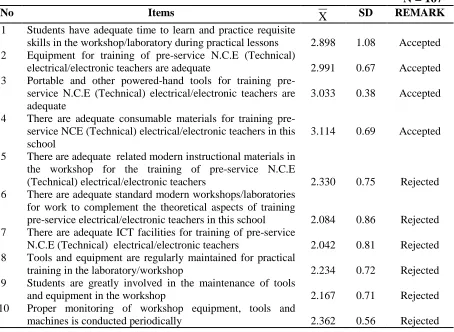
6.1 Research Question 1: To what extent do the shortage of time, training equipment, hand tools and materials affect the training of pre-service N.C.E (Technical) electrical/electronic teachers?
Table 6.1: Respondents’ Mean Scores and Standard Deviation on the Effect of Shortage of Time, Training Equipment, Hand Tools and Materials on the Training of Pre-Service N.C.E (Technical) Electrical/Electronic Teachers
N = 167
S/No Items X SD REMARK
1 Students have adequate time to learn and practice requisite
skills in the workshop/laboratory during practical lessons 2.898 1.08 Accepted 2 Equipment for training of pre-service N.C.E (Technical)
electrical/electronic teachers are adequate 2.991 0.67 Accepted
3 Portable and other powered-hand tools for training pre-service N.C.E (Technical) electrical/electronic teachers are adequate
3.033 0.38 Accepted
4 There are adequate consumable materials for training pre-service NCE (Technical) electrical/electronic teachers in this school
3.114 0.69 Accepted
5 There are adequate related modern instructional materials in the workshop for the training of pre-service N.C.E
(Technical) electrical/electronic teachers 2.330 0.75 Rejected 6 There are adequate standard modern workshops/laboratories
for work to complement the theoretical aspects of training
pre-service electrical/electronic teachers in this school 2.084 0.86 Rejected 7 There are adequate ICT facilities for training of pre-service
N.C.E (Technical) electrical/electronic teachers 2.042 0.81 Rejected 8 Tools and equipment are regularly maintained for practical
training in the laboratory/workshop 2.234 0.72 Rejected
9 Students are greatly involved in the maintenance of tools
and equipment in the workshop 2.167 0.71 Rejected
10 Proper monitoring of workshop equipment, tools and
www.ijiset.com
260 Key: NRR- Population of the respondents; 𝒙RR– Mean scores of the respondents; SD – Standard deviation of the respondents
Table 6.1 above shows the mean and standard deviation of the responses of pre-service electrical/electronic teachers in this study. Analysis of mean responses of the respondent revealed that 4 out of the 10 items addressing shortage of time, training equipment, hand tools and materials are accepted with a grand mean rating ranging from 2.898 – 3.114. The respondents further rejected 6 other items presented to them.
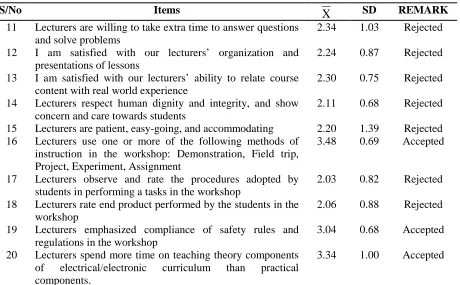
6.2 Research Question 2: Are the teaching methodology and technical/manipulative competences of trainers appropriate?
Table 6.2: Respondents’ Mean Scores and Standard Deviation on the appropriateness of trainers’ teaching methodology and technical/manipulative competences
N = 167
S/No Items X SD REMARK
11 Lecturers are willing to take extra time to answer questions and solve problems
2.34 1.03 Rejected
12 I am satisfied with our lecturers’ organization and presentations of lessons
2.24 0.87 Rejected
13 I am satisfied with our lecturers’ ability to relate course content with real world experience
2.30 0.75 Rejected
14 Lecturers respect human dignity and integrity, and show concern and care towards students
2.11 0.68 Rejected
15 Lecturers are patient, easy-going, and accommodating 2.20 1.39 Rejected 16 Lecturers use one or more of the following methods of
instruction in the workshop: Demonstration, Field trip, Project, Experiment, Assignment
3.48 0.69 Accepted
17 Lecturers observe and rate the procedures adopted by students in performing a tasks in the workshop
2.03 0.82 Rejected
18 Lecturers rate end product performed by the students in the workshop
2.06 0.88 Rejected
19 Lecturers emphasized compliance of safety rules and regulations in the workshop
3.04 0.68 Accepted
20 Lecturers spend more time on teaching theory components of electrical/electronic curriculum than practical components.
3.34 1.00 Accepted
Key: NRR- Population of the respondents; 𝒙RR– Mean scores of the respondents; SD – Standard deviation of the respondents
261
6.3 Research Question 3: To what extent do pre-service N.C.E (Technical) electrical/electronic teachers’ attitude and choice of becoming teachers have impacts on the effectiveness of their teaching job?
a. To what extent do pre-service N.C.E (Technical) electrical/electronic teachers demonstrate positive attitudes towards teaching profession?
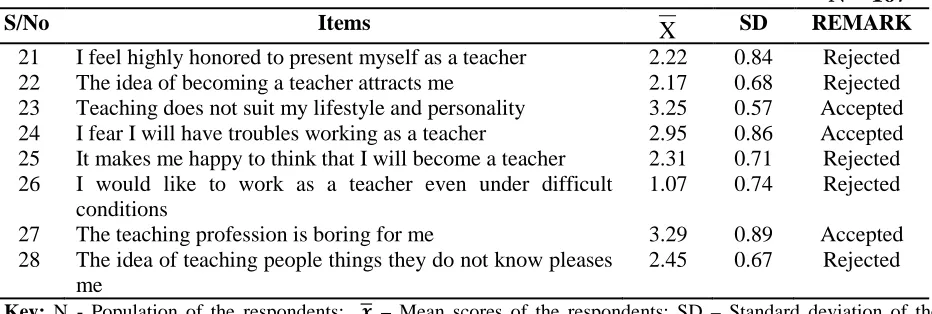
Table 6.3(a): Mean Scores and Standard Deviation of Pre-service N.C.E (Technical) electrical/electronic teachers’ Attitudes Towards Teaching as a Profession
N = 167
S/No Items X SD REMARK
21 I feel highly honored to present myself as a teacher 2.22 0.84 Rejected
22 The idea of becoming a teacher attracts me 2.17 0.68 Rejected
23 Teaching does not suit my lifestyle and personality 3.25 0.57 Accepted 24 I fear I will have troubles working as a teacher 2.95 0.86 Accepted 25 It makes me happy to think that I will become a teacher 2.31 0.71 Rejected 26 I would like to work as a teacher even under difficult
conditions
1.07 0.74 Rejected
27 The teaching profession is boring for me 3.29 0.89 Accepted
28 The idea of teaching people things they do not know pleases me
2.45 0.67 Rejected
Key: NRR- Population of the respondents; 𝒙RR– Mean scores of the respondents; SD – Standard deviation of the respondents
Table 6.3 (a) shows the mean scores of the respondents on their attitudes towards teaching. Analysis of the mean and standard deviation of the responses of the respondents reveals that 5 items out of 8 posed to address pre-service teachers’ attitudes towards teaching as a profession were rejected, even as items 23, 24, and 27 were accepted with a mean rating ranging from 2.95 – 3.29.
b. What are the pre-service N.C.E (Technical) electrical/electronic teachers’ motives for their choice of teaching career?
Table 6.3(b): Mean Scores and Standard Deviation of Pre-service N.C.E (Technical) electrical/electronic teachers’ motives for choice of teaching career
N = 167
S/No Items X SD REMARK
29 I choose teaching as my career because the salary is appealing
2.12 0.84 Rejected
30 I choose teaching as my career because of the high status of teachers in the society
www.ijiset.com
262
31 I choose teaching as my career because of the outstanding working conditions
2.25 0.57 Rejected
32 I choose teaching as my career because of the passion I have
for teaching electrical/electronic 2.15 0.86 Rejected
33 I choose teaching as my career because of the view I hold of
teaching as a valuable and important profession 2.31 0.71 Rejected 34 I choose teaching as my career because of my desires to
support children’s development and to make difference in society
3.07 0.94 Accepted
35 I choose teaching as my career because I couldn’t secure admission into other professional courses such as Medicine, Law, Engineering etc
3.29 0.89 Accepted
Key: NRR- Population of the respondents; 𝒙RR– Mean scores of the respondents; SD – Standard deviation of the respondents
The table 6.3 (b) reveals the mean scores of the respondents on their motives for choice of teaching career. Analysis of mean responses and standard deviation of the respondents as presented in the table reveals that 5 out of 7 items posed to address pre-service teachers’ motives for choice of teaching career were rejected. At the same time items 34 and 35 were accepted by the respondents.
7. Discussion and Implication
This study investigated the perceptions of pre-service Technical electrical/electronic teachers on the challenges of N.C.E electrical/electronic programme in Kano State, Nigeria. Specifically, the study examined impact of shortage of time, training equipment, hand tools and materials on their training; the suitability of teaching methodology and technical/manipulative competences of trainers; and the impact of attitude and choice of becoming teachers on the effectiveness of their teaching job. These purposes are accomplished via descriptive survey design, where a structured questionnaire designed by the researcher was administered to the respondents for the data collection. As such, the discussion of the findings that follows is organized according to the objectives that guided the study.
7.1Shortage of time, training equipment, hand tools and materials for the training of
N.C.E electrical/electronic teachers
263 enough, but the teacher’s ability to effectively use allocated time in classroom teaching is the real key to students’ achievement. This implies that workshop instructions and management will continue to yield positive results with respect to learning and practicing new skills, because time is a precious commodity for both teachers and students. The finding also revealed that there are adequate equipment, portable and other powered-hand tools, and materials in the workshop/laboratory. This finding concurs with Rafukka, Clement, and Abu Raihan (2013), who discovered that there is availability of tools, equipment and materials for the technical teacher training programme in Katsina State, Nigeria. However, Mbaga, Sambo, and Tijjani (2018) reported that equipment, tools, and machines were not enough to cater for the increasing population of students’ enrollment in the colleges of education in North-Eastern Nigeria. Also Okwelle (2006) claimed that students are exposed to obsolete and non-functional equipment and tools in technical schools. This implies that not all teacher training colleges in every parts of the country are well furnished with efficient equipment, portable and other powered-hand tools, and materials in their workshops/laboratories. 16TThe availability of16T 16Tequipment, 16Tportable and other powered-hand tools, and materials 16Taid memory by making theoretical concepts become real. Equipment and16T other 16Tfacilities make it possible for the students to interact with the learning materials that enhance teaching and learning thereby16T 16Tmaking the process meaningful and purposeful.
www.ijiset.com
264 workplaces are the hub of technical education which is believed to be one of the most successful measures of bringing about16T 16Ttechnological change that would guarantee speedy technological advancement of any 16Tcountry.
The finding further showed that there is dearth of modern instructional materials/ICT facilities in the technical teacher training institutes. This consents with Puyate (2002) who stresses the usefulness of instructional materials/ICT facilities in the teaching and learning of electrical/electronic technology education, but laments the unfortunate situation of scarce and inadequate instructional materials/ICT facilities in TVE programmes in the country. Ogbu (2015)’s work corroborates this finding in which he uncovered that inadequate instructional materials/ICT facilities influence the teaching/learning of electrical/electronic technology courses in 32 negative ways. This finding suggests that teaching and learning of TVE programmes in Nigeria will continue to be traditional and mechanistic which renders the teachers’ job as difficult, slow and ineffectual.
Furthermore, the findings disclose that tools and equipment are not regularly maintained. This finding is not coming as a surprise because Abdulkadir and Ma’aji (2014) found that preventive maintenance were not regularly observed in Technical colleges of Niger State, Nigeria. This is also supported by Asiyat (2012) that facilities in public schools are generally in a state of poor condition owing to insufficient maintenance. As a result, Kailani, Gyallesu and Yaro (2017) concluded that by and large maintenance culture is not instituted in the Nigerian work environment. This implies that the tools, equipment and other facilities will be subjected to early breakdown and therefore never reach their lifespan due to lack of frequent maintenance. This will consequently cause the level of students’ academic achievement to be low, exorbitant cost of repairs from the scanty budgetary allocation to the institutions, and institutionalize lack of maintenance culture in both teachers and students. Regular maintenance is essential to keep the equipment, machine and work environment safe and reliable. Lack of or inadequate maintenance can lead to dangerous situations, accidents and problems.
265 technical colleges in Sokoto and Kebbi States, Nigeria. Moreover, Kailani, Gyallesu and Yaro (2017) consent with this finding by maintaining that management of TVE administrations do not consistently supervise workshop/laboratory facilities. If the pre-service teachers are not involved in the maintenance of tools and equipment, they will be very much incapacitated with respect to practical skills and basic maintenance practices when they are employed to teach in the technical colleges. This is perhaps the reason why Omekwe (2009) stated that in technical schools today many teachers avoid certain practical lessons.
7.2Suitability of teaching methodology and technical/manipulative competences of
trainers
www.ijiset.com
266 is that, as the popular adage goes ‘you can’t give what you don’t have’, the students will always be at the receiving end, since teachers themselves do not possess the requisite technical/manipulative competencies. This will generally affect the academic performance of the students and render them invaluable in the job market, where technical skills are favored.
7.3(a) Pre-service teachers’ attitudes towards teaching profession
The findings from Table 6.3(a) showed that all the eight (8) items that address pre-service N.C.E (Technical) electrical/electronic teachers’ attitudes towards teaching profession are rejected. This implies that the respondents have negative attitudes towards teaching. This finding is contrary to the work of Alkhateeb (2013) in which he found that education students’ attitudes towards the teaching profession were positive on average. Similarly, Andronache, Bocoş, Bocoş, and Macri, (2014) found future teachers’ attitude towards teaching profession is generally positive. The finding is also at variance to the study of Bademcioglu, Karatas, and Bulent, (2014) that the teacher candidates in pedagogical formation certificate program have positive attitudes towards teaching profession. This finding implies that in Nigeria, there is poor societal perception with respect to teaching as a profession. Unlike other countries, there is general apathy shown by the respondents towards teaching. If this problem is not resolved, there is tendency that abrupt shortage of qualified TVE teachers will caught up with the country and will cause total collapse of technical education, jeopardizing the aspirations of the country of becoming technologically self-reliant nation.
7.4 Pre-service teachers’ motives for the choice of teaching career
267 findings of this study, since the outcome of their study suggest that perceived teaching ability, passion for teaching, social value of the profession, and prior experience of teaching and learning are important determinants to the decision of becoming a teacher. This finding implies that the conditions of service for teachers are far from being conducive in Nigerian context. This also suggests that pre-service teachers in this study have negative attitude towards the teaching profession which will undoubtedly affect their students’ performance negatively.
8. Conclusion
This study investigates the challenges for effective training of pre-service N.C.E (Technical) electrical/electronic teachers in Kano State. The results of the study demonstrate that the training institutions experience inadequate standard and modern workshops/laboratories, dearth of modern instructional materials/ICT facilities, tools and equipment are not regularly maintained, students are not involved in the maintenance of tools and equipment, trainers’ employ inappropriate teaching methodology and exhibit technical/manipulative incompetence, pre-service teachers have negative attitudes towards teaching, and they found themselves accidently in a teacher training colleges. As a result, the FGN should as a matter of urgency review the current conditions of service for teachers in the country, embark on a massive nation-wide campaign programme to enlighten prospective students, parents and the populace on the need to enroll into technical training programmes, and the curriculum should also be reviewed to instill good attitudes in the minds of the students. This will be of utmost important in order to reduce the severity of the problems and the ills it’s causing the training programmes and the country’s aspirations of becoming technologically literate society.
References
Abdulkadir, M., & Ma’aji, S. (2014). Assessment of workshop facilities management practices in technical colleges of Niger state. International Journal of Scientific and Research Publications, 4(7), 1-6.
Achuonye, K. A. (2015). Predominant teaching strategies in schools: Implications for curriculum implementation in mathematics, science and technology. Educational Research and
Reviews, 10(15), 2096-2103.
Alkhateeb, H. M. (2013). Attitudes towards teaching profession of education students in Qatar.
www.ijiset.com
268 Andronache, D., Bocoş, M., Bocoş, V., & Macri, C. (2014). Attitude towards teaching
profession. Procedia-Social and Behavioral Sciences, 142, 628-632.
16T
Asiyat, R. I. (2012). Assessing school facilities in public secondary schools in Delta State,16T
16T
Nigeria. 16T17TAfrican Research Review16T17T, 16T17T616T17T(2), 192-203.
Bademcioglu, M., Karatas, H., & Bulent, A. (2014). The investigation of teacher candidates’ attitudes towards teaching profession. International Journal of Educational Researchers, 5(2), 16-29.
Boudersa, N. (2016). The importance of teachers' training programs and professional development in the Algerian educational context: Toward informed and effective teaching practices. Expériences Pédagogiques, 1.
Federal Republic of Nigeria (2004). National Policy on Education (4P
th
P
Edition) Yaba NERDC Press.
Gobir, A. S. (1991). Mechanism for Improving workshop maintenance in Technical Colleges in Sokoto and Kebbi States. Unpublished PhD thesis, Department of Vocational Teacher Education, University of Nigeria, Nsukka, Enugu, Enugu State, Nigeria.
Ismail, K., Nopiah, Z., Rasul, M. S., & Leong, P. (2017). Malaysian teachers’ competency in technical vocational education and training: A review. Proceeding of Regionalization and
Harmonization in TVET–Abdullah et al.(Eds). London: Taylor & Francis Group.
Jehanzeb, K., Hamid, A. B. A., & Rasheed, A. (2015). What is the role of training and job satisfaction on turnover intentions? International Business Research, 8(3), 208.
Jonah, E.I. (2019). The role of teachers in national development in a multi-ethnic society like Nigeria: a re-analysis of the issues and prospects. International Journal of Education and Research, Vol. 7 No. 7 July 2019
Joseph, A. O., &. Godstime, T.C. (2016). Strategies of effective teaching and learning practical skills in technical and vocational training programmes in Nigeria. International Journal of Scientific Research Engineering & Technology (IJSRET), ISSN 2278 – 0882 Volume 5, Issue 12, December 2016
Kailani, I. S., Gyallesu, A. B., & Yaro, A. M. (2017). Obstacles to practical skill development among students in Kaduna Polytechnic, Nigeria. International Journal of Pharmaceutical
Sciences and Research, 8(3), 1381.
Keow, C. L. (2006). Motives for choosing the teaching profession: voices of preservice teachers.
Jurnal penyelidikan pendidikan guru, 2, 95-104.
269 Obisi, C. (2011). Employee training and development in Nigerian organisaitons: Some
observations and agenda for research. Australian Journal of Business and Management Research, 1(9), 82.
Odo, M., Adenle, S., & Okwori, R. (2012). Enhancing mastery of practical skills in students OF vocational and technical education through activity based. Journal of Technical
Education and Training, 4(2).
Ogbu, J. E. (2015). Influences of Inadequate Instructional Materials and Facilities in Teaching and Learning of Electrical/Electronic Technology Education Courses. Journal of
Education and Practice, 6(33), 39-46.
Ogunyinka, E. K., Okeke, T. I., & Adedoyin, R. C. (2015). Teacher education and development in Nigeria: An analysis of reforms, challenges and prospects. Education Journal, 4(3), 111-122.
Okwelle, P. C., Deebom, M. T., & Okwelle, P. (2017). Technical vocational education and training as a tool for sustainable empowerment of youths in Niger Delta, Nigeria.
International Journal of Innovative Social & Science Education Research 5 (1): 29, 38.
Okwelle, P.C. (2006). Integrating co-operative education into technology education curriculum for sustainable youth empowerment in Nigeria. Journal of Nigeria Association of
Teachers of Technology, (NATT), 6(1), 30-35
Osusu, O. O. (2003). Address by the Bayelsa state Honorable commissioner of Education at the opening Ceremony for the Business session of the 5tf meeting of the National Council on Education, held at the conference Hall, Sports Complex, Yenegoa (Monday 20th Oct. 2003).
Puyate, S. T. (2002). Survey of Vocational Education Facilities in Government Technical Colleges in Rivers State. Journal of Nigerian Association of Teachers of Technology (JONATT). 4 (1), 175 – 181.
Rafukka, S.I., Clement, C., & Raihan, M.A. (2013). An Assessment of the Effectiveness of Technical Teacher Training Programme (TTTP) in Katsina State, Nigeria. International Journal of Engineering Sciences & Research Technology
Sadker, M., Sadker, D., and Klein, S. (1991). “The Issue of Gender in Elementary and Secondary Education”. Review of Educational Research 17: pp. 269 – 334.
Topkaya, E. Z., & Uztosun, M. S. (2012). Choosing teaching as a career: Motivations of pre-service English teachers in Turkey. Journal of Language Teaching and Research, 3(1), 126.
www.ijiset.com