Optimal Operation of Distributed Generation
Unit with Micro Grid Controlling to Improve
Stability and Generation Hosting Capacity
T.Priyanka1, V.Usha Rani2
PG Student [PS], Dept. of EEE, Gokaraju Rangaraju Engineering College, Hyderabad, Telangana, India1
Assistant Professor, Dept. of EEE, Gokaraju Rangaraju Engineering College, Hyderabad, Telangana, India2
ABSTRACT: This paper proposes an integrated system of both wind power and wave power generation systems
joined with a dc micro-grid. The paper deals with the power flows in a wind turbine based Distributed generation (DG) unit. The connection of distributed generators (DG) to distribution networks greatly influence the performance and stability of such networks. In the proposed work, separate wind turbine and wave power based generation system have been considered. These energy sources are coupled to synchronous generator which is interfaced to the grid through a rectifier inverter pair. A laboratory-grade test system has been considered to examine the fundamental operating characteristics of the integrated system fed to isolated loads using a dc micro-grid. Both frequency-domain analysis and time-domain simulations are performed for the studied integrated system using MATLAB/Simulink .Simulation results are observed that with controlling of dc micro-grid the proposed system with DG units can maintain stable operation under a sudden load-switching conditions.
KEYWORDS:Distributed Generation unit, wind and wave energy, Generation hosting capacity, Micro grid control,
VSC, PMSG, LPMM.
I. INTRODUCTION
With current initiatives on smart grid and sustainable energy, distributed generations (DGs) are going to play vital role in the emerging electric power systems[1,4]. The future active network will effectively and efficiently link small and medium scale electric power sources with costumer demands. DG is often used as back-up power to enhance reliability or as a means of deferring investment in transmission and distribution networks, avoiding network charges, reducing line losses, deferring construction of large generation facilities, displacing expensive grid-supplied power, providing alternative sources of supply in markets and providing environmental benefits. In recent years, DG has become an efficient and clean alternative to the traditional electric energy sources, and recent technologies are making DGs
economically feasible. Increased demands on the nation's electrical power systems and incidences of electricity
shortages, power quality problems, rolling blackouts, and electricity price spikes have caused many utility customers to seek other sources of high-quality, reliable electricity. Distributed Energy Resources (DER), small-scale power generation sources located close to where electricity is used provide an alternative to or an enhancement of the traditional electric power grid. DER is a faster, less expensive option to the construction of large, central power plants and high-voltage transmission lines. They offer consumers the potential for lower cost, higher service reliability, high power quality, increased energy efficiency, and energy independence. The use of renewable distributed energy generation technologies and "green power" such as wind, photovoltaic, geothermal, biomass, or hydroelectric power can also provide a significant environmental benefit.
generation fleet, reduced fuel use, air emissions and equipment wear, improved localized power quality and electrical service reliability.
The simulated results of an Archimedes wave swing (AWS) power convertor coupling with a linear permanent magnet generator (LPMG) were compared with the experimental outcomes using the measured data obtained from a 2-MW AWS test system along the coastline . A configuration of a marine power plant with two AWSs connecting to a power grid was proposed in , and the outputs of the two AWSs were converted to dc quantity by individual diode bridge rectifiers and then subsequently converted into ac quantity by an inverter to reduce the fluctuation of the combined rectified output power.
II. GENERATION HOSTING CAPACITY
Hosting capacity is defined as the amount of DER that can be accommodated without adversely impacting power quality or reliability under existing control configurations. Understanding DG hosting capacity allows Electricity Distribution Businesses (EDBs) to determine the maximum amount of DG power that can be injected into each LV
network without adversely affecting network operation or breaching regulatory requirements [3].The hosting capacity
of distribution grids generally refers to the level of DG penetration that the grid can withstand before exceeding one or more performance indices.
Fig.1 Definition of hosting capacity
DG penetration could be defined in a variety of ways. For instance, a common definition of penetration is: the percentage of the total power from distributed energy resources (DER) consumed within the grid to the total
consumption during a whole year. With the desire to increase the production of renewable energy it therefore becomes
important to develop objective means to determine the maximum amount of generation that can be connected to a power distribution system – the hosting capacity. The amount of Distributed Energy Resources (DER) the network can host depends on a number of parameters such as the characteristics of the generation units, the configuration and operation of the network.
III. MODELLING AND CONTROLLING OF MICRO GRID
A micro grid can be defined as, ‘A network of low voltage power generating units, storage devices and loads capable
power systems, information systems, and network infrastructure, and are capable of feeding power back to the larger grid during times of grid failure or power outages.
Among the many benefits of having a micro grid, one is that it facilitates distributed generation (DG) and high penetration of renewable energy sources . They increase power quality and reliability of electric supply. A micro grid having renewable energy sources will help to alleviate some of the environmental issues related to burning fossil fuels. There is an extensive literature on the various challenges posed by micro grids. Despite having some benefits of micro grid architecture in the grid environment, there are some challenges related to this also. Implementation is an issue. Micro grid protection is also considered one of the most important challenges facing the implementation of micro grids.
Fig.2 Model of Micro Grid
The above grid model shown in fig.2 is then represented and simulated using Matlab Sim Power Systems toolbox.
IV.SYSTEM CONFIGURATION
The above system is constructed and simulated in MATLAB. The configuration of the studied integrated wind and wave power generation system connected to an ac grid through a dc micro-grid. The wind power generation system simulated by a permanent-magnet synchronous generator (PMSG) driven by a wind turbine (WT) is connected to the dc micro-grid through a VSC of VSC_PMSG[11]. The wave power generation system simulated by an LPMG driven by a linear permanent magnet motor (LPMM) is also connected to the dc micro-grid through a VSC of VSC_LPMG. A
resistive dc load R Load is connected to the dc micro -grid through a load dc/dc converter[12]. To achieve stable power
flow (or power balance condition) and load demand control of the dc micro-grid under different operating conditions, a battery is connected to the dc micro-grid through a bidirectional dc/dc converter, while an ac grid is connected to the dc micro-grid through a bidirectional grid-tied inverter and a transmission line. When available wind power and/or wave power can be injected into the dc micro-grid with a fully charged battery, the surplus power of the dc micro-grid can be delivered to the ac grid through the bidirectional grid-tied inverter. When no wind power or no wave power is delivered to the dc micro-grid with a low-energy battery, the insufficient power of the dc micro-grid can be captured from the ac
grid through the bidirectional grid-tied inverter[10]. The power of the resistive dc load R Load can be obtained from the
dc micro-grid through the load dc/dc converter only when the dc micro-grid has enough power[8]. The load dc/dc
converter with the resistive dc load R Load can also slightly adjust the power balance condition of the dc micro-grid.
The control functions of the bidirectional dc/dc converter, the bidirectional grid-tied inverter, and the load dc/dc converter must be adequately coordinated with each other to obtain stable operation of the dc micro-grid..
V. SIMULATION RESULTS AND DISCUSSIONS
Simulink diagram is shown below for test system, which represents optimal operation of wind energy distributed generation unit with micro grid controlling.
A B C
wind pmsg Discrete, Ts = 5e-005 s.
powergui outputs load1 load v + -v + -v + -g A B C + -VSC PMSG2 g A B C +
-VSC PMSG1
g A B C +
-VSC PMSG
A B C a b c A B C a b c A B C a b c A B C A B C A B C A B C A B C A B C Step Scope8 PMSG
A B C
A B C
PF C ORREC TION C APAC ITOR1
A B C
A B C
PF C ORREC TION C APAC ITOR
Load DC-DC A B C LPMM LPMG GridController A B C Grid Idcload Vdcload Vdc Idcgrid Ibidcdc Vdcgrid IdcLPMM IdcPMSG GRID From2 LPMM From1 PMSG From i + -i + -i + -i + -i + - +-C c 1 2 +out -out +in -in Bidirectional Dc-Dc Load +out -out +in -in Bidirectional Dc-Dc Converter Bi directional dc-dc converter + _ m
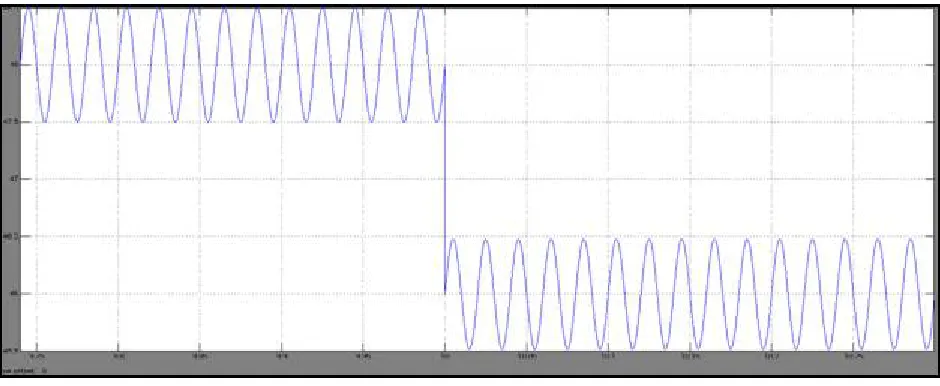
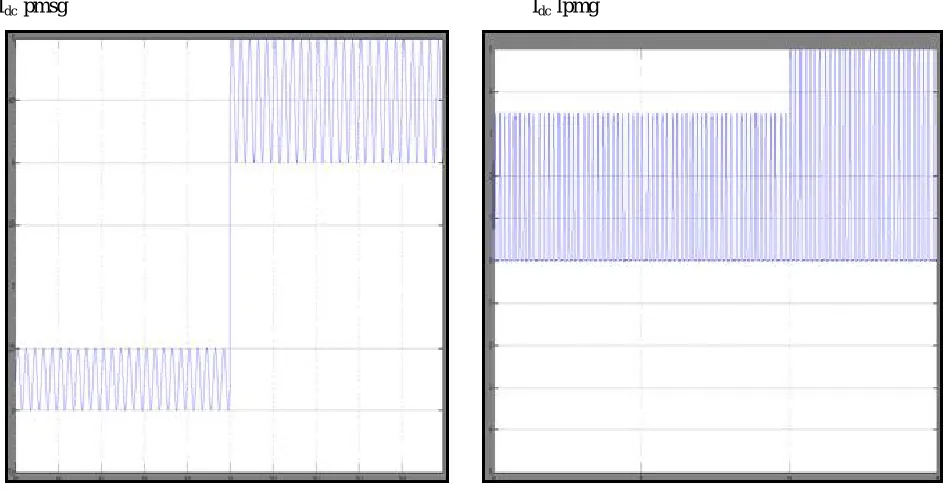
The mathematical models of the studied integrated system with the proposed dc micro-grid are derived , including the wind WT-PMSG set with its VSC, the wave LPMM-LPMG set with its VSC, the bi directional dc/dc converter with the battery, the load dc/dc converter with the resistive load, and the bidirectional grid-tied inverter. Both frequency-domain analysis and time-frequency-domain simulations are performed using MATLAB/Simulink. The simulated waveforms are shown below.
Idc grid simulation result
Fig. 5 Throughput of receiving time vs current
Vdc grid simulation result
Fig .6 Throughput of sending time Vs vdc
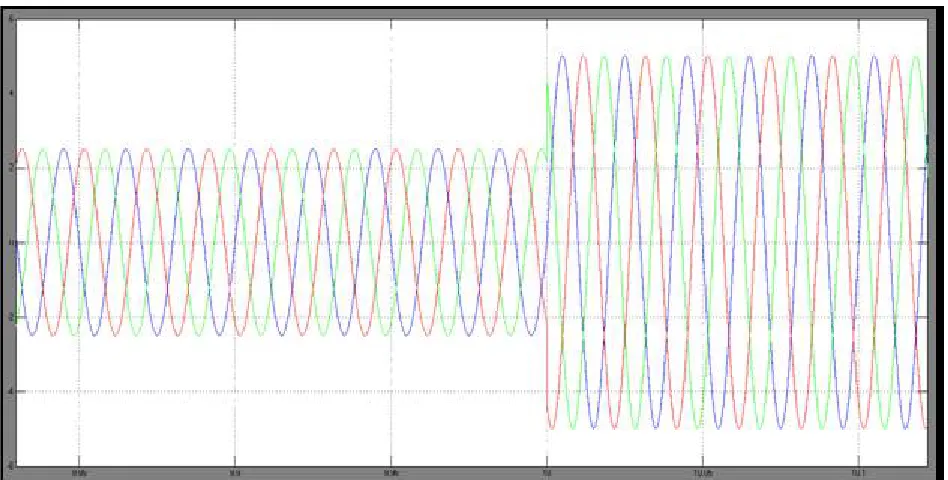
Vabc grid simulation result
Fig .7 Throughput of sending time Vs vabcgrid
In Fig 7, Throughput of sending time Vs 3phase voltage at grid is shown.
Iabc grid simulation result
Vabc wind Iabc wind
Fig .9 Throughput of sending time Vs Vabc wind Fig .10 Throughput of sending time Vs Iabc wind
Idc pmsg Idc lpmg
VI. CONCLUSION
An integration of both wind power and wave power generation systems joined with a dc micro-grid has been proposed. A laboratory-grade test system has been presented in this paper to examine the fundamental operating characteristics of the studied integrated system fed to isolated loads using a dc micro-grid. For simulation parts, the results of the root-loci plot and the time-domain responses have revealed that the studied integrated system with the proposed dc micro-grid can maintain stable operation under a sudden load-switching condition. Comparative simulated and measured results under a load switching have been performed, and it shows that the studied integrated system with the proposed dc micro-grid can be operated stably under different disturbance conditions, while both measured and simulated results can match with each other.
REFERENCES
[1] Z. Zeng, H. Yang, J. Guerrero, and R. Zhao, “Multi-functional distributed generation unit for power quality enhancement,” IET Power Electronics, vol. 8, no. 3, pp. 467–476, 2015.
[2] X. Tang, W. Deng, and Z. Qi, “Investigation of the Dynamic Stability of Microgrid,” IEEE Transactions on Power Systems, vol. 29, no. 2, pp. 698–706, Mar. 2014
[3] I. N. Santos, V. Cuk, P. M. Almeida, M. H. J. Bollen, and P. F. Ribeiro, ´ “Considerations on hosting capacity for harmonic distortions on transmission and distribution systems,” Electric Power Systems Research, vol. 119, pp. 199–206, Feb. 2015.
[4]S. Mocci, N. Natale, F. Pilo, and S. Ruggeri, “Demand side integration in {LV} micro grids with multi-agent control system,” Electric Power Systems Research, vol. 125, no. 0, pp. 23 – 33, 2015
[5] B. Zhao, M. Xue, X. Zhang, C. Wang, and J. Zhao, “An {MAS} based energy management system for a stand-alone microgrid at high altitude,” Applied Energy, vol. 143, no. 0, pp. 251 – 261, 2015.
[6] K. V. Vidyanandan and N. Senroy, "Primary frequency regulation by deloaded wind turbines using variable droop," in IEEE Transactions on Power Systems, vol. 28, no. 2, pp. 837-846, May 2013.
[7] S. Ghosh and N. Senroy, "Electromechanical Dynamics of Controlled Variable-Speed Wind Turbines," in IEEE Systems Journal, vol. 9, no. 2, pp. 639-646, June 2015.
[8] M. Sullivan, J. Bode, B. Kellow, S. Woehleke, and J. Eto, “Using residential AC load control in grid operations: PG&E’s ancillary service pilot,” IEEE Trans. Smart Grid, vol. 4, no. 2, pp. 1162–1170, Jun. 2013.
[9] P. Kadurek, J. Cobben, W. Kling, and P. Ribeiro, “Aiding power system support by means of voltage control with intelligent distribution substation,” IEEE Trans. Smart Grid, vol. 5, no. 1, pp. 84–91, Jan. 2014 .
[10] A. Millner, “Modeling lithium-ion battery degradation in electric vehicles,”in Proc. IEEE Conf. Innov. Technol. Effic. Reliable Elect. Supply(CITRES), 2010, pp. 349–356.
[11] H. Rahimi-Eichi, U. Ojha, F. Baronti, and M. Chow, “Battery management system: An overview of its application in the smart grid and electric vehicles,” IEEE Ind. Electron. Mag., vol. 7, no. 2, pp. 4–16, Jun. 2013.
[12] Doering D., Dorn J., Ebner G., Schmidt M., Siegl C.: 'Voltage Sourced Converters for HVDC Overhead Line Applications', CIGRÉ Canada Conference, Toronto, Canada, September 2014.
[13] M. Ashourloo, A. Khorsandi, and H. Mokhtari, “Stabilization of DC microgrids with constant-power loads by an active damping method,” in Power Electronics, Drive Systems and Technologies Conference (PEDSTC), 2013 4th, 2013, pp. 471–475.