Side Channel Attacks: Vulnerability Analysis of
PRINCE
and
RECTANGLE
using DPA
Ravikumar Selvam, Dillibabu Shanmugam, and Suganya Annadurai
Hardware Security Research Group,
Society for Electronic Transactions and Security, India.
{ravikumar,dillibabu,asuganya}@setsindia.net
http://www.setsindia.org/hardware.html
Abstract. Over a decade, cryptographers are more attentive on design-ing lightweight ciphers in focus to compact cryptographic devices. More often, the security of these algorithms are defined in terms of its resis-tance to mathematical cryptanalysis methods. Nevertheless, designers are well aware of implementation attacks and concentrating on new de-sign strategies to improve the defence quality against implementation attack.PRINCE [3] and RECTANGLE[17] lightweight block ciphers are de-signed using new design strategies for efficiency and security. In this
paper we analyse the security of PRINCE andRECTANGLEagainst a type
of implementation attack called Differential Power Analysis (DPA) at-tack. Our attack reduces key search space from 2128to 33008 for
PRINCE
and 280 to 288 forRECTANGLE.
Keywords:Lightweight block cipher, power characteristic, FPGA imple-mentation, differential power analysis
1 Introduction
Differential Power Analysis (DPA) attack, a type of implementation at-tack, exploits the power consumed by the device when it performs
cryp-tography operations. In 1999, Kocher et al. [11] showed that power
anal-ysis attacks can efficiently reveal the secret key. After the DPA became public, designers of cryptographic algorithm had started concentrating on the new design strategies to improve the defense quality against the attack. However, few algorithms are still vulnerable to DPA attack. This motivated us to evaluate algorithms that are vulnerable to DPA attack.
Power analysis attack make use of the dynamic power consumption, which is the dominant factor in the total power consumption of the CMOS
circuit1. The dynamic power consumption depends on the switching
ac-tivity (0 → 1 or 1 → 0) in the circuit. Thus, the power consumption is
1
dependent on the data that is processed by the cryptographic implemen-tation. Then by measuring the power consumption during its operation an attacker may estimate the number of bit transitions in the device reg-isters that are implemented using CMOS flip-flops. DPA attack makes use of the number of bit transitions that occurs during process of inter-mediate results. The number of bit transitions depends on the difference between previous and current state of the register.
With the advancement in FPGA technology, low-power FPGA [16]
are expected to become popular for battery powered applications such as smartphones, RFID cards and wireless sensor nodes. Implementation of lightweight block ciphers on low-power FPGA have also been proposed
recently [18]. Also, FPGAs are the preferred platform to investigate the
power analysis vulnerabilities of cryptographic implementations, due to
its low cost and flexibility [6]. For these reasons, we chose FPGA platform
to practically verify our attack model.
Over a decade many new lightweight block ciphers such as HIGHT [9],
DESL [12], PRESENT [2], KATAN [4], KLEIN [7], LED [8] have been
proposed with various design strategies. These block ciphers are used to
provide security for resource2 constrained devices, termed as ubiquitous
computing devices. Of these lightweight ciphers, two algorithms using new design strategy are taken for analysis: One is based on SPN with
α-reflection property(PRINCE) and other is based on SPN with Bit-slice
technique(RECTANGLE).
PRINCEis proposed in ASIACRYPT 2012 [3], by Julia Borghoff et. al. It is designed for low latency in hardware with features of reflectivity (sin-gle circuit for Encryption and decryption) and no real key schedule. The
security analysis ofPRINCEagainst Biclique and differential cryptanalysis,
reflection cryptanalysis, differential fault attack and meet-in-the-middle attack were presented in [1,10,14,15,5,13]. In [17], RECTANGLE cipher is presented with it’s security analysis. The cipher has bit-slice technique, which makes suitable for multiple platform with SCA resistant against timing and cache attacks. In this paper, we share the experimental
re-sults of the DPA attack on PRINCEand RECTANGLE.
Our contribution.In this paper, we present the power model chosen
for power analysis attack on PRINCE and RECTANGLE. Then we present
practically verified DPA attack on these algorithms using SASEBO-G
board. Our attack reduces hypotheses complexity from 2128 to 33008 for
2
PRINCEand 280 to 288 forRECTANGLE. To the best of our knowledge, this
is the first DPA attack onPRINCEand RECTANGLE.
Outline. This paper is organised as follows. Section 2 describes,
brief on PRINCE, its hardware implementation. In 3, power
character-istics and DPA attack on physical implementation of PRINCE are
pre-sented. In Sect. 4, implementation details, power model and practical
at-tack of RECTANGLE are discussed in detail. Finally we conclude the paper
in Sect.5.
2 Description of PRINCE
PRINCEhas a block size of 64-bit, and key size of 128-bit. The 128-bit key
is divided into two partsK0kK1 each of 64-bit. The K00 is derived from
K0 as shown in (1).
K00= (K0≫1)⊕(K063) (1)
Both K0 and K00 are used as whitening keys. While the 64-bit key
K1 is used inP RIN CEcore, which is the 12-round iterative block cipher.
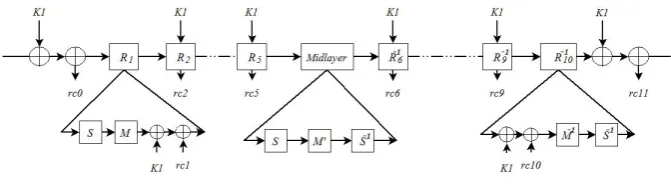
The encryption process of PRINCEis depicted in Fig. 1.
Fig. 1: PRINCE
The encryption process ofP RIN CEcore is depicted in Fig.2.
TheP RIN CEcoreoperates on a 4×4 column-major order matrix of
nibbles, termed as state. Each round of P RIN CEcore is a combination
of four operations, such as Ki-add, S-layer, M-layer and RC-add. The
process of adding the key is termed as Ki-add, where the 64-bit key K1
is exclusive-ored with the state value.
S-layer represented asS, is a non-linear operation, where each nibble in the state is substituted by a nibble generated using the S-box. The
author of PRINCE had recommended eight S-boxes to choose. We had
chosen the S-box given in test vectors of PRINCE in [3]. The inverse
S-box, represented asS−1, which is also used in the encryption process from
middle round onwards.
M-layer is a linear operation and is a composition of shift rows (SR)
and M-mapping (M0). Shift rows (SR) permutes the 16 nibbles by
ro-tating each row of state matrix by i cell positions to the left, where i
varies from 0 to 3. The inverse of SR is denoted by SR−1, which is the
inverse permutation of nibbles. The matrix M0 is a 64×64 matrix that
is multiplied with the state matrix. The full description of formation of
M0 matrix is elaborated in [3]. The matrixM0 has an involution property
that is used in the middle round without shift rows. The inverse of M
-layer, represented asM−1, is the composition of M0 and SR−1 and there
is no inverse for M0.
RC-add is the add round constant operation, where the state
ma-trix is exclusive-ored with the round constant. The pre-computed round
constant values are given in [3].
2.1 Implementation in Hardware
The architecture of round-based implementation of PRINCE, as given
in [3], is taken for our analysis. Here the round output refers to
out-put of key whitening steps andP RIN CEcoreround functions along with
middle round. So that the PRINCE takes 15 clock cycles for one block
of encryption. S-layer and M-layer have been implemented as boolean
functions. Pre-computed round constants are realised as look-up table
and RC-add fetches the constant value for its operation. In round based
structure, a 64-bit register is used to store the intermediate result of each round output.
Initially, the 64-bit plaintext is loaded inRegister-64and the register
is updated for every clock cycle. Before entering into the P RIN CEcore
block, the Register-64 is updated by exclusive-or of plaintext and key
(K0) as part of key whitening step. After completing the 12 rounds of
with key (K00) that is derived from key (K0) as given (1). Thus the
encryption completes and ciphertext is taken out fromRegister-64.
Fig. 3: Power trace for single encryption of PRINCE
The SASEBO-G board is used to experimentally verify the attack.
Fig.3shows the power consumption of PRINCEduring one encryption. It
can be observed from Fig. 3 that the 15 patterns in the trace shows the
encryption process of PRINCE. The pattern starts approximately at 585ns
(nano second) and execution of each round leads to a pattern of approx-imately 41ns, while the FPGA board was operated at 24MHz frequency.
PRINCEtakes 615ns to complete its encryption process, which means that the pattern ends approximately at 1200ns. The trace points before and after the pattern are the power consumption during loading plain-text and cipher-text.
3 Power characteristics of PRINCE
PRINCEalgorithm is designed in such a way that the non-linear
func-tion3 is used only in the second round of P RIN CEcore. Key whitening
function and first round of P RIN CEcore are designed using exclusive-or
operation. Hence the second round output is the targeted intermediate
result for DPA. To target second round function, bothK0 andK1 should
be known to find the previous state value of target state. But, inPRINCE,
the previous and next state of targeted intermediate result are unknown.
The attack perception of PRINCEis elaborated as follows
P = [p0 p1 p2...p15]; (2)
K0 = [k00 k01 k02....k015]; (3)
K1 = [k10 k11 k12....k115]; (4)
Equation (2) represents the 64-bit plaintext as 16 4-bit elements.
Sim-ilarly, (3) and (4) represent the keys K0 and K1 respectively. InPRINCE
algorithm, the key whitening step is included to increase the attack com-plexity twice. Nevertheless, this became advantageous for us to do single
hypothesis for Key (K) which is exclusive-or ofK0 andK1. This can be
defined as
K = [k0 k1 k2....k15]; (5)
where
K=K0⊕K1; (6)
InPRINCE, the unknown previous state and their values of the
regis-ter are represented as Tj and αindex respectively. Here index represents
position of elements placed in the state.
Tj =
α0 α4 α8 α12 α1 α5 α9 α13 α2 α6 α10 α14 α3 α7 α11 α15
The state values of Tj is first round output of P RIN CEcore, where
keyK1 and round constantrc0 are exclusive-or with result of key
whiten-ing step. The round constant for first round is all zeros, so that the state
value is exclusive-or of plaintext and key K. Equation (7),(8),(9), and
3
(10) shows the state values with respect to plaintext and keyK.
α0[3] =p0[3]⊕k0[3]; (7)
α0[2] =p0[2]⊕k0[2]; (8)
α0[1] =p0[1]⊕k0[1]; (9)
α0[0] =p0[0]⊕k0[0]; (10)
The targeted state is the result of second round and is represented as
Tj+1 and the values of Tj+1 is represented asβindex.
Tj+1=
β0 β4 β8 β12 β1 β5 β9 β13 β2 β6 β10 β14 β3 β7 β11 β15
The second round ofP RIN CEcore, passes previous state value through
round function operation such asS-layer,M-layer, and exclusive-or of key
K1 and round constant rc1. Each bit of Tj+1 can be written as follows:
β0[3] =S1[3]⊕S2[3]⊕S3[3]⊕k10[3]⊕rc10[3]; (11)
β0[2] =S0[2]⊕S2[2]⊕S3[2]⊕k10[2]⊕rc10[2]; (12)
β0[1] =S0[1]⊕S1[1]⊕S3[1]⊕k10[1]⊕rc10[1]; (13)
β0[0] =S0[0]⊕S1[0]⊕S2[0]⊕k10[0]⊕rc10[0]; (14)
where,
S0 =S-layer(α0) ;S1 =S-layer(α1) ; S2 =S-layer(α2);S3 =S-layer(α3);
Here we describe the targeted intermediate output, by taking single nibble element and explained its bit dependency with the previous state
value and key bits. InM-layer,M0 is a 64×64 matrix, each row contains
only three 10s. This activate single bit of three different nibbles on the
same column.S-layer takes four bit input and give four bit output by
In equation (11), the previous state elements α1, α2, and α3 along
with keyk10[3] are required, for finding single bit output ofβ0[3]. The
pre-vious state value containing the corresponding key bits ask1, k2, and k3.
Similarly each bit of targeted intermediate output depends on 12-bits of
key K and 1-bit from keyK1 of corresponding position.
3.1 Pragmatic Execution
PRINCE algorithm is practically implemented and executed for 30,000
random plaintext with fixed key K0 = [DF8B A07C 946B 5E13] and
K1 = [698B 31E5 F06B 4629]. The power traces are captured, with
4000 trace points per encryption of 30,000 samples. The key recovery has been structured by taking the suitable elements of all the plaintexts and exclusive-or with 12-bit key hypothesis. This created the hypothet-ical previous state value of targeted bit. These values are then operated
for second round function of P RIN CEcore with additional single-bit
hy-pothesis of key K1. Totally 13-bits have been hypotheses to estimate
both state values. For example in equation (7) and (11), the plaintext
nibblesp1 p2 p3 are exclusive-or with the key hypothesisk1 k2 k3 and the
result is given to non-linear layer as part of second round function. As
stated by M-layer most significant bit of every nibble is taken out from
the output of S-layer to perform exclusive-or operation. The resultant
bit is again exclusive-ored with a hypothetical key bit k10[3] and round
constantrc10[3] as given in (11). Now the Hamming distance calculated
between most significant bit ofα3 and β3 is given by.
HD(α0[3], β0[3]) =HW(α0[3]⊕β0[3]) (15)
Likewise, Hamming distance of α0[2] and β0[2] obtained by picking
the plaintext [p0 p1 p3] and key-bits [k0 k1 k3] with k10[2] are performed.
Both the results are shown in Fig.4and Fig.5. Same procedure is applied
on each bit of the state value to reveal the complete 64-bit key K with
complexity of 213 per bit and also reveals key K1 of targeted position.
The keyK0 has been recovered by XOR-ing obtained K1 andK.
Fig.4 and Fig. 5 show the plot between correlation value and 13-bit
key hypotheses. In Fig.4, both positive and negative peaks are having the
same correlation value of 0.03111 and the 13-bit key values are at 1536 ([0 6 0 0] in Hexadecimal)and 5633 ([1 6 0 0]). Both the peaks are having same 12-bit values ([6 0 0]) and differ only in the most significant bit.
The most significant bit is single-bit hypothesis of k10[3] and remaining
Fig. 4: key recovery of β0[3] Fig. 5: key recovery of β0[2]
000, which gives the positive peak at 1536 is correct key guess. This occurs
due to the targeted key bit from K1 is exclusive-ored with result ofM
-layer,that is after non-linear function. Hence the complement of targeted
key bit leads to negative correlation. Similarly from Fig. 5, the highest
correlation value 0.03996 stands at 2817 and 6913 as positive and negative values respectively. The targeted intermediate result depends on 12-bit key element [k0 k2 k3] are revealed as [B 0 0] and single bit k10[2] as000
for 2816. Thus the two bits on each nibble elements of any column reveals
the complete 64-bit keyKwith complexity of 213×22+ 25×22= 215+ 27
and also reveals the 8-bit of K1. The remaining 56- bits of K1 can be
recovered by reusing the obtained keyK and doing single-bit hypothesis
for the remaining position of K1. After revealing the complete K1, the
key K0 is obtained by exclusive-or ofK1 and K without any additional
complexity. So the overall complexity of revealing the 128-bit key is about
215+ 27+ 112 = 33008.
4 Description of RECTANGLE
RECTANGLE is a lightweight block cipher, designed using bit-slice tech-nique; which makes the cipher adoptable for multiple platforms (Hard-ware and Soft(Hard-ware). It has round function of 25 iterations with 64-bit block length and 80- or 128-bit key length. Each round function consists of the following three steps: AddRoundKey, SubColumn and ShiftRow. After final round, output is exclusive-or with the final round key.
AddRoundKey(ARK):A round subkey is bitwise exclusive-or with intermediate state.
SubColumn(SC): 4-bit SBoxes are executed in parallel on the
col-umn of the state. Sbox is tabulated as below Table 4.
x 0 1 2 3 4 5 6 7 8 9 10 11 12 13 14 15
S(x) 9 4 F A E 1 0 6 C 7 3 8 2 B 5 D
ShiftRows(SR):First row has no shift, Second row is left rotated by 1-bit position, third row is left rotated by 12-bit positions and the last row
is left rotated by 13-bit positions.
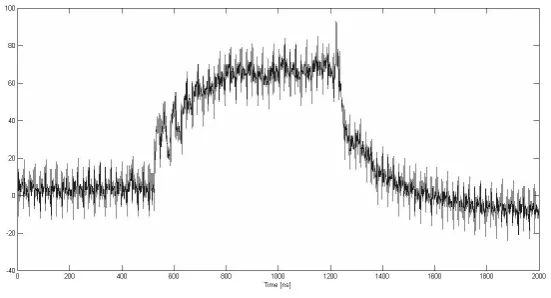
Fig. 6: Power trace of RECTANGLE
RECTANGLE, is implemented in SASEBO-G board using Verilog Hard-ware Descriptive Language. The power consumption of the cipher is as shown in Fig. 6.
From the Fig.6it is clear that the
power consumption is high for 25 iter-ations and then comes down.
4.1 Description of power model
and attack
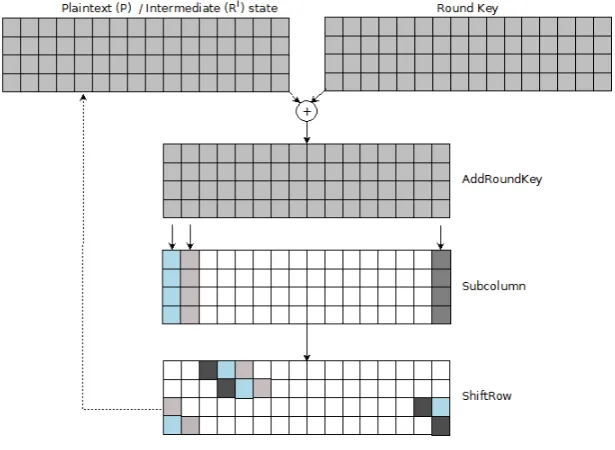
Power model should realistically describe power consumption between the intermediate states of the algorithm in hardware module. Each round has four state, such as Initialization(Pliantext/Intermediate),
AddRound-key, SubColumn, ShiftRows as shown in 7. In order to do
implementa-tion(DPA) attack, their should be a diffusion of key bits over non-linear function. In our case, sub-column has the property of non-linear function. Each round executes 16 sub-columns in parallel on its corresponding in-puts, which has key bit influences. These bits diffuse over the column by the function. Then, shift row is a permutation operation has no sig-nificant influence in power consumption. Therefore, each column of the
(Ri) is targeted as intermediate value. To model the power consumption
column of the plaintext(P) with corresponding column of the
interme-diate state(Ri) or between two successive round function intermediate
states, say, (R1) and (R2).
By this 64-bit key is revealed from 16 columns between plaintext state
(P) and the first round intermediate state (R1). For remaining 16 key bits,
the first round R1 is correlated with corresponding bits in second round
R2 as shown in Table 1.
Fig. 7: RECTANGLERound Function
HD =HW(P⊕Ri) (16)
Ri is an intermediate state value.
where, R1=SR(SC(P⊕K))
Power consumption of intermediate state(Ri) columns is given by the
below equation.
P owercolumn= (P0,j⊕R10,j) + (P1,j⊕R1,j1 ) + (P2,j⊕R12,j) + (P3,j⊕R13,j)
(17)
where 06i63 and 06j 615 refers indices of the row and column of
4.2 Summary of our attack
The power consumption of RECTANGLE is captured while it encrypts D
(with minimum of 2,00,000 samples) randomly generated plaintexts using a fixed key K4.
Intermediate hypothetical value is calculated for D plaintexts using
R1. Hypothetical power consumption value is calculated by taking
Ham-ming distance between P and R1 as given in equation 17. Then the
hy-pothetical power consumption value is correlated with the actual power
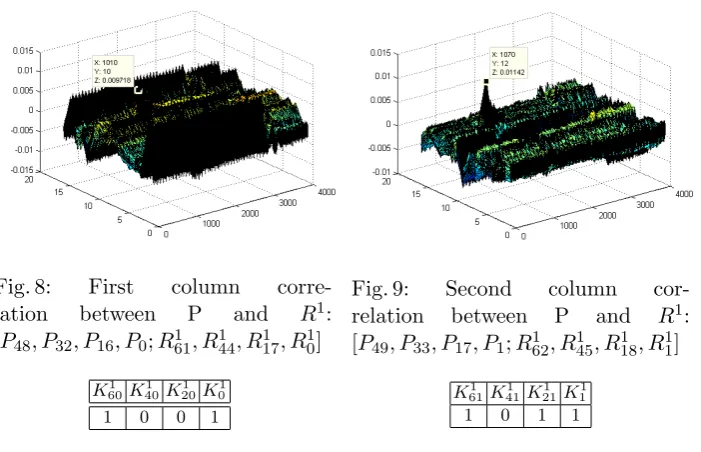
consumption value. For example, first column of P and R1 is correlated
as shown Fig. 8 for 4-bit key hypothesis. The peak appears at 10, this
means the correct key is 9 (because the index for key hypothesis in the plot starts from 1) with the correlation value of 0.01185. The correct key and its corresponding bit positions are given below. Similarly, second
col-umn of P and R1 is correlated and its key values are given in Fig. 9.
This process is repeated for sixteen columns of R1 to reveal 64-bit key.
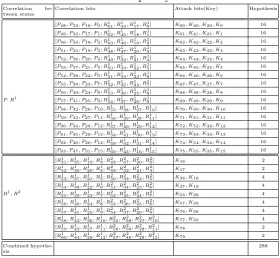
The remaining key bits are retrieved by correlatingR1 andR2. Complete
80 key bits recovery and its corresponding bits correlation with attack
complexity is tabulated as below 1.
Fig. 8: First column
corre-lation between P and R1:
[P48, P32, P16, P0;R161, R144, R117, R10]
K601 K401 K201 K01
1 0 0 1
Fig. 9: Second column
cor-relation between P and R1:
[P49, P33, P17, P1;R162, R145, R118, R11]
K611 K 1
41K
1
21K
1 1
1 0 1 1
4
Attack complexity. Differential Power analysis(DPA) is divide and conquer approach. That is, instead of trying brute force approach to reveal
80-bit key with complexity of 280; chunks of key bits are attacked with
reduced complexity. Therefore attack complexity is significantly reduced
from 280 to (24∗16) + (22∗6) + (21∗4) = 288. By the same way, other
variants of RECTANGLE algorithm can also be attacked using DPA.
Table 1: Attack complexity of RECTANGLE
Correlation be-tween states
Correlation bits Attack bits(Key) Hypothesis
[P48, P32, P16, P0;R161, R 1 44, R
1 17, R
1
0] K60, K40, K20, K0 16
[P49, P33, P17, P1;R1
62, R145, R118, R11] K61, K41, K21, K1 16 [P50, P34, P18, P2;R163, R
1 46, R
1 19, R
1
2] K62, K42, K22, K2 16
[P51, P35, P19, P3;R1
48, R147, R120, R13] K63, K43, K23, K3 16 [P52, P36, P20, P4;R149, R
1 32, R
1 21, R
1
4] K64, K44, K24, K4 16 [P53, P37, P21, P5;R1
50, R133, R122, R15] K65, K45, K25, K5 16 [P54, P38, P22, P6;R151, R
1 34, R
1 23, R
1
6] K66, K46, K26, K6 16 [P55, P39, P23, P7;R1
52, R135, R124, R17] K67, K47, K27, K7 16 [P56, P40, P24, P8;R1
53, R136, R125, R18] K68, K48, K28, K8 16
P, R1 [P
57, P41, P25, P9;R154, R 1 37, R
1 26, R
1
9] K69, K49, K29, K9 16
[P58, P42, P26, P10;R1
55, R138, R127, R110] K70, K50, K30, K10 16 [P59, P43, P27, P11;R156, R
1 39, R
1 28, R
1
11] K71, K51, K31, K11 16
[P60, P44, P28, P12;R1
57, R140, R129, R112] K72, K52, K32, K12 16 [P61, P45, P29, P13;R158, R
1 41, R
1 30, R
1
13] K73, K53, K33, K13 16 [P62, P46, P30, P14;R1
59, R142, R131, R114] K74, K54, K34, K14 16 [P63, P47, P31, P15;R160, R
1 43, R
1 16, R
1
15] K75, K55, K35, K15 16 [R1
51, R135, R119, R13;R482, R247, R220, R23] K16 2 [R152, R
1 36, R
1 20, R
1 4;R
2 49, R
2 32, R
2 21, R
2
4] K17 2
[R1
53, R137, R121, R15;R250, R233, R222, R25] K36, K18 4 [R1
54, R138, R122, R16;R251, R234, R223, R26] K37, K19 4
R1, R2 [R1
55, R139, R123, R17;R252, R235, R224, R27] K56, K38 4 [R1
56, R140, R124, R18;R253, R236, R225, R28] K57, K39 4 [R1
57, R 1 41, R
1 25, R
1 9;R
2 54, R
2 37, R
2 26, R
2
9] K76, K58 4
[R1
58, R142, R126, R110;R255, R238, R227, R210] K77, K59 4 [R1
59, R 1 43, R
1 27, R
1 11;R
2 56, R
2 39, R
2 28, R
2
11] K78 2
[R1
60, R144, R128, R112;R572, R240, R229, R212] K79 2 Combined
hypothe-sis
5 Conclusion
The results show that PRINCE and RECTANGLE cipher are vulnerable to
DPA attack and requires additional scheme to secure over the practical attack. Our work extends to incorporate countermeasure and analyse the effect of countermeasure against higher order attacks. Also we plan to analyse the overhead introduced by the countermeasure and to explore the possible optimisation techniques.
References
1. Farzaneh Abed, Eik List, and Stefan Lucks. On the security of the core of prince against biclique and differential cryptanalysis. Cryptology ePrint Archive, Report
2012/712, 2012. http://eprint.iacr.org/.
2. Andrey Bogdanov, Lars R. Knudsen, Gregor Leander, Christof Paar, Axel
Poschmann, Matthew J. B. Robshaw, Yannick Seurin, and C. Vikkelsoe. PRESENT:
An Ultra-Lightweight Block Cipher. In Pascal Paillier and Ingrid Verbauwhede, editors,CHES, volume 4727 ofLecture Notes in Computer Science, pages 450–466. Springer, 2007.
3. Julia Borghoff, Anne Canteaut, Tim G¨uneysu, Elif Bilge Kavun, Miroslav
Kneze-vic, Lars R. Knudsen, Gregor Leander, Ventzislav Nikov, Christof Paar, Christian
Rechberger, Peter Rombouts, Søren S. Thomsen, and Tolga Yal¸cin. Prince - a
low-latency block cipher for pervasive computing applications - extended abstract.
In Xiaoyun Wang and Kazue Sako, editors,ASIACRYPT, volume 7658 ofLecture
Notes in Computer Science, pages 208–225. Springer, 2012.
4. Christophe De Canni`ere, Orr Dunkelman, and Miroslav Knezevic. KATAN and
KTANTAN - A Family of Small and Efficient Hardware-Oriented Block Ciphers. In Christophe Clavier and Kris Gaj, editors,CHES, volume 5747 ofLecture Notes in Computer Science, pages 272–288. Springer, 2009.
5. Anne Canteaut, Maria Naya-Plasencia, and Bastien Vayssire.
Sieve-in-the-middle: Improved mitm attacks (full version). Cryptology ePrint Archive, Report
2013/324, 2013. http://eprint.iacr.org/.
6. Cryptography Research Inc. Protecting FPGAs from Power Analysis. http://
www.cryptography.com/public/pdf/FPGASecurity.pdf. Accessed: July, 2014.
7. Zheng Gong, Svetla Nikova, and Yee Wei Law. KLEIN: A New Family of
Lightweight Block Ciphers. In Ari Juels and Christof Paar, editors, RFIDSec,
volume 7055 ofLecture Notes in Computer Science, pages 1–18. Springer, 2011. 8. Jian Guo, Thomas Peyrin, Axel Poschmann, and Matthew J. B. Robshaw. The
LEDBlock Cipher. In Bart Preneel and Tsuyoshi Takagi, editors, CHES, volume
6917 ofLecture Notes in Computer Science, pages 326–341. Springer, 2011. 9. Deukjo Hong, Jaechul Sung, Seokhie Hong, Jongin Lim, Sangjin Lee, Bonseok
Koo, Changhoon Lee, Donghoon Chang, Jaesang Lee, Kitae Jeong, Hyun Kim, Jongsung Kim, and Seongtaek Chee. HIGHT: A New Block Cipher Suitable for
Low-Resource Device. In Louis Goubin and Mitsuru Matsui, editors,CHES,
vol-ume 4249 ofLecture Notes in Computer Science, pages 46–59. Springer, 2006.
11. Paul C. Kocher, Joshua Jaffe, and Benjamin Jun. Differential power analysis. In
Michael J. Wiener, editor,CRYPTO, volume 1666 ofLecture Notes in Computer
Science, pages 388–397. Springer, 1999.
12. Gregor Leander, Christof Paar, Axel Poschmann, and Kai Schramm. New
Lightweight DES Variants. In Alex Biryukov, editor,FSE, volume 4593 ofLecture Notes in Computer Science, pages 196–210. Springer, 2007.
13. Leibo Li, Keting Jia, and Xiaoyun Wang. Improved meet-in-the-middle attacks
on aes-192 and prince. Cryptology ePrint Archive, Report 2013/573, 2013. http:
//eprint.iacr.org/.
14. Hadi Soleimany, C´eline Blondeau, Xiaoli Yu, Wenling Wu, Kaisa Nyberg,
Huil-ing Zhang, Lei Zhang, and Yanfeng Wang. Reflection cryptanalysis of prince-like ciphers. Journal of Cryptology, pages 1–27, 2013.
15. Ling Song and Lei Hu. Differential fault attack on the prince block cipher.
Cryp-tology ePrint Archive, Report 2013/043, 2013. http://eprint.iacr.org/.
16. T. Tuan, A. Rahman, S. Das, S. Trimberger, and Sean Kao. A 90-nm Low-Power
FPGA for Battery-Powered Applications. Computer-Aided Design of Integrated
Circuits and Systems, IEEE Transactions on, 26(2):296–300, 2007.
17. Wentao Zhang, Zhenzhen Bao, Dongdai Lin, Vincent Rijmen, Bohan Yang, and Ingrid Verbauwhede. Rectangle: A bit-slice ultra-lightweight block cipher suitable
for multiple platforms. Cryptology ePrint Archive, Report 2014/084, 2014. http:
//eprint.iacr.org/.
18. Xueying Zhang, Howard M. Heys, and Cheng Li. FPGA Implementation and
Energy Cost Analysis of Two Light-Weight Involutional Block Ciphers Targeted
![Fig. 5: key recovery of β 0[2]](https://thumb-us.123doks.com/thumbv2/123dok_us/7909437.1313327/9.595.151.489.122.211/fig-key-recovery-of-b.webp)