Implementation of Energy-Efficient Resource
Allocation for OFDM-Based Cognitive Radio Networks
Anna Kumar.G1, Kishore Kumar.M2, Anjani Suputri Devi.D3
1M.Tech student, ECE, Sri Vasavi engineering college, Tadepalligudem, A.P, India 2Associate Professor, ECE, Sri Vasavi engineering college, Tadepalligudem, A.P, India
3Assistant Professor, CSE, Sri Vasavi engineering college, Tadepalligudem, A.P, India
Abstract— Cognitive radio is viewed as a novel approach for improving the utilization of the radio electromagnetic spectrum. The cognitive radio, built on a software-defined radio, is defined as an intelligent wireless communication system that is aware of its environment and uses the methodology of understanding-by-building to learn from the environment and adapt to statistical variations in the input stimuli. Following the discussion of interference temperature as a new metric for the quantification and management of interference, the paper addresses three fundamental cognitive tasks. Radio-scene analysis, Channel-state estimation and predictive modelling, Transmit-power control and dynamic spectrum management. This work also discusses the emergent behavior of cognitive radio to implement the Energy-Efficient Resource Allocation for OFDM-Based Cognitive Radio Networks. MATLAB tool is used to implement the entire system and simulation results obtained.
Index Terms—Cognitive radio, energy-efficiency, OFDM, MATLAB, Channel-state estimation.
I. INTRODUCTION
MULTIPLE receive antennas can be employed with orthogonal frequency-division multiplexing (OFDM) to improve system performance, where space diversity is achieved using subcarrier-based space combining. However, in subcarrier-based space combining, it is required that multiple discrete Fourier transform (DFT) processing, each per receive antenna, be used. As a result, such systems are quite complicated, because the complexity of DFT is a major concern for system implementation. Recently, some schemes have been proposed to reduce the number of DFT blocks required. In the principle of orthogonal designs, the number of DFT blocks is reduced to a half with 3 dB performance degradation. In the received time-domain OFDM symbols from each antenna are first weighted and then combined before the DFT processing. By doing so, the number of DFT blocks required is reduced to one. In OFDM with multiple transmit and multiple receive antennas (MIMO) is investigated, and a reduced- complexity algorithm is proposed to reduce the number of DFT blocks required to one.
Motivated by the work in and based upon Eigen analysis, we propose a receive space-diversity scheme to effectively trade off system performance and complexity. The scheme in can be regarded as a special case of our proposed scheme. However, we will show that the good
Resource Allocation (RA) is one of the most important problems in OFDM-based wireless networks. An optimized RA scheme can maximize the throughput of an OFDM system, minimize the transmission power, or support more users with given Quality-of-Service (QoS) guarantee. For OFDM-based CR networks, there are many research results on how to improve the system throughput. RA for OFDM-based CR network is formulated as a multidimensional knapsack problem. A greedy heuristic algorithm is proposed, which can produce solution close to the optimal. However, the computational cost would be very high for multiple SUs case. In [6], optimal and suboptimal power loading algorithms are presented for the single SU case. Downlink sum capacity is maximized under the constraint of PUs’ interference thresh-olds. An efficient algorithm is proposed to allocate bits among all OFDM sub-channels in CR systems. The proposed algorithm can obtain the optimal solution with low computational complexity in most cases. A fast algorithm is developed to tackle the optimal power allocation problem in an OFDM-based CR network. A low complexity algorithm is proposed to maximize the throughput of a CR system while guaranteeing proportional fairness among SUs.
In contrast to the flourish on capacity enhancing, little attention has been paid to energy efficiency of the CR systems. Nowadays, excessive energy consumption becomes a critical issue because of the consequent environment problems and operational cost. Green communication, which emphasizes on incorporating energy awareness in communication systems, is becoming more and more important. Different from the throughput-oriented RA targets, energy efficient RA aims at maximizing the energy efficiency of a wireless system. Weighted energy efficiency is maximized under pre-scribed users’ QoS requirements. A non-cooperative game is developed for energy efficient power optimization. The tradeoff between energy efficiency and spectral efficiency is investigated for the downlink of a multiuser distributed antenna system.
In this paper, we study the energy efficient RA for the OFDM-based CR systems. We try to maximize the energy efficiency of the considered system, while satisfying the throughput requirements of the SUs. Besides, the interference introduced to the PUs is kept below a tolerable threshold to prohibit the unacceptable performance degradation of the PUs. Proportional fairness among users is also considered. The formulated optimization task is computationally intractable since it is a mixed integer programming problem. To make it tractable, we relax the problem by using time-sharing method to convert it into a quasi-convex optimization one. A bisection-based algorithm is developed to work out the optimal solution. We also exploit the structure of the problem and derive a fast barrier method to reduce the computational complexity.
Our ultimate aim is to increase the channel capacity and energy efficiency of CR users by limiting the interference introduced to the primary user system. From the simulation results we can conclude that the proposed optimal algorithms offer better energy efficiency and channel capacity which is very close to the uniform optimal algorithms.
The rest of this paper is organized as follows. In Section II, we illustrate system model and formulate our optimization task. In Section III, we propose crucial Design Methodology Section IV, proposed algorithm and optimal power distribution algorithms Fast Barrier Method are presented. Simulation results are given in Section V, as well as discussions. Finally, we conclude the paper in Section V.
II. SYSTEM MODEL
Energy efficiency and Spectral efficiency are plays an important role in wireless communication systems. The increase in demand for frequency bands with high data rate requirements, we are in a need to efficiently utilize the available spectrum with better energy efficiency. So cognitive radio (CR) networks are plays vital role in utilizing the available unused spectrum efficiently with better energy efficiency.
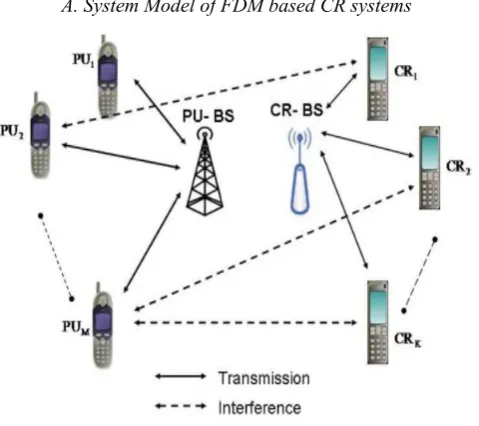
In this paper, Figure A shows the block diagram of OFDMA based CR Systems for uplink as well as downlink. It shows the signal transmission between PU and Primary User (PU)-Base Station (BS), SU and Cognitive Radio (CR)-Base Station (BS).It also sows the interference between PU‟s and SU‟s. In this each Primary radio networks (PRN) cell has one PU-BS and multiple Primary Users. Each Cognitive radio network (CRN) cell has one CR-BS and multiple SU‟s. The primary cell system coexists with the CR cell system in the same geographical location. CRN cell system control the interference to the PU‟s as well as the inter cell interference and signal transmission to SU‟s. The secondary users (SU‟s) can be able to access the available CR Bands without causing harmful interference to the primary users,
allocation is necessary for OFDM based Cognitive Radio networks to achieve the maximum energy efficiency and less interference.
A. System Model of FDM based CR systems
Figure A. Block Diagram of OFDMA based CR systems
Figure B. Spectrum Frequency band for PU‟s & SU‟s
III. DESIGN METHODOLOGIES Fast Barrier Method
Barrier method is treated as a standard technique to solve convex optimization problems. The Computational Complexity of the barrier method mainly lies in the computation of Newton step that needs matrix inversion with a complexity of O((2KN + N )3) for our considered problem. For a practical OFDM system, the number of sub-channels is always several thousand and such a complexity is too high to apply, especially for the RA problem that should be tackled in an online manner. In this work, we develop an efficient algorithm to compute the Newton step by exploiting the special structure of the problem, making the barrier method promising to perform the concerned optimization task.
IV. SIMULATION RESULTS
Figure 1: EE of CR System as Function of Transmission Power Limit.
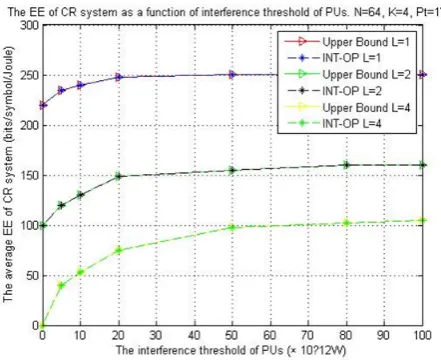
Fig.1 illustrates the EE of the CR system versus the trans-mission power limit for different numbers of sub-channels. The numbers of SUs and PUs are set to 4 and 2, respectively. The interference threshold of each PU is 5 × 10 −12W and the rate requirement of each SU is 20bits/symbol. The static circuit power is fixed to 0.25W. There are N =32 and N =64 sub-channels in the two cases. As can be seen in Fig.1, the EE of the CR system varies acutely at the beginning (growing) because the CR system outage can be reduced as the increase of the transmission power budget. When the transmission power budget is sufficient enough, all SUs’ rate requirements can be always satisfied and the EE of the CR system keeps almost invariable as seen in Fig.1. Additionally, the EE can be improved when there are more OFDM sub-channels, which is a result of channel diversity in wireless environment. Notice that the INT-OP achieves more than 98% of the Upper Bound, the upper bound can’t be a feasible solution because the relaxed form of the original problem ignores the integer constraints indicating our proposed algorithm performs quite well for the considered problem. We also depict the EE of the CR system versus the interference threshold for different numbers of PUs (L = 1, L=2 and L=4) in Fig.2. The number of sub-channels is N =64. There are 4 SUs with uniform rate requirement Rk, min = 20bits/symbol.
a function of the minimal rate requirements of SUs for different numbers of SUs. There are 64 sub-channels with the total transmission power limit Pt = 1W and static circuit power Pc = 0.25W.
Fig. 2. The EE of CR system as a function of interference threshold of PUs. N =64, K=4, Pt=1W.
Fig. 3. The EE of CR system as a function of the minimal rate requirements of SUs. N =64, L=2, Pt=1W
The number of PUs is 2 with the interference threshold Ilth = 5 × 10 −12W. The INT-OP always performs quite close to the Upper Bound. We can observe that the EE of the CR system decreases with the growth of the rate requirements for both K = 2 and K = 4. Because the growth of rate requirements not only results in exponentially increase of power consumption, but also more frequently exhausts the radio resource (sub-channels and power), even leads to system outage. Comparing the curves of the two cases, we can find the EE becomes larger with the growth of the number of SUs when the rate requirement is relatively small. However, when the rate
requirement increases, more SUs can contrarily lower the EE of the CR system, which occurs as a cut-off of the rate requirement. This phenomenon can be explained as follows. When the SUs’ rate requirements are small, the CR network benefits from multiuser diversity for more SUs case because a sub-channel is more likely to be allocated to an SU who has good channel gain over it. Thus, less power is required to maintain the SUs’ rate requirements and the EE of the CR system is larger than less SUs case. However, when an SU’s rate requirement is high, more sub-channels and much power are mandatorily allocated to the SU in order to meet the rate requirement. At this time, the sub-channels with poor link gains inevitably consume much power to meet all SUs’ rate requirements, which rather results in the decreasing of the EE. In other words, the degree of freedom for the SUs to get sub-channels with good channel gains reduces from the viewpoint of the CR system for the high rate requirements case.
Then we investigate the convergence of our proposed algorithms in Fig.4 and Fig.5. As discussed the computation load of the barrier method mainly lies in the computation of Newton step. If the number of Newton iterations is large or varies in a wide range, the algorithm would be difficult to be applied in practical wireless systems.
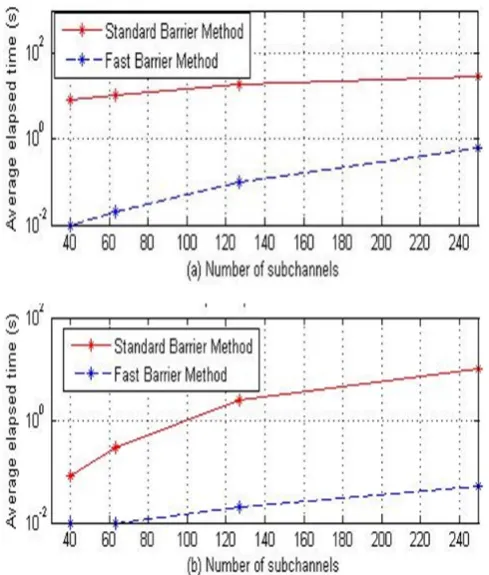
Fig.4 and Fig.5 show that it is not the case for our proposed algorithm for all concerned settings. Fig.4 shows the number of Newton iterations of the barrier method to converge in 500 random instances for both solving the relaxed RA problem and the optimal power allocation (PA). Fig.5 gives the cumulative distribution function (CDF) of the number of Newton iterations for the optimal RA based on time-sharing in (a) and optimal power allocation in (b) with different settings of N. Both Fig.4 and Fig.5 show that the number of Newton iterations varies in a narrow range with a given N. All these observations validate that our proposed algorithm is effective and efficient. We also give the time cost of our proposed algorithm and the standard one which computes Newton step by matrix inversion directly.
Fig. 4. Number of Newton iterations required for convergence with 500 channel realizations. N =64, K=4,
Fig. 5. CDF of the number of Newton iterations required for convergence for 1000 channel realizations. K=4, L=2. (a) Fast barrier method for optimal RA based on time-sharing; (b) fast barrier method for optimal power allocation.
Figure 6.1: Average time cost as a function of the number of sub-channels. (a) Optimal RA based on time-sharing; (b) optimal power allocation.
Figure 6.2: Newton Iterations with 1000 Channels.
V.
CONCLUSION
We studied the energy-efficient resource allocation in an OFDM-based CR network, which is an urgent task for green communication design. Our model is general and covers many practical constraints, leading to an intractable mixed integer programming problem. We perform a series of equivalent transformations by analyzing the formulated problem intensively, converting it into a convex optimization problem which can be solved by standard optimization technique.
Furthermore, we develop an efficient algorithm to work out the (near) optimal solution by exploiting its special structure to update Newton step in an ingenious way, reducing the computation complexity dramatically and making its applications possible. Numerical results show that our resource allocation proposal can achieve near optimal energy efficiency, while the algorithm developed in this paper converges quickly and stably.
For future work, imperfect channel state information case should be considered. Efficient heuristic methods with lower complexity are also promising for this real-time optimization problem, especially for the sub-channel assignment that introduces intractable integer variables.
By adopting UWB we are improving the energy efficiency by which the durability of device increases and power consumption is decreases which are very important in the field of Telecommunication Industry.
REFERENCES
[1]. S. Haykin, ―Cognitive radio: brain-empowered wireless communications,ǁIEEE J. Sel. Areas Commun., vol. 23, no. 2, pp. 201–220, Feb. 2005.
[2]. R. Zhang, Y.-C. Liang, and S. Cui, “Dynamic resource allocation in cognitive radio networks,” T. S. Rappaport, Wireless Communications: Principles and Practice, 2nd ed. Prentice Hall,
2002.
[3]. “Resource allocation for heterogeneous cognitive radio networks with imperfect spectrum sensing,” IEEE J. Sel. Areas Commun., vol. 31, no. 3, pp. 464–475, 2013.
[4]. M. Ge and S. Wang, “Fast optimal resource allocation is possible for multiuser OFDM-based cognitive radio networks with heterogeneous services,” IEEE Trans. Wireless Commun., vol. 11, no. 4, pp. 1500– 1509, Apr. 2012.
[5]. [1] FCC, “Facilitating opportunities for flexible, efficient, and reliable spectrum use employing cognitive radio technologies,” FCC Report, ET Docket 03-322, Dec. 2003.
AUTHORS
Anna Kumar.G1He graduated from Bhimavaram Institute of Engineering
& Technology which is affiliated to Jawaharlal Nehru Technological University, Kakinada, India in 2012. Presently he is pursuing M.Tech from Sri Vasavi Engineering College affiliated to JNTUK, Tadepalligudem, India. His stream is Digital Electronics and Communication Systems.
Kishore Kumar.M2 has a work experience of 13 years as teaching
faculty. From past 7 years he is working as a Associate Professor in Sri Vasavi Engineering College, Tadepalligudem, India. Earlier he worked as a faculty in Kakinada Institute of Engineering & Technology, India. He has done Master’s Degree from Gudlavalleru Engineering College, which is affiliated to Jawaharlal Nehru Technological University, Hyderabad, Gudlavalleru, A.P, India in 2007. He obtained his Graduated from Sri Sarathi Institute of Engineering & Technology, which is affiliated to Jawaharlal Nehru Technological University, Hyderabad, Nuzvid, A.P, India. He presented one International and one national paper. He published his work in four journals. His area of interests in Wireless Communications and Networking.
Anjani Suputri Devi .D3has a work experience of 13 years as teaching