Deriving a Domain Specific Test Collection from a Query Log
Avi Arampatzis1 Jaap Kamps1,2 Marijn Koolen1 Nir Nussbaum2 1 Archives and Information Science, University of Amsterdam
2 ISLA, Informatics Institute, University of Amsterdam
Abstract
Cultural heritage, and other special domains, pose a particular problem for information retrieval: evaluation requires a dedicated test collection that takes the particular doc-uments and information requests into ac-count, but building such a test collection re-quires substantial human effort. This paper investigates methods of generating a docu-ment retrieval test collection from a search engine’s transaction log, based on submit-ted queries and user-click data. We test our methods on a museum’s search log file, and compare the quality of the generated test collections against a collection with manu-ally generated and judged known-item top-ics. Our main findings are the following. First, the test collection derived from a trans-action log corresponds well to the actual search experience of real users. Second, the ranking of systems based on the derived judgments corresponds well to the ranking based on the manual topics. Third, deriving pseudo-relevance judgments from a transac-tion log file is an attractive optransac-tion in do-mains where dedicated test collections are not readily available.
1 Introduction
Cultural heritage, and other special domains, pose a particular problem for information retrieval. Progress in information retrieval depends heavily on the availability of suitable test collections consist-ing of a set of documents; a set of search topics;
and (human) relevance judgments. Standard bench-marks, such as those developed at TREC (2007), have been developed using newspaper and newswire data. Whilst these test collections are immensely useful to evaluate generic properties of retrieval sys-tems, such as fundamental ranking principles, they do not capture the specific context of particular do-mains (Ingwersen and J¨arvelin, 2005). To take cul-tural heritage as an example, the documents are cultural heritage descriptions which are different in character from newspaper articles, and also the search requests and relevance judgments about art are more subjective than factual queries about news (Koolen et al., 2007). As a result, special domains like cultural heritage require a dedicated test collec-tion that takes the particular documents and informa-tion requests into account, but building such a test collection requires substantial human effort.
We opt for a different approach. Search engines commonly store the actions of users in transaction logs, which allow an unobtrusive way of studying user behaviour. Logs contain valuable information such as what searchers are looking for, what re-sults they find interesting enough to click on, etc. In this paper, we investigate methods of extracting queries and user-clicks (on the search result items) from transaction logs in order to create a quality test collection for Document Retrieval.
sta-ble across a majority of human assessors. Never-theless, considering the fact that a test collection is used “as a mechanism for comparing system per-formance” (Voorhees, 2002), the requirements for completeness and reliability may be relaxed some-what.
The Text REtrial Conference (TREC) has tradi-tionally used incomplete judgements for compar-ing system effectiveness via the “poolcompar-ing” method (Jones and van Rijsbergen, 1975), and it is also well-known that human assessor agreement is rel-atively low (Voorhees and Harman, 2005). Conse-quently, test collections which preserve the effec-tiveness ranking of several systems can be consid-ered of equivalent quality in the context of com-paring system effectiveness. In order to evaluate the quality of test collections extracted in various ways from a transaction log, it would be sufficient to compare their ability to rank several retrieval sys-tems against a reference system ranking produced by an already known good test collection not produced from the log.
One can think of several ways of extracting queries and clicks from a transaction log and turn-ing them into a set of queries with relevance judg-ments. A simple (and naive) way would be to treat every query typed by a user as a topic, and every re-sult that the user clicked on as a positive relevance judgment. However, such an approach may not lead to a good test set. Previous research on user click behaviour has shown that clicks on search engine re-sults do not directly correspond to explicit, absolute relevance judgments, but can be considered as rela-tiverelevance judgments (Joachims et al., 2005), i.e., if a user skips resultaand clicks on resultb, than the user preference reflectsrank(b)> rank(a). More-over, the occurrence frequencies of queries and the numbers of retrieved items vary significantly across queries which may lead to wide variation in effec-tiveness.
The challenge we take up has several dimensions which can be summarized in the following ques-tions:
• How can we derive topics and pseudo-relevance judgments from a transaction log file, and how does this impact the quality of the gen-erated test collection?
• How does system effectiveness on the automat-ically generated test collection compare to the effectiveness on a set of manually constructed known-item topics?
If automatic methods of building test collections are indeed feasible, this opens up a whole new dimen-sion of possibilities for Information Retrieval eval-uation: there is an enormous lengths of transaction logs generated daily at numerous web-sites and at on-line search engines.
The rest of this paper is organized as follows. Next, in Section 2 we discuss transaction logs in general, and the specific transaction log from a mu-seum that we’ll use in the case study of this paper. Section 3 details how we have extracted topics and pseudo-relevance judgments from a museum’s log file, and their evaluation. Then, in Section 4, we evaluate the merits of the derived test collection in comparison to human generated and judged topics. We end with Section 5 in which we summarize our findings.
2 Transaction Logs
2.1 Previous Work
There has been substantial interest in using click-through data from transaction logs as a form of implicit feedback (Dumais et al., 2003). A range of implicit feedback techniques have been used for query expansion and user profiling in information retrieval tasks (Oard and Kim, 2001; Kelly and Tee-van, 2003). Joachims et al. (2005, p.160) conclude that “the implicit feedback generated from clicks shows reasonable agreement with the explicit judg-ments of the pages”.
Transaction logs have been analysed to study user search behaviour in Web search engines (Chau et al., 2005) and digital libraries (Jones et al., 2000), amongst others (Jansen, 2006). In Chau et al. (2005), user behaviour is studied using the transac-tion log of a website’s search engine and is com-pared to that of general purpose search engines. They find that the number of query terms used for website search engines is comparable to queries sub-mitted to general purpose search engines, but the search topics and terms are different.
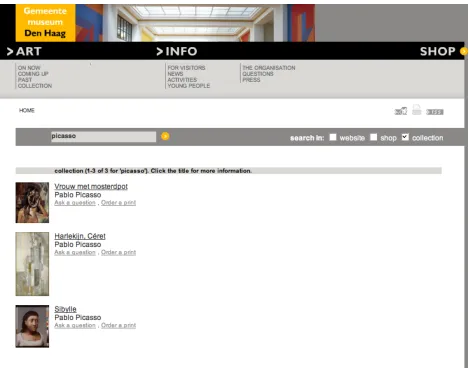
con-Figure 1: The search engine of the Gemeentemuseum’s website.
struct a test set with real user needs, queries and judgments.
2.2 A Website’s Search Engine
The website of theHaags Gemeentemuseum1in the Hague, the Netherlands, offers a search engine for three different parts of the Gemeentemuseum, the website content, the on-line shop, and the highlights of the museum’s object collection (see Figure 2.1). The searchable on-line collection consists of 1,127 objects, the highlights of the museum, from a to-tal database of 116,493 museum objects. The meta-data of these objects are stored in a legacy system, and queries are matched against the title and cre-ator fields (Koolen et al., 2007). The descriptions contain many more fields, however. The objects
1http://www.gemeentemuseum.nl
database treats the query as a Boolean AND query, and returns a warning if there is no object descrip-tion containing all terms in one field. Although the database allows a drop-back to the individual terms, the website search engine retains a strict Boolean AND query and returns an empty result list.
[image:3.612.72.541.51.419.2]This has an effect on the queries found in the log file. Queries containing bothtitleandcreatornames often lead to an empty result list, as there is no sin-gle field containing bothcreatorandtitleterms. The database looks for all the terms in one field at a time, and will not match with any object. With an empty result list, users cannot click on an object and hence, the query is not logged. Another effect is that all the results that users can click on have all the query terms in either the title orcreator field. Although end users sometimes express their information needs in terms different from the terms chosen by indexers, i.e. the curators in the museum (Markkula and Sor-munen, 2000), this discrepancy cannot be observed in the log-file data.
This may lead to the concern that the topics that can be extracted from the transaction log are “easy” topics, since the relevant descriptions necessarily contain all the query terms. It is unclear whether this affects the extracted topic set significantly, since we will look only at the relative ranking of systems over a set of queries. We will compare the abil-ity to rank systems of our automatically generated topic sets with the system ranking ability of a man-ual topic set. If the extracted topic sets preserve the system ranking of the manual topic set, the bias in the topic sets towards “easy” topics has no negative influence on the quality of the topic sets.
3 Experiments and setup
We have obtained the log files covering a period of one and a half years, between September 14, 2005 and February 26, 2007.
From the transaction log, we extracted the queries and the object identifiers from the database query, and turned them into Qrels, i.e., the object is relevant for the query.
We use the following terminology:
• User: the client side of the transaction, identi-fied by ip-address.
• Transaction: any exchange between client (user) and server (system), corresponding to a line in the transaction log.
• Session: A sequence of transactions by the same user, where the maximum interval be-tween transaction n and n + 1 is 1 hour.
Topic # Topics Query length Avg. #
set average median rel. docs
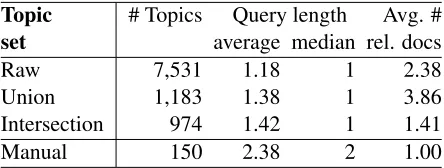
Raw 7,531 1.18 1 2.38
Union 1,183 1.38 1 3.86
Intersection 974 1.42 1 1.41
[image:4.612.316.538.54.138.2]Manual 150 2.38 2 1.00
Table 1: Statistics on the extracted topic sets.
More than 1 hour of inactivity signals a session boundary.
• Query: the string typed by the user as it ap-pears in the transaction log.
• Result: the identifier of the museum object, used to retrieve the object data from the object database.
3.1 Extraction methods
We used 3 extraction methods to construct a test set:
1. Raw queries: each query appearing in the log is used, i.e. the bag of queries. Here, a topic consist of a query and the corresponding clicked results from one session. If the same user types the same query in another session, this is treated as a new topic.
2. Unique union: All unique queries are used, i.e. the set of queries. All the results clicked by all users typing the same query are considered relevant documents.
3. Unique intersection: All unique queries are used, i.e. the set of queries. The intersection of the results clicked by all users typing the same query are considered relevant documents. Thus, a result is relevant only if all users who typed the query, clicked on that result.
are 1,183 unique queries, and on average, 3.86 re-sults are clicked by at least one user. Understand-ably, the Intersection set has less topics than the Union set, as there are queries with no single result clicked on by all users. Also, the average number of relevant documents per topic is lower for the inter-section set.
We created 150 Known-Item topics by hand and used this test set, referred to as KI-topics, on the same collection and include the results as a com-parison with the new test sets. Table 1 shows the statistics of these human generated topics in the last row. These search request have more verbose topic statements with a median length of 2, compared to a median length of 1 for the query log topics. Also the number of relevant documents differs considerably, with a unique relevant page for the human known-item topics, and several “clicked” pages per query for the transaction log.
3.2 Retrieval system
To see if our test sets lead to a stable system rank-ing, we need a number of retrieval systems to com-pare their ranking on the different test collections. To get a number of different systems, we simply use a standard retrieval model with different parameter settings to create different runs.
We use a standard language model (Hiemstra, 2001). Our system is an extension to Lucene (ILPS, 2005) and uses Jelinek-Mercer smoothing, con-trolled by the parameterλ, and a length prior, con-trolled by the parameter β, i.e., for a collectionD, documentdand queryq:
P(d|q) =P(d)·Y t∈q
((1−λ)·P(t|D) +λ·P(t|d)),
(1) where
P(t|d) = tft,d
|d| (2)
P(t|D) = P doc freq(t, D) t0∈Ddoc freq(t0, D)
(3)
P(d) = P |d| d0∈D|d|
(4)
We assign a prior probability to an document d
relative to its length in the following manner:
P(d) = |d| β
P d|d|β
, (5)
System λ β
A 0.10 0
B 0.50 0
C 0.90 0
D 0.10 1
E 0.50 1
F 0.90 1
G 0.10 2
H 0.50 2
I 0.90 2
Table 2: Parameter settings for the different systems.
where|d|is the length of a documentd. Theβ pa-rameter introduces a length bias which is propor-tional to the document length withβ = 1(the de-fault setting). For more details on language models and smoothing, see (Hiemstra, 2001). For details on the effect of the length parameter, see (Kamps et al., 2004).
3.3 Experimental Set-up
In our experiments we will emulate a set of different retrieval systems by using arbitrary parameter set-tings for smoothing (λ) and length prior (β). This will result in a range of different rankings of doc-uments, and we can compare their retrieval effec-tiveness on our various topic sets. In this way, we can compare the system ranking of the automati-cally generated topic sets with the system ranking of a manually crafted topic set.
We made 9 different runs with each topic set, us-ing 3 different values (0.10, 0.50 and 0.90) for the smoothing parameterλ, corresponding to heavy, av-erage and little smoothing respectively, and 3 differ-ent values (0, 1 and 2) for the length priorβ corre-sponding to no length normalization and length nor-malization proportional to the document length.
To measure the correlation of the system rankings resulting from the different topic sets, we look at Kendall’s tau coefficient.
[image:5.612.378.475.52.192.2]4 Results
mean-Topics # Topics MRR Success@10
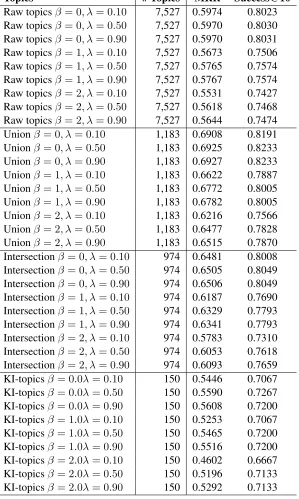
[image:6.612.159.458.70.569.2]Raw topicsβ= 0, λ= 0.10 7,527 0.5974 0.8023 Raw topicsβ= 0, λ= 0.50 7,527 0.5970 0.8030 Raw topicsβ= 0, λ= 0.90 7,527 0.5970 0.8031 Raw topicsβ= 1, λ= 0.10 7,527 0.5673 0.7506 Raw topicsβ= 1, λ= 0.50 7,527 0.5765 0.7574 Raw topicsβ= 1, λ= 0.90 7,527 0.5767 0.7574 Raw topicsβ= 2, λ= 0.10 7,527 0.5531 0.7427 Raw topicsβ= 2, λ= 0.50 7,527 0.5618 0.7468 Raw topicsβ= 2, λ= 0.90 7,527 0.5644 0.7474 Unionβ= 0, λ= 0.10 1,183 0.6908 0.8191 Unionβ= 0, λ= 0.50 1,183 0.6925 0.8233 Unionβ= 0, λ= 0.90 1,183 0.6927 0.8233 Unionβ= 1, λ= 0.10 1,183 0.6622 0.7887 Unionβ= 1, λ= 0.50 1,183 0.6772 0.8005 Unionβ= 1, λ= 0.90 1,183 0.6782 0.8005 Unionβ= 2, λ= 0.10 1,183 0.6216 0.7566 Unionβ= 2, λ= 0.50 1,183 0.6477 0.7828 Unionβ= 2, λ= 0.90 1,183 0.6515 0.7870 Intersectionβ = 0, λ= 0.10 974 0.6481 0.8008 Intersectionβ = 0, λ= 0.50 974 0.6505 0.8049 Intersectionβ = 0, λ= 0.90 974 0.6506 0.8049 Intersectionβ = 1, λ= 0.10 974 0.6187 0.7690 Intersectionβ = 1, λ= 0.50 974 0.6329 0.7793 Intersectionβ = 1, λ= 0.90 974 0.6341 0.7793 Intersectionβ = 2, λ= 0.10 974 0.5783 0.7310 Intersectionβ = 2, λ= 0.50 974 0.6053 0.7618 Intersectionβ = 2, λ= 0.90 974 0.6093 0.7659 KI-topicsβ= 0.0λ= 0.10 150 0.5446 0.7067 KI-topicsβ= 0.0λ= 0.50 150 0.5590 0.7267 KI-topicsβ= 0.0λ= 0.90 150 0.5608 0.7200 KI-topicsβ= 1.0λ= 0.10 150 0.5253 0.7067 KI-topicsβ= 1.0λ= 0.50 150 0.5465 0.7200 KI-topicsβ= 1.0λ= 0.90 150 0.5516 0.7200 KI-topicsβ= 2.0λ= 0.10 150 0.4602 0.6667 KI-topicsβ= 2.0λ= 0.50 150 0.5196 0.7133 KI-topicsβ= 2.0λ= 0.90 150 0.5292 0.7133
Table 3: Mean Reciprocal Rank and Success@10 for all topic sets on the web site objects.
Topic set System ranking
Raw AB CF E DI H G
Union CB AF E DI H G
Intersection CB AF E DI H G
KI-topics CB F E AI DH G
[image:6.612.171.442.607.677.2]KI-topics Raw Union Intersect. KI-topics 1.00
Raw 0.67 1.00
Union 0.83 0.83 1.00
[image:7.612.72.299.54.124.2]Intersection 0.83 0.83 1.00 1.00
Table 5: Rank correlation coefficients between the topic sets.
reciprocal rank (i.e., 1 over the rank at which the first relevant document is found). The rankings over the four different topic sets are given in Table 4 (based on the labeling introduced in Table 2).
The results show that ranking based on the Raw Topic set deviates slightly from ranking based on the Union and Intersection topic sets. The Union and Intersection topic sets result in exactly the same ranking. There is a clear grouping of systems with the same length prior. The systems without a length prior (A,B and C) outrank the systems with a length prior β = 1 (D, E and F), which in turn outrank the systems with length priorβ = 2(systems G, H and I). Within these groups, the system ranks corre-spond to the smoothing parameter settings. A higher
λvalue corresponds to a higher rank. The only devi-ation is observed in the ranking based on the Raw Topic set. Here, the lowest value for λ leads to the best performance for the systems with no length prior.
If we compare the three automatically generated topic sets to the manual known-item topic set, we see some more differences. For the manual topics, systems E and F, which have a unit length prior, out-rank system A, which has no length prior. A possi-ble explanation for this is that the higher λof sys-tems E and F help the longer queries of the manual topic set. In the other topic sets, most of the queries have only one term, so smoothing has very little in-fluence. This same effect might explain why system I outranks system D.
If we look at the correlation coefficient (Table 5), we see a positive correlation between all topic sets. As the Union and Intersection topic sets lead to the same system ranking, they have a correlation of 1. The system ranking of the Raw topic set shows the lowest correlation with the other topic sets, but the correlation with the manual topic set is still high,
in-dicating that all the extraction methods lead to topic sets that have an ability to rank system similar to that of a manually constructed topic set. Of course, the number of known-item topics is much smaller than the other topic sets, but these initial results point out that the automatic generation of test collections from transaction logs makes sense.
5 Discussion and Conclusions
Cultural heritage, and other special domains, pose a particular problem for information retrieval: evalu-ation requires a dedicated test collection that takes the particular documents and information requests into account, but building such a test collection re-quires substantial human effort. We have investi-gated methods of generating a document retrieval test collection from a search engine’s transaction log, based on submitted queries and user-click data. We tested our methods on a museum’s search log file, and compared the quality of the generated test collections against a collection with manually gen-erated and judged known-item topics.
Our main findings are the following. First, the test collection derived from a transaction log corre-sponds well to the actual search experience of real users. An important criterion of bench-marks is that they correspond well to the real-world phenomenon that they are supposed to measure. By basing the test collection directly on a large sample of real end-user interaction, with real information needs, we can en-sure that the test collection reflects the information seeking behaviors of users well. This is of partic-ular importance for domain-specific test collections, where results may be impacted by the particular type of information available, and the particular sorts of search requests that are likely to be issued.
rigorous comparative evaluation, with more human topics, and more diverse systems to be ranked, aim-ing to understand better the exact conditions under which the extracted test collections behave similar to human generated test collections—and when they behave differently.
Third, deriving pseudo-relevance judgments from a transaction log file is an attractive option in do-mains where dedicated test collections are not read-ily available. The results in the paper should not be interpreted as a claim to replace human rele-vance judgments with extracted topics and pseurelevance judgments. There are however many do-mains and tasks where no suitable test collection is available, and creating a new human test collection might be either impractical or even impossible. Re-call that creating human judged test collections re-quires considerable effort: it is usually a community effort where a number of participating teams pro-vide a diverse set of runs needed for pooling, or even engage in peer-assessments. Hence, deriving a test collection from a transaction log—if available—can be an attractive alternative.
Acknowledgments
This research is part of the MUSEUM (MUltiple-collection SEarching Using Metadata; http:// www.nwo.nl/catch/museum/) project of the CATCH (Continuous Access To Cultural Heritage) research program in the Netherlands.
The authors were supported by the Netherlands Organization for Scientific Research (NWO, grants # 612.066.513, 639.072.601, and 640.001.501), and by the E.U.’s 6th FP for RTD (project MultiMatch contract IST-033104).
References
Michael Chau, Xiao Fang, and Olivia R. Liu Sheng. 2005. Anal-ysis of the query logs of a web site search engine.J. Am. Soc. Inf. Sci. Technol., 56(13):1363–1376.
Susan Dumais, Thorsten Joachims, Krishna Bharat, and An-dreas Weigend. 2003. SIGIR 2003 workshop report: implicit measures of user interests and preferences. SIGIR Forum, 37:50–54.
Djoerd Hiemstra. 2001. Using Language Models for Informa-tion Retrieval. Thesis, University of Twente.
ILPS. 2005. Theilpsextension of thelucene search engine. http://ilps.science.uva.nl/Resources/. Peter Ingwersen and Kalervo J¨arvelin. 2005. The Turn:
In-tegration of Information Seeking and Retrieval in Context.
The Kluwer International Series on Information Retrieval. Springer Verlag, Heidelberg.
Bernard J. Jansen. 2006. Search log analysis: What is it; what’s been done; how to do it. Library and Information Science Research, 28(3):407–432.
Thorsten Joachims, Laura Granka, Bing Pan, Helene Hem-brooke, and Geri Gay. 2005. Accurately interpreting click-through data as implicit feedback. InSIGIR ’05: Proceed-ings of the 28th annual international ACM SIGIR conference on Research and development in information retrieval, pages 154–161. ACM Press, New York, NY, USA.
Karen Sparck Jones and C. van Rijsbergen. 1975. Report on the need for and provision of an “ideal” information retrieval test collection. British Library Research and Development report 5266, Computer Laboratory, University of Cambridge. Steve Jones, Sally Jo Cunningham, Rodger J. McNab,
and Stefan J. Boddie. 2000. A transaction log anal-ysis of a digital library. Int. j. on Digital Li-braries, 3(2):152–169. URLciteseer.ist.psu.edu/ jones00transaction.html.
Jaap Kamps, Maarten de Rijke, and B¨orkur Sigurbj¨ornsson. 2004. Length normalization in xml retrieval. In Mark Sanderson, Kalervo J¨arvelin, James Allan, and Peter Bruza, editors,Proceedings of the 27th Annual International ACM SIGIR Conference on Research and Development in Infor-mation Retrieval, pages 80–87. ACM Press, New York, NY, USA.
Diane Kelly and Jaime Teevan. 2003. Implicit feedback for inferring user preference: a bibliography. SIGIR Forum, 37:18–28.
Marijn Koolen, Avi Arampatzis, Jaap Kamps, Nir Nussbaum, and Vincent de Keijzer. 2007. Unified access to heteroge-neous data in cultural heritage. To appear.
Marjo Markkula and Eero Sormunen. 2000. End-user searching challenges indexing practices in the digital newspaper photo archive.Information Retrieval, 1:259–285.
Douglas W. Oard and Jinmook Kim. 2001. Modeling informa-tion content using observable behavior. InProceedings of the 64th Annual Meeting of the American Society for Infor-mation Science and Technology, pages 38–45.
Snowball. 2007. Stemming algorithms for use in information retrieval.http://www.snowball.tartarus.org/. TREC. 2007. Text REtrieval Conference. http://trec.
nist.gov/.
Ellen M. Voorhees. 2002. The philosophy of information re-trieval evaluation. In Carol Peters, Martin Braschler, Julio Gonzalo, and Michael Kluck, editors,Evaluation of Cross-Language Information Retrieval Systems, CLEF 2001, vol-ume 2406 ofLecture Notes in Computer Science, pages 355– 370. Springer.