A Dependency Treelet String Correspondence
Model for Statistical Machine Translation
Deyi Xiong, Qun Liu and Shouxun Lin Key Laboratory of Intelligent Information Processing
Institute of Computing Technology Chinese Academy of Sciences
Beijing, China, 100080
{dyxiong, liuqun, sxlin}@ict.ac.cn
Abstract
This paper describes a novel model using dependency structures on the source side for syntax-based statistical machine transla-tion: Dependency Treelet String Correspon-dence Model (DTSC). The DTSC model maps source dependency structures to tar-get strings. In this model translation pairs of source treelets and target strings with their word alignments are learned automatically from the parsed and aligned corpus. The DTSC model allows source treelets and tar-get strings with variables so that the model can generalize to handle dependency struc-tures with the same head word but with dif-ferent modifiers and arguments. Addition-ally, target strings can be also discontinuous by using gaps which are corresponding to the uncovered nodes which are not included in the source treelets. A chart-style decod-ing algorithm with two basic operations– substituting and attaching–is designed for the DTSC model. We argue that the DTSC model proposed here is capable of lexical-ization, generallexical-ization, and handling discon-tinuous phrases which are very desirable for machine translation. We finally evaluate our current implementation of a simplified ver-sion of DTSC for statistical machine trans-lation.
1 Introduction
Over the last several years, various statistical syntax-based models were proposed to extend traditional
word/phrase based models in statistical machine translation (SMT) (Lin, 2004; Chiang, 2005; Ding et al., 2005; Quirk et al., 2005; Marcu et al., 2006; Liu et al., 2006). It is believed that these models can improve the quality of SMT significantly. Com-pared with phrase-based models, syntax-based mod-els lead to better reordering and higher flexibility by introducing hierarchical structures and variables which make syntax-based models capable of hierar-chical reordering and generalization. Due to these advantages, syntax-based approaches are becoming an active area of research in machine translation.
In this paper, we propose a novel model based on dependency structures: Dependency Treelet String Correspondence Model (DTSC). The DTSC model maps source dependency structures to target strings. It just needs a source language parser. In contrast to the work by Lin (2004) and by Quirk et al. (2005), the DTSC model does not need to generate target language dependency structures using source struc-tures and word alignments. On the source side, we extract treelets which are any connected subgraphs and consistent with word alignments. While on the target side, we allow the aligned target sequences to be generalized and discontinuous by introducing variables and gaps. The variables on the target side are aligned to the corresponding variables of treelets, while gaps between words or variables are corre-sponding to the uncovered nodes which are not in-cluded by treelets. To complete the translation pro-cess, we design two basic operations for the decod-ing: substituting and attaching. Substituting is used to replace variable nodes which have been already translated, while attaching is used to attach
ered nodes to treelets.
In the remainder of the paper, we first define de-pendency treelet string correspondence in section 2 and describe an algorithm for extracting DTSCs from the parsed and word-aligned corpus in section 3. Then we build our model based on DTSC in sec-tion 4. The decoding algorithm and related pruning strategies are introduced in section 5. We also spec-ify the strategy to integrate phrases into our model in section 6. In section 7 we evaluate our current implementation of a simplified version of DTSC for statistical machine translation. And finally, we dis-cuss related work and conclude.
2 Dependency Treelet String Correspondence
A dependency treelet string correspondence π is a triple < D, S, A > which describes a translation pair < D, S >and their alignmentA, whereDis the dependency treelet on the source side andS is the translation string on the target side. < D, S > must be consistent with the word alignment M of the corresponding sentence pair
∀(i, j)∈M, i∈D↔j ∈S
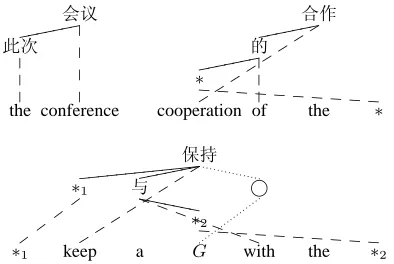
A treelet is defined to be any connected subgraph, which is similar to the definition in (Quirk et al., 2005). Treelet is more representatively flexible than subtree which is widely used in models based on phrase structures (Marcu et al., 2006; Liu et al., 2006). The most important distinction between the treelet in (Quirk et al., 2005) and ours is that we al-low variables at positions of subnodes. In our defini-tion, the root node must be lexicalized but the subn-odes can be replaced with a wild card. The target counterpart of a wildcard node inS is also replaced with a wild card. The wildcards introduced in this way generalize DTSC to match dependency struc-tures with the same head word but with different modifiers or arguments.
Another unique feature of our DTSC is that we al-low target strings with gaps between words or wild-cards. Since source treelets may not cover all subn-odes, the uncovered subnodes will generate a gap as its counterpart on the target side. A sequence of con-tinuous gaps will be merged to be one gap and gaps at the beginning and the end ofS will be removed automatically.
会议 eeeeeee
Â
Â
Â
 eeeeeee合作
s ss s s ss s 此次
Â
Â
 的
eeeeeee
Â
Â
Â
∗
] ] ] ] ] ] ] ] ] ]
the conference cooperation of the ∗
保持 eeeeeee bbbbbbbbbbbbb
s ss s s ss s ∗1
w w ww
与 Y Y Y Y Y Y Y
S S S S S S
S °
∗2
] ] ] ] ] ] ] ] ] ]
[image:2.612.329.526.56.188.2]∗1 keep a G with the ∗2
Figure 1: DTSC examples. Note that ∗represents variable andGrepresents gap.
Gap can be considered as a special kind of vari-able whose counterpart on the source side is not present. This makes the model more flexible to match more partial dependency structures on the source side. If only variables can be used, the model has to match subtrees rather than treelets on the source side. Furthermore, the positions of variables on the target side are fixed so that some reorderings related with them can be recorded in DTSC. The po-sitions of gaps on the target side, however, are not fixed until decoding. The presence of one gap and its position can not be finalized until attaching op-eration is performed. The introduction of gaps and the related attaching operation in decoding is the most important distinction between our model and the previous syntax-based models.
Figure 1 shows several different DTSCs automat-ically extracted from our training corpus. The top left DTSC is totally lexicalized, while the top right DTSC has one variable and the bottom has two vari-ables and one gap. In the bottom DTSC, note that the node ° which is aligned to the gap G of the target string is an uncovered node and therefore not included in the treelet actually. Here we just want to show there is an uncovered node aligned with the gapG.
Each node at the source treelet has three attributes
1. The head word
2. The category, i.e. the part of speech of the head word
提供/VV eeeeeee
bbbbbbbbbbbbbb]]]]]]]]]]]]]]]]]]]]]
Â
Â
Â
Â
Â
继续/VV
Â
Â
Â
D D D D
D 向/P
Y Y Y Y Y Y Y
X X X X X X X X X X X X X
X 援助/NN
eeeeeee
zz zz
z
巴勒斯坦/NR
\ \ \ \ \ \ \ \ \ \ \ \ \
\ 财政/NN
j j j jÂ
Â
go on providingfinancial aid to Palestine
[image:3.612.73.306.62.144.2]1 2 3 4 5 6 7
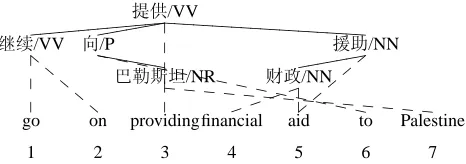
Figure 2: An example dependency tree and its align-ments
Note that the node order is defined at the context of the extracted treelets but not the context of the orig-inal tree. For example, the attributes for the node与 in the bottom DTSC of Figure 1 are{与, P, -1}. For two treelets, if and only if their structures are iden-tical and each corresponding nodes share the same attributes, we say they are matched.
3 Extracting DTSCs
To extract DTSCs from the training corpus, firstly the corpus must be parsed on the source side and aligned at the word level. The source structures pro-duced by the parser are unlabelled, ordered depen-dency trees with each word annotated with a part-of-speech. Figure 2 shows an example of dependency tree really used in our extractor.
When the source language dependency trees and word alignments between source and target lan-guages are obtained, the DTSC extraction algorithm runs in two phases along the dependency trees and alignments. In the first step, the extractor annotates each node with specific attributes defined in section 3.1. These attributes are used in the second step which extracts all possible DTSCs rooted at each node recursively.
3.1 Node annotation
For each source dependency noden, we define three attributes: word span, node span and crossed. Word span is defined to be the target word sequence aligned with the head word ofn, while node span is defined to be the closure of the union of node spans of all subnodes ofnand its word span. These two at-tributes are similar to those introduced by Lin (Lin, 2004). The third attribute crossed is an indicator that has binary values. If the node span of n overlaps the word span of its parent node or the node span
of its siblings, the crossed indicator ofn is 1 and nis therefore a crossed node, otherwise the crossed indicator is 0 and n is a non-crossed node. Only non-crossed nodes can generate DTSCs because the target word sequence aligned with the whole subtree rooted at it does not overlap any other sequences and therefore can be extracted independently.
For the dependency tree and its alignments shown in Figure 2, only the node 财政is a crossed node since its node span ([4,5]) overlaps the word span ([5,5]) of its parent node援助.
3.2 DTSCs extraction
The DTSC extraction algorithm (shown in Figure 3) runs recursively. For each non-crossed node, the al-gorithm generates all possible DTSCs rooted at it by combining DTSCs from some subsets of its direct subnodes. If one subnode n selected in the com-bination is a crossed node, all other nodes whose word/node spans overlap the node span ofnmust be also selected in this combination. This kind of com-bination is defined to be consistent with the word alignment because the DTSC generated by this com-bination is consistent with the word alignment. All DTSCs generated in this way will be returned to the last call and outputted. For each crossed node, the algorithm generates pseudo DTSCs1 using DTSCs from all of its subnodes. These pseudo DTSCs will be returned to the last call but not outputted.
During the combination of DTSCs from subnodes into larger DTSCs, there are two major tasks. One task is to generate the treelet using treelets from subnodes and the current node. This is a basic tree generation operation. It is worth mentioning that some non-crossed nodes are to be replaced with a wild card so the algorithm can learn generalized DTSCs described in section 2. Currently, we re-place any non-crossed node alone or together with their sibling non-crossed nodes. The second task is to combine target strings. The word sequences aligned with uncovered nodes will be replaced with a gap. The word sequences aligned with wildcard nodes will be replaced with a wild card.
If a non-crossed node n has m direct subnodes, all 2m combinations will be considered. This will
generate a very large number of DTSCs, which is
1
DT SCExtractor(Dnode n)
<:=∅(DTSC container of n)
for each subnodekofndo
R:=DT SCExtractor(k) L:=LSR
end for
ifn.crossed! = 1 and there are no subnodes whose span overlaps the word span ofnthen
Create a DTSCπ=< D, S, A >where the dependency treeletDonly contains the noden(not including any chil-dren of it)
outputπ
for each combinationcofn’s subnodes do
ifcis consistent with the word alignment then Generate all DTSCs R by combining DTSCs (L) from the selected subnodes with the current noden <:=<SR
end if end for
output< return<
else ifn.crossed== 1then
Create pseudo DTSCsP by combining all DTSCs from
n’s all subnodes. <:=<SP
[image:4.612.335.518.56.211.2]return< end if
Figure 3: DTSC Extraction Algorithm.
undesirable for training and decoding. Therefore we filter DTSCs according to the following restrictions
1. If the number of direct subnodes of nodenis larger than 6, we only consider combining one single subnode withneach time because in this case reorderings of subnodes are always mono-tone.
2. On the source side, the number of direct subn-odes of each node is limited to be no greater than ary-limit; the height of treeletDis limited to be no greater than depth-limit.
3. On the target side, the length of S (including gaps and variables) is limited to be no greater than len-limit; the number of gaps inS is lim-ited to be no greater than gap-limit.
4. During DTSC combination, the DTSCs from each subnode are sorted by size (in descending order). Only the top comb-limit DTSCs will be selected to generate larger DTSCs.
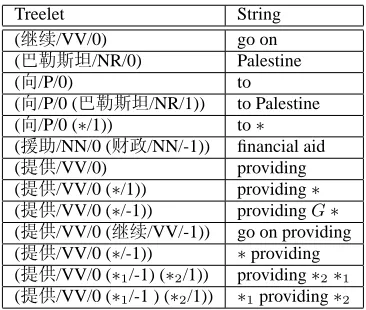
As an example, for the dependency tree and its alignments in Figure 2, all DTSCs extracted by the
Treelet String
(继续/VV/0) go on
(巴勒斯坦/NR/0) Palestine
(向/P/0) to
(向/P/0 (巴勒斯坦/NR/1)) to Palestine (向/P/0 (∗/1)) to∗ (援助/NN/0 (财政/NN/-1)) financial aid
(提供/VV/0) providing
(提供/VV/0 (∗/1)) providing∗ (提供/VV/0 (∗/-1)) providingG∗ (提供/VV/0 (继续/VV/-1)) go on providing (提供/VV/0 (∗/-1)) ∗providing (提供/VV/0 (∗1/-1) (∗2/1)) providing∗2∗1
(提供/VV/0 (∗1/-1 ) (∗2/1)) ∗1providing∗2
Table 1: Examples of DTSCs extracted from Figure 2. Alignments are not shown here because they are self-evident.
algorithm with parameters { ary-limit = 2, depth-limit = 2, len-depth-limit = 3, gap-depth-limit = 1, comb-depth-limit
= 20}are shown in the table 1.
4 The Model
Given an input dependency tree, the decoder gen-erates translations for each dependency node in bottom-up order. For each node, our algorithm will search all matched DTSCs automatically learned from the training corpus by the way mentioned in section 3. When the root node is traversed, the trans-lating is finished. This complicated procedure in-volves a large number of sequences of applications of DTSC rules. Each sequence of applications of DTSC rules can derive a translation.
We define a derivationδ as a sequence of appli-cations of DTSC rules, and letc(δ)ande(δ)be the source dependency tree and the target yield ofδ, re-spectively. The score ofδis defined to be the prod-uct of the score of the DTSC rules used in the trans-lation, and timed by other feature functions:
§(δ) =Y
i
§(i)·plm(e)lmλ ·exp(−λapA(δ)) (1)
where §(i) is the score of the ith application of DTSC rules, plm(e) is the language model score,
and exp(−λapA(δ)) is the attachment penalty,
[image:4.612.77.304.57.337.2]with more nodes covered and therefore less attach-ing operations involved.
For the score of DTSC ruleπ, we define it as fol-lows:
§(π) =Y
j
fj(π)λj (2)
where thefj are feature functions defined on DTSC
rules. Currently, we used features proved to be ef-fective in phrase-based SMT, which are:
1. The translation probabilityp(D|S).
2. The inverse translation probabilityp(S|D).
3. The lexical translation probability plex(D|S)
which is computed over the words that occur on the source and target sides of a DTSC rule by the IBM model 1.
4. The inverse lexical translation probability plex(S|D) which is computed over the words
that occur on the source and target sides of a DTSC rule by the IBM model 1.
5. The word penaltywp.
6. The DTSC penaltydpwhich allows the model to favor longer or shorter derivations.
It is worth mentioning how to integrate the N-gram language mode into our DTSC model. During decoding, we have to encounter many partial transla-tions with gaps and variables. For these translatransla-tions, firstly we only calculate the language model scores for word sequences in the translations. Later we up-date the scores when gaps are removed or specified by attachments or variables are substituted. Each up-dating involves merging two neighbor substringssl
(left) andsr(right) into one bigger strings. Let the
sequence of n−1 (n is the order of N-gram lan-guage model used) rightmost words ofslbesrl and
the sequence ofn−1leftmost words ofsrbeslr. we
have:
LM(s) =LM(sl) +LM(sr) +LM(srlslr)
−LM(srl)−LM(slr) (3)
whereLM is the logarithm of the language model probability. We only need to compute the increment of the language model score:
4LM =LM(srlslr)−LM(srl)−LM(slr) (4)
for each nodenof the input treeT, in bottom-up order do Get all matched DTSCs rooted atn
for each matched DTSCπdo for each wildcard noden∗inπdo
Substitute the corresponding wildcard on the target
side with translations from the stack ofn∗
end for
for each uncovered noden@
byπdo
Attach the translations from the stack ofn@
to the target side at the attaching point
end for end for end for
Figure 4: Chart-style Decoding Algorithm for the DTSC Model.
Melamed (2004) also used a similar way to integrate the language model.
5 Decoding
Our decoding algorithm is similar to the bottom-up chart parsing. The distinction is that the input is a tree rather than a string and therefore the chart is in-dexed by nodes of the tree rather than spans of the string. Also, several other tree-based decoding al-gorithms introduced by Eisner (2003), Quirk et al. (2005) and Liu et al. (2006) can be classified as the chart-style parsing algorithm too.
Our decoding algorithm is shown in Figure 4. Given an input dependency tree, firstly we generate the bottom-up order by postorder transversal. This order guarantees that any subnodes of nodenhave been translated before node n is done. For each nodenin the bottom-up order, all matched DTSCs rooted atnare found, and a stack is also built for it to store the candidate translations. A DTSCπis said to match the input dependency subtreeT rooted atnif and only if there is a treelet rooted atnthat matches 2the treelet ofπon the source side.
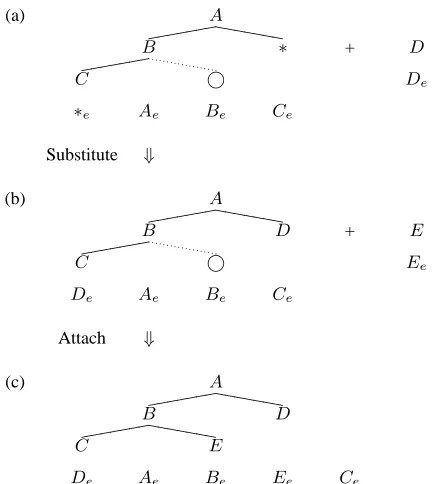
For each matched DTSCπ, two operations will be performed on it. The first one is substituting which replaces a wildcard node with the correspond-ing translated node. The second one is attachcorrespond-ing which attaches an uncovered node toπ. The two op-erations are shown in Figure 5. For each wildcard noden∗, translations from the stack of it will be se-lected to replace the corresponding wildcard on the
2
(a) A
eeeeeeeYYYYYYY
B
eeeeeee ∗ + D
C ° De
∗e Ae Be Ce
Substitute ⇓
(b) A
eeeeeeeYYYYYYY
B
eeeeeee D + E
C ° Ee
De Ae Be Ce
Attach ⇓
(c) A
eeeeeeeYYYYYYY
B
eeeeeeeYYYYYYY D
C E
[image:6.612.77.295.55.297.2]De Ae Be Ee Ce
Figure 5: Substituting and attaching operations for decoding.Xeis the translation ofX. Node that∗is
a wildcard node to be substituted and node°is an uncovered node to be attached.
target side and the scores of new translations will be calculated according to our model. For each uncov-ered node n@, firstly we determine where transla-tions from the stack ofn@should be attached on the target side. There are several different mechanisms for choosing attaching points. Currently, we imple-ment a heuristic way: on the source side, we find the noden@p which is the nearest neighbor of n@ from its parent and sibling nodes, then the attaching point is the left/right of the counterpart ofn@p on the target side according to their relative order. As an example, see the uncovered node°in Figure 5. The nearest node to it is nodeB. Since node° is at the right of node B, the attaching point is the right of Be.
One can search all possible points using an ordering model. And this ordering model can also use infor-mation from gaps on the target side. We believe this ordering model can improve the performance and let it be one of directions for our future research.
Note that the gaps on the target side are not neces-sarily attaching points in our current attaching mech-anism. If they are not attaching point, they will be removed automatically.
The search space of the decoding algorithm is
very large, therefore some pruning techniques have to be used. To speed up the decoder, the following pruning strategies are adopted.
1. Stack pruning. We use three pruning ways. The first one is recombination which converts the search to dynamic programming. When two translations in the same stack have the samewleftmost/rightmost words, wherew de-pends on the order of the language model, they will be recombined by discarding the transla-tion with lower score. The second one is the threshold pruning which discards translations that have a score worse than stack-threshold times the best score in the same stack. The last one is the histogram pruning which only keeps the top stack-limit best translations for each stack.
2. Node pruning. For each node, we only keep the top node-limit matched DTSCs rooted at that node, as ranked by the size of source treelets.
3. Operation pruning. For each operation, sub-stituting and attaching, the decoding will gen-erate a large number of partial translations3 for the current node. We only keep the top
operation-limit partial translations each time
according to their scores.
6 Integrating Phrases
Although syntax-based models are good at dealing with hierarchical reordering, but at the local level, translating idioms and similar complicated expres-sions can be a problem. However, phrase-based models are good at dealing with these translations. Therefore, integrating phrases into the syntax-based models can improve the performance (Marcu et al., 2006; Liu et al., 2006). Since our DTSC model is based on dependency structures and lexicalized nat-urally, DTSCs are more similar to phrases than other translation units based on phrase structures. This means that phrases will be easier to be integrated into our model.
The way to integrate phrases is quite straightfor-ward: if there is a treelet rooted at the current node,
3
of which the word sequence is continuous and iden-tical to the source of some phrase, then a phrase-style DTSC will be generated which uses the target string of the phrase as its own target. The procedure is finished during decoding. In our experiments, in-tegrating phrases improves the performance greatly.
7 Current Implementation
To test our idea, we implemented the dependency treelet string correspondence model in a Chinese-English machine translation system. The current im-plementation in this system is actually a simplified version of the DTSC model introduced above. In this version, we used a simple heuristic way for the operation of attaching rather than a sophisticated sta-tistical model which can learn ordering information from the training corpus. Since dependency struc-tures are more“flattened”compared with phrasal structures, there are many subnodes which will not be covered even by generalized matched DTSCs. This means the attaching operation is very common during decoding. Therefore better attaching model which calculates the best point for attaching , we be-lieve, will improve the performance greatly and is a major goal for our future research.
To obtain the dependency structures of the source side, one can parse the source sentences with a de-pendency parser or parse them with a phrasal struc-ture parser and then convert the phrasal strucstruc-tures into dependency structures. In our experiments we used a Chinese parser implemented by Xiong et al. (2005) which generates phrasal structures. The parser was trained on articles 1-270 of Penn Chinese Treebank version 1.0 and achieved 79.4% (F1 mea-sure). We then converted the phrasal structure trees into dependency trees using the way introduced by Xia (1999).
To obtain the word alignments, we use the way of Koehn et al. (2005). After running GIZA++ (Och and Ney, 2000) in both directions, we apply the “grow-diag-final” refinement rule on the in-tersection alignments for each sentence pair.
The training corpus consists of 31, 149 sentence pairs with 823K Chinese words and 927K English words. For the language model, we used SRI Lan-guage Modeling Toolkit (Stolcke, 2002) to train a trigram model with modified Kneser-Ney
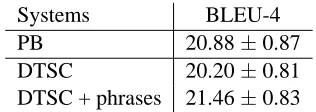
smooth-Systems BLEU-4
PB 20.88±0.87
DTSC 20.20±0.81
DTSC + phrases 21.46±0.83
Table 2: BLEU-4 scores for our system and a phrase-based system.
ing on the 31, 149 English sentences. We selected 580 short sentences of length at most 50 characters from the 2002 NIST MT Evaluation test set as our development corpus and used it to tuneλs by max-imizing the BLEU score (Och, 2003), and used the 2005 NIST MT Evaluation test set as our test corpus. From the training corpus, we learned 2, 729, 964 distinct DTSCs with the configuration { ary-limit = 4, depth-ary-limit = 4, len-ary-limit = 15, gap-ary-limit
= 2, comb-limit = 20 }. Among them, 160,694 DTSCs are used for the test set. To run our de-coder on the development and test set, we set
stack-thrshold = 0.0001, stack-limit = 100, node-limit =
100, operation-limit = 20.
We also ran a phrase-based system (PB) with a distortion reordering model (Xiong et al., 2006) on the same corpus. The results are shown in table 2. For all BLEU scores, we also show the 95% confi-dence intervals computed using Zhang’s significant tester (Zhang et al., 2004) which was modified to conform to NIST’s definition of the BLEU brevity penalty. The BLEU score of our current system with the DTSC model is lower than that of the phrase-based system. However, with phrases integrated, the performance is improved greatly, and the new BLEU score is higher than that of the phrase-based SMT. This difference is significant according to Zhang’s tester. This result can be improved further using a better parser (Quirk et al., 2006) or using a statisti-cal attaching model.
8 Related Work
[image:7.612.347.505.57.113.2]treelets allow variables at any non-crossed nodes and target strings allow gaps, which are not available in (Quirk et al., 2005). Our language model is calcu-lated during decoding while Quirk’s language model is computed after decoding because of the complex-ity of their decoding.
The DTSC model is also quite distinct from pre-vious tree-string models by Marcu et al. (2006) and Liu et al. (2006). Firstly, their models are based on phrase structure grammars. Secondly, sub-trees instead of treelets are extracted in their mod-els. Thirdly, it seems to be more difficult to integrate phrases into their models. And finally, our model al-low gaps on the target side, which is an advantage shared by (Melamed, 2004) and (Simard, 2005).
9 Conclusions and Future Work
We presented a novel syntax-based model using dependency trees on the source side–dependency treelet string correspondence model–for statistical machine translation. We described an algorithm to learn DTSCs automatically from the training corpus and a chart-style algorithm for decoding.
Currently, we implemented a simple version of the DTSC model. We believe that our performance can be improved greatly using a more sophisticated mechanism for determining attaching points. There-fore the most important future work should be to de-sign a better attaching model. Furthermore, we plan to use larger corpora for training and n-best depen-dency trees for decoding, which both are helpful for the improvement of translation quality.
Acknowledgements
This work was supported by National Natural Sci-ence Foundation of China, Contract No. 60603095 and 60573188.
References
David Chiang. 2005. A hierarchical phrase-based model for statistical machine translation. In Proceedings of ACL.
Yuan Ding and Martha Palmer. 2005. Machine Translation Us-ing Probabilistic Synchronous Dependency Insertion Gram-mars. In Proceedings of ACL.
Jason Eisner. 2003. Learning non-isomorphic tree mappings for machine translation. In Proceedings of ACL.
Philipp Koehn, Amittai Axelrod, Alexandra Birch Mayne, Chris Callison-Burch, Miles Osborne and David Talbot. 2005. Edinburgh System Description for the 2005 IWSLT Speech Translation Evaluation. In International Workshop on Spo-ken Language Translation.
Daniel Marcu, Wei Wang, Abdessamad Echihabi, and Kevin Knight. 2006. SPMT: Statistical Machine Translation with Syntactified Target Language Phraases. In Proceedings of EMNLP.
I. Dan Melamed. 2004. Algorithms for Syntax-Aware Statisti-cal Machine Translation. In Proceedings of the Conference on Theoretical and Methodological Issues in Machine Trans-lation (TMI), Baltimore, MD.
Dekang Lin. 2004. A path-based transfer model for machine translation. In Proceedings of COLING.
Yang Liu, Qun Liu, and Shouxun Lin. 2006. Tree-to-String Alignment Template for Statistical Machine Translation. In Proceedings of ACL.
Franz Josef Och. 2003. Minimum error rate training in statisti-cal machine translation. In Proceedings of ACL.
Franz Josef Och and Hermann Ney. 2000. Improved statistical alignment models. In Proceedings of ACL.
Chris Quirk, Arul Menezes and Colin Cherry. 2005. Depen-dency Treelet Translation: Syntactically Informed Phrasal SMT. In Proceedings of ACL.
Chris Quirk and Simon Corston-Oliver. 2006. The impact of parse quality on syntactically-informed statistical machine translation. In Proceedings of EMNLP, Sydney, Australia.
Michel Simard, Nicola Cancedda, Bruno Cavestro, Marc Dymetman, Eric Gaussier, Cyril Goutte, Kenji Yamada. 2005. Translating with non-contiguous phrases. In Proceed-ings of HLT-EMNLP.
Andreas Stolcke. 2002. SRILM - an extensible language mod-eling toolkit. In Proceedings of International Conference on Spoken Language Processing, volume 2, pages 901-904.
Fei Xia. 1999. Automatic Grammar Generation from Two Dif-ferent Perspectives. PhD thesis, University of Pennsylvania.
Deyi Xiong, Qun Liu, and Shouxun Lin. 2006. Maximum Entropy Based Phrase Reordering Model for Statistical Ma-chine Translation. In Proceedings of COLING-ACL, Sydney, Australia.
Deyi Xiong, Shuanglong Li, Qun Liu, Shouxun Lin, Yueliang Qian. 2005. Parsing the Penn Chinese Treebank with Se-mantic Knowledge. In Proceedings of IJCNLP, Jeju Island, Korea.