The Role of Lexical Resources in CJK Natural Language Processing
Jack Halpern
(春遍雀來
)
The CJK Dictionary Institute (CJKI) (
日中韓辭典研究所
)
34-14, 2-chome, Tohoku, Niiza-shi, Saitama 352-0001, Japan
[email protected]
Abstract
The role of lexical resources is often un-derstated in NLP research. The complex-ity of Chinese, Japanese and Korean (CJK) poses special challenges to devel-opers of NLP tools, especially in the area of word segmentation (WS), information retrieval (IR), named entity extraction (NER), and machine translation (MT). These difficulties are exacerbated by the lack of comprehensive lexical resources, especially for proper nouns, and the lack of a standardized orthography, especially in Japanese. This paper summarizes some of the major linguistic issues in the velopment NLP applications that are de-pendent on lexical resources, and dis-cusses the central role such resources should play in enhancing the accuracy of NLP tools.
1 Introduction
Developers of CJK NLP tools face various chal-lenges, some of the major ones being:
1.Identifying and processing the large number of orthographic variants in Japanese, and alternate character forms in CJK languages.
2.The lack of easily available comprehensive lexical resources, especially lexical databases, comparable to the major European languages. 3.The accurate conversion between Simplified
and Traditional Chinese (Halpern and Kerman 1999).
4.The morphological complexity of Japanese and Korean.
5.Accurate word segmentation (Emerson 2000 and Yu et al. 2000) and disambiguating am-biguous segmentations strings (ASS) (Zhou and Yu 1994).
6.The difficulty of lexeme-based retrieval and CJK CLIR (Goto et al. 2001).
7.Chinese and Japanese proper nouns, which are very numerous, are difficult to detect without a lexicon.
8.Automatic recognition of terms and their vari-ants (Jacquemin 2001).
The various attempts to tackle these tasks by statistical and algorithmic methods (Kwok 1997) have had only limited success. An important mo-tivation for such methodology has been the poor availability and high cost of acquiring and main-taining large-scale lexical databases.
This paper discusses how a lexicon-driven ap-proach exploiting large-scale lexical databases can offer reliable solutions to some of the princi-pal issues, based on over a decade of experience in building such databases for NLP applications.
2 Named Entity Extraction
Named Entity Recognition (NER) is useful in NLP applications such as question answering, machine translation and information extraction. A major difficulty in NER, and a strong motiva-tion for using tools based on probabilistic meth-ods, is that the compilation and maintenance of large entity databases is time consuming and ex-pensive. The number of personal names and their variants (e.g. over a hundred ways to spell Mo-hammed) is probably in the billions. The number of place names is also large, though they are rela-tively stable compared with the names of organi-zations and products, which change frequently.
A small number of organizations, including The CJK Dictionary Institute (CJKI), maintain databases of millions of proper nouns, but even such comprehensive databases cannot be kept fully up-to-date as countless new names are cre-ated daily. Various techniques have been used to automatically detect entities, one being the use of keywords or syntactic structures that co-occur with proper nouns, which we refer to as named entity contextual clues (NECC).
Table 1. Named Entity Contextual Clues Headword Reading Example
センター せんたー 国民生活センター
ホテル ほてる ホテルシオノ 駅 えき 朝霞駅
協会 きょうかい 日本ユニセフ協会
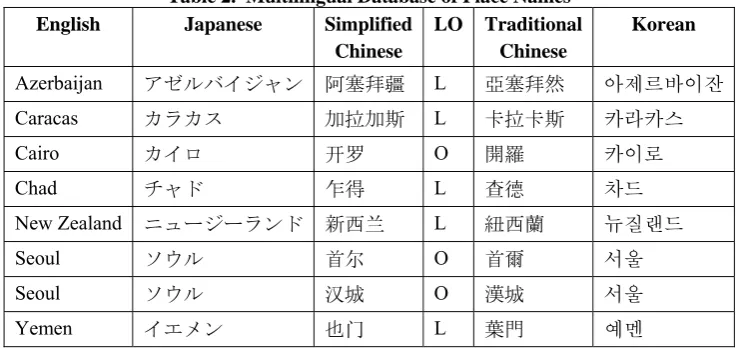
Table 1 shows NECCs for Japanese proper nouns, which when used in conjunction with en-tity lexicons like the one shown in Table 2 below achieve high precision in entity recognition. Of course for NER there is no need for such lexi-cons to be multilingual, though it is obviously essential for MT.
Table 2. Multilingual Database of Place Names English Japanese Simplified
Chinese
LO Traditional Chinese
Korean
Azerbaijan アゼルバイジャン 阿塞拜疆 L 亞塞拜然 아제르바이잔
Caracas カラカス 加拉加斯 L 卡拉卡斯 카라카스
Cairo カイロ 开罗 O 開羅 카이로
Chad チャド 乍得 L 查德 차드
New Zealand ニュージーランド 新西兰 L 紐西蘭 뉴질랜드
Seoul ソウル 首尔 O 首爾 서울
Seoul ソウル 汉城 O 漢城 서울
Yemen イエメン 也门 L 葉門 예멘
Note how the lexemic pairs (“L” in the LO column) in Table 2 above are not merely simpli-fied and traditional orthographic (“O”) versions of each other, but independent lexemes equiva-lent to American truck and British lorry.
NER, especially of personal names and place names, is an area in which lexicon-driven meth-ods have a clear advantage over probabilistic methods and in which the role of lexical re-sources should be a central one.
3 Linguistic Issues in Chinese
3.1 Processing Multiword Units
A major issue for Chinese segmentors is how to treat compound words and multiword lexical units (MWU), which are often decomposed into their components rather than treated as single units. For example, 录像带 lùxiàngdài 'video cassette' and 机器翻译 jīqifānyì 'machine trans-lation' are not tagged as segments in Chinese Gigaword, the largest tagged Chinese corpus in existence, processed by the CKIP morphological analyzer (Ma 2003). Possible reasons for this include:
1. The lexicons used by Chinese segmentors are small-scale or incomplete. Our testing of
vari-ous Chinese segmentors has shown that cover-age of MWUs is often limited.
2. Chinese linguists disagree on the concept of wordhood in Chinese. Various theories such as the Lexical Integrity Hypothesis (Huang 1984) have been proposed. Packard’s outstanding book (Packard 98) on the subject clears up much of the confusion.
3. The "correct” segmentation can depend on the application, and there are various segmenta-tion standards. For example, a search engine user looking for 录像带 is not normally inter-ested in 录像 'to videotape' and 带 'belt' per se, unless they are part of 录像带.
This last point is important enough to merit elaboration. A user searching for 中 国 人 zhōngguórén 'Chinese (person)' is not interested in 中国 'China', and vice-versa. A search for 中 国 should not retrieve 中国人 as an instance of
中国. Exactly the same logic should apply to 机 器翻译, so that a search for that keyword should only retrieve documents containing that string in its entirety. Yet performing a Google search on
occurrences of unrelated words like 机器人 'ro-bot', which the user is not interested in.
This is equivalent to saying that headwaiter should not be considered an instance of waiter, which is indeed how Google behaves. More to the point, English space-delimited lexemes like high school are not instances of the adjective high. As shown in Halpern (2000b), "the degree of solidity often has nothing to do with the status of a string as a lexeme. School bus is just as le-gitimate a lexeme as is headwaiter or word-processor. The presence or absence of spaces or hyphens, that is, the orthography, does not de-termine the lexemic status of a string."
In a similar manner, it is perfectly legitimate to consider Chinese MWUs like those shown below as indivisible units for most applications, especially information retrieval and machine translation.
丝绸之路sīchóuzhīlù silk road
机器翻译 jīqifānyì machine translation
爱国主义 àiguózhǔyì patriotism
录像带 lùxiàngdài video cassette
新西兰 Xīnxīlán New Zealand
临阵磨枪 línzhènmóqiāng
start to prepare at the last moment
One could argue that 机器翻译 is composi-tional and therefore should be considered "two words." Whether we count it as one or two "words" is not really relevant – what matters is that it is one lexeme (smallest distinctive units associating meaning with form). On the other extreme, it is clear that idiomatic expressions like 临阵磨枪, literally "sharpen one's spear be-fore going to battle," meaning 'start to prepare at the last moment,’ are indivisible units.
Predicting compositionality is not trivial and often impossible. For many purposes, the only practical solution is to consider all lexemes as indivisible. Nonetheless, currently even the most advanced segmentors fail to identify such lex-emes and missegment them into their constitu-ents, no doubt because they are not registered in the lexicon. This is an area in which expanded lexical resources can significantly improve seg-mentation accuracy.
In conclusion, lexical items like 机 器 翻 译
'machine translation' represent stand-alone, well-defined concepts and should be treated as single units. The fact that in English machineless is spelled solid and machine translation is not is an historical accident of orthography unrelated to
the fundamental fact that both are full-fledged lexemes each of which represents an indivisible, independent concept. The same logic applies to
机器翻译,which is a full-fledged lexeme that should not be decomposed.
3.2 Multilevel Segmentation
Chinese MWUs can consist of nested compo-nents that can be segmented in different ways for different levels to satisfy the requirements of different segmentation standards. The example below shows how 北 京 日 本 人 学 校 Běijīng Rìběnrén Xuéxiào 'Beijing School for Japanese (nationals)' can be segmented on five different levels.
1. 北京日本人学校 multiword lexemic 2. 北京+日本人+学校 lexemic
3. 北京+日本+人+学校 sublexemic 4. 北京 + [日本 + 人] [学+校] morphemic 5. [北+京] [日+本+人] [学+校] submorphemic
For some applications, such as MT and NER, the multiword lexemic level is most appropriate (the level most commonly used in CJKI’s dic-tionaries). For others, such as embedded speech technology where dictionary size matters, the lexemic level is best. A more advanced and ex-pensive solution is to store presegmented MWUs in the lexicon, or even to store nesting delimiters as shown above, making it possible to select the desired segmentation level.
The problem of incorrect segmentation is es-pecially obvious in the case of neologisms. Of course no lexical database can expect to keep up with the latest neologisms, and even the first edition of Chinese Gigaword does not yet have 博客 bókè 'blog'. Here are some examples of MWU neologisms, some of which are not (at least bilingually), compositional but fully qual-ify as lexemes.
电脑迷diànnǎomícyberphile
电子商务 diànzǐshāngwùe-commerce 追车族 zhuīchēzú auto fan
process of accurately converting SC to/from TC is full of complexities and pitfalls. The linguistic issues are discussed in Halpern and Kerman (1999), while technical issues are described in Lunde (1999). The conversion can be imple-mented on three levels in increasing order of sophistication:
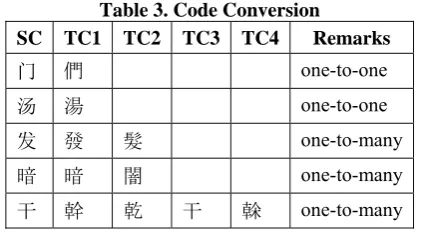
1. Code Conversion. The easiest, but most un-reliable, way to perform C2C is to transcode by using a one-to-one mapping table. Because of the numerous one-to-many ambiguities, as shown below, the rate of conversion failure is unacceptably high.
Table 3. Code Conversion
SC TC1 TC2 TC3 TC4 Remarks
门 們 one-to-one
汤 湯 one-to-one
发 發 髮 one-to-many
暗 暗 闇 one-to-many
干 幹 乾 干 榦 one-to-many
2. Orthographic Conversion. The next level of sophistication is to convert orthographic units, rather than codepoints. That is, meaningful lin-guistic units, equivalent to lexemes, with the important difference that the TC is the tradi-tional version of the SC on a character form level. While code conversion is ambiguous, or-thographic conversion gives much better results because the orthographic mapping tables enable conversion on the lexeme level, as shown below.
Table 4. Orthographic Conversion
English SC TC1 TC2 Incorrect Telephone 电话 電話
Dry 干燥 乾燥 干燥 幹燥 榦燥
阴干 陰乾 陰干
As can be seen, the ambiguities inherent in code conversion are resolved by using ortho-graphic mapping tables, which avoids false con-versions such as shown in the Incorrect column. Because of segmentation ambiguities, such con-version must be done with a segmentor that can break the text stream into meaningful units (Em-erson 2000).
An extra complication, among various others, is that some lexemes have one-to-many ortho-graphic mappings, all of which are correct. For
example, SC 阴干 correctly maps to both TC 陰 乾 'dry in the shade' and TC 陰干 'the five even numbers'. Well designed orthographic mapping tables must take such anomalies into account. 3. Lexemic Conversion. The most sophisti-cated form of C2C conversion is called lexemic conversion, which maps SC and TC lexemes that are semantically, not orthographically, equivalent. For example, SC 信息 xìnxī 'infor-mation' is converted into the semantically equivalent TC 資訊zīxùn. This is similar to the difference between British pavement and American sidewalk. Tsou (2000) has demon-strated that there are numerous lexemic differ-ences between SC and TC, especially in techni-cal terms and proper nouns, e.g. there are more than 10 variants for Osama bin Laden.
Table 5. Lexemic Conversion
English SC Taiwan TC HK TC Incorrect TC
Software 软件 軟體 軟件 軟件
Taxi 出租汽车 計程車 的士 出租汽車
Osama Bin Laden
奥萨马 本拉登
奧薩瑪賓 拉登
奧薩瑪 賓拉丹
奧薩馬本 拉登
Oahu 瓦胡岛 歐胡島 瓦胡島
3.4 Traditional Chinese Variants
Traditional Chinese has numerous variant char-acter forms, leading to much confusion. Disam-biguating these variants can be done by using mapping tables such as the one shown below. If such a table is carefully constructed by limiting it to cases of 100% semantic interchangeability for polysemes, it is easy to normalize a TC text by trivially replacing variants by their standard-ized forms. For this to work, all relevant compo-nents, such as MT dictionaries, search engine indexes and the related documents should be normalized. An extra complication is that Tai-wanese and Hong Kong variants are sometimes different (Tsou 2000).
Table 6. TC Variants
Var. 1Var. 2 English Comment
裏 裡 Inside 100% interchangeable
著 着 Particle variant 2 not in Big5
4 Orthographic Variation in Japanese
4.1 Highly Irregular Orthography
The Japanese orthography is highly irregular, significantly more so than any other major lan-guage, including Chinese. A major factor is the complex interaction of the four scripts used to write Japanese, e.g. kanji, hiragana, katakana, and the Latin alphabet, resulting in countless words that can be written in a variety of often unpredictable ways, and the lack of a standard-ized orthography. For example, toriatsukai 'han-dling' can be written in six ways: 取り扱い, 取 扱い, 取扱, とり扱い, 取りあつかい, とり あつかい.
An example of how difficult Japanese IR can be is the proverbial 'A hen that lays golden eggs.' The "standard" orthography would be 金の卵を 産む鶏 Kin no tamago o umu niwatori. In real-ity, tamago 'egg' has four variants (卵, 玉子, た まご, タマゴ), niwatori 'chicken' three (鶏, に わとり, ニワトリ) and umu 'to lay' two (産む, 生む), which expands to 24 permutations like 金 の卵を生むニワトリ, 金の玉子を産む鶏 etc. As can be easily verified by searching the web, these variants occur frequently.
Linguistic tools that perform segmentation, MT, entity extraction and the like must identify and/or normalize such variants to perform dic-tionary lookup. Below is a brief discussion of what kind of variation occurs and how such normalization can be achieved.
4.2 Okurigana Variants
One of the most common types of orthographic variation in Japanese occurs in kana endings, called okurigana, that are attached to a kanji stem. For example, okonau 'perform' can be written 行うor 行なう, whereas toriatsukai can be written in the six ways shown above. Okuri-gana variants are numerous and unpredictable. Identifying them must play a major role in Japa-nese orthographic normalization. Although it is possible to create a dictionary of okurigana vari-ants algorithmically, the resulting lexicon would be huge and may create numerous false positives not semantically interchangeable. The most ef-fective solution is to use a lexicon of okurigana variants, such as the one shown below:
Table 7. Okurigana Variants
HEADWORD READING NORMALIZED
書き著す かきあらわす 書き著す
書き著わす かきあらわす 書き著す
書著す かきあらわす 書き著す 書著わす かきあらわす 書き著す
Since Japanese is highly agglutinative and verbs can have numerous inflected forms, a lexi-con such as the above must be used in lexi- conjunc-tion with a morphological analyzer that can do accurate stemming, i.e. be capable of recogniz-ing that 書き著しませんでした is the polite form of the canonical form 書き著す.
4.3 Cross-Script Orthographic Variation Variation across the four scripts in Japanese is common and unpredictable, so that the same word can be written in any of several scripts, or even as a hybrid of multiple scripts, as shown below:
Table 8. Cross-Script Variation
Kanji Hiragana katakana Latin Hybrid Gloss
人参 にんじん ニンジン carrot
オープン OPEN open
硫黄 イオウ sulfur
ワイシャツ Yシャツ shirt
皮膚 ヒフ 皮フ skin
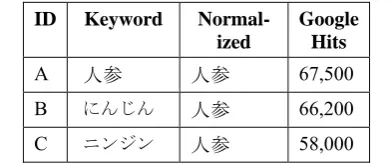
Cross-script variation can have major conse-quences for recall, as can be seen from the table below.
Table 9: Hit Distribution for 人参 'carrot' ninjin ID Keyword
Normal-ized
Google Hits
A 人参 人参 67,500
B にんじん 人参 66,200
C ニンジン 人参 58,000
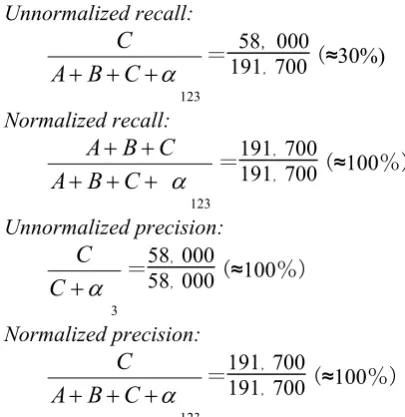
Using the ID above to represent the number of Google hits, this gives a total of A+B+C+α123
Unnormalized recall:
Unnormalized precision:
3
人参 'carrot' illustrates how serious a problem cross-orthographic variants can be. If ortho-graphic normalization is not implemented to en-sure that all variants are indexed on a standard-ized form like 人参, recall is only 30%; if it is, there is a dramatic improvement and recall goes up to nearly 100%, without any loss in precision, which hovers at 100%.
4.4 Kana Variants
A sharp increase in the use of katakana in re-cent years is a major annoyance to NLP applica-tions because katakana orthography is often ir-regular; it is quite common for the same word to be written in multiple, unpredictable ways. Al-though hiragana orthography is generally regular, a small number of irregularities persist. Some of the major types of kana variation are shown in the table below.
Table 10. Kana Variants
Type English Standard Variants
Macron computer コンピュータ コンピューター Long vowels maid メード メイド
Multiple kana team チーム ティーム
Traditional big おおきい おうきい
づ vs. ず continue つづく つずく
The above is only a brief introduction to the most important types of kana variation. Though attempts at algorithmic solutions have been made by some NLP research laboratories (Brill 2001), the most practical solution is to use a ka-takana normalization table, such as the one shown below, as is being done by Yahoo! Japan and other major portals.
Table 11. Kana Variants
HEADWORD NORMALIZED English
アーキテクチャ アーキテクチャー Architecture
アーキテクチャー アーキテクチャー Architecture
アーキテクチュア アーキテクチャー Architecture
4.5 Miscellaneous Variants
There are various other types of orthographic variants in Japanese, described in Halpern (2000a). To mention some, kanji even in con-temporary Japanese sometimes have variants, such as 才 for 歳 and 巾 for 幅, and traditional forms such as 發 for 発. In addition, many kun homophones and their variable orthography are often close or even identical in meaning, i.e., noboru means 'go up' when written 上る but 'climb' when written 登 る, so that great care must be taken in the normalization process so as to assure semantic interchangeability for all senses of polysemes; that is, to ensure that such forms are excluded from the normalization table.
4.6 Lexicon-driven Normalization
Leaving statistical methods aside, lexicon- driven normalization of Japanese orthographic variants can be achieved by using an ortho-graphic mapping table such as the one shown below, using various techniques such as:
1. Convert variants to a standardized form for indexing.
2. Normalize queries for dictionary lookup. 3. Normalize all source documents.
4. Identify forms as members of a variant group.
Table 12. Orthographic Normalization Table
Other possibilities for normalization include advanced applications such as domain-specific synonym expansion, requiring Japanese thesauri based on domain ontologies, as is done by a se-lect number of companies like Wand and Con-vera who build sophisticated Japanese IR sys-tems.
5 Orthographic Variation in Korean
Modern Korean has is a significant amount of orthographic variation, though far less than in Japanese. Combined with the morphological complexity of the language, this poses various challenges to developers of NLP tools. The is-sues are similar to Japanese in principle but dif-fer in detail.
Briefly, Korean has variant hangul spellings in the writing of loanwords, such as 케이크 keikeu and 케잌keik for 'cake', and in the writ-ing of non-Korean personal names, such as 클린턴 keulrinteon and 클린톤 keulrinton for 'Clinton'. In addition, similar to Japanese but on a smaller scale, Korean is written in a mixture of hangul, Chinese characters and the Latin alpha-bet. For example, 'shirt' can be written 와이셔츠 wai-syeacheu or Y셔츠 wai-syeacheu, whereas 'one o'clock' hanzi can written as 한시, 1시 or 一時. Another issue is the differences between South and North Korea spellings, such as N.K. 오사까 osakka vs. S.K. 오사카 osaka for 'Osaka', and the old (pre-1988) orthography ver-sus the new, i.e. modern 일군 'worker' (ilgun) used to be written 일꾼 (ilkkun).
Lexical databases, such as normalization ta-bles similar to the ones shown above for Japa-nese, are the only practical solution to identify-ing such variants, as they are in principle unpre-dictable.
6 The Role of Lexical Databases
Because of the irregular orthography of CJK languages, procedures such as orthographic normalization cannot be based on statistical and probabilistic methods (e.g. bigramming) alone, not to speak of pure algorithmic methods. Many attempts have been made along these lines, as for example Brill (2001) and Goto et al. (2001), with some claiming performance equivalent to lexicon-driven methods, while Kwok (1997) reports good results with only a small lexicon and simple segmentor.
Emerson (2000) and others have reported that a robust morphological analyzer capable of processing lexemes, rather than bigrams or n-grams, must be supported by a large-scale com-putational lexicon. This experience is shared by many of the world's major portals and MT de-velopers, who make extensive use of lexical da-tabases.
Unlike in the past, disk storage is no longer a major issue. Many researchers and developers, such as Prof. Franz Guenthner of the University of Munich, have come to realize that “language is in the data,” and “the data is in the diction-ary,” even to the point of compiling full-form dictionaries with millions of entries rather than rely on statistical methods, such as Meaningful Machines who use a full form dictionary con-taining millions of entries in developing a hu-man quality Spanish-to-English MT system.
CJKI, which specializes in CJK and Arabic computational lexicography, is engaged in an ongoing research and development effort to compile CJK and Arabic lexical databases (cur-rently about seven million entries), with special emphasis on proper nouns, orthographic nor-malization, and C2C. These resources are being subjected to heavy industrial use under real-world conditions, and the feedback thereof is being used to further expand these databases and to enhance the effectiveness of the NLP tools based on them.
7 Conclusions
References
Brill, E. and Kacmarick, G. and Brocket, C. (2001)
Automatically Harvesting Katakana-English Term Pairs from Search Engine Query Logs. Microsoft Research, Proc. of the Sixth Natural Language Processing Pacific Rim Symposium, Tokyo, Japan. Packard, L. Jerome (1998) “New Approaches to Chinese Word Formation”, Mouton Degruyter, Berlin and New York.
Emerson, T. (2000) Segmenting Chinese in Unicode. Proc. of the 16th International Unicode Confer-ence, Amsterdam
Goto, I., Uratani, N. and Ehara T. (2001) Cross-Language Information Retrieval of Proper Nouns using Context Information. NHK Science and Technical Research Laboratories. Proc. of the Sixth Natural Language Processing Pacific Rim Symposium, Tokyo, Japan
Huang, James C. (1984) Phrase Structure, Lexical Integrity, and Chinese Compounds, Journal of the Chinese Teachers Language Association, 19.2: 53-78
Jacquemin, C. (2001) Spotting and Discovering Terms through Natural Language Processing. The MIT Press, Cambridge, MA
Halpern, J. and Kerman J. (1999) The Pitfalls and Complexities of Chinese to Chinese Conversion. Proc. of the Fourteenth International Unicode Con-ference in Cambridge, MA.
Halpern, J. (2000a) The Challenges of Intelligent
Japanese Searching. Working paper
(www.cjk.org/cjk/joa/joapaper.htm), The CJK Dictionary Institute, Saitama, Japan.
Halpern, J. (2000b) Is English Segmentation Trivial?. Working paper,
(www.cjk.org/cjk/reference/engmorph.htm) The CJK Dictionary Institute, Saitama, Japan.
Kwok, K.L. (1997) Lexicon Effects on Chinese In-formation Retrieval. Proc. of 2nd Conf. on Em-pirical Methods in NLP. ACL. pp.141-8.
Lunde, Ken (1999) CJKV Information Processing. O’Reilly & Associates, Sebastopol, CA.
Yu, Shiwen, Zhu, Xue-feng and Wang, Hui (2000)
New Progress of the Grammatical Knowledge-base of Contemporary Chinese. Journal of Chinese Information Processing, Institute of Computational Linguistics, Peking University, Vol.15 No.1. Ma, Wei-yun and Chen, Keh-Jiann (2003)
Introduc-tion to CKIP Chinese Word SegmentaIntroduc-tion System for the First International Chinese Word Segmen-tation Bakeoff, Proceedings of the Second
SIGHAN Workshop on Chinese Language Proc-essingpp. 168-171 Sapporo, Japan
Yu, Shiwen, Zhu, Xue-feng and Wang, Hui (2000)
New Progress of the Grammatical Knowledge-base of Contemporary Chinese. Journal of Chinese Information Processing, Institute of Computational Linguistics, Peking University, Vol.15 No.1. Tsou, B.K., Tsoi, W.F., Lai, T.B.Y. Hu, J., and Chan
S.W.K. (2000) LIVAC, a Chinese synchronous corpus, and some applications. In "2000 Interna-tional Conference on Chinese Language Comput-ingICCLC2000", Chicago.