Volume 8, No. 3, March – April 2017
International Journal of Advanced Research in Computer Science REVIEW ARTICLE
Available Online at www.ijarcs.info
ISSN No. 0976-5697
A review on Machine Learning Techniques
Preeti, Dr. Kamna Solanki and Amita Dhankar UIET, CSE Department, MDU
Rohtak (HR),India
Abstract: Machine getting to know is the essence of synthetic intelligence. Machine Learning learns from beyond studies to improve the performances of wise applications. Machine studying; machine builds the mastering version that efficiently “learns” a way to estimate from education facts of given example. IT refers to a set of topics managing the advent and evaluation of algorithms that facilitate pattern popularity, type, and prediction, based on fashions derived from existing information. In this new technology, Machine learning is in general in use to illustrate the promise of producing always accurate estimates. The principal aim and contribution of this review paper is to provide the overview of gadget getting to know and presents system-getting to know techniques. Also paper critiques the deserves and demerits of numerous device getting to know algorithms in unique approaches.
Keywords: machine learning; supervised learning; unsupervised learning; semi-supervised learning; reinforcement learning
I. INTRODUCTION
Machine mastering is multi disciplinary area in artificial intelligence, possibility, statistics, facts theory, philosophy, psychology, and neurobiology. Machine getting to know solves the real international issues through constructing a model that is right and beneficial approximation to the statistics. The examine of Machine getting to know has grown from the efforts of exploring whether computer systems ought to learn how to mimic the human mind, and a area of facts to a broad area that has produced fundamental statistical computational theories of studying tactics. In 1946 the first pc gadget ENIAC was developed. The concept at that time becomes that human thinking and learning will be rendered logically in such a machine. In 1950 Alan Turing proposed a take a look at to degree its overall performance. The Turing test is primarily based on the idea that we can most effective decide if a machine can in reality examine if we communicate with it and cannot distinguish it from every other human. Around 1952 Arthur Samuel (IBM) wrote the first sport-playing software, for checkers, to achieve enough ability to undertaking a global champion. In 1957 Frank Rosenblatt invented the perceptron which connects an internet of points wherein easy decisions are made that come collectively within the large application to remedy more complex issues. In 1967, pattern reputation is evolved while first application capable of recognize patterns were designed based totally at the form of algorithm known as the nearest neighbour[1]. In 1981, GeroldDejong delivered explanation primarily based mastering in which previous information of the arena is provided by training examples which makes the usage of supervised studying. In the early ninety’s system studying have become very popular again because of the intersection of Computer Science and Statistics.
Advances persevered in gadget getting to know algorithm inside the standard regions of supervised and unsupervised mastering. In the prevailing technology, adaptive programming is in explored which makes use of system learning wherein programs are able to spotting styles, mastering from enjoy, abstracting new records from facts and optimizing the efficiency and accuracy of its processing and output. In the discovery of knowledge from the
multidimensional data available in a numerous amount of application areas, device gaining knowledge of techniques are used.
Because of recent computing technology, system getting to know these days isn't always like machine gaining knowledge of the past. Though many machine getting to know algorithms have been advanced from long time, latest improvement in machine gaining knowledge of is the ability to mechanically observe complicated mathematical calculations to huge records – again and again, quicker and quicker.
More interest is advanced in system mastering today is due to developing volumes and kinds of available data, computational processing this is inexpensive and extra powerful, and low-priced information storage. All of this stuff suggest it is feasible to speedy and robotically produce fashions that could examine larger, more complex information and supply faster, more correct effects even on a very massive scale. Machine mastering version produces high-value predictions that may guide better choices and smart actions in real time without human intervention.
Machine studying do no longer just respond to present day call for, however so as to expect demand in real time. As computation gets inexpensive, gadget studying makes the not possible matters feasible and those tend to begin doing them and come to be with making intelligent infrastructure. It is the want to increase newer algorithms to enhance the technology of device studying and massive amount of work that desires to be accomplished to replace current algorithms from new algorithms. To make the existing algorithms more robust and consumable it is not important to expand a super version set of rules, due to the fact an ideal version will now not be the final merchandise information frequently has most effective a temporal fee[2].
on kind of studying examples and extraordinary device gaining knowledge of tools. Section VI concludes the manuscript.
II. MACHINELEARNINGMODEL
Learning technique in device getting to know version is split into two steps as
• Training
• Testing
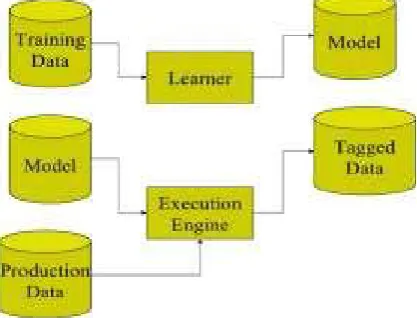
In schooling manner, samples in schooling facts are taken as input wherein functions are learned by studying algorithm or learner and build the getting to know version. In the checking out procedure, getting to know version makes use of the execution engine to make the prediction for the test or manufacturing statistics[3]. Tagged facts are the output of mastering model which offers the final prediction or categorised facts.
Figure 1. Operational model of machine learning
III MACHINE LEARNING TECNIQUES
Machine classification methods are divided into three important categories on the basis of the studying sign or remarks provide to gaining knowledge of scenario as follows:
A. Supervised learning
Supervised gaining knowledge of is skilled using classified examples, consisting of an enter where the desired output is thought. Supervised gaining knowledge of offers dataset inclusive of both capabilities and labels. For example, a piece of gadget may want to have training records points classified both as F (failed) and as R (runs). The mission of supervised mastering is to construct an estimator which is capable of predict the label of an item given the set of functions. The mastering set of rules receives a hard and fast of capabilities as inputs along side the corresponding accurate outputs, and the set of rules learns by way of evaluating its actual output with accurate outputs to find mistakes. It then modifies the version as a result.
Supervised learning is normally used in applications wherein ancient facts predicts in all likelihood future occasions. For instance, it can count on when credit card transactions are likely to be fraudulent or which coverage
client is probable to document a declare. Another application is predicting the species of iris given a set of measurements of its flower. Other greater complex examples consists of popularity gadget as given a multicolor picture of an item via a telescope, decide whether or not that item is a star, a quasar, or a galaxy, or given a list of films someone has watched and their non-public score of the movie, advise a listing of movies they would love.
Supervised learning duties are divided into two categories as classification and regression. In classification, the label is discrete, while in regression, the label is non-stop. For instance, in astronomy, the challenge of figuring out whether an object is a celeb, a galaxy, or a quasar is a class trouble where the label is from 3 distinct categories. On the alternative hand, in regression trouble, the label (age) is a non-stop quantity, for example, finding the age of an item primarily based on observations[4].
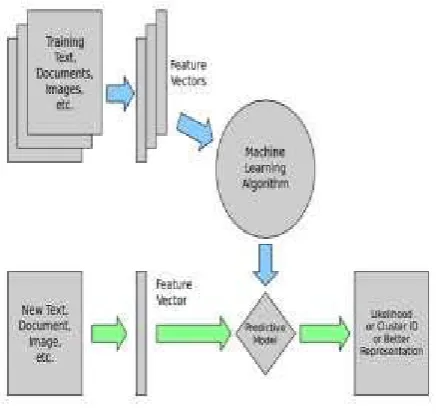
Supervised mastering version is given in determine 2 which shows that algorithm makes the distinction between the raw determined facts X that is schooling facts which can be textual content, document or photograph and some label given to the version for the duration of schooling. In the process of education, supervised mastering set of rules builds the predictive version. After education, the equipped model will attempt to are expecting the most probable labels for brand spanking new a fixed of samples X in test data. Depending on the nature of the goal y, supervised gaining knowledge of may be categorized as follows:
• If y has values in a fixed set of categorical consequences (represented through integers) the project to expect y is known as type.
• If y has floating point values (eg. To symbolize a charge, a temperature, a size...), the undertaking are expecting y is referred to as regression.
Figure 2. Supervised learning model
B. Unsupervised Learning
information together with perceive segments of clients with similar attributes who can then be dealt with further in marketing campaigns. Or it can discover the principle attributes that separate purchaser segments from every other. Other unsupervised studying issues are:
• Given targeted observations of distant galaxies, decide which capabilities or combos of features are maximum vital in distinguishing between galaxies.
• Given a combination of sound sources as an instance, someone talking over a few song, separate the two which is referred to as the blind supply separation hassle.
• Given a video, isolate a shifting object and categorize on the subject of other shifting objects that have been seen.
Typical unsupervised task is clustering wherein a set of inputs is split into organizations, not like in type, the organizations are not recognized before. Popular unsupervised techniques consist of self-organizing maps, k nearest neighbors, okay approach and singular value disintegration are also used to section textual content topics, suggest gadgets and discover information outliers. The unsupervised mastering model is given in parent 3 which suggests that unsupervised studying algorithm simplest uses a single set of observations X with n samples and n capabilities and does now not use any type of labels[6]. In the schooling manner, unsupervised getting to know algorithm builds the predictive version which will attempt to suit its parameters so one can high-quality summarize regularities located in the information.
Figure 3. Unsupervised learning model
C. Semi-supervised Learning
In many sensible learning domain including textual content processing, video indexing, bioinformatics, there may be big supply of unlabeled data however confined classified records which can be high priced to generate .So semi supervised getting to know is used for the same packages as supervised gaining knowledge of but it uses each categorized and unlabeled information for training[7]. There is a desired prediction trouble but the version ought to
analyze the systems to organize the data in addition to make predictions. Semi-supervised learning is beneficial whilst the fee related to labelling is too excessive to allow for a fully categorized schooling technique. This sort of gaining knowledge of can be used with strategies along with classification, regression and prediction. Early examples of this consist of identifying someone's face on an internet cam. Example algorithms are extensions to other flexible techniques that make assumptions about the way to version the unlabelled information.
D. Reinforcement Learning
It is regularly used for robotics, gaming and navigation. It is the mastering technique which interacts with a dynamic surroundings wherein it have to carry out a sure intention without a instructor explicitly telling it whether it has come near its goal. With reinforcement gaining knowledge of, the set of rules discovers through trial and blunders which movements yield the best rewards. So inside the chess playing, reinforcement getting to know learns to play a recreation by playing towards an opponent which plays trial and errors moves to win[8].
This type of getting to know has 3 primary additives: the learner, the surroundings and moves. The goal is for the learner to pick moves that maximize the anticipated praise over a given quantity of time. The learner will reach the intention a whole lot faster by way of following an excellent policy. So the goal in reinforcement learning is to analyze the nice coverage[9].
IV. MACHINE LEARNING ALGORITHM
A massive set of device learning algorithms are developed to build machine studying models and put in force an iterative machine gaining knowledge of process. These algorithms can be categorized on the basis of mastering fashion as follows:
A. Regression Algorithm
Regression is all about modelling the relationship between variables that is used again and again . Regression is the venture of predicting the value of a continuously various variable along with a rate, a temperature if given some input variables like functions and regressor. The maximum regression algorithms are defined as follows:
• Simple Least Square Regression • Linear Prediction
• Analytical Regression • Stair Regression
• Multivariate Changing Regression • Locally Estimation based Regression
B. Example based Primary Algorithm
• LVQ • SOM
• LWL
C. Decision Tree Classification Algorithm
Decision tree is used to predict about data using mapping methods. Tree technique in which the target variable can take finite set of values are referred to class variables. In those tree systems, leaves constitute class labels and branches represent conjunctions of capabilities that lead to those elegance labels. Decision trees in which the target variable assumes running values (generally real numbers) are called regression bushes.
Decision tools are educated on records for class and regression situation. Decision toolsare very often frequent and correct and a large preferred in machining study.The famous decision tree algorithms are:
• Classification and Regression Tree • Iterative Dichotomiser (ID3)
• C4 Five and C5 Zero (one of a kind version of a effective approach)
• Chi Squared Automatic Interaction Detection • Decision Stump
• Conditional Decision Tree
D. Bayesian Classification Algorithm
Machine Learning is a hybrid of Statistics and algorithmic Computer Science. Statistics is about managing and quantifying uncertainty. To represent all forms of uncertainty, bayesian algorithms are used which are based on opportunity theory[10]. In the following bays’ theorem which include category and regression. The famous algorithms are:
• Naive Bayes
• Gaussian Naive Bayes • Multinomial Naive Bayes
• Averaged One-Dependence Estimators
• BNNs
• Bayesian Network
E. Clustering Algorithm
Clusters are the basic approach of category of objects into special companies. It walls the statistics set into subsets or clusters, so that the statistics in each subset proportion some common trait frequently in line with some defined distance degree. Clustering is the kind of unsupervised gaining knowledge of. Clusters are like regression describedby the magnificence of the situation and the type of method. Clustering techniques are categorized as hierarchical clustering and partitional clustering. K-manner is partional clustering algorithms which uses centroid-based method. The most famous clustering algorithms are:
• okay-Means • ok-Medians
• Maximum likelihood • Hierarchical Assemblage
F. Association Rule Learning Algorithm
Association based rule is strategies that gives policies that first-class provide an explanation for found relationships between variables in records. These policies can find out vital and commercially beneficial institutions in big multidimensional datasets that may be victimised by way of the business enterprise[11]. The most famous affiliation rule getting to know algorithms are:
• Apriori algorithm • Eclat set of rules
G. Artificial Neural Network Algorithm
Artificial neural networks are fashions which makes use of supervised gaining knowledge of which are constructed primarily based at the shape of biological neural networks. It has synthetic neurons which has exceptionally weighted interconnections amongst devices and learns by means of tuning the connection weights to perform parallel distributed processing. Hence synthetic neural networks also are called parallel distributed processing networks. The popular artificial neural network algorithms are:
• Perceptron learning • Error Back Propagation • Hopfield Network
H. Deep Learning Algorithm
Learning algorithms based on deep learning approach are a current update to existing neural networks systems that gives clear plentiful cheap computation. They are concerned with building a great deal larger and more difficult neural system as many strategies are worried using supervised studying issues in which huge datasets include very little labelled facts. The most popular deep getting to know algorithms are:
• Restricted Boltzmann Machine
• DBN
• Conv Nets
• Stacked Auto-Encoders
I. Dimensionality Reduction Algorithm
Dimension is reduced in an manner to solve problem of coarse dimension way. As t the available data become sparse. This is a problem for any method that needs methods of statistics. Study of methods for dimension reduction describing the data.
Most of the time objectives are to increase search speed and decrease complexity. To improve upon quality of data for data organisation. Like methods of clustering, dimension reduction and exploit the structure inherent in the data in an unsupervised manner. The dimensionality reduction algorithms are:
• Principal Component Analysis • Principal Component Regression • Partial Least Squares Regression • Sammon Aligning
• Linear Discriminant Analysis • Mixture Discriminant Analysis • Quadratic Discriminant Analysis • Flexible Discriminant Analysis
J. Ensemble Algorithms
Ensemble methods are models based on unsupervised learning which is collection of several weak learner models that are singly trained and whose vaticination are sumed up in any way to give overall prediction. It divides the training data into number of subsets of data for which independent learning models are constructed[12]..All learning models are combined to make correct hypothesis.The popular ensemble algorithms are
• Encourage • Bagging
• Bootstrapped Accumulation • Blending
• Gradient Boosting Machines • Gradient Tree Boosting • Random Decision Forests
V. APPLICATION AND TOOLS
Machine learning applications are broadly classified based on learning techniques: supervised and unsupervised learning. Classification applications make use of supervised learning that are pattern recognition, face recognizance, character recognition, medical interpretation, web announcement. Unsupervised learning applications are clustering, explanation, association analysis, customer segmentation in CRM, image compression, bio computing. Robot control and game playing are the example application of reinforcement learning.
Tools are the articulation of the machine learning and it is needed to select an appropriate tool which is as essential as working with the best procedure. Intelligence retrieval tools makes intelligence learning faster, easier and more fun. Machine learning tools provide capabilities to deliver results in a machine learning project. Also it is used as a filter to decide whether or not to learn a new tool or new feature. Machine learning tools provide an intuitive interface onto the sub-tasks of the applied machine learning process. There’s a good mapping and suitability in the interface for the task. Great machine learning tools embody best practices
for process, configuration and implementation. Examples include automatic configuration of machine learning algorithms and good process built into the structure of the tool. Machine learning tools are separated into platforms and libraries.
VI. CONCLUSION
This paper provides a review of machine learning techniques. Machine learning model is given which describes the overview of machine learning process. Also describes the various machine learning algorithm based on types of machine learning styles. Examples of machine learning applications and need of tools are provided.
VII. REFERENCES
[1] Pedro Domingos, Department of Computer Science and
Engineering University of Washington Seattle, “A Few useeful Things to Know about Machin Learning”.2012. [2] Yogesh Singh, Pradeep Kumar Bhatia &OmprakashSangwan
“A review of studies in machine learning technique”. International Journal of Computer Science and Security, Volume (1) : Issue (1) 70 – 84, June 2007
[3]
March 10, 2015.
[4]
November 25, 2013
[5]
2015
[6] TaiwoAyodele,”Types of Machine Learning algorithms”,
FEBRUARY 2010
[7] http://www.mlplatform.nl/what-is-machine-learning/
[8] Acid S, de Campos LM (2003) “Searching for
Bayesian network structures in the space of restricted acyclic partially directed graphs”, J Artif Intell Res 18:445-490.
[9] Aha D(1997) , “lazy Learning”,Kluwer Academic
Publishers, Dordrecht.
[10] An A, Cercone N (1999) “Discretization of continuous attributes for learning classification rules”. Third Pacific- Asia conference on methodologies for knowledge discovery & data mining, 509–514
[11] An A, Cercone N (2000) “Rule quality measures improve the accuracy of rule induction: an experimental approach”. Lecture notes in computer science, vol. 1932, pp 119–129 [12]Auer P, Warmuth M (1998) “Tracking the best disjunction”,