Volume 7, No. 3, May-June 2016
International Journal of Advanced Research in Computer Science RESEARCH PAPER
Available Online at www.ijarcs.info
Evaluation of the Non-Functional Requirements of Usability: A Systematic Study
IngMarelis V. Pérez García
1, Ing. YordanVelez Rodríguez
2&Mohammad Ayaz Ahmad
31Empresa de Tecnologías de la Información y Servicios Telemáticos Avanzados, CITMATEL 2Empresa de Tecnologías de la Información para la Defensa, XETID
3
Physics Department, Faculty of Science, P.O. Box 741, University of Tabuk - 71491, Saudi Arabia
Abstract: Every day more companies and organizations insist not only on the quality of the processes that are followed in software development, but also on the quality of the products purchased and / or developed. The quality of software is perceived mainly by the flaws found in the prod-uct and by gravity they represent for their business. These failures directly affect the quality of non-functional requirements, which are mostly overlooked during the life cycle of software development. In this paper presents an investigation to determine the degree of importance of the non-functional requirements, especially for the case of usability. For this was used as a research method literature review in journals and digital libraries coming from Cuban institutions, using the CORE and Journal Citation Report (JCR) methods for evaluating of quality of publications, that from the definitions of chains of searches, a questionnaire of objective and subjective questions, criteria of inclusion and exclusion, obtained excellent publications for the exhaustive study.Finally the results of the study are analyzed and the conclusive criterion is emitted on the found results.
Keywords: usability,non-functional requirements,quality
1. INTRODUCTION
Every day more companies and organizations are deter-mined not only on the quality of the processes used in soft-ware development, but also on the quality of the products purchased and / or developed. In the called CHAOS Re-ports1that every two years the Standish Group2
In addition to the introductory section, Section 2, the state of the art, Section 3 presents detailed research design and in Section 4 the results and discussion are given.Finally,
Sec-is an analysSec-is of success and failure of projects in the field of information technology. According to the 2012 edition there is a slight increase from the previous report (2010) on successful projects, 37% to 39%. This group defined as those success-ful projects were delivered on time, within budget and with the required features and functions.However, the number of canceled projects is higher, and one factor that affects this is the usefulness and effectiveness of the use of certain prac-tices, techniques, methodologies and models which vary between institutions, organizations and projects [1]. Accord-ing Leon [2], from the point of view of the customer and users, the quality of a software product is perceived mainly by the weakness inherent in the product and the seriousness that these have for your business.This directly affects the quality of non-functional requirements (NFR), which are hardly taken into account during the life cycle of software development [3]. To this can be added the lack of proce-dures, tools, methods and techniques for testing the NFR [4]. There is therefore the need to comply by producing centers software quality in the RNF identified for each of their products.
As a first step, a preliminary literature review is conducted to see the degree of importance given to national and inter-national level to the NFR, especially usability.The aim of this paper is to provide a contribution to improve the quality in terms of usability it is in the development of IT projects, from ISO 25000.
1 It is one of the most recognized reports on the failure of projects in the field of information technology and is held every two years.
2Organization of independent international consulting, research in information tech-nology.
tion 5 concludes shown.
2. STATE OF THE ART
There are several classifications of requirements, among them non-functional requirements that are Sommervilleare limitations on services or features offered by the sys-tem.Restrictions include both timing and the development process, as imposed by standards [5].
Non-functional requirements describe the features and tech-nical aspects of the system should possess. These distinctive features span the operating environment software from processing infrastructure and connectivity to visual interfac-es, colors and how they should present information, includ-ing the prospects for security.
In the literature are few efforts regarding the verification and validation of non-functional requirements of the soft-ware.The issue of obtaining and prioritization of require-ments generally addressed much more, as in the case of proposals [6] and [7].
In the work of Sanchez and Rodriguez [8] it referred to the importance for the field of critical software3, such as SCA-DA systems (for its acronym in English)4
Another work that addresses the issue of the assessment of product quality is Rodriguez, Pedreira and Fernandez [9]. In which a solution of an evaluation of the product and then , verification of non-functional requirements or quality characteristics of the software as well call it. In it, several examples of problems that have existed for improper verification and validation of the NFR in this type of system are cited.It is further pro-posed that the implementation of non-functional ments such as reliability and security functional require-ments is done in parallel, people with the skills required for their realization.
3 Software that is used in real-time processes, medical systems, avionics, automotive or control of nuclear plants whose proper functioning rests on the lives of thousands or perhaps millions of people.
reach a quality certification thereof is presented, based on ISO / IEC 25000 standard, in this case only it takes into account the characteristic maintainability.
There are several techniques for evaluating RNF including traditional techniques and dynamics.The first used for static analysis of the safety and reliability of systems and the latter can only be used when you have a prototype or an executa-ble version of the product.Among the highlights traditional peer reviews, audits, prototyping of user interface, among others.They could mention within the dynamics associated with the source inspection manual or automated test code. When speaking of non-functional requirements is the family of ISO / IEC 25000 standards which more disaggregated the offers.ISO / IEC 25000: 2005 standard [10] provides guid-ance for the use of the new series of international standards, called Quality Requirements and Evaluation Software Prod-ucts (SQuaRE). Constitute a set of standards based on ISO 9126 and ISO 14598, and its main objective is to guide the development of software products with the specification and evaluation of quality requirements [11].
For this research will work with the ISO / IEC 25010 [12] standard belonging to the first division, this replaces and updates the standard ISO / IEC 9126-1. In the same model of software product quality it is defined and quality in use. The product quality model includes internal and external qualities of the system and is composed of eight features and subfeatures 31 [13], which is then shown in Figure. 1.
Figure. 1: Model of Product Quality ISO 25000.
3. PRELIMINARY DESIGN INVESTIGATION
A preliminary study provides the researcher have a greater area of research on the subject in question vision.For this article were taken to guide the work of Moreno [4] and [14], and Sánchez [8]. Building on this work, we consider the following elements for the study:
3.1 Research Question
The research question is formulated:
"What are the proposals (methods, procedures and tools) toassess non-functionalrequirements of usability in the soft-ware developmentprocess?"
The answers obtained when performing this question let you choose, classify and summarize knowledge regarding the evaluation of non-functional requirements of usability.For a more concrete result, the main question was divided into four sub questions.
Q. 1: What are the methods to assess non-functional re-quirements of usability?This question examines the different methods used to assess non-functional requirements of usa-bility that may or may not be related to other non-functional requirements.
Q. 2: What are the procedures used to assess non-functional
requirements of usability?his question identifies the proce-dures that help the tester to verify and validate non-functional requirements for usability.
Q. 3: What are the tools supporting the assessment of non-functional requirements of usability?This question aims to study the tools created to support the evaluation method of non-functional requirements of usability.
Q. 4: Was the proposal empirically validated?This question examines whether the proposal has been validated in a real or academic context.
3.2 SearchStrategy
Based on the research question and the sub questions de-signed publications selection process, resources and search terms is determined necessary to perform the same. For application the following three steps were taken into ac-count:
Step 1: Selected publications. When these 6 lines are com-pleted the total "Selected publications" is obtained.
- Use a search string. This search returns a set of publications that satisfy the search string in the title, abstract or keywords. (Step 2)
- Build the criteria for inclusion and exclusion. the criteria for inclusion and exclusion criteria based on the research question is formulated. (Section 3.3)
- Read the title and abstract. the titles and abstracts of publications returned by the search string are re-viewed. Based on the titles and abstracts the selec-tion criteria are applied to determine the publica-tions to include or exclude in the study. This set of publications called "potential publications."
- Read all publications. It is thoroughly read the en-tire contents of potential publications. During the reading should answer research questions (section 3.1). In addition, the inclusion or exclusion criteria must be applied again, so that only publications that are in the area of interest are selected. The re-sult will be another set of publications called "Se-lected publications".
- Search and select publications references. The last step is to review the publications referenced in se-lected publications. Thus, relevant publications which have not been found by the search string and publications that do not fall between sources de-fined in the search (step 2) are identified.
Step 2: Sources search
The sources used for the study are based on: the digital li-brary of the University of Information Science, the Cuban Journal of Computer Science, Advanced Scientific Maga-zine, among others. All publications were searched by title, abstract and keywords. The established date range is 2010 to present. To avoid discarding previous interesting jobs by 2010, the revised referenced publications. If a written prior to the 2010 publication has not been referenced in the last 10 years, we can conclude that the work is not relevant; there-fore, it is discarded for this study.
Step 3: Search string
Search string = (Non-functional requirements) AND (Soft-ware Engineering)
The terms that form the search string are:
Usability Requirements = (Usability Requirements OR user requirement OR usability evaluation OR non-functional OR usability procedures)
Software Engineering = (TDD OR test driven OR tool OR engineering OR test)
The term "non-functional" has been inserted into the group of "usability requirements" because usability very often is considered RNF (or English NFR) and therefore there may be references to usability within work based RNF.
3.3 Selection criteria
They are used to determine what studies are to include or exclude in the study, from the articles obtained with the search string. The publication is considered valid if the an-swer is yes to any of the three following inclusion criteria: IC1= Does the work defines how to assess non-functional requirements of usability?
IC2= Does the proposal applies to a system based on con-ceptual models (TDD) environment?
IC3= Does the work defines how to assess non-functional requirements of usability?
On the other hand, the exclusion criteria are taken into ac-count:
EC1= Publications studying procedures and tools that do not address the usability.
EC2= Publications that only treat the functional require-ments.
EC3= Written in a language other than English or Spanish publications.
In order to assess the reliability of inclusion, the statistical measure of Fleiss Kappa (level of agreement) on 20 poten-tial publications selected randomly applied. The value ob-tained was 0.61 Good level qualified or Sizeable.
3.4 Quality assessment
For the evaluation of the quality of the "Selected publica-tions" a questionnaire presented in Table I, containing ques-tions sub-jective and objective it was developed. The former have three alternatives (1 = yes, 0 = Clear and -1 = No). The objective questions, No. 8 and No. 9 have these alternatives (1 = Very important, 0 = Important, 1 = not important) and (1 = more than 4, 0 = 2 to 4, -1 = me-us 2) respectively. For question No. 8 it is considered conferences and journals. For objective classification of conferences, the ranking CORE is used. The publication is "very important" if the conference is CORE A or B or if it is part of a book, "Important" if CORE C or if it is a workshop, "not so important" when the conference is not in CORE.
For journals, it has been used objective classification of the Journal Citation Report (JCR). The publication is "very important" if the magazine appears in the JCR, "Important" when indexed on another list and "not so important" when it is nowhere known. For question No. 9 the Publish or Perish tool is used to determine the number of times it is cited pub-lication. Is assigned 1 if this number is "more than 4", 0 if it is "Between 2 and 4" and -1 if it is "Less than 2".
Completed the questionnaire the average of the individual responses of each reviewer is calculated. In the end, all av-erages obtained are added together, the resul-state is a value
between -10 and 10. It is considered the publication "very good" if the value is greater than or equal to 3, "Good" if it is between -2 and 2.9 and "Bad" if less than -2.
TableI: Questionnaire.
Subjective questions 1 = Yes0 = Partialy-1 = No 1.Does the method for evaluating usability requirements clearly defined?
2.Do assessment procedures nonfunctional requirements are understandable?
3.Do assessment procedures nonfunctional requirements are useful in another context?
4.Do the tools supporting publications are downloada-ble?
5.Is there a case study or example of the proposal?
6.Does the proposal is validated empirically?
7.Are the results are clearly explained?
Objectivequestions
8.Does the publication is in a magazine or in a confe-rence proceedings?
1 = Very important 0 = Important -1 = Notso important
9.Does the publication has been cited by other authors? 1 = Moreof 40 = Between 2 and 4 -1 = Less of 2 A series of questions which the study is based are set.
3.5 Data extraction strategy
Defines how the information required for each selected publication is obtained. Taking into account the sub ques-tions for the study, it defined the following sets to group the possible answers in categories that are of interest to the preliminary study.
Q1. Methods to assess non-functional requirements for usa-bility
1.1. Yes. When the methods evaluate usability requirements or other non-functional or contain usability requirements. 1.2. No. When the method does not explain clearly how to conduct assessment of usability requirements. They are NFRs assessment methods that do not cover or interaction usability.
1.3. Not concerned. If the publication has no method. Q2. Usability procedures used to assess non-functional re-quirements for usability
2.1. Existing. If the publication uses existing procedures for evaluation or analysis requirements usability.
2.2. Proposals. If the procedures used in the publication have been developed by the author.
2.3. Does not exist. If no known method is not used or created.
Q3. Support tools assessing non-functional requirements for usability
3.1. Interface design. If the proposal is oriented tool for multimedia user interface.
3.2. Development model. If the proposal is a support tool for the development of conceptual models.
3.3. Does not exist. If the method does not suggest any tool but it might be possible to use some.
3.4. Not concerned. If publications do not try tools. Q4. Empirical validation environment
4.1. Industrial. If the empirical validation of the proposal made in the publication is carried out in an industrial con-text.
4.3. Any. If there is no empirical validation.
4. RESULTSAND DISCUSSION
From data extraction applied in the previous section, the achieved results that revolve around the evaluation methods of nonfunctional requirements usability is. These works have been published in conferences, magazines, books, workshops and other events.
Works like Mellado et al found. [15] in building a methodo-logical and instrumental environment based on the ISO 25000 which provides the ability to evaluate the quality of both the source code and design software to develop. It focuses on three of the eight quality characteristics of this model: maintainability, safety and usability, providing a set of metrics, heuristics and check lists of possible use.
In the work of Moreno and Martin [14] presented a way to manage and validate non-functional requirements in web applications through usability testing techniques. In the same great emphasis on the importance of usability for Web applications is.
In the work of Florian, Solarte and Reyes [16] the subject of evaluation and usability testing within their own software development is introduced, adding an auditor role in the process. The same is evidenced the importance of making this feature in web applications, in this case a digital refer-ence library of documents in the area of computer scirefer-ence (PREACH). mention of non-empirical and empirical me-thods for usability evaluation is done, specifically used in empirical work, which covers terms of usability testing and user testing as they are also known. To minimum require-ments referred to design more usable and accessible web interfaces.
In Cuba the software development companies are not out-side the situation presented in the global studies on streng-thening the software industry, which has led to the creation of various strategies in order to increase production and quality Cuban software. Thus it was createdIncusoft5
Some companies in the country to achieve better products and services have implemented a quality management sys-tem that meets the requirements of the International Stan-dard NC-ISO 9001: 2008 [17]. This stanStan-dard is combined with the NC ISO / IEC 9126-1: 2005 standard [18] for the , where companies producing software are integrated into the coun-try.
One such organization that integrates Incusoft, is the Uni-versity of Information Science. In the modifications they have been made to the software development processes and between the processes of software quality.
In the literature review some works collected in Table II were found, the more jobs are diploma and focused on quali-ty assurance of usabiliquali-ty feature, mainly for management systems. These are guided by the ISO 9126, which is consi-dered very important but there are features that are ad-dressed in this standard in a very general way, such as relia-bility and security.
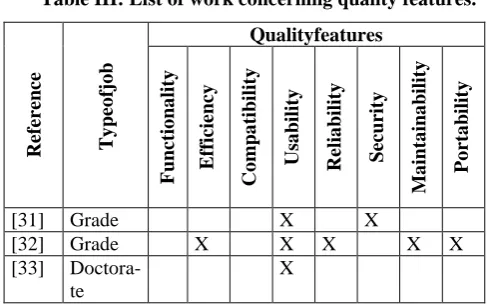
Some works that address the issue of quality assessment was also found, which are shown in Table III.
5 Industry Cuban Software, was created with the aim of combining the
individual efforts they have been making various institutions of the country in this field to reach a strength that allows venture, more effectively in foreign markets, its main objective is to achieve high quality software products to meet customer expectations.
[image:4.595.315.561.161.424.2]case of companies producing software. In some companies then they dictate procedures to guide the development and evaluation of software produced, looking for a better prod-uct positioning in the market. There are companies which are currently being evaluated only two (functionality and usability) of the six features that this rule proposes.
Table II: Thesis ratio of the UCI regarding quality cha-racteristics R ef eren ce T yp eof job
Características de calidad
F unc tio n a li ty E ff ici en cy C o m p a tib ilit y U sa b ilit y R elia b ilit y Se cur ity M a in ta in a b ilit y P o rt a b ilit y
[19] Grade X
[20] Grade X
[21] Grade X
[22] Grade X
[23] Grade X
[24] Grade X
[25] Grade X
[26] Grade X
[27] Grade X
[28] Grade X
[29] Master X
[30] Master X
Relates a number of diploma thesis work and expertise found in a search in the library of the UCI.
Table III: List of work concerning quality features.
R ef eren ce T yp eof job Qualityfeatures F unc ti o na li ty E ff ici en cy C o m p a tib ilit y U sa b ilit y R elia b ilit y S ecu ri ty M a in ta in a b ilit y P o rt a b ilit y
[31] Grade X X
[32] Grade X X X X X
[33] Doctora-te
X
A series of related papers found in a search in several public digital libraries online.
In the software production process, specifically when re-quirements engineering is done, the NFR are not explicitly disclosed in Specification requirements (ER) or Project Profiles. It is performed only a small mention of the format in which the user interface, for example will be presented: "The user interface is presented for the web. The navigation should be intuitive, presenting on every page menus to access site information. User interfaces should follow design guidelines defined and approved by the customer ".
In other cases RNF are collected in a document called Tech-nical script. They are collected in the same well as hardware and software requirements, aspects concerning:
[image:4.595.315.559.442.594.2]digi-tal product.
- Usability: Levels of Access to Information.
- Portability: Platforms in which the digital work is executed.
- Security: Set the access authenticates users based on their role, and the allocation of permits accord-ing to the required functionality.
All this information is recognized as useful but not achieved with the same goal proposal because in the stages of product evaluation becomes very long. The projects then present their processes inherent problems such as deadlines and unfulfilled budgets, customer dissatisfaction and / or user to whom it is addressed, low productivity and poor quality software produced.
[image:5.595.310.564.54.266.2]Some features that should be taken into account to achieve a higher quality web application propose them Luis [31], including highlights to be aesthetically attractive and have a simple design and intuitive navigation.
[image:5.595.30.272.386.474.2]Table IV shows the amount of potential and selected publi-cations classified by source of origin. These data also in-clude publications obtained by reference. Table V shows the number of potential and selected publications that have been presented at conferences level A, B or C according CORE. Extracting data from selected publications has been made based on the research categories. In turn, each category is classified into different sets described in section 3.5.
Table IV: Number of publications by source.
Source Potential Selected
Conference 31 14
Journals 16 9
Books 4 3
Workshops 4 1
Others 15 8
Total 70 35
Table V: Number of publications according to the CORE classification
LevelsConferences Potential Selected
Level A 12 6
LevelB 10 4
LevelC 9 4
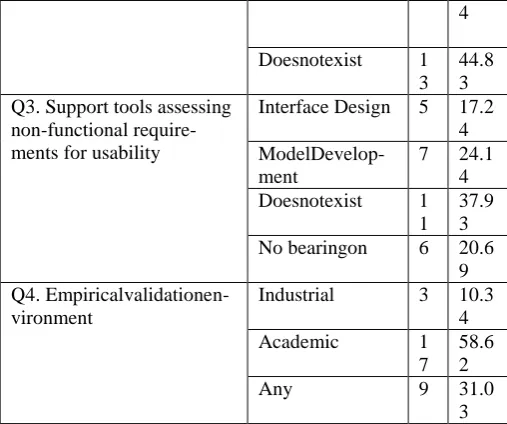
[image:5.595.32.286.634.785.2]Table VI shows the percentage of publications that have been found in each of the sets of categories. The total num-ber of selected publications for our study is 29.
Table VI: Results of the preliminary study
Sub questionsResearch Possibleanswers N
o
%
Q1. Methods to assess non-functional requirements for usability
Yes 7 24.1
4
No 1
1 37.9 3 No bearingon 1
1 37.9 3 Q2. Usability procedures
used to assess
non-functional requirements for usability
Existing 9 31.0
3
Proposals 7 24.1
4
Doesnotexist 1 3
44.8 3 Q3. Support tools assessing
non-functional require-ments for usability
Interface Design 5 17.2 4
ModelDevelop-ment
7 24.1 4 Doesnotexist 1
1 37.9 3 No bearingon 6 20.6
9 Q4.
Empiricalvalidationen-vironment
Industrial 3 10.3
4
Academic 1
7 58.6 2
Any 9 31.0
3
The proposals found in the study help overcome some of the obstacles to the integration of usability and its significance by stakeholders. However the application of the procedures required, in general, the interpretation of a usability expert for proper use.
All tools proposed in the publications studied are prototypes that have limited functionality when its use is oriented eval-uation process requirements. In addition, its use requires some degree of effort in understanding and implementation by the tester.
In all case studies, experiments or examples that arise (both academic and industrial), there are no explicit metrics that determine the level of usability achieved by the system.
5. CONCLUSIONS
To achieve quality RNF first thing to do is to describe these in a way that can be measured is then necessary to quantify, defined intervals and scales should be aligned with the mar-ket and the value of the cost.
The ultimate goal of this work is to study the existing stu-dies that propose optimize usability features within the soft-ware development process. Of all existing jobs, this paper aims to analyze in more detail those who propose optimizing usability from the early stages of development.
The systematic study has been prepared based on the me-thodology proposed by Kitchenham and focused on a quest for the past 12 years. The results although in accordance with the approach of assessing usability requirements do not solve greatly the problems that have applications in the development process (continuous change in the require-ments, the presence of new requirerequire-ments, understanding the mechanism of interaction user, application of new guidelines and standards for various platforms and technologies, among others). If we focus on publications that address usability requirements assessment, lack of jobs is even more pro-nounced. Virtually no work today.
The systematic study largely serves to detect the problems in the studies analyzed and identify future work that have not yet been addressed. Based on the study results, it can be concluded that there is a clear line of research in the field of usability requirements.
conducted around the evaluation of non-functional require-ments for usability.
6. ACKNOWLEDGEMENT
The authors acknowledgethekeen support and help of theInstitutes “Empresa de Tecnologías de la Información y Servicios Telemáticos Avanzados, CITMATEL” and thePhysicsDe-partemnt, Faculty of Science, University of Tabuk, KSA. Theauthorsfrom U.O.T are highlygratefulto Vice Presidencyfor-Graduate / Studies and ScientificResearch at University of Tabuk, and Ministry of HigherEducation, Kingdom of Saudi Arabia fort-hekindfinancialassistance [34-38 and referencestherein].
7. REFERENCES
[1]. The Standish Group. CHAOS MANIFESTO 2013. Think Big, Act Small, 2013.
[2]. León Perdomo, Y: “Estrategia de Pruebas Explorato-rias para mejorar el rendimiento del Laboratorio Indus-trial de Pruebas de Software de Calisoft”, Tesis de ma-estría, Universidad de las Ciencias Informáticas, La Habana, 2012.
[3]. Serna-Montoya, É: “Estado actual de la investigación en requisitos no funcionales”. Colombia, 2012.
[4]. Moreno, J. C., &Marciszack, M. M: “La Usabilidad Desde La Perspectiva De La Validación de Requeri-mientos No Funcionales Para Aplicaciones Web”. Córdoba: Universidad Tecnológica Nacional, 2013. [5]. Sommerville, I: Ingeniería de Software, Novena ed.
México. México: Pearson Educación, 2011.
[6]. Martínez Carod, N: Ponderación de Requisitos de Software usando Técnicas Cognitivas y Orientación por Objetivos. CACIC 2010 - XVICongresoargentino de ciencias de la computación, 1072–1077, 2010. [7]. Mohd, S., &Mohd, S: Elicitation and Prioritization of
Software Requirements. International Journal of Re-cent Trends in Engineering, 2(3), 138–142, 2009. [8]. Sánchez Domínguez, J. C., & Rodríguez Dapena, P:
Verificación de los requisitos no funcionales en el software crítico. Forum Calidad, (142), 25–31, 2003. [9]. Rodríguez, M.; Pedreira, O. y Fernández, C. M.:
Certi-ficación de la Mantenibilidad del Producto Software: Un Caso Práctico. RevistaLatinoamericana de Inge-niería de Software, 3(3): 127-134, ISSN 2314-2642, 2015.
[10].ISO/IEC 25000. Software Engineering -- Software product Quality Requirements and Evaluation (SQuaRE) -- Guide to SQuaRE. ISO, 2005.
[11].Portal ISO 25000. (15 de diciembre de 2014). Calidad del Producto Software. Obtenido de http://iso25000.com
[12].ISO/IEC 25010. (s.f.). Systems and software engineer-ing -- Systems and software Quality Requirements and Evaluation (SQuaRE) -- System and software quality models. ISO, 2011.
[13].Polillo, R: Quality Models for Web [2.0] Sites: a Me-thodological Approach and a Proposal. 2nd Workshop on The Web and Requirements Engineering (WeRE´11) In (ICWE 2011). Milano, Italia, 2011. [14].Moreno, J.C., Martín Marciszack, M.: Validación de
Especificaciones No Funcionales de Aplicaciones Web a Través de Técnicas de Testing de Usabilidad. XV Workshop de investigadores en ciencias de la compu-tación. Paraná, Entre Ríos, pp 490-494. 2013.
[15].Mellado Fernández, D.; Rodríguez, M.; Verdugo, J.; Piattini, M. & Fernández-Medina, E.: “Evaluación de la calidad y seguridad en productos software”, proyec-to MEDUSAS (IDI-20090557) del Ministerio de
Cien-cia e Innovación (España - CDTI),
url:http://www.audisec.es/es/aviso-legal/8-i-d-i/30-medusas.html. 2009.
[16].Florián, B.E.; Solarte, O.; Reyes, J.M.: “Propuesta para incorporar evaluación y pruebas de usabilidad dentro de un proceso de desarrollo de software”, Revista EIA, ISSN 1794-1237 Número 13, p. 123-141, Medellín (Colombia), 2010.
[17].NC-ISO 9001. Sistemas de Gestión de la Calidad-Requisitos, 2008.
[18].NC ISO/IEC 9126-1. Ingeniería de software-Calidad del producto-Parte1: Modelo de la Calidad, 2005. [19].MulénMustelier, E., & López Salar, Y:
“Procedimien-to para la evaluación de la usabilidad de los produc“Procedimien-tos software desarrollados en el CESIM”, Tesis de diplo-ma, Universidad de las Ciencias Informáticas, La Habana, 2010.
[20].Espronceda Jorge, K., & León Sosa, Y: “Diseño de un procedimiento para evaluar la confiabilidad de los pro-ductos con tecnología Postgres, de DATEC”, Tesis de diploma, Universidad de las Ciencias Informáticas, La Habana, 2010.
[21].Navarro Suárez, M: “Procedimiento para realizar Pruebas de Seguridad a la Plataforma de Transmisión Abierta de Radio y Televisión (PTARTV)”, Tesis de diploma, Universidad de las Ciencias Informáticas, La Habana, 2011.
[22].Martínez Ortega, C: “Procedimiento para evaluar la Mantenibilidad de componentes de software”, Tesis de diploma, Universidad de las Ciencias Informáticas, La Habana, 2011.
[23].González Matos, A. M: “Procedimiento para el asegu-ramiento y la evaluación de la usabilidad en los siste-mas de gestión del CEIGE”, Tesis de diploma, Univer-sidad de las Ciencias Informáticas, La Habana, 2011. [24].García Cabrera, D: “Evaluación de la Portabilidad de
Componentes Software”, Tesis de diploma, Universi-dad de las Ciencias Informáticas, La Habana, 2011. [25].CordovesMustelier, S: “Propuesta deProcedimiento y
Herramienta para el desarrollo de Pruebas de Rendi-miento de Carga y Estrés en el Grupo de Calidad de FORTES”, Tesis de diploma, Universidad de las Cien-cias Informáticas, La Habana, 2011.
[26].Pérez Dima, Y: “Evaluación de la Usabilidad de pro-ductos software”, Tesis de diploma, Universidad de las Ciencias Informáticas, La Habana, 2011.
[27].Estrada Peña, Y: “Procedimiento para evaluar la carac-terística de funcionalidad de componentes software”, Tesis de diploma, Universidad de las Ciencias In-formáticas, La Habana, 2012.
[28].Burnes Domínguez, K: “Procedimiento para gestionar la Usabilidad en el desarrollo de productos de portales web del centro CENIA”, Tesis de diploma, Universi-dad de las Ciencias Informáticas, La Habana, 2013. [29].Pupo Leyva, I: “Procedimiento para el aseguramiento
Informáticas, La Habana, 2012.
[30].Nogales Cobas, P. M: “Procedimiento para desarrollar la interoperabilidad en proyectos de desarrollo de Sis-temas de Gestión Empresarial en Cuba”, Tesis de ma-estría, Universidad de las Ciencias Informáticas, La Habana, 2012.
[31].Luis Alfonzo, P: “Revisión de modelos para evaluar la calidad de productos Web. Experimentación en porta-les bancarios del NEA”, Tesis de diploma, Universidad Nacional de La Plata, Argentina, 2012.
[32].Ocampo Acosta, A., & Correa Tapasco, L. M.: “Im-pacto de las pruebas no funcionales en la medición de la calidad del producto software desarrollado”, Tesis de diploma, Universidad Tecnológica de Pereira, Pe-reira, 2011.
[33].Hurtado Cortés, L.L.: “Desarrollo de una metodología de evaluación de usabilidad de interfaces humano-máquina (IHM) para la mejora del proceso de toma de decisiones en tareas de supervisión industrial”, Tesis de doctorado, Universidad Nacional de Colombia, Co-lombia, 2013.
[34].AnghelDrugarinCornelia Victoria, M. Ayaz Ahmad, N. Ameer Ahmad, DraghicSilviu, “TheMathematicalS-tudy of Data Transmission in Digital Electronics”, Int. J. of AdvancedResearch (IJAR), Vol. 3 (3), pp. 697- 702, 2015.
[35].AnghelDrugarinCornelia Victoria, M. Ayaz Ahmad, N. Ameer Ahmad, Vyacheslav V. Lyashenko,
“Algo-rithmicResearch and ApplicationUsingtheRayleighMethod”, Int. Journal of
Science&Research (IJSR), Vol 4 (4), pp. 1669-1671, 2015.
[36].Anghel D. CorneliaVictoria , M. Ayaz Ahmad , Vya-cheslav V. Lyashenko, “A Study of New Cycloid
Swing Link SpeedReducerbyusingAlgorithmicDesign”,
Internatio-nal JourInternatio-nal of Science and Research (IJSR), Vol. 4 (5), pp. 408-411, 2015.
[37].M. Ayaz Ahmad, M. Yassen El-Bakry, T. A. Hamda-lla, Mir HashimRasool, ShafiqAhmad , A Systema-ticStudy of High Energy Nuclear Collisions (light and heavy nuclei) bySimulations / EventGenerators, Inter-national Journal of AdvancedResearch (IJAR),Vol. 4(1), pp. 28-43, 2016.
[38].M Ayaz Ahmad, AlveeraKhan, V. Lyashenko, S.Joshi, Dielectric and ElectricalCharacterizationStudy of SynthesizedAlumina Fibre ReinforcedEpoxyComposi-tes., Elixir International Journal: CrystalResearch, Vol. 87, pp.35801-35805, 2015.
8. CURRICULAR SUMMARY AUTHORS
Marelis V. Pérez García is a graduate engineer in 2008 at the University of Information Science. He has taken courses in the areas of process improvement, quality assurance processes and products, conformity assessment of software products,
requirement management, introduction to control engineering, intermediate English, etc. He has tutored about 8 diploma thesis in the area of software testing, which have achieved excellent results. In the 7 years of work experience he has served as a professor of accounting and finance subjects and business administration with more teaching and instructor roles test team leader, designer and tester test cases. He fulfilled internationalist mission in the Bolivarian Republic of Venezuela in the development projects of ALBA Guardian SCADA and SCADA Deployment Guardian of ALBA. She has authored and co-author of scientific papers published in the proceedings of the Meeting RELME 24, technological Peña’s (the 8th, 9th and 10th) of Interior Ministry in the IV Technical
Meeting of Computer Science, Automation and
Communications MINAG in the X International Conference events law and Informatics, TECNOGEST'2014 and IBERGECYT 2014.
Yordan Velez Rodriguez is a graduate engineer in 2008 at the University of Computer Sciences. He has taken courses in software development in C ++ advanced information security management, server management in free software. He has tutored around 12 diploma thesis in the area of IT security and networks, which have achieved excellent results. In the last 7 years of work experience he has served as chief security center and telematics services, data center manager. He fulfilled internationalist mission in the Bolivarian Republic of Venezuela in the draft Comprehensive Solution for the Council Secretariat of National Defense (SECODENA) in the sub-projects office equipment, remodeling the center data digitization center and situation room. In the past year he has served as head of the division of internal production services, which is subordinated to the central quality of the company in which currently working.
Mohammad Ayaz Ahmad,completedPh.D. in experimental highenergyphysics in 2010 and M. Phil. (physics) in 2005 fromthePhysicsDepartment, AligarhMuslimUniversity, Aligarh, India, underthesupervision of Prof. Shafiq Ahmad. He worked as a guestlecturerfor B. Sc. LaboratoryClasses in thesameDepartment, AligarhMuslimUniversity, Aligarhw.e.f. 10th Oct. 2002 to 10th Oct. 2008 and also as a Lecturer at SeniorSecondaryCollege (Boy’s) of AligarhMuslimUniversity, Aligarhw.e.f. 11th Oct. 2008 to 15th Dec. 2010.