International Journal of Advanced Research in Computer Science
RESEARCH PAPER
Available Online at www.ijarcs.info
© 2015-19, IJARCS All Rights Reserved 47
Effective Resource Management and Quality of Service in Virtualized Environment of
Cloud Computing
Gyaderla Ranjith
HOD & Assistant Professor
Department of Computer Science and Engineering Warangal Institute of Technology and Science
Warangal, Telangana State, India.
Jadala Vijaya Chandra
Assistant Professor
Department of Computer Science and Engineering Warangal Institute of Technology and Science
Warangal, Telangana State, India.
Chindam Ravali
M.Tech Student (Software Engineering) Department of Computer Science and Engineering
Warangal Institute of Technology and Science Warangal, Telangana State, India.
Abstract: Cloud computing is one of the latest resources sharing computing paradigm; it delivers IT resources as services. Virtualization is one of the cloud based services it takes the advantage of statistical multiplexing across applications to yield significant cost savings to the cloud user. However, there are significant problems exists in achieving similar benefits with real-time services that can be a challenge. This paper addresses the system-wide virtualization issues such as performance modelling, workload modelling, virtualization, deployment, and monitoring by seeking to a reduced financial and environmental costs of real- time services and also offering end-users a guaranteed Quality of Services. The differences in the deadlines associated with multiplex services such as Video-on-Demand and Internet Protocol Television services and modelling are discussed. We concentrated on the behaviour and performance of applications in Cloud-based IT resources which are done by a generalized framework computing the amount of resources needed to support multiple services, without missing the deadline for any service using generic cost function and analytical performance that is queuing network system model, workload information to supply intelligent input about system requirements to an application provisioned with limited information about the physical infrastructure which detects the changes in workload intensity. In this paper we discussed various algorithms and an algorithmic approach is given, along with mathematical problem solving method. An Experimental Analysis is given which enables virtualization infrastructure to provide cloud computing services more efficiently and certainly.
Keywords: Virtualization, Cloud Computing, Quality of Service, Monitoring, Security.
I. INTRODUCTION
Virtualization proposes to associate applications and servers, and changes relationship between software and hardware. Virtualization enables more than one application to run on a server and the capability to distribute multiple applications over multiple servers for resiliency. This consolidation increase resource utilization, boosts efficiency, lower capital investment and maintenance costs, and provides the basis of increased security. Virtualization in cloud computing minimizes risk by enhancing security through centralized IT management, easily update service packs and patches, easily restore servers and desktops. Virtualization is the creation of a virtual that means rather than actual, instance of something, such as an operating system, a server, a storage device or network resources. The major areas where the virtualization works is server based, storage based and network based, it is the backbone for the cloud computing. Cloud Computing refers to the use and access of multiple servers based on computational resources via internet. Virtualization is for cost effective ness, operational efficiency, Environment friendliness and heterogeneous environments [2].
A number of dynamics such as scalability, inter-operability, network communication, the delivery of enterprise applications, large quantity of data storage at different data
storage center and web-services contributed to the emergence of cloud computing, where virtualization is one of the key aspect developed to best utilize computing capacity.
Virtualization is a way to abstract applications and their underlying components away from the hardware supporting them and present a logical or virtual view of these resources. The Implementation of Virtualization can be accessed on Access, Application, Processing, Network and Storage. The goal of virtualization is to obtain high levels of performance, scalability, reliability, quickness and secured domain management. The virtual view is constructed using excess processing power, memory, storage or network bandwidth. Virtualization can create the artificial view that is many computers are clustered as a single computing resource or that a single machine is really many individual computers. It can make a Single large storage resource appears to be many smaller ones or make many smaller storage devices appear to be a single device [12].
servers, applications and operating systems. Virtualization is based on the concept of a virtual machine running on a physical computing platform [3]. Virtualization is controlled by a virtual machine monitor. The VM based cloud management software we are using for our experiment is Citrix.
II. RELATED WORK
Virtualization allows sharing single physical instance of an application or resource among multiple organizations or tenants. Multitenant cloud computing data centers run diverse workloads with time varying resource demands inside virtual machines. The machine on which the virtual machine is created is known as host –machine and virtual machine is referred as a guest machine. This virtual machine is managed by software or firmware, which is known as hypervisor. Virtualization offers a means to consolidate applications and servers, and changes the traditional relationship between software and hardware. Virtualization enables more than one application to run on a server and the capability to distribute multiple applications over multiple servers for resiliency. This consolidation increase resource utilization, boosts efficiency, lower capital investment and maintenance costs, and provides the basis of increased security.
Nowadays we are having virtualized environment in every domain so first thing we should know is the meaning of virtualized environment. It means to run multiple servers in single machine so that we can more efficiently use high performance CPU’S and also we don’t need any physical servers for sharing the resources not only this we can reduce hardware, space and power costs that’s why it is mostly used in present world. Second important thing we should know is cloud computing, it is basically a service which highly depends upon virtualized environment. Cloud computing is the concept based on utility computing service where RAM, CPU cycles, storage and network bandwidth are commodities which has to be consumed on pay per use basis such as water, electricity[1]. Cloud computing basically relies on both physical and virtual servers it is configured both in hardware and software for providing high reliability and availability. In this paper we are dealing with how to manage effectively resources as well as service quality in virtualized environment of cloud computing. Virtualized systems used multiplexing techniques for gaining more advantage on cost savings to the operator. In this paper we will be using internet protocol television services which are used for delivering television services with the help of packet switched network to the users. Internet protocol television services are used in this paper because it reduces provider cost on the basis of internet protocol television services virtualized architecture. In present world we are having more demand of live TV as compared to video on demand so we have to effectively multiplex the services used by both. It means we have to properly set the time-shifting for different services on the basis of internet protocol television services virtualized architecture
We are presenting different amount of resources required for providing multiple services taking care of targets which has been set for different services. Multiple forms are required for detecting the cost or price for the different functions such
as concave and convex functions. So basically in this paper we are reducing the load from 90% to 83% on the services used under internet protocol television services so that user can watch any videos online without any hindrance. Our main goal in this project is to achieve or rather improve efficiency of the system using analytical information and workload information so that skillful information can be given as an input to the application expert. Our reproduction based exploratory results utilizing generation workload models demonstrate that the proposed provisioning method recognizes changes in workload power (landing example, asset requests) that happen after some time and designates various virtualized IT assets in like manner to accomplish application quality assurance targets.
III.OPTIMIZATION FRAMEWORK OF IPTV
A. Optimization Frame work for Better Performance As IP-based feature conveyance turns out to be better known, the requests put upon the administration supplier's assets have drastically expanded. Administration suppliers normally procurement for the crest requests of every administration over the endorser populace. Not with standing, provisioning for top requests leaves assets under used at all different periods. This is especially apparent with Instant Channel Change asks for in IPTV. Distributed computing is the most recent advancement of registering, where IT assets are offered as administrations. The equipment and programming frameworks that deal with these administrations are alluded to as Infrastructure as a Service and Platform as a Service, while the genuine applications oversaw and conveyed by Infrastructure as a Service and Platform are alluded to as Software as a Service. Our objective in this paper is to exploit the distinction in workloads of the diverse IPTV administrations to better use the conveyed servers. For instance, while ICC workload is exceptionally burst with an extensive top to normal proportion, video on demand has a moderately enduring load and forces "not all that stringent" deferral bounds. More essentially, it offers open doors for the administration supplier to convey the video on demand content in foresight and possibly out of-request, exploiting the buffering accessible at the beneficiaries. We look to minimize the asset necessities for taking so as to support the administration favorable position of measurable multiplexing over the distinctive administrations - in the sense; we try to fulfill the aggregate's top of the administrations' requests, instead of the crest's whole request of each administration when they are taken care of freely. Virtualization offers us the capacity to share the server assets over these administrations [11].
landscape of Internet based computing in cloud computing shares a pool of configurable computing resources such as networks, servers and storage which can be rapidly provisioned and released to support multiple services within the same Cloud infrastructure.
An IPTV service provider is typically involved in delivering multiple real time services. Each service has a deadline for delivery, which may be slightly different, so that the play out buffer at the client does not under-run, resulting in a user-perceived impairment. Analyzing the amount of resources required when multiple real time services with deadlines are deployed in a cloud infrastructure to estimate the resource requirements for serving arriving requests which have a delay constraint (delivering VoIP Packets) and assuming the arrival process is Poisson. We first extend the analysis so that our results apply for any general arrival process and we also consider multiple services with different deadlines. The optimization algorithm computes the number of servers needed at each time (the server-tuple) based on the composite workload of requests from these different services. The main optimization goal is to minimize a cost function which depends on the server tuple such that all the deadline constraints are satisfied and also relaxing the impact of deadline constraint on the optimal cost. The significant resource savings can be achieved by dynamically allocating resources across services, as compared to provisioning resources for each service independently [13].
There are mostly three strings of related work, in particular distributed computing, booking with due date requirements, and advancement. Distributed computing has as of late changed the scene of Internet based registering, whereby a mutual pool of configurable processing assets (systems, servers, capacity) can be quickly provisioned and discharged to bolster various administrations inside of the same base. Because of its inclination of serving computationally concentrated applications, cloud foundation is especially suitable for substance conveyance applications. Ordinarily Live-TV and video on demand administrations are worked utilizing committed servers, while this paper considers the choice of working numerous administrations via cautious re adjusting of assets progressively inside of the same cloud foundation. Now we will discuss about comprehensive cloud provisioning approach which basically covers three points in it:
1) Virtual Machine Provisioning: Virtual Machine Provisioning, which includes instantiation of one or more Virtual Machines that match the particular equipment attributes and programming prerequisites of an application. Most Cloud suppliers offer an arrangement of universally useful virtual machine classes with nonexclusive programming and asset setups. For instance Flip kart EC2 underpins 11 sorts of virtual machines, everyone with diverse alternatives of processors, memory, and I/O execution.
2) Resource Provisioning: Asset Provisioning, which is the mapping and booking of virtual machines onto physical Cloud servers inside of a cloud. At present, most suppliers don't give any control over asset provisioning to application
suppliers. As such, mapping of virtual machines to physical servers is totally escaped application suppliers.
3) Application Provisioning: Application Provisioning, which is the organization of particular applications, (for example, enterprise resource framework, basic local alignment tools examinations, and web servers) inside VMs and mapping of end client's solicitations to application cases.
B. Optimization Frame work models
There are two types models used in effective resource management and quality of service in virtualized environment of cloud computing which are
1) System model: Mists arrange server farms as systems of virtualized (registering servers, databases, and systems) with the goal that suppliers have the capacity to get to and send applications from anyplace on the planet on interest at focused expenses driven by quality of service requirements. The Cloud figuring framework is an arrangement of Cloud. Application occurrences are illustrations of programming that can be claimed by little and medium business undertakings and governments who decide to offer their applications by means of Clouds. Without misfortune in all inclusive statement, we consider in this paper the situation where applications and stages are offered by one association and Cloud-based IT assets are possessed by an alternate association.
2) Application model: The cloud application situation considered in this paper identifies with execution of certain sort of activity or usefulness, by an application component to end-clients. The activity or usefulness fluctuates taking into account the application model. For instance, an open registering administration, for example, Folding and gives usefulness to executing scientific models in a given arrangement of information, though a Web server is an administration that conveys substance, for example, site pages, utilizing the Hypertext Transfer Protocol (HTTP) over the Internet. Inevitable conditions among solicitations are thought to be taken care of at the client side. Along these lines, from the perspective and demands for activities or functionalities are free from one another. This is the situation, for instance, of preparing of HTTP solicitations. Despite the fact that some data about condition of sessions may be put away in the Cloud, conditions (e.g., security exemptions and conventions for correspondence) are taken care of toward the end-client side by its web program.
obliged when different continuous administrations with due dates are sent in a cloud base [9].
We propose a component for element virtual machine provisioning in IaaS server farms in view of grouping. In such a work, it is vital not just to focus the quantity of virtualized application occurrences additionally their sorts. In our methodology, sort of case is not an issue's piece; subsequently sent cases can simply be utilized to serve demands. Dynamic optimization is an optimization theory which deals with optimizing required control variables of a discrete time dynamic system by considering finite-horizon optimization where the optimal control parameters with finite look-ahead are to be found as we know the arrival pattern of the server requests with their deadlines in the future so as to minimize the cost function by deriving closed form solutions possible for various cost functions. We also propose a dynamic system for virtual machine provisioning in view of control hypothesis considering client spending plan. On the other hand, such a methodology considers reconfiguration of accessible virtual examples (build or abatement their ability) and not expanding/diminishing number of cases for a client, alternately to our methodology that applies the last approach for virtual machine provisioning [10].
IV. MATHEMATICAL ANALYSIS
Cloud infrastructure is particularly suitable for content delivery applications due to its nature of serving computationally intensive applications.
This paper considers the option of operating multiple services by careful rebalancing of resources in real time within the same cloud infrastructure. For a given set of processors and incoming jobs are characterized by arrival time and requirement to finish by certain deadline. EDF (Earliest Deadline First) schedules the jobs such that each job finishes by the deadline. In this paper, there are multiple sets of services providing jobs. Each of these services send request for chunks with different deadlines and a region is formed by server tuples so that all the chunks are serviced such that no chunk misses deadline. Dynamic optimization is an optimization theory which deals with optimizing required control variables of a discrete time dynamic system. Here we consider finite-horizon optimization where the optimal control parameters with finite look-ahead are to be found as we know the arrival pattern of the IPTV and VoD requests with their deadlines in the future so as to minimize the cost function by deriving closed form solutions possible for various cost functions.
The effective resource management involves delivery of real-time services by analyzing the amount of resources required when deploying multiple real-time services with deadlines in cloud infrastructure. This paper involves optimization and adaptive provisioning mechanisms for effective resource management and handling the problems related to estimations, dynamic workload and uncertain behavior. Based on the composite workload of requests from different services the numbers of servers needed at each time are computed. The ultimate goal of optimization is to minimize the cost function by multiplexing diverse services on a common infrastructure by dynamically allocating the resources [6]. The adaptive virtualization machine provisioning approach includes
software components which are administrated by the service provider. This approach involves a Saas layer where the instance of virtualization has optimizing cloud resources for delivering the services through virtualization. The K requests in the queue are accepted and are forwarded to PaaS layer and the new requests are rejected as they violate. The formalization of optimization approach has the number of class (j) requests arriving at time instant i, which is denoted by r(j) where i ∈ {1, 2, . . . , T }, j ∈{1, 2, . . . , k} where k denotes the number of service classes. If all the service requests belonging to the same class, the number of servers needed at each time is
( )
i t d i t n n i n i
r n
s
+ − +
= =
≤
∑
∑
∀ ≤ ≤ + ≤
1
i
i
t
T t
,
≥
d
Since the cost for providing a service over a time interval is 1
≤ i ≤ T and dj is the deadline for every class (j) request. As the
main goal of optimization approach is to minimize the cost of server-tuples (the number of servers needed at each time) at the time interval 1 ≤ i ≤ T is c(s1, s2, s3,……..sT) i.e., the
number of servers needed in the time window I and i+1 is always should be greater than sum of arriving jobs with deadlines. The equation
0
(
)
0
l T
n
n n T l
r T
n
s
l
T
= = −
−
≤
∀ ≤ ≤
∑
∑
Specifies a boundary condition that all the jobs of the servers have to completed and to be delivered at time instant T. The service capacity of k service classes includes number of servers needed at each time where (s1, s2,….sT) si∈Z+ (where
Z+ denotes the set of whole numbers). These server requests are served before the deadline. In order to achieve this we use a strategy called Earliest Dead Line First (EDF). This strategy serves all the server packets at time “i” are served. If the time instance i<T and the last time instant is prior to I then the queue becomes empty i.e., the queue was empty at least at time instant 0 and the queue was not empty at any subsequent point before “i” at time instance 0. The equations.
1,..., 1
( )
1
min(
)
j
i t d
k i t
j n k
j n i n i
r n
s
i
i t
d
d
+ − +
= = =
≤
∀ ≤ ≤ + ≥
∑ ∑
∑
1 0
(
)
0
k l T
j n
j n n T l
r T
n
s
l
T
= = = −
−
≤
∀ ≤ ≤
∑ ∑
∑
Specifies that the requests arrived from servers j to i have not missed their deadlines if i < j + min (d1,..dK) and are departed
if i ≥j + min(d1, · · · , dK).
If i=T, the queue becomes empty and all the requests served at time T are examined as the deadline for some requests between j and T is more. Assuming if j-1 is the last time instance where the queue last becomes empty i.e., the number of requests were served from time j to time T. This approach minimizes the cost of resources in cloud.
V. EXPERIMENTAL ANALYSIS OF IPTV
accept requests from the users after that he will forward those accepted requests to the application provisional who is the persons which deals with provision of the applications.
Figure 1: Block Diagram of IPTV at Cloud Computing
In this figure we are having two types of layers first one is SaaS layer and second layer is PaaS layer first we will discuss about SaaS layer in this there is only one person existing which is admission control who is dealing with person requests. In second layer we are having workload analyzer who analyzes the workload after that we are having load predictor and performance modeler and finally there is application finalize or provisioned which will make provision for some applications or can finalize it, update the status, destroy, creates the virtual machines and forward it to the virtualized application instances. So admission control will forward the workload information to the workload analyzer after that it will predict arrival rates and it will send it to load predictor where it will generate an intelligent output and that output will be preceded to the application provisioned where it will create virtual machine or destroy virtual machine afterwards it will be sent to resource provisioned from their it will be transferred to virtualized application instances [5].
VI. EXPERIMENTAL ANALYSIS
The optimization based IPTV for cloud computing, the analysis is as follows
1) Estimation mistake: IT chiefs proprietors can without much of a stretch under or overestimate their needs on account of absence of comprehension of prerequisites because of complexities of Cloud-based IT assets and applications. Accordingly, it turns out to be to a great degree hard for IT supervisors to locate the right blend of Cloud-based IT assets that can suitably fit present and foreseen application workload. 2) Very dynamic workload: An application administration is utilized by extensive quantities of end-clients, in this way exceedingly variable burden spikes sought after can happen, contingent upon the day and the season of year, and the fame of an application. Further the normal for workload could shift altogether crosswise over application sorts (superior, web facilitating, and long range interpersonal communication). This reasons difficult issues while assessing the workload conduct (entry design, I/O conduct,
[image:5.595.51.275.102.270.2]administration time appropriation, and system utilization) and related asset prerequisites.
Figure 2: Live TV ICC and VoD Concurrent sessions Vs time
In figure 2, we can see graph for number of concurrent sessions and time in minutes in this we are dealing with two things which are video on demand and live TV. As we can see channel is changing every half an hour for video on demand as well as live TV and for both video on demand as well as live TV. And also we can see from this graph is change of workloads for both the services red mark is for video on demand, blue mark is for video on demand and live TV and black mark is for live TV so as we can see that live TV is having more acceleration rate as compared to video on demand so content delivery for this is more as compared to video on demand [4].
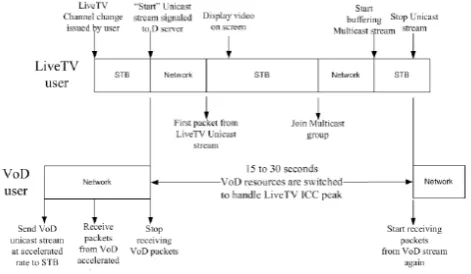
Figure 3: Live TV ICC and VoD Packet buffering timeline
[image:5.595.312.548.410.547.2]will stop receiving video on demand packets [14]. Around 15 to 30 seconds it takes for video on demand resources which are switched to handle live TV ICC peak then the process continues it will again start receiving packets from video on demand stream again in the network [7].
VII.CONCLUSION
Despite the fact that reception of Cloud figuring stages as application provisioning situations has a few advantages, there are still complexities impeding the smooth provisioning and conveyance of utilization administrations in such situations. To counter those complexities identified with application provisioning over Clouds, this paper displayed a versatile provisioning system for conveyance of assets to SaaS applications. The instrument utilizes scientific execution (queueing framework model) and workload data to drive choices of an application provisioner. The proposed methodology has the capacity show the framework utilizing just data that IaaS suppliers make accessible to clients and observing information from running VMs. The model's objective is to meet quality of service targets identified with administration time and dismissal rate of solicitations and usage of accessible assets [8]. Our paper gave summed up system to registering the measure of assets expected to bolster numerous administrations with due dates. We figured the issue as a general streamlining issue and figured the quantity of servers presupposed by nonspecific expense capacity. We considered various structures for the expense capacity (e.g., min-max, curved what's more, inward) and explained for the ideal number of servers that are obliged to bolster these administrations without missing any due dates [15].
VIII.REFERENCES
[1]. Qingling Wang; Varela, C.A., "Impact of Cloud
Computing Virtualization Strategies on Workloads' Performance," Fourth IEEE International Conference on Utility and Cloud Computing (UCC)- 2011, vol., no., pp.130,137, 5-8 Dec. 2011.
[2]. J.Vijaya Chandra, Dr.NarasimhamChalla and
Dr.Mohammed Ali Hussain,“Data and Information Storage Security from Advanced Persistent Attack in Cloud Computing”, pp.7755-7768,International Journal of Applied Engineering Research, Volume 9, Number 20(2014).
[3]. Salapura, V., "Cloud computing: Virtualization and resiliency for data center computing," IEEE 30th International Conference on Computer Design (ICCD)- 2012, pp.1,2, Sept. 30 2012-Oct. 3 2012.
[4]. Haikun Liu; Bingsheng He, "VMbuddies:
Coordinating Live Migration of Multi-Tier Applications in Cloud Environments," IEEE Transactions onParallel and Distributed Systems, vol.26, no.4, pp.1192-1205, April 1 2015.
[5]. Theng, D.; Hande, K.N., "VM Management for
Cross-Cloud Computing Environment," International
Conference on Communication Systems and Network Technologies (CSNT) -2012 , pp.731,735, 11-13 May 2012. [6]. J.Vijaya Chandra, Dr. Narasimham Challa, Dr. Sai Kiran Pasupuleti, Dr. K. Thirupathi Rao, Dr. V. Krishna Reddy, “Numerical Formulation and Simulation of Social Networks Using Graph Theory on Social Cloud Platform,” pp. 1253-1264, Global Journal of Pure and Applied Mathematics, Volume 11, Number 2(2015).
[7]. Acharya, S.; D'Mello, D.A., "A taxonomy of Live Virtual Machine (VM) Migration mechanisms in cloud computing environment," International Conference on Green Computing, Communication and Conservation of Energy (ICGCE) - 2013 , pp.809,815, 12-14 Dec. 2013.
[8]. Sahal, R.; Omara, F.A., "Effective virtual machine configuration for cloud environment," 9th International Conference onInformatics and Systems (INFOS), 2014, pp.PDC-15 toPDC-20, 15-17 Dec. 2014.
[9]. Celesti, A.; Tusa, F.; Villari, M.; Puliafito, A., "Improving Virtual Machine Migration in Federated Cloud Environments," Second International Conference on Evolving Internet (INTERNET)-2010, pp.61-67, 20-25 Sept. 2010. [10]. Calheiros, R.N.; Ranjan, R.; Buyya, R., "Virtual Machine Provisioning Based on Analytical Performance and QoS in Cloud Computing Environments," International conference on Parallel Processing (ICPP) – 2011, pp.295-304, 13-16 Sept. 2011.
[11]. V. Krishna Reddy, B. Thirumal Rao, L.S.S. Reddy, P. Sai Kiran “Research Issues in Cloud Computing” Global Journal of Computer Science and Technology, Volume 11, Issue 11, July 2011.
[12]. G.Ranjith, J.Vijayachandra, P.Sagarika, B.Prathusha, “Intelligence Based Authentication-Authorization and Auditing for Secured Data Storage”, International Journal of Advances in Engineering & Technology, Vol8, issue 4, PP 628-636, August 2015.
[13]. Jinzhao Liu; Yaoxue Zhang; Yuezhi Zhou; Di Zhang; Hao Liu, "Aggressive Resource Provisioning for Ensuring QoS in Virtualized Environments," IEEE Transactions on Cloud Computing, vol.3, no.2, pp.119,131, April-June 1 2015.
[14]. En-Hao Chang; Chen-Chieh Wang; Chien-Te Liu;
Kuan-Chung Chen; Chung-Ho Chen, "Virtualization Technology for TCP/IP Offload Engine," IEEE Transactions on Cloud Computing, vol.2, no.2, pp.117,129, April-June 2014.
[15]. Chiang, R.C.; Rajasekaran, S.; Nan Zhang; Huang,