E-Connecting Balkan Languages
Cvetana KrstevFaculty of Philology University of Belgrade [email protected]
Ranka Stankovi! Faculty of Mining and
Geology University of Belgrade
Duško Vitas Faculty of Mathematics
University of Belgrade [email protected]
Svetla Koeva Dep. of Computational
Linguistics Institute for Bulgarian
Abstract
In this paper we present a versatile language processing tool that can be successfully used for many Balkan languages. For its work, this tool relies on several sophisticated textual and lexical resources that have been developed for most Balkan languages. These resources are based on several de facto
standards in natural language processing.
Keywords
Query expansion, e-dictionaries, wordnets, proper names, aligned texts
1.
Introduction
The software tool WS4LR (shortened for WorkStation for Language Resources) has been developed by the Language Technology Group organized at the Faculty of Mathematics for several years now. Its first version was introduced in 2004 [8] and it dealt mainly with harmonizing various heterogeneous lexical resources. Subsequently, many new features have been added, particularly those that have helped in the production and exploration of aligned texts on the basis of the lexical resources incorporated [9]. The new tool WS4QE (shortened for Work Station for Query Expansion) was developed on the basis of WS4LR that enables the expansion of queries submitted to the Google search engine [10]. The integrated lexical resources enable modifications of users’ queries for both monolingual and multi lingual searches.
When presenting WS4LR and WS4QE, we have always stressed that, although they have been mainly used for Serbian, they are by no means language dependent as long as compatible lexical resources exist for any two languages. Nevertheless, the full potential of these tools was until now used only for Serbian, and in bilingual context, for Serbian and English.
In this paper we will show that the tools WS4LR and WS4QE are truly independent both from Serbian, for which they were initially developed, and from English which seems to be in the background of many natural language processing tools. The main presupposition for the usage of these tools for other languages is the existence of textual and lexical resources developed in the same methodological framework. Since this prerequisite has been satisfied for Bulgarian, and, to some extent, for some other Balkan languages (Greek, Romanian, etc…), we will
therefore show that WS4LR and WS4QE can be successfully used for these languages.
WS4LR, written in C#, is organized in modules which perform different functions. The core of the system WS4LR_Core comprises four .Net libraries, used by two components: the stand-alone windows application WS4LR.exe and the web service wsQueryExpand.asm. Web application WS4QE.asp manages user query request, than uses web service in order to expand user query, submits the expanded query to Google search engine and finally presents retrieved result.
2.
Integrated Language Resources
In order to prove the usability of WS4LR and WS4QE for languages other than Serbian and English, we have used various resources, both textual and lexical. In the following sections we will briefly present these resources, what methodological framework was used for their development, and how they were integrated for their successful usage.
2.1
Textual Resources – Aligned Texts
The aligned texts as a special form of multilingual corpora were the focus of many projects in the past few decades. A systematic approach to the development of multilingual corpora was initiated within the Multext project, which subsequently included East-European languages through the Multext-East project [5]. In the meantime, many multilingual corpora have been compiled from large corpora, usually fully automatically prepared, which have a range comprised from texts in the limited technical domain [18] to more versatile literary corpora [5] that are often more modest in size but minutely prepared.Versions of the novel in fifteen different languages have been acquired, but not all of these texts have yet been aligned. Among the already aligned texts are the French original and translations in English and four Balkan languages – Serbian, Bulgarian, Greek, and Romanian.
In the preparatory phase each translation was marked in accordance with the TEI-standard in XML, and the title (<head>), paragraph (<p>) and segments (<seg>) were included as units of a text logical layout. At the beginning of the alignment process, all segments coincided with sentences automatically tagged by Unitex. The XAlign system [1] was used for the alignment process. Starting from the French version, the goal of the alignment was to establish 1:1 relations with all other languages on the segmental level. In order to achieve this goal and after manually checking all aligned segments, some of them had to be divided into smaller units, and some were grouped into larger units. Thus, we arrived at the total of 4,409 segments in all texts. This way, the missing segments or the inconsistencies between the source text and its translations were identified in most of the cases. In the following example the English segment is given only for the sake of translation.
<tu id=" n2941"> <seg lang="en">
<s id="Verne80days.n2941">
Between Omaha and the Pacific, the railway crosses a territory which is still infested by Indians and wild beasts, and a large tract which the Mormons, after they were driven from Illinois in 1845, began to colonise.</s></seg>
<seg lang="fr">
<s id="Verne80days.n2941">
Entre Omaha et le Pacifique, le chemin de fer franchit une contrée encore fréquentée par les Indiens et les fauves, -- vaste étendue de territoire que les Mormons commencèrent à coloniser vers 1845, après qu'ils eurent été chassés de l'Illinois.</s></seg> <seg lang="sr">
<s id="Verne80days. n2941">
Izme"u Omahe i Tihog okeana pruga prolazi kroz predeo u kome još ima Indijanaca i divljih zveri - prostranu zemlju koju su po#eli naseljavati mormoni oko 1845. godine, kada su ih prognali iz države Ilinois.</s> </seg>
<seg lang="bg">
<s id="Verne80days. n2941">
$%&'( )*+,+ - .-,-/ 01%+2 &%3%405672+7+ 3-2-/ 58%109/:+ 8+;02, :9% 0<% 2+9%3/:+2 07 -2'-+2=- - '-:- 4:%80:%. .0:+ % 0>?-82+ 7%8-708-/, 10/70 *08*02-7% 9+ 4+50@2+3- '+ 10302-4-8+7 01030 1845 A., 93%' 1+70 9+ >-3- 580A02%2- 07 <+7+ B3-20;9.</s></seg>
<seg lang="gr">
<s id="Verne80days. n2941">
CDEµFGH GIJD KµELH MHN GIOD PNQJDNMR, IO IQSDO TNHGLUVFN WFQNOLSX RWOY GYLDEVOYD HMRµH ZDTNEDON MHN H[QUµNH -IFQEGINH FTH\NM] SMIHGJ IJD OWOUH HQLNGHD DH HWONMUVOYD ON µOQµRDON µFIE IO 1845, OWRIF MYDJ[]^JMHD HWR IO Z_NDRNX.</s></seg>
<seg lang="ro">
<s id=" Verne80days.n569">
între Omaha `i Pacific drumul de fier trece printr-o regiune populatã încã de indieni `i fiare, - vastã întindere pe care mormonii au început s-o colonizeze pe la 1845 dupã ce au fost izgoniai din Illinois.</s>
</tu>
2.2
Morphological Dictionaries in LADL
Format
Morphological dictionaries are a necessary resource in various phases of the automatic analysis of a text. The tool WS4LR expects morphological dictionaries to be in the format known as DELAS/DELAF presented in [2] that was developed in LADL (Laboratoire d'Automatique Documentaire et Linguistique) under the guidance of Maurice Gross. The format of a DELAS-type dictionary basically consists of simple word lemmas accompanied with inflectional class codes which allow for the production of a DELAF-type dictionary, which consists of all inflectional forms with their grammatical information. In the Unitex environment, one finite-state transducer responsible for the generation of all inflectional forms of each DELAS lemma corresponds to each inflectional class code. The Serbian morphological dictionary of simple words contains 121,000 lemmas which yield the production of approximately 1,450,000 different lexical words. Close to 87,000 simple lemmas belong to the general lexica, while the remaining 34,000 lemmas represent various kinds of simple proper names [11]. The Bulgarian Grammar dictionary (DELAS dictionary) consists of 127,000 lemmas distributed as follows: app. 85,000 simple lemmas belong to the general lexis, app. 6,000 lemmas represent domain specific lexis and app. 36,000 lemmas are simple proper names. The corresponding DELAF dictionary consists of app. 1,260,000 entries [7].
2.3
Semantic Networks - Wordnet
the lexicalization of concepts in various languages and the way which they are connected.
The Serbian wordnet today consists of more than 15,000 synsets built by app. 25,000 literals. All of them are linked to PWN, except for 532 Balkan specific concepts that are connected with other Balkan languages, and 155 Serbian specific concepts that remain unconnected with other languages. The Bulgarian wordnet consists of more then 31,000 synsets built by more than 66,000 literals. The synsets are linked with the PWN as well; again there are 436 Balkan specific concepts shared with other Balkan languages and 182 Bulgarian language specific concepts. Both Serbian and Bulgarian wordnets, as well as wordnets for other Balkan languages, are represented in WS4LR using common XML schema.
2.4
The Prolex Database
The Prolex project was initiated in the 1990’s with the study of toponyms in French and had the aim of appropriately processing proper names in natural language applications [16]. This work was followed by the development of a Serbian version, which finally led to the design and construction of a relational multilingual dictionary of Proper Names, the Prolexbase, in the form of a relational database [19]. This model is based on two main concepts: the pivot (that represents the conceptual proper name) at a language independent level and the prolexeme (the projection of the pivot onto a particular language) which is a set of lemmas that includes the name, but also its aliases (variations in orthography, abbreviated forms, acronyms, etc.) and its derivatives. For instance, if a meronymy relation is established between the concepts “New York” and “the United States of America”, then their Serbian Latin equivalents Njujork and Sjedinjene Ameri!ke Države, their Serbian Cyrillic equivalents "#$%&' and
($)*+,)-) ./)&+0') 1&234), and their Bulgarian
equivalents 567%&' and (8)*+-)-+3/)&+'3-9'+:3;+ are all connected automatically.
3.
Using WS4LR with Aligned Texts
The WS4LR module that works with aligned texts expects them to be in the Translation Memory eXchange (TMX) format1. It can transform texts previously aligned by
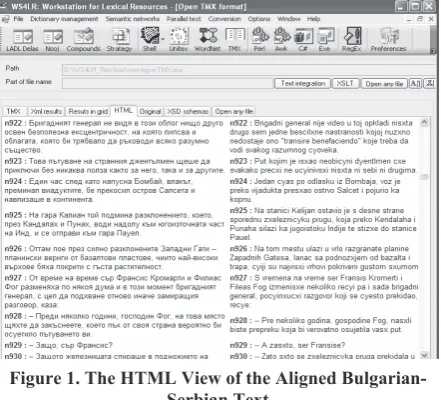
XAlign into this format as well as into several other formats: textual, XML and tabular. This is particularly important since XAlign has been integrated into Unitex software starting from its version 2.1. In addition, the user can also produce various visualizations of aligned texts by applying appropriate XSLT transformations. Thus, the user can freely browse with such visualized texts. One such visualization is represented in Figure 1.
1 For details on TMX format see
http://www.lisa.org/tmx/tmx.htm
Browsing, however, is not a particularly successful form of text exploration. The WS4LR module for aligned texts offers the user the ability to posit different forms of queries that can be automatically expanded by using various bilingual lexical resources presented in the previous section. WS4LR offers the user the possibility to expand the query not only morphologically and semantically, but also to another language. If the first language is Serbian, the second language can be English, Bulgarian, or any other. A user can choose two working languages by adjusting the parameters in the “Preferences” menu of WS4LR. Besides this, WS4LR provides further possibilities for the user to control their query formulation, since in addition to expansion it also offers the query to be narrowed. Namely, a user can reject some of the automatically offered query expansions.
[image:3.595.316.537.296.496.2]
Figure 1. The HTML View of the Aligned Bulgarian-Serbian Text
checking the box “Semantic extension” in this form and by choosing the appropriate resource (Wordnet in this case), while the bilingual expansion is obtained by checking the box “Another language extension”.
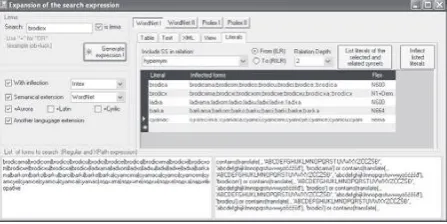
[image:4.595.312.536.116.481.2]In the same form, the user can choose to morphologically inflect all chosen keywords in both languages. If he or she wishes to do so the box “With inflection” should be checked. Morphological expansion is performed by Unitex modules that use morphological dictionaries of simple words as well as inflectional transducers. This options works only if a particular query keyword is listed in the morphological dictionary of the corresponding language. If this is not so, the aligned text will be searched only with the original keyword. As shown in Figure 2, the automatically added inflected forms of chosen keywords are presented in an editable form in which some of these inflected forms can be deleted or modified. For instance, the Serbian word put “path” has two plural forms: putevi and puti. The second one is restricted to poetical usage and a user can choose to delete it from the expended query if the working text is not of that kind.
Figure 2. The original query keyword glava is shown in the upper left corner. The chosen query expansions are shown on the left side. The query expended by the Bulgarian wordnet is
shown on the right side, together with the automatically obtained list of inflected forms that can be edited. The two
fields at bottom show the final query set.
Finally, when a query is launched, the result is obtained with all the retrieved occurrences highlighted (see Figure 3).
[image:4.595.314.537.122.283.2]The query can be further semantically expanded by the choice of a particular semantic relation (e.g. hypernymy/hyponymy), in which case synsets pertaining to hypernyms/hyponyms of concepts from the initial group will also appear among the query set. This feature will be illustrated by a query which starts with the Serbian keyword brodi>“small boat”. We would like to perform a bilingual search with a semantic expansion. The chosen Serbian keyword belongs to only one synset {brodica:1, brodi!:1} whose corresponding Bulgarian synset is {30'1+:1, 3+'-/:1}. Figure 4 shows that these synsets are deep in the hypernymy/hyponymy hierarchy. In such a situation, expending query with hypernym synsets can be useful.
Figure 3. Some representative examples of aligned segments with the keywords glava and !"#$# and their inflectional
[image:4.595.313.531.295.455.2]forms in HTML format.
Figure 4. The hypernym/hyponym wordnet hierarchy of the Bulgarian synset {!"#$%:1, !%#&':1}. The corresponding
Serbian synset belongs to a similar tree.
Figure 5. shows the query expansion form in which the original query brodi> is expanded, not only with a literal from its corresponding synset brodica, but also with the literals from synsets belonging to the hypernym branch of the length two, that are {barka:1, #amac:1, #un:1} “boat” and {la"a:1} “vessel”.
Figure 5. In the query expansion form, the user can choose the type of semantic relation for the expansion and the length of
[image:4.595.71.292.365.463.2] [image:4.595.316.540.560.672.2]Since in this case a bilingual search is initiated, the user can perform the same semantic expansion for the second language, presented in Figure 6. The two Bulgarian literals thus obtained are ?=343;)=)-98* and /3=8''%&3@ which are multi-word units. Since inflection of multi-word units for Bulgarian is not yet integrated in WS4LR, as will be explained in the final section, the user can choose to delete it from the final query set or to keep only the nouns 98* and '%&3@, as we have done in our example search.
Figure 6. The semantic expansion in the second language – Bulgarian – using hypernym relation
The results obtained by this query are very interesting and, show the potential this tool offers for various linguistic and literary researches on their own. This query retrieved 129 aligned segments, each of which contained at least one of the keywords from the produced query set in at least one of the languages. It comes as a surprise that only 8 of these segments contained query keywords in both languages. This is mainly due to the fact that adjectives ?=343;)=)-and /3=8'were omitted from the Bulgarian keywords thus broadening the query on the Bulgarian side too much. There were 5 segments with the keyword 98*, with two occurrences of ?=343;)=)- 98* “vessel”; none of them corresponded to the Serbian wordnet equivalent laAa. There were also 90 occurrences of '%&3@ among which there was not one /3=8''%&3@; in this case, however, the Serbian equivalent for '%&3@ was almost unmistakably brod, as suggested by both wordnets.
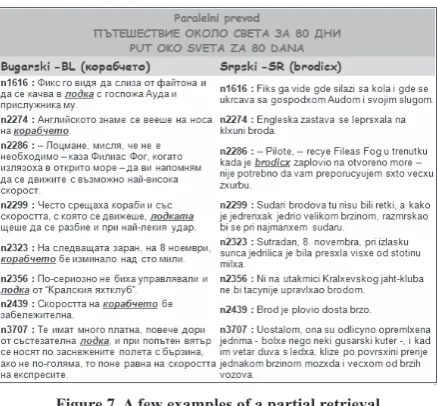
Figure 7 shows some examples of a partial retrieval. The first (n1616) and third (n2286) segments in this sample occur due to the fact that the reference to a “boat” is missing in one of the languages. The other segments show that the Serbian brod, besides corresponding to the English ship and the Bulgarian '%&3@, is also a generic notion and should probably be added to the hypernym synset (segments n2274, n2356 and n2439). On the other hand, Serbian jedrilica and jedrenjak “sailing vessel” are translated in Bulgarian with the “sister” synsets '%&3@ or '%&3@0) instead of using a more specific Bulgarian word ?=3;-%B%* (segments n2299 and n2323). In the last example (n3707), in Bulgarian a rather arbitrary choice =%*'3 is made for a more specific type of a vessel referred to in Serbian as kuter “cutter”.
Figure 7. A few examples of a partial retrieval
Figure 8 shows eight examples of the full retrieval. In one of these examples (n1972) for the Serbian !amac the near synonym in Bulgarian '%&3@0);% is used (as determined by wordnets). In two cases (n2267 and n2294) for the Serbian brodi> the near hypernym '%&3@0);% is used, while in five cases (n514, n518, n586, n3827, n4049) for the Serbian !amac and barka the near hyponym =%*'3 is used. This is not an unexpected result; rather it only proves that searching with the help of semantic networks, on the web for instance, can be useful, which is the ultimate goal of our experiments.
Figure 8. All occurrences of a full retrieval
[image:5.595.71.295.221.330.2]is performed in the same way, using the same methods as for common words. In the given example, the query expansion for Serbian gives more results since the Prolex database for Bulgarian has only some sample entries.
Figure 9. Prolex based semantic expansions
4.
Additional Possibilities
We have illustrated the functions of WS4LR for working with aligned texts in the previous section by using the Serbian and Bulgarian pair. This can be successfully used for other Balkan languages as well. Wordnets have been being developed through the Balkanet project for Greek, Romanian and Turkish, which have enabled the experiments to have semantic query expansions for those languages as well. For Greek [12] and Romanian [3], morphological dictionaries in the LADL format have also been developed – however, these resources were not at our disposal so we have not been able to experiment with morphological expansion for these languages.
The possibility and the need for some of the functions developed within WS4LR to become available also on the web have led to the development of the WS4QE web application for lexical resources. This application is still under development, but some of its functions can already be used. Numerous user functions are envisaged for this tool, but the largest set is related to the expansion of queries submitted to the Google search engine, and they have already been implemented. In fact, they are very similar to those presented in the previous section. The only difference is that expanded queries are not applied to an aligned text but are rather forwarded to the search engine.
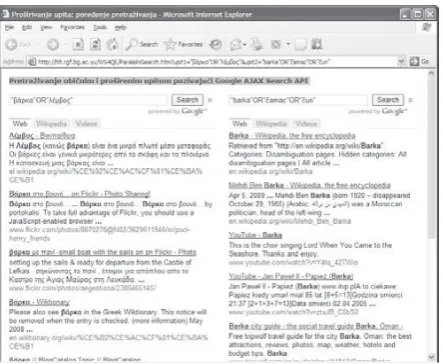
Figure 10 shows such a retrieval that starts with the Serbian keyword barka “boat” and is further expended by the Serbian synset {barka:1, #amac:1, #un:1} and Greek corresponding synset {bEQMH:0, _SµbOX:0}. Figure 11 represents the first results retrieved with such an expanded query by Google.
Figure 10. A bilingual query expansion with WS4QE –
An example of Serbian and Greek
5.
Further Work
[image:6.595.71.299.174.309.2]Our main concern for our future work is the adequate processing of multi-word units. That is, we would like our tool to treat multi-word units in the same way as simple words and to inflect them correctly upon request. The first version of this approach was presented in [10]. Although this version gave promising results for Serbian, it was hardwired into the tool itself so that it was not easy to modify the Serbian module or to apply it to other languages. With a new approach that relies on the feature structure description of a particular language’s morphology [6] and widely uses XML technology, the portability to other languages will be much easier [17]. On a more practical level, our aim is enrich our lexical resources, first of all to enrich the Prolex database, as we plan to use it in a translation environment [14]. It is our wish to work in a future with a true aligned Balkan text – that is, a text originally written in a Balkan language and translated into other Balkan languages.
[image:6.595.315.537.506.688.2]6.
References
[1] P. Bonhomme, T. M. H. Nguyen, S. O’Rourke. XAlign: l’aligneur de Langue & Dialogue,
http://www.loria.fr/equipes/led/outils/ALIGN/align.html, 2001.
[2] B. Courtois, M. Silberztein (eds.). Dictionnaires électroniques du français. Langue française. 87, Larousse, Paris, 1990.
[3] D.-M. Dimitriu. Grammaires de flexion du roumain en format DELA, Rapport interne 2005-02 de l’Institut Gaspard-Monge, CNRS, 2005.
[4] T. Erjavec and N. Ide. The MULTEXT-East Corpus. In
LREC’98, Granada, pp. 971-974, 1998.
[5] A. Gelbukh, G. Sidorov, J.-A. Vera-Félix.ABilingual CorpusofNovelsAlignedat ParagraphLevel.In proc.
FinTAL-2006.LectureNotesin ArtificialIntelligence,no. 4139,Springer-Verlag,pp.16–23,2006.
[6] ISO 24610. Language resource management – Feature Structures, ISO/TC 37/SC 4, 2005.
[7] S. Koeva. Modern language technologies – applications and perspectives, in: Lows of/for language, Hejzal, Sofia, 2004, 111- 157, 2004.
[8] C. Krstev, et al. Combining Heterogeneous Lexical Resources, in Proc. of the Fourth International Conference LREC, Lisbon, Portugal, May 2004, vol. 4, pp. 1103-1106, 2004.
[9] C. Krstev, R. Stankovi!, D. Vitas, I. Obradovi!. WS4LR: A Workstation for Lexical Resources, Proceedings of the 5th International Conference on Language Resources and Evaluation, LREC 2006, Genoa, Italy, May 2006, pp. 1692-1697, 2006.
[10] C. Krstev, R. Stankovi!, D. Vitas, I. Obradovi!, The Usage of Various Lexical Resources and Tools to Improve the Performance of Web Search Engines, in Proceedings of the Sixth Interantional Conference on Language Resources and Evaluation (LREC'08), Marrakech, Morocco, 28-30 May 2008, European Language Resources Association (ELRA), 2008.
[11] C. Krstev. Processing of Serbian, Faculty of Phylology, University of Belgrade, Belgrade, 2008.
[12] T. Kyriacopoulou. Les dictionnaires électroniques: Morphologie et syntaxe. Le cas du grec moderne,
Proceedings AILA 1990, Chalcidique, 1990.
[13] E. Laporte, T. Nakamura, S. Voyatzi. A French Corpus Annotated for Multiword Nouns, in: Towards a Shared Task for Multiword Expressions (MWE 2008), in scope of the
Sixth Interantional Conference on Language Resources and Evaluation (LREC'08),
http://multiword.sourceforge.net/download/MWE2008-papers/8_Laporte.pdf, 2008.
[14] D. Maurel, D. Vitas, C. Krstev, S. Koeva. Prolex: a lexical model for translation of proper names. Application to French, Serbian and Bulgarian, in Bulag - Bulletin de Linguistique Appliquée et Générale, Les langues slaves et le français : approches formelles dans les études contrastives, eds. A. Dziadkiewicz & I. Thomas, No. 32, pp. 55-72, Presses Universitaires de Franche Comté, Besançon, 2007.
[15] S. Paumier. Unitex 2.1 User Manual, http://www-igm.univ-mlv.fr/~unitex/UnitexManual2.1.pdf, 2008.
[16] O. Piton, D. Maurel. Beijing frowns and Washington takes notice: Computer Processing of Relations between Geographical Proper Names in Foreign Affairs, Fourth International Workshop on Applications of Natural Language to Data Bases (NLDB'00), Versailles, 28-30 juin (Actes p. 66-78), 2000.
[17] R. Stankovi!. Improvement of Queries using a Rule Based Procedure for Inflection of Compounds and Phrases. Polibits (37) 2008, Special section: Natural Language Processing, Journal of Research and Development in Computer Science and Engineering, ed. Grigori Sidorov, Centro Innovación y Desarrollo Tecnológico en Computo, Instituto Politécnico Nacional, Mexico, pp. 14-20, 2008.
[18] R. Steinberger,B. Pouliquen,A. Widiger,C. Ignat, T. Erjavec,D. Tufi`. 2006. The JRC-Acquis: A multilingual aligned parallel corpus with 20+ languages. In Proceedings of the 5th LREC Conference, Genoa, Italy, 22-28 May, 2006, pp.2142-2147, 2006.
[19] M. Tran, D. Maurel. Prolexbase : Un dictionnaire relationnel multilingue de noms propres, Traitement automatique des langues, Vol. 47-3, 2006.
[20] D. Tufi` (ed.). Special Issue on BalkaNet Project, Romanian Journal on Information Science and Technology. Bucure`ti: Publishing house of the Romanian academy, Vol. 7, No.1-2, 2004.
[21] D. Tufi`, S. Koeva, T. Erjavec, M. Gavrilidou, and C. Krstev. Building Language Resources and Translation Models for Machine Translation focused on South Slavic and Balkan Languages. In M. Tadi!, M. Dimitrova-Vulchanova and S. Koeva (eds.) Proceedings of the Sixth International Conference Formal Approaches to South Slavic and Balkan Languages (FASSBL 2008), pp. 145-152, Dubrovnik, Croatia, September 25-28, 2008.