Volume 6, No. 3, May 2015 (Special Issue)
International Journal of Advanced Research in Computer Science
RESEARCH PAPER
Available Online at www.ijarcs.info
ISSN No. 0976-5697
A Cram on Semantic Web Components
J.Sirisha
Research Scholor, Krishna University & Asst. Professor
Department of IT,
PVP Siddhartha Institute of Technology Kanuru, Vijayawada.
e-mail: [email protected]
B.V.SubbaRao
Professor Department of IT,PVP Siddhartha Institute of Technology Kanuru, Vijayawada.
e-mail:[email protected]
D.Kavitha
Sr.Asst. Professor Department of IT,PVP Siddhartha Institute of Technology Kanuru, Vijayawada.
e-mail:[email protected]
Abstract: Semantic web, also known as next generation web (web 3.0) is one of prominent research areas for modern researchers .It is a web with a meaning and is defined as an extended web of machine-readable information and automated services. The objective of the Semantic web Architecture is to provide a knowledge representation of linked data in order to allow machine processing on a global scale. To make this feasible we depend upon semantic web Components, Tools, Technologies, Processes etc. In this paper we have discussed about Semantic Web Services, Semantic Web Search Engines and Application areas.
Keywords: Semantic Web, Semantic Web Services, Semantic Web Search Engine
I. INTRODUCTION
The semantic web is a web capable of understanding the content of web pages. Semantic Web technology facilitates information search, retrieval, representation, extraction, interpretation and maintenance. The main building blocks of the semantic web are Resource description Framework (RDF), Web Ontology language (OWL) and Rule based Markup language (Rule-ML). RDF mainly describes the available resources on the web portal[1]. We have so many numbers of Languages like XML, XML-Schema, DAML (DARPA Agent Markup Language) and OWL used for interpreting the description about the contents of the web where the OWL is specifically used to generate ontologies. Ontology provides an explicit conceptualization for entries in a specific field. RuleML is the open language standard for Rule interchange or rule markup. It enables rule translation, execution and publication in RDF and XML. Rule ML specifies queries and inferences in Web ontologies, mappings between Web ontologies, and dynamic Web behaviors of workflows, services, and agents. Components of semantic web include web services, search engines, web portals, mark –up tools, applications etc.
In this paper we survey the state of the art of current enabling technologies related to the Semantic Web. In this paper we discuss about the some of the components like semantic web services, Semantic Web Search Engines and application areas related to semantic web. In order to publish and consume semantic web content in various semantic application areas we make use of semantic web services. Semantic web services combine conventional web services communication technology to the intelligent processing of ontology based metadata by making use of the Resource description Framework (RDF), web ontology language (OWL). Semantic search engines retrieve knowledge from the structured data sources like ontologies. The rest of the paper is structured as follows: Section 2 provides information about available web services for the traditional web and their usage. Section 3 describes about
approaches for semantic web services and we also compare and analyzed those approaches. Section 4 provides a brief introduction to various search engines related to semantic web and Section 5 provides Application areas associated with semantic web.
Semantic web components
Semantic Web Services(SWS)
Semantic Web Search Engines
Semantic Web Application
Areas
IRS OWL-S WSMF
Ontology Search
Engine Semantic Search Engine Knowledge Management Social Networking
E-based Applications
(Approaches for SWS Frameworks)
Figure 1. Semantic Web Components
Web Services: In General web service is a standalone component or a software system identified by a URI (Uniform Resource Identifier), whose public interfaces and bindings are defined and described using XML. These services mainly aim at Information access and E-Business and classically consumed by software agents and web applications.
[3] Web services have become a standard way of implementing Service Oriented Architectures The available basic web service platform elements are :
SOAP (Simple Object Access Protocol), based on XML for accessing a web service and provides an exchange of structured information between the applications in a distributed environment. It Enables the creation of web services. SOAP developed in 1998 by Microsoft SOAP became a W3C Recommendation from 24. June 2003 [7].
WSDL (Web Services Description Language) is an XML-based language for locating and describing network or web services and enables the communication in a structured and organized way by making use of XML grammar. In general the WSDL file acts like a contract between the client and the service for the effective communication between the wo parties. WSDL was developed by IBM in 2000 and recommended by W3C in 2007 [4,6].
UDDI (Universal Description Discovery and Integration) was developed in 2000.It is a common registry or a directory where we register information about web services and technical interfaces that may be used to access those services. These interfaces are based on XML and SOAP and uses HTTP to interact with the registry. It also provides the services supporting the description and discovery of businesses, organizations and other web service providers [5].
Pitfalls of current web services are :
i) We don‟t have any semantically marked up content / services
ii) Web Service usability, usage, and integration needs to be inspected manually
Semantic Web Services :
The next Web generation promises to deliver Semantic Web Services (SWS): Services that are self-described and amenable to automated discovery, composition and invocation.
Semantic services are a component of the semantic web, because they use markup which makes data machine-readable in a detailed and sophisticated way. Semantic web services are built around universal standards for the interchange of semantic data, which makes it easy for programmers to combine data from different sources and services without losing meaning. Web services can be activated "behind the scenes" when a web browser makes a request to a web server, which then uses various web services to construct a more sophisticated reply than it would have been able to do on its own [8].
Functionalities of Semantic web services are:
i) Defining exhaustive description frameworks for describing Web Services and related aspects
ii) Preparing support ontologies as the underlying data model to allow machine supported data interpretation iii) Defining semantically driven technologies for automation of the Web Service usage process [9].
The activities required for running an application using SWS include: publication, discovery, selection, composition, mediation, and execution.
Publication: Make the description of a Web Services available on the Web
Discovery : Detect suitable services for a
Solving given task
Selection: Choose the most appropriate services among the usable ones
Composition: Combine services to achieve a Goal
Mediation: Solve mismatches (data, protocol, process) among the elements that shall interoperate Execution: Invoke services according to
consumption interface and programmatic conventions [12]
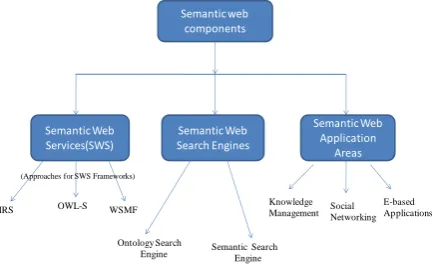
We have three approaches that force the growth of Semantic Web Services (SWS) frameworks. They are IRS ( Internet and Reasoning Service), OWL-S (Ontology Web Language for services) and WSMF (Web Service Modeling Framework).
Figure 3. SWS Approaches
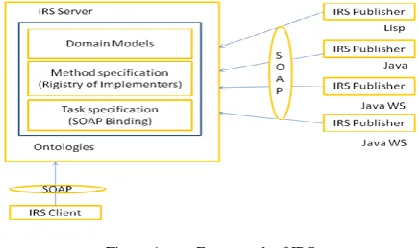
The Internet Reasoning Service (IRS) Approach: is a semantic web service framework which allows applications to semantically describe and execute web services .The overall framework of the IRS is shown in figure 1. The main components are the IRS Server, the IRS Publisher and the IRS Client. These components communicate through SOAP [10,11].
Figure 4. Framework of IRS
The IRS Publisher plays two roles in the IRS framework. Firstly, it links Web services to semantic descriptions within the IRS server. Secondly, it automatically generates a wrapper which allows any standalone language Lisp or Java code to be invoked as well as a Web service through its WSDL(Web Service Description Language) description.
IRS Client , a key feature of IRS is that Web service invocation is capability driven.The IRS Client supports this by providing an interface and a set of APIs which are task centric. An IRS user simply asks for a task to be achieved and the server selects and invokes an appropriate Web service.
OWL-S Approach: This approach is based on Artificial Intelligence setting and consists of a set of ontologies designed for describing and reasoning over service descriptions. OWL-S blends the expresses of description language and its simplicity established in the emerging web service standards, to describe services that can be expressed semantically. The OWL-S is originated around three interrelated sub-ontologies: ServiceProfile, ServiceModel and ServiceGrounding.
Figure 5. Sub Ontologies in OWL_S approach
The ServiceProfile describes „what the service does‟. This description is essential if an agent is to determine whether or not the service meets its need. The ServiceModel explains „how a service works‟. This is a process model which describes how to use the service, how to ask for it and what happens when the service is carried out. The ServiceGrounding gives the details of how a service requester agent can interact with a service. Additionally it must specify for each semantic type of input or output specified in the Service Model [14,15].
Web Service Modeling Framework (WSMF) Approach: This framework provides a model for describing the diverse aspects related to the web services. Its main purpose is to make e-commerce possible by applying semantic web technology to web services.WSMF is the product of research on modeling of reusable knowledge components. This framework is based on a strong de-coupling of various components that realize an e-commerce application and a strong mediation service to communicate in a scalable manner.
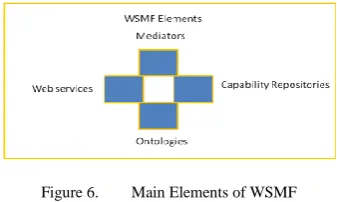
The four main elements of WSMF are:
i) Ontologies that offer the terminology used by other elements
ii) Target or capability repositories that define the problems to be tackled by web services
iii) Web services metaphors that define facets of a web service
iv) Mediators who bypass interoperability problems
Figure 6. Main Elements of WSMF
All the above three approaches represent different development advances which meets the same objective. They provide different reasoning support which are based on different logic and ontology frameworks.IRS has strong user and application integration support while OWL-S supports a high XML based service ontology WSMF has a comprehensive conceptual architecture required for e-business[15,16]
The Internet Reasoning Service (IRS-II) is knowledge based approach , which evolved from research on reusable knowledge component. OWL-S is fundamentally an ontology based agent-Oriented for describing Web service capabilities. Web Service Modeling Framework (WSMF) is a business –Oriented approach focusing on a set of e-commerce requirements for web services including trust and security[17].
Semantic Web Search Engines :
The search engine is a tool which helps in retrieving information from the Internet. Traditional search engines do not provide a precise result because they do not concern polysemy and synonymy of data while processing the information.
Most web search engines are based on purely statistical techniques. While they are not able to figure out the meaning of a query, they can provide answers by returning the statistically most appropriate answer to a user‟s query. In contrast to it semantic web search engines allow us to retrieve meaningful information and capable of answering intelligent queries from the users. SWSE operates over RDF Web data also known as Linked Data and supports intelligent retrieval. It improves search accuracy by understanding user intention and the contextual meaning of terms as they appear in the dataspace to generate more relevant results [19].
Semantic search integrates the technologies of the Semantic Web and Search engine to improve the search results.
Semantic search engine stores semantic information about Web resources and is able to solve complex queries. Research queries will benefit from semantic search [18]. Based on the ontologies and semantics related to data provided by the user we have two types of search engines, They are:
1. Ontology search engines 2. Semantic search engines
These search engines make the current search engine more “semantic” / “intelligent” by adding meaning and structure to web pages and queries. They Map Web pages/objects to a knowledge base relative to ontology. In the process of ontology based Information Retrieval the user poses a question to the system and the system answers the question using knowledge formalized in a logical language. Ontology search engines are divided into two categories based on the approaches called Meta search based approach and Crawler based approach [28]. They are A) Ontology Meta Search Engine : Here we can search the web documents by giving names or file types or search by labels by converting the both documents and queries to an intermediate format that is not ignorable for ordinary search engines. Ontology meta search engine improves search coverage. It gives a great practical significance if we apply ontology to meta search to achieve functions of the semantics of the user query processing and understanding. B) Crawler Based Ontology Search Engines: These search engine applications are similar to previous one but here we use a specific crawler for finding Semantic web documents according to a relevancy and discards the irrelevant Web pages. The Relevancy is identified by making use of the concept of ontology which provides the meaning of terms and relationship among them
Semantic Search Engines:
Traditional search is mostly based on the occurrence of words in documents. Web2.0 search engines have low performance in both precision and recall. Semantic Search attempts to augment and improve traditional search results by using data from the Semantic Web. Semantic web search engines provide search results using SW standards and languages and explicit semantics. These search engines are categorized into three types:
a) Context Based Search Engines: To develop useful and performance based context-aware applications, the identification of relevant context aspects is crucial. Context based search engines are most popular search engines in the semantic world and retrieves documents depending on the user specific context where the context is detected from the user query. Depending upon the user context we will generate metadata for crawling pages with the help of annotation concept. Performance of context based search engines will be enhanced by combining the results with matching RDF graphs. [19,28]
b) Evolutionary Search Engines: This search engine retrieves all the information about a specific topic. Here we may use external metadata . This category of search engines is usually specific for particular application domains. These search engines are similar in functionality with set of context based semantic search engines.
c) Semantic Association Discovery Engines:
Semantic association discovery engines relate to higher layers of semantic web. The functionality of these search engines is finding various semantic relations between input terms (usually two) and then rank the results based on semantic distance metrics. These Semantic Associations capture complex relationships between the two entities based on user requirements [28].
Applications Areas of Semantic Web:
We can apply the semantic web concept to the following areas such as
i) Knowledge management ii) Social networking
iii) E-based semantic applications
KnowledgeMangement : Knowledge management is the key aspect of semantic web technology. Traditional web management has so many problems like information overloading, Information integration, in efficient keyword searching as it doesn‟t support knowledge based management of data. Knowledge Management mainly focuses on content specific ontologies i.e. onto knowledge is important for knowledge management in today‟s web (Semantic web). Ontologies are formal theories supporting knowledge sharing and reuse. They can be used to explicitly represent semantics of semi-structured information. The ontologies carry out the following functions for knowledge management
i) Acquiring semantic information from textual information by applying text mining and extraction techniques with the tools like ontology extraction (Ontoextract).
ii) Defining the syntax and semantics of information sources using RDF and XML with the tools like ontology editor (ontoedit), ontology storage and retrieval (Seseme) iii) Accessing the information using push services
and agent based technology with the tools like ontology based information navigation and querying (RDF ferret) and ontology based visualization of information (Spectacle) Example applications include : British Telecome call Center, Swiss life applications, Ener Search application.[29] Social Networking: A social network is a website whereby individuals describe themselves in a personal profile, reveal themselves through participation in communities, and form networks of interactions by declaring one another to be 'friends'. Examples of social network include: a) Friendster b) Orkut c) Facebook etc. Semantic web has the ability to support interaction between groups of people across the world through the concept called social networking.
FOAF is first the social semantic web application started in 2000 by Libby Miller and Dan Brickley This project provides a simple language that describes people, their activities and their relations to other people [32].
DBpedia project was developed by people at Free University of Berlin and its first data set was published in 2007.The main intention behind DBpedia is to publish structured data extracted from Wikipedia.It allows Semantic Web agents to provide inferencing and advanced querying over the Wikipedia-derived dataset and facilitating interlinking, re-use and extension in other data-sources [31]. Scitable is a worldwide collaborative community of scientists, researchers, teachers and students to bring together a library of scientific overviews. Scitable currently concentrates on genetics and cell biology which include the topics of evolution, gene expression etc. [33].
E-based Semantic applications: Here we can apply semantic knowledge or technology to various e-related applications to improve efficiency in using the service, reducing the time spent on particular customer service. The following are the e-services which uses Semantic Technology: a) Digital Libraries b) E-commerce c) E-Learning etc.
Digital Libraries : In general digital libraries contain shared catalogues which can be published and browsed. They use common metadata to describe the fields of catalogs such as author, title, date, publisher. The semantic digital library is nothing but application of semantic technologies to normal digital libraries we use semantic concepts like ontologies , annotations so that the machine can understand the relationship between digital objects , their meaning and how users would like to interact with them. Here we publish the metadata in RDF formats [34]. There are several initiatives involved with defining metadata standards in library and publishing community. They are:
a) Dublin Core Meta Data Initiative (DCIM): DCIM contains a set of vocabulary terms which can be used to describe resources for the purpose of discovery It provides a standard set of machine readable fields and guidelines. b) PRISM: The Publishing Requirements for Industry Standard Metadata (PRISM) specification defines an XML metadata vocabulary for managing, aggregating, post-processing, multi-purposing and aggregating magazine, news, catalogues, book, and mainstream journal content
Software agents can search for products, form buyer and seller coalitions, negotiate about products, or help automatically configure products and services according to specified user requirements [35].
E-Commerce: With the rapid development of internet and the number of goods online, the e-Commerce plays an important role in present days. A semantic web based e-commerce application suitable for retrieving the data without inconsistency of data. It is more flexible and automated by standardizing ontologies, message content, and message protocols. Ontologies are used to extract the power of online-commerce. They enable
machine-understandable semantics of data, and building this data infrastructure will enable completely new kinds of automated services. Software agents can search for products, form buyer and seller coalitions, negotiate about products, or help automatically configure products and services according to specified user requirements. Semantic web technology also offers various services like automatic
producer recognition, automatic product and service recognition and in price and quality comparisons [36,37]. E-learning: E-learning is the use of information stored on electronic media through communication technologies. With the application of semantic Technology, E-learning will provide the facilities like allowing e-learning content to be created, annotated, shared and discussed, together with supplying resources such as lecture notes, course description, documents, announcements, student papers, useful URL links, exercises and quizzes for evaluation of the student knowledge [38]. Semantic e-learning frameworks utilizes the advantages of semantic services, interoperability, ontologies and semantic annotation. It offers more flexibility in e-learning systems through the use of new emergent semantic web technologies such as collaborative/discussion and annotation tools [39].
II. CONCLUSION
Semantic Web represents the next major evolution in connecting information by using the above discussed components. In this paper we have done a survey of the existing literature regarding semantic web components like Semantic Web Services (SWS), Semantic Search Engines, Application areas associated with semantic web. we also reviewed how they are connected and how they are going to create the next generation web possible. In each domain there is a possibility of doing broader and deeper research. SWS research efforts focus on the various aspects of service Lifecycle. Multimedia information retrieval and standard test collection for evaluating annotations are the future research areas for semantic search engines. In Future Large application areas, like the Health Care and Life Sciences, the data integration possibilities of the Semantic Web is one of the technologies that might provide significant assistance in solving their R&D problems.
III. REFERENCES
[1] Berners-Lee, Tim, James Hendler, and Ora Lassila. "The semantic web." Scientific american 284.5 (2001): 28-37.
[2] McIlraith, Sheila A., Tran Cao Son, and Honglei Zeng. "Semantic web services."Intelligent Systems, IEEE 16.2 (2001): 46-53.
[3] www. w3schools.com/webservices/default.asp [4]
http://www.w3.org/Submission/2005/SUBM-WSDL-S-20051107/ [5] http://www.uddi.org [6] http://www.wsdl.org [7] http://www.soap.org11
[8] http://en.wikipedia.org/wiki/Semantic_Web_Services [9] Stollberg, Michael, and Armin Haller. "Semantic
Web Services Tutorial." InIEEE SCC. 2005.
[10] The Internet Reasoning Service: http://technologies.kmi.open.ac.uk/irs/#irsiii
Vol. 2870. Springer-Verlag, Heidelberg (2003) 306– 318
[12] Sycara, Katia, et al. "Automated discovery, interaction and composition of semantic web services." Web Semantics: Science, Services and Agents on the World Wide Web 1.1 (2003): 27-46. [13] Foundations of the Semantic Web: XML, RDF &
Ontology by Rajendra Akerkar,ISBN-10: 1842655353,ISBN-13:978-1842655351
[14] Vaculín, Roman, and Katia Sycara. "Semantic web services monitoring: An OWL-S based
approach." Hawaii International Conference on System Sciences, Proceedings of the 41st Annual. IEEE, 2008.
[15] http://en.wikipedia.org/wiki/Semantic_Web_Services [16] Fensel, Dieter, and Christoph Bussler. "The web
service modeling framework WSMF." Electronic Commerce Research and Applications 1, no. 2 (2002): 113-137.
[17] Usmani, Tauqeer Ahmad, Durgesh Pant, and Kunwar Singh Vaisla. "Semantic Web Services and Its Approaches." International Journal on Computer Science and Engineering 3.7 (2011): 2642-2648. [18] G.Madhu and Dr.A.Govardhan, Dr.T.V.Rajinikanth
“Intelligent semantic web search engines: a brief survey “ , International journal of Web & Semantic Technology (IJWEST), Vol.2, No.1, January 2011 [19] G.Sudeepthi1 , G. Anuradha , M.Surendra Prasad
Babu, “A Survey on Semantic Web Search Engine” IJCSI International Journal of Computer Science Issues, Vol. 9, Issue 2, No 1, March 2012,ISSN (Online): 1694-0814
[20] http://www.usd.edu/institute-of-american-indian-studies/oralhist/search/docs/features.cfm
[21] Junaidah Mohamed Kassim and Mahathir Rahmany ,“Introduction to Semantic Search Engine”, International Conference on Electrical Engineering and Informatics(ICEEI)-2009, Volume:02 ,Pages: 380 – 386,ISBN: 978-1-4244-4913-2,Published by IEEEXplore
[22] Duc Thanh Tran, Philipp Cimiano, Sebastian Rudolph, Rudi Studer ,“Ontology-based Interpretation of Keywords for Semantic Search” , Proceedings of the 6th International Semantic Web Conference (ISWC'07), pages: 523-536, Busan, Korea, November, 2007
[23] R. Guha, R. McCool, and E. Miller. Semantic Search. In Proceedings of the 12th international conference on World Wide Web, pages 700–709, 2003
[24] Kyumars Sheykh Esmaili, Hassan Abolhassani, Mahmood Neshati, and Babak Bagheri Hariri ,“MOSSE: A Multi Ontological Semantic SearchEngine “ , ASWC2006 Workshop on Web Search Technology, Beijing, China
[25] Finin, T., Mayfield, J., Joshi, A., Cost, R. S., & Fink, C. (2005, January). “Information retrieval and the semantic web”, System Sciences, 2005. HICSS'05. Proceedings of the 38th Annual Hawaii International Conference on(pp. 113a-113a). IEEE.
[26] Swati Ringe, Nevin Francis, Palanawala Altaf H.S.A ‟Ontology Based Web Crawler‟, International
Journal of Computer Applications in Engineering Sciences. Vol 2, Issue 3, september 2012. ISSN: 2231-4946.
[27] Rutuja. A. Ajmire1, Prof. A. V. Deorankar, Dr. P. N. Chatur, „Ontology Based Web Search‟ International Journal Of Pure And Applied Research In Engineering And Technology, IJPRET- 2013; Volume 1(8): 902-906, IJPRET- 2013 ,ISSN: 2319-507X
[28] Esmaili, Kyumars Sheykh, and Hassan Abolhassani. "A Categorization Scheme for Semantic Web Search Engines." In AICCSA, pp. 171-178. 2006.
[29] Fensel, Dieter, Christoph Bussler, Ying Ding, Vera Kartseva, Michel Klein, Maksym Korotkiy, Borys Omelayenko, and Ronny Siebes. "Semantic web application areas." In NLDB Workshop. 2002. [30] http://www.springerreference.com/docs/html/chapter
dbid/300528.html
[31] http://en.wikipedia.org/wiki/DBpedia [32] h ttp://en.wikipedia.org/wiki/FOAF [33] http://www.nature.com/scitable
[34] Kholif, Mohamed, and Suaad Awad Mohamed. "A Semantic Assistant Agent for Digital Libraries.", World Academy of science,Engineering and Technology72,2012
[35] Matthews, Brian. "Semantic web technologies." E-learning 6.6 (2005): 8,JISC Technology and standards Watch
[36] Fensel, Dieter, D. L. McGuiness, Ellen Schulten, Wee Keong Ng, Ge Peng Lim, and Guanghao Yan. "Ontologies and electronic commerce." Intelligent Systems, IEEE 16, no. 1 (2001): 8-14.
[37] B VijayaLakshmi, A.GauthamiLatha, Dr. Y Srinivas and K.Rajesh. Article: Perspectives of Semantic Web in E- Commerce.International Journal of Computer Applications 25(10):52-56, 2011. Published by Foundation of Computer Science, New York, USA [38] Fayed, et al. "E-learning model based on semantic
web technology."International Journal of Computing & Information Sciences 4.2 (2006): 63-71
[39] Moreale, Emanuela, and Maria Vargas-Vera. "Semantic Services in e-Learning: an Argumentation Case Study." Educational Technology & Society 7.4 (2004): 112-128.
[40] Maedche, Alexander, and Steffen Staab. "Ontology