Original Research Article
A clinical study of tramadol as an analgesic in labour
Shyamsundar B.*, Vinutha M. B.
INTRODUCTION
Labour is a painful event, may be the most painful event that she has even experienced. It is unpleasant, disturbing and extremely unbearable for many.1 It is characterised
by regular, painful uterine contractions that increase in frequency and intensity and are associated with progressive cervical effacement and dilatation.
In former years progress of labour was assessed by the degree of pain and it was thought to be indicating successful labour outcome. This led to negligence of labour pains. To add to the misery, pain relief was denied to the labouring women on the basis of religious, cultural
and social grounds. In 1846, labour analgesia was provided for the first time by Simpson by administering ether and delivered a dead child, which led to wide spread opposition from the laymen, public and clergy group.2 In 1853 Sir John Snow anaesthetised Queen
Victoria for the birth of 8th child, prince Leopald.2 Spinal
anaesthesia introduced by Bier in 1899 was used in almost all branches of surgery including obstetrics and gynaecology.2 Subarachnoid and caudal block for vaginal
delivery, scopolamine and morphine for ‘twilight sleep’ during labour were introduced during first 2 years of 19th
century. In 1933, Minnitt introduced a portable Nitrous oxide/air machine for inhalation analgesia which became widespread. Unfortunately, the mixture of Nitrous oxide
ABSTRACT
Background: Labour is a painful event, may be the most painful event that women has even experienced. It is unpleasant disturbing and extremely unbearable for many.
Methods: The clinical trial was conducted from July 2016 to June 2017 at Karnataka Institute of Medical Sciences, Hubballi. 200 parturients which included both primigravidae and multigravidae in labour at term were alternatively divided into two groups. The study group (n = 100) received 50mg-100mg of Tramadol and control group (n = 100) received no analgesic at the onset of active labour. Degree of pain relief, type of delivery, duration of labour, maternal and foetal morbidity were noted.
Results: Pain relief in stage I was grade I (no pain) in 24% V/s 2%, grade II (mild pain) in 62% V/s 40%, grade III (moderate pain) in 13% V/s 56% and grade IV (severe pain) in 1% V/s 2% in study and control groups respectively (p < 0.001). Pain relief in stage II was grade I (no pain) in 8% V/s 0%, grade II (mild pain) in 47% V/s 7%, grade III (moderate pain) in 33% V/s 49% and grade IV (severe pain) in 12% V/s 43% in study and control groups respectively (p < 0.001). Duration of labour was significantly shorter in study group as compared to control group. There was minimal maternal morbidity in study group and no significant difference in the incidence of foetal morbidity in both the groups.
Conclusions: Tramadol is an effective and safe labour analgesic. Besides it also shortens the duration of labour. Keywords: Analgesic, Foetal morbidity, Labour pain, Maternal morbidity, Tramadol
Department of Obstetrics and Gynecology, KIMS, Hubli, Karnataka, India
Received: 15 November 2017 Accepted: 09 December 2017 *Correspondence:
Dr.Shyamsundar B.,
E-mail: [email protected]
Copyright: © the author(s), publisher and licensee Medip Academy. This is an open-access article distributed under the terms of the Creative Commons Attribution Non-Commercial License, which permits unrestricted non-commercial use, distribution, and reproduction in any medium, provided the original work is properly cited.
and air was hypoxic. Nevertheless, the Minnitt apparatus was used widely in UK for many years.2
Tramadol, a synthetic analogue of codeine, is a centrally acting opioid analgesic with low affinity for opioid receptors. It inhibits serotonin and norepinephrine re uptake, enhancing the inhibitory effects on pain transmission in the spinal cord. It is shown to be effective, well tolerated and likely to be of great value in treating several painful conditions (step II of World Health Organization ladder) where treatment with strong opioids is not required.3 Tramadol has less dependence
than equianalgesic doses of strong opioids.4 Its abuse
potential is low. Intravenous 100mg of tramadol is equivalent in analgesic potency to 10mg of IM morphine.5 Tramadol can be used as a basic analgesic for
the treatment of patients with moderate to severe pain.6
Analgesic effect of parenteral tramadol in labour found to have no adverse effect on the course of labour or on the newborn. It did not exert inhibitory effect upon respiratory centre.7 A study conducted to know the
pharmacodynamic and pharmacokinetic properties and therapeutic potential of Tramadol found that it is well tolerated in short term use with dizziness, nausea, vomiting, sedation, dry mouth and sweating being the principal adverse effects. Respiratory depression was observed in few patients when tramadol infusion was given for pain relief in labour but it did not cause respiratory depression in neonates.8
Analgesic potency and tolerability of IM tramadol was compared with standard obstetric analgesic pethidine. Tramadol was proved to be safe for both mother and child and caused effective pain relief.9 In another study,
the analgesic efficacy and safety of tramadol was compared with Pethidine. It concluded that 100mg IM tramadol is as effective as 75mg pethidine for pain relief in labour and has a superior safety profile both on mother and foetus.10
The pioneers in obstetric analgesia have proved that it can be used with adequate care and skill. Ideal analgesia is one which is safe, provide good analgesia, does not cause maternal and foetal depression, does not affect the progress of labour, does not have unpleasant side effects and has high technical success rate.2 This study tests if
tramadol fulfils the features of an ideal analgesic for labour. Merits, demerits and outcome of IM tramadol as labour analgesia and the effect of the drug in both mother and baby are evaluated.
METHODS
The Study was conducted for a period of one year from July 2016 to June 2017 in the Department of obstetrics and gynaecology, Karnataka Institute of Medical Sciences, Hubballi, after approval from Institutional Ethics Committee. Total of 200 parturients of age group 18 to 35 years were divided into 2 groups, control and
study group of 100 parturients each. The study group was given intra muscular tramadol 50-100mg and the control group did not receive any analgesics for pain relief. Gestational age of all cases was between 37-42 weeks, with vertex presentation, having good foetal status, in active phase of labour, without any obstetric complication, no CPD and in whom vaginal delivery was anticipated. Active Phase was defined as cervical dilatation of ≥3cms with full effacement and with good uterine contractions of at least two every 10 minutes and lasting for 30 seconds or more. Prior to the start of the technique, proper assessment of the patient was done with special reference to obstetric history.
Patients with history of hypersensitivity to the drug, respiratory disease, hypertension, heart disease, epilepsy, psychiatry disorders were excluded from the study.
All patients were examined and assessed routinely for vital parameters like pulse rate, blood pressure, respiratory rate, hemoglobin, urine analysis for albumin, sugar and microscopy. All narcotic analgesic drugs were withheld for the patients who were subjected to the study, in order to avoid drug interaction.
Group I study group. Once the patient is in established active phase of labour, vitals were recorded and pain score was noted before administering the drug. Injection tramadol 50mg IM was given and repeated ½ hour late if no signs of pain relief was observed (i.e the total dose becomes 100mg). Pulse rate, respiratory rate, blood pressure, foetal heart rate were recorded. Patient was advised to inform as soon as pain begins to decrease in intensity or even if there is no pain relief at all. Onset of action of the drug and side effects were recorded. Vitals were monitored every 10 minutes for the first half an hour, at 15 minutes interval for the next half an hour and every 30 minutes thereafter. Foetal heart rate, progress of labour were monitored clinically. Assessment of analgesia was done every 15 minutes by scoring system, injection was repeated every 3-4 hours, not exceeding 400 mg/day. Patient level of consciousness, alertness, psychological disturbance was judged intermittently by conversing with the patient. The duration of labour, degree of pain relief in 1st and 2nd stage, the total dose of
tramadol given, the mode of delivery and recovery time in each patient was noted and recorded with the help of partogram. Apgar score at 1 and 5 minutes interval after delivery of neonate was recorded. Any complications during the course of labour was recorded. Patient was observed for 2 hours after delivery and was shifted to ward if there were no complications.
recorded. Complication during the course of labour and type of delivery was recorded.
The degree of pain relief was assessed using visual analogue scale and rupees scale.11 A 10cm line is drawn
on a piece of white paper and represents the patients opinion of degree of pain. It was explained to the subject that one end of the line represents as much pain as she can possibly imagine, while the other represents no pain at all. The subject rates the degree of pain by making a mark on the linear scale. Values are obtained by measuring the distance from 0 to that mark. Results are calculated as percentage of the line length.11 The formula
recommended to assess the degree of pain relief using visual linear analogue scale is as below.
[(Analogueline representing pain before analgesia) -(Analogueline representing pain after analgesia)/ Analogueline representing pain before analgesia]×100
However, this formula was applied to only literate patients.
Rupees scale was another method used for evaluating pain relief. The degree of pain relief was expressed as % of the whole rupee. The degree of pain was graded as Grade-I no pain – 0, Grade-II is mild pain but comfortable – 25%, Grade-III is moderate pain with discomfort – 50% and Grade-IV is severe pain.
Statistical analysis included calculating Mean values (M) with standard deviation (SD) as sample is large (more than 30) by the formula. Mean = ∑ / N I = 1. n, SD = √∑ (x-X)2 / n. The standard error or difference between two means was calculated by the SD/√n. Relative deviation (RD) was calculated by RD = X1- X2 / standard error of difference. RD > 2 the difference between 2 means is significant and if RD <2, the difference between 2 means is not significant. Probability level of significance P <0.05, P <0.01, P <0.001.
RESULTS
In this study, 100 patients of different age group were studied to evaluate the efficacy and safety of tramadol in providing pain relief during labour and its side effects on patients. This was compared with control group of 100 patients where no drug for analgesia was administered.
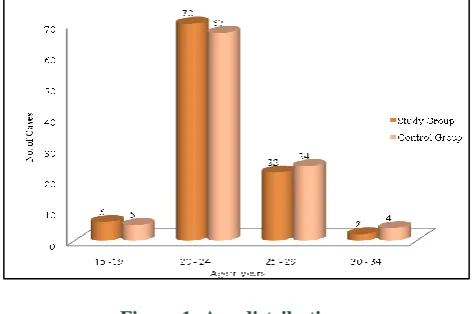
Figure 1 shows the age distribution of patients. All patients were in the age group between 15-35 years. In the both the groups, maximum number of patients were between 20-24 years.
[image:3.595.309.548.62.415.2]Figure 2 shows the distribution of primigravidae, multigravida and grand multigravida. Primi, multi and grand multi gravida were chosen for the study. Maximum number of patients were primi and the next preponderance were multigravida.
[image:3.595.311.548.75.232.2]Figure 1: Age distribution.
Figure 1: Parity distribution.
[image:3.595.310.549.228.401.2]Table 1 shows different modes of delivery in study and control groups. In the study group 91% patients had vaginal delivery of which 17 had FTND and 74 had FTND with episiotomy.
Table 1: Mode of delivery.
Mode of delivery
Study group (n=100)
Control group (n=100)
FTND 17 11
FTND with episiotomy 74 81
Forceps 7 5
LSCS 2 3
Total 100 100
Chi-square, X2=2.14 P=0.05 Non significant
[image:3.595.315.545.517.611.2]Table 2: Duration of labour.
Mode of delivery Study group Control Group Study V/s Control
No. of cases
Range (Hrs)
Mean±SD No. of cases
Range (Hrs)
Mean±SD
t-value*
p-value FTND 17 3.16-7.58 4.00±1.14 11 5.17-12.83 6.87±2.14 3.24 <0.01, S FTND with episiotomy 74 3.87-11.75 7.16±1.80 81 5.93-12.92 9.89±1.98 8.96 <0.001, HS Forceps 7 5.33-9.50 7.62±1.51 5 7.25-12.75 10.68±2.21 2.68 <0.05, S LSCS 2 7-9 8.00±1.41 3 7.10 8.67±1.53 0.58 0.62, NS
*student’s t test
Table 2 shows the duration of labour for different modes of delivery in both the groups. Patients who underwent FTND, duration of labour was in the range between 3.16-7.58 hours in the study group with a mean value of 4.6 and standard deviation of ±1.14 compared to the control group which showed a range of 5.17-12.83 hours with mean value of 6.87 and standard deviation of ±2.14. This was found to be statistically significant. Among patients who underwent FTND with episiotomy in the study group, the duration of labour ranged from 3.87-11.75 hours with mean value of 7.16 and standard deviation ±1.80. In the control group, range was from 5.93-12.92 hours with mean value of 9.89 and standard deviation ±1.98. This was also found to be statistically significant. The duration of labour in forceps delivery was 5.33-9.50 hours with mean value of 7.62 and standard deviation of±1.51 in study group whereas in the control group, 7.25-12.75 hours was the range with mean value 10.68 and standard deviation ±2.21. This was found to be statistically insignificant.
Table 3: Degree of pain relief.
Degree of pain
Study group Control Group
Before giving drug
I-stage
II Stage
I-stage
II-stage
Grade I 0 24 8 2 0 Grade II 24 62 47 40 7 Grade III 69 13 33 56 49 Grade IV 7 1 12 2 44 Total 100 100 100 100 100 Mean
grade±SD
2.8±0.5 1.9±0.6 2.5±0.8 2.6±0.6 3.4±0.6
Table 3 shows the degree of pain relief. In the study group 24% patients had Grade I i.e no pain after administering tramadol IM in first stage compared to the control group in which only 2% patients had no pain in first stage. In the study group, 24% patients had Grade II pain before administering the drug and 62% had Grade II pain after drug administration. During first stage in the study group 13% and 1% had Grade III and Grade IV respectively. Whereas in the control group, 56% and 2% had grade III and IV pain in the first stage. This was found to be statistically significant. During second stage, 47% in the study group and 7% of control group had grade II pain. 33% and 12% of patients in study group had Grade III and IV pain, whereas 49% and 44% of
patients in control group had Grade III and IV pain respectively, which was statistically significant.
Table 4: Maternal morbidity.
Maternal morbidity Study group Control group
Vomiting and nausea 9 -
Dizziness 2 -
Restlessness 2 -
Headache 2 -
Burning of legs - -
Sweating 4 -
Table 4 shows the side effects in both the groups. A few of the side effects of tramadol like nausea, vomiting, dizziness, headache, sweating, restlessness was found in the study group only.
Table 5: Foetal morbidity.
Foetal morbidity Study group (n=100)
Control group (n=100)
Foetal distress 7 3 Meconium aspiration 2 1 Mild birth asphyxia 1 3
Table 5 shows foetal morbidity in both the groups. In this study, full term outlet forceps delivery were 7% cases of all of which were for foetal distress. 2% cases in the study group underwent cesarean section. Both were for foetal distress.
Table 6: APGAR.
Apgar Score
Study group Control group
1’ 5’ 1’ 5’
2-5 14 4 17 4
6-7 86 11 82 14
8-10 - 85 - 81
Total 100 100 99 99 Mean
Score±SD
5.7±0.7 7.6±0.8 5.8±0.8 7.7±0.7
DISCUSSION
“The distress and pain which women often endure while they are struggling through labour are beyond description and seem to be more than human nature would be able to bear under any other circumstance” – Sir James Young Simpson 1848. Labour pain causes excessive maternal suffering, increased mechanical work, marked maternal hyperventilation and increased oxygen demand. These natural responses result in increased catecholamine levels leading to uterine hypo perfusion, foetal hypoxia and acidosis.
Pain is a sensory experience which is subjective. The scientific study of pain is a subject of peculiar difficulty and these difficulties are admirably set out by H.R. Beecher. The technique of pain score was 1st described by
Hewer and Kell in 1948 for assessment of the efficacy of the various forms of analgesia and has been used extensively since then. For many years, the potent narcotic agents are in use for post operative pain relief and it seemed as if analgesia, emesis, respiratory depression and addiction potential were inseparable. An exception to this statement is Tramadol. Tramadol is a narcotic drug introduced in Germany 1971 is available throughout the world. It was introduced in India for the last couple of years. It is a weak opioid analgesic which interacts with mu, delta, kappa opioid receptors, where it exhibits purely agonist effects.
In the present study, the effect of intramuscular tramadol in labour between the age group 15-35 years was studied. Primi, multi and grandmulti were taken into consideration in both study and control group. They belonged to the same socioeconomic status. 100 patients taken in study group and 100 others in the control group with same inclusion and exclusion criteria.
In this study, 91% of study group and 92% patients of control group had full term normal delivery. Whereas in the study conducted by Rani U et al, 84% had FTND.12
Outlet forceps was used for 7% of patients in study group and 5% in the control group, all of which were for foetal distress. In the study conducted by Rani U et al, 10% patients in the study and 20% in the control had forceps delivery.12 Among the 7 cases which had foetal distress, 2
babies had two loops of cord around the neck, 1 had congenital heart disease, 1 was a case of undiagnosed anomalous baby. The cause of foetal distress in 3 babies was not known.
In this study, caesarian section rate was 2%. Both were for foetal distress, with thick meconium stained liquor. In the control group, Caesarean section rate was 3%, done for thick meconium stained liquor with foetal distress. But in the study conducted by Rani U et al 6% of patients in study group and 14% of patients in control group underwent caesarean section.12
Here, subjects who underwent FTND, duration of labour was found to show a range between 3.16-7.58 hours with mean value of 4.60 and standard deviation of ±1.14 in the study group whereas the control group showed a range of 5.17-12.83 hours, mean value of 6.87 with standard deviation of ±2.14. This was found to be statistically significant.
Patients who had FTND with episiotomy, the duration of labour ranged from 3.17-11.75 hours with mean value of 7.16 and standard deviation ±1.80. In the control group the range was from 5.93-12.92 hours, mean value of 9.89 and standard deviation ±1.98. This was also found to be statistically highly significant. The duration of labour in forceps delivery was 5.33-9.50 hours with mean value of 7.62, standard deviation ±1.51 in study group. In control group, 7.25-12.75 hours was the range with mean value 10.68 and standard deviation ±2.21. This was found to be statistically insignificant. In a study conducted by Rani U et al there was significant shorter duration of labour in study group compared to control group which supports the present study is shown in the table.
Pain is a subjective phenomenon and so its relief is difficult to measure. In the present study, the degree of pain relief was assessed by asking the patient extent and degree of pain relief. Since most of our patients are illiterate it was easier to relate pain relief by rupee scale. Visual analogue scale is only applicable to literate patients.11 Analgesia was classified according to the pain
score described by Heever and Kella in 1948. Out of 100 patients in the study group, before giving the drug no patient had Grade I pain or no pain, 24 had Grade II pain, 69 had Grade III and 7 had Grade IV pain. After administration of 50-100mg tramadol intramuscularly, in the first stage 24% patients in the study group and 2% patients in the control group had Grade I pain. 62% patients in the study group had Grade II pain but only 40% in the control group had this pain. In the control group 58% patients had Grade III and Grade IV pain i.e maximum pain whereas it was only 14% in the study group. Grading is numerically assessed and connected to mean grading. Chi square test i.e x2=50.5 p <0.001. This
value is statistically significant. In the second stage, 8 in study group had Grade I pain and no patients in control group had Grade I pain. In the study group 47% patients had Grade II pain and 45% had Grade III and IV pain. In control group, only 7 patients had Grade II pain and the rest 93% patients had Grade III and IV pain. x2=59.0 p
<0.001, which was found to be statistically highly significant. Mean gradings in both Stage 1 and 2 in study group is less compared to control group. This assessment holds well with studies conducted by Li E et al and Viegas et al.10,13 This has proved, beyond doubt, that
tramadol has very good efficacy as an analgesia in labour and it has decreased the intensity of pain, in both 1st and
2nd stage of labour. Patients were co-operative at the time
Side effects were nausea, vomiting, headache, dizziness, tingling of legs, restlessness, sweating, burning of legs and hypotension. Nausea and vomiting was seen in 9% of the patients. Dizziness was seen in 2% patients. Headache in 2%, restlessness in 2%, sweating in 4%.
In this study, there was no significant change in the vital parameters like pulse rate, respiratory rate, blood pressure except in 1 case who had hypotension. In the study conducted by Bajaj et al pulse rate and blood pressure were found to be decreased, but it was not statistically insignificant. There was a statistically significant fall in respiratory rate in their study group. Scientific monogram by SG pharmaceuticals in the study have shown that tramadol has only negligible effect on systemic and pulmonary circulation, such that tramadol can be given to patients with pain due to myocardial infarction. Tramadol has no significant effect on respiratory rate, tidal volume, minute volume, atrial carbon dioxide tension, ventricular carbon dioxide response or mouth occlusion pressure. Vickers MD et al have compared pain relief by an opioid without depression of respiration.14 They compared
tramadol and pethidine in 30 patients, patient controlled analgesia. They concluded that small but statistically significant difference in blood pressure between two groups may be due to nor adrenaline uptake by tramadol, but effect on cardiovascular is clearly minimal.
There was no case on maternal mortality in both study and control group.
Here, in the study group 8% babies had foetal distress as compared to 3% in the control group, 2 babies had meconium aspiration compared to 1 in the control group. This baby had to be resuscitated and shifted to NICU. Baby was given oxygen and returned to the mother on 2nd
post natal day. In the control group 3 babies had mild birth asphyxia. One had two loops of cord around the neck.
In this study, 14% babies in the study group had Apgar score of 2-5 after 1 minute and 4% babies had Apgar score of 2-5 after 5 minutes. In the control group 17% babies had Apgar score of 2-5 at 1 minute and 4% babies had Apgar score 2-5 in 5 minutes. It is not possible to attribute the cause of foetal distress to tramadol, as for doing so, it is ideal to access the plasma level of the drug in the baby. This is not done in our study.
From this study, it can be said that tramadol is an effective drug which can be used for labour analgesia and is safe for both mother and baby with minimal morbidity and no mortality. It provides the expectant mother with all the satisfaction of a normal child birth, without the agony of labour pains or at least reduces a major part of it.
Funding: No funding sources Conflict of interest: None declared
Ethical approval: The study was approved by the Institutional Ethics Committee
REFERENCES
1. Sarkar B, Mukhopadhyay AK. Tramadol hydrochloride in dysfunctional labour. Clinical trial. J Obstet Gynecol India. 1997;47(1):42-8.
2. Schaer HM, Marx GF, Barrell GM. History of pain relief in obstetrics. Obstet Anal Anaesth. 1980:1-19. 3. Dayer P, Desmeules J, Collart L. Pharmacology of
tramadol. Drugs. 1997;53:18-24.
4. Grond S, Sablotzki A. Clinical pharmacology of tramadol. Clin Pharmacokinet. 2004;43(13):879-923. 5. Tripathi KD. Essentials of medical Pharmacology”. In Chapter 34: Opioid analgesics an antagonists. 6th
ed. Jaypee Brother Medical Publishers Pvt. Ltd; 2008:460-1.
6. Lehman KA. Tramadol for the management of acute pain. Drugs. 1994;47(1):19-32.
7. Bitsch M, Emmrich J, Hary J, Lippach G, Rindt W. Obstetrical analgesia with Tramadol. Fortschr Med. 1980;98:632-4.
8. Lee CR, McTavish D, Sorkin EM. Tramadol: a preliminary review of its pharmacodynamic and pharmacokinetic properties and therapeutic potential in acute and chronic pain status. Drugs. 1993;46:313-40.
9. Kainz C, Joura E, Obwegeser R, Plockinger B, Gruber W. Effectiveness and tolerance of tramadol with and without an antemetic and pethidine in obstetric analgesia. Geburtshilfe Perinatal. 1992;196:78-82.
10. Viegas OA, Khaw B, Ratnam SS. Tramadol in labour pain in primi parous patient. Eur J Obstet Gynecol Reprod Biol. 1993 May 1;49(3):131-5. 11. Bonica JJ. The management of pain. In: Chapter 32.
Measurement of pain. Champman RC, Syrjala K (eds), 2nd ed. Lea and Febiger; 1990;1:581-2.
12. Sharma UR, Verma RS. Use of Tramadol or Analgesic in normal and abnormal labour. J Obstet Gynecol India. 1999;49(6):67-9.
13. Li E, Weng L. Influence of dihyrotrophine hydrochloride and tramadol in labour pain and umbilical blood gas. Zhonghua Fu Chan Ke Za Hi. 1995 June;30(6):345-8.
14. Vickers MD, O’Flaherty D, Szekely SM, Read M, Yoshizumi J. Tramadol Pain relief by an opioid without depression of respiration. Anaesthesia. 1992;47:291-6.