Original Research Article
A comparative study of ectopic pregnancy at a tertiary care centre
Radhika Pusuloori, K. Dilzith Arora*
INTRODUCTION
Ectopic pregnancy is defined as any intra or extra-uterine pregnancy in which the fertilized ovum implants at an aberrant site which is inconducive to its growth and development.1 It is catastrophic and life threatening
condition and one of the commonest acute abdominal emergency in day to day practice affecting approximately 2% of all pregnancies.2 It is the most important cause of
maternal mortality and morbidity in the first trimester.3
An ectopic pregnancy is assuming greater importance
because of its increasing incidence and its impact on future fertility.4,5 It is a challenge for the obstetricians due
to its bizarre clinical presentation. Diagnosis requires a high index of suspicion as the classic triad of amenorrhea, abdominal pain and vaginal bleeding is not seen in all cases. Women may present with non-specific symptoms, unaware of an ongoing pregnancy or may even present with hemodynamic shock. The early diagnosis of this condition over the past two decades has allowed a definitive medical management of unruptured ectopic pregnancy with successful outcomes.6,7
Department of Obstetrics and Gynecology, Chalmeda Anandarao Institute of Medical Sciences, Karimnagar, Telangana, India
Received: 15 December 2017 Accepted: 08 January 2018
*Correspondence: Dr.K. Dilzith Arora,
E-mail: [email protected]
Copyright: © the author(s), publisher and licensee Medip Academy. This is an open-access article distributed under the terms of the Creative Commons Attribution Non-Commercial License, which permits unrestricted non-commercial use, distribution, and reproduction in any medium, provided the original work is properly cited.
ABSTRACT
Background: Ectopic pregnancy is a global problem and is the most common life-threatening emergency in early pregnancy leading to significant morbidity and fetal loss. It occurs in variable presentations. The rate of ectopic pregnancies has increased from 0.5% in 1970 to 2% today. The aim of this study was to determine the incidence, clinical presentation, risk factors, treatment, and morbidity and mortality associated with ectopic pregnancy.
Methods: The present retrospective study was conducted over a period of three years in the Department of Obstetrics and Gynecology at Chalmeda Anandarao Institute of Medical Sciences, Karimnagar, Telangana from February 2014 to January 2017. A total of 80 patients with ectopic pregnancy were analyzed regarding clinical presentation, risk factors, operative findings and treatment modality.
Results: Total number of 80 cases of ectopic pregnancies were admitted during this period against 2645 deliveries representing frequency of 3%. Majority of cases (43.75%) were in the age group of 25-29 years and 41.25% were gravida 4 and above. Risk factors were identifiable in 66.25% of cases. Previous abortion was the most common risk factor (31.25%). The classical triad of amenorrhea, pain abdomen and vaginal bleeding was present in 71.25% of cases. More than half of case (55%) had ruptured tubal pregnancy on admission. Unruptured tubal pregnancy was seen in 10% case. Interestingly we found one rare case of bilateral ectopic pregnancy. Salpingectomy by open method was the mainstay of treatment (86.25%).
Conclusions: Ectopic pregnancy is still a major challenge in gynecological practice. In our country most of the cases present late after tubal rupture requiring radical surgical treatment. Early diagnosis and timely intervention in the form of medical treatment or conservative surgery not only reduces maternal morbidity but also preserves future fertility.
The overall incidence of ectopic pregnancy is increasing in the past three decades but due to early diagnosis and management the case fatality rate has come down. In spite of good diagnostic methods available most women present late as majority of case are asymptomatic till they rupture. Ectopic pregnancy commonly occurs in the fallopian tubes (97%).8
Although women with ectopic pregnancy frequently have no identifiable risk factors, a prospective and case controlled study has shown that increase awareness of ectopic pregnancy and knowledge of the associated risk factors like pelvic inflammatory disease, history of previous ectopic pregnancy, tubal sterilization and any previous pelvic or abdominal surgery help in identifying women at higher risk in order to facilitate early and more accurate diagnosis.9 Management of the case depends on
the clinical presentation, site of the ectopic and need for future reproductive function. Management can be medical as well as surgical.
METHODS
This retrospective study was conducted over a period of three years from February 2014 to January 2017 in Department of Obstetrics and Gynecology at Chalmeda Anandarao Institute of Medical Sciences, Karimnagar, Telangana, India. It is a tertiary care centre getting referrals from nearby cities and other hospitals. A total of 80 cases reported during this frame with ectopic pregnancy and were admitted at our hospital through emergency or outpatient department. The diagnosis of ectopic pregnancy was made mainly by history-taking, clinical physical examination, laboratory (urine pregnancy test/serum beta HCG), and radiological (ultrasound) investigations. These cases were traced through the registers kept in casualty, gynecology wards and OT records. The labour room registers were used to determine the total number of deliveries during this period.
The information of each patient was obtained from their case records kept in the Medical Records Department. All the relevant demographic data was analyzed. Records were studied for a period of amenorrhea at the time of diagnosis, presenting complaints like pain abdomen, bleeding per vagina or acute abdomen.
Predisposing high risk factors were also analyzed. A documentation of urine pregnancy test done, relevant ultrasound findings were also noted down. Treatment options offered and important intra operative findings were studied. All the informations were entered in a pre-structured proforma. All the data was analyzed by percentage method
Inclusion criteria
All women with confirmed ectopic pregnancies.
RESULTS
In the present study, which was conducted over a period of 3 years, the total number of deliveries was 2645 and the total number of ectopic pregnancies was 80, giving an incidence of 3% or 30 per 1000 deliveries.
[image:2.595.311.544.199.352.2]It was found that the majority of ectopic pregnancies, occurred in the females between age group 25-29 years (43.75%) (Figure 1).
Figure 1: Distribution of cases according to age.
Gravida 4 and above accounted for the maximum number of cases (41.25%) (Table 1).
Table 1: Distribution of cases according to gravida.
Gravida Number of cases Percentage
G1 15 18.75
G2 12 15
G3 20 25
G4≥ 33 41.25
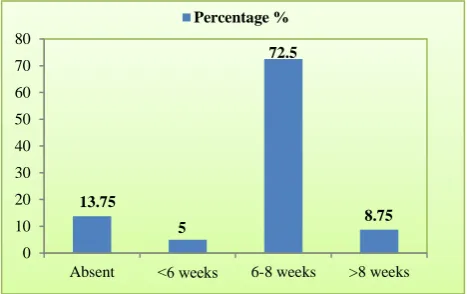
Most of the cases were diagnosed at a gestational age of 6-8 weeks (72.5%) (Figure 2).
Figure 2: Duration of amenorrhoea.
More than half of the cases (66.25%) had one or the other identifiable risk factor (Table 2). Amongst the various risk factors studied either spontaneous or induced
0 10 20 30 40 50
˂20 20-24 25-29 30-34 35-39 40 and above Percentage %
1.25 20
43.75
26.25
3.75 5
0 10 20 30 40 50 60 70 80
Absent ˂6 weeks 6-8 weeks >8 weeks Percentage %
13.75
5
72.5
[image:2.595.311.545.552.699.2]abortion was found in 31.25%. This was followed by a history of previous abdominopelvic surgery (23.75%).
Table 2: Distribution of cases according to risk factors.
High risk factors No. of cases Percentage
Previous abortion 25 31.25 MT pill intake 11 13.75 Tubal ligation 9 11.25
LSCS 9 11.25
PID 8 10
Infertility 5 6.25 Previous ectopic pregnancy 3 3.75% Tuboplasty 1 1.25 Ovulation Induction 1 1.25
IUCD 1 1.25
No risk factor identifiable 27 33.75
Among women who had undergone surgeries 11.25% had tubectomy, 11.25% had previous LSCS and one patient had tuboplasty. History of self-administered MT pill intake was present in 13.75%. Repeat ectopic pregnancies were seen 3.75% of cases. There was no identifiable risk factor in 33.75% of cases.
The classic triad of abdominal pain, amenorrhoea and vaginal bleeding was present in 71.25% of cases (Figure 3).
Figure 3: Clinical features.
Shock was present in 42.5% of cases. Abdominal pain was present in 100% of the cases. Amenorrhea was present in 86.25% of the cases. Urine pregnancy test was positive in 95% cases. Ultrasonography was conclusive in 96.25% of cases confirming the diagnosis except in 3 cases, which needed a diagnostic laparoscopy to arrive at a final diagnosis.
The most common site of tubal pregnancy was ampulla (42.5%) (Figure 4). One case of bilateral ectopic pregnancy was detected per operatively. There was only one case of ovarian pregnancy. Left side was in 53.1% of
[image:3.595.313.544.299.438.2]cases and 47.1% were on right side. Upon opening the abdomen, tubal pregnancies of different acquity were found (Figure 5).
[image:3.595.51.283.423.589.2]Figure 4: Distribution of cases according to site.
Figure 5: Distribution of cases according to per op findings.
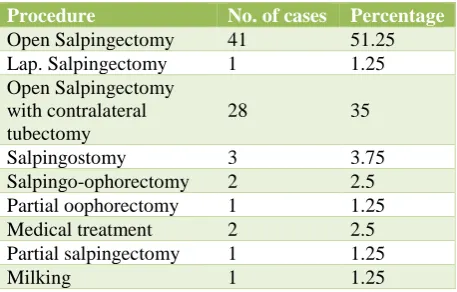
Ruptured ectopic pregnancies were seen in 55% of the cases, unruptured in 10%, tubal abortion in 16.25% and chronic ectopic in 18.75% of the cases. Hemoperitoneum was present in 91.25% of cases. As high as 60% of cases needed blood transfusion (1-2 units in 52.5% and more than 2 units in 7.5% of cases). Salpingectomy by open method (86.25%) remained the mainstay of treatment (Table 3).
Table 3: Distribution of cases according to type of surgery done.
Procedure No. of cases Percentage
Open Salpingectomy 41 51.25 Lap. Salpingectomy 1 1.25 Open Salpingectomy
with contralateral tubectomy
28 35
Salpingostomy 3 3.75 Salpingo-ophorectomy 2 2.5 Partial oophorectomy 1 1.25 Medical treatment 2 2.5 Partial salpingectomy 1 1.25
Milking 1 1.25
Abdominal pain Amenorrhea
Bleeding Pervaginum Shock
100 42.5
0 5 10 15 20 25 30 35 40 45
Ampullary Isthmic Fimbrial Interstitial Ovarian Percentage
42.5
15
3.75 2.5
1.25
Ruptured Tubal abortion Unruptured Chronic ectopic
55 18.75
[image:3.595.315.544.613.759.2]Two patients (2.5%) were given medical treatment and were successfully managed with a single dose methotrexate. Laparoscopic salpingectomy was done in one case of hemodynamically stable unmarried female.
Salpingectomy along with contralateral tubectomy was performed in 35% of the cases as their family was complete. In case of bilateral ectopic pregnancy diagnosed per op Salpingectomy on one side and salpingostomy on the other side was done. There was no maternal death in the present study.
DISCUSSION
Ectopic pregnancy is a life-threatening emergency in obstetrics. It remains as an important contributor to maternal morbidity and mortality, and is one of the commonest causes of 1st trimester maternal deaths. The prevalence of ectopic pregnancy among women who go to an emergency department with first trimester bleeding, pain or both, varies from 6 to 16%.10 Globally its
incidence has been on the rise over the past decades, complicating 0.25-2.0% of all pregnancies worldwide. It accounts for 3.5-7.1% of maternal mortality in India.11,12
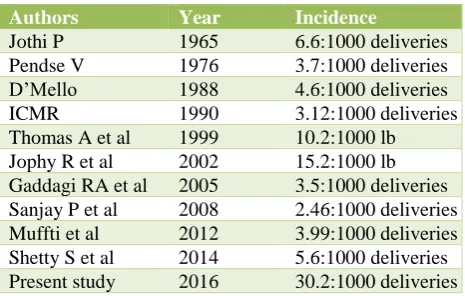
In India the incidence of ectopic pregnancy reported by the Indian council of medical research (ICMR 1990) task force in their multi-centric case control study was 3.12 per 1000 pregnancies or 3.86 per 1000 live births in the hospital reported pregnancies. In present study the incidence is significantly higher at 3%, than most of the other studies in developing countries, where it ranges from 0.56-1.5%.2,10,13-15 Comparison of incidence quoted
[image:4.595.52.285.496.644.2]by several authors is represented in Table 4.
Table 4: Comparison of incidence quoted by several authors.
Authors Year Incidence
Jothi P 1965 6.6:1000 deliveries Pendse V 1976 3.7:1000 deliveries D’Mello 1988 4.6:1000 deliveries ICMR 1990 3.12:1000 deliveries Thomas A et al 1999 10.2:1000 lb Jophy R et al 2002 15.2:1000 lb Gaddagi RA et al 2005 3.5:1000 deliveries Sanjay P et al 2008 2.46:1000 deliveries Muffti et al 2012 3.99:1000 deliveries Shetty S et al 2014 5.6:1000 deliveries Present study 2016 30.2:1000 deliveries
In the present study majority of cases belonged to age group of 25-29 years (43.75%) similar to most of the studies from developing countries. Younger age group has high prevalence because they are more active sexually, predisposed to STI, PID and their sequelae. Studies in USA, however reported an increasing incidence of ectopic pregnancy with advancing age.
The difference observed in our country might be owing to the fact that women here enter in to married life earlier and end reproduction earlier too. In the present study, maximum occurrence of ectopic gestation was seen predominantly in higher birth order. Some studies showed no specific relation to parity, but few reported that there is a decrease in the incidence of ectopic pregnancy with rising parity.7,9 In the ICMR multi-centric
case control study of ectopic pregnancy, majority of women were young and had low parity.10
Ectopic pregnancies are generally diagnosed earlier due to their association with symptoms like bleeding and pain. Most frequent gestational age at diagnosis was around 6-8 weeks in present study, which is similar to the observation made by Khaleeque et al.15 Amongst the
complaints at the time of presentation the classical triad of abdominal pain, amenorrhaea and vaginal bleeding was present in 71.25% of the cases. In their studies Wakankar et al and Jophy et al have also reported classic triad in 53.84% and 66% cases respectively.16,17 This
suggests that this classical triad is reliable most of the time for raising a suspicion of ectopic gestation. Shock as a presenting emergency was observed in 42.5% of cases, which was comparable to studies by Maji et al and Begum S et al (32%).18,19 Amenorrhoea was present in
86.25% of the cases, which was also seen in studies of Jophy et al (78.5%) and Pal A et al (73%).17,20 In the
absence of amenorrhoea woman may be unaware of an ongoing pregnancy and hence may not anticipate a pregnancy associated complication. This subjects her to increased risk due to delayed diagnosis. A detailed history taking is imperative in all the cases of ectopic gestation, so that underlying causative etiology is established. In current study history revealed presence of at least one high risk factor in 66.25% of cases.13,15
Amongst the risk factors studied, history of having previous abortion (induced and spontaneous) was the most common finding. (31.25%) Similar observations were made by Maji et al (26.1%) and Muffi et al (21.05%).18,21 This observation asserts the sequelae of
unsafe abortion causing tubal damage or dysfunction, and thus highlights the need of education to promote safe abortion practices and post abortal care.
Significant number of cases (13.75%) had a history of MTP pill intake over the counter and it is comparable to study of Shetty et al (9.7%).10 This highlights the urgent
bringing legislation, seeking a protocol on the sale of MTP pills over the counter.
Singh et al have reported prior tubal surgery as a common risk factor (40%).13 In present study history of tubal
surgery, including tubal sterilization and tuboplasty, was seen in 12.5% cases. Thus, patients ought to be counseled and educated about its failure and the risk for ectopic pregnancy in future. In present study 3.75% of the cases have had the history of previous ectopic pregnancy. Recurrence of ectopic has been reported in various studies, ranging between 3.2% to 20%. So, such patients need to be educated about the risk of recurrences. Significant incidence of prolonged infertility and its
causal relationship to ectopic pregnancy has been observed by various authors. Positive history of infertility was reported as high as 48% by Devi S et al.22 But in
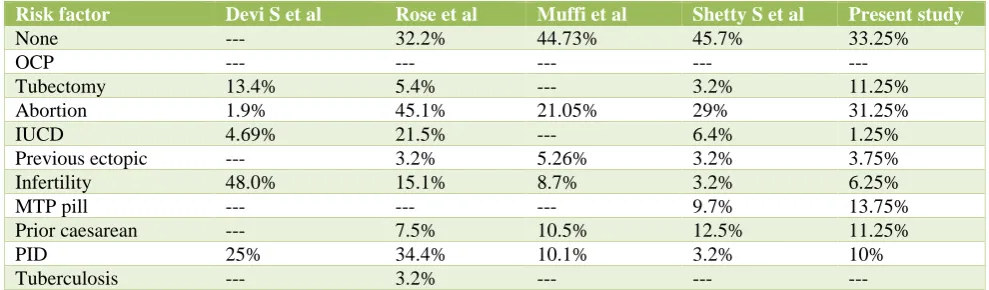
present study only 6.25% of cases had history of infertility. However, 33.75% of cases had no recognizable risk factor similar to study of Begum S et al (36%) and Rose et al (32.2%).17,19 Therefore, ectopic
[image:5.595.50.545.280.425.2]pregnancy should be suspected in every woman of reproductive age who presents with unexplained abdominal pain, irrespective of amenorrhea and vaginal bleeding and whether risk factors are present or not. Comparable reports of risk factors for ectopic pregnancy in various studies are represented in the Table 5.
Table 5: Risk factors for ectopic pregnancy in various studies.
Risk factor Devi S et al Rose et al Muffi et al Shetty S et al Present study
None --- 32.2% 44.73% 45.7% 33.25%
OCP --- --- --- --- ---
Tubectomy 13.4% 5.4% --- 3.2% 11.25% Abortion 1.9% 45.1% 21.05% 29% 31.25%
IUCD 4.69% 21.5% --- 6.4% 1.25%
Previous ectopic --- 3.2% 5.26% 3.2% 3.75% Infertility 48.0% 15.1% 8.7% 3.2% 6.25%
MTP pill --- --- --- 9.7% 13.75%
Prior caesarean --- 7.5% 10.5% 12.5% 11.25%
PID 25% 34.4% 10.1% 3.2% 10%
Tuberculosis --- 3.2% --- --- ---
In most of the cases ultrasound findings corroborated with the intra-operative findings. The fallopian tube was the most common site of ectopic pregnancy (98.75%). Ampulla was the commonest site (42.5%), similar to the observation of Shetty et al (45.2%).10 One case (1.25%)
was diagnosed with ovarian pregnancy, and it was confirmed by histopathology also. Similar incidence was reported by Singh et al and Wakankar et al.13,16 Ruptured
ectopic pregnancy was present in 55% cases and tubal abortion in 16.25% cases, similar to results of Shetty et al (61.3% and 12.9% respectively).10
In present study 10% of cases had unruptured ectopic which is correlating with the study done by Gaddagi RA et al (8.1%).23 Chronic ectopic pregnancy was seen in
18.75% of cases. Intraoperative diagnosis for the same was made by presence of organized mass in POD. In current study both right and left side of tubes were involved with equal frequency similar to study of Porwal et al.24 One rare case of bilateral ectopic pregnancy was
diagnosed per-operatively, thus emphasizing the need to examine both the tubes during operation even in the presence of adhesions, as diagnosing bilateral ectopics preoperatively has always been a challenging task. In developing countries majority of the patients are diagnosed after tubal rupture. Our centre being a tertiary
referral centre, more than half of the cases came with ruptured ectopic pregnancies. It emphasizes that in India majority of the cases present late, either due to late diagnosis or because of delay in referral. It was observed that majority of the cases had to undergo a laparotomy, because of unstable condition at presentation. Salpingectomy (86.25%) by open method was the most common modality of treatment. Out of this 35% cases had salpingectomy with contralateral tubectomy by modified Pomeroy’s method as they were not desirous of further child bearing. Laparoscopic salpingectomy was done in only one case of unmarried female in stable hemodynamic condition. Laparotomy with salpingectomy was the most common modality of treatment in other studies too (Shetty et al 90.3%, Maji et al 81.9%).10,16 In
some studies lack of expertise in laparoscopy and presentation of the patient late in night when seniors are not around also led to increase in the rate of laparotomy.
In the present study group, medical therapy was given in 2 cases, (2.5%), who fulfilled the criteria for medical management. Similar number of medically managed cases were reported by Maji et al (1.75%).16
There was no mortality in the current study. Maternal mortality due to ectopic pregnancy is reported between 0% and 1.3% in various studies.10,14,21 It is possible to
prevent maternal mortality in low-resource countries by maintaining basic clinical and surgical skills.
CONCLUSION
Ectopic pregnancy is still a major challenge in obstetrical practice because of its bizarre clinical presentation and is one of the commonest causes of pregnancy related deaths in the first trimester. It can be diagnosed early by keeping a high index of suspicion. Despite exhaustive efforts to prevent ectopics the numbers are constantly rising due to increased reporting of the cases and improved diagnostic modalities. Delay in referral causes significant morbidity and diminishes the chances of preserving future fertility. Mass education regarding safe abortion practices and post abortal care should be promoted. Unsupervised usage of MTP pill intake should be condemned.
Funding: No funding sources Conflict of interest: None declared
Ethical approval: The study was approved by the Institutional Ethics Committee
REFERENCES
1. Te linde’s Operative Gynaecology, 8th edition.
Philadelphia: Lippincott- Raven; 1997:501-27. 2. Gary CF, Leveno KJ, Bloom SL, Hauth JC, Rouse
DJ, Spong CY. Williams Obstetrics. Ectopic pregnancy. 23rd ed. The Mc Grew-Hill Companies;
2010:238-54.
3. Mahboob U, Mazhar SB. Management of ectopic pregnancy: a two-year study. J Ayub Med Coll Abbottabad. 2006;18(4):34-7.
4. Centers for disease control and prevention. Ectopic pregnancy-United States, 1990-1992. JAMA. 1995;273:533.
5. Rajkhowa M, Glass MR, Rutherford AJ, Balen AH, Sharma V, Cuckle HS. Trends in the incidence of ectopic pregnancy in England and Wales from 1966 to 1996. BJOG. 2000;107:369-74.
6. Stovall TG, Ling FW, Buster JE. Outpatient chemotherapy of unruptured ectopic pregnancy. Fertil Steril. 1989;51:435-8.
7. Stovall TG, Ling FW, Gray LA, Carson SA, Buster JE. Methotrexate treatment of unruptured ectopic pregnancy: A report of 100 cases. Obstet Gynecol. 1991;77:749-53.
8. Vasquez G, Winston RML, Brosens IA. Tubal mucosa and ectopic pregnancy. BJOG. 1983;90:468. 9. Karaer A, Avsar FA, Batioglu S. Risk factors for
ectopic pregnancy: a case-control study. Aust N Z J Obstet Gynaecol. 2006;46:521-7.
10. Shetty S, Shetty A. A clinical study of ectopic pregnancies in a tertiary care hospital of Mangalore, India. Innov J Med Health Sci. 2014;4(1).
11. Shah P, Shah S, Kutty RV, Modi D. Changing epidemiology of maternal mortality in rural India: time to reset strategies for MDG-5. Trop Med Int Health. 2014;19(5):568-75.
12. Yadav K, Namdeo A, Bhargava M. A retrospective and prospective study of maternal mortality in a rural tertiary care hospital of Central India. Indian J Community Health. 2013;25(1):16-21.
13. Singh S, Mahendra G, Vijayalakshmi S, Pukale RS. Clinical study of ectopic pregnancy in a rural setup: a two-year survey. Natl J Med Res. 2014;4(1):37-9. 14. Udigwe GO, Umeononihu OS, Mbachu II. Ectopic
pregnancy: a 5-year review of cases at Nnamdiazikiwe University Teaching Hospital (NAUTH) Nnewi. Niger Med J. 2010;51(4):160. 15. Khaleeque F, Siddiqui RI, Jafarey SN. Ectopic
pregnancies: a three-year study. J Pak Med Assoc. 2001;51(7):240-2.
16. Wakankar R, Kedar K. Ectopic pregnancy-a rising trend. Int J Sci Stud. 2015;3(5):18-22.
17. Rose J, Thomas A, Mhaskar A. Ectopic pregnancy: five years experience. J Obstet Gynecol India. 2002;52:55-8.
18. Majhi AK, Roy N, Karmakar KS, Banerjee PK. Ectopic pregnancy: an analysis of 180 cases. J Indian Med Assoc. 2007;105(6):308-12.
19. Shaikh S, Jampala S, Devi S, Malika M. A study of ectopic pregnancy in a tertiary care teaching hospital. Indian J Obstet Gynecol Res. 2016;3(2):132-6. 20. Pal A, Gupta KB, Sarin R. A study of ectopic
pregnancy and high-risk factors in Himachal Pradesh. J Indian Med Assoc. 1996;94(5):172-3. 21. Mufti S, Rather S, Mufti S, Rangrez RA, Wasiqa K.
Ectopic pregnancy: an analysis of 114 cases. JK-Pract. 2012;17(4):20-3.
22. Devi YS. Laparoscopic treatment of ectopic pregnancy. J Obstet Gynecol India. 2000;50:69. 23. Gaddagi RA, Chandrashekhar AP. A clinical study
of ectopic pregnancy. J Clin Diag Res. 2012;6(5):867-9.
24. Gupta R, Porwal S, Swarnkar M, Sharma N, Maheshwari P. Incidence, trends and risk factors for Ectopic Pregnancies in a tertiary care hospital of Rajasthan. JPBMS. 2012;16(16):1-3.