DOI:10.1051/epjconf/201611611007
C
Owned by the authors, published byEDP Sciences, 2016
Global 3
ν
oscillation analysis: Status of unknown parameters
and future systematic challenges for ORCA and PINGU
Francesco Capozzi1,2, Eligio Lisi2,a, and Antonio Marrone1,2
1Dipartimento Interateneo di Fisica, Università di Bari, via Amendola 173, 70126 Bari, Italy 2Istituto Nazionale di Fisica Nucleare, Sezione di Bari, via Orabona 4, 70126 Bari, Italy
Abstract. Within the standard 3ν oscillation framework, we illustrate the status of
currently unknown oscillation parameters: the 23 octant, the mass hierarchy (normal or
inverted), and the possible CP-violating phase , as derived by a (preliminary) global
analysis of oscillation data available in 2015. We then discuss some challenges that will be faced by future, high-statistics analyses of spectral data, starting with one-dimensional energy spectra in reactor experiments, and concluding with two-dimensional energy-angle spectra in large-volume atmospheric experiments. It is shown that systematic uncertainties in the spectral shapes can noticeably affect the prospective sensitivities to unknown oscillation parameters, in particular to the mass hierarchy.
1. Introduction
The 2015 Nobel Prize in Physics, awarded jointly to Takaaki Kajita and Arthur B. McDonald “for the discovery of neutrino oscillations, which shows that neutrinos have mass” [1], represents both the crowning point of a long quest for neutrino flavor transformations, and an incitement to further proceed in understanding the physics ofν masses and mixings. Indeed, world neutrino data have established a simple 3ν framework, where the three known flavor statesν(=e,,) are mixed with three mass states νi (i=1, 2, 3), separated by two squared mass gaps m2 andm2, via three mixing angles
12,13,23 and a possible CP-violating phase [2]. Although global ν data analyses such as [3] provide precise constraints on five parameters (the squared mass gaps and the three mixing angles), we still do not know the octant of23(</4 or>/4), the sign ofm2which tells the mass spectrum hierarchy (normal NH for +m2 or inverted IH for −m2), and the value of the Dirac phasethat could induce CP violating effects in the leptonic sector (if=0,). Further unknowns, not considered herein, include the absoluteνmass scale and the Dirac or Majorana nature of the neutrino fields [2], as well as possible new neutrino states or interactions beyond the standard 3νframework.
In this contribution we illustrate the status of the unknown parameters23−/4, sign(m2), and
, in the light of a recent global neutrino data analysis. We then argue that future analyses of high-statistics (and large volume) neutrino experiments will face new and unprecedented challenges, related
ae-mail:[email protected]
0 1 2 3 4
N
δ
LBL+Sol+KL +SBL Reac +SK atm
/
0.0 0.5 1.0 1.5 2.0
NH IH
/
0.0 0.5 1.0 1.5 2.0
NH IH
/
0.0 0.5 1.0 1.5 2.0
NH IH
θ23
∆χ
2 (IH-NH)octant
-1.4 -0.9 -0.1
23 2 sin
0.3 0.4 0.5 0.6 0.7
0 1 2 3 4
N
23 2 sin
0.3 0.4 0.5 0.6 0.7 0
23 2 sin
0.3 0.4 0.5 0.6 0.7
2014 2014 2014
23 2 sin
0.3 0.4 0.5 0.6 0.7 0
+0.3
/
0.0 0.5 1.0 1.5 2.0
NH IH
2015
+T2K anti-v
23 2 sin
0.3 0.4 0.5 0.6 0.7
2015
+NOvA (LID)
+0.3
/
0.0 0.5 1.0 1.5 2.0
NH IH
Figure 1. Global neutrino data analysis, with preliminary updates with respect to [3]. Upper panels: Contraints on
sin223 in terms ofN=2 for increasingly rich data sets. Lower panels: Corresponding constraints on the
CP-violating phase. Middle row: Corresponding values of the2for hierarchy difference (IH vs NH).
to spectral shape systematics which may hinder, e.g., mass hierarchy signatures. We shall first discuss these issues in the relatively simple context of medium-baseline reactor projects, and then in connection with prospective atmospheric neutrino experiments in ice (or water).
2. Global
3
ν
oscillation data analysis: Status of unknowns
Our latest published globalνdata analysis, presented in terms of2best-fit values and allowed regions, was reported in [3]. In the context of unknown oscillation parameters, we illustrate here preliminary updated results including short-baseline (SBL) reactorν data from the Neutrino 2014 Conference [4], as well as recent long-baseline (LBL) accelerator data from the T2K (νrun) and NOvA experiments in theν→νeappearance channel, as appeared in 2015 [5]. A more complete analysis, including recent atmospheric data from Super-Kamiokande and IceCube [6], will be reported elsewhere [7].
Figure1shows the values of2 or, equivalently,N
=
2for three unknown parameters: the
23octant, the mass hierarchy, and the CP-violating phase. From left to right, the first three panels refer to the combination of LBL, solar and KamLAND data, plus SBL reactor data, plus SK atmospheric data, all updated to 2014 with respect to [3]. The last two panels contain, in addition, 2015 data from T2K and then from NOvA in the default (so-called LID) analysis [5]. It can be seen that, at 90% C.L. (∼1.6), and even in the most complete data set (right panels), it is not possible to assign a specific octant to 23, nor to select a preferred hierarchy: both octants and hierarchies are allowed. On the other hand, an intriguing hint emerges in favor of=0, and, in particular, in favor of sin<0, with a best fit close to3/2. This value corresponds to a case of “maximal CP violation” (sin −1), while the opposite maximal case (sin +1) is disfavored at3.
2 3 4 5 6 7 8 9 0.8
0.9 1.0 1.1 1.2
2 3 4 5 6 7 8 9
0.8 0.9 1.0 1.1 1.2
2 3 4 5 6 7 8 9
0.8 0.9 1.0 1.1 1.2
2 3 4 5 6 7 8 9 2 3 4 5 6 7 8 9 2 3 4 5 6 7 8 9
0.98 0.99 1.00 1.01 1.02
0.98 0.99 1.00 1.01 1.02
0.98 0.99 1.00 1.01 1.02 NH true
E’/E
’/
E (MeV) E (MeV) E (MeV)
osc. + norm. + energy scale + flux shape
0 1 2 3 4 5
0 5 10
NH true osc. + norm. + energy scale + flux shape
N
T (y)
(b)
(a)
Figure 2. JUNO prospective data analysis for true NH (from [8]). Panel (a): Rejection power for the wrong IH, in terms ofNas a function of timeT (with tics scaling as√T). From top to bottom, the curves include: oscillation
parameters and flux normalization errors (osc.+norm), plus energy scale uncertaintiesE/E(+energy scale), plus
flux shape uncertainties /(+ flux shape). Panel (b): Corresponding best-fits of theE/E and/energy
profiles for prospective 5-yr data-taking, overlaid to the current±1error bands (in blue). The case of true IH (not shown, see [8]) leads to similar results.
JUNO (reactor) and PINGU (atmospheric) neutrino projects have the potential to address the mass hierarchy issue (and PINGU also the 23 octant) with future high-statistics measurements which, however, will present new challenges for globalνdata analyses, as shown in the next sections.
3. JUNO and systematics of one-dimensional neutrino spectra
Unoscillated reactor neutrino spectra (E), which depend only on one variable (the ν energy E), were thought to be accurately known at a few % level until recently. However, a “bump” structure at∼5 MeV in prompt energy was discovered in the three independent experiments RENO, Daya Bay and Double Chooz [4], leading toO(10%) local variations with respect to previous expectations, likely due to poorly known nuclear reaction spectral components. Conservatively, one should thus consider the possibility that the reactor spectra may be affected by continuous “functional” uncertainties on both the energy scale (spectrumx-axis,E→E(E)), and the flux shape (spectrumy-axis,(E)→(E)), especially in future experiments which will measure the oscillated spectra with high statistics and very good resolution, such as in the JUNO (China) and RENO-50 (South Korea) projects [4], which aim at determining the neutrino mass hierarchy via precision oscillometry.
In [8] we systematically performed the exercise of letting both ratiosE/Eand/vary smoothly, within their currently allowed error bands, in a JUNO-like experimental setting. Representative results for the mass hierarchy discrimination are shown in Fig.2. In the left panel (a), the dotted black curve shows the increase of the mass hierarchy sensitivity in time, assuming solely the systematic uncertainties related to the oscillation parameters and to the reactor flux and geoneutrino background normalizations. Such curve basically scales as √T, showing that such systematics do not spoil significantly the intrinsic statistical sensitivity. However, including first the energy-scale errors and then the flux-shape uncertainties (as smooth variations of E/E and / from unity, respectively) the sensitivity is significantly degraded, and can eventually be<3even after 10 years of data taking. Panel (b) of the same figure shows the best-fit functional forms ofE/Eand/, which are well within the colored 1error bands. By halving such error bands, e.g., via proper calibrations, one could reach a sensitivity
1 10
0.5 0.6 0.7 0.8 0.9
1 1
10
0.5 0.6 0.7 0.8 0.9
1 1
10
0.5 0.6 0.7 0.8 0.9
1 1
10
0.5 0.6 0.7 0.8 0.9 1 1
10
0.5 0.6 0.7 0.8 0.9
1 1
10
0.5 0.6 0.7 0.8 0.9
1 1
10
0.5 0.6 0.7 0.8 0.9
1 1
10
0.5 0.6 0.7 0.8 0.9 1 CC
α
σ
α
Φ
eff α
V =0.5)
23 2 (s NH α
P NNHα (unsmeared) NNHα (smeared)
E/GeV
E/GeV
= muon
α
= electron
α
π
/ π
θ θ/ θ/π θ/π
Unoscillated kernel
Oscillation factor
Integral (unsmeared)
Integral (smeared)
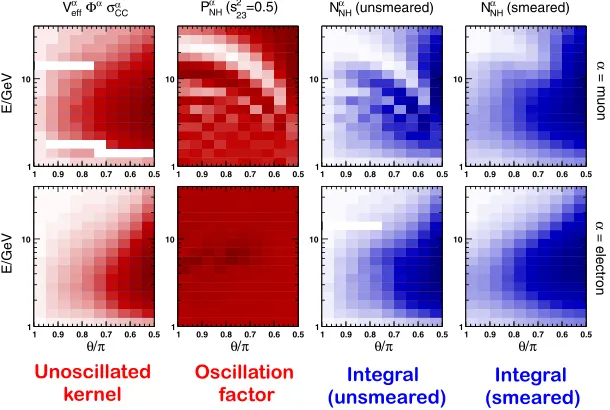
Figure 3. Breakdown of the main ingredients of muon (upper panels) and electron (lower panels) spectra in PINGU (taken from [9]), in an arbitrary color scale ranging from white (null event rate) to dark colors for increasing event rates (with pixels representing data bins). From left to right: Unoscillated kernel (flux times target volume times cross-section); flavor oscillation factors for sin223=/4; resulting integral spectrum for perfect energy-angle resolutions (unsmeared) and finally for realistic resolutions (smeared). The final smeared spectra for NH (this figure) and for IH (not shown) would not be distinguishable by eye.
In conclusion, even for a relatively simple one-dimensional spectrum (such as(E) at reactors), shape systematics may play a relevant role. The next section will deal with the more challenging case of two-dimensional event spectra in energy and angle.
4. PINGU (ORCA) and systematics of two-dimensional neutrino spectra
In this Workshop, extensive discussions have been focussed on future large-volume, high-statistics atmospheric neutrino experiments such as PINGU [6] and ORCA [10]. Here we report some results from our recent analysis of prospective data and sensitivities to the mass hierarchy and to 23 in a PINGU-like experimental setting [9]. (Qualitatively, our results also apply to an ORCA-like setting.)
PINGU will measure the incoming energy and direction of muons and electrons (but with no lepton charge discrimination), which represent proxies for the unknown incoming energyEand zenith angle direction of the parent neutrinos. The observable two-dimensional (energy-angle) spectra of -like ande-like events are obtained as convolutions of several ingredients related to the source (atmospheric neutrino fluxes), to flavor change in propagation (oscillations), to the interaction process (cross section and target volume), and to detection characteristics (energy and angular resolutions).
0 5 10
0 5 10 0
5 10
0 5 10 0
5 10
0 5 10 0
5 10
0 5 10
0 5 10
0 5 10 0
5 10
0 5 10 0
5 10
0 5 10 0
5 10
0 5 10
Stat + syst (osc+norm) + resolution (scale,width) + polynomial + uncorrelated
σ
N
σ
N
Normal hierarchy
Inverted hierarchy
Time (y) Time (y) Time (y) Time (y)
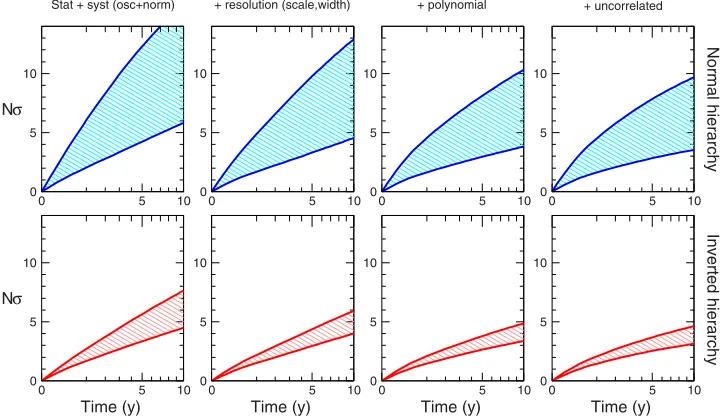
Figure 4. PINGU sensitivity to the hierarchy (N), for either true NH (top panels) or true IH (bottom panels), as a function of the live timeT in years. The abscissa is scaled as√T, so that the sensitivity bands would grow linearly for purely statistical errors. From left to right, the fit includes the following systematic errors: oscillation and normalization uncertainties, energy scale and resolution width errors, polynomial shape systematics (with up to quartic terms) at the 1.5% level, and uncorrelated systematics at the 1.5% level. See [9] for details.
but there are also other systematics related to the oscillating factors, to the energy-angle resolution functions, and to the effective target volume as a function of energy [9].
In [9] we have performed a thorough analysis of the effects of several systematic errors, both correlated and uncorrelated within bins, and with both known and uncertain energy-angle shape, in the context of PINGU. Figure 4 shows the main results of such work, in terms of sensitivity bands as a function of time for the cases of true NH (top) and true IH (bottom). The width of the bands is determined by the relatively large error on the 23 mixing angle, which we take in the range sin223∈[0.4, 0.6]. From left to right, the fit includes the following systematic errors: oscillation and normalization uncertainties, energy scale and resolution width errors, polynomial shape systematics (with up to quartic terms), and uncorrelated systematics. The last two error sources are kept at the default level of 1.5% (see [9] for a detailed definition of such uncertainties). Note that polynomial shape systematics are meant to parametrize smooth deviations from the expected shapes, due to a variety of energy-angle spectral uncertainties (atmospheric fluxes, differential cross sections, detector efficiencies, etc.) Including only normalization and systematic errors, the sensitivityNgrows almost linearly withT, i.e., the experiment is not limited by these systematics, even after 10 years of data taking. However, the progressive inclusion of correlated shape systematics, both “known” (resolution scale and widths) and “unknown” (ad hoc polynomial deviations), and eventually of uncorrelated shape systematics, provide an overall decrease in the 5-year (10-year) PINGU sensitivity by up to∼35% (∼40%). In particular, in the worst case of true IH, a 3discrimination of the hierarchy might take∼10 yr.
Best fit
σ
1
σ
2
σ
3
(d)
0.30 0.35 0.40 0.45 0.50 0.55 0.60 0.65 0.70
(a)
0.40 0.45 0.50 0.55 0.60
(c)
0.40 0.45 0.50 0.55 0.60 0.30
0.35 0.40 0.45 0.50 0.55 0.60 0.65 0.70
(b)
NH true IH true
fitθ23
2
sin
fitθ23
2
sin
NH test
IH test
true 23 θ 2
sin true
23 θ 2 sin
0.30
0.30 0.35
0.35 0.40
0.40 0.45
0.45 0.50
0.50 0.55
0.55 0.60
0.60 0.65
0.65 0.70
0.70
0.40 0.45 0.50 0.55 0.60 0.40 0.45 0.50 0.55 0.60
Figure 5. Fitted value sin2fit
23(at 1, 2 and 3) versus the true value sin 2true
23 , for the four possible cases where
the test hierarchy (i.e., the one assumed in the fit) is either the true or the wrong one: (a) NH = true, NH = test; (b) NH = true, IH = test; (c) IH = true, IH = test; (d) IH = true, NH = test.
Although PINGU itself will contribute to improve the accuracy on 23, the interpretation of its prospective23bounds depends, in turn, upon the mass hierarchy determination: until the NH/IH issue it is not settled and remains ambiguous, the23bounds in PINGU may be significantly biased. Figure5 shows the subtle interplay between hierarchy discrimination and23, in the four cases where the test hierarchy is equal (or not) to the true hierarchy. The cases where there is an hierarchy mismatch clearly lead to biased results for the23bounds; see [9] for a more extensive discussion.
In conclusion, in the context of the standard 3νframework and of a global data analysis, we have illustrated the status of the unknown oscillation parameters: the 23 octant, the mass hierarchy, and the possible CP phase. We have then discussed the challenges related to spectral shape uncertainties in some future experiments, which aim at determining the mass hierarchy via one-dimensional event spectra (e.g., JUNO and RENO-50 with reactor neutrinos) or two-dimensional event spectra (e.g., PINGU and ORCA with atmospheric neutrinos). Improvements in our understanding and control of spectral shape systematics are needed to safely reach>3sensitivities for the NH/IH discrimination.
E.L. thanks the VLVNT 2015 organizers for kind hospitality and support. This work is supported by INFN and MIUR through the “Theoretical Astroparticle Physics” project.
References
[1] www.nobelprize.org/nobel_prizes/physics/laureates/2015/
[2] K.A. Olive et al. (Particle Data Group), Chin. Phys. C 38, 090001 (2014)
[3] F. Capozzi et al., Phys. Rev. D 89, 093018 (2014)[arXiv:1312.2878 [hep-ph]]
[4] Neutrino 2014, XXVI International Conf. on ν Physics and Astrophysics, neutrino2014. bu.edu/
[5] A. Weber, talk at this Workshop [6] J.-P. Yanez, talk at this Workshop
[7] F. Capozzi, E. Lisi, A. Marrone, D. Montanino, and A. Palazzo (2016), in preparation. [8] F. Capozzi et al., Phys. Rev. D 92, 093011 (2015)[arXiv:1508.01392 [hep-ph]] [9] F. Capozzi et al., Phys. Rev. D 91, 073011 (2015)[arXiv:1503.01999 [hep-ph]] [10] D. Samtleben, talk at this Workshop
![Figure 1. Global neutrino data analysis, with preliminary updates with respect to [CP-violating phase3]](https://thumb-us.123doks.com/thumbv2/123dok_us/8163816.1362244/2.482.80.401.61.292/figure-global-neutrino-analysis-preliminary-updates-respect-violating.webp)
![Figure 2. JUNO prospective data analysis for true NH (from [parameters and flux normalization errors (osc.+norm), plus energy scale uncertaintiesflux shape uncertaintiesshown, see [profiles for prospective 5-yr data-taking, overlaid to the current8])](https://thumb-us.123doks.com/thumbv2/123dok_us/8163816.1362244/3.482.59.419.64.206/prospective-analysis-parameters-normalization-uncertaintiesux-uncertaintiesshown-proles-prospective.webp)